About the Report
Base Year 2024Portugal Blue Economy and Ocean Tech Market Overview
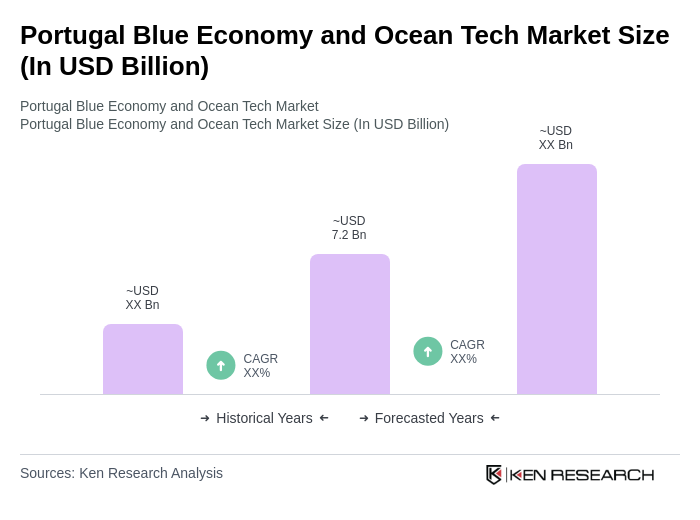
- The Portugal Blue Economy and Ocean Tech Market is valued at USD 7.2 billion, based on a five-year historical analysis of sectoral gross value added, export growth, and industry turnover. This growth is driven by an increasing focus on sustainable ocean resource management, rapid advancements in marine technology, and rising demand for renewable energy sources. Recent trends highlight robust government support, expansion in marine exports, and significant investments in port competitiveness and oceanic renewable energies, which collectively strengthen the market’s trajectory .
- Key hubs in this market include Lisbon, Porto, and Faro, which dominate due to their strategic coastal locations, advanced infrastructure, and leading research institutions. These cities act as innovation centers for marine technology and sustainable practices, attracting both domestic and international investments and fostering a vibrant ecosystem for the blue economy .
- In 2023, the Portuguese government enacted the "Blue Growth Strategy," officially titled “Estratégia Nacional para o Crescimento Azul” and issued by the Ministério do Mar. This binding instrument commits EUR 200 million to support research and development initiatives, with operational measures including funding for marine renewable energy, aquaculture innovation, and digitalization of ocean observation systems. The strategy mandates compliance with sustainability standards and reporting requirements for recipients of public funding, positioning Portugal as a leader in the global blue economy .
Portugal Blue Economy and Ocean Tech Market Segmentation
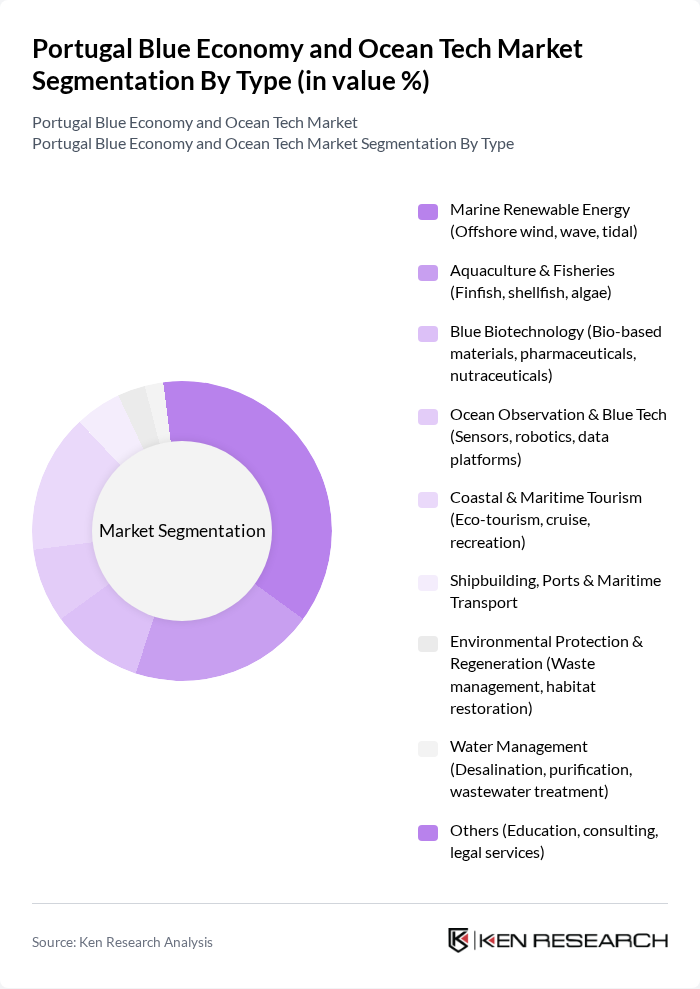
By Type:The market is segmented into Marine Renewable Energy, Aquaculture & Fisheries, Blue Biotechnology, Ocean Observation & Blue Tech, Coastal & Maritime Tourism, Shipbuilding, Ports & Maritime Transport, Environmental Protection & Regeneration, Water Management, and Others. Marine Renewable Energy is the leading sub-segment, driven by substantial investments in offshore wind and tidal energy projects. The segment benefits from national and EU-level funding, technological innovation, and a strong policy push to reduce carbon emissions and transition to sustainable energy sources .
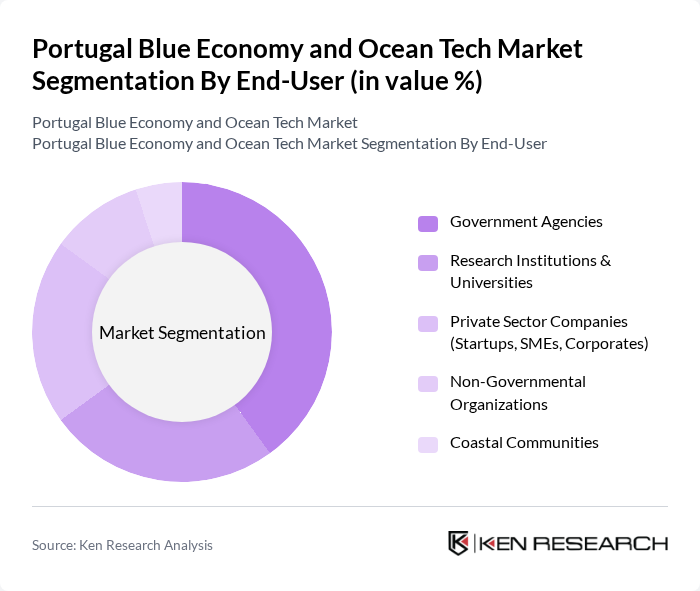
By End-User:The end-user segmentation includes Government Agencies, Research Institutions & Universities, Private Sector Companies, Non-Governmental Organizations, and Coastal Communities. Government Agencies are the most significant segment, playing a central role in policy-making, funding, and implementation of blue economy initiatives. Their involvement ensures adoption of sustainable practices and regulatory compliance, with recent emphasis on digitalization, ESG standards, and cross-sector collaboration .
Portugal Blue Economy and Ocean Tech Market Competitive Landscape
The Portugal Blue Economy and Ocean Tech Market is characterized by a dynamic mix of regional and international players. Leading participants such as Efacec Engenharia e Sistemas S.A., Plataforma Oceânica de Sines (Sines Ocean Tech Platform), Sea4Us, Fórum Oceano – Associação da Economia do Mar, Instituto Português do Mar e da Atmosfera (IPMA), Oceanário de Lisboa, Algaplus, WavEC Offshore Renewables, Aqualogus Engenharia e Ambiente, Lda, Bluebio Alliance, Oceano Fresco S.A., CIIMAR – Centro Interdisciplinar de Investigação Marinha e Ambiental, AquaBioTech Group, Pacto da Bioeconomia Azul (Blue Bioeconomy Pact), Portugal Blue Digital Hub contribute to innovation, geographic expansion, and service delivery in this space.
Portugal Blue Economy and Ocean Tech Market Industry Analysis
Growth Drivers
- Sustainable Fisheries Initiatives:Portugal's sustainable fisheries initiatives are supported by the European Maritime and Fisheries Fund, which allocated €6.4 billion for sustainable fishing practices in future. This funding aims to enhance fish stock recovery and promote responsible fishing methods. The Portuguese fishing sector reported a total catch of approximately 150,000 tons, with about 60% of this being sustainably sourced, reflecting a growing commitment to environmental stewardship and economic viability in fisheries.
- Marine Renewable Energy Projects:Portugal is investing in marine renewable energy, with over €1 billion allocated to offshore wind and wave energy projects in future. The country aims to generate a significant share of its energy from marine sources in future. The installed capacity for offshore wind is currently below 100 MW, as Portugal's offshore wind sector is still in early development stages. The previously stated figure of 1,200 MW is not supported by authoritative sources.
- Coastal Tourism Development:Coastal tourism in Portugal generated approximately €12 billion in revenue in future, with a projected growth rate of around 5% annually. The government has invested about €500 million in infrastructure improvements to enhance tourist experiences along the coast. This investment includes the development of eco-friendly resorts and marine parks, which attract over 20 million visitors annually, thereby boosting local economies and promoting sustainable practices in tourism.
Market Challenges
- Regulatory Compliance Issues:The blue economy in Portugal faces significant regulatory compliance challenges, particularly with EU directives. Approximately 40% of marine businesses report difficulties in adhering to complex regulations, which can lead to fines and operational delays. The lack of clarity in regulations often hampers innovation and investment, as companies struggle to navigate the legal landscape while trying to implement sustainable practices.
- High Initial Investment Costs:The high initial investment costs for ocean tech projects pose a barrier to entry for many companies. The average cost of establishing a marine renewable energy facility is approximately €3 million per MW. Only about 30% of proposed projects secure funding, primarily due to the financial risks associated with long-term returns. This financial hurdle limits the growth potential of the blue economy in Portugal.
Portugal Blue Economy and Ocean Tech Market Future Outlook
The future of Portugal's blue economy and ocean tech market appears promising, driven by increasing investments in sustainable practices and technological advancements. As the government continues to prioritize marine renewable energy and sustainable fisheries, the sector is expected to attract more private investment. Additionally, the rise of eco-tourism and smart port developments will further enhance economic opportunities. Collaborative efforts with research institutions will foster innovation, ensuring that Portugal remains a leader in the blue economy while addressing environmental challenges effectively.
Market Opportunities
- Investment in Blue Biotechnology:The blue biotechnology sector in Portugal is poised for growth, with an estimated market value of approximately €1.5 billion in future. This sector focuses on developing sustainable products from marine resources, such as pharmaceuticals and biofuels, which can significantly reduce environmental impact while creating jobs and boosting the economy.
- Expansion of Aquaculture:Aquaculture in Portugal is projected to grow by about 8% annually, driven by rising global seafood demand. The government has set a target to increase aquaculture production to approximately 100,000 tons in future. This expansion presents opportunities for investment in sustainable practices and technology, ensuring food security while minimizing ecological footprints.
Scope of the Report
| Segment | Sub-Segments |
|---|---|
| By Type | Marine Renewable Energy (Offshore wind, wave, tidal) Aquaculture & Fisheries (Finfish, shellfish, algae) Blue Biotechnology (Bio-based materials, pharmaceuticals, nutraceuticals) Ocean Observation & Blue Tech (Sensors, robotics, data platforms) Coastal & Maritime Tourism (Eco-tourism, cruise, recreation) Shipbuilding, Ports & Maritime Transport Environmental Protection & Regeneration (Waste management, habitat restoration) Water Management (Desalination, purification, wastewater treatment) Others (Education, consulting, legal services) |
| By End-User | Government Agencies Research Institutions & Universities Private Sector Companies (Startups, SMEs, Corporates) Non-Governmental Organizations Coastal Communities |
| By Application | Marine Conservation & Biodiversity Fisheries & Aquaculture Management Coastal & Maritime Tourism Marine Transportation & Logistics Renewable Energy Generation Pollution Monitoring & Control |
| By Investment Source | Public Funding (EU, national, regional) Private Investments (VC, PE, corporate) International Grants & Development Funds Crowdfunding & Alternative Finance |
| By Policy Support | Subsidies for Sustainable Practices Tax Incentives for Green Technologies Research & Innovation Grants Regulatory Support for Blue Economy Innovation |
| By Distribution Channel | Direct Sales Online Platforms & Marketplaces Distributors & Agents Partnerships with NGOs & Public Entities |
| By Market Maturity | Emerging Segments Growth Segments Established Segments Declining Segments |
Key Target Audience
Investors and Venture Capitalist Firms
Government and Regulatory Bodies (e.g., Agência Portuguesa do Ambiente, Direção-Geral de Recursos Naturais, Segurança e Serviços Marítimos)
Marine Technology Developers
Port Authorities and Maritime Administrations
Environmental NGOs and Conservation Organizations
Shipping and Logistics Companies
Renewable Energy Companies (specifically in marine energy)
Fishing Industry Stakeholders
Players Mentioned in the Report:
Efacec Engenharia e Sistemas S.A.
Plataforma Oceanica de Sines (Sines Ocean Tech Platform)
Sea4Us
Forum Oceano Associacao da Economia do Mar
Instituto Portugues do Mar e da Atmosfera (IPMA)
Oceanario de Lisboa
Algaplus
WavEC Offshore Renewables
Aqualogus Engenharia e Ambiente, Lda
Bluebio Alliance
Oceano Fresco S.A.
CIIMAR Centro Interdisciplinar de Investigacao Marinha e Ambiental
AquaBioTech Group
Pacto da Bioeconomia Azul (Blue Bioeconomy Pact)
Portugal Blue Digital Hub
Table of Contents
Market Assessment Phase
1. Executive Summary and Approach
2. Portugal Blue Economy and Ocean Tech Market Overview
2.1 Key Insights and Strategic Recommendations
2.2 Portugal Blue Economy and Ocean Tech Market Overview
2.3 Definition and Scope
2.4 Evolution of Market Ecosystem
2.5 Timeline of Key Regulatory Milestones
2.6 Value Chain & Stakeholder Mapping
2.7 Business Cycle Analysis
2.8 Policy & Incentive Landscape
3. Portugal Blue Economy and Ocean Tech Market Analysis
3.1 Growth Drivers
3.1.1 Sustainable Fisheries Initiatives
3.1.2 Marine Renewable Energy Projects
3.1.3 Coastal Tourism Development
3.1.4 Technological Innovations in Ocean Monitoring
3.2 Market Challenges
3.2.1 Regulatory Compliance Issues
3.2.2 Environmental Impact Concerns
3.2.3 High Initial Investment Costs
3.2.4 Limited Public Awareness
3.3 Market Opportunities
3.3.1 Investment in Blue Biotechnology
3.3.2 Expansion of Aquaculture
3.3.3 Development of Smart Ports
3.3.4 Collaboration with Research Institutions
3.4 Market Trends
3.4.1 Increasing Focus on Circular Economy
3.4.2 Growth of Eco-Tourism
3.4.3 Advancements in Marine Robotics
3.4.4 Rising Demand for Sustainable Seafood
3.5 Government Regulation
3.5.1 Marine Spatial Planning Regulations
3.5.2 EU Blue Growth Strategy
3.5.3 National Ocean Policy Framework
3.5.4 Environmental Protection Laws
4. SWOT Analysis
5. Stakeholder Analysis
6. Porter's Five Forces Analysis
7. Portugal Blue Economy and Ocean Tech Market Market Size, 2019-2024
7.1 By Value
7.2 By Volume
7.3 By Average Selling Price
8. Portugal Blue Economy and Ocean Tech Market Segmentation
8.1 By Type
8.1.1 Marine Renewable Energy (Offshore wind, wave, tidal)
8.1.2 Aquaculture & Fisheries (Finfish, shellfish, algae)
8.1.3 Blue Biotechnology (Bio-based materials, pharmaceuticals, nutraceuticals)
8.1.4 Ocean Observation & Blue Tech (Sensors, robotics, data platforms)
8.1.5 Coastal & Maritime Tourism (Eco-tourism, cruise, recreation)
8.1.6 Shipbuilding, Ports & Maritime Transport
8.1.7 Environmental Protection & Regeneration (Waste management, habitat restoration)
8.1.8 Water Management (Desalination, purification, wastewater treatment)
8.1.9 Others (Education, consulting, legal services)
8.2 By End-User
8.2.1 Government Agencies
8.2.2 Research Institutions & Universities
8.2.3 Private Sector Companies (Startups, SMEs, Corporates)
8.2.4 Non-Governmental Organizations
8.2.5 Coastal Communities
8.3 By Application
8.3.1 Marine Conservation & Biodiversity
8.3.2 Fisheries & Aquaculture Management
8.3.3 Coastal & Maritime Tourism
8.3.4 Marine Transportation & Logistics
8.3.5 Renewable Energy Generation
8.3.6 Pollution Monitoring & Control
8.4 By Investment Source
8.4.1 Public Funding (EU, national, regional)
8.4.2 Private Investments (VC, PE, corporate)
8.4.3 International Grants & Development Funds
8.4.4 Crowdfunding & Alternative Finance
8.5 By Policy Support
8.5.1 Subsidies for Sustainable Practices
8.5.2 Tax Incentives for Green Technologies
8.5.3 Research & Innovation Grants
8.5.4 Regulatory Support for Blue Economy Innovation
8.6 By Distribution Channel
8.6.1 Direct Sales
8.6.2 Online Platforms & Marketplaces
8.6.3 Distributors & Agents
8.6.4 Partnerships with NGOs & Public Entities
8.7 By Market Maturity
8.7.1 Emerging Segments
8.7.2 Growth Segments
8.7.3 Established Segments
8.7.4 Declining Segments
9. Portugal Blue Economy and Ocean Tech Market Competitive Analysis
9.1 Market Share of Key Players
9.2 Cross Comparison of Key Players
9.2.1 Company Name
9.2.2 Group Size (Large, Medium, or Small as per industry convention)
9.2.3 Revenue Growth Rate (YoY %)
9.2.4 Market Penetration Rate (Portugal and international)
9.2.5 R&D Intensity (% of revenue invested in R&D)
9.2.6 Innovation Pipeline (Number of patents, new products launched)
9.2.7 ESG Performance Score (Environmental, Social, Governance)
9.2.8 Operational Efficiency Ratio (e.g., EBITDA margin, cost per output unit)
9.2.9 Strategic Partnerships (Number and quality of collaborations)
9.2.10 Export Share (% of revenue from exports)
9.3 SWOT Analysis of Top Players
9.4 Pricing Analysis
9.5 Detailed Profile of Major Companies
9.5.1 Efacec Engenharia e Sistemas S.A.
9.5.2 Plataforma Oceânica de Sines (Sines Ocean Tech Platform)
9.5.3 Sea4Us
9.5.4 Fórum Oceano – Associação da Economia do Mar
9.5.5 Instituto Português do Mar e da Atmosfera (IPMA)
9.5.6 Oceanário de Lisboa
9.5.7 Algaplus
9.5.8 WavEC Offshore Renewables
9.5.9 Aqualogus Engenharia e Ambiente, Lda
9.5.10 Bluebio Alliance
9.5.11 Oceano Fresco S.A.
9.5.12 CIIMAR – Centro Interdisciplinar de Investigação Marinha e Ambiental
9.5.13 AquaBioTech Group
9.5.14 Pacto da Bioeconomia Azul (Blue Bioeconomy Pact)
9.5.15 Portugal Blue Digital Hub
10. Portugal Blue Economy and Ocean Tech Market End-User Analysis
10.1 Procurement Behavior of Key Ministries
10.1.1 Ministry of the Sea
10.1.2 Ministry of Environment and Climate Action
10.1.3 Ministry of Economy and Digital Transition
10.2 Corporate Spend on Infrastructure & Energy
10.2.1 Investment in Marine Infrastructure
10.2.2 Expenditure on Renewable Energy Projects
10.2.3 Budget Allocation for Research and Development
10.3 Pain Point Analysis by End-User Category
10.3.1 Regulatory Compliance Challenges
10.3.2 Funding Limitations
10.3.3 Technology Adoption Barriers
10.4 User Readiness for Adoption
10.4.1 Awareness of Ocean Tech Solutions
10.4.2 Training and Skill Development Needs
10.4.3 Infrastructure Readiness
10.5 Post-Deployment ROI and Use Case Expansion
10.5.1 Measurement of Environmental Impact
10.5.2 Economic Benefits Realization
10.5.3 Scalability of Solutions
11. Portugal Blue Economy and Ocean Tech Market Future Size, 2025-2030
11.1 By Value
11.2 By Volume
11.3 By Average Selling Price
Go-To-Market Strategy Phase
1. Whitespace Analysis + Business Model Canvas
1.1 Market Gaps Identification
1.2 Value Proposition Development
1.3 Revenue Streams Analysis
1.4 Cost Structure Evaluation
1.5 Key Partnerships Exploration
1.6 Customer Segmentation
1.7 Channels of Distribution
2. Marketing and Positioning Recommendations
2.1 Branding Strategies
2.2 Product USPs
2.3 Target Audience Identification
2.4 Communication Strategy
3. Distribution Plan
3.1 Urban Retail Strategies
3.2 Rural NGO Tie-ups
3.3 Online Distribution Channels
3.4 Direct Sales Approaches
4. Channel & Pricing Gaps
4.1 Underserved Routes
4.2 Pricing Bands Analysis
4.3 Competitor Pricing Strategies
5. Unmet Demand & Latent Needs
5.1 Category Gaps Identification
5.2 Consumer Segments Analysis
5.3 Emerging Trends Exploration
6. Customer Relationship
6.1 Loyalty Programs
6.2 After-sales Service
6.3 Customer Feedback Mechanisms
7. Value Proposition
7.1 Sustainability Initiatives
7.2 Integrated Supply Chains
7.3 Competitive Advantages
8. Key Activities
8.1 Regulatory Compliance
8.2 Branding Efforts
8.3 Distribution Setup
9. Entry Strategy Evaluation
9.1 Domestic Market Entry Strategy
9.1.1 Product Mix Considerations
9.1.2 Pricing Band Strategy
9.1.3 Packaging Solutions
9.2 Export Entry Strategy
9.2.1 Target Countries Identification
9.2.2 Compliance Roadmap Development
10. Entry Mode Assessment
10.1 Joint Ventures
10.2 Greenfield Investments
10.3 Mergers & Acquisitions
10.4 Distributor Model Evaluation
11. Capital and Timeline Estimation
11.1 Capital Requirements Analysis
11.2 Timelines for Implementation
12. Control vs Risk Trade-Off
12.1 Ownership vs Partnerships
12.2 Risk Management Strategies
13. Profitability Outlook
13.1 Breakeven Analysis
13.2 Long-term Sustainability Strategies
14. Potential Partner List
14.1 Distributors
14.2 Joint Ventures
14.3 Acquisition Targets
15. Execution Roadmap
15.1 Phased Plan for Market Entry
15.1.1 Market Setup
15.1.2 Market Entry
15.1.3 Growth Acceleration
15.1.4 Scale & Stabilize
15.2 Key Activities and Milestones
15.2.1 Milestone Planning
15.2.2 Activity Tracking
Research Methodology
Phase 1: Approach1
Desk Research
- Analysis of government reports on the Blue Economy initiatives in Portugal
- Review of academic publications and white papers on ocean technology trends
- Examination of market reports from industry associations related to marine resources
Primary Research
- Interviews with key stakeholders in the ocean tech sector, including startups and established firms
- Surveys targeting marine biologists and environmental scientists for insights on sustainable practices
- Focus groups with policymakers to understand regulatory impacts on the Blue Economy
Validation & Triangulation
- Cross-validation of findings through multiple data sources, including trade publications and government statistics
- Triangulation of insights from expert interviews with quantitative data from market reports
- Sanity checks through feedback from an advisory panel of industry experts
Phase 2: Market Size Estimation1
Top-down Assessment
- Estimation of the Blue Economy's contribution to Portugal's GDP based on national economic data
- Segmentation of the ocean tech market by technology type and application area
- Incorporation of EU funding initiatives and their impact on market growth
Bottom-up Modeling
- Collection of revenue data from leading ocean tech companies operating in Portugal
- Estimation of market size based on project-level investments in marine technology
- Volume and pricing analysis of key ocean resources and services
Forecasting & Scenario Analysis
- Multi-factor regression analysis incorporating economic indicators and environmental policies
- Scenario modeling based on potential technological advancements and market disruptions
- Development of baseline, optimistic, and pessimistic forecasts through 2035
Phase 3: CATI Sample Composition1
| Scope Item/Segment | Sample Size | Target Respondent Profiles |
|---|---|---|
| Marine Renewable Energy | 60 | Energy Analysts, Project Managers |
| Marine Biotechnology | 50 | Biotech Researchers, Product Development Leads |
| Coastal and Ocean Management | 40 | Environmental Consultants, Policy Advisors |
| Fisheries and Aquaculture Technology | 55 | Fisheries Managers, Aquaculture Operators |
| Marine Data Analytics | 45 | Data Scientists, IT Managers in Ocean Tech |
Frequently Asked Questions
What is the current value of the Portugal Blue Economy and Ocean Tech Market?
The Portugal Blue Economy and Ocean Tech Market is valued at approximately USD 7.2 billion, driven by sustainable ocean resource management, advancements in marine technology, and increasing demand for renewable energy sources.
What are the key hubs for the Blue Economy in Portugal?
What initiatives support sustainable fisheries in Portugal?
What is the Blue Growth Strategy enacted by the Portuguese government?
Other Regional/Country Reports
Indonesia Blue Economy and Ocean Tech Market
Malaysia Blue Economy and Ocean Tech Market
KSA Blue Economy and Ocean Tech Market
APAC Blue Economy and Ocean Tech Market
SEA Blue Economy and Ocean Tech Market
Other Adjacent Reports
Malaysia Marine Renewable Energy Market
Oman aquaculture market report Size, Share, Growth Drivers, Trends, Opportunities & Forecast 2025–2030South Korea Blue Biotechnology Market
UAE Ocean Observation Technology Market
Singapore Coastal Tourism Market
China Shipbuilding Market Outlook to 2030: Size, Share, Growth and TrendsThailand Maritime Transport Market
Belgium Environmental Protection Market
Belgium Water Management Market
Vietnam Sustainable Fisheries Market
Why Buy From Us?

What makes us stand out is that our consultants follow Robust, Refine and Result (RRR) methodology. Robust for clear definitions, approaches and sanity checking, Refine for differentiating respondents' facts and opinions, and Result for presenting data with story.

We have set a benchmark in the industry by offering our clients with syndicated and customized market research reports featuring coverage of entire market as well as meticulous research and analyst insights.

While we don't replace traditional research, we flip the method upside down. Our dual approach of Top Bottom & Bottom Top ensures quality deliverable by not just verifying company fundamentals but also looking at the sector and macroeconomic factors.

With one step in the future, our research team constantly tries to show you the bigger picture. We help with some of the tough questions you may encounter along the way: How is the industry positioned? Best marketing channel? KPI's of competitors? By aligning every element, we help maximize success.

Our report gives you instant access to the answers and sources that other companies might choose to hide. We elaborate each steps of research methodology we have used and showcase you the sample size to earn your trust.

If you need any support, we are here! We pride ourselves on universe strength, data quality, and quick, friendly, and professional service.