About the Report
Base Year 2025India Flavor Potential Market Overview
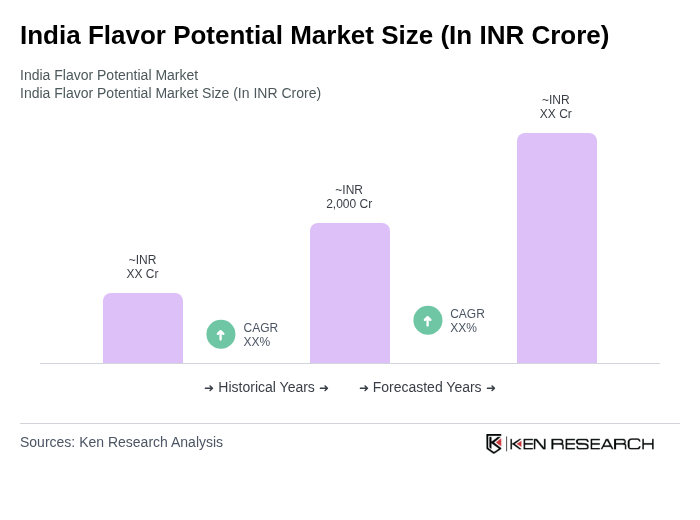
- The India Flavor Potential Market is valued at INR 2,000 crore, based on a five-year historical analysis of the broader India flavors category. This growth is primarily driven by the increasing demand for processed foods, beverages, and convenience products, along with a rising trend of flavor innovation and premiumization among manufacturers in categories such as snacks, dairy, ready-to-drink beverages, and quick-service restaurant offerings. The market is also supported by the growing consumer preference for diverse, regional, and exotic flavors, the influence of global cuisines, and health-oriented variants (such as low-sugar, functional, and fortification-friendly flavors), which has led to a surge in customized flavor solutions and product offerings across multiple sectors.
- Key contributors to this market include major metropolitan areas such as Mumbai, Delhi, and Bengaluru, which dominate due to their robust food and beverage manufacturing base, presence of multinational and domestic FMCG players, and strong cold-chain and retail distribution networks. These urban centers are also hubs for innovation and research, hosting application labs and development centers of leading global flavor houses and large Indian food companies, thereby attracting investments and fostering collaborations among flavor manufacturers, food producers, quick-service restaurant chains, and emerging start-ups in the packaged food and beverage ecosystem.
- In 2023, the Food Safety and Standards Authority of India (FSSAI) notified the Food Safety and Standards (Food Products Standards and Food Additives) First Amendment Regulations, 2023, under the Food Safety and Standards Act, 2006, which further updated standards and permitted use levels for various food additives and ingredients, including flavoring agents, across multiple food categories. These regulations require manufacturers to use only approved flavoring substances within specified limits, comply with labeling requirements such as declaring class names and additive categories where applicable, and adhere to Good Manufacturing Practices, thereby strengthening food safety, quality assurance, and consumer confidence in flavored food and beverage products in India.
India Flavor Potential Market Segmentation
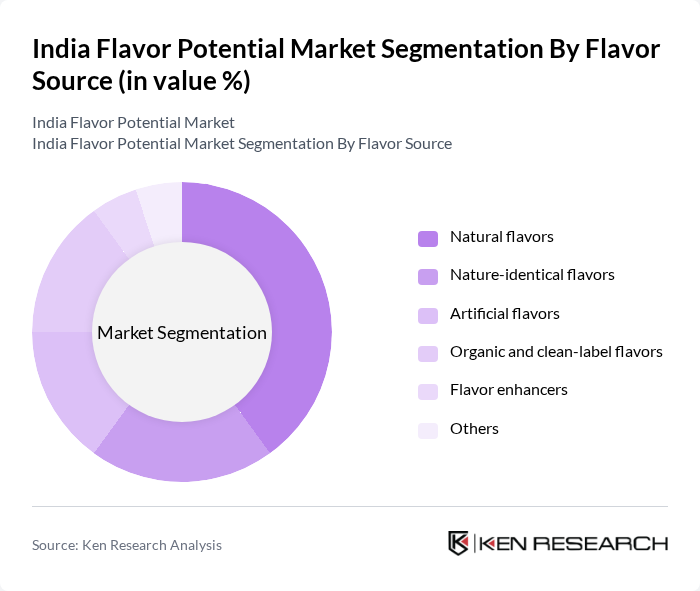
By Flavor Source:This segmentation covers natural, nature-identical, artificial, organic and clean-label flavors, flavor enhancers, and other specialty ingredients used across India’s food and beverage industry. Natural flavors are gaining stronger preference as consumers shift towards clean-label, minimally processed, plant-based, and botanically derived products. Brands are increasingly using “no artificial flavors” and “free-from” positioning to build trust and differentiate products. Organic and clean-label flavors are also expanding as health-conscious consumers demand transparency in ingredient sourcing, traceability, and sustainability. This is encouraging manufacturers to reformulate products with natural extracts, reduce synthetic additives, and develop allergen-conscious or organic-certified flavor portfolios. Demand is especially visible across beverages, dairy, snacks, bakery, confectionery, and nutraceuticals, where flavor authenticity and perceived health value influence purchase decisions. This makes flavor sourcing a key competitive lever for manufacturers.
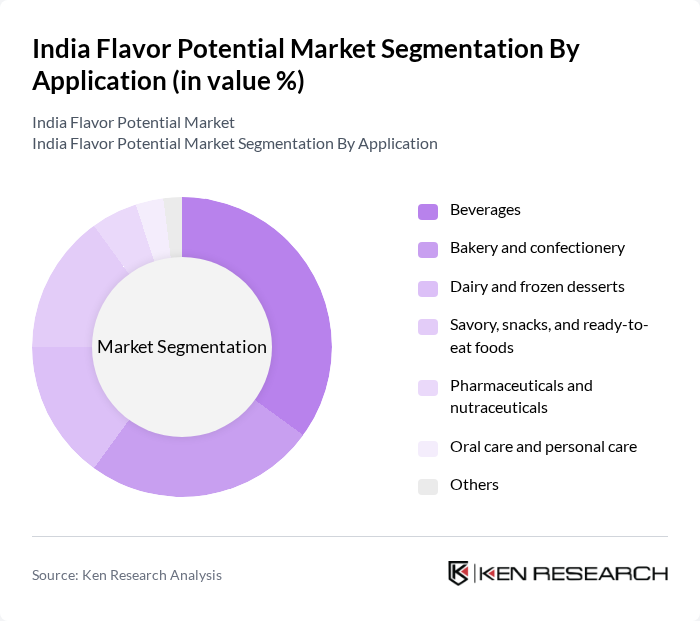
By Application:This segmentation covers beverages, bakery and confectionery, dairy and frozen desserts, savoury products, snacks and ready-to-eat foods, pharmaceuticals and nutraceuticals, oral care and personal care, and other end-use categories. Beverages remain the leading application area, supported by demand for carbonated drinks, energy drinks, flavoured waters, teas, juices, and ready-to-drink functional beverages. Innovation in regional, fusion, and low- or no-sugar profiles is further increasing flavour usage. Bakery and confectionery are also expanding as consumers seek indulgent and differentiated taste experiences across biscuits, cakes, chocolates, sugar confectionery, and traditional Indian sweets. Savoury snacks and ready-to-eat foods are witnessing strong uptake through flavoured namkeens, extruded snacks, instant noodles, frozen meals, and convenience foods, creating sustained demand for customised flavour and enhancer systems.
India Flavor Potential Market Competitive Landscape
The India Flavor Potential Market is characterized by a dynamic mix of regional and international players. Leading participants such as Givaudan, Firmenich, Symrise, International Flavors & Fragrances (IFF), and Sensient Technologies contribute to innovation, geographic expansion, and service delivery in this space.
India Flavor Potential Market Industry Analysis
Growth Drivers
- Increasing Consumer Demand for Natural Flavors:The Indian flavor market is witnessing a significant shift towards natural flavors, driven by consumer preferences for healthier options. In future, the demand for natural flavors is projected to reach approximately ?1,200 crores, reflecting a 15% increase from the previous period. This growth is fueled by rising awareness of the health benefits associated with natural ingredients, as consumers increasingly seek products free from artificial additives, aligning with global health trends.
- Rising Health Consciousness Among Consumers:Health consciousness is a major driver in the Indian flavor market, with 70% of consumers prioritizing health-oriented products. The market for health-focused flavors is expected to grow to ?800 crores in the future, as consumers opt for flavors that enhance nutritional value. This trend is supported by the increasing prevalence of lifestyle diseases, prompting consumers to seek flavors that complement healthier eating habits, thus driving innovation in flavor development.
- Expansion of the Retail Sector:The retail sector in India is expanding rapidly, with an estimated growth rate of 10% annually, projected to reach ?60 trillion in the future. This expansion facilitates greater accessibility to diverse flavor products, particularly in tier-2 and tier-3 cities. Enhanced distribution channels and the rise of modern retail formats are enabling consumers to explore a wider range of flavor options, thereby boosting overall market growth and consumer engagement.
Market Challenges
- Stringent Regulatory Requirements:The Indian flavor market faces significant challenges due to stringent regulatory requirements imposed by the Food Safety and Standards Authority of India (FSSAI). Compliance with these regulations can be costly and time-consuming, impacting small and medium enterprises disproportionately. In the future, it is estimated that compliance costs could account for up to 5% of total operational expenses, hindering innovation and market entry for new players.
- High Competition from Synthetic Flavor Products:The market is highly competitive, with synthetic flavor products dominating the market share. This dominance poses a challenge for natural flavor producers, as synthetic flavors are often cheaper and more readily available. In the future, the synthetic flavor segment is expected to generate revenues, making it difficult for natural flavor companies to compete on price while maintaining quality and sustainability.
India Flavor Potential Market Future Outlook
The future of the Indian flavor market appears promising, driven by evolving consumer preferences and technological advancements. As the demand for clean-label products continues to rise, companies are likely to invest in innovative extraction technologies to enhance flavor profiles. Additionally, the growth of e-commerce platforms is expected to facilitate wider distribution, allowing consumers to access diverse flavor options conveniently. This trend will likely encourage brands to tailor their offerings to regional tastes, further driving market expansion.
Market Opportunities
- Growing Trend of Plant-Based Products:The increasing popularity of plant-based diets presents a significant opportunity for flavor manufacturers. With the plant-based food market projected to reach ?1,000 crores in the future, flavor companies can capitalize on this trend by developing innovative flavors that cater to this demographic, enhancing the appeal of plant-based offerings.
- Expansion into Untapped Rural Markets:Rural markets in India represent a largely untapped opportunity for flavor producers. With over 65% of the population residing in rural areas, the growth potential is substantial. In the future, rural consumer spending on food products is expected to increase by ?500 crores, providing a lucrative avenue for flavor companies to expand their reach and diversify their customer base.
Scope of the Report
| Segment | Sub-Segments |
|---|---|
| By Flavor Source | Natural flavors Nature-identical flavors Artificial flavors Organic and clean-label flavors Flavor enhancers Others |
| By Application | Beverages Bakery and confectionery Dairy and frozen desserts Savory, snacks, and ready-to-eat foods Pharmaceuticals and nutraceuticals Oral care and personal care Others |
| By Form | Liquid flavors Powder flavors Emulsions and encapsulated flavors Pastes and others |
| By End-Use Industry | Food and beverage manufacturers QSR and HoReCa Pharmaceutical companies Nutraceutical and wellness brands Personal care and cosmetics manufacturers Others |
| By Distribution Channel | Direct (B2B) sales Distributors and agents Online B2B platforms Retail and specialty ingredient stores Others |
| By Flavor Profile | Sweet Savory and umami Spicy and masala Sour and tangy Bitter and others |
| By Region | North India South India East India West India Central India |
Key Target Audience
Investors and Venture Capitalist Firms
Government and Regulatory Bodies (e.g., Food Safety and Standards Authority of India, Ministry of Food Processing Industries)
Manufacturers and Producers
Distributors and Retailers
Flavor and Fragrance Companies
Food and Beverage Companies
Packaging Suppliers
Exporters and Importers
Players Mentioned in the Report:
Givaudan
Firmenich
Symrise
International Flavors & Fragrances
Sensient Technologies
Takasago International Corporation
Mane
Robertet
T. Hasegawa
Frutarom
Table of Contents
Market Assessment Phase
1. Executive Summary and Approach
2. India Flavor Potential Market Overview
2.1 Key Insights and Strategic Recommendations
2.2 India Flavor Potential Market Overview
2.3 Definition and Scope
2.4 Evolution of Market Ecosystem
2.5 Timeline of Key Regulatory Milestones
2.6 Value Chain & Stakeholder Mapping
2.7 Business Cycle Analysis
2.8 Policy & Incentive Landscape
3. India Flavor Potential Market Analysis
3.1 Growth Drivers
3.1.1 Increasing consumer demand for natural flavors
3.1.2 Growth of the food and beverage industry
3.1.3 Rising health consciousness among consumers
3.1.4 Expansion of the retail sector
3.2 Market Challenges
3.2.1 Stringent regulatory requirements
3.2.2 High competition from synthetic flavor products
3.2.3 Fluctuating raw material prices
3.2.4 Limited awareness of flavor innovations
3.3 Market Opportunities
3.3.1 Growing trend of plant-based products
3.3.2 Expansion into untapped rural markets
3.3.3 Increasing demand for organic flavors
3.3.4 Collaborations with local food brands
3.4 Market Trends
3.4.1 Shift towards clean label products
3.4.2 Rise of e-commerce in food distribution
3.4.3 Innovations in flavor extraction technologies
3.4.4 Customization of flavors for regional preferences
3.5 Government Regulation
3.5.1 FSSAI guidelines on flavor additives
3.5.2 Import regulations for flavoring substances
3.5.3 Standards for organic flavor certification
3.5.4 Labeling requirements for food products
4. SWOT Analysis
5. Stakeholder Analysis
6. Porter's Five Forces Analysis
7. India Flavor Potential Market Size, 2019-2024
7.1 By Value
7.2 By Volume
7.3 By Average Selling Price
8. India Flavor Potential Market Segmentation
8.1 By Flavor Source
8.1.1 Natural flavors
8.1.2 Nature-identical flavors
8.1.3 Artificial flavors
8.1.4 Organic and clean-label flavors
8.1.5 Flavor enhancers
8.1.6 Others
8.2 By Application
8.2.1 Beverages
8.2.2 Bakery and confectionery
8.2.3 Dairy and frozen desserts
8.2.4 Savory, snacks, and ready-to-eat foods
8.2.5 Pharmaceuticals and nutraceuticals
8.2.6 Oral care and personal care
8.2.7 Others
8.3 By Form
8.3.1 Liquid flavors
8.3.2 Powder flavors
8.3.3 Emulsions and encapsulated flavors
8.3.4 Pastes and others
8.4 By End-Use Industry
8.4.1 Food and beverage manufacturers
8.4.2 QSR and HoReCa
8.4.3 Pharmaceutical companies
8.4.4 Nutraceutical and wellness brands
8.4.5 Personal care and cosmetics manufacturers
8.4.6 Others
8.5 By Distribution Channel
8.5.1 Direct (B2B) sales
8.5.2 Distributors and agents
8.5.3 Online B2B platforms
8.5.4 Retail and specialty ingredient stores
8.5.5 Others
8.6 By Flavor Profile
8.6.1 Sweet
8.6.2 Savory and umami
8.6.3 Spicy and masala
8.6.4 Sour and tangy
8.6.5 Bitter and others
8.7 By Region
8.7.1 North India
8.7.2 South India
8.7.3 East India
8.7.4 West India
8.7.5 Central India
9. India Flavor Potential Market Competitive Analysis
9.1 Market Share of Key Players
9.2 Cross Comparison of Key Players
9.2.1 Company name
9.2.2 Group size (large, medium, or small as per industry convention)
9.2.3 India flavor revenue (INR crore / USD million)
9.2.4 3-year India flavor revenue CAGR (%)
9.2.5 EBITDA margin from India flavor business (%)
9.2.6 Market share in India flavor market (%)
9.2.7 Number of active flavor SKUs in India
9.2.8 R&D / innovation spend as % of sales
9.2.9 New launches in India (past 24 months)
9.2.10 Customer concentration (top 5 customers’ share of revenue, %)
9.2.11 Distribution reach (number of B2B accounts / key cities covered)
9.2.12 On-time delivery rate (%)
9.2.13 Average realization per kg / liter (pricing band)
9.3 SWOT Analysis of Top Players
9.4 Pricing Analysis
9.5 Detailed Profile of Major Companies
9.5.1 Givaudan
9.5.2 Firmenich
9.5.3 Symrise
9.5.4 International Flavors & Fragrances (IFF)
9.5.5 Sensient Technologies
9.5.6 Takasago International Corporation
9.5.7 Mane
9.5.8 Robertet
9.5.9 T. Hasegawa
9.5.10 Frutarom (part of IFF)
9.5.11 Naturex (part of Givaudan)
9.5.12 DDW, The Color House (formerly D.D. Williamson)
9.5.13 A.M.A. Flavours
9.5.14 Flavorchem Corporation
9.5.15 Wild Flavors (an ADM company)
10. India Flavor Potential Market End-User Analysis
10.1 Procurement Behavior of Key Ministries
10.1.1 Government procurement policies
10.1.2 Budget allocation for flavor products
10.1.3 Supplier selection criteria
10.1.4 Contract management practices
10.2 Corporate Spend on Infrastructure & Energy
10.2.1 Investment trends in flavor technology
10.2.2 Budgeting for flavor innovation
10.2.3 Spending on sustainability initiatives
10.2.4 Others
10.3 Pain Point Analysis by End-User Category
10.3.1 Quality consistency issues
10.3.2 Supply chain disruptions
10.3.3 Regulatory compliance challenges
10.3.4 Others
10.4 User Readiness for Adoption
10.4.1 Awareness of flavor innovations
10.4.2 Willingness to switch to natural flavors
10.4.3 Training needs for staff
10.4.4 Others
10.5 Post-Deployment ROI and Use Case Expansion
10.5.1 Measurement of ROI
10.5.2 Case studies of successful implementations
10.5.3 Opportunities for scaling
10.5.4 Others
11. India Flavor Potential Market Future Size, 2025-2030
11.1 By Value
11.2 By Volume
11.3 By Average Selling Price
Go-To-Market Strategy Phase
1. Whitespace Analysis + Business Model Canvas
1.1 Market gaps identification
1.2 Value proposition development
1.3 Revenue model exploration
1.4 Customer segment analysis
1.5 Competitive landscape overview
1.6 Key partnerships identification
1.7 Cost structure analysis
2. Marketing and Positioning Recommendations
2.1 Branding strategies
2.2 Product USPs
2.3 Target audience segmentation
2.4 Communication strategies
2.5 Digital marketing initiatives
2.6 Trade marketing strategies
2.7 Customer engagement tactics
3. Distribution Plan
3.1 Urban retail strategies
3.2 Rural NGO tie-ups
3.3 E-commerce partnerships
3.4 Direct sales channels
3.5 Distribution network optimization
3.6 Logistics and supply chain management
3.7 Inventory management practices
4. Channel & Pricing Gaps
4.1 Underserved routes
4.2 Pricing bands analysis
4.3 Competitor pricing strategies
4.4 Value-based pricing models
4.5 Discounting strategies
4.6 Price elasticity considerations
4.7 Customer willingness to pay
5. Unmet Demand & Latent Needs
5.1 Category gaps identification
5.2 Consumer segments analysis
5.3 Emerging trends exploration
5.4 Product development opportunities
5.5 Market entry barriers
5.6 Customer feedback mechanisms
5.7 Innovation pipeline assessment
6. Customer Relationship
6.1 Loyalty programs
6.2 After-sales service
6.3 Customer feedback loops
6.4 Relationship management strategies
6.5 Community engagement initiatives
6.6 Customer education programs
6.7 Retention strategies
7. Value Proposition
7.1 Sustainability initiatives
7.2 Integrated supply chains
7.3 Unique selling propositions
7.4 Customer-centric approaches
7.5 Competitive advantages
7.6 Brand loyalty factors
7.7 Value delivery mechanisms
8. Key Activities
8.1 Regulatory compliance
8.2 Branding efforts
8.3 Distribution setup
8.4 Marketing campaigns
8.5 Product development
8.6 Customer service enhancements
8.7 Performance monitoring
9. Entry Strategy Evaluation
9.1 Domestic Market Entry Strategy
9.1.1 Product mix considerations
9.1.2 Pricing band strategies
9.1.3 Packaging innovations
9.2 Export Entry Strategy
9.2.1 Target countries analysis
9.2.2 Compliance roadmap development
10. Entry Mode Assessment
10.1 Joint Ventures
10.2 Greenfield investments
10.3 Mergers & Acquisitions
10.4 Distributor Model
10.5 Risk assessment
10.6 Strategic fit evaluation
10.7 Long-term partnership considerations
11. Capital and Timeline Estimation
11.1 Capital requirements
11.2 Timelines for market entry
11.3 Funding sources
11.4 Financial projections
11.5 Cost-benefit analysis
11.6 Investment return expectations
12. Control vs Risk Trade-Off
12.1 Ownership considerations
12.2 Partnership dynamics
12.3 Risk management strategies
12.4 Control mechanisms
12.5 Exit strategies
12.6 Long-term sustainability
13. Profitability Outlook
13.1 Breakeven analysis
13.2 Long-term sustainability
13.3 Profit margin expectations
13.4 Revenue growth projections
13.5 Cost management strategies
13.6 Financial health indicators
14. Potential Partner List
14.1 Distributors
14.2 Joint Ventures
14.3 Acquisition targets
14.4 Strategic alliances
14.5 Industry collaborations
14.6 Research partnerships
14.7 Community engagement partners
15. Execution Roadmap
15.1 Phased Plan for Market Entry
15.1.1 Market Setup
15.1.2 Market Entry
15.1.3 Growth Acceleration
15.1.4 Scale & Stabilize
15.2 Key Activities and Milestones
15.2.1 Timeline for key activities
15.2.2 Milestone tracking
15.2.3 Performance evaluation
Research Methodology
Phase 1: Approach1
Desk Research
- Analysis of market reports from the Ministry of Food Processing Industries
- Review of consumer behavior studies published by Indian market research firms
- Examination of trade publications and journals focusing on flavor trends in India
Primary Research
- Interviews with flavor manufacturers and suppliers in the Indian market
- Surveys targeting food and beverage product developers and R&D teams
- Focus groups with consumers to gauge flavor preferences and trends
Validation & Triangulation
- Cross-validation of findings with industry expert opinions and market data
- Triangulation of consumer insights with sales data from major retailers
- Sanity checks through feedback from culinary professionals and chefs
Phase 2: Market Size Estimation1
Top-down Assessment
- Estimation of market size based on national food and beverage industry revenue
- Segmentation by flavor categories such as natural, artificial, and organic
- Incorporation of growth rates from government initiatives promoting local flavors
Bottom-up Modeling
- Volume estimates derived from production data of key flavoring agents
- Cost analysis based on pricing models from leading flavor suppliers
- Calculation of market size using consumption patterns across various food segments
Forecasting & Scenario Analysis
- Multi-variable forecasting incorporating trends in health consciousness and sustainability
- Scenario modeling based on regulatory changes affecting flavor ingredients
- Development of baseline, optimistic, and pessimistic market growth projections through 2030
Phase 3: CATI Sample Composition1
| Scope Item/Segment | Sample Size | Target Respondent Profiles |
|---|---|---|
| Food & Beverage Manufacturers | 120 | Product Development Managers, Flavor Technologists |
| Retail Sector Insights | 100 | Category Managers, Merchandising Directors |
| Consumer Preferences Survey | 140 | General Consumers, Food Enthusiasts |
| Health & Wellness Product Developers | 80 | Nutritionists, Health Product Managers |
| Culinary Professionals Feedback | 60 | Chefs, Culinary School Instructors |
Frequently Asked Questions
What is the current value of the India Flavor Potential Market?
The India Flavor Potential Market is valued at approximately INR 2,000 crore, reflecting a robust growth trajectory driven by increasing demand for processed foods, beverages, and innovative flavor solutions across various sectors.
What factors are driving growth in the India Flavor Potential Market?
Which regions in India are key contributors to the flavor market?
How has consumer preference influenced the flavor market in India?
Other Regional/Country Reports
Indonesia Flavor Market
Malaysia Flavor Market
KSA Flavor Market
APAC Flavor Market
SEA Flavor Market
Vietnam Flavor Market
Other Adjacent Reports
Qatar Natural Ingredients Market
Egypt Flavor Enhancers MarketQatar Beverage Manufacturing Market
South Korea Bakery and Confectionery Market
Germany Dairy and Frozen Desserts Market
Vietnam Savory Snacks Market Size, Share, Growth Drivers, Trends, Opportunities & Forecast 2025–2030Singapore Ready-to-Eat Foods Market
Oman Pharmaceutical Flavors Market
GCC Nutraceuticals MarketWhy Buy From Us?

What makes us stand out is that our consultants follow Robust, Refine and Result (RRR) methodology. Robust for clear definitions, approaches and sanity checking, Refine for differentiating respondents' facts and opinions, and Result for presenting data with story.

We have set a benchmark in the industry by offering our clients with syndicated and customized market research reports featuring coverage of entire market as well as meticulous research and analyst insights.

While we don't replace traditional research, we flip the method upside down. Our dual approach of Top Bottom & Bottom Top ensures quality deliverable by not just verifying company fundamentals but also looking at the sector and macroeconomic factors.

With one step in the future, our research team constantly tries to show you the bigger picture. We help with some of the tough questions you may encounter along the way: How is the industry positioned? Best marketing channel? KPI's of competitors? By aligning every element, we help maximize success.

Our report gives you instant access to the answers and sources that other companies might choose to hide. We elaborate each steps of research methodology we have used and showcase you the sample size to earn your trust.

If you need any support, we are here! We pride ourselves on universe strength, data quality, and quick, friendly, and professional service.