About the Report
Base Year 2024Indonesia Automated Medical Washer Disinfector Market Overview
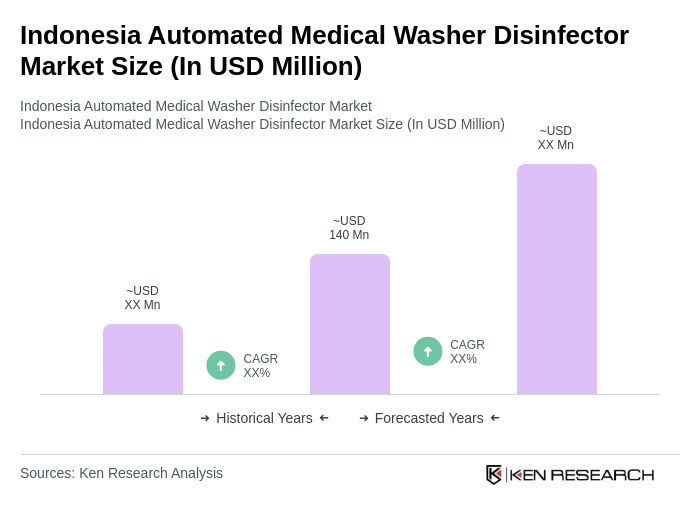
- The Indonesia Automated Medical Washer Disinfector Market is valued at USD 140 million, based on a five-year historical analysis. This growth is primarily driven by the increasing demand for efficient sterilization processes in healthcare facilities, rising awareness regarding infection control and patient safety, and the adoption of advanced automated disinfection systems. The transition from manual cleaning to automated washer disinfectors is a significant trend, as healthcare providers seek higher efficiency, improved infection control, and compliance with evolving healthcare standards. Additionally, the expansion of minimally invasive procedures and the need for safe reprocessing of complex instruments further accelerate market growth .
- Key cities such as Jakarta, Surabaya, and Bandung dominate the market due to their high concentration of healthcare facilities and hospitals. Jakarta, as the capital, has a significant number of private and public hospitals, while Surabaya and Bandung are emerging as healthcare hubs with increasing investments in medical infrastructure. This urbanization trend, coupled with ongoing investments in healthcare modernization, is propelling the demand for automated medical washer disinfectors in these regions .
- The Indonesian government regulates sterilization standards for healthcare facilities through the “Regulation of the Minister of Health of the Republic of Indonesia Number 24 of 2016 concerning Technical Requirements for Hospital Environmental Health.” This regulation mandates that hospitals implement validated sterilization protocols, including the use of automated washer disinfectors for medical instruments, to ensure patient safety and compliance with national and international health standards. The regulation covers operational procedures, equipment validation, and monitoring requirements for infection control .
Indonesia Automated Medical Washer Disinfector Market Segmentation
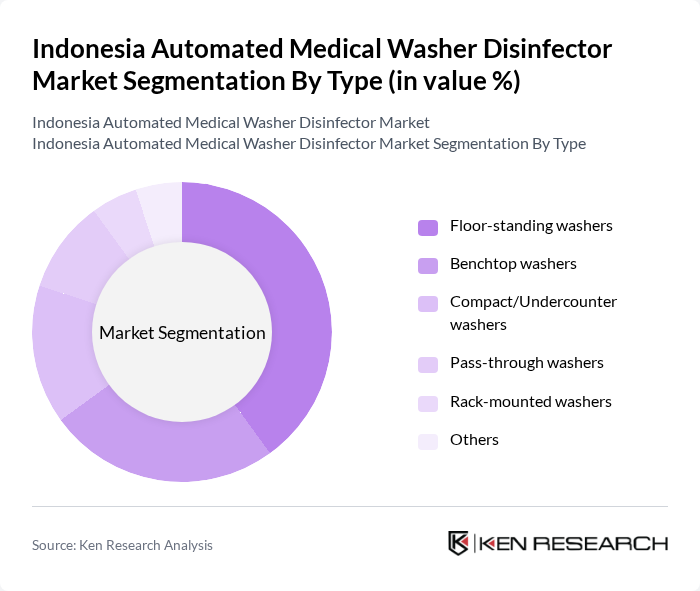
By Type:The market is segmented into various types of automated medical washer disinfectors, including floor-standing washers, benchtop washers, compact/undercounter washers, pass-through washers, rack-mounted washers, and others. Among these, floor-standing washers are the most widely adopted due to their high capacity and efficiency in processing large volumes of medical instruments. The growing emphasis on infection control and the need for reliable, high-throughput sterilization in hospitals and large clinics have driven demand for these robust systems .
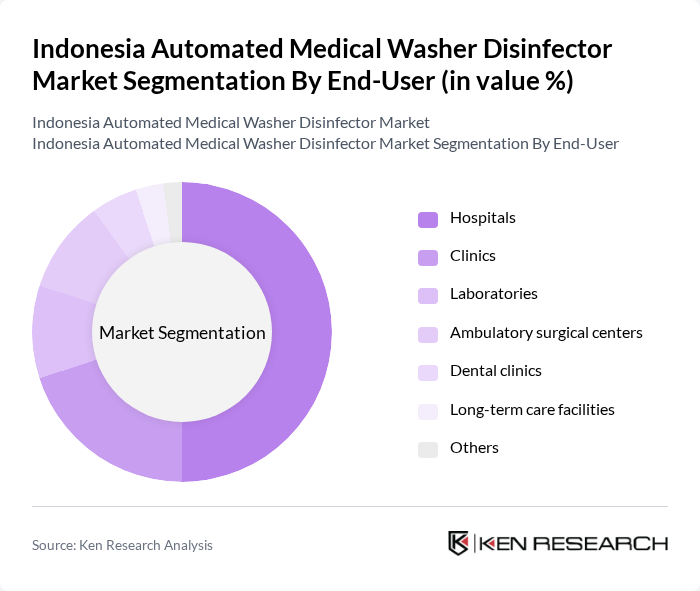
By End-User:The end-user segment includes hospitals, clinics, laboratories, ambulatory surgical centers, dental clinics, long-term care facilities, and others. Hospitals are the leading end-users, driven by the need for efficient sterilization of surgical instruments and other medical equipment. The increasing number of surgical procedures, greater focus on infection prevention, and regulatory requirements for validated sterilization processes are key factors contributing to the growth of this segment .
Indonesia Automated Medical Washer Disinfector Market Competitive Landscape
The Indonesia Automated Medical Washer Disinfector Market is characterized by a dynamic mix of regional and international players. Leading participants such as Getinge Group, Ecolab Inc., STERIS Corporation, Belimed AG, Miele Professional, CISA S.p.A., HARTMANN GROUP, Shinva Medical Instrument Co., Ltd., AT-OS S.p.A., SciCan Ltd., Eschmann Technologies Ltd., Skytron LLC, Ken Hygiene Systems A/S, Sakura Seiki Co., Ltd., DGM Pharma-Apparate Handel AG contribute to innovation, geographic expansion, and service delivery in this space.
Indonesia Automated Medical Washer Disinfector Market Industry Analysis
Growth Drivers
- Increasing Demand for Infection Control:The Indonesian healthcare sector is witnessing a surge in demand for infection control measures, driven by a reported 1.5 million hospital-acquired infections annually. This has prompted healthcare facilities to invest in automated medical washer disinfectors, which are essential for maintaining hygiene standards. The Ministry of Health's budget allocation for infection control initiatives is projected to reach IDR 1 trillion in future, further supporting this growth driver.
- Technological Advancements:The market is benefiting from rapid technological advancements in automated disinfection processes. Innovations such as UV-C light technology and advanced sensor systems are enhancing the efficacy of disinfection. In future, the Indonesian government plans to allocate IDR 500 billion for research and development in healthcare technologies, which is expected to foster the adoption of these advanced automated systems in hospitals and clinics across the country.
- Rising Awareness of Hygiene Standards:There is a growing awareness among healthcare providers regarding the importance of hygiene standards, particularly post-COVID-19. A survey conducted by the Indonesian Hospital Association indicated that 78% of hospitals are prioritizing investments in infection control technologies. This shift is expected to drive the demand for automated medical washer disinfectors, with an estimated increase in procurement budgets by 20% in future to enhance hygiene practices.
Market Challenges
- High Initial Investment Costs:One of the significant challenges facing the adoption of automated medical washer disinfectors in Indonesia is the high initial investment required. The average cost of these systems ranges from IDR 300 million to IDR 1 billion, which can be prohibitive for smaller healthcare facilities. This financial barrier is compounded by limited access to financing options, making it difficult for many institutions to upgrade their disinfection processes.
- Regulatory Compliance Complexities:Navigating the regulatory landscape for automated disinfection equipment poses a challenge for manufacturers and healthcare providers. The Indonesian Food and Drug Authority (BPOM) has stringent certification requirements that can delay the market entry of new technologies. Compliance with these regulations often requires significant time and resources, which can deter healthcare facilities from investing in automated solutions.
Indonesia Automated Medical Washer Disinfector Market Future Outlook
The future of the Indonesia automated medical washer disinfector market appears promising, driven by ongoing advancements in technology and increasing healthcare investments. As the government continues to prioritize healthcare infrastructure, the integration of smart technologies and IoT in disinfection systems is expected to gain traction. Additionally, the rising focus on sustainability will likely encourage the development of eco-friendly disinfection solutions, further enhancing market growth and adoption rates in the coming years.
Market Opportunities
- Expansion of Healthcare Facilities:The expansion of healthcare facilities in rural areas presents a significant opportunity for automated medical washer disinfectors. With the government aiming to increase healthcare access, an estimated 200 new clinics are expected to open in future, creating a demand for efficient disinfection solutions to ensure hygiene standards are met.
- Integration of IoT Technologies:The integration of IoT technologies into automated disinfection systems offers a lucrative opportunity for market players. In future, it is anticipated that 30% of new disinfection systems will incorporate IoT capabilities, allowing for real-time monitoring and data analytics, which can enhance operational efficiency and compliance with hygiene standards.
Scope of the Report
| Segment | Sub-Segments |
|---|---|
| By Type | Floor-standing washers Benchtop washers Compact/Undercounter washers Pass-through washers Rack-mounted washers Others |
| By End-User | Hospitals Clinics Laboratories Ambulatory surgical centers Dental clinics Long-term care facilities Others |
| By Application | Surgical instruments Endoscopes Glassware and laboratory equipment General medical equipment Others |
| By Distribution Channel | Direct sales Distributors Online sales Others |
| By Price Range | Budget Mid-range Premium |
| By Region | Java Sumatra Bali Kalimantan Sulawesi Others |
| By Technology | Conventional Fully automated systems Semi-automated systems Hybrid systems Others |
Key Target Audience
Investors and Venture Capitalist Firms
Government and Regulatory Bodies (e.g., Ministry of Health, National Agency of Drug and Food Control)
Manufacturers and Producers
Distributors and Retailers
Healthcare Facilities and Hospitals
Medical Equipment Suppliers
Industry Associations (e.g., Indonesian Hospital Association)
Financial Institutions
Players Mentioned in the Report:
Getinge Group
Ecolab Inc.
STERIS Corporation
Belimed AG
Miele Professional
CISA S.p.A.
HARTMANN GROUP
Shinva Medical Instrument Co., Ltd.
AT-OS S.p.A.
SciCan Ltd.
Eschmann Technologies Ltd.
Skytron LLC
Ken Hygiene Systems A/S
Sakura Seiki Co., Ltd.
DGM Pharma-Apparate Handel AG
Table of Contents
Market Assessment Phase
1. Executive Summary and Approach
2. Indonesia Automated Medical Washer Disinfector Market Overview
2.1 Key Insights and Strategic Recommendations
2.2 Indonesia Automated Medical Washer Disinfector Market Overview
2.3 Definition and Scope
2.4 Evolution of Market Ecosystem
2.5 Timeline of Key Regulatory Milestones
2.6 Value Chain & Stakeholder Mapping
2.7 Business Cycle Analysis
2.8 Policy & Incentive Landscape
3. Indonesia Automated Medical Washer Disinfector Market Analysis
3.1 Growth Drivers
3.1.1 Increasing demand for infection control in healthcare facilities
3.1.2 Technological advancements in automated disinfection processes
3.1.3 Rising awareness of hygiene standards among healthcare providers
3.1.4 Government initiatives promoting healthcare infrastructure development
3.2 Market Challenges
3.2.1 High initial investment costs for automated systems
3.2.2 Limited awareness and understanding of automated solutions
3.2.3 Regulatory compliance complexities
3.2.4 Competition from traditional manual cleaning methods
3.3 Market Opportunities
3.3.1 Expansion of healthcare facilities in rural areas
3.3.2 Integration of IoT in automated disinfection systems
3.3.3 Partnerships with local distributors for market penetration
3.3.4 Increasing focus on sustainability and eco-friendly solutions
3.4 Market Trends
3.4.1 Shift towards smart healthcare technologies
3.4.2 Growing preference for modular and scalable disinfection systems
3.4.3 Emphasis on real-time monitoring and reporting
3.4.4 Rising demand for customized solutions based on facility needs
3.5 Government Regulation
3.5.1 Standards for medical device safety and efficacy
3.5.2 Guidelines for infection control in healthcare settings
3.5.3 Certification requirements for automated disinfection equipment
3.5.4 Incentives for adopting advanced healthcare technologies
4. SWOT Analysis
5. Stakeholder Analysis
6. Porter's Five Forces Analysis
7. Indonesia Automated Medical Washer Disinfector Market Market Size, 2019-2024
7.1 By Value
7.2 By Volume
7.3 By Average Selling Price
8. Indonesia Automated Medical Washer Disinfector Market Segmentation
8.1 By Type
8.1.1 Floor-standing washers
8.1.2 Benchtop washers
8.1.3 Compact/Undercounter washers
8.1.4 Pass-through washers
8.1.5 Rack-mounted washers
8.1.6 Others
8.2 By End-User
8.2.1 Hospitals
8.2.2 Clinics
8.2.3 Laboratories
8.2.4 Ambulatory surgical centers
8.2.5 Dental clinics
8.2.6 Long-term care facilities
8.2.7 Others
8.3 By Application
8.3.1 Surgical instruments
8.3.2 Endoscopes
8.3.3 Glassware and laboratory equipment
8.3.4 General medical equipment
8.3.5 Others
8.4 By Distribution Channel
8.4.1 Direct sales
8.4.2 Distributors
8.4.3 Online sales
8.4.4 Others
8.5 By Price Range
8.5.1 Budget
8.5.2 Mid-range
8.5.3 Premium
8.6 By Region
8.6.1 Java
8.6.2 Sumatra
8.6.3 Bali
8.6.4 Kalimantan
8.6.5 Sulawesi
8.6.6 Others
8.7 By Technology
8.7.1 Conventional
8.7.2 Fully automated systems
8.7.3 Semi-automated systems
8.7.4 Hybrid systems
8.7.5 Others
9. Indonesia Automated Medical Washer Disinfector Market Competitive Analysis
9.1 Market Share of Key Players
9.2 KPIs for Cross Comparison of Key Players
9.2.1 Company Name
9.2.2 Group Size (Large, Medium, or Small as per industry convention)
9.2.3 Indonesia Market Revenue (USD, latest year)
9.2.4 Revenue Growth Rate (Indonesia, 3-year CAGR)
9.2.5 Market Share in Indonesia (%)
9.2.6 Installed Base (Number of Units in Indonesia)
9.2.7 Product Portfolio Breadth (Number of Models/Types)
9.2.8 Distribution Network Coverage (Number of Cities/Regions)
9.2.9 Customer Segments Served (e.g., hospitals, labs, clinics)
9.2.10 Regulatory Certifications (e.g., Indonesian MoH, CE, ISO)
9.2.11 After-Sales Service Presence (Number of Service Centers/Partners)
9.2.12 Product Innovation Rate (Number of New Launches, 3 years)
9.2.13 Customer Satisfaction Score (Indonesia, latest survey)
9.2.14 Operational Cost Efficiency
9.2.15 Pricing Strategy (Positioning: Budget, Mid, Premium)
9.3 SWOT Analysis of Top Players
9.4 Pricing Analysis
9.5 Detailed Profile of Major Companies
9.5.1 Getinge Group
9.5.2 Ecolab Inc.
9.5.3 STERIS Corporation
9.5.4 Belimed AG
9.5.5 Miele Professional
9.5.6 CISA S.p.A.
9.5.7 HARTMANN GROUP
9.5.8 Shinva Medical Instrument Co., Ltd.
9.5.9 AT-OS S.p.A.
9.5.10 SciCan Ltd.
9.5.11 Eschmann Technologies Ltd.
9.5.12 Skytron LLC
9.5.13 Ken Hygiene Systems A/S
9.5.14 Sakura Seiki Co., Ltd.
9.5.15 DGM Pharma-Apparate Handel AG
10. Indonesia Automated Medical Washer Disinfector Market End-User Analysis
10.1 Procurement Behavior of Key Ministries
10.1.1 Budget allocation for healthcare equipment
10.1.2 Decision-making processes
10.1.3 Preferred procurement methods
10.1.4 Evaluation criteria for suppliers
10.2 Corporate Spend on Infrastructure & Energy
10.2.1 Investment trends in healthcare infrastructure
10.2.2 Budgeting for energy-efficient solutions
10.2.3 Long-term financial commitments
10.3 Pain Point Analysis by End-User Category
10.3.1 Challenges in maintaining hygiene standards
10.3.2 Issues with existing cleaning processes
10.3.3 Need for reliable and efficient equipment
10.4 User Readiness for Adoption
10.4.1 Training requirements for staff
10.4.2 Awareness of automated solutions
10.4.3 Infrastructure readiness
10.5 Post-Deployment ROI and Use Case Expansion
10.5.1 Metrics for evaluating ROI
10.5.2 Potential for scaling operations
10.5.3 Case studies of successful implementations
11. Indonesia Automated Medical Washer Disinfector Market Future Size, 2025-2030
11.1 By Value
11.2 By Volume
11.3 By Average Selling Price
Go-To-Market Strategy Phase
1. Whitespace Analysis + Business Model Canvas
1.1 Market gaps and opportunities
1.2 Value proposition development
1.3 Revenue model identification
1.4 Key partnerships and resources
1.5 Customer segments and relationships
1.6 Channels for delivery
1.7 Cost structure analysis
2. Marketing and Positioning Recommendations
2.1 Branding strategies
2.2 Product USPs
2.3 Target audience identification
2.4 Communication strategies
2.5 Digital marketing approaches
3. Distribution Plan
3.1 Urban retail strategies
3.2 Rural NGO tie-ups
3.3 Online distribution channels
3.4 Partnerships with local distributors
4. Channel & Pricing Gaps
4.1 Underserved routes
4.2 Pricing bands analysis
4.3 Competitor pricing strategies
5. Unmet Demand & Latent Needs
5.1 Category gaps
5.2 Consumer segments analysis
5.3 Emerging trends and needs
6. Customer Relationship
6.1 Loyalty programs
6.2 After-sales service
6.3 Customer feedback mechanisms
7. Value Proposition
7.1 Sustainability initiatives
7.2 Integrated supply chains
7.3 Competitive advantages
8. Key Activities
8.1 Regulatory compliance
8.2 Branding efforts
8.3 Distribution setup
9. Entry Strategy Evaluation
9.1 Domestic Market Entry Strategy
9.1.1 Product mix considerations
9.1.2 Pricing band strategies
9.1.3 Packaging approaches
9.2 Export Entry Strategy
9.2.1 Target countries analysis
9.2.2 Compliance roadmap development
10. Entry Mode Assessment
10.1 Joint Ventures
10.2 Greenfield investments
10.3 Mergers & Acquisitions
10.4 Distributor Model
11. Capital and Timeline Estimation
11.1 Capital requirements
11.2 Timelines for market entry
12. Control vs Risk Trade-Off
12.1 Ownership considerations
12.2 Partnerships evaluation
13. Profitability Outlook
13.1 Breakeven analysis
13.2 Long-term sustainability strategies
14. Potential Partner List
14.1 Distributors
14.2 Joint Ventures
14.3 Acquisition targets
15. Execution Roadmap
15.1 Phased Plan for Market Entry
15.1.1 Market Setup
15.1.2 Market Entry
15.1.3 Growth Acceleration
15.1.4 Scale & Stabilize
15.2 Key Activities and Milestones
15.2.1 Milestone tracking
15.2.2 Activity scheduling
Research Methodology
Phase 1: Approach1
Desk Research
- Analysis of industry reports from health and medical equipment associations in Indonesia
- Review of government publications and healthcare policies impacting medical equipment
- Examination of market trends and forecasts from reputable healthcare market research firms
Primary Research
- Interviews with hospital procurement managers and decision-makers in healthcare facilities
- Surveys conducted with manufacturers and distributors of medical washer disinfectors
- Field interviews with infection control specialists and hospital administrators
Validation & Triangulation
- Cross-validation of findings through multiple data sources including trade publications and expert opinions
- Triangulation of market data with insights from healthcare professionals and industry experts
- Sanity checks through expert panel reviews to ensure data accuracy and relevance
Phase 2: Market Size Estimation1
Top-down Assessment
- Estimation of market size based on national healthcare expenditure and hospital infrastructure growth
- Segmentation of the market by end-user categories such as hospitals, clinics, and laboratories
- Incorporation of government healthcare initiatives and funding for medical equipment
Bottom-up Modeling
- Volume estimates derived from sales data of leading medical washer disinfectors in Indonesia
- Operational cost analysis based on pricing models from manufacturers and service providers
- Calculation of market size based on unit sales and average selling prices
Forecasting & Scenario Analysis
- Multi-factor regression analysis considering factors such as population growth and healthcare demand
- Scenario modeling based on potential regulatory changes and technological advancements
- Development of baseline, optimistic, and pessimistic market projections through 2030
Phase 3: CATI Sample Composition1
| Scope Item/Segment | Sample Size | Target Respondent Profiles |
|---|---|---|
| Hospital Procurement Departments | 100 | Procurement Managers, Supply Chain Coordinators |
| Healthcare Facility Administrators | 70 | Facility Managers, Operations Directors |
| Infection Control Specialists | 50 | Infection Control Officers, Clinical Managers |
| Medical Equipment Distributors | 60 | Sales Managers, Product Specialists |
| Regulatory Bodies and Health Authorities | 40 | Policy Makers, Regulatory Affairs Managers |
Frequently Asked Questions
What is the current value of the Indonesia Automated Medical Washer Disinfector Market?
The Indonesia Automated Medical Washer Disinfector Market is valued at approximately USD 140 million, reflecting a significant growth trend driven by the increasing demand for efficient sterilization processes in healthcare facilities and rising awareness of infection control.
What factors are driving the growth of the Automated Medical Washer Disinfector Market in Indonesia?
Which cities in Indonesia are leading in the Automated Medical Washer Disinfector Market?
What types of automated medical washer disinfectors are available in the Indonesian market?
Other Regional/Country Reports
Malaysia Automated Medical Washer Disinfector Market
KSA Automated Medical Washer Disinfector Market
APAC Automated Medical Washer Disinfector Market
SEA Automated Medical Washer Disinfector Market
Other Adjacent Reports
South Korea Medical Sterilization Equipment Market
Indonesia Infection Control Solutions Market
Vietnam Surgical Instrument Cleaning Market
Brazil Hospital Disinfection Systems Market
Kuwait endoscope reprocessing market report Size, Share, Growth Drivers, Trends, Opportunities & Forecast 2025–2030Oman Healthcare Hygiene Products Market
Kuwait Medical Device Cleaning Market Report Size Share Growth Drivers Trends Opportunities & Forecast 2025–2030KSA Sterile Processing Technology Market
Vietnam Automated Cleaning Systems Market
Qatar Infection Prevention Devices Market
Why Buy From Us?

What makes us stand out is that our consultants follow Robust, Refine and Result (RRR) methodology. Robust for clear definitions, approaches and sanity checking, Refine for differentiating respondents' facts and opinions, and Result for presenting data with story.

We have set a benchmark in the industry by offering our clients with syndicated and customized market research reports featuring coverage of entire market as well as meticulous research and analyst insights.

While we don't replace traditional research, we flip the method upside down. Our dual approach of Top Bottom & Bottom Top ensures quality deliverable by not just verifying company fundamentals but also looking at the sector and macroeconomic factors.

With one step in the future, our research team constantly tries to show you the bigger picture. We help with some of the tough questions you may encounter along the way: How is the industry positioned? Best marketing channel? KPI's of competitors? By aligning every element, we help maximize success.

Our report gives you instant access to the answers and sources that other companies might choose to hide. We elaborate each steps of research methodology we have used and showcase you the sample size to earn your trust.

If you need any support, we are here! We pride ourselves on universe strength, data quality, and quick, friendly, and professional service.