About the Report
Base Year 2024Kuwait Endoscope Reprocessing Market Overview
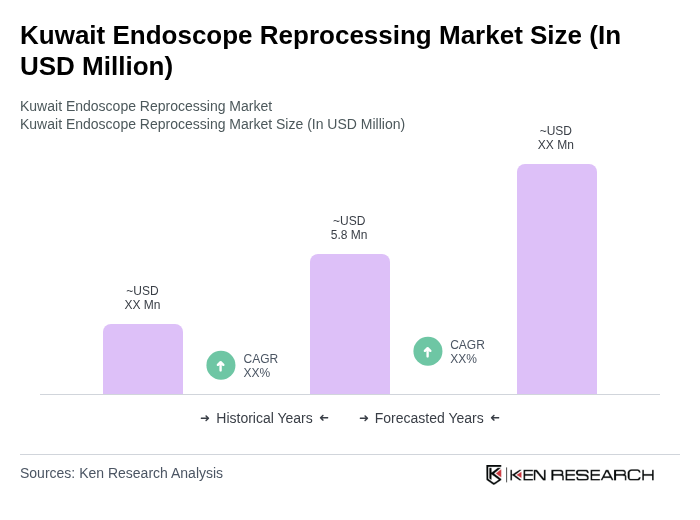
- The Kuwait Endoscope Reprocessing Market is valued at approximately USD 5.8 million, based on current market analysis. This growth is primarily driven by the increasing prevalence of gastrointestinal diseases and the rising number of endoscopic procedures performed in healthcare facilities. The demand for effective reprocessing solutions is further fueled by heightened awareness regarding infection control and patient safety standards.
- Kuwait City is the dominant region in the market due to its advanced healthcare infrastructure and concentration of hospitals and surgical centers. The presence of leading healthcare providers and a growing population seeking medical services contribute to the market's expansion. Additionally, the government's investment in healthcare facilities enhances the demand for endoscope reprocessing solutions.
- The Kuwaiti Ministry of Health has established comprehensive infection control protocols requiring healthcare facilities to implement high-level disinfection standards and utilize validated reprocessing methodologies. These operational requirements mandate the use of approved disinfectants and automated endoscope reprocessors in all accredited healthcare facilities, standardizing infection control practices and ensuring patient safety, thereby driving the demand for advanced reprocessing technologies in the market.
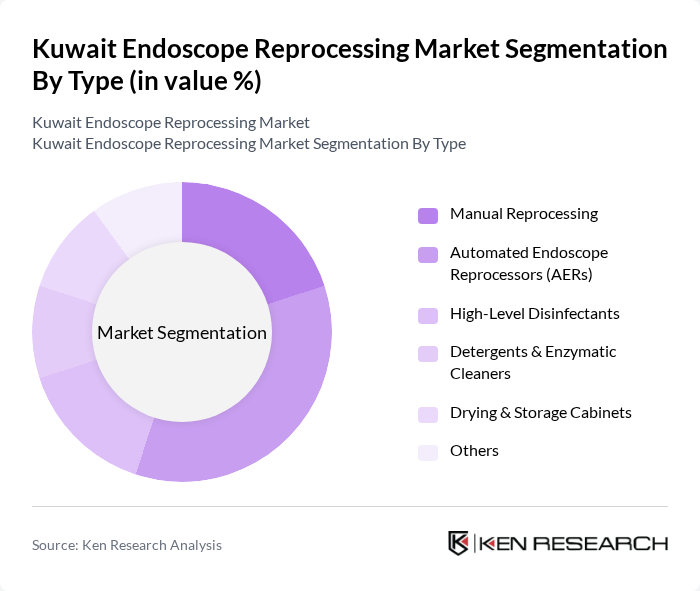
Kuwait Endoscope Reprocessing Market Segmentation
By Type:The market is segmented into various types, including Manual Reprocessing, Automated Endoscope Reprocessors (AERs), High-Level Disinfectants, Detergents & Enzymatic Cleaners, Drying & Storage Cabinets, and Others. Among these, Automated Endoscope Reprocessors (AERs) are gaining traction due to their efficiency and ability to minimize human error in the reprocessing cycle. High-level disinfectants represent a significant segment, reflecting the critical importance of chemical disinfection in endoscope reprocessing protocols.
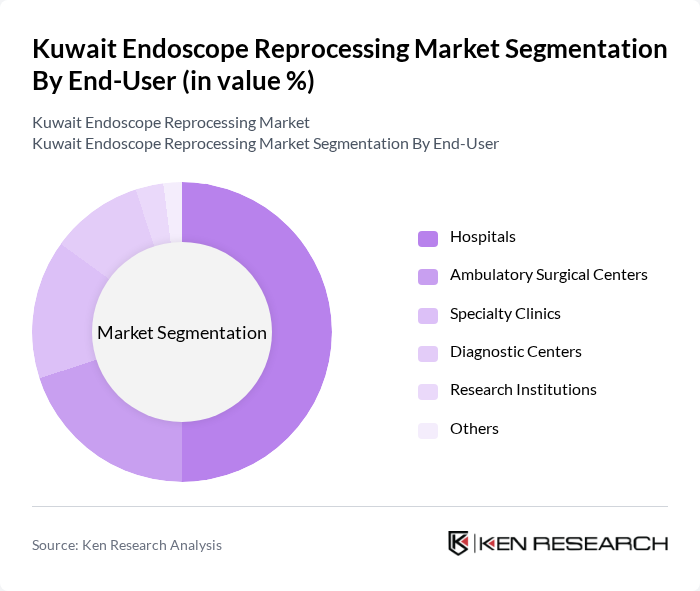
By End-User:The end-user segment includes Hospitals, Ambulatory Surgical Centers, Specialty Clinics, Diagnostic Centers, Research Institutions, and Others. Hospitals are the leading end-users, driven by the high volume of endoscopic procedures performed and the need for stringent infection control measures.
Kuwait Endoscope Reprocessing Market Competitive Landscape
The Kuwait Endoscope Reprocessing Market is characterized by a dynamic mix of regional and international players. Leading participants such as Olympus Corporation, Pentax Medical (HOYA Corporation), Karl Storz SE & Co. KG, STERIS plc, Medivators Inc. (Cantel Medical, now part of STERIS), Getinge AB, Advanced Sterilization Products (ASP, a Fortive company), Ecolab Inc., 3M Company, B. Braun Melsungen AG, Halyard Health, Inc. (now part of Owens & Minor), Sterigenics International LLC, Wassenburg Medical (A Member of Hoya Group), Steelco S.p.A. (A Member of Miele Group), Belimed AG contribute to innovation, geographic expansion, and service delivery in this space.
Kuwait Endoscope Reprocessing Market Industry Analysis
Growth Drivers
- Increasing Prevalence of Gastrointestinal Diseases:The rise in gastrointestinal diseases in Kuwait is significant, with over 1,600 new cases reported annually, according to the Ministry of Health. This increase drives the demand for endoscopic procedures, necessitating efficient reprocessing systems. The World Health Organization indicates that gastrointestinal disorders are among the leading causes of morbidity in the region, further emphasizing the need for advanced reprocessing solutions to ensure patient safety and effective treatment.
- Rising Demand for Minimally Invasive Surgeries:Kuwait's healthcare sector is witnessing a shift towards minimally invasive surgeries, with a reported 35% increase in such procedures over the past three years. This trend is fueled by patient preference for quicker recovery times and reduced hospital stays. As a result, the demand for reliable endoscope reprocessing systems is surging, as these procedures require stringent sterilization protocols to prevent infections and ensure optimal outcomes for patients.
- Technological Advancements in Endoscope Reprocessing:The endoscope reprocessing market in Kuwait is benefiting from technological innovations, with investments in automated systems increasing by 30% in the last year. These advancements enhance efficiency and reduce human error in the reprocessing cycle. The integration of advanced cleaning technologies and monitoring systems is crucial for maintaining high standards of infection control, thereby supporting the growing number of endoscopic procedures performed in healthcare facilities across the country.
Market Challenges
- High Costs of Advanced Reprocessing Equipment:The initial investment required for advanced endoscope reprocessing equipment can exceed KWD 55,000, posing a significant barrier for many healthcare facilities in Kuwait. This high cost limits the adoption of state-of-the-art technologies, particularly in smaller hospitals and clinics. As a result, many facilities continue to rely on outdated systems, which can compromise the quality of reprocessing and increase the risk of infections during procedures.
- Stringent Regulatory Requirements:Compliance with stringent regulatory standards for endoscope reprocessing in Kuwait can be challenging for healthcare providers. The Ministry of Health mandates adherence to international sterilization protocols, which require continuous monitoring and reporting. Facilities that fail to meet these regulations face penalties, which can deter investment in new technologies. This regulatory landscape creates a complex environment for healthcare providers, impacting their operational efficiency and ability to adopt innovative solutions.
Kuwait Endoscope Reprocessing Market Future Outlook
The future of the endoscope reprocessing market in Kuwait appears promising, driven by ongoing advancements in technology and a growing emphasis on patient safety. As healthcare facilities increasingly adopt automated reprocessing systems, efficiency and compliance with sterilization standards will improve. Additionally, the integration of IoT technologies is expected to enhance monitoring capabilities, ensuring higher quality assurance. These trends will likely lead to a more robust market, addressing both current challenges and future demands in the healthcare sector.
Market Opportunities
- Expansion of Healthcare Infrastructure:Kuwait's government is investing over KWD 1.2 billion in healthcare infrastructure development, creating opportunities for advanced endoscope reprocessing systems. This expansion will facilitate the establishment of new healthcare facilities, increasing the demand for efficient reprocessing solutions to support the growing number of procedures performed.
- Increasing Investments in Healthcare Technology:With healthcare technology investments projected to reach KWD 350 million in future, there is a significant opportunity for companies specializing in endoscope reprocessing solutions. This influx of capital will enable the adoption of innovative technologies, enhancing the overall quality of healthcare services and patient outcomes in Kuwait.
Scope of the Report
| Segment | Sub-Segments |
|---|---|
| By Type | Manual Reprocessing Automated Endoscope Reprocessors (AERs) High-Level Disinfectants Detergents & Enzymatic Cleaners Drying & Storage Cabinets Others |
| By End-User | Hospitals Ambulatory Surgical Centers Specialty Clinics Diagnostic Centers Research Institutions Others |
| By Application | Gastroenterology Pulmonology Urology Gynecology ENT (Ear, Nose, Throat) Others |
| By Equipment Type | Endoscope Washers/Disinfectors Sterilizers High-Level Disinfection Systems Drying Cabinets Test Strips & Indicators Accessories Others |
| By Distribution Channel | Direct Sales Distributors Online Sales Others |
| By Region | Capital Governorate Hawalli Governorate Al Ahmadi Governorate Farwaniya Governorate Mubarak Al-Kabeer Governorate Jahra Governorate Others |
| By Policy Support | Government Subsidies Tax Incentives Research Grants Others |
Key Target Audience
Investors and Venture Capitalist Firms
Government and Regulatory Bodies (e.g., Ministry of Health, Kuwait Institute for Scientific Research)
Manufacturers and Producers
Distributors and Retailers
Healthcare Providers (e.g., Hospitals, Clinics)
Medical Device Regulatory Authorities
Industry Associations (e.g., Kuwait Medical Association)
Financial Institutions
Players Mentioned in the Report:
Olympus Corporation
Pentax Medical (HOYA Corporation)
Karl Storz SE & Co. KG
STERIS plc
Medivators Inc. (Cantel Medical, now part of STERIS)
Getinge AB
Advanced Sterilization Products (ASP, a Fortive company)
Ecolab Inc.
3M Company
B. Braun Melsungen AG
Halyard Health, Inc. (now part of Owens & Minor)
Sterigenics International LLC
Wassenburg Medical (A Member of Hoya Group)
Steelco S.p.A. (A Member of Miele Group)
Belimed AG
Table of Contents
Market Assessment Phase
1. Executive Summary and Approach
2. Kuwait Endoscope Reprocessing Market Overview
2.1 Key Insights and Strategic Recommendations
2.2 Kuwait Endoscope Reprocessing Market Overview
2.3 Definition and Scope
2.4 Evolution of Market Ecosystem
2.5 Timeline of Key Regulatory Milestones
2.6 Value Chain & Stakeholder Mapping
2.7 Business Cycle Analysis
2.8 Policy & Incentive Landscape
3. Kuwait Endoscope Reprocessing Market Analysis
3.1 Growth Drivers
3.1.1 Increasing prevalence of gastrointestinal diseases
3.1.2 Rising demand for minimally invasive surgeries
3.1.3 Technological advancements in endoscope reprocessing
3.1.4 Growing awareness about infection control
3.2 Market Challenges
3.2.1 High costs of advanced reprocessing equipment
3.2.2 Stringent regulatory requirements
3.2.3 Limited availability of trained personnel
3.2.4 Resistance to adopting new technologies
3.3 Market Opportunities
3.3.1 Expansion of healthcare infrastructure
3.3.2 Increasing investments in healthcare technology
3.3.3 Rising demand for eco-friendly reprocessing solutions
3.3.4 Collaborations with international healthcare organizations
3.4 Market Trends
3.4.1 Shift towards automated reprocessing systems
3.4.2 Integration of IoT in endoscope reprocessing
3.4.3 Focus on sustainability and waste reduction
3.4.4 Growing emphasis on patient safety and quality assurance
3.5 Government Regulation
3.5.1 Compliance with international sterilization standards
3.5.2 Implementation of infection control guidelines
3.5.3 Monitoring and reporting of reprocessing practices
3.5.4 Support for research and development in healthcare technologies
4. SWOT Analysis
5. Stakeholder Analysis
6. Porter's Five Forces Analysis
7. Kuwait Endoscope Reprocessing Market Market Size, 2019-2024
7.1 By Value
7.2 By Volume
7.3 By Average Selling Price
8. Kuwait Endoscope Reprocessing Market Segmentation
8.1 By Type
8.1.1 Manual Reprocessing
8.1.2 Automated Endoscope Reprocessors (AERs)
8.1.3 High-Level Disinfectants
8.1.4 Detergents & Enzymatic Cleaners
8.1.5 Drying & Storage Cabinets
8.1.6 Others
8.2 By End-User
8.2.1 Hospitals
8.2.2 Ambulatory Surgical Centers
8.2.3 Specialty Clinics
8.2.4 Diagnostic Centers
8.2.5 Research Institutions
8.2.6 Others
8.3 By Application
8.3.1 Gastroenterology
8.3.2 Pulmonology
8.3.3 Urology
8.3.4 Gynecology
8.3.5 ENT (Ear, Nose, Throat)
8.3.6 Others
8.4 By Equipment Type
8.4.1 Endoscope Washers/Disinfectors
8.4.2 Sterilizers
8.4.3 High-Level Disinfection Systems
8.4.4 Drying Cabinets
8.4.5 Test Strips & Indicators
8.4.6 Accessories
8.4.7 Others
8.5 By Distribution Channel
8.5.1 Direct Sales
8.5.2 Distributors
8.5.3 Online Sales
8.5.4 Others
8.6 By Region
8.6.1 Capital Governorate
8.6.2 Hawalli Governorate
8.6.3 Al Ahmadi Governorate
8.6.4 Farwaniya Governorate
8.6.5 Mubarak Al-Kabeer Governorate
8.6.6 Jahra Governorate
8.6.7 Others
8.7 By Policy Support
8.7.1 Government Subsidies
8.7.2 Tax Incentives
8.7.3 Research Grants
8.7.4 Others
9. Kuwait Endoscope Reprocessing Market Competitive Analysis
9.1 Market Share of Key Players
9.2 Cross Comparison of Key Players
9.2.1 Company Name
9.2.2 Group Size (Large, Medium, or Small as per industry convention)
9.2.3 Revenue Growth Rate (Kuwait/MENA)
9.2.4 Market Penetration Rate (Number of Installations/Facilities Served in Kuwait)
9.2.5 Regulatory Compliance Certifications (e.g., CE, ISO, MOH Kuwait)
9.2.6 Product Portfolio Breadth (Number of Endoscope Reprocessing SKUs)
9.2.7 Customer Retention Rate (Healthcare Facility Contracts Renewed)
9.2.8 Service & Maintenance Response Time (Average in Hours)
9.2.9 Innovation Rate (New Product Launches/Patents in Last 3 Years)
9.2.10 Brand Recognition Score (Survey-Based or Market Share Proxy)
9.2.11 Pricing Strategy (Premium/Value/Volume)
9.2.12 Operational Efficiency (Downtime per 1000 Cycles)
9.3 SWOT Analysis of Top Players
9.4 Pricing Analysis
9.5 Detailed Profile of Major Companies
9.5.1 Olympus Corporation
9.5.2 Pentax Medical (HOYA Corporation)
9.5.3 Karl Storz SE & Co. KG
9.5.4 STERIS plc
9.5.5 Medivators Inc. (Cantel Medical, now part of STERIS)
9.5.6 Getinge AB
9.5.7 Advanced Sterilization Products (ASP, a Fortive company)
9.5.8 Ecolab Inc.
9.5.9 3M Company
9.5.10 B. Braun Melsungen AG
9.5.11 Halyard Health, Inc. (now part of Owens & Minor)
9.5.12 Sterigenics International LLC
9.5.13 Wassenburg Medical (A Member of Hoya Group)
9.5.14 Steelco S.p.A. (A Member of Miele Group)
9.5.15 Belimed AG
10. Kuwait Endoscope Reprocessing Market End-User Analysis
10.1 Procurement Behavior of Key Ministries
10.1.1 Budget Allocation Trends
10.1.2 Decision-Making Processes
10.1.3 Preferred Suppliers
10.1.4 Compliance Requirements
10.2 Corporate Spend on Infrastructure & Energy
10.2.1 Investment Trends
10.2.2 Spending Priorities
10.2.3 Funding Sources
10.2.4 Projected Growth Areas
10.3 Pain Point Analysis by End-User Category
10.3.1 Equipment Availability
10.3.2 Training and Support
10.3.3 Maintenance Challenges
10.3.4 Cost Management
10.4 User Readiness for Adoption
10.4.1 Awareness Levels
10.4.2 Training Needs
10.4.3 Technology Acceptance
10.4.4 Feedback Mechanisms
10.5 Post-Deployment ROI and Use Case Expansion
10.5.1 Performance Metrics
10.5.2 User Satisfaction Levels
10.5.3 Future Investment Plans
10.5.4 Expansion Opportunities
11. Kuwait Endoscope Reprocessing Market Future Size, 2025-2030
11.1 By Value
11.2 By Volume
11.3 By Average Selling Price
Go-To-Market Strategy Phase
1. Whitespace Analysis + Business Model Canvas
1.1 Market Gaps Identification
1.2 Value Proposition Development
1.3 Revenue Model Structuring
1.4 Key Partnerships Identification
1.5 Customer Segmentation
1.6 Cost Structure Analysis
1.7 Competitive Advantage Assessment
2. Marketing and Positioning Recommendations
2.1 Branding Strategies
2.2 Product USPs
2.3 Target Market Identification
2.4 Communication Strategy
2.5 Digital Marketing Approach
2.6 Customer Engagement Tactics
2.7 Performance Metrics
3. Distribution Plan
3.1 Urban Retail Strategies
3.2 Rural NGO Tie-ups
3.3 Online Distribution Channels
3.4 Direct Sales Approaches
3.5 Logistics and Supply Chain Management
3.6 Partnership with Distributors
3.7 Performance Evaluation
4. Channel & Pricing Gaps
4.1 Underserved Routes
4.2 Pricing Bands Analysis
4.3 Competitor Pricing Strategies
4.4 Customer Price Sensitivity
4.5 Value-Based Pricing Models
4.6 Discount and Promotion Strategies
4.7 Performance Metrics
5. Unmet Demand & Latent Needs
5.1 Category Gaps
5.2 Consumer Segments Analysis
5.3 Emerging Trends Identification
5.4 Customer Feedback Mechanisms
5.5 Market Research Insights
5.6 Future Demand Projections
5.7 Performance Metrics
6. Customer Relationship
6.1 Loyalty Programs
6.2 After-sales Service
6.3 Customer Feedback Systems
6.4 Relationship Management Strategies
6.5 Performance Metrics
7. Value Proposition
7.1 Sustainability Initiatives
7.2 Integrated Supply Chains
7.3 Customer-Centric Approaches
7.4 Competitive Differentiation
7.5 Performance Metrics
8. Key Activities
8.1 Regulatory Compliance
8.2 Branding Initiatives
8.3 Distribution Setup
8.4 Training and Development
8.5 Performance Metrics
9. Entry Strategy Evaluation
9.1 Domestic Market Entry Strategy
9.1.1 Product Mix
9.1.2 Pricing Band
9.1.3 Packaging
9.2 Export Entry Strategy
9.2.1 Target Countries
9.2.2 Compliance Roadmap
10. Entry Mode Assessment
10.1 Joint Ventures
10.2 Greenfield Investments
10.3 Mergers & Acquisitions
10.4 Distributor Model
10.5 Performance Metrics
11. Capital and Timeline Estimation
11.1 Capital Requirements
11.2 Timelines
11.3 Funding Sources
11.4 Risk Assessment
11.5 Performance Metrics
12. Control vs Risk Trade-Off
12.1 Ownership vs Partnerships
12.2 Risk Mitigation Strategies
12.3 Performance Metrics
13. Profitability Outlook
13.1 Breakeven Analysis
13.2 Long-term Sustainability
13.3 Financial Projections
13.4 Performance Metrics
14. Potential Partner List
14.1 Distributors
14.2 Joint Ventures
14.3 Acquisition Targets
14.4 Performance Metrics
15. Execution Roadmap
15.1 Phased Plan for Market Entry
15.1.1 Market Setup
15.1.2 Market Entry
15.1.3 Growth Acceleration
15.1.4 Scale & Stabilize
15.2 Key Activities and Milestones
15.2.1 Activity Planning
15.2.2 Milestone Tracking
15.2.3 Performance Metrics
Research Methodology
Phase 1: Approach1
Desk Research
- Analysis of industry reports from healthcare associations and medical device regulatory bodies
- Review of published articles and white papers on endoscope reprocessing technologies
- Examination of market trends and statistics from government health departments and trade publications
Primary Research
- Interviews with hospital administrators and infection control specialists
- Surveys with endoscope manufacturers and reprocessing equipment suppliers
- Field visits to healthcare facilities to observe reprocessing workflows and practices
Validation & Triangulation
- Cross-validation of findings through multiple data sources including market reports and expert opinions
- Triangulation of data from primary interviews and secondary research to ensure consistency
- Sanity checks conducted through expert panel discussions with industry veterans
Phase 2: Market Size Estimation1
Top-down Assessment
- Estimation of total healthcare expenditure in Kuwait and its allocation to endoscopy services
- Analysis of the growth rate of endoscopic procedures and their impact on reprocessing demand
- Incorporation of government healthcare initiatives and funding for infection control measures
Bottom-up Modeling
- Collection of data on the number of endoscopes in use across hospitals and clinics
- Estimation of reprocessing frequency based on procedural data and guidelines
- Cost analysis of reprocessing equipment and consumables to derive market value
Forecasting & Scenario Analysis
- Multi-variable forecasting model incorporating trends in healthcare technology adoption
- Scenario analysis based on potential regulatory changes and advancements in reprocessing methods
- Development of baseline, optimistic, and pessimistic market growth projections through 2030
Phase 3: CATI Sample Composition1
| Scope Item/Segment | Sample Size | Target Respondent Profiles |
|---|---|---|
| Hospital Endoscopy Departments | 100 | Endoscopy Unit Managers, Infection Control Officers |
| Outpatient Surgical Centers | 60 | Clinical Directors, Surgical Coordinators |
| Endoscope Manufacturers | 40 | Product Managers, Sales Executives |
| Reprocessing Equipment Suppliers | 40 | Technical Support Managers, Sales Representatives |
| Healthcare Regulatory Bodies | 30 | Policy Analysts, Compliance Officers |
Frequently Asked Questions
What is the current value of the Kuwait Endoscope Reprocessing Market?
The Kuwait Endoscope Reprocessing Market is valued at approximately USD 5.8 million. This valuation reflects the increasing prevalence of gastrointestinal diseases and the rising number of endoscopic procedures in healthcare facilities across the country.
What factors are driving the growth of the Kuwait Endoscope Reprocessing Market?
Which region in Kuwait dominates the Endoscope Reprocessing Market?
What are the regulatory requirements for endoscope reprocessing in Kuwait?
Other Regional/Country Reports
Indonesia Endoscope Reprocessing Market
Malaysia Endoscope Reprocessing Market
KSA Endoscope Reprocessing Market
APAC Endoscope Reprocessing Market
SEA Endoscope Reprocessing Market
Vietnam Endoscope Reprocessing Market
Other Adjacent Reports
Brazil Endoscopy Devices Market
Kuwait Infection Control Market
South Korea Sterilization Equipment Market
South Africa Medical Device Cleaning Market
Egypt High-Level Disinfectants Market
Kuwait Automated Reprocessing Systems Market
South Africa Gastrointestinal Diagnostics Market
Vietnam Hospital Infection Prevention Market
KSA Surgical Instruments Market
Egypt Healthcare Sterilization Services Market
Why Buy From Us?

What makes us stand out is that our consultants follow Robust, Refine and Result (RRR) methodology. Robust for clear definitions, approaches and sanity checking, Refine for differentiating respondents' facts and opinions, and Result for presenting data with story.

We have set a benchmark in the industry by offering our clients with syndicated and customized market research reports featuring coverage of entire market as well as meticulous research and analyst insights.

While we don't replace traditional research, we flip the method upside down. Our dual approach of Top Bottom & Bottom Top ensures quality deliverable by not just verifying company fundamentals but also looking at the sector and macroeconomic factors.

With one step in the future, our research team constantly tries to show you the bigger picture. We help with some of the tough questions you may encounter along the way: How is the industry positioned? Best marketing channel? KPI's of competitors? By aligning every element, we help maximize success.

Our report gives you instant access to the answers and sources that other companies might choose to hide. We elaborate each steps of research methodology we have used and showcase you the sample size to earn your trust.

If you need any support, we are here! We pride ourselves on universe strength, data quality, and quick, friendly, and professional service.