About the Report
Base Year 2024Indonesia Liquid Dietary Supplements Market Overview
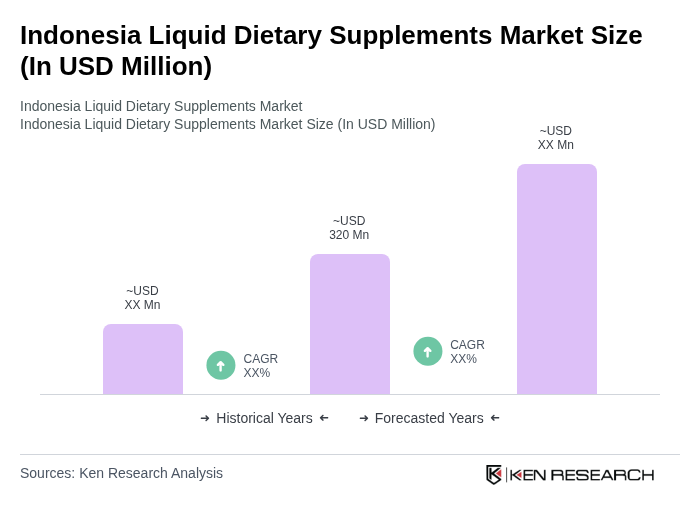
- The Indonesia Liquid Dietary Supplements Market is valued at USD 320 million, based on a five-year historical analysis. This growth is primarily driven by increasing health consciousness among consumers, a rise in disposable incomes, and a growing trend towards preventive healthcare. The demand for liquid dietary supplements has surged as consumers seek convenient and effective ways to enhance their nutrition and overall well-being.
- Key cities such asJakarta, Surabaya, and Bandungdominate the market due to their large populations and urbanization trends. Jakarta, being the capital, serves as a hub for health and wellness products, while Surabaya and Bandung have seen a rise in health awareness and purchasing power, making them significant contributors to the market's growth.
- The regulation of dietary supplements in Indonesia is governed byRegulation of the Head of the National Agency of Drug and Food Control (BPOM) Number 12 of 2019 on Food Supplements, issued by the National Agency of Drug and Food Control (BPOM). This regulation mandates that all dietary supplements, including liquid forms, must be registered with BPOM prior to distribution, and must comply with safety, efficacy, and quality standards, including labeling and advertising requirements.
Indonesia Liquid Dietary Supplements Market Segmentation
By Type:The market is segmented into various types of liquid dietary supplements, includingVitamins & Minerals, Herbal/Botanical Supplements, Protein & Amino Acid Supplements, Sports & Performance Nutrition, Weight Management Supplements, Immune Health Supplements, and Others. Each of these subsegments caters to specific consumer needs and preferences, reflecting the diverse health and wellness trends in Indonesia.

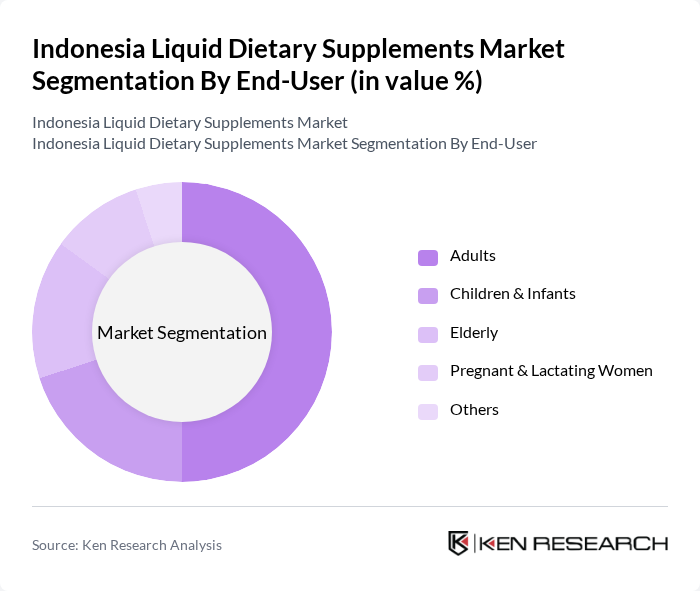
By End-User:The end-user segmentation includesAdults, Children & Infants, Elderly, Pregnant & Lactating Women, and Others. Each group has distinct nutritional needs, influencing the types of liquid dietary supplements they prefer. The adult segment is particularly significant due to the increasing focus on health and fitness among working professionals.
Indonesia Liquid Dietary Supplements Market Competitive Landscape
The Indonesia Liquid Dietary Supplements Market is characterized by a dynamic mix of regional and international players. Leading participants such as Herbalife Nutrition Ltd., Amway Indonesia, PT Kalbe Farma Tbk, PT Sido Muncul Tbk, PT Nutrifood Indonesia, PT Deltomed Laboratories, PT Darya-Varia Laboratoria Tbk, PT Sarihusada Generasi Mahardhika, PT Bintang Toedjoe, PT Indofarma Tbk, PT Kimia Farma Tbk, PT Soho Global Health, PT Tempo Scan Pacific Tbk, PT Lapi Laboratories, PT Pharos Indonesia contribute to innovation, geographic expansion, and service delivery in this space.
Indonesia Liquid Dietary Supplements Market Industry Analysis
Growth Drivers
- Increasing Health Awareness:The Indonesian population is becoming increasingly health-conscious, with a reported 60% of adults actively seeking ways to improve their health through dietary supplements. This trend is supported by the World Health Organization's findings that indicate a rise in lifestyle-related diseases, prompting consumers to prioritize preventive health measures. The government’s health initiatives, aiming to reduce non-communicable diseases, further bolster this awareness, driving demand for liquid dietary supplements as a convenient health solution.
- Rising Demand for Convenient Nutrition:As urbanization accelerates, the need for convenient nutrition solutions is surging. In future, it is estimated that over 70% of urban dwellers in Indonesia will prefer ready-to-consume dietary options due to their busy lifestyles. This shift is reflected in the growing sales of liquid dietary supplements, which offer easy consumption without the need for preparation. The convenience factor is crucial, especially among working professionals and students, who prioritize quick and effective nutritional solutions.
- Growth of E-commerce Platforms:The e-commerce sector in Indonesia is projected to reach USD 53 billion in future, significantly enhancing the accessibility of liquid dietary supplements. With over 90 million internet users in the country, online shopping has become a preferred method for purchasing health products. This trend is further supported by the increasing number of local and international brands establishing their presence on digital platforms, making it easier for consumers to access a variety of dietary supplements tailored to their needs.
Market Challenges
- Regulatory Compliance Issues:Navigating the regulatory landscape in Indonesia poses significant challenges for dietary supplement manufacturers. The Food and Drug Administration (BPOM) enforces stringent guidelines that require extensive documentation and testing before products can be marketed. In future, it is estimated that compliance costs could account for up to 15% of total production expenses, creating barriers for smaller companies and potentially limiting market entry for innovative products.
- Consumer Skepticism Towards Supplements:Despite the growing market, a notable segment of the Indonesian population remains skeptical about the efficacy of dietary supplements. Approximately 40% of consumers express doubts regarding the health benefits claimed by brands, influenced by a lack of trust in product labeling and marketing. This skepticism can hinder sales growth, as consumers often prefer traditional food sources over supplements, necessitating brands to invest in education and transparency to build trust.
Indonesia Liquid Dietary Supplements Market Future Outlook
The future of the liquid dietary supplements market in Indonesia appears promising, driven by increasing health awareness and the growing trend of personalized nutrition. As consumers seek tailored health solutions, brands that innovate and adapt to these preferences are likely to thrive. Additionally, the expansion of e-commerce and retail channels will facilitate greater access to products, enabling companies to reach diverse consumer segments, including those in rural areas, thereby enhancing market penetration and growth potential.
Market Opportunities
- Development of Innovative Products:There is a significant opportunity for companies to develop innovative liquid dietary supplements that cater to specific health needs, such as immunity boosting or digestive health. With the increasing consumer demand for functional foods, brands that invest in research and development can capture a larger market share and differentiate themselves from competitors.
- Targeting Emerging Consumer Segments:The rise of health-conscious millennials and Gen Z consumers presents a lucrative opportunity for dietary supplement brands. By tailoring marketing strategies and product offerings to appeal to these demographics, companies can tap into a growing market segment that values health, sustainability, and convenience, driving future sales growth.
Scope of the Report
| Segment | Sub-Segments |
|---|---|
| By Type | Vitamins & Minerals Herbal/Botanical Supplements Protein & Amino Acid Supplements Sports & Performance Nutrition Weight Management Supplements Immune Health Supplements Others |
| By End-User | Adults Children & Infants Elderly Pregnant & Lactating Women Others |
| By Distribution Channel | Online Retail (e-commerce platforms) Supermarkets/Hypermarkets Pharmacies/Drugstores Health & Wellness Stores Direct Sales (MLM) Others |
| By Formulation | Liquid Powder Capsule/Softgel Tablet Others |
| By Ingredient Source | Natural Synthetic Organic Others |
| By Packaging Type | Bottles Sachets Tetra Packs Ampoules Others |
| By Price Range | Low Medium High Others |
Key Target Audience
Investors and Venture Capitalist Firms
Government and Regulatory Bodies (e.g., Badan Pengawas Obat dan Makanan - BPOM)
Manufacturers and Producers
Distributors and Retailers
Health and Wellness Organizations
Pharmaceutical Companies
Industry Associations (e.g., Asosiasi Perusahaan Jamu dan Obat Tradisional - APJOT)
Financial Institutions
Players Mentioned in the Report:
Herbalife Nutrition Ltd.
Amway Indonesia
PT Kalbe Farma Tbk
PT Sido Muncul Tbk
PT Nutrifood Indonesia
PT Deltomed Laboratories
PT Darya-Varia Laboratoria Tbk
PT Sarihusada Generasi Mahardhika
PT Bintang Toedjoe
PT Indofarma Tbk
PT Kimia Farma Tbk
PT Soho Global Health
PT Tempo Scan Pacific Tbk
PT Lapi Laboratories
PT Pharos Indonesia
Table of Contents
Market Assessment Phase
1. Executive Summary and Approach
2. Indonesia Liquid Dietary Supplements Market Overview
2.1 Key Insights and Strategic Recommendations
2.2 Indonesia Liquid Dietary Supplements Market Overview
2.3 Definition and Scope
2.4 Evolution of Market Ecosystem
2.5 Timeline of Key Regulatory Milestones
2.6 Value Chain & Stakeholder Mapping
2.7 Business Cycle Analysis
2.8 Policy & Incentive Landscape
3. Indonesia Liquid Dietary Supplements Market Analysis
3.1 Growth Drivers
3.1.1 Increasing Health Awareness
3.1.2 Rising Demand for Convenient Nutrition
3.1.3 Growth of E-commerce Platforms
3.1.4 Expansion of Retail Channels
3.2 Market Challenges
3.2.1 Regulatory Compliance Issues
3.2.2 High Competition Among Brands
3.2.3 Consumer Skepticism Towards Supplements
3.2.4 Price Sensitivity Among Consumers
3.3 Market Opportunities
3.3.1 Development of Innovative Products
3.3.2 Targeting Emerging Consumer Segments
3.3.3 Collaborations with Health Professionals
3.3.4 Expansion into Rural Markets
3.4 Market Trends
3.4.1 Growth of Plant-Based Supplements
3.4.2 Increasing Use of Digital Marketing
3.4.3 Focus on Personalized Nutrition
3.4.4 Rise of Subscription-Based Models
3.5 Government Regulation
3.5.1 Food and Drug Administration (BPOM) Guidelines
3.5.2 Halal Certification Requirements
3.5.3 Labeling and Advertising Regulations
3.5.4 Import Regulations for Dietary Supplements
4. SWOT Analysis
5. Stakeholder Analysis
6. Porter's Five Forces Analysis
7. Indonesia Liquid Dietary Supplements Market Market Size, 2019-2024
7.1 By Value
7.2 By Volume
7.3 By Average Selling Price
8. Indonesia Liquid Dietary Supplements Market Segmentation
8.1 By Type
8.1.1 Vitamins & Minerals
8.1.2 Herbal/Botanical Supplements
8.1.3 Protein & Amino Acid Supplements
8.1.4 Sports & Performance Nutrition
8.1.5 Weight Management Supplements
8.1.6 Immune Health Supplements
8.1.7 Others
8.2 By End-User
8.2.1 Adults
8.2.2 Children & Infants
8.2.3 Elderly
8.2.4 Pregnant & Lactating Women
8.2.5 Others
8.3 By Distribution Channel
8.3.1 Online Retail (e-commerce platforms)
8.3.2 Supermarkets/Hypermarkets
8.3.3 Pharmacies/Drugstores
8.3.4 Health & Wellness Stores
8.3.5 Direct Sales (MLM)
8.3.6 Others
8.4 By Formulation
8.4.1 Liquid
8.4.2 Powder
8.4.3 Capsule/Softgel
8.4.4 Tablet
8.4.5 Others
8.5 By Ingredient Source
8.5.1 Natural
8.5.2 Synthetic
8.5.3 Organic
8.5.4 Others
8.6 By Packaging Type
8.6.1 Bottles
8.6.2 Sachets
8.6.3 Tetra Packs
8.6.4 Ampoules
8.6.5 Others
8.7 By Price Range
8.7.1 Low
8.7.2 Medium
8.7.3 High
8.7.4 Others
9. Indonesia Liquid Dietary Supplements Market Competitive Analysis
9.1 Market Share of Key Players
9.2 Cross Comparison of Key Players
9.2.1 Company Name
9.2.2 Group Size (Large, Medium, or Small as per industry convention)
9.2.3 Revenue Growth Rate (YoY %)
9.2.4 Market Share (%)
9.2.5 Product Portfolio Breadth
9.2.6 Distribution Network Coverage (national/regional)
9.2.7 Brand Awareness Index
9.2.8 Regulatory Compliance Score (BPOM, Halal)
9.2.9 Innovation Rate (new product launches/year)
9.2.10 Customer Satisfaction Score (NPS or equivalent)
9.2.11 Digital Presence Strength (e-commerce, social media engagement)
9.3 SWOT Analysis of Top Players
9.4 Pricing Analysis
9.5 Detailed Profile of Major Companies
9.5.1 Herbalife Nutrition Ltd.
9.5.2 Amway Indonesia
9.5.3 PT Kalbe Farma Tbk
9.5.4 PT Sido Muncul Tbk
9.5.5 PT Nutrifood Indonesia
9.5.6 PT Deltomed Laboratories
9.5.7 PT Darya-Varia Laboratoria Tbk
9.5.8 PT Sarihusada Generasi Mahardhika
9.5.9 PT Bintang Toedjoe
9.5.10 PT Indofarma Tbk
9.5.11 PT Kimia Farma Tbk
9.5.12 PT Soho Global Health
9.5.13 PT Tempo Scan Pacific Tbk
9.5.14 PT Lapi Laboratories
9.5.15 PT Pharos Indonesia
10. Indonesia Liquid Dietary Supplements Market End-User Analysis
10.1 Procurement Behavior of Key Ministries
10.1.1 Budget Allocation for Health Programs
10.1.2 Preference for Local vs. Imported Products
10.1.3 Evaluation Criteria for Supplier Selection
10.1.4 Frequency of Procurement Cycles
10.2 Corporate Spend on Infrastructure & Energy
10.2.1 Investment in Health and Wellness Initiatives
10.2.2 Budget Trends in Corporate Wellness Programs
10.3 Pain Point Analysis by End-User Category
10.3.1 Accessibility of Products
10.3.2 Affordability Concerns
10.3.3 Quality Assurance Issues
10.3.4 Information Gaps on Product Benefits
10.4 User Readiness for Adoption
10.4.1 Awareness Levels of Dietary Supplements
10.4.2 Willingness to Pay for Quality Products
10.5 Post-Deployment ROI and Use Case Expansion
10.5.1 Measurement of Health Outcomes
10.5.2 Long-term User Engagement Strategies
11. Indonesia Liquid Dietary Supplements Market Future Size, 2025-2030
11.1 By Value
11.2 By Volume
11.3 By Average Selling Price
Go-To-Market Strategy Phase
1. Whitespace Analysis + Business Model Canvas
1.1 Market Gaps Identification
1.2 Business Model Development
2. Marketing and Positioning Recommendations
2.1 Branding Strategies
2.2 Product USPs
3. Distribution Plan
3.1 Urban Retail vs Rural NGO Tie-ups
4. Channel & Pricing Gaps
4.1 Underserved Routes
4.2 Pricing Bands
5. Unmet Demand & Latent Needs
5.1 Category Gaps
5.2 Consumer Segments
6. Customer Relationship
6.1 Loyalty Programs
6.2 After-sales Service
7. Value Proposition
7.1 Sustainability
7.2 Integrated Supply Chains
8. Key Activities
8.1 Regulatory Compliance
8.2 Branding
8.3 Distribution Setup
9. Entry Strategy Evaluation
9.1 Domestic Market Entry Strategy
9.1.1 Product Mix
9.1.2 Pricing Band
9.1.3 Packaging
9.2 Export Entry Strategy
9.2.1 Target Countries
9.2.2 Compliance Roadmap
10. Entry Mode Assessment
10.1 JV
10.2 Greenfield
10.3 M&A
10.4 Distributor Model
11. Capital and Timeline Estimation
11.1 Capital Requirements
11.2 Timelines
12. Control vs Risk Trade-Off
12.1 Ownership vs Partnerships
13. Profitability Outlook
13.1 Breakeven Analysis
13.2 Long-term Sustainability
14. Potential Partner List
14.1 Distributors
14.2 JVs
14.3 Acquisition Targets
15. Execution Roadmap
15.1 Phased Plan for Market Entry
15.1.1 Market Setup
15.1.2 Market Entry
15.1.3 Growth Acceleration
15.1.4 Scale & Stabilize
15.2 Key Activities and Milestones
15.2.1 Milestone Planning
Research Methodology
Phase 1: Approach1
Desk Research
- Analysis of industry reports from health and wellness organizations
- Review of government publications on dietary supplement regulations in Indonesia
- Examination of market trends and consumer behavior studies from academic journals
Primary Research
- Interviews with key opinion leaders in the nutrition and dietary supplement sectors
- Surveys conducted with health professionals and nutritionists across Indonesia
- Focus group discussions with consumers to understand preferences and buying behavior
Validation & Triangulation
- Cross-validation of findings through multiple data sources including sales data and consumer feedback
- Triangulation of insights from industry experts and market analysts
- Sanity checks through peer reviews and expert panel discussions
Phase 2: Market Size Estimation1
Top-down Assessment
- Estimation of market size based on national health expenditure and dietary supplement spending
- Segmentation of the market by product type, distribution channel, and consumer demographics
- Incorporation of growth rates from historical data and projected trends in health consciousness
Bottom-up Modeling
- Collection of sales data from leading liquid dietary supplement manufacturers
- Estimation of average selling prices and volume sold across various distribution channels
- Analysis of consumer purchasing patterns and frequency of dietary supplement consumption
Forecasting & Scenario Analysis
- Utilization of time series analysis to project future market growth based on current trends
- Scenario modeling based on potential regulatory changes and shifts in consumer preferences
- Development of best-case, worst-case, and most-likely market scenarios through 2030
Phase 3: CATI Sample Composition1
| Scope Item/Segment | Sample Size | Target Respondent Profiles |
|---|---|---|
| Retail Market for Liquid Dietary Supplements | 80 | Retail Managers, Store Owners |
| Health and Wellness Professionals | 70 | Nutritionists, Dietitians |
| Consumer Preferences and Trends | 120 | Health-Conscious Consumers, Fitness Enthusiasts |
| Distribution Channel Insights | 70 | Wholesalers, Distributors |
| Regulatory Impact Assessment | 40 | Regulatory Affairs Specialists, Compliance Officers |
Frequently Asked Questions
What is the current value of the Indonesia Liquid Dietary Supplements Market?
The Indonesia Liquid Dietary Supplements Market is valued at approximately USD 320 million, reflecting a significant growth trend driven by increasing health consciousness, rising disposable incomes, and a shift towards preventive healthcare among consumers.
What factors are driving the growth of liquid dietary supplements in Indonesia?
Which cities are the main contributors to the Indonesia Liquid Dietary Supplements Market?
What types of liquid dietary supplements are available in Indonesia?
Other Regional/Country Reports
Other Adjacent Reports
Oman Vitamins and Minerals Supplements Market
Philippines Herbal and Botanical Supplements Market
Egypt Protein and Amino Acid Supplements Market
South Africa Sports and Performance Nutrition Market
South Africa Weight Management Supplements Market
Kuwait Immune Health Supplements Market
Philippines Nutraceuticals Market
Malaysia Functional Beverages Market
Vietnam Personalized Nutrition Market
Belgium E-commerce Health Products Market
Why Buy From Us?

What makes us stand out is that our consultants follow Robust, Refine and Result (RRR) methodology. Robust for clear definitions, approaches and sanity checking, Refine for differentiating respondents' facts and opinions, and Result for presenting data with story.

We have set a benchmark in the industry by offering our clients with syndicated and customized market research reports featuring coverage of entire market as well as meticulous research and analyst insights.

While we don't replace traditional research, we flip the method upside down. Our dual approach of Top Bottom & Bottom Top ensures quality deliverable by not just verifying company fundamentals but also looking at the sector and macroeconomic factors.

With one step in the future, our research team constantly tries to show you the bigger picture. We help with some of the tough questions you may encounter along the way: How is the industry positioned? Best marketing channel? KPI's of competitors? By aligning every element, we help maximize success.

Our report gives you instant access to the answers and sources that other companies might choose to hide. We elaborate each steps of research methodology we have used and showcase you the sample size to earn your trust.

If you need any support, we are here! We pride ourselves on universe strength, data quality, and quick, friendly, and professional service.