About the Report
Base Year 2024Indonesia Smart Home Security Camera Market Overview
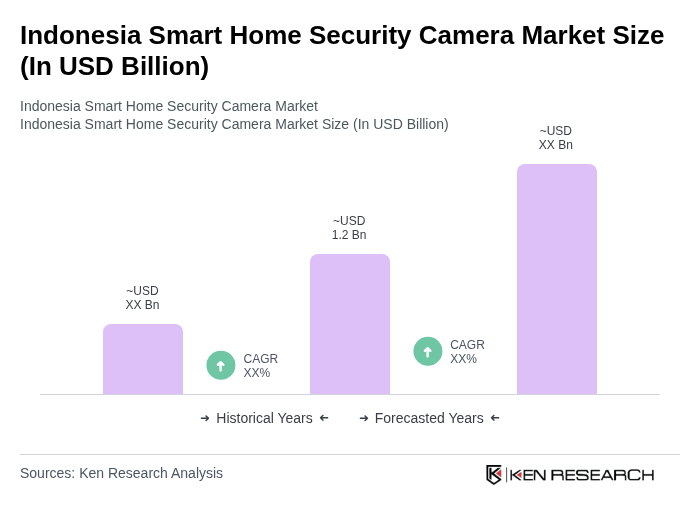
- The Indonesia Smart Home Security Camera Market is valued at USD 1.2 billion, based on a five-year historical analysis. This growth is primarily driven by increasing urbanization, rising disposable incomes, and heightened awareness of home security among consumers. The proliferation of smart home technologies and the integration of advanced features such as AI-powered analytics, cloud-based storage, and remote monitoring have further fueled demand for smart security cameras. The adoption of IoT-enabled devices and the expansion of high-speed internet infrastructure have also contributed to the market’s expansion, making smart security solutions more accessible and reliable for Indonesian households and businesses .
- Key cities such as Jakarta, Surabaya, and Bandung dominate the market due to their high population density and rapid urban development. These urban centers are witnessing a surge in residential and commercial construction, leading to increased investments in smart home technologies. The growing trend of smart living and the need for enhanced security solutions in these areas contribute significantly to market growth. Additionally, the rise of gated communities, condominiums, and smart city initiatives in these regions has accelerated the deployment of smart security cameras .
- In 2023, the Indonesian government implemented the Personal Data Protection Law (Undang-Undang Perlindungan Data Pribadi) and issued technical guidelines for smart home devices, including security cameras. These regulations require all smart devices to comply with specific cybersecurity and data privacy standards, including mandatory encryption, secure authentication, and regular software updates. The initiative aims to foster consumer trust and encourage the adoption of smart home technologies across the nation by ensuring robust protection of user data and privacy .
Indonesia Smart Home Security Camera Market Segmentation
By Type:The market is segmented into various types of smart home security cameras, including Indoor Cameras, Outdoor Cameras, Wireless Cameras, Wired Cameras, PTZ Cameras, Smart Doorbell Cameras, and Others. Each type serves different consumer needs and preferences, with specific features tailored to enhance security and surveillance capabilities.
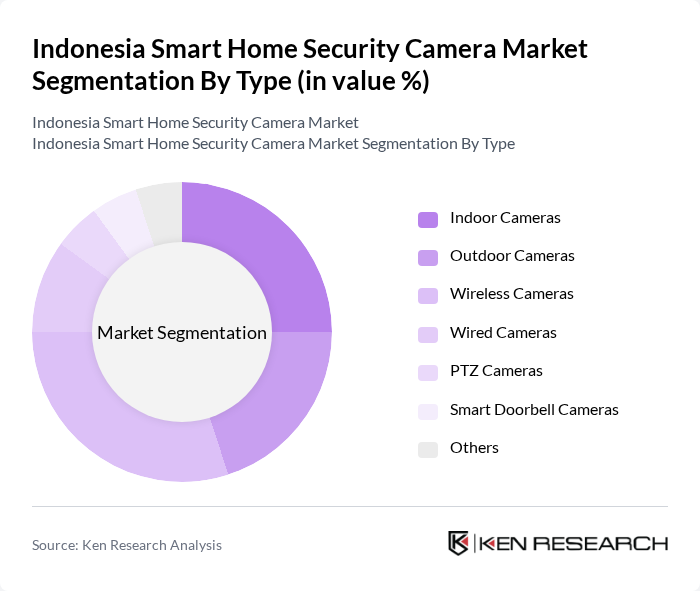
The Wireless Cameras segment is currently dominating the market due to their ease of installation and flexibility in placement. Consumers prefer wireless options for their convenience and the ability to connect seamlessly with smart home systems. Additionally, advancements in battery technology and connectivity options have made wireless cameras more reliable and appealing. The trend towards smart homes and the increasing demand for remote monitoring solutions further bolster the popularity of wireless cameras.
By End-User:The market is segmented by end-user into Residential, Commercial, Industrial, Government & Utilities, and Others. Each segment has unique requirements and preferences, influencing the types of security cameras adopted.
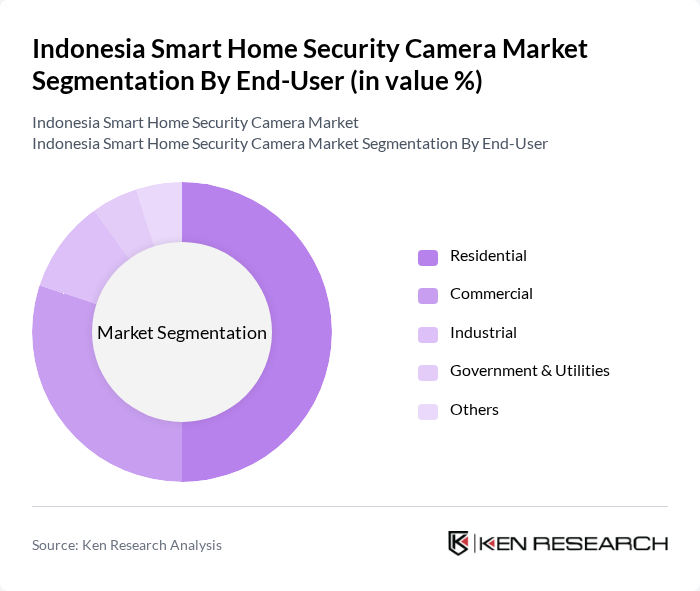
The Residential segment leads the market, driven by increasing consumer awareness regarding home security and the growing trend of smart home integration. Homeowners are investing in smart security solutions to protect their properties and loved ones, leading to a surge in demand for various types of security cameras. The rise in disposable income and the availability of affordable smart home products further contribute to the growth of this segment.
Indonesia Smart Home Security Camera Market Competitive Landscape
The Indonesia Smart Home Security Camera Market is characterized by a dynamic mix of regional and international players. Leading participants such as Hikvision, Dahua Technology, TP-Link, Xiaomi, Arlo Technologies, Ring (Amazon), Nest (Google), Reolink, Lorex Technology, Swann Communications, EZVIZ, Amcrest Technologies, Netgear, Blink (Amazon), TP-Link Tapo contribute to innovation, geographic expansion, and service delivery in this space.
Indonesia Smart Home Security Camera Market Industry Analysis
Growth Drivers
- Increasing Urbanization and Demand for Home Security:Indonesia's urban population is projected to reach 57% by future, up from 54% in 2020, according to the World Bank. This rapid urbanization drives the demand for home security solutions, as urban areas often experience higher crime rates. The increase in urban households, estimated at over 20 million by future, further fuels the need for smart home security cameras, making them essential for safeguarding properties and enhancing residents' peace of mind.
- Rising Disposable Income Among Consumers:The World Bank forecasts Indonesia's GDP per capita to rise to approximately $4,580 by future, reflecting a growing middle class with increased purchasing power. As disposable incomes rise, consumers are more willing to invest in advanced home security solutions. This trend is evident as the average household expenditure on security products is expected to increase by 15% annually, indicating a strong market potential for smart home security cameras.
- Technological Advancements in Smart Home Devices:The Indonesian smart home market is experiencing significant technological advancements, with a projected increase in smart device adoption by 30% by future. Innovations such as AI-driven features and enhanced connectivity options are making smart home security cameras more appealing. As consumers seek integrated solutions, the demand for cameras that offer remote monitoring and real-time alerts is expected to surge, driving market growth.
Market Challenges
- High Initial Investment Costs:The average cost of a smart home security camera system in Indonesia is around IDR 3 million (approximately $190), which can be a significant barrier for many consumers. With a large portion of the population earning below the national average income of IDR 4.5 million (approximately $285) per month, the high upfront costs deter potential buyers. This challenge is compounded by the need for additional equipment, such as routers and storage solutions, further increasing the financial burden.
- Privacy Concerns Among Consumers:A survey by the Indonesian Institute of Sciences indicates that 65% of consumers express concerns about privacy when using surveillance cameras. This apprehension is heightened by the lack of robust data protection laws in Indonesia, which can lead to hesitance in adopting smart home security solutions. As privacy issues remain a significant challenge, manufacturers must address these concerns to build consumer trust and encourage market growth.
Indonesia Smart Home Security Camera Market Future Outlook
The future of the smart home security camera market in Indonesia appears promising, driven by technological advancements and increasing consumer awareness. As urbanization continues, the demand for integrated security solutions will likely rise. Additionally, the expansion of e-commerce platforms will facilitate easier access to these products, enhancing market penetration. Companies that prioritize user-friendly designs and robust privacy measures will be well-positioned to capture a larger share of this evolving market landscape.
Market Opportunities
- Expansion of E-commerce Platforms for Sales:The growth of e-commerce in Indonesia, projected to reach $50 billion by future, presents a significant opportunity for smart home security camera sales. Online platforms enable consumers to access a wider range of products and competitive pricing, driving adoption rates. This shift towards online shopping is expected to enhance market visibility and accessibility for various consumer segments.
- Integration with Smart Home Ecosystems:As the smart home ecosystem expands, integrating security cameras with other smart devices will create new opportunities. The increasing popularity of interconnected devices, with an expected growth rate of 25% by future, allows for seamless user experiences. This integration can enhance functionality and appeal, encouraging consumers to invest in comprehensive smart home solutions that include security features.
Scope of the Report
| Segment | Sub-Segments |
|---|---|
| By Type | Indoor Cameras Outdoor Cameras Wireless Cameras Wired Cameras PTZ Cameras Smart Doorbell Cameras Others |
| By End-User | Residential Commercial Industrial Government & Utilities Others |
| By Region | Java Sumatra Bali Kalimantan Sulawesi |
| By Technology | Wired Technology Wireless Technology Cloud-Based Technology AI-Enabled Technology Others |
| By Application | Home Security Business Surveillance Monitoring Children and Pets Elderly Care Others |
| By Investment Source | Domestic Investment Foreign Direct Investment (FDI) Public-Private Partnerships (PPP) Government Schemes Others |
| By Policy Support | Subsidies Tax Exemptions Regulatory Compliance Support Others |
Key Target Audience
Investors and Venture Capitalist Firms
Government and Regulatory Bodies (e.g., Kementerian Perindustrian, Kementerian Komunikasi dan Informatika)
Manufacturers and Producers
Distributors and Retailers
Telecommunication Companies
Home Automation System Integrators
Security Service Providers
Insurance Companies
Players Mentioned in the Report:
Hikvision
Dahua Technology
TP-Link
Xiaomi
Arlo Technologies
Ring (Amazon)
Nest (Google)
Reolink
Lorex Technology
Swann Communications
EZVIZ
Amcrest Technologies
Netgear
Blink (Amazon)
TP-Link Tapo
Table of Contents
Market Assessment Phase
1. Executive Summary and Approach
2. Indonesia Smart Home Security Camera Market Overview
2.1 Key Insights and Strategic Recommendations
2.2 Indonesia Smart Home Security Camera Market Overview
2.3 Definition and Scope
2.4 Evolution of Market Ecosystem
2.5 Timeline of Key Regulatory Milestones
2.6 Value Chain & Stakeholder Mapping
2.7 Business Cycle Analysis
2.8 Policy & Incentive Landscape
3. Indonesia Smart Home Security Camera Market Analysis
3.1 Growth Drivers
3.1.1 Increasing urbanization and demand for home security
3.1.2 Rising disposable income among consumers
3.1.3 Technological advancements in smart home devices
3.1.4 Growing awareness of safety and security issues
3.2 Market Challenges
3.2.1 High initial investment costs
3.2.2 Privacy concerns among consumers
3.2.3 Limited internet connectivity in rural areas
3.2.4 Competition from traditional security systems
3.3 Market Opportunities
3.3.1 Expansion of e-commerce platforms for sales
3.3.2 Integration with smart home ecosystems
3.3.3 Government initiatives promoting smart cities
3.3.4 Increasing demand for remote monitoring solutions
3.4 Market Trends
3.4.1 Adoption of AI and machine learning in security cameras
3.4.2 Growth of subscription-based monitoring services
3.4.3 Shift towards DIY security solutions
3.4.4 Rising popularity of cloud storage for video footage
3.5 Government Regulation
3.5.1 Data protection laws affecting surveillance
3.5.2 Standards for product safety and quality
3.5.3 Incentives for smart home technology adoption
3.5.4 Regulations on installation and usage of cameras
4. SWOT Analysis
5. Stakeholder Analysis
6. Porter's Five Forces Analysis
7. Indonesia Smart Home Security Camera Market Market Size, 2019-2024
7.1 By Value
7.2 By Volume
7.3 By Average Selling Price
8. Indonesia Smart Home Security Camera Market Segmentation
8.1 By Type
8.1.1 Indoor Cameras
8.1.2 Outdoor Cameras
8.1.3 Wireless Cameras
8.1.4 Wired Cameras
8.1.5 PTZ Cameras
8.1.6 Smart Doorbell Cameras
8.1.7 Others
8.2 By End-User
8.2.1 Residential
8.2.2 Commercial
8.2.3 Industrial
8.2.4 Government & Utilities
8.2.5 Others
8.3 By Region
8.3.1 Java
8.3.2 Sumatra
8.3.3 Bali
8.3.4 Kalimantan
8.3.5 Sulawesi
8.4 By Technology
8.4.1 Wired Technology
8.4.2 Wireless Technology
8.4.3 Cloud-Based Technology
8.4.4 AI-Enabled Technology
8.4.5 Others
8.5 By Application
8.5.1 Home Security
8.5.2 Business Surveillance
8.5.3 Monitoring Children and Pets
8.5.4 Elderly Care
8.5.5 Others
8.6 By Investment Source
8.6.1 Domestic Investment
8.6.2 Foreign Direct Investment (FDI)
8.6.3 Public-Private Partnerships (PPP)
8.6.4 Government Schemes
8.6.5 Others
8.7 By Policy Support
8.7.1 Subsidies
8.7.2 Tax Exemptions
8.7.3 Regulatory Compliance Support
8.7.4 Others
9. Indonesia Smart Home Security Camera Market Competitive Analysis
9.1 Market Share of Key Players
9.2 Cross Comparison of Key Players
9.2.1 Company Name
9.2.2 Group Size (Large, Medium, or Small as per industry convention)
9.2.3 Revenue Growth Rate (YoY)
9.2.4 Market Penetration Rate (by units sold in Indonesia)
9.2.5 Customer Retention Rate (annual)
9.2.6 Pricing Strategy (Premium, Mid-tier, Budget)
9.2.7 Product Innovation Rate (new product launches per year)
9.2.8 Distribution Channel Efficiency (online vs offline reach)
9.2.9 Brand Recognition Score (based on consumer surveys)
9.2.10 Customer Satisfaction Index (CSAT/NPS)
9.3 SWOT Analysis of Top Players
9.4 Pricing Analysis
9.5 Detailed Profile of Major Companies
9.5.1 Hikvision
9.5.2 Dahua Technology
9.5.3 TP-Link
9.5.4 Xiaomi
9.5.5 Arlo Technologies
9.5.6 Ring (Amazon)
9.5.7 Nest (Google)
9.5.8 Reolink
9.5.9 Lorex Technology
9.5.10 Swann Communications
9.5.11 EZVIZ
9.5.12 Amcrest Technologies
9.5.13 Netgear
9.5.14 Blink (Amazon)
9.5.15 TP-Link Tapo
10. Indonesia Smart Home Security Camera Market End-User Analysis
10.1 Procurement Behavior of Key Ministries
10.1.1 Budget Allocation for Security Solutions
10.1.2 Decision-Making Process
10.1.3 Preferred Vendors
10.1.4 Compliance Requirements
10.2 Corporate Spend on Infrastructure & Energy
10.2.1 Investment Trends in Security Technologies
10.2.2 Budgeting for Smart Home Solutions
10.2.3 Long-term Contracts with Providers
10.3 Pain Point Analysis by End-User Category
10.3.1 Security Concerns
10.3.2 Cost of Implementation
10.3.3 Maintenance and Support Issues
10.4 User Readiness for Adoption
10.4.1 Awareness of Smart Home Technologies
10.4.2 Willingness to Invest
10.4.3 Training and Support Needs
10.5 Post-Deployment ROI and Use Case Expansion
10.5.1 Measurement of Security Improvements
10.5.2 Cost Savings Analysis
10.5.3 Expansion into New Use Cases
11. Indonesia Smart Home Security Camera Market Future Size, 2025-2030
11.1 By Value
11.2 By Volume
11.3 By Average Selling Price
Go-To-Market Strategy Phase
1. Whitespace Analysis + Business Model Canvas
1.1 Market Gaps Identification
1.2 Business Model Development
2. Marketing and Positioning Recommendations
2.1 Branding Strategies
2.2 Product USPs
3. Distribution Plan
3.1 Urban Retail vs Rural NGO Tie-ups
4. Channel & Pricing Gaps4.1 Underserved Routes4.2 Pricing Bands5. Unmet Demand & Latent Needs5.1 Category Gaps5.2 Consumer Segments6. Customer Relationship6.1 Loyalty Programs6.2 After-sales Service7. Value Proposition7.1 Sustainability7.2 Integrated Supply Chains8. Key Activities8.1 Regulatory Compliance8.2 Branding8.3 Distribution Setup9. Entry Strategy Evaluation9.1 Domestic Market Entry Strategy9.1.1 Product Mix9.1.2 Pricing Band9.1.3 Packaging9.2 Export Entry Strategy9.2.1 Target Countries9.2.2 Compliance Roadmap10. Entry Mode Assessment10.1 Joint Ventures10.2 Greenfield Investments10.3 Mergers & Acquisitions10.4 Distributor Model11. Capital and Timeline Estimation11.1 Capital Requirements11.2 Timelines12. Control vs Risk Trade-Off12.1 Ownership vs Partnerships13. Profitability Outlook13.1 Breakeven Analysis13.2 Long-term Sustainability14. Potential Partner List14.1 Distributors14.2 Joint Ventures14.3 Acquisition Targets15. Execution Roadmap15.1 Phased Plan for Market Entry15.1.1 Market Setup15.1.2 Market Entry15.1.3 Growth Acceleration15.1.4 Scale & Stabilize15.2 Key Activities and Milestones15.2.1 Activity Planning15.2.2 Milestone TrackingDisclaimerContact Us
Research Methodology
Phase 1: Approach1
Desk Research
- Analysis of market reports from industry associations and government publications
- Review of academic journals and white papers on smart home technology trends
- Examination of online consumer behavior studies related to home security systems
Primary Research
- Interviews with product managers at leading smart home security camera manufacturers
- Surveys with homeowners regarding their preferences and concerns about security cameras
- Focus groups with technology experts to discuss emerging trends in smart home security
Validation & Triangulation
- Cross-validation of findings through multiple data sources including sales data and consumer feedback
- Triangulation of insights from primary interviews and secondary research findings
- Sanity checks conducted through expert panel reviews to ensure data accuracy
Phase 2: Market Size Estimation1
Top-down Assessment
- Estimation of market size based on national electronics sales and smart home adoption rates
- Segmentation of the market by urban vs. rural adoption of smart security solutions
- Incorporation of government initiatives promoting smart home technologies
Bottom-up Modeling
- Collection of sales data from major retailers and e-commerce platforms for smart cameras
- Estimation of average selling prices and unit sales across different camera models
- Analysis of installation and subscription service revenues associated with smart cameras
Forecasting & Scenario Analysis
- Multi-variable forecasting using factors such as urbanization rates and crime statistics
- Scenario analysis based on potential regulatory changes and technological advancements
- Development of baseline, optimistic, and pessimistic market growth projections through 2030
Phase 3: CATI Sample Composition1
| Scope Item/Segment | Sample Size | Target Respondent Profiles |
|---|---|---|
| Homeowners with Smart Security Systems | 100 | Homeowners, Property Managers |
| Retailers of Smart Home Devices | 60 | Store Managers, Sales Representatives |
| Installation Service Providers | 50 | Technicians, Service Managers |
| Technology Experts in Home Automation | 40 | Industry Analysts, Product Developers |
| Consumers Interested in Smart Home Security | 80 | Potential Buyers, Tech Enthusiasts |
Frequently Asked Questions
What is the current value of the Indonesia Smart Home Security Camera Market?
The Indonesia Smart Home Security Camera Market is valued at approximately USD 1.2 billion, driven by urbanization, rising disposable incomes, and increased consumer awareness regarding home security solutions.
What factors are driving the growth of smart home security cameras in Indonesia?
Which cities in Indonesia are leading in the smart home security camera market?
What types of smart home security cameras are available in Indonesia?
Other Regional/Country Reports
Malaysia Smart Home Security Camera Market
KSA Smart Home Security Camera Market
APAC Smart Home Security Camera Market
SEA Smart Home Security Camera Market
Other Adjacent Reports
Bahrain Home Security Systems Market
UAE Iot Devices MarketBelgium Surveillance Equipment Market
Germany Wireless Networking Market
Brazil AI Analytics Software Market
Kuwait Cloud Storage Services Market
UAE Cybersecurity Solutions Market
Oman Smart Lighting Market
Qatar E-commerce Platforms Market
Why Buy From Us?

What makes us stand out is that our consultants follow Robust, Refine and Result (RRR) methodology. Robust for clear definitions, approaches and sanity checking, Refine for differentiating respondents' facts and opinions, and Result for presenting data with story.

We have set a benchmark in the industry by offering our clients with syndicated and customized market research reports featuring coverage of entire market as well as meticulous research and analyst insights.

While we don't replace traditional research, we flip the method upside down. Our dual approach of Top Bottom & Bottom Top ensures quality deliverable by not just verifying company fundamentals but also looking at the sector and macroeconomic factors.

With one step in the future, our research team constantly tries to show you the bigger picture. We help with some of the tough questions you may encounter along the way: How is the industry positioned? Best marketing channel? KPI's of competitors? By aligning every element, we help maximize success.

Our report gives you instant access to the answers and sources that other companies might choose to hide. We elaborate each steps of research methodology we have used and showcase you the sample size to earn your trust.

If you need any support, we are here! We pride ourselves on universe strength, data quality, and quick, friendly, and professional service.