About the Report
Base Year 2024Global Smart Home Automation Market Overview
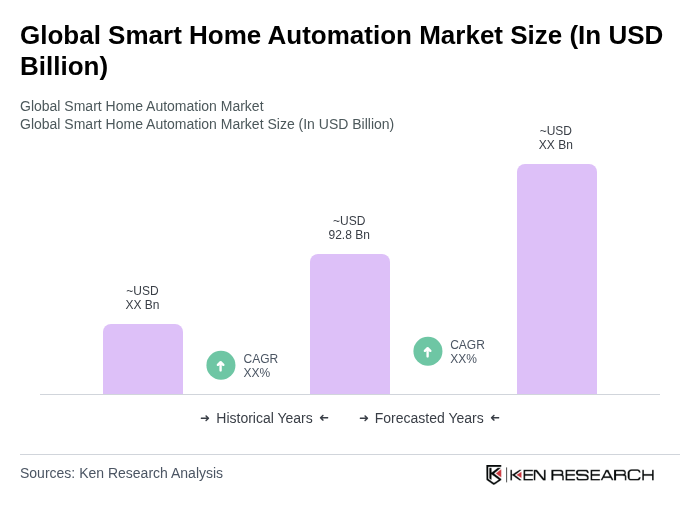
- The Global Smart Home Automation Market is valued at USD 92.8 billion, based on a five-year historical analysis. This growth is primarily driven by the increasing adoption of IoT devices, rising consumer demand for energy-efficient solutions, and advancements in smart technologies. The integration of artificial intelligence and machine learning into smart home systems has further propelled market expansion, as consumers seek enhanced convenience, security, and seamless connectivity in their living environments. Additional growth drivers include the proliferation of 5G networks, greater interoperability among devices, and the expansion of smart energy management systems, which help reduce energy consumption and carbon emissions .
- Key players in this market include the United States, Germany, and China, which dominate due to their strong technological infrastructure, high disposable incomes, and a growing trend towards smart living. The U.S. leads in innovation and product development, while Germany is known for its engineering excellence in smart devices. China, with its vast manufacturing capabilities, plays a crucial role in the supply chain, making these countries pivotal in the global smart home automation landscape. North America maintains the largest market share, while Asia Pacific is experiencing rapid growth due to increasing urbanization and smart city initiatives .
- The General Data Protection Regulation (GDPR), issued by the European Parliament and Council in 2016 and enforced from 2018, governs data protection and privacy for individuals within the European Union. GDPR mandates that companies must obtain explicit consent from users before collecting personal data, ensuring consumers have greater control over their information. Compliance with GDPR is crucial for companies operating in the smart home automation market, as it affects product design, data handling practices, and cross-border data transfers .
Global Smart Home Automation Market Segmentation
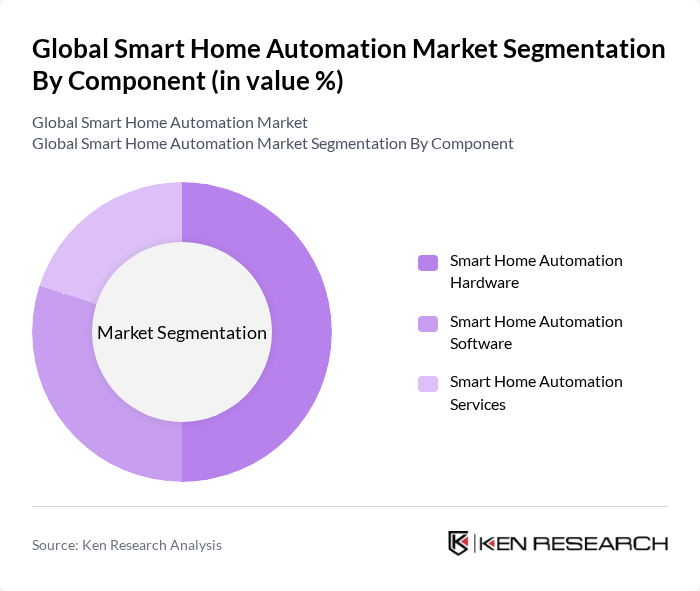
By Component:The smart home automation market is segmented into three main components: Smart Home Automation Hardware, Smart Home Automation Software, and Smart Home Automation Services. Among these, Smart Home Automation Hardware is the leading segment, driven by the increasing demand for devices such as smart speakers, security cameras, and smart lighting systems. The trend towards home security and energy efficiency has led consumers to invest in hardware solutions that enhance their living environments. Smart Home Automation Software follows closely, as it enables seamless integration and control of various devices, while Smart Home Automation Services are gaining traction due to the growing need for installation and maintenance support .
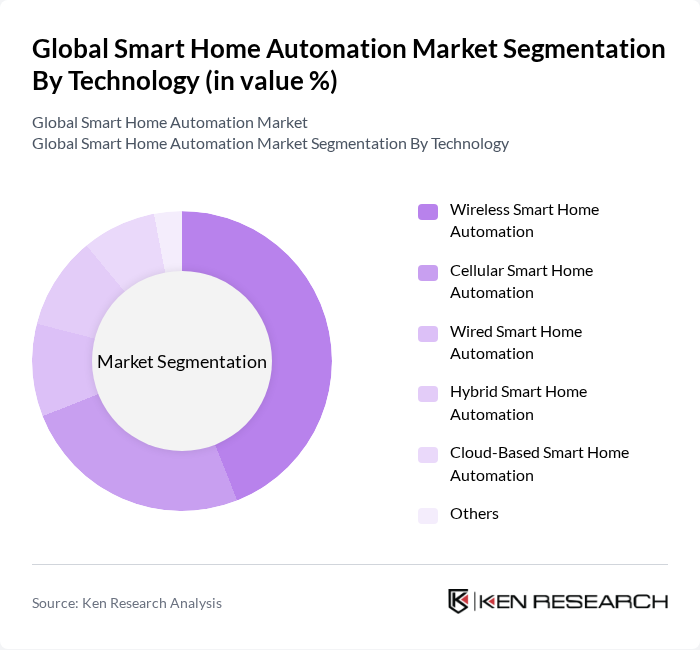
By Technology:The market is also segmented by technology into Wireless Smart Home Automation, Cellular Smart Home Automation, Wired Smart Home Automation, Hybrid Smart Home Automation, Cloud-Based Smart Home Automation, and Others. Wireless Smart Home Automation is the dominant technology segment, favored for its ease of installation and flexibility. The increasing proliferation of Wi-Fi and Bluetooth technologies has made wireless solutions more accessible to consumers. Cellular Smart Home Automation is gaining popularity due to its reliability and coverage, while Cloud-Based Smart Home Automation is emerging as a preferred choice for remote access and control of smart devices .
Global Smart Home Automation Market Competitive Landscape
The Global Smart Home Automation Market is characterized by a dynamic mix of regional and international players. Leading participants such as Amazon.com Inc., Google LLC, Apple Inc., Samsung Electronics Co. Ltd., Philips Hue (Signify N.V.), Nest Labs (Google LLC), Ecobee Inc., Ring LLC (Amazon.com Inc.), Honeywell International Inc., August Home Inc., TP-Link Technologies Co., Ltd., Logitech International S.A., Lutron Electronics Co., Inc., Z-Wave Alliance, FIBARO Group S.A., Schneider Electric SE, Robert Bosch GmbH, Johnson Controls International plc, Legrand SA, Vivint Inc. contribute to innovation, geographic expansion, and service delivery in this space.
Global Smart Home Automation Market Industry Analysis
Growth Drivers
- Increasing Consumer Demand for Energy Efficiency:The global push for energy efficiency is driving the smart home automation market, with consumers increasingly seeking solutions that reduce energy consumption. In future, the average household in None is projected to save approximately $250 annually on energy bills through smart devices. This trend is supported by government initiatives promoting energy-efficient technologies, with investments in smart home solutions expected to reach $6 billion in None, reflecting a growing consumer preference for sustainable living.
- Advancements in IoT Technology:The rapid evolution of Internet of Things (IoT) technology is a significant growth driver for smart home automation. In future, the number of connected devices in None is expected to exceed 1.5 billion, facilitating seamless integration of smart home systems. This technological advancement enhances user experience and functionality, with IoT-enabled devices projected to account for 75% of all smart home installations, thereby driving market growth and consumer adoption in the region.
- Rising Adoption of Smart Devices:The increasing penetration of smart devices in households is propelling the smart home automation market. In None, the number of smart home devices is anticipated to reach 60 million by future, driven by consumer interest in convenience and control. This surge is supported by a 35% increase in smartphone ownership, enabling users to manage their smart home systems remotely, thus enhancing the appeal of automation solutions among tech-savvy consumers.
Market Challenges
- High Initial Investment Costs:One of the primary challenges facing the smart home automation market is the high initial investment required for setup. In None, the average cost of installing a comprehensive smart home system is estimated at $3,000, which can deter potential consumers. This upfront expense is compounded by the need for professional installation in many cases, limiting accessibility for budget-conscious households and hindering widespread adoption of smart technologies.
- Data Privacy and Security Concerns:Data privacy and security issues pose significant challenges to the smart home automation market. In None, 70% of consumers express concerns about the potential for data breaches associated with smart devices. This apprehension is exacerbated by high-profile security incidents, leading to hesitance in adopting smart home technologies. As a result, manufacturers must prioritize robust security measures to build consumer trust and encourage market growth.
Global Smart Home Automation Market Future Outlook
The future of the smart home automation market in None appears promising, driven by technological advancements and evolving consumer preferences. As IoT technology continues to mature, integration with artificial intelligence will enhance device functionality and user experience. Additionally, the increasing focus on energy efficiency and sustainability will likely spur innovation in smart home products, making them more appealing to environmentally conscious consumers. This evolving landscape presents significant opportunities for growth and development in the sector.
Market Opportunities
- Expansion in Emerging Markets:Emerging markets present a substantial opportunity for smart home automation growth. With urbanization rates in None projected to reach 75% by future, the demand for smart home solutions is expected to rise significantly. This demographic shift will drive investments in smart technologies, creating a fertile ground for market expansion and innovation.
- Integration of AI and Machine Learning:The integration of artificial intelligence and machine learning into smart home systems offers a transformative opportunity. By future, AI-driven smart home devices are expected to enhance user personalization and automation capabilities, leading to a projected 50% increase in consumer satisfaction. This technological advancement will not only improve user experience but also drive further adoption of smart home solutions in None.
Scope of the Report
| Segment | Sub-Segments |
|---|---|
| By Component | Smart Home Automation Hardware Smart Home Automation Software Smart Home Automation Services |
| By Technology | Wireless Smart Home Automation Cellular Smart Home Automation Wired Smart Home Automation Hybrid Smart Home Automation Cloud-Based Smart Home Automation Others |
| By Application Area | Security & Access Control Lighting Control Entertainment Control HVAC & Energy Management Smart Kitchen Appliances Smoke Detection & Safety Others |
| By End-User | Residential Commercial Industrial Government & Utilities Others |
| By Region | North America Europe Asia-Pacific Latin America Middle East & Africa |
Key Target Audience
Investors and Venture Capitalist Firms
Government and Regulatory Bodies (e.g., Federal Communications Commission, Department of Energy)
Manufacturers and Producers
Distributors and Retailers
Telecommunications Companies
Home Security Service Providers
Smart Appliance Manufacturers
Energy Management Companies
Players Mentioned in the Report:
Amazon.com Inc.
Google LLC
Apple Inc.
Samsung Electronics Co. Ltd.
Philips Hue (Signify N.V.)
Nest Labs (Google LLC)
Ecobee Inc.
Ring LLC (Amazon.com Inc.)
Honeywell International Inc.
August Home Inc.
TP-Link Technologies Co., Ltd.
Logitech International S.A.
Lutron Electronics Co., Inc.
Z-Wave Alliance
FIBARO Group S.A.
Schneider Electric SE
Robert Bosch GmbH
Johnson Controls International plc
Legrand SA
Vivint Inc.
Table of Contents
Market Assessment Phase
1. Executive Summary and Approach
2. Global Smart Home Automation Market Overview
2.1 Key Insights and Strategic Recommendations
2.2 Global Smart Home Automation Market Overview
2.3 Definition and Scope
2.4 Evolution of Market Ecosystem
2.5 Timeline of Key Regulatory Milestones
2.6 Value Chain & Stakeholder Mapping
2.7 Business Cycle Analysis
2.8 Policy & Incentive Landscape
3. Global Smart Home Automation Market Analysis
3.1 Growth Drivers
3.1.1 Increasing Consumer Demand for Energy Efficiency
3.1.2 Advancements in IoT Technology
3.1.3 Rising Adoption of Smart Devices
3.1.4 Growing Focus on Home Security Solutions
3.2 Market Challenges
3.2.1 High Initial Investment Costs
3.2.2 Data Privacy and Security Concerns
3.2.3 Lack of Standardization
3.2.4 Limited Consumer Awareness
3.3 Market Opportunities
3.3.1 Expansion in Emerging Markets
3.3.2 Integration of AI and Machine Learning
3.3.3 Development of Interoperable Systems
3.3.4 Increasing Demand for Home Health Monitoring
3.4 Market Trends
3.4.1 Rise of Voice-Activated Devices
3.4.2 Growth of DIY Smart Home Solutions
3.4.3 Shift Towards Sustainable Smart Home Products
3.4.4 Increasing Use of Mobile Applications for Control
3.5 Government Regulation
3.5.1 Energy Efficiency Standards
3.5.2 Data Protection Regulations
3.5.3 Incentives for Smart Home Technology Adoption
3.5.4 Building Code Updates for Smart Technologies
4. SWOT Analysis
5. Stakeholder Analysis
6. Porter's Five Forces Analysis
7. Global Smart Home Automation Market Market Size, 2019-2024
7.1 By Value
7.2 By Volume
7.3 By Average Selling Price
8. Global Smart Home Automation Market Segmentation
8.1 By Component
8.1.1 Smart Home Automation Hardware
8.1.2 Smart Home Automation Software
8.1.3 Smart Home Automation Services
8.2 By Technology
8.2.1 Wireless Smart Home Automation
8.2.2 Cellular Smart Home Automation
8.2.3 Wired Smart Home Automation
8.2.4 Hybrid Smart Home Automation
8.2.5 Cloud-Based Smart Home Automation
8.2.6 Others
8.3 By Application Area
8.3.1 Security & Access Control
8.3.2 Lighting Control
8.3.3 Entertainment Control
8.3.4 HVAC & Energy Management
8.3.5 Smart Kitchen Appliances
8.3.6 Smoke Detection & Safety
8.3.7 Others
8.4 By End-User
8.4.1 Residential
8.4.2 Commercial
8.4.3 Industrial
8.4.4 Government & Utilities
8.4.5 Others
8.5 By Region
8.5.1 North America
8.5.2 Europe
8.5.3 Asia-Pacific
8.5.4 Latin America
8.5.5 Middle East & Africa
9. Global Smart Home Automation Market Competitive Analysis
9.1 Market Share of Key Players
9.2 KPIs for Cross Comparison of Key Players
9.2.1 Company Name
9.2.2 Group Size (Large, Medium, or Small as per industry convention)
9.2.3 Revenue Growth Rate
9.2.4 Market Share in Smart Home Automation
9.2.5 Geographic Coverage
9.2.6 R&D Investment as % of Revenue
9.2.7 Number of Connected Devices Sold
9.2.8 Customer Acquisition Cost
9.2.9 Customer Retention Rate
9.2.10 Market Penetration Rate
9.2.11 Average Order Value
9.2.12 Pricing Strategy
9.2.13 Product Return Rate
9.2.14 Customer Satisfaction Score (NPS)
9.2.15 Interoperability Score
9.2.16 Sustainability Initiatives
9.3 SWOT Analysis of Top Players
9.4 Pricing Analysis
9.5 Detailed Profile of Major Companies
9.5.1 Amazon.com Inc.
9.5.2 Google LLC
9.5.3 Apple Inc.
9.5.4 Samsung Electronics Co. Ltd.
9.5.5 Philips Hue (Signify N.V.)
9.5.6 Nest Labs (Google LLC)
9.5.7 Ecobee Inc.
9.5.8 Ring LLC (Amazon.com Inc.)
9.5.9 Honeywell International Inc.
9.5.10 August Home Inc.
9.5.11 TP-Link Technologies Co., Ltd.
9.5.12 Logitech International S.A.
9.5.13 Lutron Electronics Co., Inc.
9.5.14 Z-Wave Alliance
9.5.15 FIBARO Group S.A.
9.5.16 Schneider Electric SE
9.5.17 Robert Bosch GmbH
9.5.18 Johnson Controls International plc
9.5.19 Legrand SA
9.5.20 Vivint Inc.
10. Global Smart Home Automation Market End-User Analysis
10.1 Procurement Behavior of Key Ministries
10.1.1 Budget Allocation for Smart Technologies
10.1.2 Decision-Making Processes
10.1.3 Evaluation Criteria for Smart Home Solutions
10.1.4 Collaboration with Technology Providers
10.2 Corporate Spend on Infrastructure & Energy
10.2.1 Investment Trends in Smart Home Technologies
10.2.2 Budgeting for Energy Efficiency Solutions
10.2.3 Corporate Sustainability Initiatives
10.2.4 Partnerships with Smart Home Providers
10.3 Pain Point Analysis by End-User Category
10.3.1 Common Challenges Faced by Residential Users
10.3.2 Issues Encountered by Commercial Users
10.3.3 Industrial User Pain Points
10.3.4 Government & Utilities Challenges
10.4 User Readiness for Adoption
10.4.1 Awareness Levels Among Consumers
10.4.2 Perceived Benefits of Smart Home Technologies
10.4.3 Barriers to Adoption
10.4.4 Readiness for Investment
10.5 Post-Deployment ROI and Use Case Expansion
10.5.1 Measurement of ROI in Smart Home Solutions
10.5.2 Case Studies of Successful Implementations
10.5.3 Expansion Opportunities Post-Deployment
10.5.4 User Feedback and Iterative Improvements
11. Global Smart Home Automation Market Future Size, 2025-2030
11.1 By Value
11.2 By Volume
11.3 By Average Selling Price
Go-To-Market Strategy Phase
1. Whitespace Analysis + Business Model Canvas
1.1 Market Gaps Identification
1.2 Business Model Development
2. Marketing and Positioning Recommendations
2.1 Branding Strategies
2.2 Product USPs
3. Distribution Plan
3.1 Urban Retail vs Rural NGO Tie-ups
4. Channel & Pricing Gaps
4.1 Underserved Routes
4.2 Pricing Bands
5. Unmet Demand & Latent Needs
5.1 Category Gaps
5.2 Consumer Segments
6. Customer Relationship
6.1 Loyalty Programs
6.2 After-sales Service
7. Value Proposition
7.1 Sustainability
7.2 Integrated Supply Chains
8. Key Activities
8.1 Regulatory Compliance
8.2 Branding
8.3 Distribution Setup
9. Entry Strategy Evaluation
9.1 Domestic Market Entry Strategy
9.1.1 Product Mix
9.1.2 Pricing Band
9.1.3 Packaging
9.2 Export Entry Strategy
9.2.1 Target Countries
9.2.2 Compliance Roadmap
10. Entry Mode Assessment
10.1 JV
10.2 Greenfield
10.3 M&A
10.4 Distributor Model
11. Capital and Timeline Estimation
11.1 Capital Requirements
11.2 Timelines
12. Control vs Risk Trade-Off
12.1 Ownership vs Partnerships
13. Profitability Outlook
13.1 Breakeven Analysis
13.2 Long-term Sustainability
14. Potential Partner List
14.1 Distributors
14.2 JVs
14.3 Acquisition Targets
15. Execution Roadmap
15.1 Phased Plan for Market Entry
15.1.1 Market Setup
15.1.2 Market Entry
15.1.3 Growth Acceleration
15.1.4 Scale & Stabilize
15.2 Key Activities and Milestones
15.2.1 Milestone Planning
15.2.2 Activity Tracking
Research Methodology
Phase 1: Approach1
Desk Research
- Market reports from industry associations such as the Consumer Technology Association
- Analysis of smart home automation trends from technology journals and publications
- Government publications on smart home regulations and energy efficiency standards
Primary Research
- Interviews with product managers at leading smart home device manufacturers
- Surveys with homeowners regarding adoption rates and preferences
- Focus groups with technology experts and home automation consultants
Validation & Triangulation
- Cross-validation of data from multiple industry reports and market surveys
- Triangulation of consumer insights with sales data from major retailers
- Sanity checks through expert panel discussions and feedback sessions
Phase 2: Market Size Estimation1
Top-down Assessment
- Estimation of market size based on global smart home technology spending trends
- Segmentation by device type, including security systems, lighting, and HVAC controls
- Incorporation of regional growth rates and demographic factors influencing adoption
Bottom-up Modeling
- Volume estimates based on sales data from leading smart home product retailers
- Cost analysis of smart home installations and recurring service fees
- Aggregation of data from various smart home device categories to derive total market value
Forecasting & Scenario Analysis
- Multi-variable regression analysis incorporating economic indicators and technology adoption rates
- Scenario modeling based on potential regulatory changes and consumer behavior shifts
- Development of baseline, optimistic, and pessimistic market forecasts through 2030
Phase 3: CATI Sample Composition1
| Scope Item/Segment | Sample Size | Target Respondent Profiles |
|---|---|---|
| Home Security Systems | 100 | Homeowners, Security System Installers |
| Smart Lighting Solutions | 60 | Interior Designers, Home Automation Specialists |
| HVAC Control Systems | 50 | HVAC Technicians, Energy Efficiency Consultants |
| Smart Appliances | 70 | Retail Managers, Appliance Manufacturers |
| Home Automation Platforms | 40 | Software Developers, Tech Entrepreneurs |
Frequently Asked Questions
What is the current value of the Global Smart Home Automation Market?
The Global Smart Home Automation Market is valued at approximately USD 92.8 billion, driven by the increasing adoption of IoT devices, consumer demand for energy-efficient solutions, and advancements in smart technologies.
What are the main components of smart home automation?
Which technologies dominate the smart home automation market?
What are the key growth drivers for the smart home automation market?
Other Regional/Country Reports
Indonesia Smart Home Automation Market
Malaysia Smart Home Automation Market
KSA Smart Home Automation Market
APAC Smart Home Automation Market
SEA Smart Home Automation Market
Vietnam Smart Home Automation Market
Other Adjacent Reports
Philippines Home Security Systems Market
Germany Smart Lighting Market
Mexico Energy Management Systems Market
Japan Voice Assistant Devices Market
Thailand Connected Home Entertainment Market
Indonesia IoT Platforms Market
Vietnam Wireless Communication Technologies Market
Philippines AI Integration Services Market
Saudi Arabia Building Automation Systems Market Size, Share, Trends & Forecast 2025–2030Why Buy From Us?

What makes us stand out is that our consultants follow Robust, Refine and Result (RRR) methodology. Robust for clear definitions, approaches and sanity checking, Refine for differentiating respondents' facts and opinions, and Result for presenting data with story.

We have set a benchmark in the industry by offering our clients with syndicated and customized market research reports featuring coverage of entire market as well as meticulous research and analyst insights.

While we don't replace traditional research, we flip the method upside down. Our dual approach of Top Bottom & Bottom Top ensures quality deliverable by not just verifying company fundamentals but also looking at the sector and macroeconomic factors.

With one step in the future, our research team constantly tries to show you the bigger picture. We help with some of the tough questions you may encounter along the way: How is the industry positioned? Best marketing channel? KPI's of competitors? By aligning every element, we help maximize success.

Our report gives you instant access to the answers and sources that other companies might choose to hide. We elaborate each steps of research methodology we have used and showcase you the sample size to earn your trust.

If you need any support, we are here! We pride ourselves on universe strength, data quality, and quick, friendly, and professional service.