About the Report
Base Year 2024Indonesia Upper Limb Prosthetics Market Overview
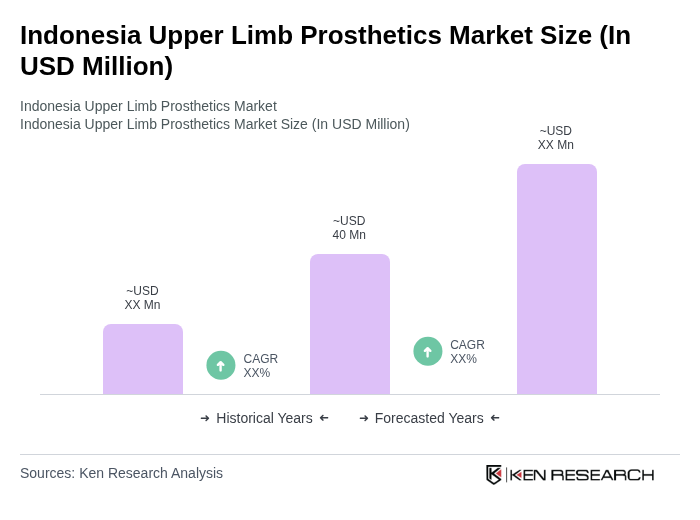
- The Indonesia Upper Limb Prosthetics Market is valued at USD 40 million, based on a five-year historical analysis. This growth is primarily driven by the increasing prevalence of upper limb amputations due to road traffic accidents, diabetes, and trauma, alongside advancements in prosthetic technology such as myoelectric and sensor-enabled devices that enhance functionality and user comfort. Additional growth drivers include rising healthcare investments, improved access to rehabilitation services, and expanding awareness of prosthetic solutions among both patients and healthcare providers .
- Key cities such as Jakarta, Surabaya, and Bandung dominate the market due to their higher population density and superior access to healthcare infrastructure. The concentration of hospitals, rehabilitation centers, and prosthetic clinics in these urban areas facilitates the adoption of advanced prosthetic solutions, making them pivotal in the market landscape .
- The regulation of prosthetic devices in Indonesia is governed by the “Regulation of the Minister of Health of the Republic of Indonesia Number 62 of 2017 on the Distribution of Medical Devices and Household Health Supplies,” issued by the Ministry of Health. This regulation mandates that all prosthetic devices distributed in Indonesia must meet specific safety and quality standards, including registration, labeling, and post-market surveillance requirements. Compliance ensures that patients receive certified, high-quality products, thereby fostering trust in the healthcare system and promoting the use of prosthetics.
Indonesia Upper Limb Prosthetics Market Segmentation
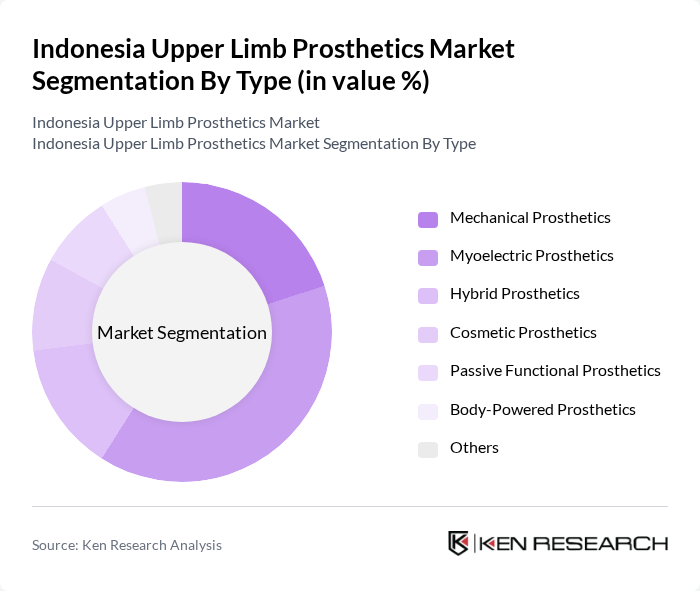
By Type:The market is segmented into various types of prosthetics, including Mechanical Prosthetics, Myoelectric Prosthetics, Hybrid Prosthetics, Cosmetic Prosthetics, Passive Functional Prosthetics, Body-Powered Prosthetics, and Others. Among these, Myoelectric Prosthetics are gaining significant traction due to advanced technology enabling more natural movement and intuitive control, appealing to users seeking improved functionality and comfort. The increasing awareness and acceptance of these devices among healthcare professionals and patients, coupled with ongoing technological innovations, are driving their adoption .
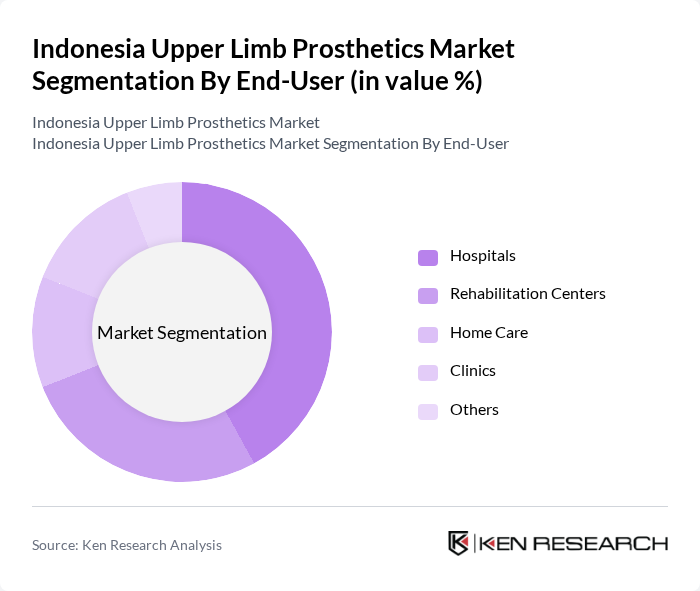
By End-User:The end-user segmentation includes Hospitals, Rehabilitation Centers, Home Care, Clinics, and Others. Hospitals are the leading segment, as they provide comprehensive care and rehabilitation services for amputees. The presence of specialized departments and multidisciplinary teams in hospitals facilitates the fitting and adjustment of prosthetics, making them the preferred choice for patients seeking immediate and effective solutions. Rehabilitation centers are also witnessing increased adoption due to the integration of occupational therapy and advanced prosthetic training programs .
Indonesia Upper Limb Prosthetics Market Competitive Landscape
The Indonesia Upper Limb Prosthetics Market is characterized by a dynamic mix of regional and international players. Leading participants such as PT. Otto Bock Indonesia, PT. Protesa, PT. OrthoCare, PT. Medika Sarana, PT. Sinar Medika, PT. Bionic Indonesia, PT. RehaMed, PT. Cipta Prosthetics, PT. Sehat Prosthetics, PT. Karya Sehat, PT. Anugerah Prosthetics, PT. Sumber Prosthetics, PT. Harapan Prosthetics, PT. Maju Prosthetics, PT. Abadi Prosthetics, Ottobock SE & Co. KGaA, Össur Asia Pacific, TASKA Prosthetics, Fillauer LLC, College Park Industries contribute to innovation, geographic expansion, and service delivery in this space.
Indonesia Upper Limb Prosthetics Market Industry Analysis
Growth Drivers
- Increasing Prevalence of Upper Limb Disabilities:The World Health Organization estimates that approximately 15% of the global population lives with some form of disability, with upper limb disabilities affecting around 1.5 million individuals in Indonesia alone. This rising prevalence is driven by factors such as road traffic accidents, industrial injuries, and congenital conditions. As the population ages, the demand for upper limb prosthetics is expected to increase significantly, necessitating improved access to these devices for affected individuals.
- Advancements in Prosthetic Technology:The Indonesian upper limb prosthetics market is witnessing rapid technological advancements, with innovations such as myoelectric prosthetics and 3D-printed devices becoming more accessible. In future, the global market for advanced prosthetics is projected to reach $1.5 billion, with Indonesia benefiting from these developments. Enhanced functionality and user comfort are driving demand, as patients seek solutions that improve their quality of life and enable greater independence in daily activities.
- Rising Healthcare Expenditure:Indonesia's healthcare expenditure is projected to reach $46 billion in future, reflecting a growing commitment to improving health services. This increase is expected to enhance access to prosthetic devices, as more funds are allocated to rehabilitation and assistive technologies. The government’s focus on universal health coverage aims to ensure that individuals with disabilities receive necessary support, further driving the demand for upper limb prosthetics in the country.
Market Challenges
- High Cost of Advanced Prosthetics:The cost of advanced prosthetic devices can be prohibitively high, with prices ranging from $5,000 to $100,000 depending on the technology used. This financial barrier limits access for many individuals in Indonesia, where the average annual income is approximately $4,000. Consequently, many patients are unable to afford the latest prosthetic solutions, which can significantly impact their quality of life and rehabilitation outcomes.
- Limited Access to Healthcare Facilities:In Indonesia, approximately 44% of the population lives in rural areas, where access to healthcare facilities is severely limited. Many regions lack specialized clinics for prosthetic fitting and rehabilitation services, making it difficult for individuals with upper limb disabilities to receive timely and adequate care. This geographical disparity poses a significant challenge to the growth of the upper limb prosthetics market, as many potential users remain underserved.
Indonesia Upper Limb Prosthetics Market Future Outlook
The future of the upper limb prosthetics market in Indonesia appears promising, driven by technological advancements and increased healthcare investments. As the government prioritizes disability support, initiatives aimed at improving access to prosthetics are expected to gain momentum. Additionally, the integration of telehealth services will facilitate remote consultations and follow-ups, enhancing patient care. These trends indicate a shift towards more inclusive healthcare solutions, ultimately improving the quality of life for individuals with upper limb disabilities in the region.
Market Opportunities
- Expansion of Telehealth Services:The rise of telehealth services presents a significant opportunity for the upper limb prosthetics market. In future, telehealth is expected to account for 25% of healthcare consultations in Indonesia, allowing patients to access expert advice and follow-up care remotely. This can enhance the fitting process and ongoing support for prosthetic users, ultimately improving patient outcomes and satisfaction.
- Government Initiatives for Disability Support:The Indonesian government is increasingly focusing on disability support, with plans to allocate $10 million in future for programs aimed at improving access to assistive devices. These initiatives will likely include subsidies for prosthetic procurement and funding for rehabilitation services, creating a favorable environment for market growth and encouraging private sector investment in innovative prosthetic solutions.
Scope of the Report
| Segment | Sub-Segments |
|---|---|
| By Type | Mechanical Prosthetics Myoelectric Prosthetics Hybrid Prosthetics Cosmetic Prosthetics Passive Functional Prosthetics Body-Powered Prosthetics Others |
| By End-User | Hospitals Rehabilitation Centers Home Care Clinics Others |
| By Age Group | Pediatric Adult Geriatric Others |
| By Material | Plastic Metal Composite Silicone Others |
| By Distribution Channel | Direct Sales Online Sales Retail Pharmacies Medical Device Distributors Others |
| By Region | Java Sumatra Bali Kalimantan Sulawesi Others |
| By Insurance Coverage | Public Insurance Private Insurance Out-of-Pocket Others |
Key Target Audience
Investors and Venture Capitalist Firms
Government and Regulatory Bodies (e.g., Ministry of Health, National Agency of Drug and Food Control)
Manufacturers and Producers
Distributors and Retailers
Healthcare Providers and Rehabilitation Centers
Non-Governmental Organizations (NGOs) focused on disability and rehabilitation
Insurance Companies and Health Plans
Industry Associations and Advocacy Groups
Players Mentioned in the Report:
PT. Otto Bock Indonesia
PT. Protesa
PT. OrthoCare
PT. Medika Sarana
PT. Sinar Medika
PT. Bionic Indonesia
PT. RehaMed
PT. Cipta Prosthetics
PT. Sehat Prosthetics
PT. Karya Sehat
PT. Anugerah Prosthetics
PT. Sumber Prosthetics
PT. Harapan Prosthetics
PT. Maju Prosthetics
PT. Abadi Prosthetics
Ottobock SE & Co. KGaA
Ossur Asia Pacific
TASKA Prosthetics
Fillauer LLC
College Park Industries
Table of Contents
Market Assessment Phase
1. Executive Summary and Approach
2. Indonesia Upper Limb Prosthetics Market Overview
2.1 Key Insights and Strategic Recommendations
2.2 Indonesia Upper Limb Prosthetics Market Overview
2.3 Definition and Scope
2.4 Evolution of Market Ecosystem
2.5 Timeline of Key Regulatory Milestones
2.6 Value Chain & Stakeholder Mapping
2.7 Business Cycle Analysis
2.8 Policy & Incentive Landscape
3. Indonesia Upper Limb Prosthetics Market Analysis
3.1 Growth Drivers
3.1.1 Increasing prevalence of upper limb disabilities
3.1.2 Advancements in prosthetic technology
3.1.3 Rising healthcare expenditure
3.1.4 Growing awareness and acceptance of prosthetics
3.2 Market Challenges
3.2.1 High cost of advanced prosthetics
3.2.2 Limited access to healthcare facilities
3.2.3 Lack of trained professionals
3.2.4 Cultural stigma associated with prosthetics
3.3 Market Opportunities
3.3.1 Expansion of telehealth services
3.3.2 Government initiatives for disability support
3.3.3 Collaborations with NGOs for outreach
3.3.4 Development of affordable prosthetic solutions
3.4 Market Trends
3.4.1 Customization of prosthetics
3.4.2 Integration of smart technology in prosthetics
3.4.3 Focus on sustainability in materials
3.4.4 Increased patient-centric care models
3.5 Government Regulation
3.5.1 Standards for prosthetic devices
3.5.2 Subsidies for prosthetic procurement
3.5.3 Regulations on manufacturing practices
3.5.4 Policies promoting rehabilitation services
4. SWOT Analysis
5. Stakeholder Analysis
6. Porter's Five Forces Analysis
7. Indonesia Upper Limb Prosthetics Market Market Size, 2019-2024
7.1 By Value
7.2 By Volume
7.3 By Average Selling Price
8. Indonesia Upper Limb Prosthetics Market Segmentation
8.1 By Type
8.1.1 Mechanical Prosthetics
8.1.2 Myoelectric Prosthetics
8.1.3 Hybrid Prosthetics
8.1.4 Cosmetic Prosthetics
8.1.5 Passive Functional Prosthetics
8.1.6 Body-Powered Prosthetics
8.1.7 Others
8.2 By End-User
8.2.1 Hospitals
8.2.2 Rehabilitation Centers
8.2.3 Home Care
8.2.4 Clinics
8.2.5 Others
8.3 By Age Group
8.3.1 Pediatric
8.3.2 Adult
8.3.3 Geriatric
8.3.4 Others
8.4 By Material
8.4.1 Plastic
8.4.2 Metal
8.4.3 Composite
8.4.4 Silicone
8.4.5 Others
8.5 By Distribution Channel
8.5.1 Direct Sales
8.5.2 Online Sales
8.5.3 Retail Pharmacies
8.5.4 Medical Device Distributors
8.5.5 Others
8.6 By Region
8.6.1 Java
8.6.2 Sumatra
8.6.3 Bali
8.6.4 Kalimantan
8.6.5 Sulawesi
8.6.6 Others
8.7 By Insurance Coverage
8.7.1 Public Insurance
8.7.2 Private Insurance
8.7.3 Out-of-Pocket
8.7.4 Others
9. Indonesia Upper Limb Prosthetics Market Competitive Analysis
9.1 Market Share of Key Players
9.2 Cross Comparison of Key Players
9.2.1 Company Name
9.2.2 Group Size (Large, Medium, or Small as per industry convention)
9.2.3 Revenue Growth Rate (YoY %)
9.2.4 Market Penetration Rate (% of target population served)
9.2.5 Customer Retention Rate (%)
9.2.6 Product Innovation Rate (number of new products launched annually)
9.2.7 Distribution Efficiency (average delivery time, % coverage)
9.2.8 Average Selling Price (USD)
9.2.9 Brand Recognition (survey-based index)
9.2.10 Customer Satisfaction Score (Net Promoter Score or equivalent)
9.2.11 Regulatory Compliance (number of certifications, audit results)
9.2.12 Local Manufacturing Capability (% of products made in Indonesia)
9.3 SWOT Analysis of Top Players
9.4 Pricing Analysis
9.5 Detailed Profile of Major Companies
9.5.1 PT. Otto Bock Indonesia
9.5.2 PT. Protesa
9.5.3 PT. OrthoCare
9.5.4 PT. Medika Sarana
9.5.5 PT. Sinar Medika
9.5.6 PT. Bionic Indonesia
9.5.7 PT. RehaMed
9.5.8 PT. Cipta Prosthetics
9.5.9 PT. Sehat Prosthetics
9.5.10 PT. Karya Sehat
9.5.11 PT. Anugerah Prosthetics
9.5.12 PT. Sumber Prosthetics
9.5.13 PT. Harapan Prosthetics
9.5.14 PT. Maju Prosthetics
9.5.15 PT. Abadi Prosthetics
9.5.16 Ottobock SE & Co. KGaA
9.5.17 Össur Asia Pacific
9.5.18 TASKA Prosthetics
9.5.19 Fillauer LLC
9.5.20 College Park Industries
10. Indonesia Upper Limb Prosthetics Market End-User Analysis
10.1 Procurement Behavior of Key Ministries
10.1.1 Ministry of Health
10.1.2 Ministry of Social Affairs
10.1.3 Ministry of Education
10.1.4 Others
10.2 Corporate Spend on Infrastructure & Energy
10.2.1 Healthcare Infrastructure
10.2.2 Rehabilitation Facilities
10.2.3 Research and Development
10.2.4 Others
10.3 Pain Point Analysis by End-User Category
10.3.1 Patients
10.3.2 Healthcare Providers
10.3.3 Insurance Companies
10.3.4 Others
10.4 User Readiness for Adoption
10.4.1 Awareness Levels
10.4.2 Accessibility of Services
10.4.3 Financial Readiness
10.4.4 Others
10.5 Post-Deployment ROI and Use Case Expansion
10.5.1 Performance Metrics
10.5.2 User Feedback
10.5.3 Market Expansion Opportunities
10.5.4 Others
11. Indonesia Upper Limb Prosthetics Market Future Size, 2025-2030
11.1 By Value
11.2 By Volume
11.3 By Average Selling Price
Go-To-Market Strategy Phase
1. Whitespace Analysis + Business Model Canvas
1.1 Market Gaps Identification
1.2 Business Model Development
2. Marketing and Positioning Recommendations
2.1 Branding Strategies
2.2 Product USPs
3. Distribution Plan
3.1 Urban Retail Strategies
3.2 Rural NGO Tie-ups
4. Channel & Pricing Gaps
4.1 Underserved Routes
4.2 Pricing Bands
5. Unmet Demand & Latent Needs
5.1 Category Gaps
5.2 Consumer Segments
6. Customer Relationship
6.1 Loyalty Programs
6.2 After-sales Service
7. Value Proposition
7.1 Sustainability
7.2 Integrated Supply Chains
8. Key Activities
8.1 Regulatory Compliance
8.2 Branding
8.3 Distribution Setup
9. Entry Strategy Evaluation
9.1 Domestic Market Entry Strategy
9.1.1 Product Mix
9.1.2 Pricing Band
9.1.3 Packaging
9.2 Export Entry Strategy
9.2.1 Target Countries
9.2.2 Compliance Roadmap
10. Entry Mode Assessment
10.1 JV
10.2 Greenfield
10.3 M&A
10.4 Distributor Model
11. Capital and Timeline Estimation
11.1 Capital Requirements
11.2 Timelines
12. Control vs Risk Trade-Off
12.1 Ownership vs Partnerships
13. Profitability Outlook
13.1 Breakeven Analysis
13.2 Long-term Sustainability
14. Potential Partner List
14.1 Distributors
14.2 JVs
14.3 Acquisition Targets
15. Execution Roadmap
15.1 Phased Plan for Market Entry
15.1.1 Market Setup
15.1.2 Market Entry
15.1.3 Growth Acceleration
15.1.4 Scale & Stabilize
15.2 Key Activities and Milestones
15.2.1 Milestone Planning
15.2.2 Activity Tracking
Research Methodology
Phase 1: Approach1
Desk Research
- Analysis of government health reports and disability statistics in Indonesia
- Review of industry publications and market reports on prosthetics
- Examination of academic journals focusing on upper limb prosthetics technology and trends
Primary Research
- Interviews with orthopedic surgeons and prosthetists specializing in upper limb prosthetics
- Surveys conducted with patients using upper limb prosthetics to gather user experience data
- Focus groups with healthcare providers to understand the challenges in prosthetic adoption
Validation & Triangulation
- Cross-validation of findings with multiple data sources including health organizations and NGOs
- Triangulation of market data with insights from industry experts and academic research
- Sanity checks through expert panel reviews to ensure data accuracy and relevance
Phase 2: Market Size Estimation1
Top-down Assessment
- Estimation of total addressable market based on national healthcare expenditure on prosthetics
- Segmentation of market size by demographic factors such as age and disability prevalence
- Incorporation of government initiatives and funding for disability support programs
Bottom-up Modeling
- Collection of sales data from leading prosthetic manufacturers in Indonesia
- Estimation of average selling prices for various types of upper limb prosthetics
- Volume estimates based on patient population and prosthetic fitting rates
Forecasting & Scenario Analysis
- Multi-factor regression analysis considering economic growth, healthcare access, and technological advancements
- Scenario modeling based on potential changes in healthcare policies and funding
- Development of baseline, optimistic, and pessimistic market growth projections through 2030
Phase 3: CATI Sample Composition1
| Scope Item/Segment | Sample Size | Target Respondent Profiles |
|---|---|---|
| Healthcare Providers | 60 | Orthopedic Surgeons, Rehabilitation Specialists |
| Prosthetic Users | 100 | Patients with Upper Limb Amputations |
| Manufacturers and Suppliers | 40 | Product Managers, Sales Directors |
| Policy Makers | 40 | Government Health Officials, NGO Representatives |
| Insurance Providers | 40 | Claims Adjusters, Policy Underwriters |
Frequently Asked Questions
What is the current value of the Indonesia Upper Limb Prosthetics Market?
The Indonesia Upper Limb Prosthetics Market is valued at approximately USD 40 million, reflecting a five-year historical analysis. This growth is driven by increasing upper limb amputations and advancements in prosthetic technology.
What factors are driving the growth of the upper limb prosthetics market in Indonesia?
Which cities in Indonesia dominate the upper limb prosthetics market?
What types of prosthetics are available in the Indonesian market?
Other Regional/Country Reports
Malaysia Upper Limb Prosthetics Market
KSA Upper Limb Prosthetics Market
APAC Upper Limb Prosthetics Market
SEA Upper Limb Prosthetics Market
Vietnam Upper Limb Prosthetics Market
Thailand Upper Limb Prosthetics Market
Other Adjacent Reports
Egypt Rehabilitation Services Market
Vietnam Assistive Technology Market
South Korea Medical Robotics Market
Ksa 3D Printed Prosthetics Market Report Size, Share, Growth Drivers, Trends, Opportunities & Forecast 2025–2030Belgium Bionic Devices Market
South Korea Myoelectric Prosthetics Market
South Korea Disability Aids Market
Turkey Healthcare Wearables MarketWhy Buy From Us?

What makes us stand out is that our consultants follow Robust, Refine and Result (RRR) methodology. Robust for clear definitions, approaches and sanity checking, Refine for differentiating respondents' facts and opinions, and Result for presenting data with story.

We have set a benchmark in the industry by offering our clients with syndicated and customized market research reports featuring coverage of entire market as well as meticulous research and analyst insights.

While we don't replace traditional research, we flip the method upside down. Our dual approach of Top Bottom & Bottom Top ensures quality deliverable by not just verifying company fundamentals but also looking at the sector and macroeconomic factors.

With one step in the future, our research team constantly tries to show you the bigger picture. We help with some of the tough questions you may encounter along the way: How is the industry positioned? Best marketing channel? KPI's of competitors? By aligning every element, we help maximize success.

Our report gives you instant access to the answers and sources that other companies might choose to hide. We elaborate each steps of research methodology we have used and showcase you the sample size to earn your trust.

If you need any support, we are here! We pride ourselves on universe strength, data quality, and quick, friendly, and professional service.