
APAC NDT Testing Market Outlook to 2030
Region:Asia
Author(s):Mukul
Product Code:KROD7354
October 2024
98
About the Report
APAC NDT Testing Market Overview
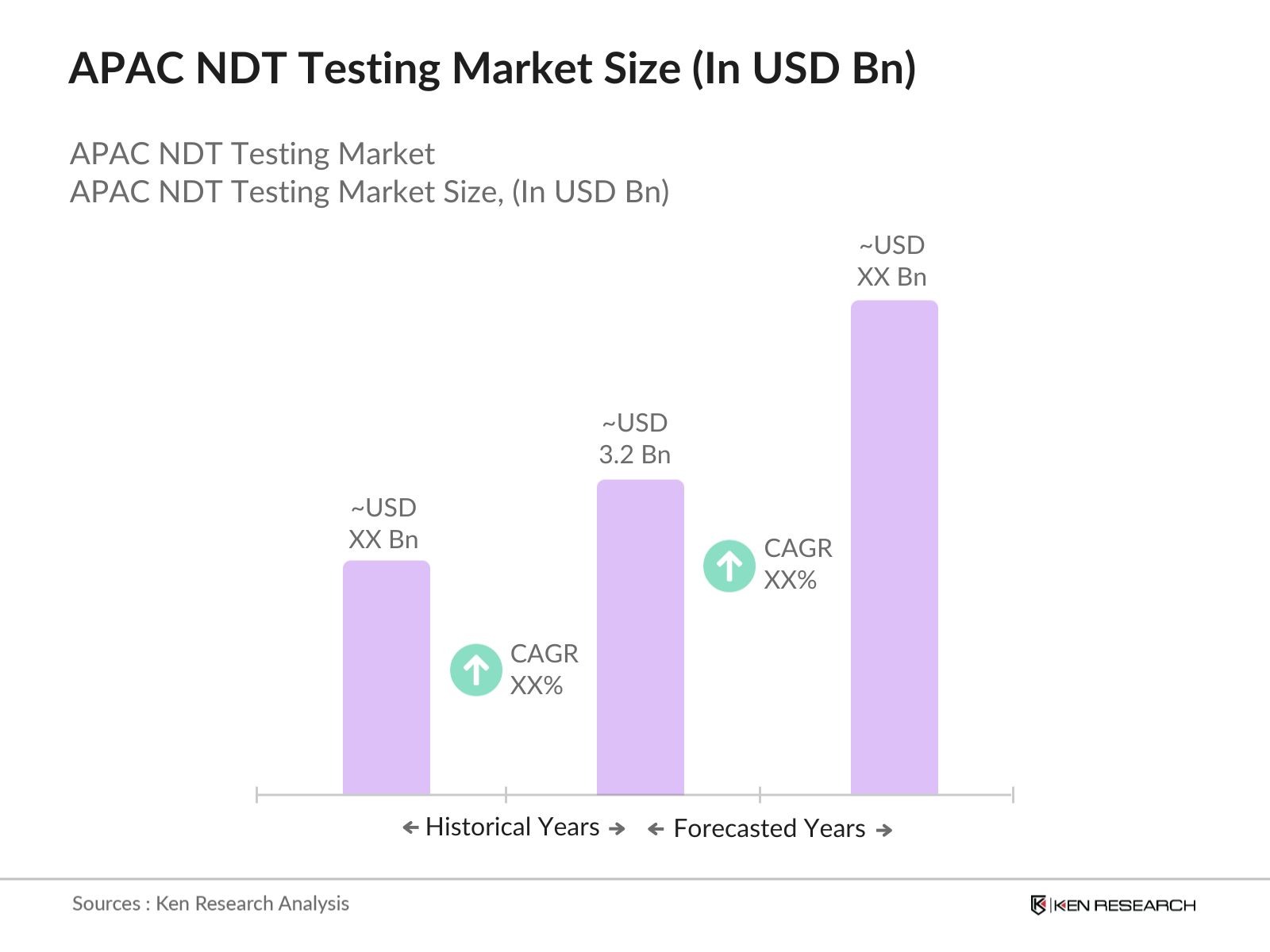
- The APAC NDT (Non-Destructive Testing) Testing market is valued at USD 3.2 billion based on a five-year historical analysis. This market is driven by the rapid industrialization in countries such as China, India, and Japan, particularly in sectors like oil and gas, aerospace, and automotive manufacturing. The region's infrastructure growth, along with stringent safety regulations in industries, has propelled the need for advanced NDT techniques to ensure structural integrity and maintenance without causing damage.
- Key cities and countries driving dominance in the APAC NDT Testing market include China, India, and Japan. China's dominance stems from its expansive manufacturing base, including automotive, aerospace, and shipbuilding sectors. India follows closely due to its growing oil and gas exploration activities and infrastructure projects. Japan is a leader in technological innovation and has adopted automated and AI-driven NDT solutions, giving it a competitive edge in the regional market.
- Governments in APAC are implementing stringent safety and quality control initiatives that mandate the use of NDT methods. In 2023, Indias Ministry of Steel introduced regulations requiring NDT for all large-scale steel structures to prevent failures. Similarly, Chinas State Administration for Market Regulation mandates NDT testing for critical infrastructure projects, such as bridges and tunnels, to comply with national safety standards. These initiatives are aimed at enhancing the quality and safety of public infrastructure, driving the demand for NDT services.
APAC NDT Testing Market Segmentation
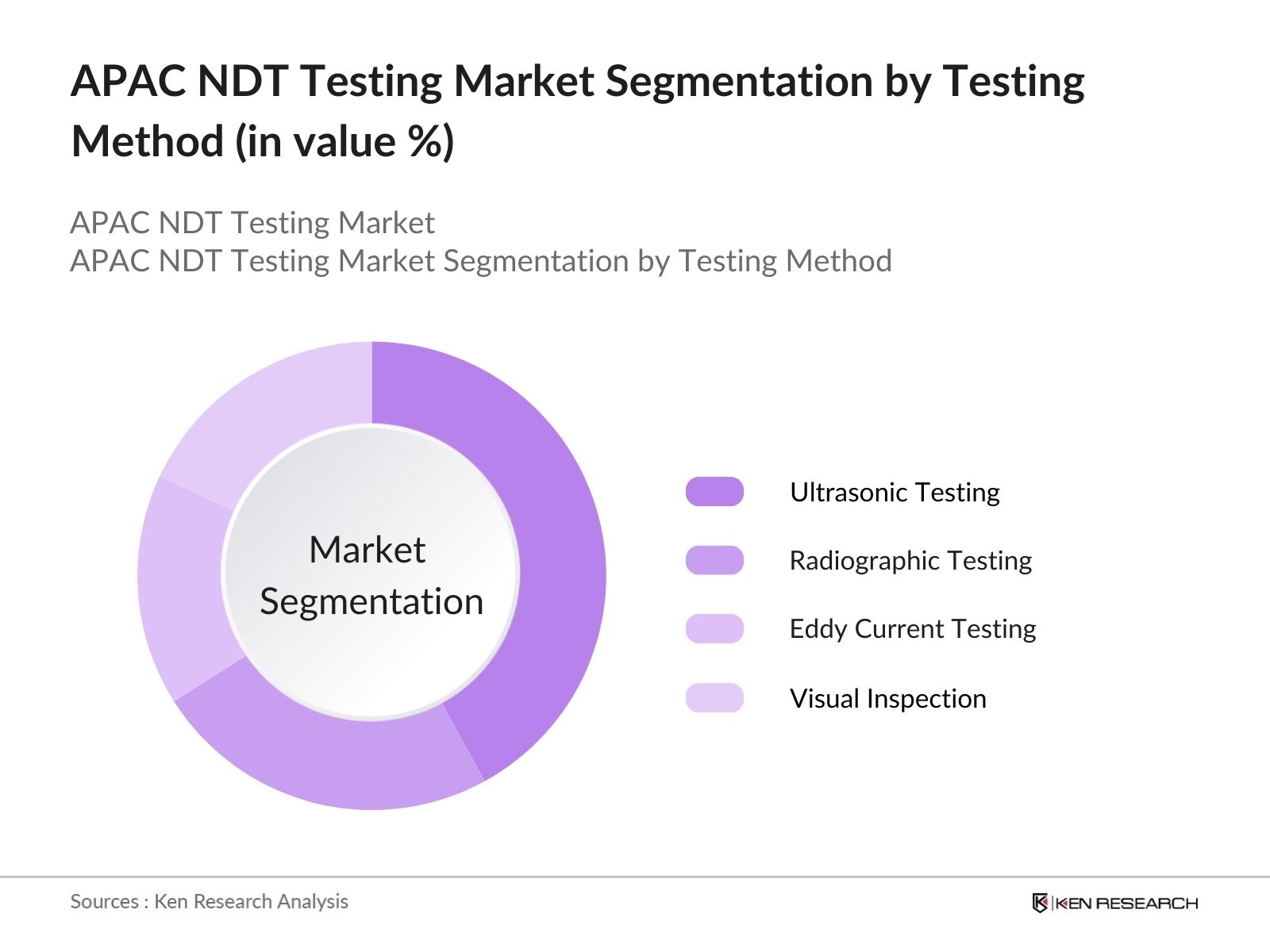
- By Testing Method: The APAC NDT Testing market is segmented by testing methods into ultrasonic testing, radiographic testing, eddy current testing, visual inspection, and magnetic particle testing. Recently, ultrasonic testing has held a dominant market share due to its widespread use in detecting flaws in metals, plastics, and composites. Its efficiency in pinpointing internal defects without damaging the product has made it a preferred choice, particularly in the aerospace and oil and gas sectors.
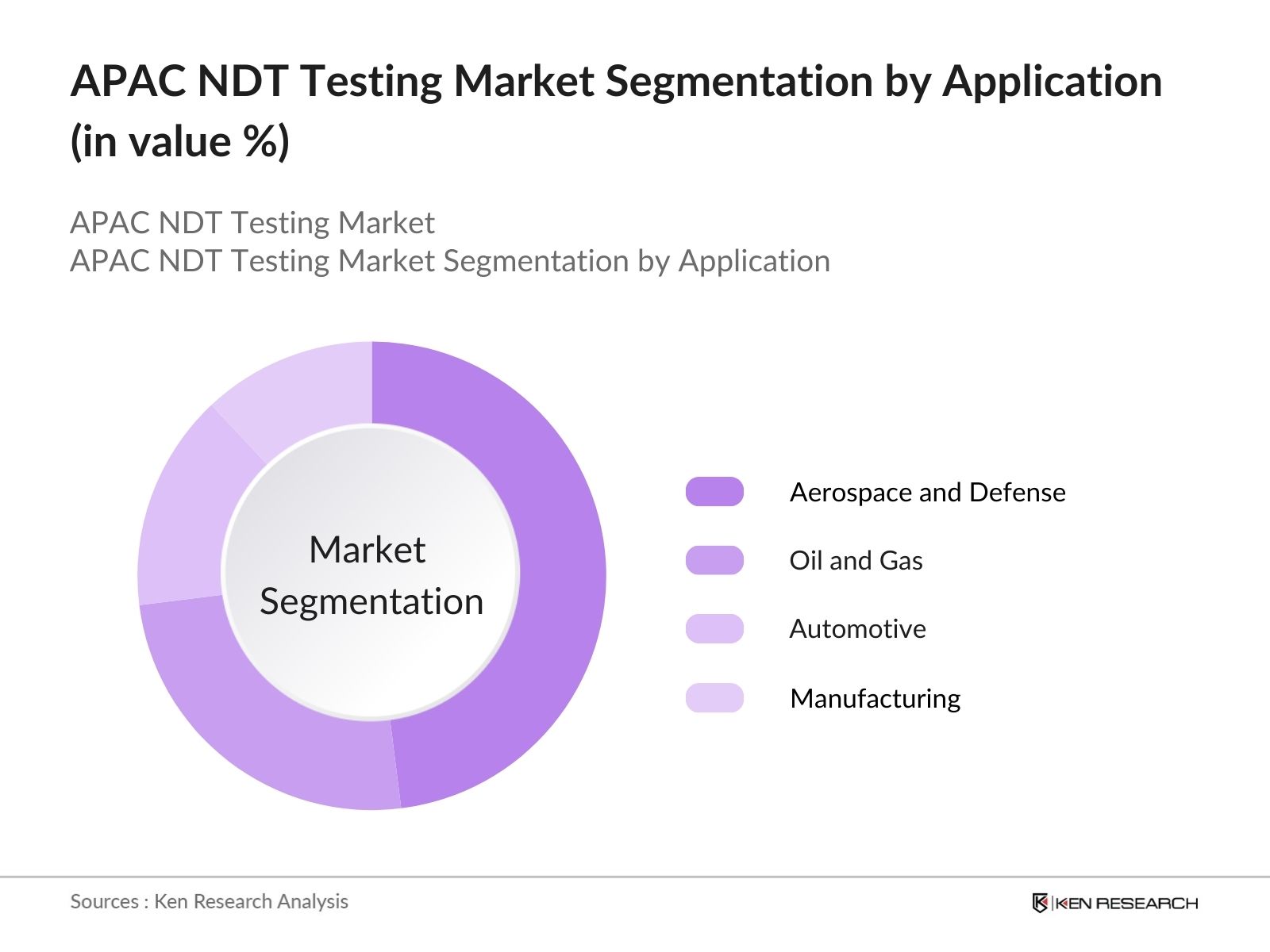
- By Application: The market is also segmented by application into aerospace and defense, oil and gas, automotive, manufacturing, and infrastructure. Among these, aerospace and defense hold the dominant market share due to the critical importance of safety and reliability in aircraft manufacturing and maintenance. NDT plays a crucial role in ensuring that components meet stringent safety standards without compromising on structural integrity, which is vital for this industry.
APAC NDT Testing Market Competitive Landscape
The APAC NDT Testing market is competitive, with key players striving to gain market share through innovations and partnerships. Companies like Olympus Corporation and Baker Hughes have introduced advanced NDT technologies, while firms like MISTRAS Group and SGS Group focus on expanding their service offerings and geographical reach. This consolidation highlights the significant influence of these key companies within the market.
|
Company Name |
Establishment Year |
Headquarters |
No. of Employees |
Revenue (USD) |
Global Reach |
NDT Method Expertise |
Key Industries Served |
Major Certification |
|
Olympus Corporation |
1919 |
Tokyo, Japan |
||||||
|
Baker Hughes |
1907 |
Houston, USA |
||||||
|
MISTRAS Group |
1978 |
New Jersey, USA |
||||||
|
SGS Group |
1878 |
Geneva, Switzerland |
||||||
|
TV Rheinland |
1872 |
Cologne, Germany |
APAC NDT Testing Industry Analysis
Growth Drivers
- Increasing Demand from Aerospace & Defense (sector-specific): The aerospace and defense sectors in the APAC region are heavily reliant on NDT (Non-Destructive Testing) methods to ensure the integrity and safety of critical components. According to the Asia-Pacific Economic Cooperation (APEC), the defense budget for major APAC countries like China, India, and Japan reached $612 billion in 2023, emphasizing the need for advanced NDT methods in aircraft and missile testing. Additionally, China alone is projected to produce over 2,500 aircraft by 2025, requiring robust NDT solutions to ensure safety standards are met. This growing investment in aerospace and defense directly drives the demand for advanced NDT testing in the region.
- Expansion of Oil & Gas Industry (industry growth factors): The oil and gas industry in the APAC region is seeing significant growth, with key players like India and China investing in exploration and extraction. Indias Ministry of Petroleum and Natural Gas reported an annual production of 35 million tons of crude oil in 2023, and this number is projected to increase as the government pushes for domestic energy production. Given the high-risk nature of oil and gas pipelines, pressure vessels, and offshore platforms, NDT methods are critical to maintaining safety standards. The industrys expansion requires sophisticated NDT technologies for regular inspections, further boosting demand.
- Rising Infrastructure Development Projects (sector-specific): Infrastructure development in APAC has been growing at an accelerated pace. The Asian Development Bank estimates that the region requires $1.7 trillion annually to meet its infrastructure needs through 2030, including investments in roads, bridges, and utilities. Countries like India and Indonesia are significantly ramping up infrastructure projects, and quality control via NDT is essential for ensuring the structural integrity of these developments. In 2024, China alone allocated $572 billion for infrastructure development, further necessitating the use of NDT testing to comply with safety and quality standards.
Market Restraints
- Lack of Skilled Technicians (labor force challenge): One of the major challenges hindering the growth of the NDT market in APAC is the lack of skilled technicians. The International Labour Organization highlighted that in 2023, only 34% of technicians in countries like India and Indonesia had formal training in specialized NDT methods. This shortage of qualified professionals limits the adoption and effective use of advanced NDT techniques, particularly in industries like aerospace, where safety is paramount. Without addressing the skills gap, the growth potential of the NDT market in the region will remain constrained.
- Limited Adoption in Small-Scale Industries (market penetration issues)
Despite the growing adoption of NDT technologies in large-scale industries, small-scale industries in APAC, such as those in Thailand and Malaysia, face challenges in embracing these methods. The United Nations Industrial Development Organization (UNIDO) noted that many small manufacturing firms in APAC operate on tight budgets, with capital expenditures of less than $500,000 annually in 2023. This limits their ability to invest in NDT equipment and training. The lack of access to advanced quality control technologies reduces the competitiveness of these smaller firms, particularly in export-oriented markets.
APAC NDT Testing Market Future Outlook
Over the next five years, the APAC NDT Testing market is expected to experience robust growth driven by the increasing demand for automated testing solutions, technological advancements, and stringent regulatory frameworks across industries. The growth of industries such as aerospace, automotive, and oil and gas will continue to propel the need for advanced NDT solutions, with particular emphasis on AI-integrated and automated systems.
Market Opportunities
- Emerging Use of AI and Automation in NDT: AI and automation are revolutionizing the NDT industry in APAC, providing new opportunities for market growth. As reported by the International Telecommunication Union (ITU), investments in AI technology in APAC reached $25 billion in 2023. Automation technologies are increasingly being integrated into NDT systems for faster and more accurate defect detection. South Korea, for instance, has implemented AI-driven NDT systems in its shipbuilding sector, leading to a 30% improvement in inspection efficiency. The growing use of AI in NDT presents an opportunity for companies to enhance their testing processes.
- Growing Investments in R&D for Advanced NDT Methods (innovation focus)
Investment in R&D for advanced NDT methods is rising in APAC as governments and private sectors seek innovation. Japans Ministry of Economy, Trade, and Industry (METI) reported $3.2 billion in R&D investments focused on new NDT technologies in 2023. This includes advancements in ultrasonic and radiographic testing methods, which are essential for the region's growing aerospace, automotive, and construction sectors. Such innovations will drive further improvements in inspection efficiency and accuracy, presenting opportunities for companies investing in NDT solutions
Scope of the Report
|
Testing Method |
Ultrasonic Testing, Radiographic Testing, Magnetic Particle Testing, Eddy Current Testing, Visual Inspection |
|
Application |
Aerospace & Defense, Oil & Gas, Automotive, Manufacturing, Infrastructure |
|
Service Type |
Inspection Services, Equipment Rental Services, Calibration Services |
|
Technology |
Manual NDT Testing, Automated NDT Testing, Semi-Automated NDT Testing |
|
Region |
East Asia, Southeast Asia, South Asia, Australia & New Zealand, Pacific Islands |
Products
Key Target Audience
NDT Equipment Manufacturers
Oil & Gas Exploration Companies
Aerospace and Defense Contractors
Automotive Manufacturers
Infrastructure Development Companies
Government and Regulatory Bodies (e.g., ISO, ASME)
Investments and Venture Capitalist Firms
Energy and Power Industry Players
Companies
Players Mentioned in the Report:
Olympus Corporation
Baker Hughes
MISTRAS Group
SGS Group
TV Rheinland
Applus+
Bureau Veritas SA
Intertek Group PLC
General Electric Company (GE)
Zetec Inc.
Fujifilm Holdings Corporation
Ashtead Technology Ltd.
Sonatest Ltd.
YXLON International
DEKRA SE
Table of Contents
1. APAC NDT Testing Market Overview
1.1. Definition and Scope
1.2. Market Taxonomy
1.3. Market Growth Rate
1.4. Market Segmentation Overview
1.5. Industry Life Cycle Stage
2. APAC NDT Testing Market Size (In USD Bn)
2.1. Historical Market Size
2.2. Year-On-Year Growth Analysis
2.3. Key Market Developments and Milestones
3. APAC NDT Testing Market Analysis
3.1. Growth Drivers
3.1.1. Increasing Demand from Aerospace & Defense (sector-specific)
3.1.2. Expansion of Oil & Gas Industry (industry growth factors)
3.1.3. Rising Infrastructure Development Projects (sector-specific)
3.1.4. Adoption of NDT in Manufacturing Process Quality Control
3.2. Market Challenges
3.2.1. High Initial Investment and Equipment Costs (market entry barriers)
3.2.2. Lack of Skilled Technicians (labor force challenge)
3.2.3. Limited Adoption in Small-Scale Industries (market penetration issues)
3.3. Opportunities
3.3.1. Emerging Use of AI and Automation in NDT
3.3.2. Growing Investments in R&D for Advanced NDT Methods (innovation focus)
3.3.3. Opportunities in the Renewable Energy Sector (sector-specific)
3.4. Trends
3.4.1. Shift Toward Portable NDT Equipment
3.4.2. Integration of NDT with Predictive Maintenance (tech trend)
3.4.3. Increasing Adoption of Ultrasonic and Eddy Current Testing (methodology trend)
3.5. Government Regulations and Standards
3.5.1. ISO and ASME Certification Requirements (compliance standards)
3.5.2. National Safety and Quality Control Initiatives
3.5.3. Environmental and Workplace Safety Regulations
3.6. SWOT Analysis
3.7. Stakeholder Ecosystem (manufacturers, service providers, end users)
3.8. Porters Five Forces
3.9. Competitive Ecosystem
4. APAC NDT Testing Market Segmentation
4.1. By Testing Method (In Value %)
4.1.1. Ultrasonic Testing
4.1.2. Radiographic Testing
4.1.3. Magnetic Particle Testing
4.1.4. Eddy Current Testing
4.1.5. Visual Inspection
4.2. By Application (In Value %) 4.2.1. Aerospace & Defense
4.2.2. Oil & Gas
4.2.3. Automotive
4.2.4. Manufacturing
4.2.5. Infrastructure
4.3. By Service Type (In Value %) 4.3.1. Inspection Services
4.3.2. Equipment Rental Services
4.3.3. Calibration Services
4.4. By Technology (In Value %) 4.4.1. Manual NDT Testing
4.4.2. Automated NDT Testing
4.4.3. Semi-Automated NDT Testing
4.5. By Region (In Value %) 4.5.1. East Asia
4.5.2. Southeast Asia
4.5.3. South Asia
4.5.4. Australia & New Zealand
4.5.5. Pacific Islands
5. APAC NDT Testing Market Competitive Analysis
5.1 Detailed Profiles of Major Companies
5.1.1. Baker Hughes Company
5.1.2. Olympus Corporation
5.1.3. MISTRAS Group
5.1.4. SGS Group
5.1.5. Intertek Group PLC
5.1.6. TV Rheinland
5.1.7. Applus+
5.1.8. Bureau Veritas SA
5.1.9. DEKRA SE
5.1.10. General Electric Company (GE)
5.1.11. Zetec Inc.
5.1.12. YXLON International
5.1.13. Ashtead Technology Ltd.
5.1.14. Fujifilm Holdings Corporation
5.1.15. Sonatest Ltd.
5.2 Cross Comparison Parameters (No. of Employees, Headquarters, Inception Year, Revenue, NDT Methods Used, Certification Standards, Global Presence, Key Industry Focus)
5.3. Market Share Analysis
5.4. Strategic Initiatives
5.5. Mergers and Acquisitions
5.6. Investment Analysis
5.7. Venture Capital Funding
5.8. Government Grants
5.9. Private Equity Investments
6. APAC NDT Testing Market Regulatory Framework
6.1. International Standards (ISO, ASME)
6.2. National Compliance Requirements
6.3. Certification Processes
7. APAC NDT Testing Future Market Size (In USD Bn)
7.1. Future Market Size Projections
7.2. Key Factors Driving Future Market Growth
8. APAC NDT Testing Future Market Segmentation
8.1. By Testing Method (In Value %)
8.2. By Application (In Value %)
8.3. By Service Type (In Value %)
8.4. By Technology (In Value %)
8.5. By Region (In Value %)
9. APAC NDT Testing Market Analysts Recommendations
9.1. TAM/SAM/SOM Analysis
9.2. Customer Cohort Analysis
9.3. Marketing Initiatives
9.4. White Space Opportunity Analysis
Disclaimer
Contact Us
Research Methodology
Step 1: Identification of Key Variables
The initial phase involves constructing an ecosystem map that includes all major stakeholders within the APAC NDT Testing Market. This step is based on desk research and utilizes secondary and proprietary databases to gather comprehensive industry-level information. The key objective is to identify critical market variables like industry verticals, testing methodologies, and regulatory influences.
Step 2: Market Analysis and Construction
In this step, we compile and analyze historical data on the APAC NDT Testing Market, including market penetration, regional adoption, and service provider revenue. A focus on emerging technologies such as AI-driven automated testing is also included to evaluate future potential.
Step 3: Hypothesis Validation and Expert Consultation
Market hypotheses are validated through interviews with industry experts and key stakeholders. The consultation provides insights into operational challenges and financial metrics, which are crucial for verifying market trends and opportunities.
Step 4: Research Synthesis and Final Output
The final step involves synthesizing the collected data and engaging with NDT equipment manufacturers and service providers to ensure accuracy. This phase guarantees that the research is grounded in real-time industry data and includes expert insights.
Frequently Asked Questions
01. How big is the APAC NDT Testing Market?
The APAC NDT Testing market is valued at USD 3.2 billion, driven by the industrial expansion in sectors such as oil and gas, aerospace, and infrastructure across key countries like China and India.
02. What are the challenges in the APAC NDT Testing Market?
The market faces challenges such as high initial costs of advanced NDT equipment, a shortage of skilled technicians, and the complexity of complying with diverse regional regulatory standards.
03. Who are the major players in the APAC NDT Testing Market?
Key players include Olympus Corporation, Baker Hughes, MISTRAS Group, SGS Group, and TV Rheinland, with their dominance attributed to technological advancements, global reach, and industry-specific expertise.
04. What are the growth drivers of the APAC NDT Testing Market?
The market's growth is fueled by the increasing adoption of NDT technologies in oil and gas, aerospace, and manufacturing industries, as well as the integration of AI and automation in testing procedures.
Why Buy From Us?

What makes us stand out is that our consultants follows Robust, Refine and Result (RRR) methodology. i.e. Robust for clear definitions, approaches and sanity checking, Refine for differentiating respondents facts and opinions and Result for presenting data with story

We have set a benchmark in the industry by offering our clients with syndicated and customized market research reports featuring coverage of entire market as well as meticulous research and analyst insights.

While we don't replace traditional research, we flip the method upside down. Our dual approach of Top Bottom & Bottom Top ensures quality deliverable by not just verifying company fundamentals but also looking at the sector and macroeconomic factors.

With one step in the future, our research team constantly tries to show you the bigger picture. We help with some of the tough questions you may encounter along the way: How is the industry positioned? Best marketing channel? KPI's of competitors? By aligning every element, we help maximize success.

Our report gives you instant access to the answers and sources that other companies might choose to hide. We elaborate each steps of research methodology we have used and showcase you the sample size to earn your trust.

If you need any support, we are here! We pride ourselves on universe strength, data quality, and quick, friendly, and professional service.