Ken Research Logo

APAC Neuromorphic Computing Market Outlook to 2030

Region:Asia

Author(s):Shambhavi

Product Code:KROD5792

Published On

November 2024

Total pages

100

About the Report

APAC Neuromorphic Computing Market Overview

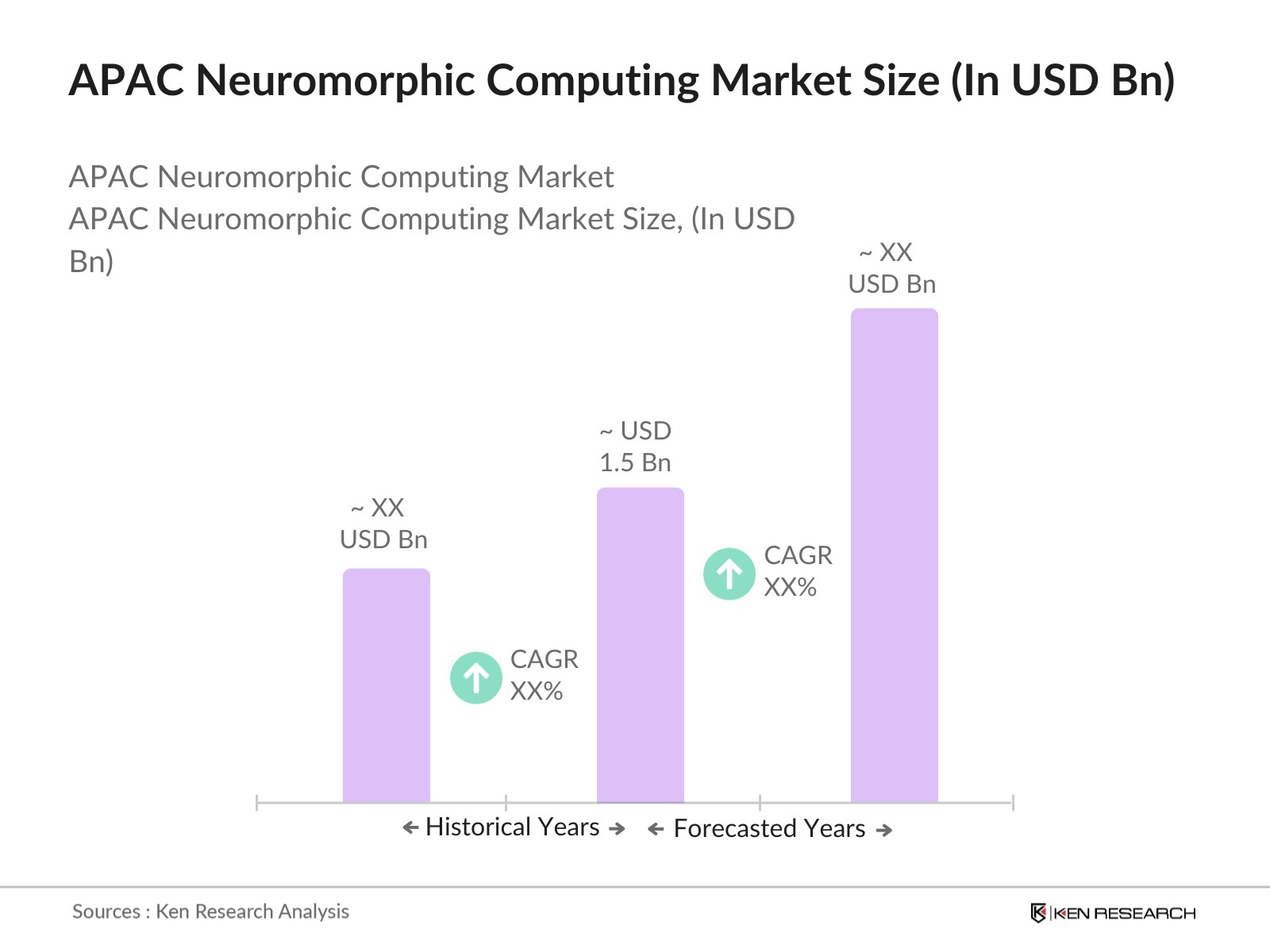
  • The APAC Neuromorphic Computing Market is valued at USD 1.5 billion, based on a five-year historical analysis. This market is driven by the increasing adoption of artificial intelligence (AI), machine learning (ML), and neural networks across industries. Neuromorphic computing systems mimic the human brains structure and functionality, making them ideal for real-time data processing in sectors like healthcare, automotive, and robotics. Significant advancements in edge computing, particularly for low-power and real-time operations, further fuel the demand for neuromorphic systems across APAC.

APAC Neuromorphic Computing Market

  • Key countries dominating the APAC Neuromorphic Computing Market include China, Japan, and South Korea. Chinas dominance stems from its massive investments in AI research and semiconductor technologies, coupled with its governments strategic focus on becoming a leader in AI. Japan and South Korea, on the other hand, have strong industrial automation sectors and advanced manufacturing capabilities, which position them as key players in the neuromorphic computing landscape.
  • Governments across the APAC region are actively supporting AI advancements, which includes neuromorphic computing as a key focus area. In 2024, China, through its National AI Development Plan, allocated USD 150 billion towards advancing AI technologies, including neuromorphic systems. Similarly, South Korea has launched several initiatives aimed at developing cutting-edge AI infrastructure, focusing on neuromorphic computing for autonomous systems. These government initiatives are expected to drive innovation, R&D, and adoption of neuromorphic technologies, positioning the APAC region as a leader in the global AI race.

APAC Neuromorphic Computing Market Segmentation

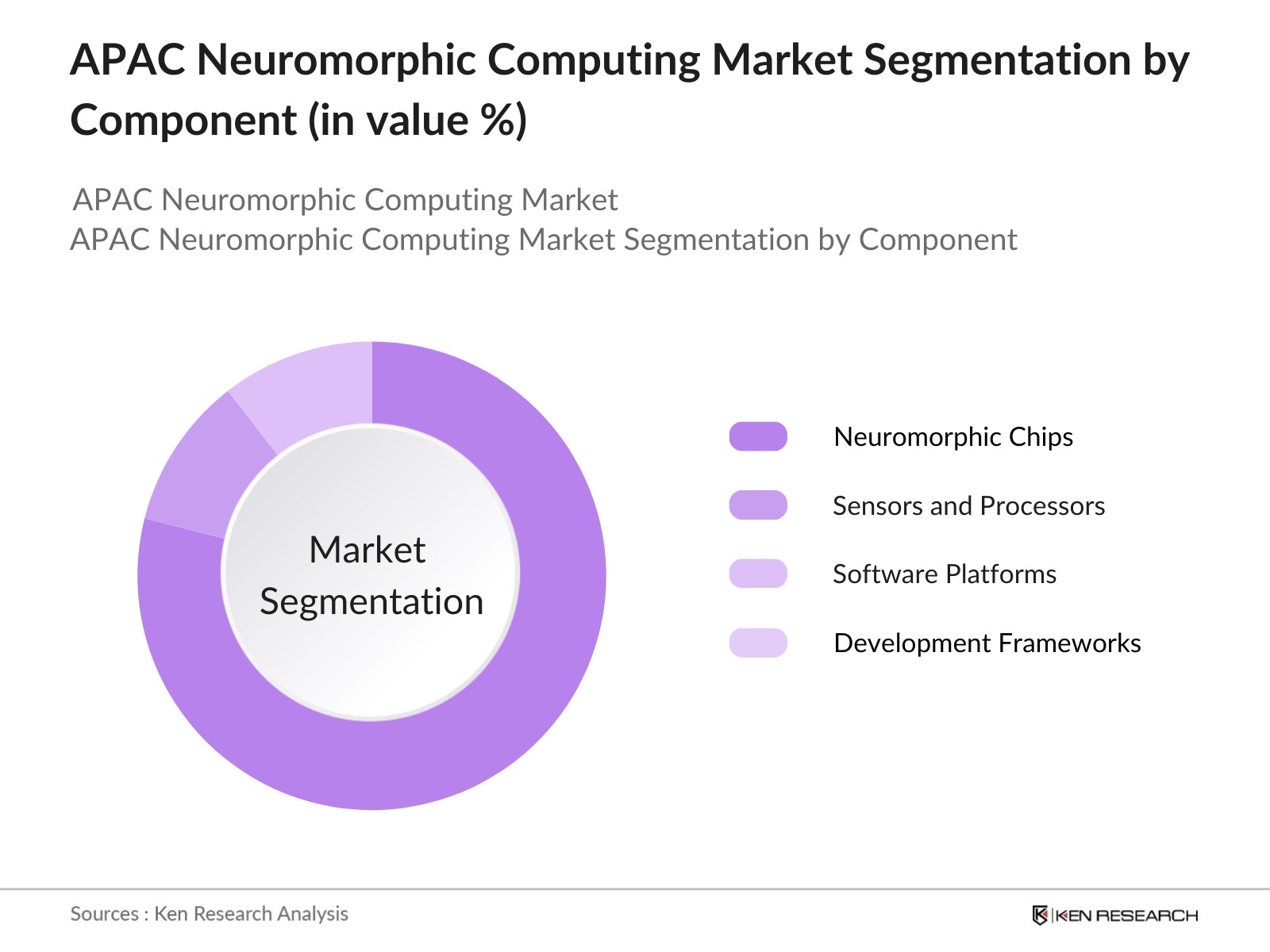
By Component: The APAC Neuromorphic Computing market is segmented by component into neuromorphic chips, sensors and processors, software platforms, and development frameworks. Among these, neuromorphic chips hold a dominant market share, driven by their crucial role in processing vast amounts of data in real-time. These chips are pivotal for applications like autonomous vehicles and robotics, where decision-making speed is critical. The growing integration of these chips into IoT devices and AI systems also accelerates their demand across the region.
APAC Neuromorphic Computing Market Segmentation

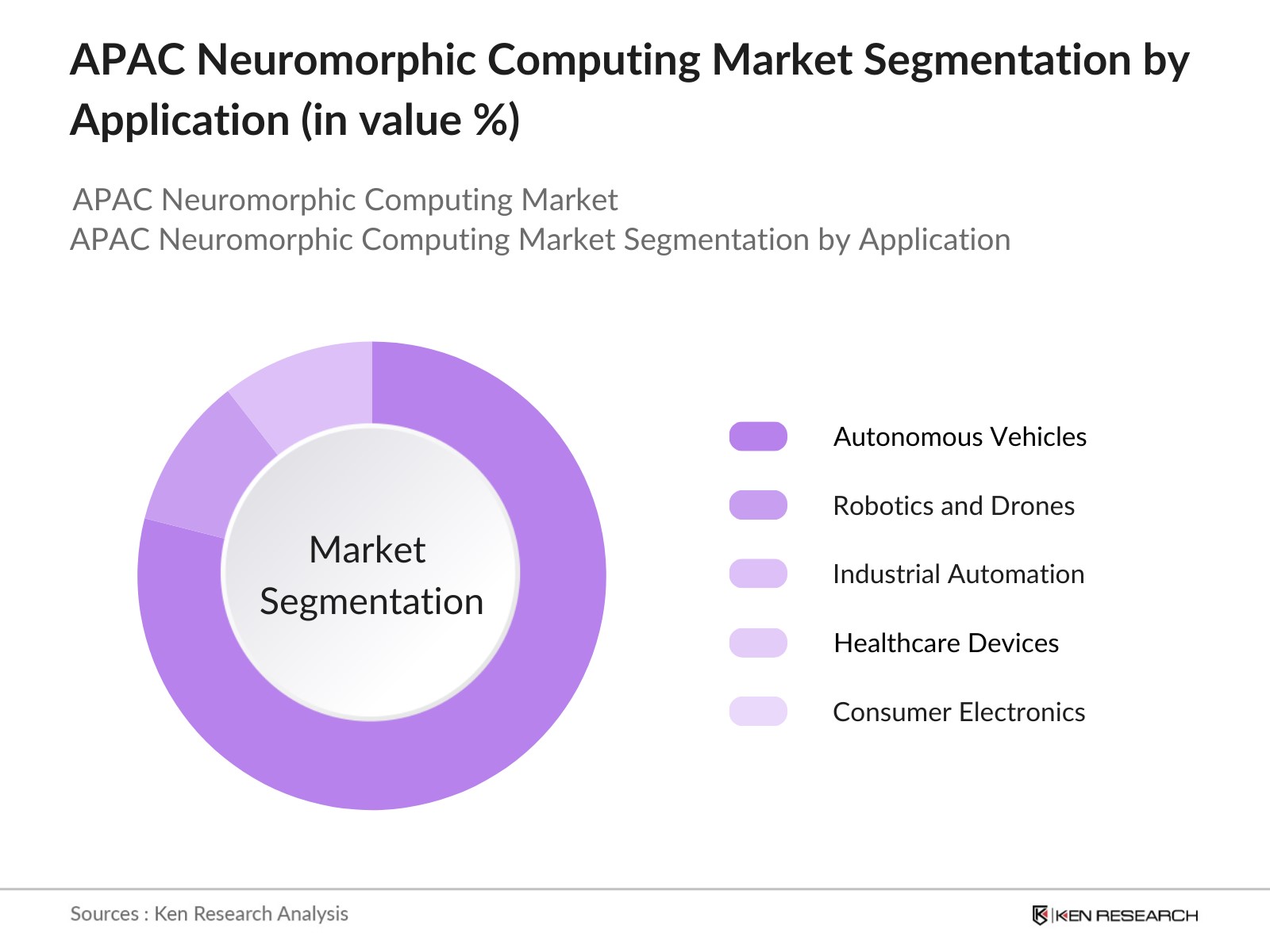
By Application: The APAC Neuromorphic Computing market is segmented by application into autonomous vehicles, robotics and drones, industrial automation, healthcare devices, and consumer electronics. The autonomous vehicles sub-segment dominates the market, with manufacturers investing heavily in neuromorphic computing to enhance real-time decision-making, reduce latency, and improve safety features. The rising demand for self-driving cars in countries like China and Japan further solidifies the leadership of this sub-segment.
APAC Neuromorphic Computing Market Segmentation

APAC Neuromorphic Computing Market Competitive Landscape

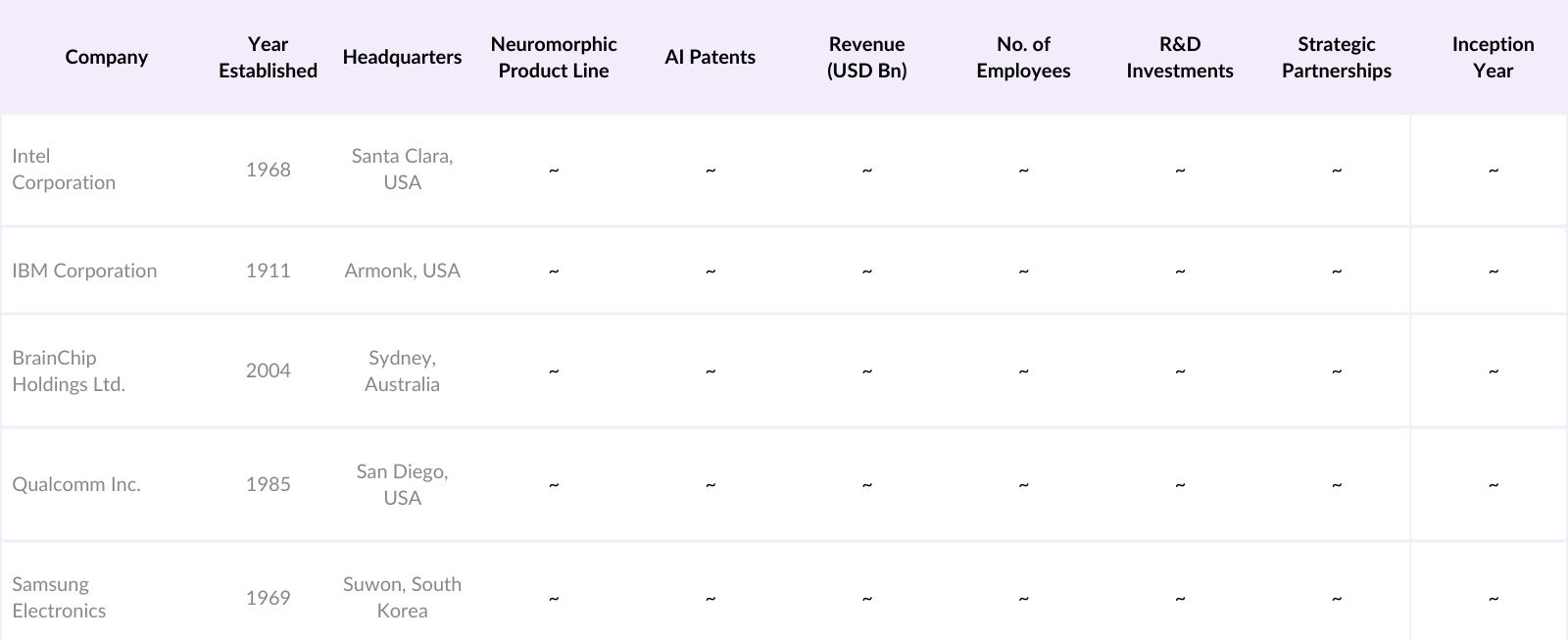
The APAC Neuromorphic Computing market is dominated by a mix of global technology giants and innovative local startups. Companies are leveraging partnerships and collaborations to accelerate research and development in neuromorphic systems, while also investing in AI software platforms.
APAC Neuromorphic Computing Market Competitive Landscape

APAC Neuromorphic Computing Market Analysis

Growth Drivers

  • Rise in AI and Machine Learning Applications: The rising demand for artificial intelligence (AI) and machine learning (ML) applications across APAC is one of the primary growth drivers for the neuromorphic computing market. As of 2024, governments and enterprises in the region have allocated significant investments towards AI-driven initiatives. For example, China has pledged over USD 150 billion into AI research and applications across sectors like manufacturing, healthcare, and transportation. The increasing use of AI in areas such as autonomous vehicles and smart cities in countries like Japan and South Korea further supports this trend. The International Monetary Fund (IMF) data from 2024 shows that the rapid digital transformation across these nations is generating robust economic activity, propelling the need for advanced computing technologies like neuromorphic systems.
  • Demand for Low-Power Computation in IoT Devices: The demand for low-power computation in IoT devices has surged due to the proliferation of smart infrastructure projects and connected devices in the APAC region. By 2024, over 15 billion IoT devices are expected to be operational across China, India, and Japan, necessitating efficient, real-time data processing capabilities. Neuromorphic computing is uniquely suited to address this need due to its energy-efficient architecture. According to data from the World Bank, the growing push for energy-efficient solutions in smart cities and connected factories is increasing demand for low-power systems like neuromorphic chips, which are 1000x more efficient than traditional chips for specific tasks.
  • Growing Need for Real-Time Data Processing: The need for real-time data processing is becoming crucial in various industries, including finance, healthcare, and autonomous systems. In 2024, the global volume of data generated daily exceeds 200 exabytes, and the need for immediate insights and decision-making capabilities is driving the adoption of neuromorphic computing in the APAC region. For instance, Japans expanding autonomous vehicle market and Chinas rapid development in AI-based healthcare diagnostics rely heavily on real-time data processing capabilities, which neuromorphic systems provide. According to IMF economic forecasts, the exponential growth in data traffic and real-time applications is boosting demand for neuromorphic architectures across the region.

Market Challenges

  • Complexity in Neuromorphic Chip Design: Neuromorphic chip design is highly complex due to the need to replicate the human brains synaptic architecture. This complexity increases both the development time and costs. As of 2024, neuromorphic chip developers in APAC face significant challenges in scaling production, with costs estimated at over USD 500 million for designing a single neuromorphic processor. Additionally, hardware compatibility issues across different platforms exacerbate the challenge of designing standardized solutions that can be adopted widely. According to World Bank estimates, the regions semiconductor industry, despite its advancements, struggles with integrating neuromorphic systems into mainstream consumer electronics due to these design complexities.
  • Limited Commercialization of Neuromorphic Technology: While neuromorphic computing offers revolutionary potential, its commercialization remains limited, especially in the APAC region. The high R&D costs, coupled with the absence of mass-market applications, restrict its adoption. In 2024, only a handful of industries, such as aerospace and healthcare, have begun integrating neuromorphic systems at a commercial scale. According to the IMF, the limited production infrastructure in emerging markets like India and Indonesia further slows down the commercialization of neuromorphic computing technologies. This limits the ability of companies to scale production and meet the growing demand.

APAC Neuromorphic Computing Market Future Outlook

Over the next five years, the APAC Neuromorphic Computing market is expected to experience significant growth, driven by advancements in AI technologies, rising demand for low-power computing, and increased investments in autonomous systems. The market will likely see further integration of neuromorphic systems in various industries, such as automotive, healthcare, and consumer electronics. Collaboration between technology firms and AI startups will also continue to accelerate the development of innovative neuromorphic products and applications, positioning the APAC region as a key player in global neuromorphic computing advancements.

Future Market Opportunities

  • Expansion into Healthcare Diagnostics: Neuromorphic computing presents significant opportunities in the healthcare sector, particularly in diagnostics and real-time monitoring. In 2024, APAC countries like Japan and South Korea are at the forefront of deploying AI-powered diagnostic tools, many of which are enhanced by neuromorphic processors. According to World Bank data, the healthcare AI market in APAC is valued at USD 15 billion, with a significant portion expected to benefit from neuromorphic technologies. This expansion into healthcare will allow for faster, more accurate diagnostics, especially in imaging and patient monitoring systems, where real-time processing is crucial.
  • Integration with Quantum Computing: The integration of neuromorphic computing with quantum computing represents a new frontier in processing capabilities. APAC countries, especially China and Japan, are making substantial investments in quantum research. As of 2024, Chinas quantum computing program has received over USD 10 billion in government funding, according to the IMF. Neuromorphic systems, with their ability to process information in a brain-like manner, complement quantum computings potential for solving complex problems. The convergence of these two technologies could revolutionize industries such as cybersecurity and materials science, providing a significant growth opportunity for neuromorphic systems.

Scope of the Report

Segments

Sub-Segments

By Component

Neuromorphic Chips

Sensors and Processors

Software Platforms

Development Frameworks

By Application

Autonomous Vehicles

Robotics and Drones

Industrial Automation

Healthcare Devices

Consumer Electronics

By Technology

Spiking Neural Networks (SNNs)

Neuromorphic Vision Systems

Neuromorphic Memory Architectures

Neuromorphic Learning Algorithms

By End User

Automotive

Consumer Electronics

Aerospace and Defense

Industrial and Manufacturing

Healthcare

By Region

China

Japan

South Korea

India

Australia

Major Players in the APAC Neuromorphic Computing Market

  • Intel Corporation
  • IBM Corporation
  • BrainChip Holdings Ltd.
  • Qualcomm Inc.
  • Samsung Electronics
  • Prophesee
  • Numenta, Inc.
  • Gyrfalcon Technology
  • SynSense
  • MemComputing, Inc.
  • HP Labs
  • Applied Brain Research Inc.
  • General Vision Inc.
  • CEA-Leti
  • NeuroGrid

Products


Key Target Audience

  • Semiconductor Manufacturers

  • AI and Machine Learning Startups

  • Automotive Manufacturers

  • Robotics and Automation Companies

  • Healthcare Technology Providers

  • Investors and Venture Capitalist Firms

  • Government and Regulatory Bodies (AI Regulatory Commission, Ministry of Industry)

  • Research and Development Institutions

Table of Contents

  1. APAC Neuromorphic Computing Market Overview 1.1. Definition and Scope
    1.2. Market Taxonomy
    1.3. Market Growth Rate (Neuromorphic Chips, Computing Frameworks)
    1.4. Market Segmentation Overview
  2. APAC Neuromorphic Computing Market Size (In USD Mn)
    2.1. Historical Market Size
    2.2. Key Milestones in the Market
    2.3. Neuromorphic Development Timeline
  3. APAC Neuromorphic Computing Market Analysis 3.1. Growth Drivers (Neural Network Algorithms, Edge Computing)
    3.1.1. Rise in AI and Machine Learning Applications
    3.1.2. Demand for Low-Power Computation in IoT Devices
    3.1.3. Growing Need for Real-Time Data Processing
    3.1.4. Integration of Neuromorphic Systems in Robotics 3.2. Market Challenges (Hardware Compatibility, High R&D Costs)
    3.2.1. Complexity in Neuromorphic Chip Design
    3.2.2. Limited Commercialization of Neuromorphic Technology
    3.2.3. Lack of Standardization
    3.2.4. Barriers to Mass Production
    3.3. Opportunities (Edge AI, Neuromorphic Computing in Autonomous Vehicles)
    3.3.1. Expansion into Healthcare Diagnostics
    3.3.2. Integration with Quantum Computing
    3.3.3. Government Initiatives on AI Advancements
    3.3.4. Collaboration with Semiconductor Companies
    3.4. Trends (Neuromorphic Sensors, Self-Learning Algorithms)
    3.4.1. Emergence of Neuromorphic Cloud Computing
    3.4.2. Collaboration with AI and ML Startups
    3.4.3. Miniaturization of Neuromorphic Hardware
    3.4.4. Growth in Research Funding for AI Systems
    3.5. Government Regulations (AI Policy, Semiconductor Policies)
    3.5.1. National AI Strategies in APAC
    3.5.2. Data Privacy and AI Regulations
    3.5.3. Semiconductor Manufacturing Policies
    3.5.4. Funding for Research and Innovation
    3.6. SWOT Analysis
    3.7. Stakeholder Ecosystem (Hardware Manufacturers, Research Institutes)
    3.8. Porters Five Forces (Chip Suppliers, AI Software Companies)
    3.9. Competition Ecosystem (Global Chip Manufacturers, Local AI Startups)
  4. APAC Neuromorphic Computing Market Segmentation 4.1. By Component (In Value %) 4.1.1. Neuromorphic Chips
    4.1.2. Sensors and Processors
    4.1.3. Software Platforms
    4.1.4. Development Frameworks
    4.2. By Application (In Value %) 4.2.1. Autonomous Vehicles
    4.2.2. Robotics and Drones
    4.2.3. Industrial Automation
    4.2.4. Healthcare Devices
    4.2.5. Consumer Electronics
    4.3. By Technology (In Value %) 4.3.1. Spiking Neural Networks (SNNs)
    4.3.2. Neuromorphic Vision Systems
    4.3.3. Neuromorphic Memory Architectures
    4.3.4. Neuromorphic Learning Algorithms
    4.4. By End User (In Value %) 4.4.1. Automotive
    4.4.2. Consumer Electronics
    4.4.3. Aerospace and Defense
    4.4.4. Industrial and Manufacturing
    4.4.5. Healthcare
    4.5. By Region (In Value %) 4.5.1. China
    4.5.2. Japan
    4.5.3. South Korea
    4.5.4. India
    4.5.5. Australia
  5. APAC Neuromorphic Computing Market Competitive Analysis 5.1. Detailed Profiles of Major Companies
    5.1.1. Intel Corporation
    5.1.2. IBM Corporation
    5.1.3. Qualcomm Inc.
    5.1.4. BrainChip Holdings Ltd.
    5.1.5. General Vision Inc.
    5.1.6. Applied Brain Research Inc.
    5.1.7. HP Labs
    5.1.8. SynSense
    5.1.9. Samsung Electronics
    5.1.10. Prophesee
    5.1.11. MemComputing, Inc.
    5.1.12. Gyrfalcon Technology
    5.1.13. Numenta, Inc.
    5.1.14. CEA-Leti
    5.1.15. NeuroGrid
    5.2. Cross Comparison Parameters (No. of Employees, Revenue, Neuromorphic Product Line, AI Patents, Inception Year, Headquarters, Strategic Partnerships, R&D Investment)
    5.3. Market Share Analysis
    5.4. Strategic Initiatives
    5.5. Mergers and Acquisitions
    5.6. Investment Analysis
    5.7. Venture Capital Funding
    5.8. Government Grants
    5.9. Private Equity Investments
  6. APAC Neuromorphic Computing Market Regulatory Framework 6.1. AI Policy and Governance
    6.2. Semiconductor Compliance Standards
    6.3. Data Privacy and Security Regulations
    6.4. Certification Processes
  7. APAC Neuromorphic Computing Future Market Size (In USD Mn) 7.1. Future Market Size Projections
    7.2. Key Factors Driving Future Market Growth
  8. APAC Neuromorphic Computing Future Market Segmentation 8.1. By Component
    8.2. By Application
    8.3. By Technology
    8.4. By End User
    8.5. By Region
  9. APAC Neuromorphic Computing Market Analysts Recommendations 9.1. TAM/SAM/SOM Analysis
    9.2. Customer Cohort Analysis
    9.3. Marketing Initiatives
    9.4. White Space Opportunity Analysis

DisclaimerContact Us

Research Methodology


Step 1: Identification of Key Variables


The initial phase involved creating a detailed ecosystem map of the APAC Neuromorphic Computing Market. This included identifying major stakeholders such as semiconductor manufacturers, AI startups, and end-users across industries. Data was collected from credible secondary sources and proprietary databases to define critical variables influencing market dynamics.


Step 2: Market Analysis and Construction


In this step, historical data related to the APAC Neuromorphic Computing market was compiled and analyzed. This included evaluating market penetration rates, sales of neuromorphic chips, and the impact of AI-based solutions on various industries. These data points were cross-verified for accuracy and consistency.


Step 3: Hypothesis Validation and Expert Consultation


Market hypotheses were developed and validated through consultations with industry experts, including neuromorphic chip manufacturers and AI specialists. These consultations provided insights into technological advancements, market challenges, and future growth trajectories, refining our understanding of market dynamics.


Step 4: Research Synthesis and Final Output


In the final phase, we engaged with neuromorphic computing companies to gather detailed insights into product segments, sales performance, and customer preferences. This data was then synthesized to ensure a comprehensive, validated analysis of the APAC Neuromorphic Computing market.


Frequently Asked Questions

  1. How big is the APAC Neuromorphic Computing Market?

    The APAC Neuromorphic Computing market is valued at USD 1.5 billion, driven by rapid advancements in AI and neural network technologies, particularly in industries such as automotive, healthcare, and robotics.
  2. What are the challenges in the APAC Neuromorphic Computing Market?

    Key challenges include the high cost of R&D, lack of standardization in neuromorphic technologies, and limited commercialization of these systems, which can hinder their widespread adoption across industries.
  3. Who are the major players in the APAC Neuromorphic Computing Market?

    Key players in the market include Intel Corporation, IBM Corporation, BrainChip Holdings Ltd., Qualcomm Inc., and Samsung Electronics. These companies dominate due to their extensive R&D investments and strong partnerships with AI and machine learning startups.
  4. What are the growth drivers for the APAC Neuromorphic Computing Market?

    The market is propelled by increasing demand for low-power, real-time data processing systems, advancements in AI, and growing integration of neuromorphic chips into autonomous vehicles and robotics.
  5. What are the future opportunities in the APAC Neuromorphic Computing Market?

    Future opportunities include the expansion of neuromorphic computing applications in healthcare diagnostics, industrial automation, and edge AI, as well as collaborations between semiconductor firms and AI startups

Why Buy From Us?

RRR
Refine Robust Result (RRR) Framework

What makes us stand out is that our consultants follows Robust, Refine and Result (RRR) methodology. i.e. Robust for clear definitions, approaches and sanity checking, Refine for differentiating respondents facts and opinions and Result for presenting data with story

Our Reach Is Unmatched

We have set a benchmark in the industry by offering our clients with syndicated and customized market research reports featuring coverage of entire market as well as meticulous research and analyst insights.

Research
Shifting the Research Paradigm

While we don't replace traditional research, we flip the method upside down. Our dual approach of Top Bottom & Bottom Top ensures quality deliverable by not just verifying company fundamentals but also looking at the sector and macroeconomic factors.

Insite
More Insights-Better Decisions

With one step in the future, our research team constantly tries to show you the bigger picture. We help with some of the tough questions you may encounter along the way: How is the industry positioned? Best marketing channel? KPI's of competitors? By aligning every element, we help maximize success.

Trust
Transparency and Trust

Our report gives you instant access to the answers and sources that other companies might choose to hide. We elaborate each steps of research methodology we have used and showcase you the sample size to earn your trust.

support
Round the Clock Support

If you need any support, we are here! We pride ourselves on universe strength, data quality, and quick, friendly, and professional service.

Why Client Choose Us?

400000+ Reports in repository
150+ Consulting project a year
100+ Analysts
8000+ Client Queries in 2022