
Asia Pacific Machine Tools Market Outlook to 2030
Region:Asia
Author(s):Vijay Kumar
Product Code:KROD8706
November 2024
94
About the Report
Asia Pacific Machine Tools Market Overview
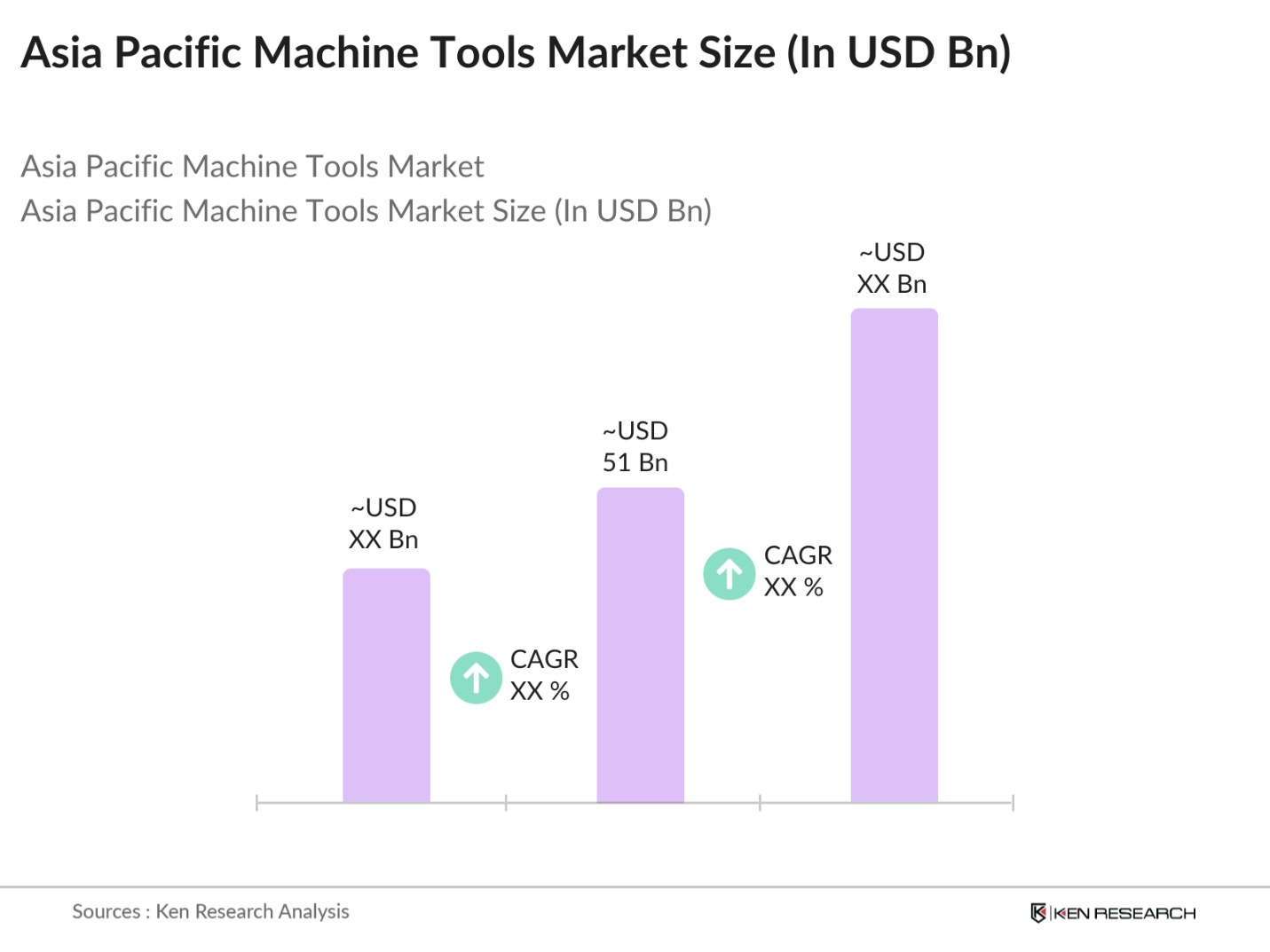
- The Asia Pacific Machine Tools Market is valued at USD 51 billion, based on a five-year historical analysis. This market is primarily driven by rapid industrialization across the region, with demand surging from sectors such as automotive, aerospace, and electronics. The increased adoption of advanced manufacturing processes, particularly in precision engineering and automated systems, has spurred significant investment in CNC (Computer Numerical Control) technology. These trends are pushing the market forward as industries prioritize precision, efficiency, and productivity in large-scale production environments.
- China, Japan, and South Korea dominate this market due to their robust industrial bases, well-established manufacturing sectors, and strategic focus on technological innovation. China, as a global manufacturing hub, leads in production capacity, while Japan and South Korea excel in advanced manufacturing technologies. These countries' ability to produce high-quality, precise machine tools, combined with favorable government policies, underpins their dominance in the region.
- Compliance with industry standards like ISO is mandatory for machine tools, ensuring quality and safety. As of 2024, Japans METI mandates ISO 23125 compliance for CNC machine tools, focusing on operational safety. Similarly, South Korea has enforced compliance with KS standards, enhancing the durability and safety of imported and domestically produced machine tools, as per the Korean Standards Association.
Asia Pacific Machine Tools Market Segmentation
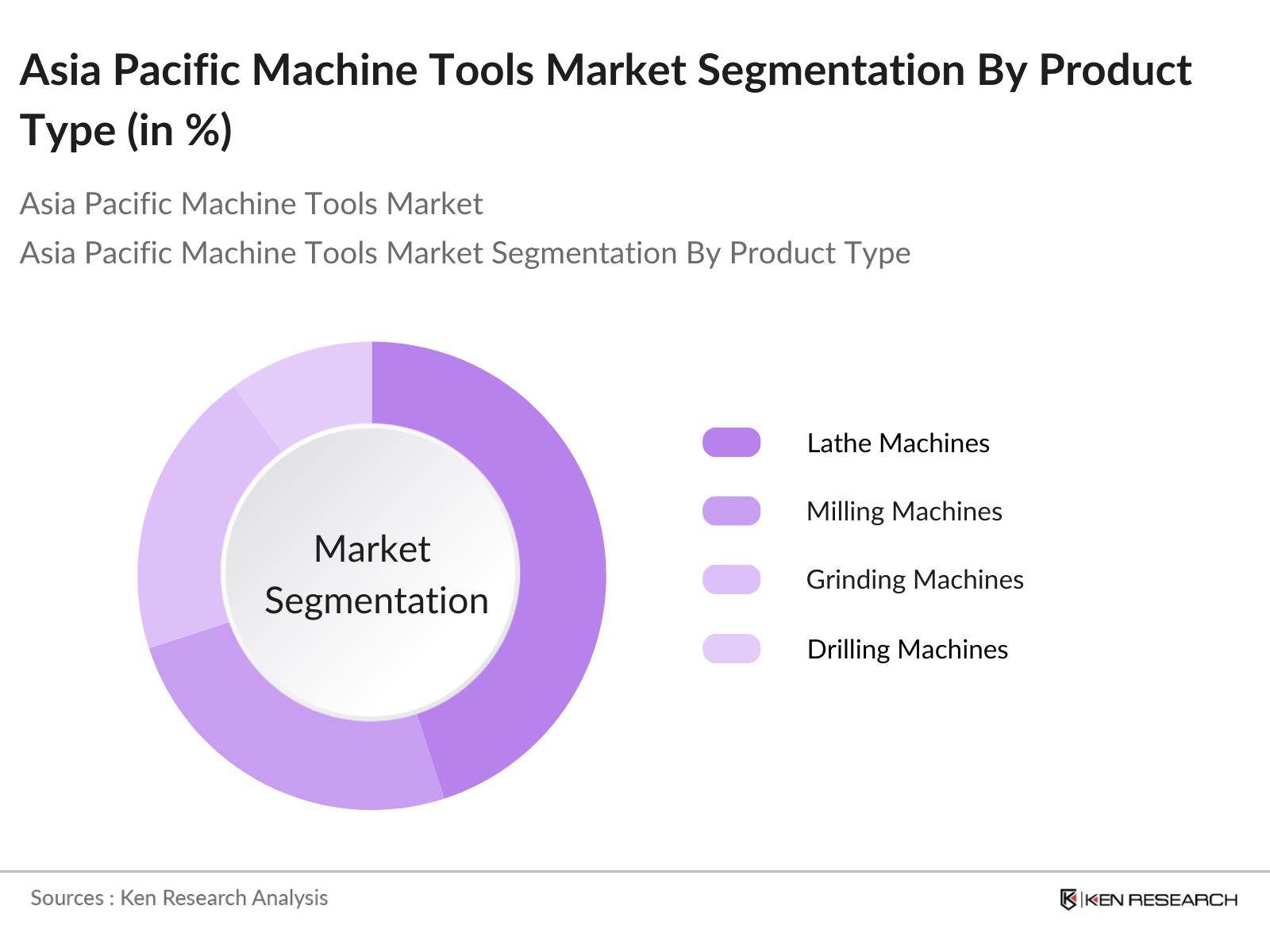
By Product Type: The market is segmented by product type into lathe machines, milling machines, grinding machines, drilling machines, and electrical discharge machines (EDMs). Recently, lathe machines have a dominant market share under the product type segment due to their broad applications across various industries, particularly in automotive and metal fabrication. Lathe machines' versatility, allowing the efficient cutting, sanding, and drilling of materials, has made them essential in large-scale manufacturing setups. Key manufacturers have focused on enhancing lathe precision, which has further solidified their popularity in this segment.
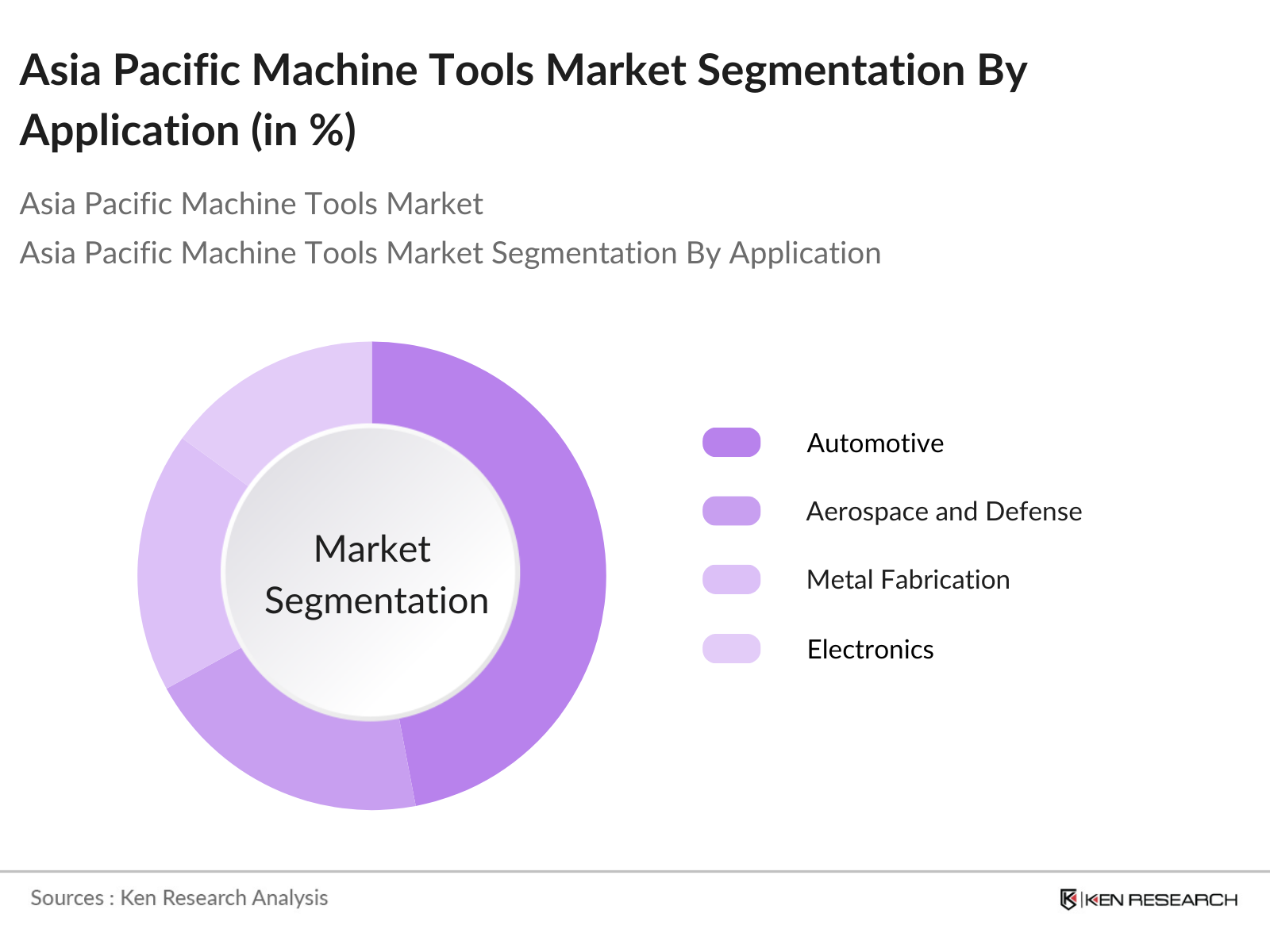
By Application: The market is also segmented by application into automotive, aerospace and defense, metal fabrication, electronics, and industrial machinery. Within this segmentation, the automotive sector holds a dominant share due to continuous advancements in manufacturing technology and the high demand for precision-engineered components. The automotive industry relies heavily on machine tools to produce parts with stringent tolerances, ensuring safety and efficiency.
Asia Pacific Machine Tools Market Competitive Landscape
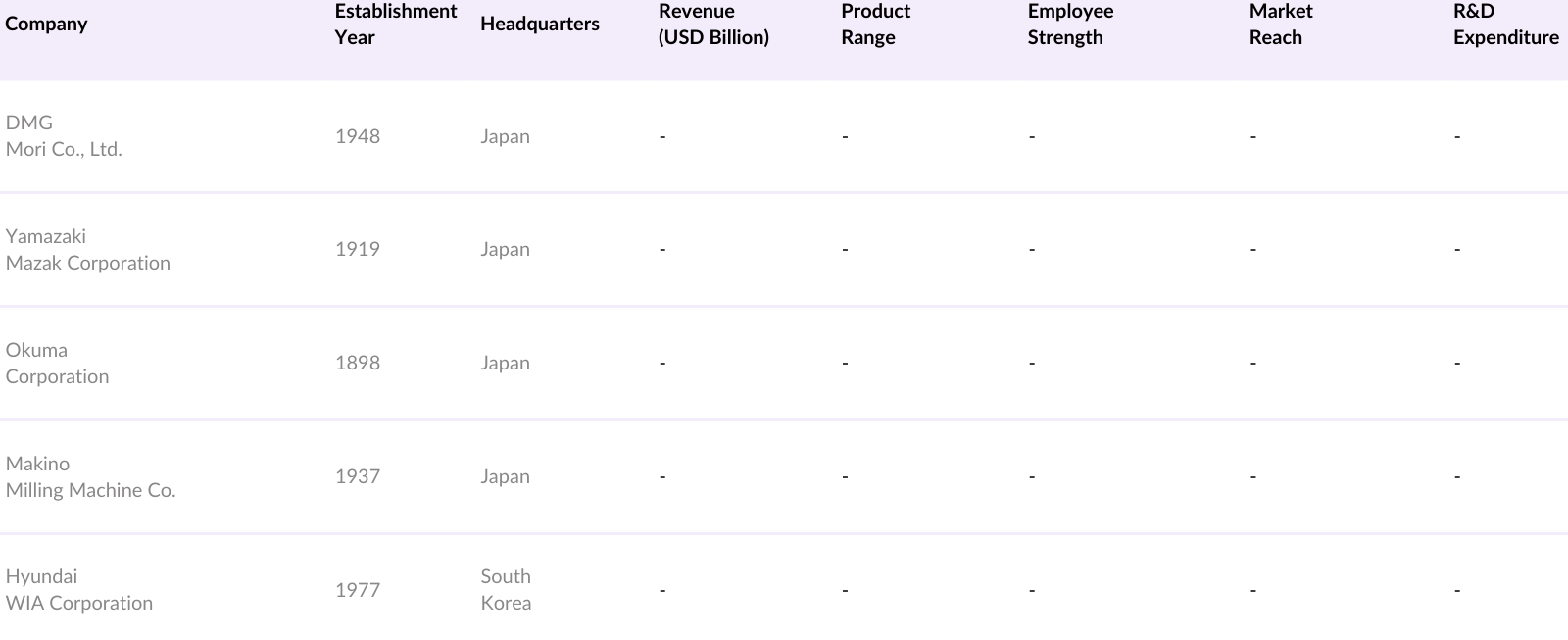
The Asia Pacific Machine Tools Market is dominated by a few major players, including established local manufacturers and globally recognized brands. This competitive landscape is shaped by the strategic focus on advanced manufacturing technologies, partnerships, and product innovation.
Asia Pacific Machine Tools Industry Analysis
Growth Drivers
- Technological Advancements: Technological advancements in machine tools, particularly in the Asia Pacific, have accelerated manufacturing efficiencies in sectors like automotive and aerospace. In 2024, Japan remains a leader in machine tool technology, with investments in AI-driven automation increasing production efficiencies by nearly 30% across industries, as reported by Japan's Ministry of Economy, Trade, and Industry (METI). For instance, Chinas integration of smart sensors in CNC machines has expanded, with over 45,000 units incorporating smart features by 2024, according to Chinas National Bureau of Statistics.
- Rising Demand in Automotive & Aerospace Sectors: The Asia Pacific region, led by China, Japan, and South Korea, has seen a robust demand for machine tools, driven by expansions in automotive and aerospace sectors. In 2024, South Koreas automotive production levels reached over 3.5 million units, necessitating a continuous supply of advanced machine tools, as per data from Korea Automobile Manufacturers Association. Additionally, aircraft production in the region has surged, with aerospace companies in Japan increasing machine tool usage by 20% to support precision manufacturing, as noted by Japans METI.
- Expansion in Industrial Automation: Industrial automation is witnessing substantial growth in Asia Pacific, pushing machine tool manufacturers to integrate robotics and automation technologies. In 2023, Japans industrial robot exports hit 190,000 units, while South Korea reached 60,000, marking a substantial increase, as stated by the International Federation of Robotics. These statistics underscore the demand for automated machine tools to support seamless production processes, especially in sectors like electronics manufacturing in Taiwan, which recorded a 12% increase in machine tool imports for automation applications in 2024.
Market Challenges
- High Capital Investment: Machine tools require substantial capital investment, limiting adoption among small and medium enterprises (SMEs). In 2024, Japans average cost of advanced machine tools was reported at approximately USD 100,000, making it financially challenging for smaller businesses, according to METI. Chinas machine tool sector faces similar hurdles, with manufacturing businesses requiring government loans to offset costs for high-end machinery imports. Data from Chinas Ministry of Finance suggests over 30% of machine tool investments were supported through financial aid in 2023.
- Skilled Labor Shortage: The Asia Pacific region faces a shortage of skilled labor capable of operating advanced machine tools. In 2024, South Korea's Ministry of Employment and Labor reported a deficit of 50,000 skilled technicians in precision manufacturing, with only 30% of companies reporting sufficient skilled labor. Similarly, Taiwans machine tool industry noted a lack of CNC-certified operators, affecting production efficiency and leading to higher recruitment costs, according to the Taiwan Ministry of Labor.
Asia Pacific Machine Tools Market Future Outlook
Over the next five years, the Asia Pacific Machine Tools Market is expected to witness significant growth, driven by increased investments in smart manufacturing, Industry 4.0, and a surge in demand for automation and precision engineering solutions. Rapid advancements in CNC technology, coupled with the adoption of IoT-enabled machine tools, are anticipated to drive efficiency and reduce operational costs.
Market Opportunities
- Adoption of IoT-Enabled Machine Tools: IoT adoption is enhancing machine tool efficiency and predictive maintenance, with Asia Pacific industries seeing significant adoption. In 2024, IoT-enabled machine tools represented over 15% of the total machine tool installations in Japan, as reported by METI. South Koreas Ministry of Science and ICT indicates IoT integration in manufacturing saved approximately USD 20 million in operational costs through predictive maintenance in 2023, showcasing the potential for continued adoption of IoT machine tools in the region.
- Green Manufacturing Initiatives: The drive for sustainable manufacturing is opening opportunities for energy-efficient machine tools. Japan's Ministry of Environment reported in 2024 that industries adopting green manufacturing practices, including energy-efficient tools, reduced emissions by 10%. China also supports green manufacturing, with its National Development and Reform Commission funding machine tool manufacturers that reduce energy usage, amounting to USD 3.1 billion in 2023, as per Chinas Ministry of Industry and Information Technology (MIIT).
Scope of the Report
|
Product Type |
Lathe Machines Milling Machines Drilling Machines Grinding Machines Electrical Discharge Machines (EDMs) |
|
Technology |
Computer Numerical Control (CNC) Traditional Machine Tools |
|
Application |
Automotive Aerospace and Defense Electrical and Electronics Metal Fabrication Other Industrial Applications |
|
Sales Channel |
Direct Sales Distributors Online Channels |
|
Region |
China Japan India South Korea Rest of Asia Pacific |
Products
Key Target Audience
Manufacturers in Automotive and Aerospace Sectors
Machine Tool Distributors and Suppliers
Original Equipment Manufacturers (OEMs)
Investors and Venture Capitalist Firms
Government and Regulatory Bodies (e.g., Ministry of Economy, Trade and Industry in Japan)
Industrial Automation Firms
Metal Fabrication Companies
Electronics Manufacturers
Companies
Players Mentioned in the Report
DMG Mori Co., Ltd.
Yamazaki Mazak Corporation
Okuma Corporation
Makino Milling Machine Co., Ltd.
Hyundai WIA Corporation
FANUC Corporation
Mitsubishi Heavy Industries Machine Tool Co., Ltd.
Haas Automation, Inc.
JTEKT Corporation
Amada Co., Ltd.
Table of Contents
1. Asia Pacific Machine Tools Market Overview
1.1 Definition and Scope
1.2 Market Taxonomy
1.3 Market Growth Rate
1.4 Market Segmentation Overview
2. Asia Pacific Machine Tools Market Size (In USD Billion)
2.1 Historical Market Size
2.2 Year-On-Year Growth Analysis
2.3 Key Market Developments and Milestones
3. Asia Pacific Machine Tools Market Analysis
3.1 Growth Drivers
3.1.1 Technological Advancements
3.1.2 Rising Demand in Automotive & Aerospace Sectors
3.1.3 Expansion in Industrial Automation
3.1.4 Government Incentives for Manufacturing
3.2 Market Challenges
3.2.1 High Capital Investment
3.2.2 Skilled Labor Shortage
3.2.3 Competition from Low-Cost Manufacturers
3.3 Opportunities
3.3.1 Adoption of IoT-Enabled Machine Tools
3.3.2 Green Manufacturing Initiatives
3.3.3 Growing Popularity of Smart Manufacturing
3.4 Trends
3.4.1 Rise in Precision Engineering
3.4.2 Integration with Robotics
3.4.3 Increase in Retrofitting and Modernization
3.5 Regulatory Overview
3.5.1 Industry Standards and Compliance
3.5.2 Import and Export Regulations
3.5.3 Safety and Quality Certifications
3.6 SWOT Analysis
3.7 Stakeholder Ecosystem
3.8 Porters Five Forces Analysis
3.9 Competition Ecosystem
4. Asia Pacific Machine Tools Market Segmentation
4.1 By Product Type (In Value %)
4.1.1 Lathe Machines
4.1.2 Milling Machines
4.1.3 Drilling Machines
4.1.4 Grinding Machines
4.1.5 Electrical Discharge Machines (EDMs)
4.2 By Technology (In Value %)
4.2.1 Computer Numerical Control (CNC)
4.2.2 Traditional Machine Tools
4.3 By Application (In Value %)
4.3.1 Automotive
4.3.2 Aerospace and Defense
4.3.3 Electrical and Electronics
4.3.4 Metal Fabrication
4.3.5 Other Industrial Applications
4.4 By Sales Channel (In Value %)
4.4.1 Direct Sales
4.4.2 Distributors
4.4.3 Online Channels
4.5 By Country (In Value %)
4.5.1 China
4.5.2 Japan
4.5.3 India
4.5.4 South Korea
4.5.5 Rest of Asia Pacific
5. Asia Pacific Machine Tools Market Competitive Analysis
5.1 Detailed Profiles of Major Companies
5.1.1 DMG Mori Co., Ltd.
5.1.2 Yamazaki Mazak Corporation
5.1.3 Okuma Corporation
5.1.4 Makino Milling Machine Co., Ltd.
5.1.5 Doosan Machine Tools Co., Ltd.
5.1.6 Hyundai WIA Corporation
5.1.7 FANUC Corporation
5.1.8 Mitsubishi Heavy Industries Machine Tool Co., Ltd.
5.1.9 Haas Automation, Inc.
5.1.10 JTEKT Corporation
5.1.11 Amada Co., Ltd.
5.1.12 Hurco Companies, Inc.
5.1.13 Schuler Group
5.1.14 EMAG GmbH & Co. KG
5.1.15 Trumpf GmbH + Co. KG
5.2 Cross Comparison Parameters (Market Share, Revenue, Product Portfolio, Number of Employees, Geographic Reach, Manufacturing Capacity, Innovation Index, Customer Base)
5.3 Market Share Analysis
5.4 Strategic Initiatives
5.5 Mergers and Acquisitions
5.6 Investment Analysis
5.7 Venture Capital Funding
5.8 Government Subsidies
5.9 Private Equity Investments
6. Asia Pacific Machine Tools Market Regulatory Framework
6.1 Industry Standards and Certifications
6.2 Compliance Requirements
6.3 Import and Export Policies
7. Asia Pacific Machine Tools Market Future Size (In USD Billion)
7.1 Future Market Size Projections
7.2 Key Factors Driving Future Market Growth
8. Asia Pacific Machine Tools Future Market Segmentation
8.1 By Product Type (In Value %)
8.2 By Technology (In Value %)
8.3 By Application (In Value %)
8.4 By Sales Channel (In Value %)
8.5 By Country (In Value %)
9. Asia Pacific Machine Tools Market Analysts Recommendations
9.1 Total Addressable Market (TAM) Analysis
9.2 Customer Cohort Analysis
9.3 Marketing and Distribution Strategies
9.4 White Space Opportunity Analysis
Disclaimer Contact UsResearch Methodology
Step 1: Identification of Key Variables
In this initial phase, we mapped out the machine tools ecosystem across Asia Pacific. This step relied on extensive secondary research from industry reports and proprietary databases to capture the core variables influencing market dynamics.
Step 2: Market Analysis and Construction
This phase focused on historical data analysis for market penetration, segmentation ratios, and revenue generation. We also evaluated service quality indicators to refine the accuracy of revenue projections.
Step 3: Hypothesis Validation and Expert Consultation
Market hypotheses were crafted and then validated through consultations with industry professionals. Expert insights obtained through these interviews provided essential data to refine our findings.
Step 4: Research Synthesis and Final Output
Our team engaged directly with manufacturers and distributors to gain insights on product performance, sales, and consumer trends. This bottom-up approach ensured a validated and comprehensive analysis of the Asia Pacific Machine Tools Market.
Frequently Asked Questions
1. How big is the Asia Pacific Machine Tools Market?
The Asia Pacific Machine Tools Market is valued at USD 51 billion, based on a five-year historical analysis. This market is primarily driven by rapid industrialization across the region, with demand surging from sectors such as automotive, aerospace, and electronics.
2. What challenges does the Asia Pacific Machine Tools Market face?
Challenges include high initial investment costs, skilled labor shortages, and strong competition from low-cost machine tool manufacturers, especially in emerging markets.
3. Who are the key players in the Asia Pacific Machine Tools Market?
Major players include DMG Mori Co., Ltd., Yamazaki Mazak Corporation, Okuma Corporation, Makino Milling Machine Co., Ltd., and Hyundai WIA Corporation.
4. What is driving growth in the Asia Pacific Machine Tools Market?
Growth drivers include advancements in CNC technology, the rise of smart manufacturing, and supportive government policies encouraging automation and modernization.
Why Buy From Us?

What makes us stand out is that our consultants follows Robust, Refine and Result (RRR) methodology. i.e. Robust for clear definitions, approaches and sanity checking, Refine for differentiating respondents facts and opinions and Result for presenting data with story

We have set a benchmark in the industry by offering our clients with syndicated and customized market research reports featuring coverage of entire market as well as meticulous research and analyst insights.

While we don't replace traditional research, we flip the method upside down. Our dual approach of Top Bottom & Bottom Top ensures quality deliverable by not just verifying company fundamentals but also looking at the sector and macroeconomic factors.

With one step in the future, our research team constantly tries to show you the bigger picture. We help with some of the tough questions you may encounter along the way: How is the industry positioned? Best marketing channel? KPI's of competitors? By aligning every element, we help maximize success.

Our report gives you instant access to the answers and sources that other companies might choose to hide. We elaborate each steps of research methodology we have used and showcase you the sample size to earn your trust.

If you need any support, we are here! We pride ourselves on universe strength, data quality, and quick, friendly, and professional service.