
Asia Pacific Precast Concrete Market Outlook to 2030
Region:Asia
Author(s):Meenakshi
Product Code:KROD3473
October 2024
81
About the Report
Asia Pacific Precast Concrete Market Overview
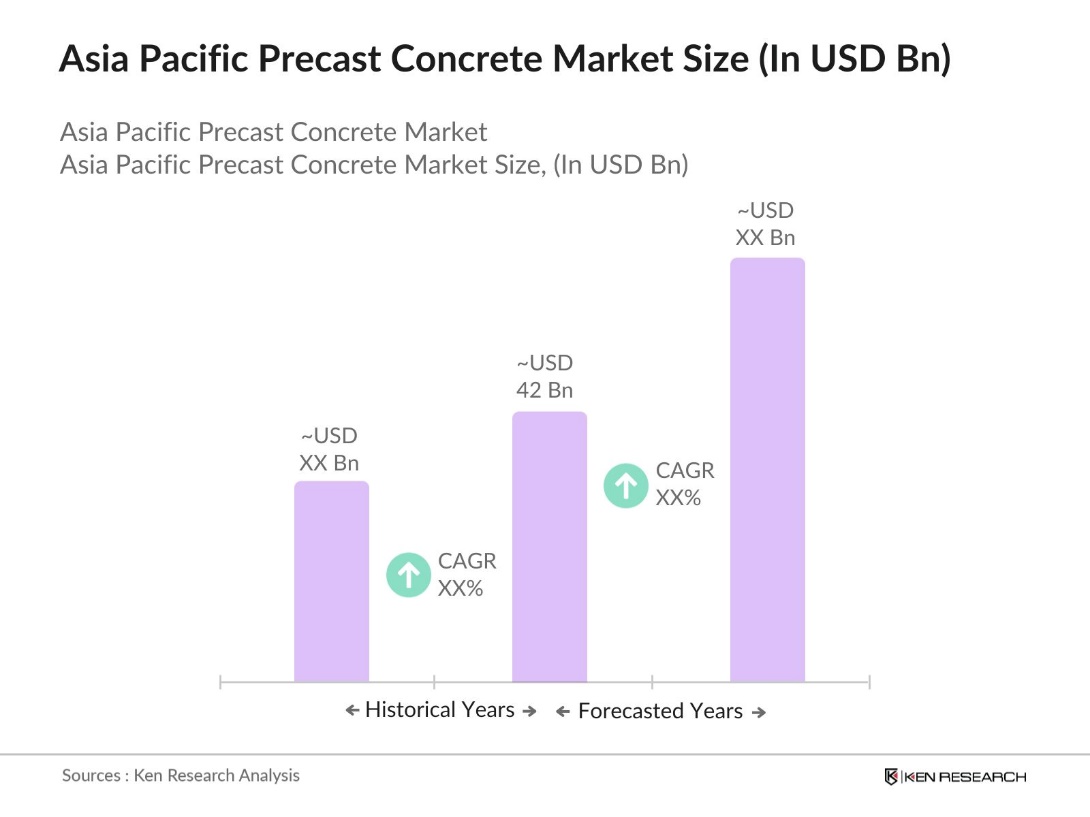
- The Asia Pacific Precast Concrete Market is valued at USD 42 billion, based on a five-year historical analysis. This market is driven by the increasing demand for durable, cost-effective, and sustainable construction materials, particularly in rapidly urbanizing countries like China and India. The adoption of precast concrete technology, which reduces construction time and enhances efficiency, is further supported by growing infrastructure investments, government initiatives, and urban population expansion in the region.
- China and India dominate the precast concrete market in Asia Pacific, owing to their massive infrastructure projects, urban development programs, and increasing population density. These countries have prioritized the use of precast concrete for high-rise buildings, bridges, and industrial applications due to its cost-effectiveness and faster construction timelines. Additionally, government-driven smart city initiatives and industrial growth are significant contributors to this dominance.
- The "Make in India" initiativeby the Government of India proposes investments worth US$964.5 million in the infrastructure sector in India by 2040. According to the Indian Brand Equity Foundation (IBEF), an investment worth US$50 trillion is required in India for infrastructure development by 2022 to achieve sustainable development in the country.
Asia Pacific Precast Concrete Market Segmentation
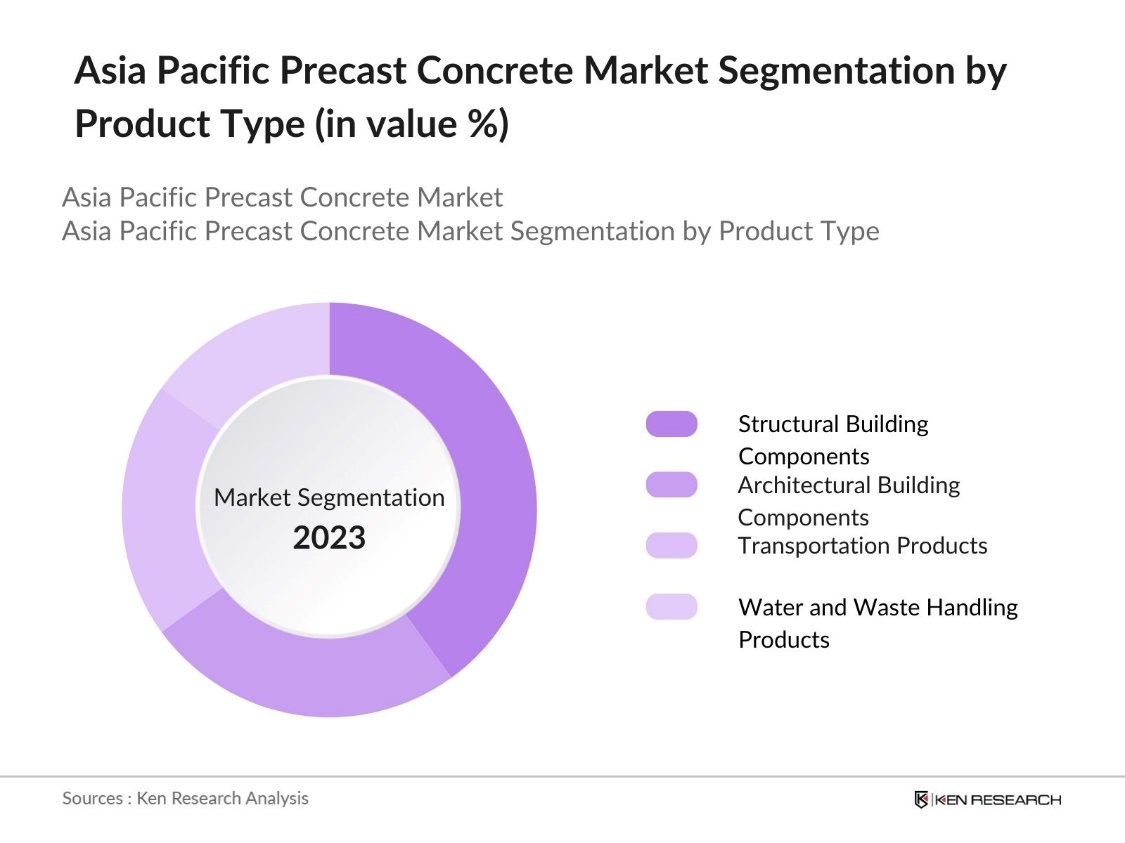
- By Product Type: The Asia Pacific precast concrete market is segmented by product type into structural building components, architectural building components, transportation products, and water and waste handling products. Among these, structural building components dominate the market due to their wide usage in residential and commercial projects. Their pre-fabrication ensures faster assembly and reduced labor costs, making them a preferred choice for large-scale construction projects.
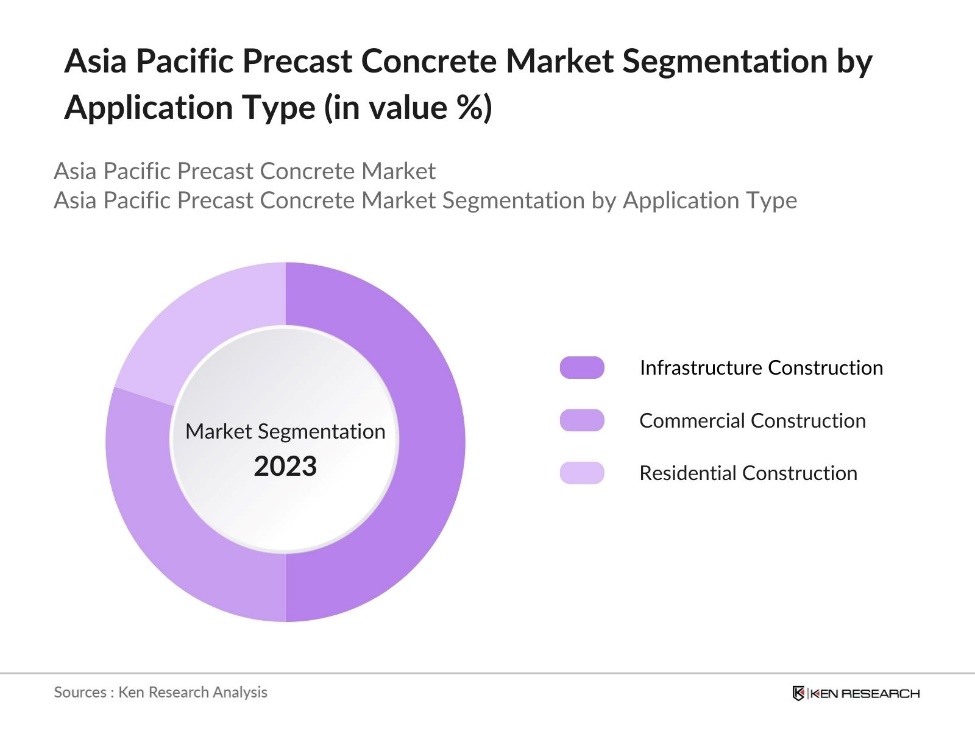
- By Application: The Asia Pacific precast concrete market is segmented by application into commercial construction, residential construction, and infrastructure construction. Commercial construction leads this segment, driven by increasing investments in office spaces, shopping malls, and industrial parks. The regions urbanization push, coupled with an influx of foreign direct investments in commercial real estate, supports this segment's dominance. Countries such as China, Japan, and India are experiencing rapid expansion of their commercial infrastructure, bolstering demand for precast concrete solutions.
Asia Pacific Precast Concrete Market Competitive Landscape
The Asia Pacific precast concrete market is dominated by a mix of regional players and global companies. These companies have established their presence through strategic partnerships, product innovation, and investments in sustainable construction materials. The market's consolidation highlights the influence of key players, particularly those involved in large-scale infrastructure projects and government-backed initiatives.
|
Company Name |
Establishment Year |
Headquarters |
Regional Presence |
Revenue (USD Billion) |
Product Portfolio |
Sustainability Initiatives |
R&D Investment (USD) |
No. of Employees |
Industry Focus |
|
LafargeHolcim |
1833 |
Switzerland |
|||||||
|
CEMEX S.A.B. de C.V. |
1906 |
Mexico |
|||||||
|
Boral Limited |
1946 |
Australia |
|||||||
|
HeidelbergCement AG |
1874 |
Germany |
|||||||
|
CRH plc |
1970 |
Ireland |
Asia Pacific Precast Concrete Industry Analysis
Growth Drivers
- Infrastructure Development (Roads, Railways, Bridges): The Asia Pacific region has seen a significant surge in infrastructure projects, with governments allocating substantial budgets to road, railway, and bridge construction. For example, Indias government allocated USD 130 billion, the Bharatmala Project proposes to build or upgrade nearly 34,800 kilometres of national highways and border roads to provide road connectivity throughout the nation. As part of the project, national highways, bridges, flyovers, bypasses, ring roads, elevated corridors, tunnels, and overpasses will be built to improve India's overall connectivity.
- Urbanization and Smart City Initiatives: The rapid urbanization across Asia Pacific is driving the demand for precast concrete structures. Countries such as India, China, and Indonesia have announced smart city projects, where modern infrastructure is key. For example, the Indian government has allocated 16,000 crore (approximately $1.9 billion) for its Smart Cities Mission, which targets the development the cities using sustainable construction materials like precast concrete.
- Demand for Sustainable Construction Methods: The push for sustainable construction in the Asia Pacific is driving the adoption of green building practices. Countries are increasingly using eco-friendly methods like precast concrete, which helps reduce waste and energy consumption. The growing focus on lowering carbon emissions has made precast concrete a preferred choice in construction projects across the region. The growing focus on reducing carbon emissions in construction is thus fueling the adoption of precast concrete solutions across the region.
Market Challenges
- High Initial Capital Investment: The precast concrete industry requires significant upfront investment in manufacturing facilities, specialized machinery, and skilled labor, creating barriers for smaller companies to enter the market. Ongoing maintenance and energy costs add to the financial burden, making it challenging for businesses, especially in emerging economies, to adopt precast technology on a large scale. This high capital requirement limits wider industry adoption.
- Lack of Skilled Labor in Precast Technology: The increasing demand for precast concrete faces challenges due to a shortage of skilled labor capable of handling this technology. This gap in expertise leads to project delays and higher costs for construction firms, as they struggle to find workers trained in precast techniques. As a result, the adoption of precast concrete is slowed, impacting the overall efficiency of construction projects.
Asia Pacific Precast Concrete Market Future Outlook
Over the next five years, the Asia Pacific Precast Concrete Market is expected to experience significant growth driven by rapid urbanization, infrastructure development, and advancements in construction technologies. Governments across the region are making substantial investments in transportation, housing, and industrial projects, creating substantial demand for precast concrete. Additionally, the growing trend towards sustainable and green building solutions is expected to further propel the market as companies explore eco-friendly precast materials.
Market Opportunities
- Expansion in Emerging Economies: Emerging economies in Asia Pacific, such as Vietnam, Myanmar, and Bangladesh, offer significant growth opportunities for the precast concrete market. These countries are focused on upgrading urban infrastructure and housing, increasing the demand for efficient construction methods. The expanding infrastructure projects in these regions provide a strong foundation for the adoption of precast concrete, especially in urban development initiatives.
- Advancements in Precast Technologies: Technological advancements such as automation and 3D printing are enhancing the quality and efficiency of precast concrete production. These innovations are streamlining manufacturing processes, reducing labor costs, and improving project timelines. The adoption of these advanced technologies is creating new opportunities for companies to scale production and strengthen their market position in the region.
Scope of the Report
|
By Product Type |
Structural Building Components Architectural Building Components Transportation Products Water and Waste Handling Products |
|
By Application |
Commercial Construction Residential Construction Infrastructure Construction |
|
By Technology |
Wet Cast Dry Cast Hybrid |
|
By Material Type |
Reinforced Concrete Prestressed Concrete GFRC |
|
By Region |
China India Japan Southeast Asia Australia |
Products
Key Target Audience
Precast Concrete Manufacturers
Infrastructure Development Companies
Construction Companies
Architects and Engineering Firms
Investments and Venture Capitalist Firms
Government Agencies (Chinas Ministry of Housing and Urban-Rural Development, India's Ministry of Urban Development)
Banks and Financial Institutions
Companies
Major Players
LafargeHolcim
CEMEX S.A.B. de C.V.
Boral Limited
China National Building Material Company
HeidelbergCement AG
CRH plc
Skanska AB
Julius Berger Nigeria Plc
Taisei Corporation
Bouygues Construction
Vinci
Kajima Corporation
Kier Group plc
Larsen & Toubro Ltd
Holcim Group
Table of Contents
1. Asia Pacific Precast Concrete Market Overview
1.1. Definition and Scope
1.2. Market Taxonomy
1.3. Market Growth Rate
1.4. Market Segmentation Overview
2. Asia Pacific Precast Concrete Market Size (In USD Bn)
2.1. Historical Market Size
2.2. Year-on-Year Growth Analysis
2.3. Key Market Developments and Milestones
3. Asia Pacific Precast Concrete Market Analysis
3.1. Growth Drivers
3.1.1. Infrastructure Development (Roads, Railways, Bridges)
3.1.2. Urbanization and Smart City Initiatives
3.1.3. Government Investments in Construction
3.1.4. Demand for Sustainable Construction Methods
3.2. Market Challenges
3.2.1. High Initial Capital Investment
3.2.2. Lack of Skilled Labor in Precast Technology
3.2.3. Supply Chain and Logistics Complexity
3.3. Opportunities
3.3.1. Expansion in Emerging Economies
3.3.2. Advancements in Precast Technologies
3.3.3. Increased Adoption of Green Building Materials
3.4. Trends
3.4.1. Integration of Digital Technologies (BIM, IoT)
3.4.2. Modular and Prefabricated Building Construction
3.4.3. Use of High-Performance Concrete
3.5. Government Regulation
3.5.1. Construction Codes and Standards
3.5.2. Environmental Regulations
3.5.3. Public-Private Partnerships (PPP)
3.6. SWOT Analysis
3.7. Stakeholder Ecosystem
3.8. Porters Five Forces Analysis
3.9. Competition Ecosystem
4. Asia Pacific Precast Concrete Market Segmentation
4.1. By Product Type (In Value %)
4.1.1. Structural Building Components
4.1.2. Architectural Building Components
4.1.3. Transportation Products
4.1.4. Water and Waste Handling Products
4.2. By Application (In Value %)
4.2.1. Commercial Construction
4.2.2. Residential Construction
4.2.3. Infrastructure Construction
4.3. By Technology (In Value %)
4.3.1. Wet Cast
4.3.2. Dry Cast
4.3.3. Hybrid
4.4. By Material Type (In Value %)
4.4.1. Reinforced Concrete
4.4.2. Prestressed Concrete
4.4.3. Glass Fiber Reinforced Concrete (GFRC)
4.5. By Region (In Value %)
4.5.1. China
4.5.2. India
4.5.3. Japan
4.5.4. Southeast Asia
4.5.5. Australia
5. Asia Pacific Precast Concrete Market Competitive Analysis
5.1. Detailed Profiles of Major Companies
5.1.1. LafargeHolcim
5.1.2. CEMEX S.A.B. de C.V.
5.1.3. Boral Limited
5.1.4. Elematic Oyj
5.1.5. HeidelbergCement AG
5.1.6. CRH plc
5.1.7. Skanska AB
5.1.8. China National Building Material Company
5.1.9. Taisei Corporation
5.1.10. Julius Berger Nigeria Plc
5.1.11. Larsen & Toubro Ltd
5.1.12. Bouygues Construction
5.1.13. Vinci
5.1.14. Kajima Corporation
5.1.15. Kier Group plc
5.2. Cross Comparison Parameters (Market Capitalization, Revenue, No. of Employees, Regional Presence, Product Portfolio, Inception Year, Industry Focus, Sustainability Initiatives)
5.3. Market Share Analysis
5.4. Strategic Initiatives (Joint Ventures, Collaborations)
5.5. Mergers and Acquisitions
5.6. Investment Analysis
5.7. Venture Capital Funding
5.8. Government Grants
5.9. Private Equity Investments
6. Asia Pacific Precast Concrete Market Regulatory Framework
6.1. Building Code Regulations
6.2. Compliance and Certification Requirements
6.3. Sustainability and Environmental Standards
7. Asia Pacific Precast Concrete Future Market Size (In USD Bn)
7.1. Future Market Size Projections
7.2. Key Factors Driving Future Market Growth
8. Asia Pacific Precast Concrete Future Market Segmentation
8.1. By Product Type (In Value %)
8.2. By Application (In Value %)
8.3. By Technology (In Value %)
8.4. By Material Type (In Value %)
8.5. By Region (In Value %)
9. Asia Pacific Precast Concrete Market Analysts Recommendations
9.1. TAM/SAM/SOM Analysis
9.2. Customer Cohort Analysis
9.3. Marketing Initiatives
9.4. White Space Opportunity Analysis
Research Methodology
Step 1: Identification of Key Variables
In this step, an ecosystem map of the Asia Pacific Precast Concrete Market was constructed, involving all major stakeholders. Extensive desk research and secondary databases were utilized to identify and define the critical variables affecting the market dynamics.
Step 2: Market Analysis and Construction
This phase involved compiling and analyzing historical data, including market penetration rates, construction project scales, and revenue generation. Additionally, qualitative insights into service quality and reliability were included to support the revenue estimates.
Step 3: Hypothesis Validation and Expert Consultation
Market hypotheses were validated through consultations with industry experts from leading companies. These interviews provided operational and financial insights, which were instrumental in refining the collected data.
Step 4: Research Synthesis and Final Output
In the final phase, engagement with precast concrete manufacturers helped verify the data and ensured an accurate analysis of the market. This step involved direct discussions on product sales performance and consumer preferences, which were synthesized to form the final output.
Frequently Asked Questions
01. How big is the Asia Pacific Precast Concrete Market?
The Asia Pacific Precast Concrete Market was valued at USD 42 billion, driven by rising demand for infrastructure projects and sustainable construction practices in countries like China, India, and Japan.
02. What are the challenges in the Asia Pacific Precast Concrete Market?
Key challenges in Asia Pacific Precast Concrete Market include high initial capital investment, logistics complexities due to the transportation of precast components, and a lack of skilled labor in handling precast technology across emerging economies.
03. Who are the major players in the Asia Pacific Precast Concrete Market?
Major players in Asia Pacific Precast Concrete Market include LafargeHolcim, Boral Limited, China National Building Material Company, HeidelbergCement AG, and CEMEX S.A.B. de C.V., who dominate through innovation, strategic partnerships, and regional market penetration.
04. What are the growth drivers of the Asia Pacific Precast Concrete Market?
The Asia Pacific Precast Concrete Market is driven by rapid urbanization, large-scale government infrastructure investments, the growing demand for sustainable construction methods, and innovations in precast concrete technology.
Why Buy From Us?

What makes us stand out is that our consultants follows Robust, Refine and Result (RRR) methodology. i.e. Robust for clear definitions, approaches and sanity checking, Refine for differentiating respondents facts and opinions and Result for presenting data with story

We have set a benchmark in the industry by offering our clients with syndicated and customized market research reports featuring coverage of entire market as well as meticulous research and analyst insights.

While we don't replace traditional research, we flip the method upside down. Our dual approach of Top Bottom & Bottom Top ensures quality deliverable by not just verifying company fundamentals but also looking at the sector and macroeconomic factors.

With one step in the future, our research team constantly tries to show you the bigger picture. We help with some of the tough questions you may encounter along the way: How is the industry positioned? Best marketing channel? KPI's of competitors? By aligning every element, we help maximize success.

Our report gives you instant access to the answers and sources that other companies might choose to hide. We elaborate each steps of research methodology we have used and showcase you the sample size to earn your trust.

If you need any support, we are here! We pride ourselves on universe strength, data quality, and quick, friendly, and professional service.