
Europe Dump Truck Market Outlook to 2030
Region:Europe
Author(s):Shreya Garg
Product Code:KROD5267
December 2024
85
About the Report
Europe Dump Truck Market Overview
- The Europe dump truck market is valued at USD 1.2 billion, driven by the steady growth of infrastructure development, mining, and waste management industries across the region. The market's growth has been supported by government investments in major road construction projects and urban expansion initiatives. Additionally, the adoption of innovative technologies such as electric dump trucks is contributing to increased demand, as companies seek to reduce operational costs and comply with stricter environmental regulations. The industry's expansion is further fueled by the need for robust transport solutions in heavy industries.
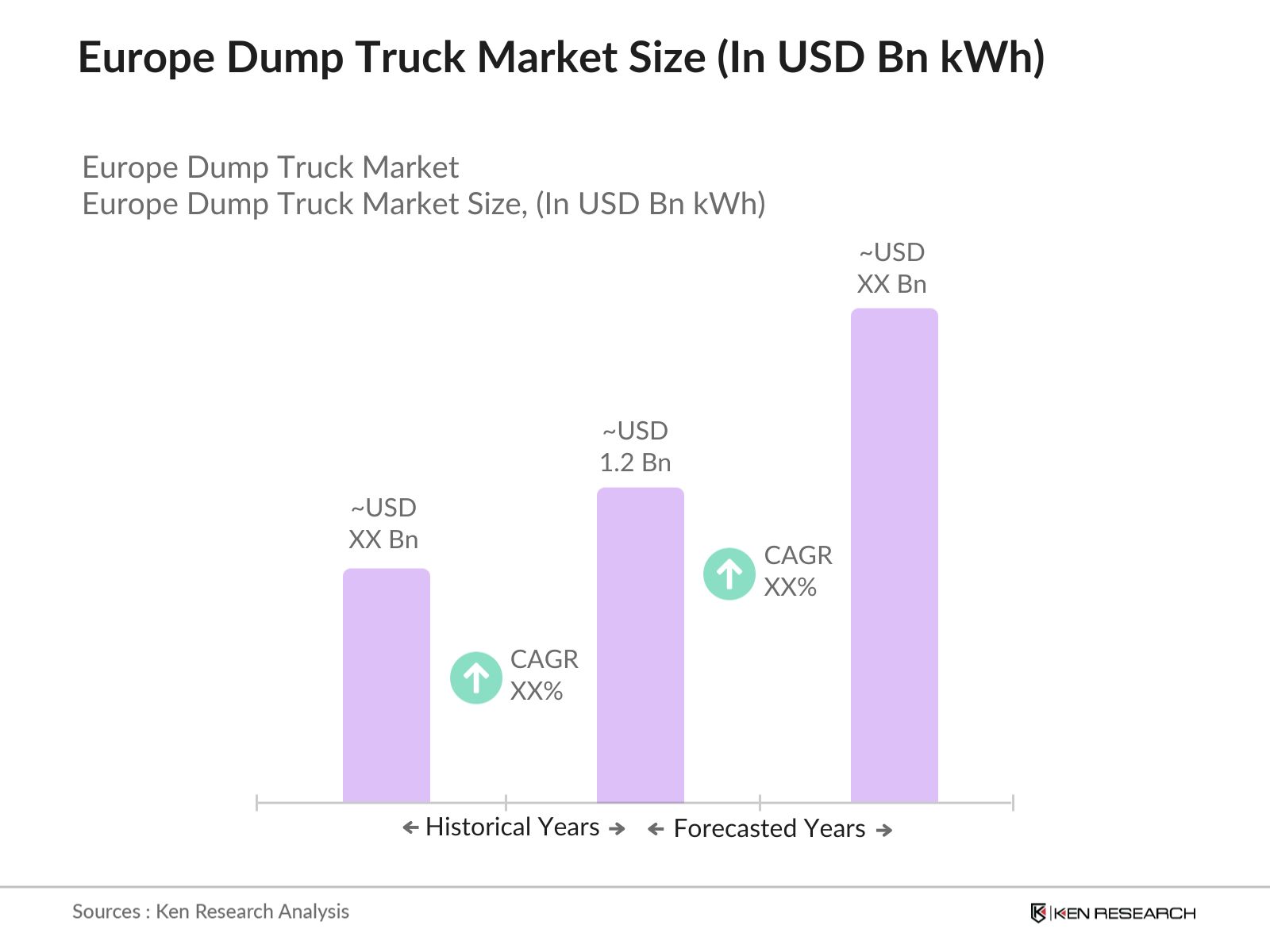
- Key countries dominating the European dump truck market include Germany, the UK, and France. Germanys dominance is attributed to its well-established industrial base and substantial infrastructure investments, particularly in road and railway expansion. France follows closely due to urbanization and construction projects in cities like Paris. The UK remains a strong player, primarily due to increasing demand for dump trucks in construction, driven by large-scale government infrastructure projects like HS2 (High-Speed Rail 2) and urban development in London.
- The European Union's stringent emission standards, particularly the Euro 6 regulations, have a impact on the dump truck market. These regulations limit nitrogen oxide emissions to 0.4 grams per kilowatt-hour, making it challenging for older truck models to comply. In 2024, the EU further tightened its CO2 reduction targets for heavy-duty vehicles, pushing for a 30% reduction by 2030. This has led to a surge in demand for low-emission vehicles, particularly electric and hybrid models, as companies strive to meet regulatory requirements.
Europe Dump Truck Market Segmentation
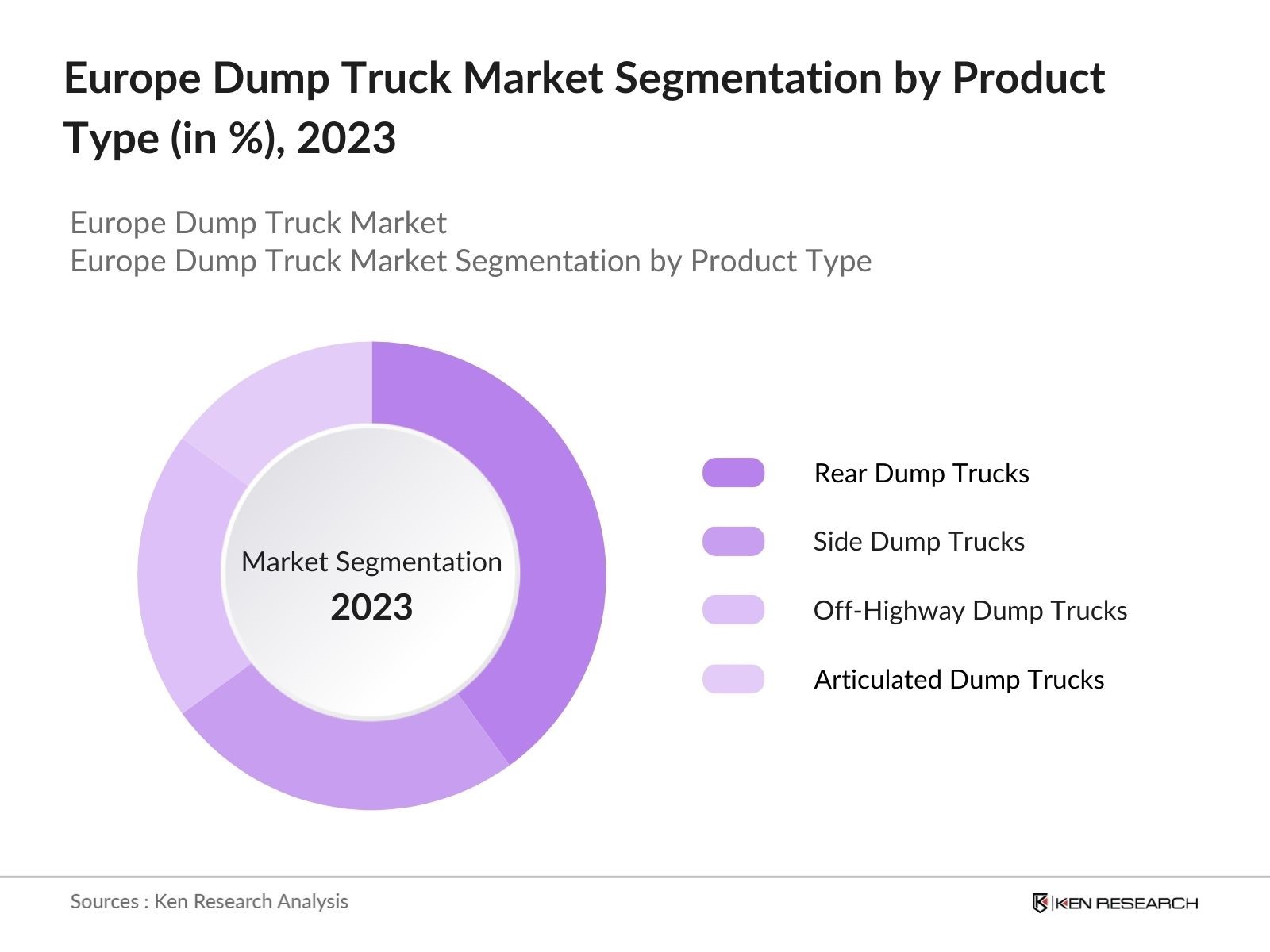
By Product Type: The market is segmented by product type into rear dump trucks, side dump trucks, off-highway dump trucks, and articulated dump trucks. Among these, rear dump trucks dominate the market due to their widespread use in construction and mining applications. These trucks are highly efficient in handling large volumes of materials, which makes them indispensable in heavy-duty tasks. The strong presence of companies like Volvo Trucks and Caterpillar, who manufacture advanced rear dump trucks, also contributes to the segment's growth. Their reliability and capability in operating in rough terrains have solidified their position in the market.
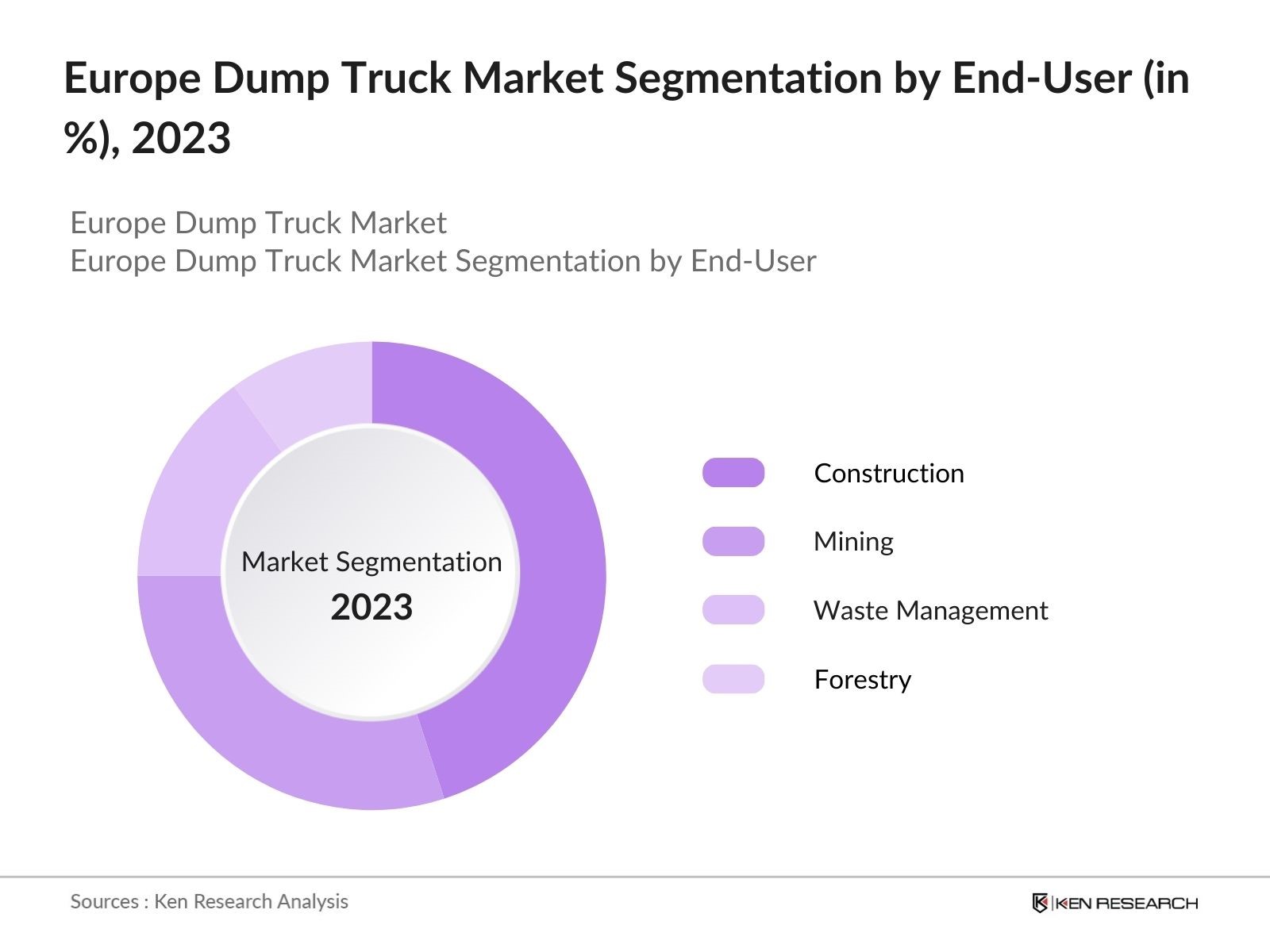
By End-User: The market is further segmented by end-user into construction, mining, waste management, and forestry. The construction sector holds a dominant share due to the massive infrastructure development projects across Europe, including residential, commercial, and industrial buildings. The ongoing emphasis on urbanization and road construction is driving demand for high-capacity dump trucks. Moreover, governmental support for large-scale construction projects aimed at boosting regional connectivity further strengthens the position of this segment. The use of advanced dump trucks in these operations enhances productivity, making them a crucial asset for construction companies.
Europe Dump Truck Market Competitive Landscape
The European dump truck market is characterized by the presence of both global and regional players, with a few dominating the competitive landscape. Key players such as Volvo Trucks, Caterpillar Inc., and Scania AB have maintained a strong foothold due to their extensive product portfolios, technological advancements, and established supply chains. Many of these companies have invested heavily in research and development to introduce electric and autonomous dump trucks, catering to the growing demand for eco-friendly transportation solutions in Europe.
|
Company Name |
Establishment Year |
Headquarters |
Product Range |
R&D Investments |
Regional Presence |
Employee Strength |
Sustainability Initiatives |
Revenue (USD Bn) |
|
Volvo Trucks |
1927 |
Gothenburg, Sweden |
||||||
|
Caterpillar Inc. |
1925 |
Illinois, USA |
||||||
|
Scania AB |
1891 |
Sdertlje, Sweden |
||||||
|
Liebherr Group |
1949 |
Bulle, Switzerland |
||||||
|
Terex Corporation |
1933 |
Connecticut, USA |
Europe Dump Truck Industry Analysis
Growth Drivers
- Infrastructure Development: Europes investment in infrastructure is a key driver of the dump truck market, with major road and rail construction projects fueling demand. In 2024, the European Union has allocated approximately 30 billion for the Trans-European Transport Network (TEN-T), which focuses on expanding transportation corridors. Germany, the largest economy in Europe, has allocated 270 billion for infrastructure projects through 2030, boosting the demand for dump trucks for material transport and site preparation. Similarly, France's Grand Paris Express is currently one of Europes largest urban transit projects, generating dump truck activity.
- Mining Activities: Europes mining sector, particularly in countries like Poland and Sweden, is driving the demand for heavy-duty dump trucks. In 2024, the mining industry in Europe is valued at approximately $80 billion, with material transport being one of the key components of operational costs. Poland's lignite coal mining contributes to the high demand for dump trucks, with nearly 60 million metric tons extracted annually, requiring large-scale transport solutions. Additionally, Sweden's iron ore mining operations, which contribute to 90% of the EU's iron production, rely on dump trucks.
- Urbanization and Construction Boom: The urbanization boom across Europe, especially in countries like Germany and Spain, is a driver of the construction sector. In 2024, over 72% of Europeans live in urban areas, pushing forward large-scale construction projects in housing and industrial zones. Spains recovery plan, NextGenerationEU, allocates over 140 billion for new housing and infrastructure, which creates opportunities for the dump truck market to transport materials like concrete, asphalt, and debris for these developments. Additionally, Germany plans to build 1.5 million homes by 2025, further boosting demand for construction vehicles.
Market Challenges
- Stringent Emission Norms: Europes stringent emission regulations pose a challenge for the dump truck market. The European Commission introduced the Euro 6 emission standards, which require vehicles to emit no more than 0.4 grams of nitrogen oxide per kilowatt-hour. In 2024, several countries like Germany and France are pushing for even stricter measures, making compliance costly for dump truck manufacturers and operators. Trucks that fail to meet these standards are restricted in urban areas, limiting their usability and increasing the cost of operations for companies reliant on older models.
- High Operating and Maintenance Costs: The high operating and maintenance costs of dump trucks, driven by rising fuel prices and frequent service needs, are a considerable challenge in Europe. In 2024, diesel prices in the EU average 1.68 per liter, which directly impacts the profitability of dump truck operations. Maintenance costs for these trucks are also, with annual expenses reaching up to 15,000 per vehicle, especially for older models. Additionally, the cost of replacing parts and maintaining emissions compliance adds to the overall operational expenditure.
Europe Dump Truck Market Future Outlook
Over the next five years, the European dump truck market is expected to show considerable growth driven by continuous advancements in truck technology, the rising adoption of electric vehicles, and increasing government investments in large infrastructure projects. As sustainability becomes a focal point, there will be growing demand for eco-friendly and electric dump trucks, especially in countries like Germany and France, where environmental regulations are stringent. Additionally, technological innovations like autonomous dump trucks will reshape the market landscape, enhancing operational efficiency and reducing labor costs.
Future Market Opportunities
- Electric Dump Trucks: Electric dump trucks are an emerging opportunity in Europe as the continent strives for zero-emission transport solutions. In 2024, the European Union set a target to cut 50% of CO2 emissions from heavy-duty vehicles by 2030. Volvo and other manufacturers are now launching fully electric dump trucks capable of transporting 40 tons per load. Electric vehicles reduce operating costs by up to 20% and eliminate diesel consumption, making them a sustainable and economically viable option for companies looking to meet emissions regulations while cutting fuel costs.
- Expansion into Eastern Europe: Eastern Europe presents a growth opportunity for the dump truck market, particularly in emerging economies like Romania and Bulgaria. These countries are experiencing rapid growth in infrastructure development, driven by European Union funding. For instance, Romania received 30 billion under the Recovery and Resilience Facility in 2024, earmarked for roads, railways, and construction, creating high demand for heavy-duty dump trucks. Additionally, Bulgarias investments in mining and construction have increased, further enhancing the need for reliable material transport vehicles.
Scope of the Report
|
By Product Type |
Rear Dump Trucks Side Dump Trucks Off-Highway Dump Trucks Articulated Dump Truck |
|
By End-User |
Construction Mining Waste Management Forestry |
|
By Engine Capacity |
Below 200 HP 201-400 HP Above 400 HP |
|
By Fuel Type |
Diesel Hybrid Electric |
|
By Region |
Western Eastern Northern Southern |
Products
Key Target Audience
Dump Truck Manufacturers
Heavy Equipment Dealers
Construction Firms
Mining Companies
Government and Regulatory Bodies (European Commission, National Environmental Agencies)
Transportation and Logistics Companies
Investor and Venture Capitalist Firms
Technology Providers (Autonomous Driving and Electric Vehicle Tech)
Banks and Financial Institutions
Companies
Major Players
Volvo Trucks
Caterpillar Inc.
Scania AB
Liebherr Group
Terex Corporation
Komatsu Ltd.
Hitachi Construction Machinery
Bell Equipment
John Deere
Tata Motors
Ashok Leyland
Daimler AG
MAN SE
Isuzu Motors
Iveco Group
Table of Contents
1. Europe Dump Truck Market Overview
1.1. Definition and Scope
1.2. Market Taxonomy
1.3. Market Growth Rate
1.4. Market Segmentation Overview
2. Europe Dump Truck Market Size (In USD Bn)
2.1. Historical Market Size
2.2. Year-On-Year Growth Analysis
2.3. Key Market Developments and Milestones
3. Europe Dump Truck Market Analysis
3.1. Growth Drivers
3.1.1. Increasing Construction and Infrastructure Projects (Infrastructure Growth, Government Spending)
3.1.2. Rise in Mining Activities (Mining Exploration, Commodity Demand)
3.1.3. Technological Advancements in Dump Trucks (Automation, Electric Dump Trucks)
3.1.4. Government Regulations Supporting Sustainable Transport (Emissions Standards, Green Initiatives)
3.2. Market Challenges
3.2.1. High Initial Investment Costs (Cost of Ownership, Equipment Leasing)
3.2.2. Fluctuating Raw Material Prices (Steel, Tires, Fuel Costs)
3.2.3. Environmental Concerns and Emission Regulations (Carbon Footprint, Environmental Impact)
3.3. Opportunities
3.3.1. Growing Focus on Electric and Hybrid Dump Trucks (Electrification, Reduced Operating Costs)
3.3.2. Expansion of Smart City Projects (Urbanization, Waste Management)
3.3.3. Increased Use in Renewable Energy Projects (Wind Farms, Solar Plants)
3.4. Trends
3.4.1. Autonomous Dump Trucks (Self-driving Capabilities, Safety Innovations)
3.4.2. Increasing Preference for Renting and Leasing over Purchasing (Cost Efficiency, Maintenance)
3.4.3. Integration of Telematics and IoT in Dump Trucks (Real-time Monitoring, Efficiency Optimization)
3.5. Government Regulations
3.5.1. Euro Emission Standards for Heavy-Duty Vehicles (CO2 Emissions, Compliance Costs)
3.5.2. Sustainability and Green Transport Initiatives (Green Deal, Electric Vehicle Subsidies)
3.5.3. Road Safety Regulations (Heavy-Duty Vehicle Safety Standards)
3.6. SWOT Analysis
3.6.1. Strengths (Strong Demand in Infrastructure, Technological Advancements)
3.6.2. Weaknesses (High Operating Costs, Regulatory Pressures)
3.6.3. Opportunities (Growing Renewable Projects, Expanding Rental Market)
3.6.4. Threats (Economic Slowdown, Fluctuating Raw Material Costs)
3.7. Stakeholder Ecosystem
3.7.1. OEMs
3.7.2. Rental and Leasing Companies
3.7.3. End-users (Construction Companies, Mining Firms)
3.7.4. Component Suppliers
3.8. Porter’s Five Forces Analysis
3.8.1. Bargaining Power of Suppliers
3.8.2. Bargaining Power of Buyers
3.8.3. Threat of New Entrants
3.8.4. Threat of Substitutes
3.8.5. Industry Rivalry
3.9. Competition Ecosystem
3.9.1. Market Share Analysis (Top Players, Market Penetration)
3.9.2. Competitive Landscape (Pricing Strategies, Distribution Networks)
4. Europe Dump Truck Market Segmentation
4.1. By Type (In Value %)
4.1.1. Standard Dump Trucks
4.1.2. Articulated Dump Trucks
4.1.3. Transfer Dump Trucks
4.1.4. Side Dump Trucks
4.1.5. Super Dump Trucks
4.2. By Application (In Value %)
4.2.1. Construction
4.2.2. Mining
4.2.3. Infrastructure
4.2.4. Waste Management
4.2.5. Agriculture
4.3. By Payload Capacity (In Value %)
4.3.1. Below 15 Tons
4.3.2. 15-30 Tons
4.3.3. 31-50 Tons
4.3.4. Above 50 Tons
4.4. By Fuel Type (In Value %)
4.4.1. Diesel
4.4.2. Electric
4.4.3. Hybrid
4.5. By Region (In Value %)
4.5.1. Western
4.5.2. Eastern
4.5.3. Northern
4.5.4. Southern
4.5.5. Central
5. Europe Dump Truck Market Competitive Analysis
5.1. Detailed Profiles of Major Companies
5.1.1. Volvo Trucks
5.1.2. Caterpillar Inc.
5.1.3. Komatsu Ltd.
5.1.4. Liebherr Group
5.1.5. Hitachi Construction Machinery Co., Ltd.
5.1.6. Scania AB
5.1.7. MAN Truck & Bus SE
5.1.8. Mercedes-Benz Trucks
5.1.9. Bell Equipment
5.1.10. John Deere
5.1.11. Kenworth
5.1.12. Terex Trucks
5.1.13. Mack Trucks
5.1.14. Hino Motors
5.1.15. Sany Heavy Industry
5.2. Cross Comparison Parameters (Number of Employees, Headquarters, Inception Year, Revenue, Product Portfolio, Geographical Reach, Sustainability Initiatives, Technology Adoption)
5.3. Market Share Analysis
5.4. Strategic Initiatives
5.5. Mergers and Acquisitions
5.6. Investment Analysis
5.7. Government Grants
5.8. Private Equity Investments
6. Europe Dump Truck Market Regulatory Framework
6.1. Environmental Standards (Emissions Regulations, Noise Pollution Control)
6.2. Safety Standards (Driver Assistance Systems, Crashworthiness)
6.3. Compliance and Certification (ISO Standards, EU Certification)
7. Europe Dump Truck Future Market Size (In USD Bn)
7.1. Future Market Size Projections
7.2. Key Factors Driving Future Market Growth
8. Europe Dump Truck Future Market Segmentation
8.1. By Type
8.2. By Application
8.3. By Payload Capacity
8.4. By Fuel Type
8.5. By Region
9. Europe Dump Truck Market Analysts’ Recommendations
9.1. TAM/SAM/SOM Analysis
9.2. Customer Cohort Analysis
9.3. Marketing Initiatives
9.4. White Space Opportunity Analysis
Disclaimer
Contact Us
Research Methodology
Step 1: Identification of Key Variables
The first step involves identifying critical variables within the Europe Dump Truck Market, including end-user demand, regulatory influence, and technological advancements. Extensive desk research is conducted using proprietary databases and industry reports to gather relevant data. This process helps outline the market landscape.
Step 2: Market Analysis and Construction
In this phase, historical data is analyzed to understand the demand patterns and key market drivers. A thorough evaluation of the market structure is conducted, including analysis of product categories and segmentation by geography and end-use industries.
Step 3: Hypothesis Validation and Expert Consultation
After analyzing the data, hypotheses are created to predict future trends. These are validated through interviews and consultations with industry experts who provide insights on market dynamics and operational challenges.
Step 4: Research Synthesis and Final Output
Finally, the data collected is synthesized into a comprehensive market report, including accurate forecasts, company profiling, and segment-specific analysis. The bottom-up approach ensures that the report is backed by verifiable data.
Frequently Asked Questions
01. How big is the Europe Dump Truck Market?
The Europe dump truck market is valued at USD 12.5 billion, driven by infrastructure development, mining operations, and urbanization projects across major European countries.
02. What are the challenges in the Europe Dump Truck Market? Table of Contents: Europe Dump Truck Market
Challenges in the Europe dump truck market include high operational and maintenance costs, stringent environmental regulations, and a shortage of skilled labor for operating heavy-duty trucks.
03. Who are the major players in the Europe Dump Truck Market?
Key players in the Europe dump truck market include Volvo Trucks, Caterpillar Inc., Scania AB, Liebherr Group, and Terex Corporation, known for their technological advancements and wide range of products.
04. What are the growth drivers of the Europe Dump Truck Market?
Growth in the Europe dump truck market is propelled by infrastructure development projects, the adoption of electric and autonomous vehicles, and government support for eco-friendly transportation solutions.
05. Which countries dominate the Europe Dump Truck Market?
Germany, the UK, and France dominate the market due to their industrial base, infrastructure investments, and strong regulatory frameworks promoting sustainability and efficiency in the Europe dump truck market.
Why Buy From Us?

What makes us stand out is that our consultants follows Robust, Refine and Result (RRR) methodology. i.e. Robust for clear definitions, approaches and sanity checking, Refine for differentiating respondents facts and opinions and Result for presenting data with story

We have set a benchmark in the industry by offering our clients with syndicated and customized market research reports featuring coverage of entire market as well as meticulous research and analyst insights.

While we don't replace traditional research, we flip the method upside down. Our dual approach of Top Bottom & Bottom Top ensures quality deliverable by not just verifying company fundamentals but also looking at the sector and macroeconomic factors.

With one step in the future, our research team constantly tries to show you the bigger picture. We help with some of the tough questions you may encounter along the way: How is the industry positioned? Best marketing channel? KPI's of competitors? By aligning every element, we help maximize success.

Our report gives you instant access to the answers and sources that other companies might choose to hide. We elaborate each steps of research methodology we have used and showcase you the sample size to earn your trust.

If you need any support, we are here! We pride ourselves on universe strength, data quality, and quick, friendly, and professional service.