
Europe Sewing Machine Market Outlook to 2030
Region:Albania
Author(s):Shreya Garg
Product Code:KROD8192
Region:Albania
Author(s):Shreya Garg
Product Code:KROD8192
December 2024
100
By Product Type: The market is segmented by product type into mechanical, electronic, computerized, overlock, and embroidery machines. Recently, computerized sewing machines have captured a dominant share in the market due to their ability to perform a range of complex stitching tasks with precision, appealing to both professionals and hobbyists. The surge in demand is attributed to their versatility and automation features, which cater to efficiency-focused manufacturing environments as well as custom embroidery applications. 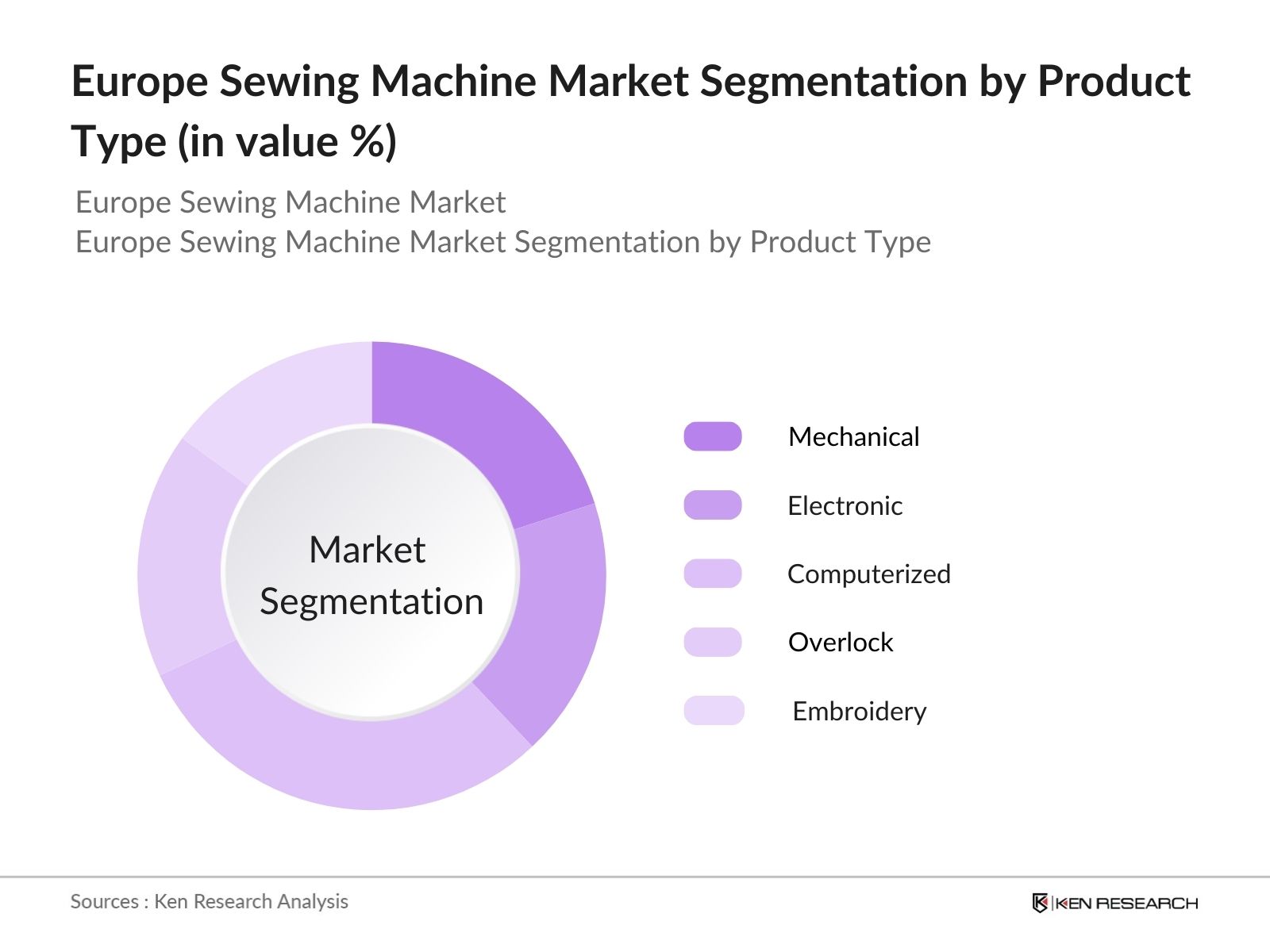
By Application: The market is further segmented by application into household, industrial, and commercial sectors. In this segmentation, the industrial segment holds a significant share, driven by the regions high-volume apparel and textile production demands. Industrial sewing machines are engineered for durability and speed, making them essential in factories and mass-production settings. This segments dominance is reinforced by rising demand from textile manufacturers in Western Europe, who rely on these machines to maintain high output and consistent quality. 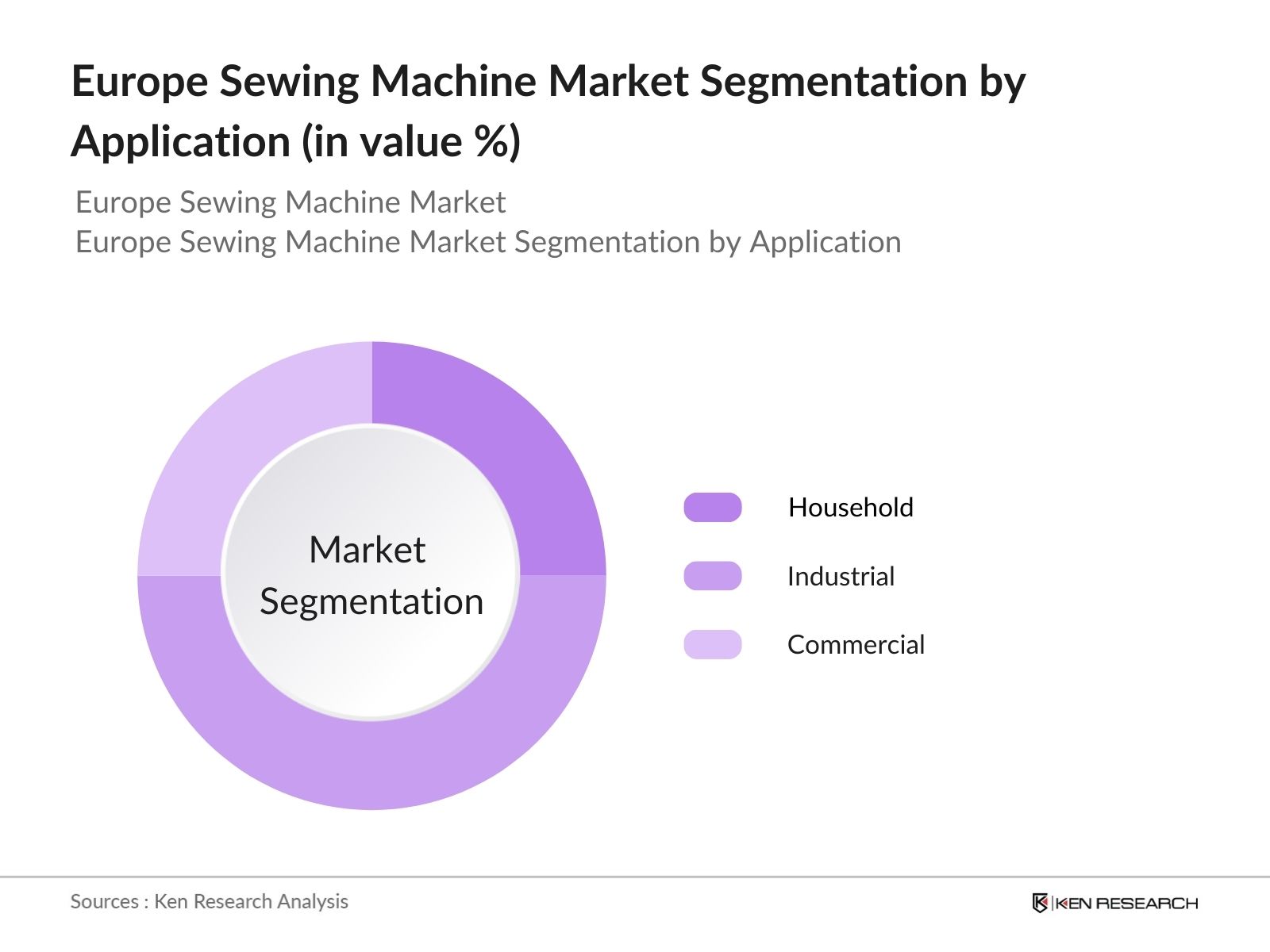
The Europe Sewing Machine market is dominated by prominent players that specialize in both industrial and domestic sewing solutions. These companies not only cater to the European demand but also drive exports globally, showcasing strong brand loyalty and innovation in sewing technology. The Europe Sewing Machine market's competitive landscape reflects a blend of established multinational players and niche local brands.
|
Company |
Established |
Headquarters |
Product Range |
Key Markets |
Innovation Focus |
Revenue |
Employee Strength |
Distribution Channels |
|
Brother Industries Ltd. |
1908 |
Japan |
||||||
|
Bernina International AG |
1893 |
Switzerland |
||||||
|
Juki Corporation |
1938 |
Japan |
||||||
|
Singer Corporation |
1851 |
USA |
||||||
|
Pfaff |
1862 |
Germany |
The Europe Sewing Machine Market is expected to see continued demand growth, driven by an increase in home-based apparel businesses, evolving preferences for custom clothing, and technological advancements in sewing efficiency and automation. The steady focus on sustainability and eco-friendly production practices among European manufacturers is also expected to fuel the adoption of energy-efficient machines. Additionally, growing exports to emerging markets will likely boost production needs for industrial sewing machines.
|
Product Type |
Mechanical Electronic Computerized Overlock Embroidery |
|
Application |
Household Industrial Commercial |
|
Sales Channel |
Direct Sales Specialty Retailers E-commerce Distributors and Wholesalers |
|
End-User Industry |
Apparel Automotive Furniture Upholstery Leather and Footwear |
|
Region |
West East North South |
1.1. Definition and Scope
1.2. Market Taxonomy
1.3. Market Growth Rate (Growth Rate by Product Type, Application)
1.4. Market Segmentation Overview
2.1. Historical Market Size
2.2. Year-On-Year Growth Analysis
2.3. Key Market Developments and Milestones
3.1. Growth Drivers
- 3.1.1. Demand in Apparel Industry (Demand from SMEs and Major Brands)
- 3.1.2. Growth of Home Sewing Trends
- 3.1.3. Industrial Automation (Automation Impact on Production)
- 3.1.4. Government Initiatives in Skill Development
3.2. Market Challenges
- 3.2.1. High Manufacturing Costs (Material and Labor Costs)
- 3.2.2. Competitive Pricing Pressures
- 3.2.3. Supply Chain Disruptions
3.3. Opportunities
- 3.3.1. Emerging Demand in Home-based Businesses
- 3.3.2. Technological Advancements in Stitching Precision
- 3.3.3. Export Growth to Emerging Markets
3.4. Market Trends
- 3.4.1. Integration of IoT for Smart Sewing Machines
- 3.4.2. Rising Popularity of Customization and Personalization
- 3.4.3. Adoption of Energy-efficient Machines
3.5. Government Regulations
- 3.5.1. EU Machinery Directives (Compliance and Standards)
- 3.5.2. Environmental Policies on Emissions
- 3.5.3. Subsidies for Industrial Automation
3.6. SWOT Analysis
3.7. Stakeholder Ecosystem (Manufacturers, Distributors, End-users)
3.8. Porters Five Forces Analysis
3.9. Competitive Landscape Ecosystem
4.1. By Product Type (In Value %)
- 4.1.1. Mechanical Sewing Machines
- 4.1.2. Electronic Sewing Machines
- 4.1.3. Computerized Sewing Machines
- 4.1.4. Overlock Sewing Machines
- 4.1.5. Embroidery Machines
4.2. By Application (In Value %)
- 4.2.1. Household
- 4.2.2. Industrial
- 4.2.3. Commercial
4.3. By Sales Channel (In Value %)
- 4.3.1. Direct Sales
- 4.3.2. Specialty Retailers
- 4.3.3. E-commerce Platforms
- 4.3.4. Distributors and Wholesalers
4.4. By End-User Industry (In Value %)
- 4.4.1. Apparel
- 4.4.2. Automotive
- 4.4.3. Furniture Upholstery
- 4.4.4. Leather and Footwear
4.5. By Region (In Value %)
- 4.5.1. Western Europe
- 4.5.2. Eastern Europe
- 4.5.3. Northern Europe
- 4.5.4. Southern Europe
- 4.5.5. Central Europe
5.1. Detailed Profiles of Major Companies
- 5.1.1. Bernina International AG
- 5.1.2. Brother Industries Ltd.
- 5.1.3. Janome Sewing Machine Co. Ltd.
- 5.1.4. Singer Corporation
- 5.1.5. Juki Corporation
- 5.1.6. PFAFF
- 5.1.7. Husqvarna Viking
- 5.1.8. Consew
- 5.1.9. Baby Lock
- 5.1.10. Elna International
- 5.1.11. Pegasus Sewing Machine Mfg. Co. Ltd.
- 5.1.12. Durkopp Adler AG
- 5.1.13. Rimoldi & CF
- 5.1.14. Toyota Home Sewing
- 5.1.15. Global Industrial Sewing Machines
5.2. Cross Comparison Parameters (Product Portfolio, Market Share, Innovation, Distribution Network, Revenue, Regional Reach, Technological Capabilities, Customer Support)
5.3. Market Share Analysis
5.4. Strategic Initiatives (Joint Ventures, Partnerships, Product Launches)
5.5. Mergers and Acquisitions
5.6. Investment Analysis
5.7. Venture Capital and Funding
5.8. Government Grants
5.9. Private Equity Investments
6.1. EU Machinery Safety Standards
6.2. Compliance with Product Safety Directives
6.3. Certification Requirements for Imports
6.4. Environmental Impact Regulations
7.1. Future Market Size Projections
7.2. Key Drivers for Future Market Growth
8.1. By Product Type
8.2. By Application
8.3. By Sales Channel
8.4. By End-User Industry
8.5. By Region
9.1. TAM/SAM/SOM Analysis
9.2. Customer Segment Analysis
9.3. Strategic Marketing Recommendations
9.4. White Space Opportunity Analysis
Disclaimer Contact UsThe initial phase involved constructing an ecosystem map of all major stakeholders within the Europe Sewing Machine Market. This step was supported by extensive desk research using secondary and proprietary databases to outline the critical variables affecting market dynamics.
This phase included compiling historical data on market penetration, examining the ratio of product types across household, industrial, and commercial applications, and assessing resultant revenue generation. This analysis focused on data consistency and industry reliability.
Market hypotheses were developed and validated through computer-assisted interviews with industry experts across multiple companies, providing insights into operational and financial performance factors and ensuring data accuracy.
The final phase engaged directly with sewing machine manufacturers, acquiring detailed insights into product segments, sales performance, and consumer preferences. This step verified and enriched statistics derived from the bottom-up approach, ensuring a comprehensive and validated analysis.
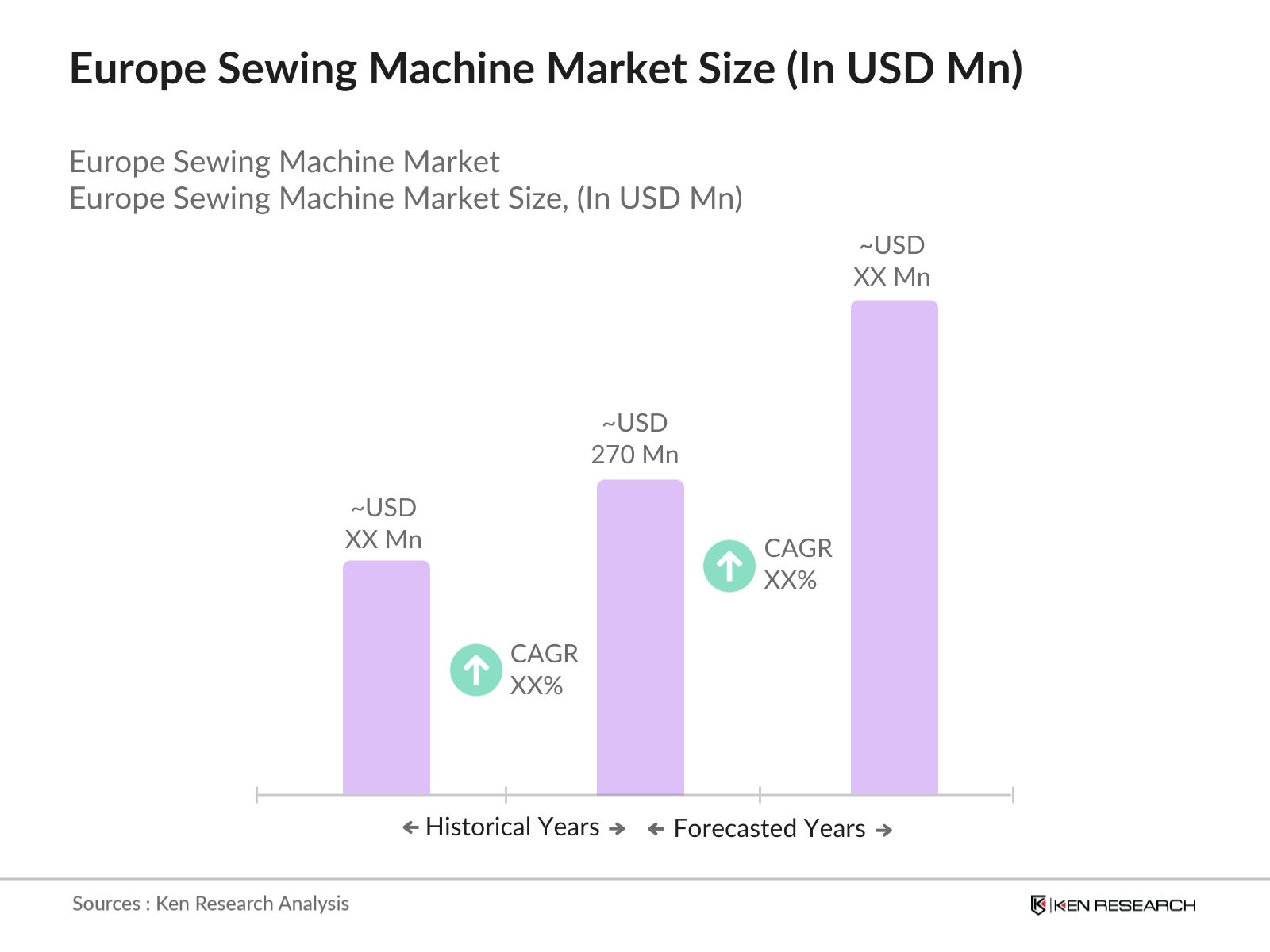
The Europe Sewing Machine Market is valued at USD 270 million, with demand driven by the apparel industry and advancements in machine technology.
Challenges in the Europe Sewing Machine Market include competitive pricing pressures, high manufacturing costs, and ongoing supply chain disruptions impacting timely availability of components.
Key players in the Europe Sewing Machine Market include Brother Industries, Bernina International, Juki Corporation, Singer Corporation, and Pfaff, each holding strong market positions due to innovation and distribution strength.
The Europe Sewing Machine Market is driven by demand from the apparel and textile sectors, increased popularity of home-based businesses, and continuous technological advancements in automation and IoT integration.
The industrial segment dominates the Europe Sewing Machine Market due to high demand from textile manufacturing, where speed, durability, and high output are critical requirements.

What makes us stand out is that our consultants follows Robust, Refine and Result (RRR) methodology. i.e. Robust for clear definitions, approaches and sanity checking, Refine for differentiating respondents facts and opinions and Result for presenting data with story

We have set a benchmark in the industry by offering our clients with syndicated and customized market research reports featuring coverage of entire market as well as meticulous research and analyst insights.

While we don't replace traditional research, we flip the method upside down. Our dual approach of Top Bottom & Bottom Top ensures quality deliverable by not just verifying company fundamentals but also looking at the sector and macroeconomic factors.

With one step in the future, our research team constantly tries to show you the bigger picture. We help with some of the tough questions you may encounter along the way: How is the industry positioned? Best marketing channel? KPI's of competitors? By aligning every element, we help maximize success.

Our report gives you instant access to the answers and sources that other companies might choose to hide. We elaborate each steps of research methodology we have used and showcase you the sample size to earn your trust.

If you need any support, we are here! We pride ourselves on universe strength, data quality, and quick, friendly, and professional service.