
Global 3D Printing Industry Outlook to 2030
Region:Global
Author(s):Sanjeev
Product Code:KROD1735
Region:Global
Author(s):Sanjeev
Product Code:KROD1735
October 2024
95
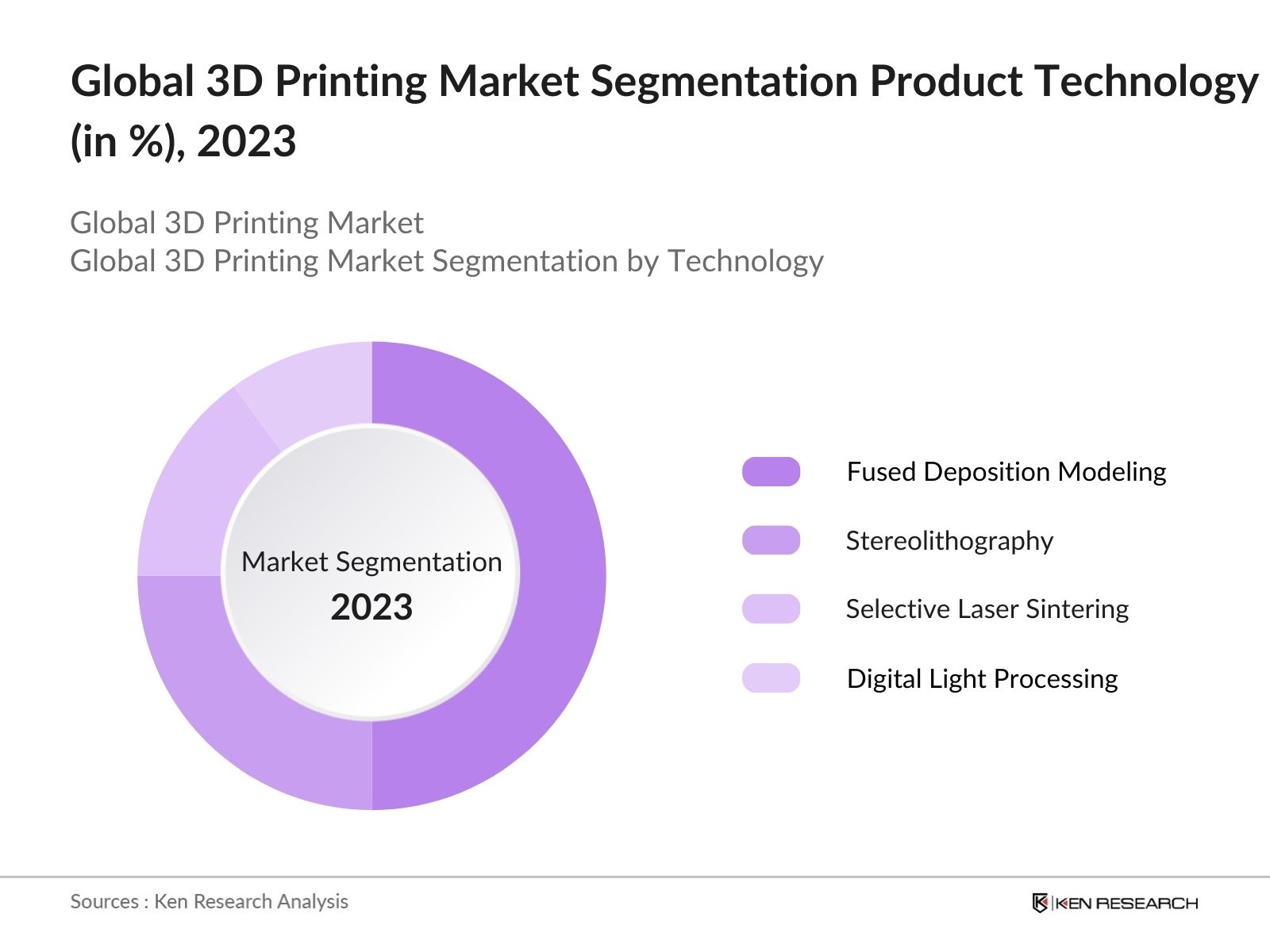
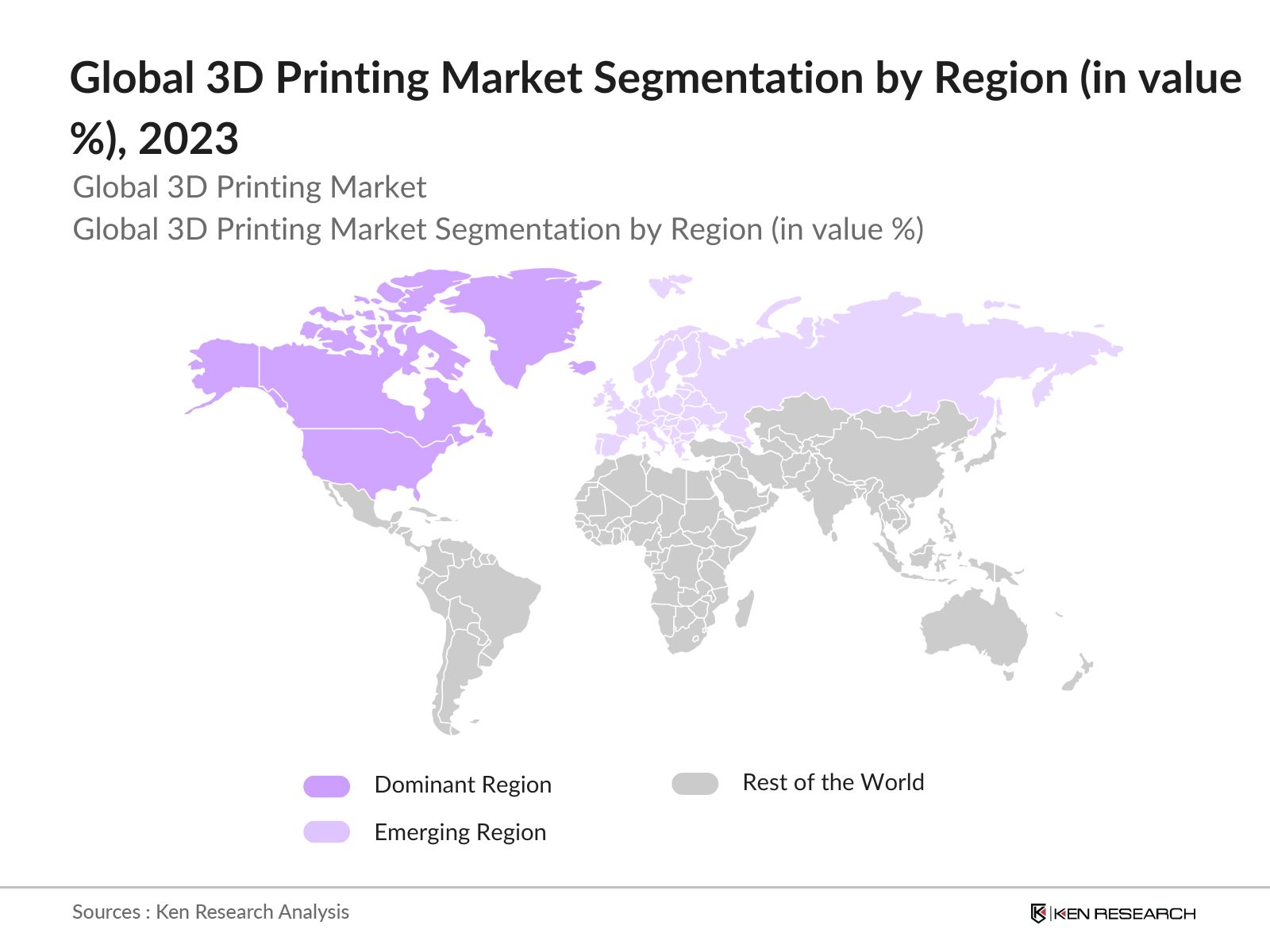
The Global 3D Printing Market can be segmented based on technology, application, and region:
|
Company |
Establishment Year |
Headquarters |
|
Renishaw plc |
1973 |
Wotton-under-Edge, UK |
|
SLM Solutions Group AG |
2006 |
Lbeck, Germany |
|
ExOne Company |
2005 |
North Huntingdon, USA |
|
Voxeljet AG |
1999 |
Friedberg, Germany |
|
HP Inc. |
1939 |
Palo Alto, USA |
Rising Demand for Customized Products: The increasing demand for customized and personalized products across various industries is driving the need for 3D printing solutions. The flexibility of additive manufacturing allows for the production of bespoke designs and short production runs that traditional manufacturing cannot efficiently accommodate. The automotive sector also shows a strong inclination toward 3D printing for producing lightweight and fuel-efficient components, holding a market share exceeding61%in 2023.
High Initial Investment Costs: The cost of acquiring advanced 3D printing equipment, materials, and necessary software can be prohibitive, particularly for small and medium-sized enterprises. These upfront costs, along with ongoing maintenance and operational expenses, can slow down the adoption of 3D printing technologies, especially in industries with tight budgets.
Horizon 2020 Program (European Union): Horizon 2020, the EU's largest research and innovation program, ran from 2014 to 2020 with a budget of 80 billion. General Electric has been incorporating 3D printing into its digital technology mission for some years now, investing USD 1.5 bn in the pioneering technique since 2010. This program has played a crucial role in enhancing the global competitiveness of European industries, fostering innovation in additive manufacturing, and supporting numerous 3D printing projects that have led to significant technological advancements.
The Global 3D Printing Market is expected to continue its growth, driven by the increasing demand for customized manufacturing solutions, advancements in 3D printing technologies, and the growing focus on sustainable and efficient production methods.
|
By Region |
North America Europe Asia-Pacific Latin America Middle East & Africa |
|
By Technology |
Stereolithography (SLA) Fused Deposition Modeling (FDM) Selective Laser Sintering (SLS) Digital Light Processing (DLP) |
|
By Application |
Aerospace & Defense Healthcare Automotive Industrial Consumer Products |
|
By Material |
Polymers Ceramics Metals |
|
By Functionality |
Prototyping Tooling Production Parts End-of-Life Parts Customization |
1.1. Definition and Scope
1.2. Market Taxonomy
1.3. Market Growth Rate
1.4. Market Segmentation Overview
2.1. Historical Market Size
2.2. Year-on-Year Growth Analysis
2.3. Key Market Developments and Milestones
3.1. Growth Drivers
3.1.1. Rising Demand for Customized Products
3.1.2. Advancements in 3D Printing Technology
3.1.3. Government Support for Innovation
3.2. Restraints
3.2.1. High Initial Investment Costs
3.2.2. Material Limitations and Costs
3.2.3. Lack of Standardization and Certification
3.3. Opportunities
3.3.1. Expansion of Metal 3D Printing
3.3.2. Growth in Healthcare Applications
3.3.3. Integration of Artificial Intelligence
3.4. Trends
3.4.1. Increased Adoption of AI and Machine Learning
3.4.2. Rise in Sustainable Manufacturing Practices
3.4.3. Focus on Customization and On-Demand Production
3.5. Government Regulation
3.5.1. Horizon 2020 Program (European Union)
3.5.2. Made Smarter Initiative (UK)
3.5.3. America Makes Initiative (USA)
3.5.4. National Additive Manufacturing Innovation Fund (China)
3.6. SWOT Analysis
3.7. Stake Ecosystem
3.8. Competition Ecosystem
4.1. By Technology (in Value %)
4.1.1. Stereolithography (SLA)
4.1.2. Fused Deposition Modeling (FDM)
4.1.3. Selective Laser Sintering (SLS)
4.1.4. Digital Light Processing (DLP)
4.2. By Application (in Value %)
4.2.1. Aerospace & Defense
4.2.2. Healthcare
4.2.3. Automotive
4.2.4. Industrial
4.2.5. Consumer Products
4.3. By Material (in Value %)
4.3.1. Polymers
4.3.2. Ceramics
4.3.3. Metals
4.3.4. Biomaterials
4.3.5. Elastomers
4.3.6. Composites
4.3.7. Hybrid Materials
4.3.8. Recycled Materials
4.4. By Region (in Value %)
4.4.1. North America
4.4.2. Europe
4.4.3. Asia-Pacific
4.4.4. Latin America
4.4.5. Middle East & Africa
4.5. By Functionality (in Value %)
4.5.1. Prototyping
4.5.2. Tooling
4.5.3. Production Parts
4.5.4. End-of-Life Parts
4.5.5. Customization
5.1 Detailed Profiles of Major Companies
5.1.1. Stratasys Ltd.
5.1.2. 3D Systems Corporation
5.1.3. Materialise NV
5.1.4. EOS GmbH
5.1.5. Renishaw plc
5.1.6. SLM Solutions Group AG
5.1.7. ExOne Company
5.1.8. Voxeljet AG
5.1.9. HP Inc.
5.1.10. GE Additive
5.1.11. Markforged Inc.
5.1.12. Ultimaker BV
5.1.13. Desktop Metal Inc.
5.2 Cross Comparison Parameters (No. of Employees, Headquarters, Inception Year, Revenue)
6.1. Market Share Analysis
6.2. Strategic Initiatives
6.3. Mergers and Acquisitions
6.4. Investment Analysis
6.4.1. Venture Capital Funding
6.4.2. Government Grants
6.4.3. Private Equity Investments
7.1. Environmental Standards
7.2. Compliance Requirements
7.3. Certification Processes
8.1. Future Market Size Projections
8.2. Key Factors Driving Future Market Growth
9.1. By Technology (in Value %)
9.2. By Application (in Value %)
9.3. By Material (in Value %)
9.4. By Region (in Value %)
10.1. TAM/SAM/SOM Analysis
10.2. Customer Cohort Analysis
10.3. Marketing Initiatives
10.4. White Space Opportunity Analysis
Disclaimer Contact UsBuilding an ecosystem of major entities in the Global 3D Printing Market and referencing multiple secondary and proprietary databases to conduct desk research. This includes gathering industry-level information on market drivers, challenges, and key players, as well as understanding technological advancements and regulatory impacts.
Collecting statistics on the global 3D Printing market over the years, including historical market size, growth rates, and adoption of 3D printing technologies. We will analyze market share, revenue generated by major players, and emerging trends to ensure accuracy and reliability in the data presented.
Formulating market hypotheses and conducting CATIs (Computer-Assisted Telephone Interviews) with industry experts from leading 3D printing companies. These interviews will help validate the collected statistics and provide insights into operational and financial aspects directly from company representatives.
Our team will engage with multiple 3D printing technology providers to understand the dynamics of market segments, consumer preferences, and sales trends. This process will validate the derived statistics using a bottom-to-top approach, ensuring that the final data accurately reflects the actual market conditions.
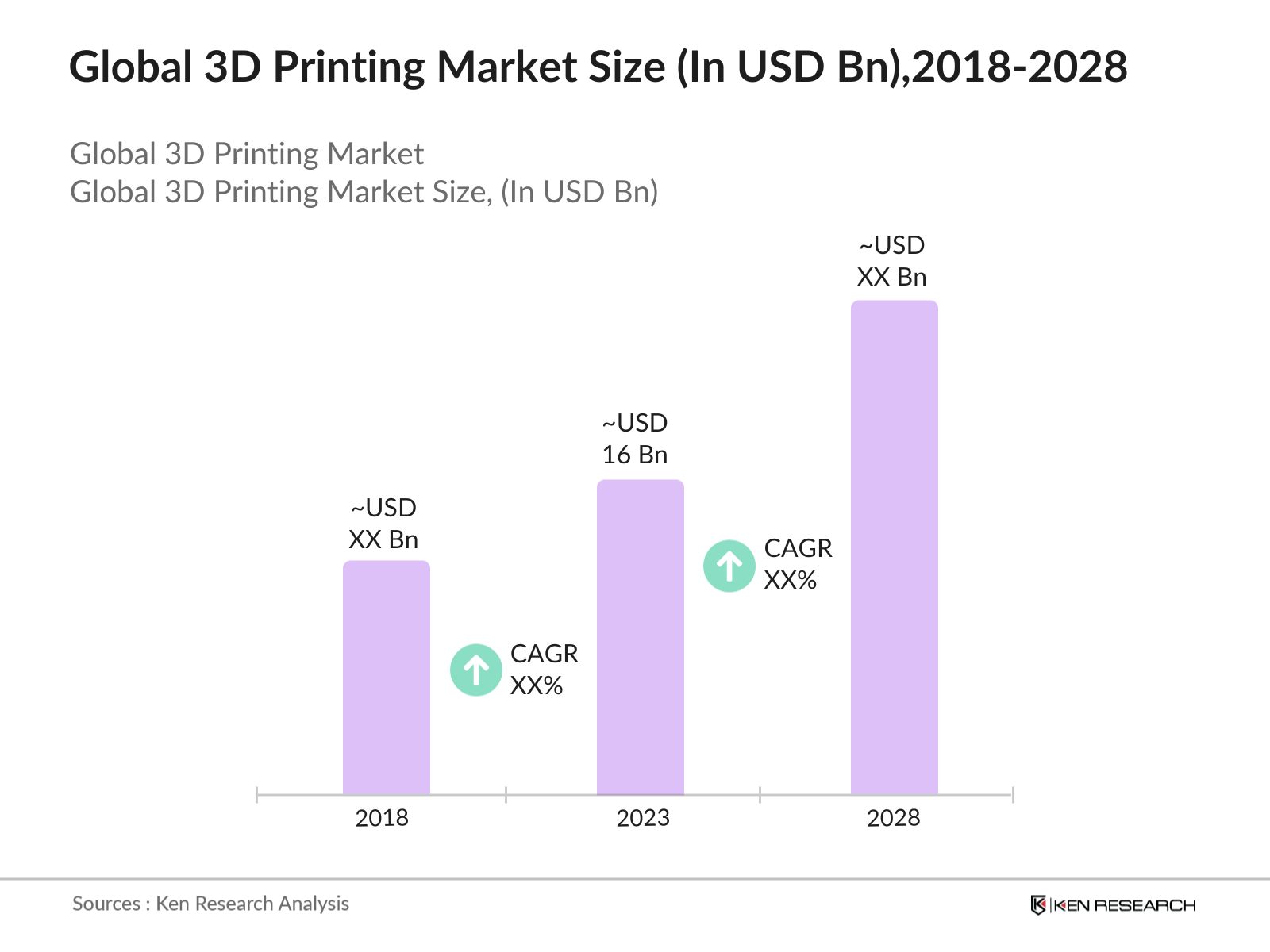
In 2023, the Global 3D Printing Market was valued at USD 16 billion. The market is driven by the increasing demand for customized manufacturing solutions, coupled with technological advancements in additive manufacturing. The market's growth reflects the critical role of these technologies in enhancing production efficiency and product innovation.
Challenges in the Global 3D Printing Market include high initial investment costs and the limitations of available materials. Additionally, integrating 3D printing into existing manufacturing workflows can be complex and require significant technical expertise.
Major players in the Global 3D Printing Market include Stratasys Ltd., 3D Systems Corporation, Materialise NV, and EOS GmbH. These companies are at the forefront of innovation in additive manufacturing technologies, offering comprehensive solutions that cater to various industries.
Key growth drivers in the Global 3D Printing Market include the rising demand for customized products across industries and the continuous advancements in 3D printing technologies, such as multi-material and metal 3D printing. Government support for innovation and sustainable manufacturing practices also contributes to market growth.

What makes us stand out is that our consultants follows Robust, Refine and Result (RRR) methodology. i.e. Robust for clear definitions, approaches and sanity checking, Refine for differentiating respondents facts and opinions and Result for presenting data with story

We have set a benchmark in the industry by offering our clients with syndicated and customized market research reports featuring coverage of entire market as well as meticulous research and analyst insights.

While we don't replace traditional research, we flip the method upside down. Our dual approach of Top Bottom & Bottom Top ensures quality deliverable by not just verifying company fundamentals but also looking at the sector and macroeconomic factors.

With one step in the future, our research team constantly tries to show you the bigger picture. We help with some of the tough questions you may encounter along the way: How is the industry positioned? Best marketing channel? KPI's of competitors? By aligning every element, we help maximize success.

Our report gives you instant access to the answers and sources that other companies might choose to hide. We elaborate each steps of research methodology we have used and showcase you the sample size to earn your trust.

If you need any support, we are here! We pride ourselves on universe strength, data quality, and quick, friendly, and professional service.