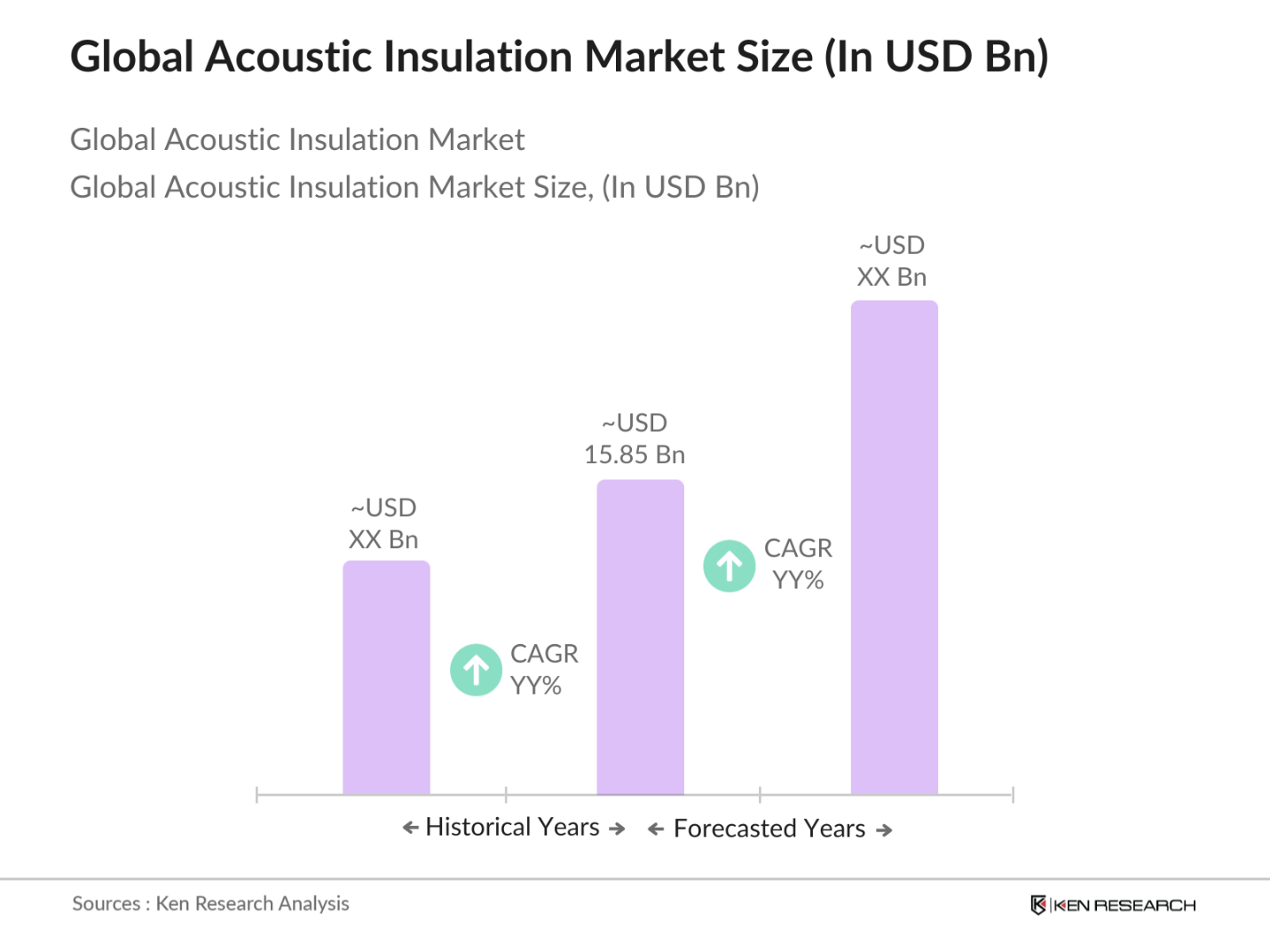
Global Acoustic Insulation Market Outlook 2030

Region:Global

Author(s):Shivani Mehra

Product Code:KROD11492

Published On

November 2024

Total pages

89

About the Report

Global Acoustic Insulation Market Overview

  • The global acoustic insulation market is valued at USD 15.85 billion, driven by increasing urbanization, industrial growth, and rising health concerns over noise pollution. With an ongoing demand for soundproofing in residential, commercial, and industrial sectors, the need for high-performance acoustic materials like stone wool and glass wool is rapidly growing. Government regulations enforcing noise control across construction, transportation, and industrial sectors further push this growth. Construction projects and transportation hubs particularly drive demand due to their stringent sound control requirements. Reliable sources confirm that urban development in regions like North America and Europe fuels this market, with the building sector representing a significant portion of acoustic material consumption.

Global Acoustic Insulation Market Size

  • Countries like the United States, Germany, and China dominate the acoustic insulation market due to their advanced infrastructure, increased construction activities, and regulatory frameworks focused on reducing environmental noise. The U.S., with its emphasis on residential soundproofing, and Germany, home to numerous industrial facilities, drive market leadership. Meanwhile, China benefits from rapid urbanization and industrial expansion, which heightens the need for soundproofing solutions across the board.
  • Building codes and standards for acoustic insulation have become increasingly stringent, particularly in developed markets like the US, Canada, and the EU. In the US, regulations like the International Building Code (IBC) and the Leadership in Energy and Environmental Design (LEED) set specific acoustic performance standards for new buildings. These regulations mandate the use of soundproofing materials to reduce noise levels in residential and commercial spaces, driving demand for compliant insulation products. Compliance with such standards is crucial for developers seeking certification or avoiding penalties.

Global Acoustic Insulation Market Segmentation

By Material Type: The acoustic insulation market is segmented by material type into stone wool, glass wool, foamed plastic, and elastomeric foam. Glass wool holds a dominant market share due to its superior sound absorption properties, fire resistance, and affordability. As a lightweight and flexible material, glass wool is commonly used in the construction of walls, roofs, and floors in both residential and commercial buildings. Its widespread use is attributed to its excellent thermal and acoustic insulation performance, making it a popular choice for builders.
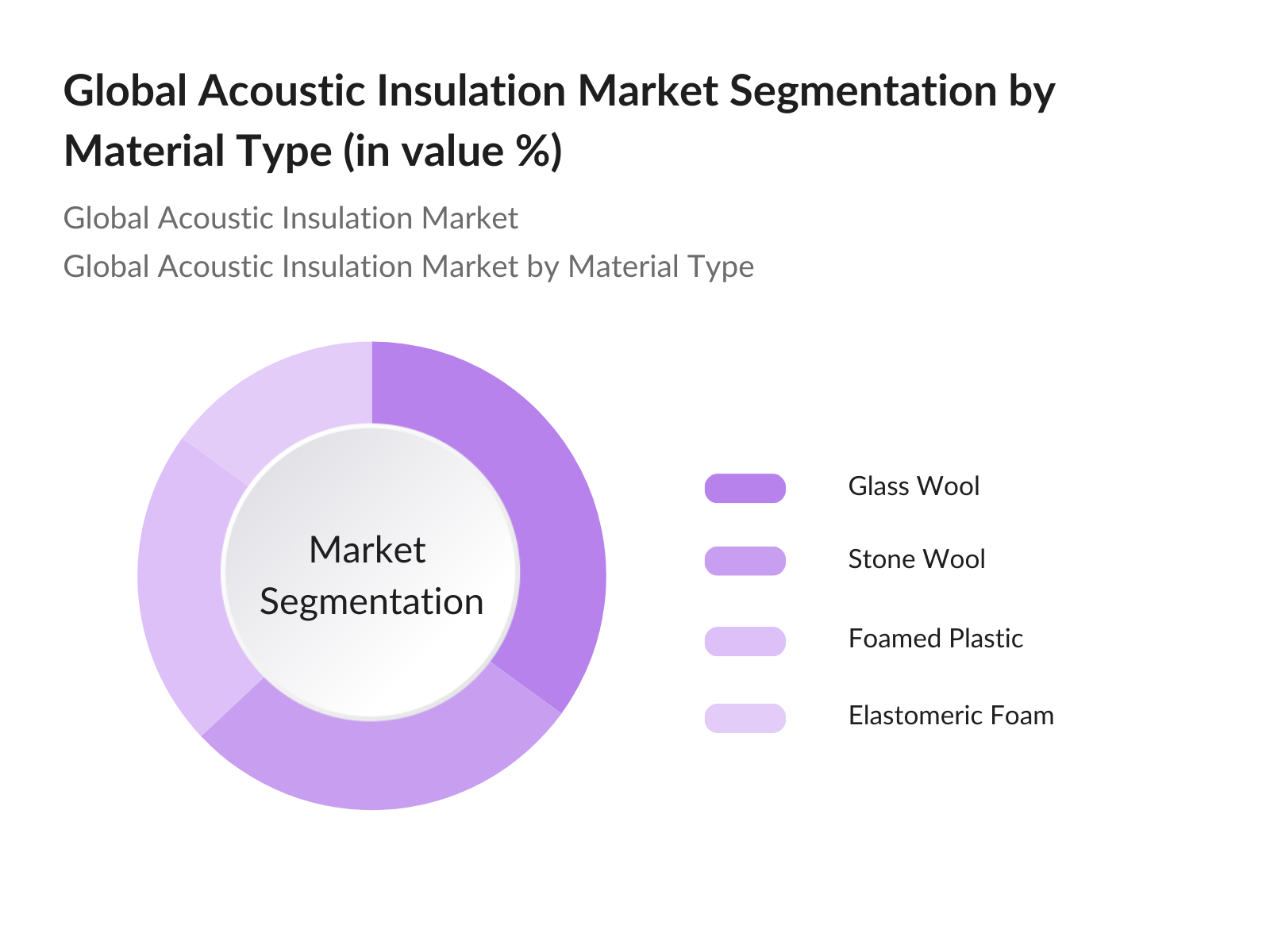
Global Acoustic Insulation Market Segmentation by Material Type

By Region: The market is segmented into North America, Europe, Asia Pacific, Middle East & Africa, and Latin America. Europe holds the largest share due to stringent environmental and noise pollution regulations, coupled with strong demand from the construction sector. Germany, in particular, plays a key role in Europe's dominance, given its focus on industrial soundproofing. Meanwhile, Asia-Pacific is rapidly growing, driven by industrialization in China and India and increased government spending on infrastructure.
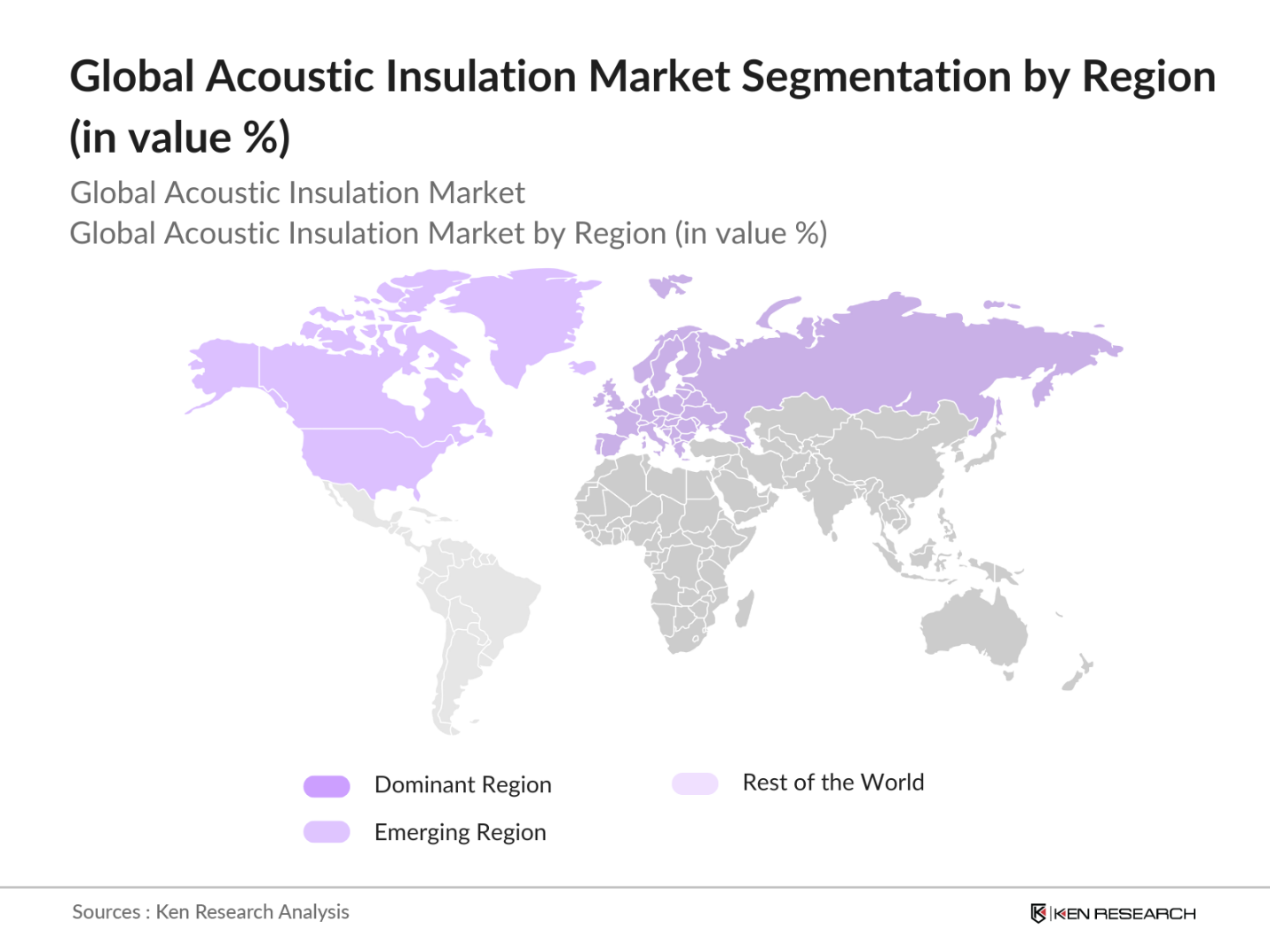
Global Acoustic Insulation Market Segmentation by Region

Global Acoustic Insulation Market Competitive Landscape

The global acoustic insulation market is characterized by the presence of key international players. These companies focus on continuous product development, mergers and acquisitions, and regional expansions to maintain their market positions. For instance, companies like Knauf Insulation and Rockwool invest heavily in R&D to develop more sustainable and cost-efficient solutions

Company Name

Establishment Year

Headquarters

Revenue

Employee Count

R&D Investment

Product Portfolio

Global Reach

Recent M&A Activities

Knauf Insulation

1932

Germany

$2.4 Bn

Rockwool International A/S

1909

Denmark

$2.3 Bn

Saint-Gobain

1665

France

$50.1 Bn

Owens Corning

1938

United States

$7.2 Bn

Armacell

1957

Germany

$0.7 Bn

Global Acoustic Insulation Market Analysis

Market Growth Drivers

  • Government Regulations: Stringent government regulations for noise control have significantly impacted the demand for acoustic insulation products. Countries such as Germany, the UK, and Japan have implemented strict standards for noise levels in residential and commercial buildings. For instance, the European Union's Environmental Noise Directive mandates strict noise control measures for urban areas, covering over 100 million people affected by road traffic noise. These regulations are pushing industries and residential construction projects toward more acoustic insulation solutions to comply with these legal requirements.
  • Construction Sector Growth: The construction sector is witnessing a surge in acoustic insulation demand due to increased urban housing and infrastructure projects. The global construction industry accounted for over $13 trillion in spending in 2023, driven by growth in developing nations. Acoustic insulation is particularly sought in sectors like residential, commercial, and public infrastructure projects, where soundproofing is critical for comfort and regulatory compliance. Major markets like India and China are heavily investing in soundproof building materials due to their burgeoning middle-class housing demands.
  • Urbanization and Industrialization: The rapid urbanization and industrialization across developing nations have led to an increase in noise pollution, driving the demand for acoustic insulation. According to the World Bank, more than 4.2 billion people reside in urban areas as of 2024, and this number is expected to rise. The growing urban population increases the need for soundproofing solutions in residential, commercial, and industrial sectors to mitigate noise levels in congested environments. The rise of megacities, with populations exceeding 10 million, further amplifies the demand for effective acoustic insulation solutions.

Market Challenges:

  • High Material Costs: The cost of key raw materials used in acoustic insulation, such as stone wool and glass wool, remains a significant challenge. For example, the cost of glass wool has surged due to supply chain disruptions and rising energy costs associated with manufacturing. These high material costs increase the overall price of acoustic insulation products, making them less accessible for smaller construction projects or emerging markets with budget constraints. This challenge is particularly pronounced in regions where pricing pressures limit the use of premium insulation solutions, restricting broader adoption.
  • Lack of Awareness in Emerging Markets: In many emerging markets, acoustic insulation is still underutilized due to limited awareness of its benefits. Countries in regions like Southeast Asia and Sub-Saharan Africa have experienced rapid urbanization, but the adoption of acoustic solutions remains low. Despite significant urban noise pollution, the usage of acoustic insulation in building materials is minimal. Governments and industry stakeholders have yet to fully recognize the importance of soundproofing in enhancing building quality and complying with potential noise pollution regulations, which could help address increasing environmental noise challenges in these regions.

Global Acoustic Insulation Market Future Outlook

Over the next few years, the acoustic insulation market is expected to show significant growth driven by increasing demand for noise control solutions in construction and transportation sectors. Governments worldwide are imposing stricter noise regulations, pushing the adoption of high-performance acoustic insulation materials. Additionally, technological advancements, such as the development of aerogels, are likely to open new opportunities for market expansion.

Market Opportunities:

  • Use of Recycled Materials: The use of recycled materials in acoustic insulation is gaining momentum as sustainability becomes a top priority. Manufacturers are increasingly utilizing recycled glass, denim, and other materials to create eco-friendly insulation products. For example, insulation made from recycled denim can achieve noise reduction levels comparable to conventional materials while significantly reducing landfill waste. In 2023, the production of acoustic insulation products using recycled materials has risen, with further growth anticipated as sustainability regulations become stricter across industries, encouraging the adoption of more environmentally friendly building materials.
  • Enhanced Performance Insulation: Innovations in 3D volumetric diffusers and electro-acoustic technologies are advancing acoustic insulation performance. These cutting-edge solutions not only improve soundproofing capabilities but also enhance sound quality by modulating acoustic waves. Initially used in high-end architectural projects and recording studios, these technologies are now gradually being adopted in residential and commercial applications. The growing demand for high-performance acoustic solutions reflects an increasing need for both effective noise control and enhanced auditory experiences in diverse settings. This trend is expected to continue as more industries recognize the benefits of these advanced technologies.

Scope of the Report

By Material Type

Stone Wool

Glass Wool

Foamed Plastic

Elastomeric Foam

Others

By End-Use Industry

Building & Construction

Transportation

Industrial

Oil & Gas

Energy & Utilities

By Application

Residential

Commercial

Industrial

Transportation

By Technology

Continuous Insulation

Intermittent Insulation

By Region

North America

Europe

Asia Pacific

Middle East & Africa

Latin America

Products

Key Target Audience

  • Acoustic Insulation Manufacturers

  • Construction Companies

  • Automotive and Transportation OEMs

  • Government and Regulatory Bodies (EPA, OSHA)

  • Energy and Utility Companies

  • Oil & Gas and Petrochemical Firms

  • Investments and Venture Capitalist Firms

  • Industrial and OEM Manufacturers

Companies

Players Mention in the Report 

  • Knauf Insulation

  • Rockwool International A/S

  • Saint-Gobain

  • Owens Corning

  • Armacell

  • Soprema

  • Huntsman International LLC

  • BASF SE

  • Kingspan Group PLC

  • Johns Manville

  • Fletcher Insulation

  • Cabot Corporation

  • Trelleborg AB

  • Auralex Acoustics Inc.

  • INS Acoustics Ltd.

Table of Contents

01. Global Acoustic Insulation Market Overview

1.1 Definition and Scope

1.2 Market Taxonomy

1.3 Market Growth Dynamics

1.4 Market Segmentation Overview

02. Global Acoustic Insulation Market Size (In USD Bn)

2.1 Historical Market Size

2.2 Year-on-Year Growth Analysis

2.3 Key Market Developments and Milestones

03. Global Acoustic Insulation Market Analysis

3.1 Growth Drivers

Urbanization and Industrialization (Noise pollution, rising demand for soundproofing solutions)

Government Regulations (Stringent noise control regulations)

Construction Sector Growth (High acoustic demand in buildings)

3.2 Market Challenges

High Material Costs (Raw materials like stone wool, glass wool)

Lack of Awareness in Emerging Markets

Environmental Concerns (Recyclability of materials)

3.3 Opportunities

Technological Advancements (Innovations in aerogel technology)

Increased Use in Automotive and Transportation (Soundproofing in vehicles)

Expansion into Industrial and Oil & Gas Sectors (Industrial soundproofing needs)

3.4 Trends

Adoption of Nanotechnology (Nanomaterials for advanced insulation)

Use of Recycled Materials (Sustainable insulation solutions)

Enhanced Performance Insulation (3D volumetric diffusers, electro-acoustic technologies)

3.5 Government Regulations

Building Acoustic Standards (Region-specific regulations)

Noise Reduction Incentives (Programs for commercial and residential buildings)

3.6 SWOT Analysis

3.7 Stake Ecosystem

3.8 Porters Five Forces Analysis

3.9 Competition Ecosystem

04. Global Acoustic Insulation Market Segmentation

4.1 By Material Type (In Value %)

Stone Wool

Glass Wool

Foamed Plastic

Elastomeric Foam

Others

4.2 By End-Use Industry (In Value %)

Building & Construction

Transportation

Industrial & OEM

Oil & Gas and Petrochemicals

4.3 By Application (In Value %)

Residential

Commercial

Industrial

Transportation

4.4 By Technology (In Value %)

Continuous Insulation

Intermittent Insulation

4.5 By Region (In Value %)

North America

Europe

Asia Pacific

Middle East & Africa

Latin America

05. Global Acoustic Insulation Market Competitive Analysis

5.1 Detailed Profiles of Major Companies

Knauf Insulation

Rockwool International A/S

Saint-Gobain

Armacell International

Owens Corning

Huntsman International LLC

Soprema

Johns Manville

BASF SE

Kingspan Group PLC

Auralex Acoustics Inc.

Fletcher Insulation

Cabot Corporation

Trelleborg AB

INS Acoustics Ltd.

5.2 Cross Comparison Parameters (Revenue, Market Share, R&D Investment, Product Portfolio)

5.3 Market Share Analysis

5.4 Strategic Initiatives

5.5 Mergers & Acquisitions

5.6 Investment and Expansion Plans

5.7 Venture Capital Funding

06. Global Acoustic Insulation Market Regulatory Framework

6.1 Building Codes and Regulations

6.2 Compliance Standards

6.3 Certification Processes (LEED Certification, ISO Standards)

07. Global Acoustic Insulation Future Market Size (In USD Bn)

7.1 Future Market Size Projections

7.2 Key Factors Driving Future Growth

08. Global Acoustic Insulation Future Market Segmentation

8.1 By Material Type (In Value %)

8.2 By End-Use Industry (In Value %)

8.3 By Application (In Value %)

8.4 By Region (In Value %)

09. Global Acoustic Insulation Market Analysts Recommendations

9.1 TAM/SAM/SOM Analysis

9.2 Customer Cohort Analysis

9.3 Marketing and Sales Strategies

9.4 White Space Opportunity Analysis

Disclaimer
Contact Us

Research Methodology

Step 1: Identification of Key Variables

The initial step involves mapping all major stakeholders in the global acoustic insulation market. Extensive desk research is conducted using proprietary and secondary sources to gather industry-specific data on market drivers, challenges, and growth opportunities.

Step 2: Market Analysis and Construction

Historical data related to market size, material demand, and key industry players is compiled and analyzed. Market penetration, technological advancements, and industry trends are assessed to generate reliable revenue estimates.

Step 3: Hypothesis Validation and Expert Consultation

To validate market hypotheses, interviews with industry experts and stakeholders are conducted. These consultations provide critical insights into operational dynamics and future market trends.

Step 4: Research Synthesis and Final Output

The final phase involves synthesizing data from primary and secondary sources, ensuring accurate and validated insights. This phase includes cross-referencing expert opinions with statistical data for reliability.

Frequently Asked Questions

01. How big is the global acoustic insulation market?

The global acoustic insulation market is valued at USD 15.85 billion, driven by urbanization and rising noise pollution concerns in key industries.

02. What are the key growth drivers in the acoustic insulation market?

The main drivers include increasing noise pollution regulations, rapid urbanization, and demand for soundproofing in construction and transportation sectors.

03. Who are the major players in the global acoustic insulation market?

Leading companies include Knauf Insulation, Rockwool International A/S, Saint-Gobain, Owens Corning, and Armacell.

04. What challenges does the acoustic insulation market face?

Challenges include the high cost of materials and limited awareness in emerging markets regarding advanced acoustic solutions.

Why Buy From Us?

RRR
Refine Robust Result (RRR) Framework

What makes us stand out is that our consultants follows Robust, Refine and Result (RRR) methodology. i.e. Robust for clear definitions, approaches and sanity checking, Refine for differentiating respondents facts and opinions and Result for presenting data with story

Our Reach Is Unmatched

We have set a benchmark in the industry by offering our clients with syndicated and customized market research reports featuring coverage of entire market as well as meticulous research and analyst insights.

Research
Shifting the Research Paradigm

While we don't replace traditional research, we flip the method upside down. Our dual approach of Top Bottom & Bottom Top ensures quality deliverable by not just verifying company fundamentals but also looking at the sector and macroeconomic factors.

Insite
More Insights-Better Decisions

With one step in the future, our research team constantly tries to show you the bigger picture. We help with some of the tough questions you may encounter along the way: How is the industry positioned? Best marketing channel? KPI's of competitors? By aligning every element, we help maximize success.

Trust
Transparency and Trust

Our report gives you instant access to the answers and sources that other companies might choose to hide. We elaborate each steps of research methodology we have used and showcase you the sample size to earn your trust.

support
Round the Clock Support

If you need any support, we are here! We pride ourselves on universe strength, data quality, and quick, friendly, and professional service.

Why Client Choose Us?

400000+ Reports in repository
150+ Consulting project a year
100+ Analysts
8000+ Client Queries in 2022