
Global Automotive Gears Market Outlook 2030
Region:Global
Author(s):Shivani Mehra
Product Code:KROD11346
Region:Global
Author(s):Shivani Mehra
Product Code:KROD11346
November 2024
84
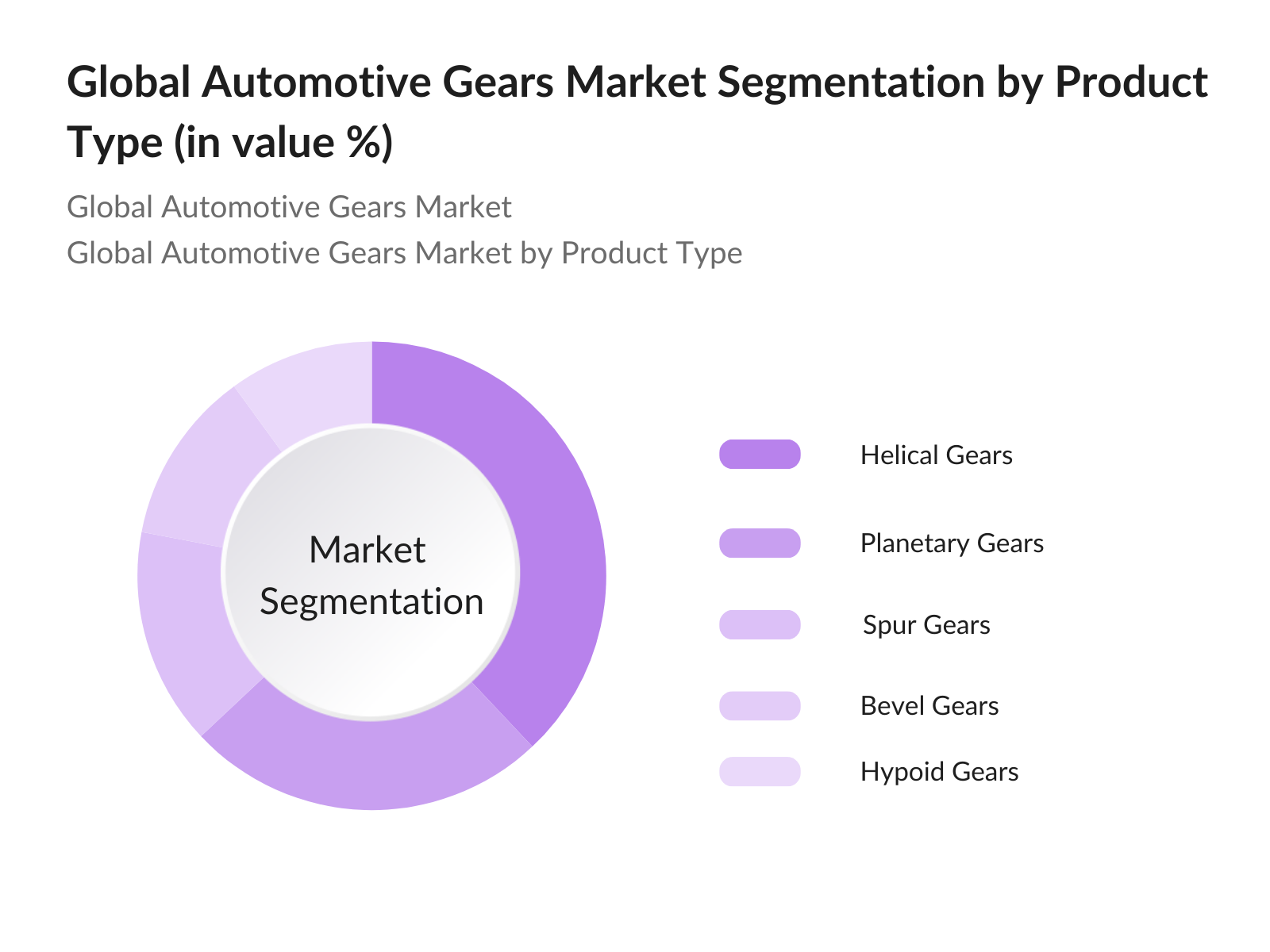
By Product Type: The automotive gears market is segmented by product type into planetary gears, helical gears, bevel gears, spur gears, and hypoid gears. Helical gears hold a dominant share in the product segmentation due to their efficiency and ability to operate smoothly at high speeds. These gears are widely used in both manual and automatic transmissions in passenger cars, ensuring better torque handling. Their noise reduction capability also makes them the preferred choice for luxury and electric vehicles, where cabin comfort is a priority. The growing adoption of electric vehicles, which demand quieter and more efficient gears, further solidifies the dominance of helical gears.
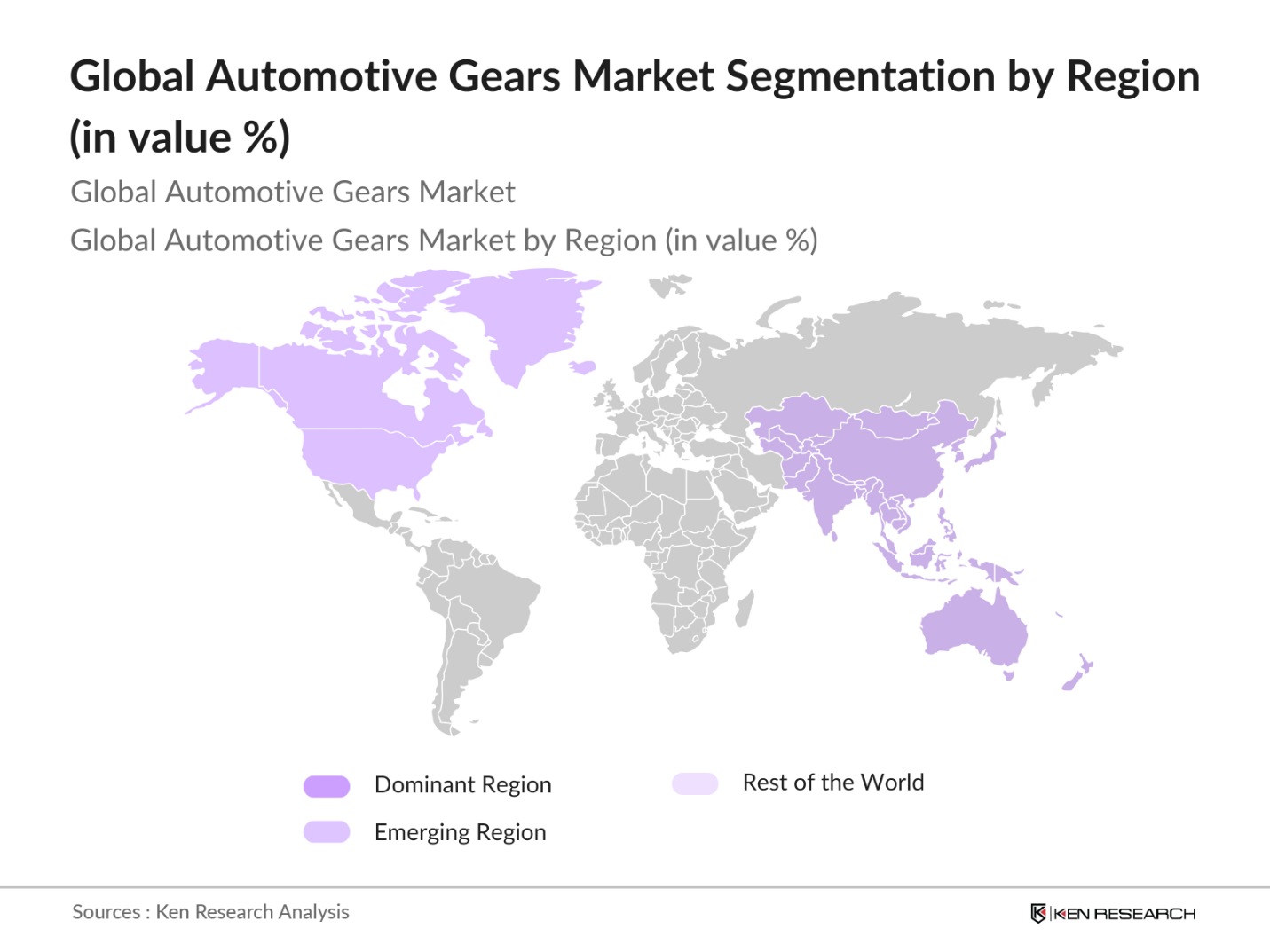
By Region: The automotive gears market is segmented by region into North America, Europe, Asia-Pacific, Latin America, and the Middle East and Africa. Asia-Pacific dominates the regional segmentation due to the presence of major automotive manufacturing hubs like China, Japan, and India. China leads this region as the largest producer of automobiles, including both traditional and electric vehicles. India's growing automotive industry and increasing demand for commercial vehicles further contribute to the region's dominance. The high vehicle production and export capacity of countries in this region make it the most significant market for automotive gears globally.
The global automotive gears market is characterized by a few dominant players who control a significant share of the market. These companies focus on research and development to innovate new gear solutions, especially in the electric vehicle segment. Mergers and acquisitions are common in this competitive landscape as key players aim to expand their geographical presence and enhance their product offerings.
|
Company Name |
Establishment Year |
Headquarters |
R&D Expenditure |
Product Innovation |
Global Reach |
No. of Employees |
Partnerships |
Revenue (USD Bn) |
|
ZF Friedrichshafen AG |
1915 |
Friedrichshafen, Germany |
High |
- |
- |
- |
- |
- |
|
Dana Incorporated |
1904 |
Maumee, Ohio, USA |
Medium |
- |
- |
- |
- |
- |
|
GKN Automotive |
1759 |
London, UK |
Medium |
- |
- |
- |
- |
- |
|
BorgWarner Inc. |
1928 |
Auburn Hills, Michigan, USA |
High |
- |
- |
- |
- |
- |
|
Magna International |
1957 |
Aurora, Canada |
High |
- |
- |
- |
- |
- |
Over the next five years, the global automotive gears market is expected to grow significantly, driven by the increasing production of electric vehicles and advancements in gear manufacturing technologies. The demand for lightweight, high-efficiency gears will continue to rise as automotive manufacturers aim to meet stringent emission norms and fuel efficiency standards. Additionally, the adoption of smart manufacturing practices, such as digital twin technology and automation in production processes, is expected to further enhance gear quality and performance, fueling market growth.
|
By Product Type |
Planetary Gears Helical Gears Bevel Gears Spur Gears Hypoid Gears |
|
By Application |
Passenger Vehicles Commercial Vehicles Electric Vehicles Heavy-Duty Trucks |
|
By Material Type |
Steel Aluminum Composite Materials Others |
|
By Manufacturing Process |
Forged Machined Moulded |
|
By Region |
North America Europe Asia-Pacific Latin America Middle East and Africa |
1.1. Definition and Scope
1.2. Market Taxonomy
1.3. Market Growth Rate
1.4. Market Segmentation Overview
2.1. Historical Market Size
2.2. Year-on-Year Growth Analysis
2.3. Key Market Developments and Milestones
3.1. Growth Drivers
3.1.1. Increasing Vehicle Production
3.1.2. Advancements in Transmission Technologies
3.1.3. Government Regulations on Fuel Efficiency and Emissions
3.2. Market Challenges
3.2.1. High Cost of Raw Materials (Steel, Aluminum, Titanium)
3.2.2. Complex Manufacturing Process
3.2.3. Volatility in the Automotive Industry (Chip Shortage Impact)
3.3. Opportunities
3.3.1. Growth of Electric Vehicles (EV Gear Design)
3.3.2. Demand for Lightweight Gears in Automotive Industry
3.3.3. Expansion of Aftermarket Sales
3.4. Trends
3.4.1. Adoption of Precision Gear Manufacturing
3.4.2. Increased Use of Additive Manufacturing
3.4.3. Automation in Gear Production
3.5. Technological Advancements
3.5.1. Integration of AI in Gear Design
3.5.2. Hybrid Powertrain Gears
3.5.3. Digital Twin Technology in Gear Testing
3.6. Government Regulations
3.6.1. Fuel Efficiency Standards
3.6.2. Emission Norms for Passenger and Commercial Vehicles
3.6.3. Tax Incentives for Green Gears Manufacturing
3.7. SWOT Analysis
3.8. Porters Five Forces
3.9. Stakeholder Ecosystem
4.1. By Product Type (In Value %)
4.1.1. Planetary Gears
4.1.2. Helical Gears
4.1.3. Bevel Gears
4.1.4. Spur Gears
4.1.5. Hypoid Gears
4.2. By Application (In Value %)
4.2.1. Passenger Vehicles
4.2.2. Commercial Vehicles
4.2.3. Electric Vehicles
4.2.4. Heavy-Duty Trucks
4.3. By Material Type (In Value %)
4.3.1. Steel
4.3.2. Aluminum
4.3.3. Composite Materials
4.3.4. Others
4.4. By Manufacturing Process (In Value %)
4.4.1. Forged
4.4.2. Machined
4.4.3. Moulded
4.5. By Region (In Value %)
4.5.1. North America
4.5.2. Europe
4.5.3. Asia-Pacific
4.5.4. Latin America
4.5.5. Middle East and Africa
5.1. Detailed Profiles of Major Companies
5.1.1. ZF Friedrichshafen AG
5.1.2. Dana Incorporated
5.1.3. GKN Automotive
5.1.4. American Axle & Manufacturing
5.1.5. BorgWarner Inc.
5.1.6. Robert Bosch GmbH
5.1.7. Magna International Inc.
5.1.8. Eaton Corporation
5.1.9. Schaeffler Group
5.1.10. Linamar Corporation
5.1.11. NSK Ltd.
5.1.12. Meritor, Inc.
5.1.13. Oerlikon Graziano
5.1.14. Aisin Seiki Co., Ltd.
5.1.15. Bharat Gears Ltd.
5.2. Cross Comparison Parameters (Revenue, R&D Expenditure, Product Portfolio, Market Reach, Innovations, Strategic Alliances, M&A Activity, Employee Strength)
5.3. Market Share Analysis
5.4. Strategic Initiatives
5.5. Mergers & Acquisitions
5.6. Investment Analysis
5.7. Venture Capital Funding
5.8. Government Grants
5.9. Private Equity Investments
6.1. Emission Control Standards
6.2. Automotive Gear Manufacturing Certifications
6.3. Compliance with International Safety Standards
7.1. Future Market Size Projections
7.2. Key Factors Driving Future Market Growth
8.1. By Product Type (In Value %)
8.2. By Application (In Value %)
8.3. By Material Type (In Value %)
8.4. By Manufacturing Process (In Value %)
8.5. By Region (In Value %)
9.1. TAM/SAM/SOM Analysis
9.2. Customer Cohort Analysis
9.3. Marketing Initiatives
9.4. White Space Opportunity Analysis
The initial phase of research involved mapping the automotive gears market ecosystem, including major stakeholders such as manufacturers, suppliers, and consumers. This phase included extensive desk research through secondary sources like industry reports, and databases to identify critical variables influencing market growth, such as material cost and vehicle production rates.
In this step, historical data was compiled to analyze the market penetration of different gear types in automotive applications. Sales performance, technological advancements, and vehicle production statistics were examined to ensure accuracy in revenue estimations for 2023.
Market hypotheses were validated through consultations with industry experts using structured interviews. These consultations provided in-depth insights into operational and financial trends, directly from key market players and gear manufacturers.
The final stage involved engaging with multiple automotive manufacturers to gather insights into product segments and consumer preferences. The information collected was synthesized to provide a comprehensive analysis of the global automotive gears market, ensuring that the findings are validated and reliable.
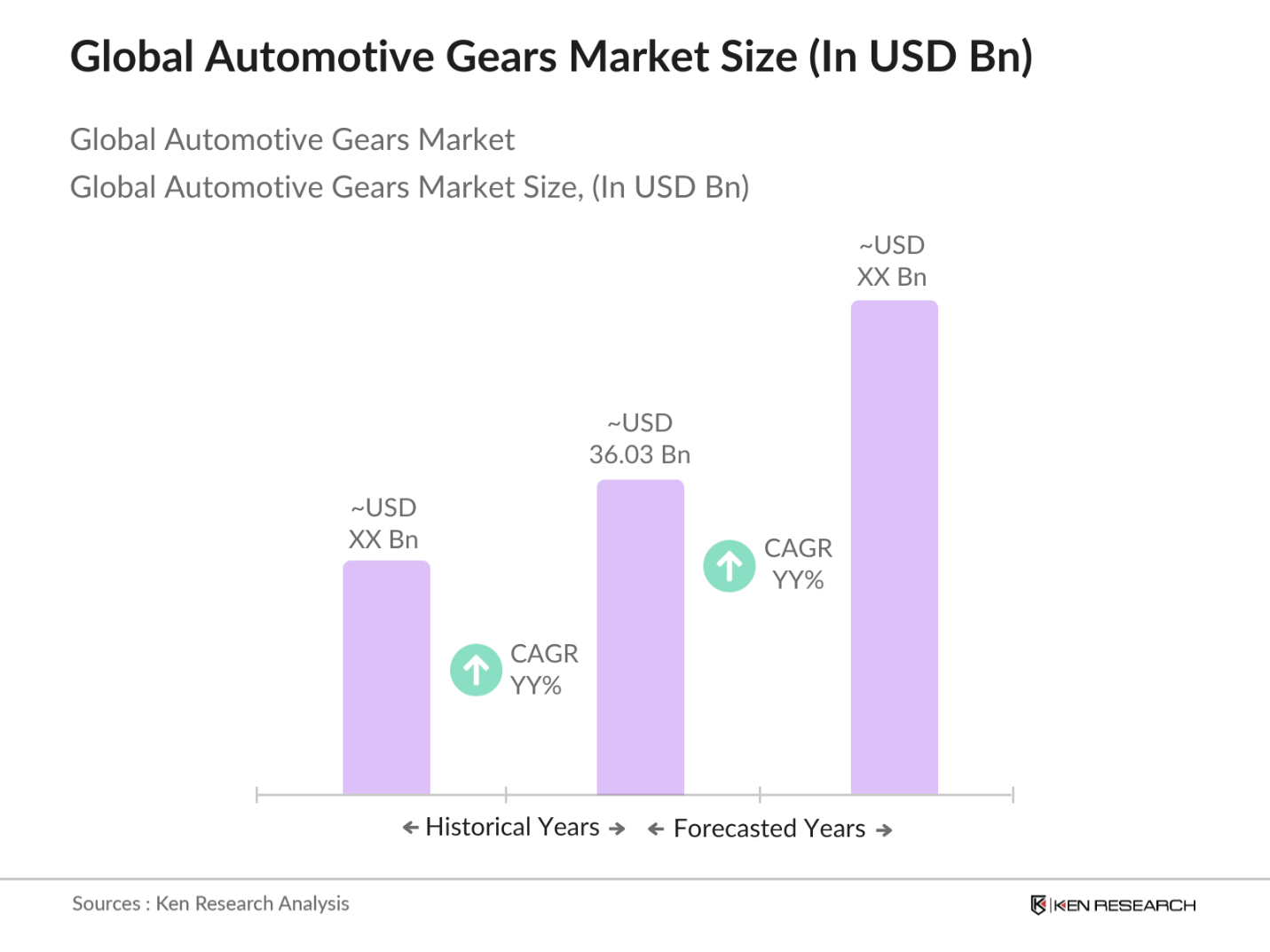
The global automotive gears market is valued at USD 36.03 billion, driven by the increasing adoption of electric vehicles and advancements in transmission technology.
Challenges include high material costs, particularly for steel and aluminum, as well as complex manufacturing processes. Additionally, the automotive industry's volatility, especially due to chip shortages, affects market stability.
Key players include ZF Friedrichshafen AG, Dana Incorporated, GKN Automotive, BorgWarner Inc., and Magna International. These companies dominate due to their strong R&D capabilities and extensive product portfolios.
The market is driven by the rising production of electric vehicles, advancements in lightweight gear technologies, and increasing demand for fuel-efficient and low-emission vehicles.

What makes us stand out is that our consultants follows Robust, Refine and Result (RRR) methodology. i.e. Robust for clear definitions, approaches and sanity checking, Refine for differentiating respondents facts and opinions and Result for presenting data with story

We have set a benchmark in the industry by offering our clients with syndicated and customized market research reports featuring coverage of entire market as well as meticulous research and analyst insights.

While we don't replace traditional research, we flip the method upside down. Our dual approach of Top Bottom & Bottom Top ensures quality deliverable by not just verifying company fundamentals but also looking at the sector and macroeconomic factors.

With one step in the future, our research team constantly tries to show you the bigger picture. We help with some of the tough questions you may encounter along the way: How is the industry positioned? Best marketing channel? KPI's of competitors? By aligning every element, we help maximize success.

Our report gives you instant access to the answers and sources that other companies might choose to hide. We elaborate each steps of research methodology we have used and showcase you the sample size to earn your trust.

If you need any support, we are here! We pride ourselves on universe strength, data quality, and quick, friendly, and professional service.