Ken Research Logo

Global Autonomous Vehicles Market Outlook to 2030

Region:Global

Author(s):Sanjeev

Product Code:KROD1917

Published On

November 2024

Total pages

87

About the Report

Global Autonomous Vehicles Market Overview

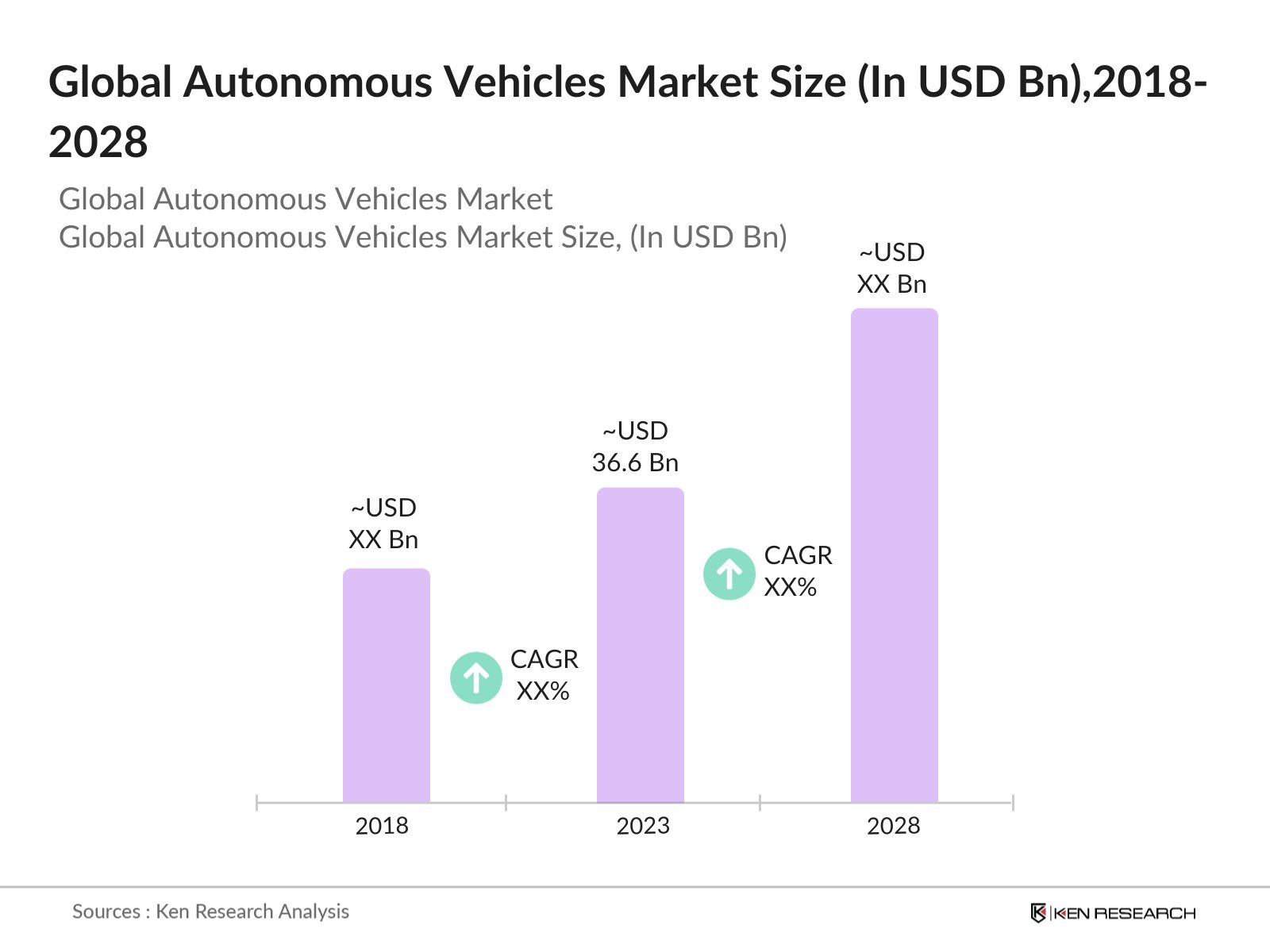
  • In 2023, the Global Autonomous Vehicles Market was valued at USD 36.6 billion, driven by technological advancements in artificial intelligence, increased investments in autonomous driving technology, and the growing need for safer and more efficient transportation solutions. The market is segmented into fully autonomous vehicles and semi-autonomous vehicles, with semi-autonomous vehicles being the most dominant due to their immediate applicability and integration with existing infrastructure.
  • Major players in the Global Autonomous Vehicles Market include Tesla, Waymo, General Motors, Ford, and Uber, recognized for their innovative technologies, extensive R&D investments, and strategic partnerships. Tesla leads the market with its advanced Autopilot system and full self-driving software, which continue to push the boundaries of autonomous driving capabilities.
  • North America, Europe, and Asia-Pacific are prominent markets, driven by technological advancements, supportive regulatory frameworks, and increasing consumer acceptance. These regions are characterized by high investment in autonomous driving research, robust automotive industries, and a strong focus on innovation and safety standards.
  • In 2023, Waymo expanded its autonomous taxi service to additional cities in the United States, reflecting the growing adoption of autonomous vehicles for public transportation. This expansion underscores the ongoing shift towards autonomous mobility solutions, highlighting broader trends in the automotive industry towards automation and smart transportation.market overviews

Global Autonomous Vehicles Market Segmentation

The Global Autonomous Vehicles Market can be segmented by vehicle type, component, level of automation, and region:
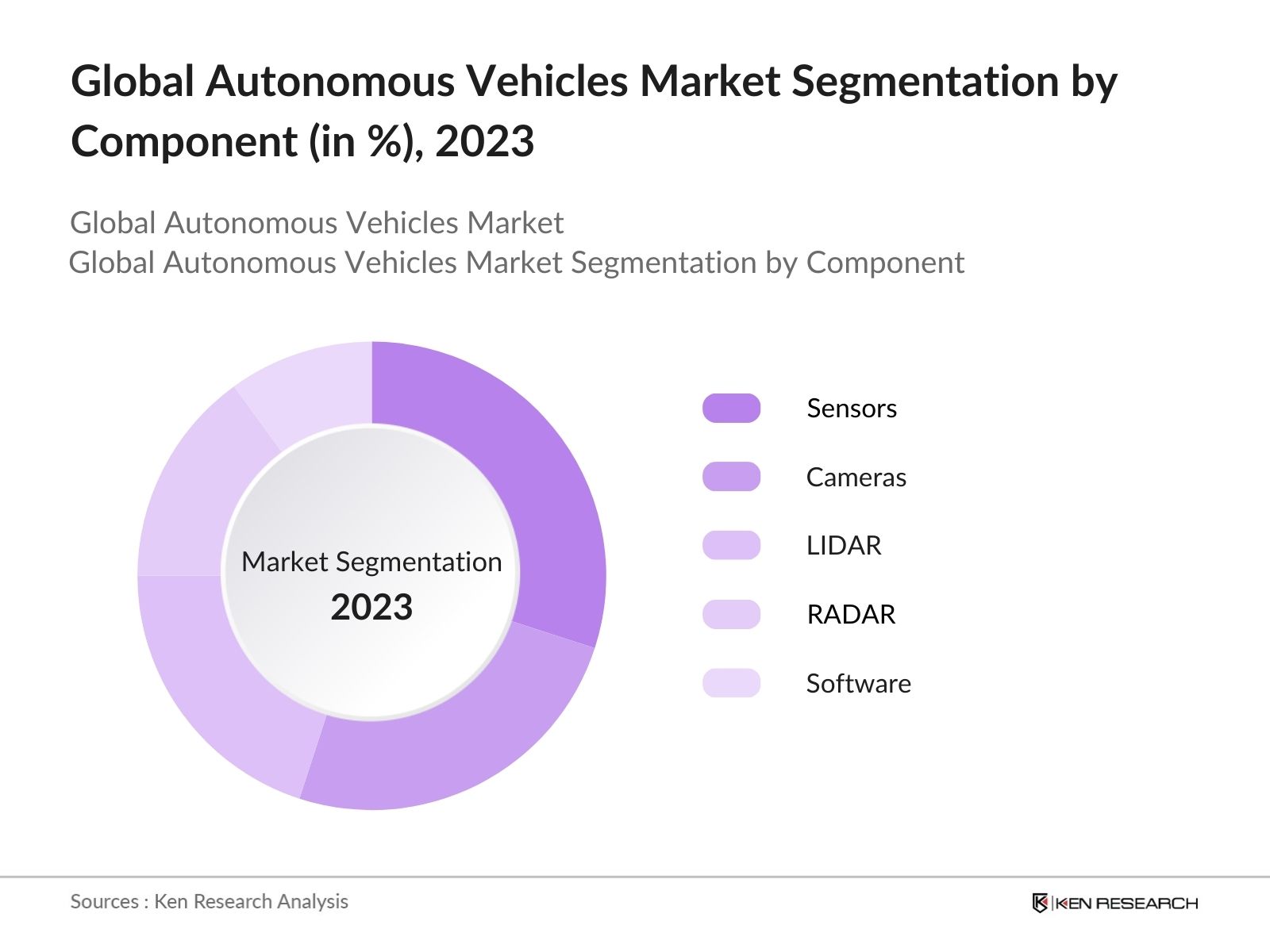
  • By Component: The Global Autonomous Vehicles market can be segmented by components into Sensors, Cameras, LIDAR, RADAR, and Software. In 2023, software solutions dominate the market due to their crucial role in processing data and making real-time decisions for autonomous vehicles.market overviews
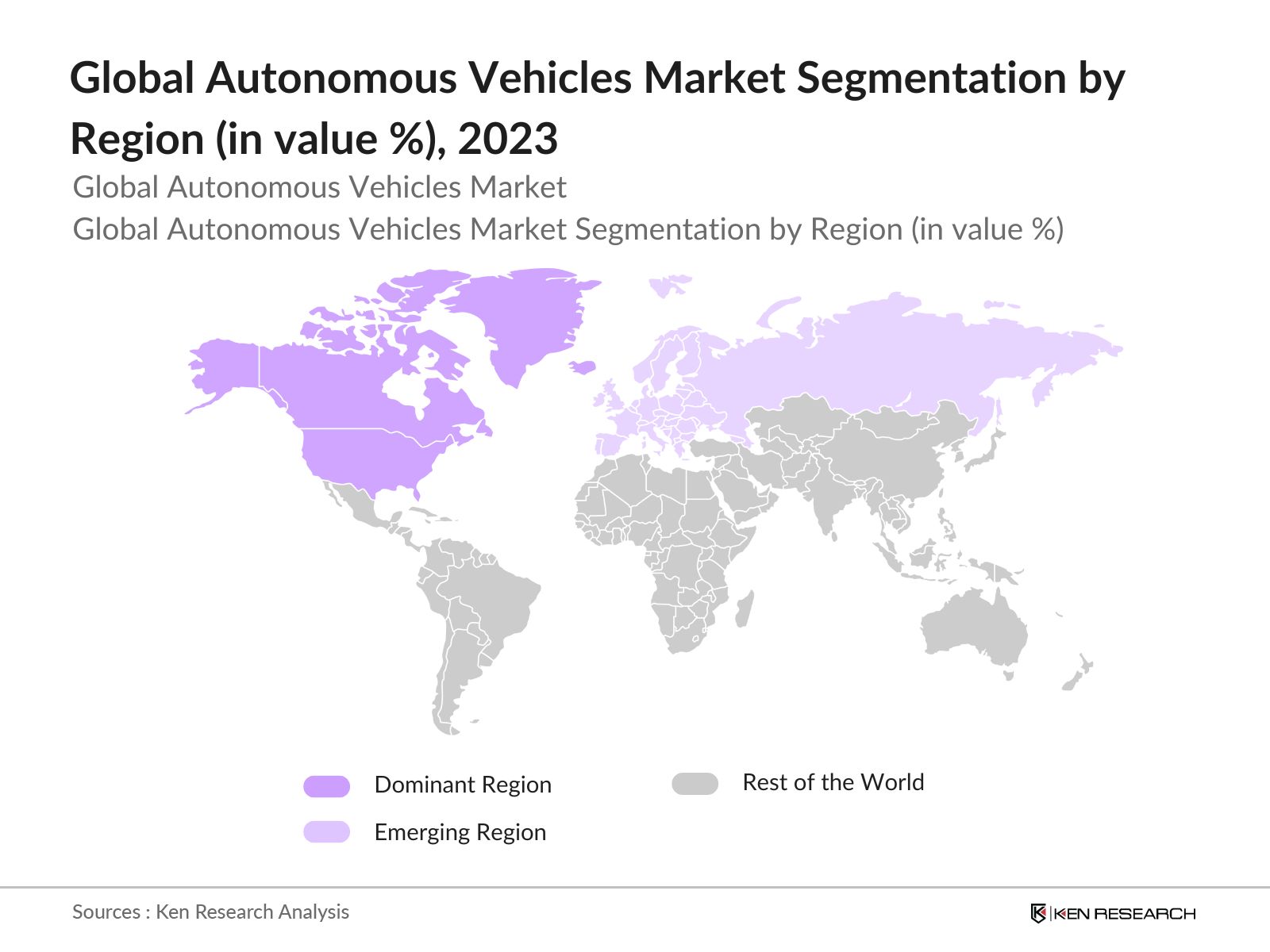
  • By Region: The market can be segmented by region into North America, Europe, Asia-Pacific, Middle East & Africa and Latin America. In 2023, North America leads the market due to significant investments in autonomous vehicle research and development, supportive regulatory environments, and high consumer awareness.market overviews
  • By Vehicle Type: The Global Autonomous Vehicles market can be segmented by vehicle type into Fully Autonomous Vehicles and Semi-Autonomous Vehicles. In 2023, semi-autonomous vehicles remain the most dominant due to their current feasibility and compatibility with existing road networks. This segment includes advanced driver-assistance systems (ADAS) and Level 2 and Level 3 automation features.

Global Autonomous Vehicles Market Competitive Landscape

Company

Establishment Year

Headquarters

Tesla

2003

Palo Alto, USA

Waymo

2009

Mountain View, USA

General Motors

1908

Detroit, USA

Ford

1903

Dearborn, USA

Uber

2009

San Francisco, USA

  • Tesla: In 2023, Tesla enhanced its Full Self-Driving (FSD) software, incorporating new features for urban environments. This launch aims to strengthen the company's position in the market, where there is increasing consumer interest in advanced autonomous driving capabilities.
  • Waymo: In 2024, Waymo announced its plans to deploy fully autonomous trucks for logistics in the United States. This expansion into freight underscores the company's commitment to advancing autonomous driving technology beyond passenger vehicles.

Global Autonomous Vehicles Market Analysis

Market Growth Drivers:

  • Technological Advancements in AI and Machine Learning: Rapid advancements in artificial intelligence and machine learning are driving the development of more sophisticated autonomous driving algorithms, enhancing vehicle safety and decision-making capabilities. According to a 2023 report by the International Data Corporation (IDC), global spending on AI technologies for autonomous driving is projected to reach USD 10 billion by 2024.
  • Increasing Investments in Autonomous Driving Technology: Governments and private companies are heavily investing in autonomous vehicle technologies to promote safer, more efficient transportation. In 2023, the European Union allocated EUR 500 million to fund research and development in autonomous driving under the Horizon Europe program, reflecting the growing focus on innovation in the automotive sector.
  • Growing Need for Safer Transportation Solutions: The increasing incidence of road accidents has heightened the demand for safer transportation solutions. According to the World Health Organization (WHO), road accidents cause approximately 1.35 million deaths globally each year, prompting governments to explore autonomous driving technologies as a solution to reduce traffic fatalities.

Market Challenges:

  • High Costs of Autonomous Vehicle Technology: The development and deployment of autonomous vehicle technology require significant capital investment, posing challenges for manufacturers and consumers alike. High costs associated with sensors, software development, and regulatory compliance can limit market penetration, particularly in emerging economies.
  • Regulatory and Legal Constraints: Autonomous vehicles face stringent regulatory requirements across different regions, which can hinder market growth. Navigating the complex legal landscape surrounding liability, safety standards, and data privacy remains a significant challenge for companies developing autonomous driving technology.
  • Public Perception and Trust Issues: Despite technological advancements, many consumers remain skeptical about the safety and reliability of autonomous vehicles. Incidents involving autonomous vehicles have attracted significant media attention, leading to public distrust. Overcoming these perceptions and gaining widespread consumer acceptance is a major challenge that companies need to address through extensive safety validations, transparent communication, and education.

Government Initiatives:

  • U.S. Automated Driving Systems (ADS) Demonstration Grants: In 2019, the U.S. Department of Transportation (USDOT) awarded $60 million in Automated Driving Systems (ADS) Demonstration Grants to eight projects across the United States. These projects focus on advancing autonomous vehicle technologies through real-world testing and data collection, aiming to enhance safety and public trust in autonomous driving systems. The projects funded under this initiative include testing and evaluation of autonomous driving systems in diverse environments, such as rural areas and urban settings, to understand the practical challenges and develop solutions for wide-scale deployment.
  • China's Intelligent and Connected Vehicles (ICV) Roadmap: In 2020, Chinas Ministry of Industry and Information Technology (MIIT) released its "Intelligent and Connected Vehicles (ICV) Roadmap," aiming to achieve mass production of Level 3 autonomous vehicles by 2025 and commercial deployment of Level 4 vehicles by 2030. To support this vision, The International Energy Agency (IEA) estimates that overall energy R&D spending by the Chinese government in 2021 was $8.3 billion, which is 26% of world energy R&D spending.

Global Autonomous Vehicles Market Future Market Outlook

The Global Autonomous Vehicles Market is expected to continue its rapid growth, driven by advancements in autonomous driving technology, increasing consumer acceptance, and supportive regulatory frameworks.

Future Market Trends:

  • Expansion of Autonomous Ride-Sharing Services: Autonomous ride-sharing services are expected to gain popularity, offering convenient, cost-effective transportation solutions in urban areas. This model reduces the need for personal vehicle ownership and supports the shift towards sustainable, shared mobility.
  • Integration of Autonomous Vehicles with Smart City Infrastructure: The development of smart cities is anticipated to accelerate the deployment of autonomous vehicles, enabling seamless integration with connected infrastructure such as smart traffic management systems, dedicated lanes, and V2X (Vehicle-to-Everything) communication networks.

Scope of the Report

By Region

North America

Europe

Asia-Pacific

Middle East & Africa

Latin America

By Vehicle Type

Fully Autonomous Vehicles

Semi-Autonomous Vehicles

By Component

Sensors

Cameras

LIDAR

RADAR

Software

By Level of Automation

Level 1 (Driver Assistance)

Level 2 (Partial Automation)

Level 3 (Conditional Automation)

Level 4 (High Automation)

Level 5 (Full Automation)

By Software and Services

Autonomous Driving Software

Vehicle Connectivity Solutions

Fleet Management Services

Products

Key Target Audience Organizations and Entities Who Can Benefit by Subscribing to This Report:

  • Automotive Manufacturers

  • Autonomous Vehicle Technology Providers

  • Governments and Regulatory Bodies (USDOT, NHTSA, MOLIT, ISO)

  • Research Institutions

  • Transportation and Logistics Companies

  • Ride-Sharing Companies

  • Urban Planners and Smart City Developers

  • Investors and Venture Capitalists

  • Insurance Companies

  • Automotive Component Suppliers

  • Software Development Companies

  • Data Analytics Firms

  • Academic and Research Institutions

  • Non-Governmental Organizations

Time Period Captured in the Report:

  • Historical Period: 2018-2023

  • Base Year: 2023

  • Forecast Period: 2023-2028

Companies

Players Mentioned in the Report:

  • Tesla

  • Waymo

  • General Motors

  • Ford

  • Uber

  • Volkswagen Group

  • Daimler AG

  • Baidu

  • NVIDIA

  • Aptiv PLC

  • Intel Corporation

  • Mobileye

  • Nuro

  • Cruise

  • Aurora Innovation

Table of Contents

1. Global Autonomous Vehicles Market Overview

1.1. Definition and Scope

1.2. Market Taxonomy

1.3. Market Growth Rate

1.4. Market Segmentation Overview

2. Global Autonomous Vehicles Market Size (in USD Bn), 2018-2023

2.1. Historical Market Size

2.2. Year-on-Year Growth Analysis

2.3. Key Market Developments and Milestones

3. Global Autonomous Vehicles Market Analysis

3.1. Growth Drivers

3.1.1. Technological Advancements in AI and Machine Learning

3.1.2. Increasing Investments in Autonomous Driving Technology

3.1.3. Growing Need for Safer Transportation Solutions

3.2. Restraints

3.2.1. High Costs of Autonomous Vehicle Technology

3.2.2. Regulatory and Legal Constraints

3.2.3. Public Perception and Trust Issues

3.3. Opportunities

3.3.1. Expansion of Autonomous Ride-Sharing Services

3.3.2. Integration of Autonomous Vehicles with Smart City Infrastructure

3.4. Trends

3.4.1. Growth of Autonomous Ride-Sharing Services

3.4.2. Integration of Autonomous Vehicles with Smart City Infrastructure

3.5. Government Regulation

3.5.1. U.S. Automated Driving Systems (ADS) Demonstration Grants

3.5.2. China's Intelligent and Connected Vehicles (ICV) Roadmap

3.6. SWOT Analysis

3.7. Stakeholder Ecosystem

3.8. Competitive Ecosystem

4. Global Autonomous Vehicles Market Segmentation, 2023

4.1. By Vehicle Type (in Value %)

4.1.1. Fully Autonomous Vehicles

4.1.2. Semi-Autonomous Vehicles

4.2. By Component (in Value %)

4.2.1. Sensors

4.2.2. Cameras

4.2.3. LIDAR

4.2.4. RADAR

4.2.5. Software

4.3. By Level of Automation (in Value %)

4.3.1. Level 1 (Driver Assistance)

4.3.2. Level 2 (Partial Automation)

4.3.3. Level 3 (Conditional Automation)

4.3.4. Level 4 (High Automation)

4.3.5. Level 5 (Full Automation)

4.4. By Software and Services (in Value %)

4.4.1. Autonomous Driving Software

4.4.2. Vehicle Connectivity Solutions

4.4.3. Fleet Management Services

4.5. By Region (in Value %)

4.5.1. North America

4.5.2. Europe

4.5.3. Asia-Pacific

4.5.4. Middle East & Africa

4.5.5. Latin America

5. Global Autonomous Vehicles Market Cross Comparison

5.1. Detailed Profiles of Major Companies

5.1.1. Tesla

5.1.2. Waymo

5.1.3. General Motors

5.1.4. Ford

5.1.5. Uber

5.1.6. Volkswagen Group

5.1.7. Daimler AG

5.1.8. Baidu

5.1.9. NVIDIA

5.1.10. Aptiv PLC

5.1.11. Intel Corporation

5.1.12. Mobileye

5.1.13. Nuro

5.1.14. Cruise

5.1.15. Aurora Innovation

5.2. Cross Comparison Parameters (No. of Employees, Headquarters, Inception Year, Revenue)

6. Global Autonomous Vehicles Market Competitive Landscape

6.1. Market Share Analysis

6.2. Strategic Initiatives

6.3. Mergers and Acquisitions

6.4. Investment Analysis

6.4.1. Venture Capital Funding

6.4.2. Government Grants

6.4.3. Private Equity Investments

7. Global Autonomous Vehicles Market Regulatory Framework

7.1. Environmental Standards

7.2. Compliance Requirements

7.3. Certification Processes

8. Global Autonomous Vehicles Market Future Market Size (in USD Bn), 2023-2028

8.1. Future Market Size Projections

8.2. Key Factors Driving Future Market Growth

9. Global Autonomous Vehicles Market Future Market Segmentation, 2028

9.1. By Vehicle Type (in Value %)

9.2. By Component (in Value %)

9.3. By Level of Automation (in Value %)

9.4. By Software and Services (in Value %)

9.5. By Region (in Value %)

10. Global Autonomous Vehicles Market Analysts Recommendations

10.1. TAM/SAM/SOM Analysis

10.2. Customer Cohort Analysis

10.3. Marketing Initiatives

10.4. White Space Opportunity Analysis

Disclaimer Contact Us

Research Methodology

Step 1: Identifying Key Variables

We begin by referencing multiple secondary and proprietary databases to conduct desk research. This includes gathering industry-level information on market drivers, challenges, key players, consumer behavior, and technological trends in autonomous vehicles. We also assess regulatory impacts and market dynamics specific to the global autonomous vehicle market.

Step 2: Market Building

We collect historical data on market size, growth rates, and segmentation by vehicle type (fully autonomous and semi-autonomous vehicles), component (sensors, cameras, LIDAR, RADAR, software), and region (North America, Europe, Asia-Pacific, and Rest of the World). We also analyze market share and revenue generated by leading companies, emerging trends in autonomous vehicle technology, and consumer preferences to ensure accuracy and reliability in the data presented.

Step 3: Validating and Finalizing

We perform Computer-Assisted Telephone Interviews (CATIs) with industry experts, including representatives from leading automotive manufacturers, technology providers, and regulatory bodies. These interviews validate the statistics collected and provide insights into operational and financial aspects, such as technological advancements, regulatory challenges, and consumer acceptance of autonomous vehicles.

Step 4: Research Output

Our team interacts with autonomous vehicle manufacturers, technology developers, regulatory authorities, and market analysts to understand the dynamics of market segments, evolving technological trends, and consumer behavior. This process helps validate the derived statistics using a bottom-to-top approach, ensuring that the final data accurately reflects the actual market conditions.

Frequently Asked Questions

01. How large is the Global Autonomous Vehicles Market?

In 2023, the Global Autonomous Vehicles Market was valued at approximately USD 36.6 billion. The market's growth is driven by advancements in autonomous driving technology, increased investments from both public and private sectors, and a growing need for safer, more efficient transportation solutions.

02. What are the challenges in the Global Autonomous Vehicles Market?

Challenges in the Global Autonomous Vehicles Market include the high costs associated with developing and deploying autonomous vehicle technology, stringent regulatory and legal constraints across different regions, and the complexities of integrating autonomous vehicles with existing infrastructure and traffic systems. Additionally, ensuring data privacy and cybersecurity in autonomous vehicle operations poses significant challenges.

03. Who are the major players in the Global Autonomous Vehicles Market?

Major players in the Global Autonomous Vehicles Market include Tesla, Waymo, General Motors, Ford, and Uber. These companies lead the market with innovative technologies, extensive research and development investments, and strategic partnerships to advance autonomous driving capabilities.

04. What are the growth drivers of the Global Autonomous Vehicles Market?

Key growth drivers include technological advancements in artificial intelligence and machine learning, which enhance the safety and efficiency of autonomous driving systems. Increasing investments in autonomous driving technology by both public and private entities, along with supportive regulatory frameworks, are also propelling market growth. Additionally, the rising need for safer transportation solutions, especially in densely populated urban areas, is driving the demand for autonomous vehicles.

Why Buy From Us?

RRR
Refine Robust Result (RRR) Framework

What makes us stand out is that our consultants follows Robust, Refine and Result (RRR) methodology. i.e. Robust for clear definitions, approaches and sanity checking, Refine for differentiating respondents facts and opinions and Result for presenting data with story

Our Reach Is Unmatched

We have set a benchmark in the industry by offering our clients with syndicated and customized market research reports featuring coverage of entire market as well as meticulous research and analyst insights.

Research
Shifting the Research Paradigm

While we don't replace traditional research, we flip the method upside down. Our dual approach of Top Bottom & Bottom Top ensures quality deliverable by not just verifying company fundamentals but also looking at the sector and macroeconomic factors.

Insite
More Insights-Better Decisions

With one step in the future, our research team constantly tries to show you the bigger picture. We help with some of the tough questions you may encounter along the way: How is the industry positioned? Best marketing channel? KPI's of competitors? By aligning every element, we help maximize success.

Trust
Transparency and Trust

Our report gives you instant access to the answers and sources that other companies might choose to hide. We elaborate each steps of research methodology we have used and showcase you the sample size to earn your trust.

support
Round the Clock Support

If you need any support, we are here! We pride ourselves on universe strength, data quality, and quick, friendly, and professional service.

Why Client Choose Us?

400000+ Reports in repository
150+ Consulting project a year
100+ Analysts
8000+ Client Queries in 2022