
Global Jet bridge Market Outlook to 2030
Region:Global
Author(s):Yogita Sahu
Product Code:KROD4692
Region:Global
Author(s):Yogita Sahu
Product Code:KROD4692
October 2024
92

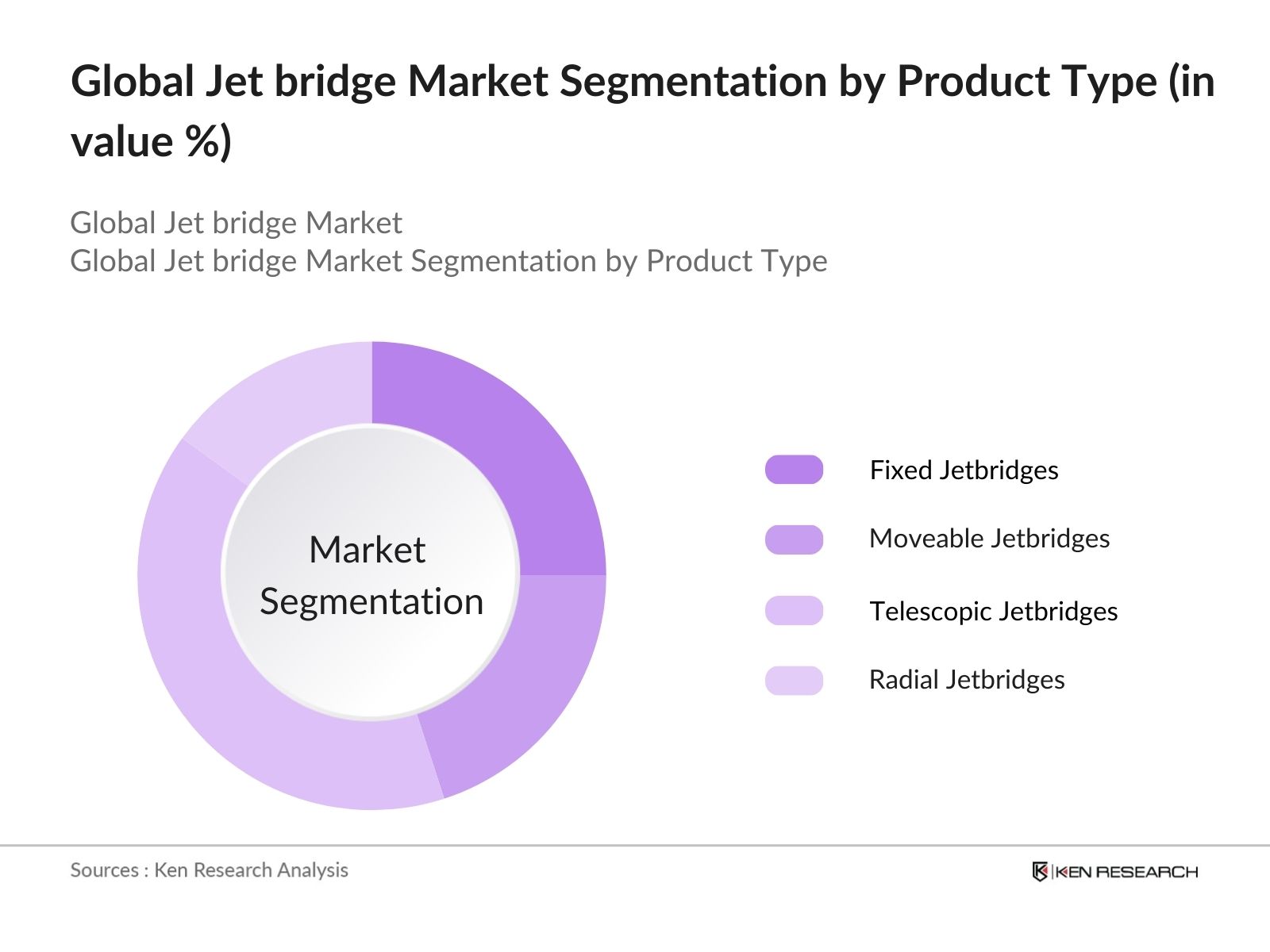
By Product Type: The market is segmented by product type into fixed Jet bridges, moveable Jet bridges, telescopic Jet bridges, and radial Jet bridges. Telescopic Jet bridges have gained a dominant market share within the product type segment due to their flexibility and ease of integration in varying airport designs. Airports prefer telescopic bridges because they can accommodate a wider range of aircraft sizes and provide seamless passenger transfer, minimizing boarding time.
By Application: The market is segmented by application into commercial aviation, military aviation, and cargo operations. Commercial aviation dominates this segment, capturing the largest share due to the significant rise in global air passenger traffic. As airlines expand fleets and airports upgrade their infrastructure to handle growing volumes, commercial aviation continues to drive the demand for advanced Jet bridges that facilitate faster and safer passenger boarding.
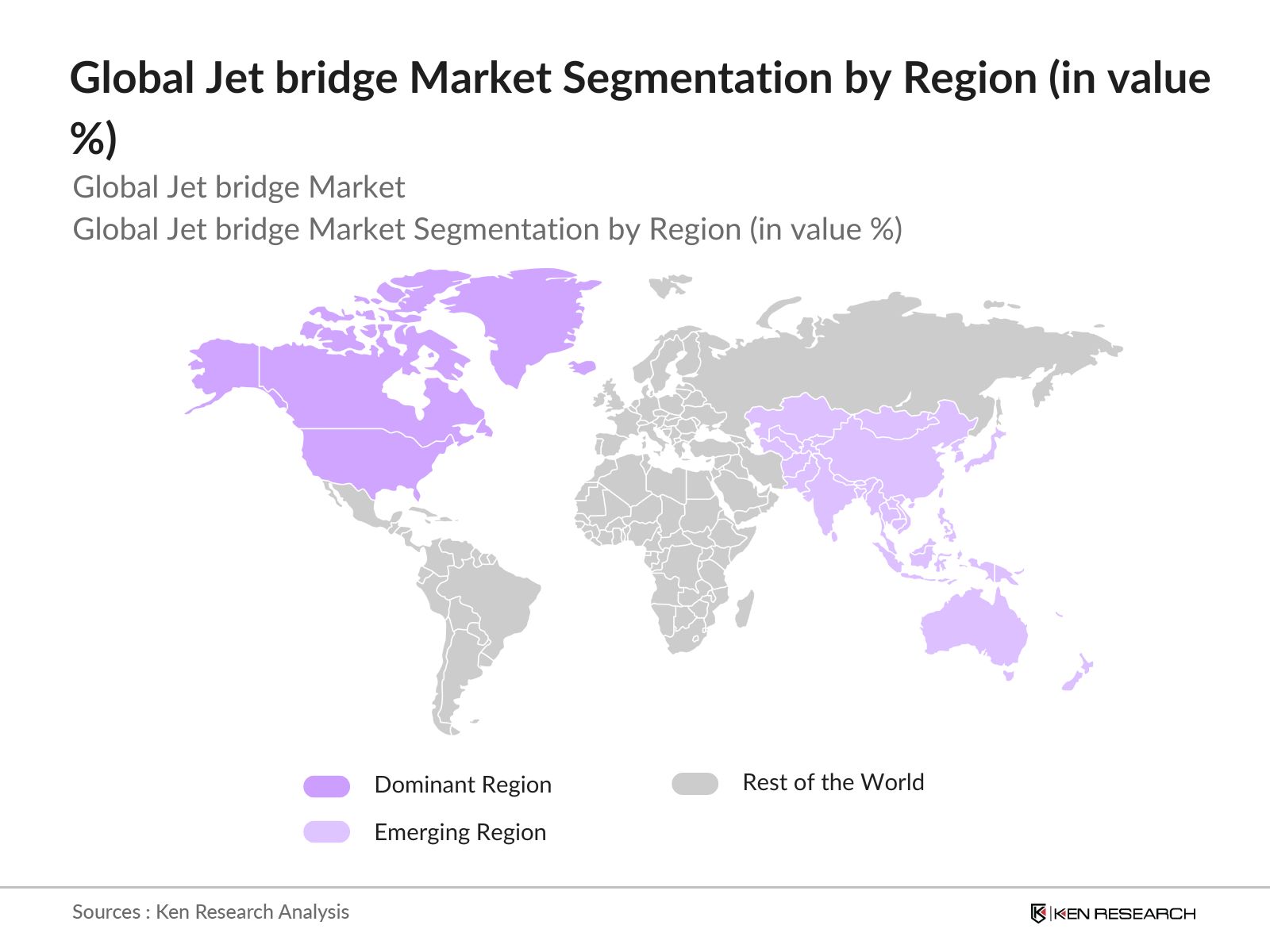
By Region: The market is segmented by region into North America, Europe, Asia-Pacific, Middle East & Africa, and Latin America. North America leads the market due to the extensive number of airports and significant investments in upgrading aging infrastructure. The U.S., in particular, benefits from a strong aviation industry and large-scale commercial operations. Meanwhile, Asia-Pacific is experiencing rapid growth, with countries like China and India investing heavily in airport infrastructure to support rising passenger numbers and air traffic, contributing to their increasing market share.
The market is dominated by a few major players with influence due to their established presence, strong engineering capabilities, and innovation-driven strategies. Companies like Thyssenkrupp AG and JBT Corporation lead the market with their wide range of product offerings and global footprint.
|
Company |
Establishment Year |
Headquarters |
Revenue |
Number of Employees |
Product Portfolio |
R&D Investment |
Geographical Reach |
Innovation Capability |
|
Thyssenkrupp AG |
1811 |
Essen, Germany |
||||||
|
JBT Corporation |
1884 |
Chicago, USA |
||||||
|
Adelte Group |
1952 |
Barcelona, Spain |
||||||
|
CIMC TianDa Holdings Co. |
1989 |
Shenzhen, China |
||||||
|
FMT Aircraft Gate Support Systems |
1967 |
Arlandastad, Sweden |
Over the next five years, the Global Jet bridge industry is expected to show substantial growth, driven by increased global investments in airport infrastructure, rising air passenger traffic, and the demand for seamless and efficient passenger boarding solutions. Additionally, the push for sustainable and environmentally friendly technologies is expected to lead to the development of electric and autonomous jet bridges.
|
By Product Type |
Fixed Jet bridges |
|
Moveable Jet bridges |
|
|
Telescopic Jet bridges |
|
|
Radial Jet bridges |
|
|
By Application |
Commercial Aviation |
|
Military Aviation |
|
|
Cargo Operations |
|
|
By Drive System |
Manual Jet bridges |
|
Hydraulic Jet bridges |
|
|
Electro-Mechanical Jet bridges |
|
|
By Material Type |
Steel Jet bridges |
|
Aluminum Jet bridges |
|
|
Glass-Fiber Composite Jet bridges |
|
|
By Region |
North America |
|
Europe |
|
|
Asia-Pacific |
|
|
Middle East & Africa |
|
|
Latin America |
1.1. Definition and Scope
1.2. Market Taxonomy
1.3. Market Growth Rate
1.4. Market Segmentation Overview
2.1. Historical Market Size
2.2. Year-On-Year Growth Analysis
2.3. Key Market Developments and Milestones
3.1. Growth Drivers (Aircraft Fleet Growth, Airport Expansion Projects, Increasing Air Passenger Traffic, Environmental Concerns)
3.1.1. Growing Commercial Aviation Industry
3.1.2. Increasing Government Investment in Airport Infrastructure
3.1.3. Adoption of Environment-Friendly Technology
3.1.4. Rising Demand for Seamless Passenger Experience
3.2. Market Challenges (High Installation and Maintenance Costs, Regulatory Compliance, Space Constraints at Airports)
3.2.1. High Cost of Technologically Advanced Jet bridges
3.2.2. Regulatory Challenges and Environmental Compliance
3.2.3. Technical and Operational Complexity
3.2.4. Lack of Uniform Standards Across Different Regions
3.3. Opportunities (Emerging Markets, Smart Airport Integration, Electric and Autonomous Jet bridges)
3.3.1. Expansion of Airports in Emerging Economies
3.3.2. Integration with Smart Airports and IoT Technologies
3.3.3. Development of Autonomous Jet bridge Solutions
3.3.4. Growing Focus on Passenger Convenience and Safety
3.4. Trends (Automation, Sustainability Initiatives, Modular Jet bridge Design)
3.4.1. Introduction of Automated and AI-Integrated Jet bridges
3.4.2. Increasing Focus on Eco-Friendly and Energy-Efficient Designs
3.4.3. Modular Jet bridge Systems for Efficient Space Utilization
3.4.4. Increasing Use of Electric Jet bridges to Reduce Emissions
3.5. Government Regulation (Airport Construction Standards, Environmental Guidelines, Safety Regulations)
3.5.1. International Civil Aviation Organization (ICAO) Guidelines
3.5.2. Environmental and Energy Efficiency Standards
3.5.3. Airport Safety and Passenger Mobility Regulations
3.5.4. National Airport Development Plans
3.6. SWOT Analysis
3.7. Stake Ecosystem (Airports, Manufacturers, Airlines, Maintenance Providers)
3.8. Porters Five Forces
3.9. Competition Ecosystem
4.1. By Product Type (In Value %)
4.1.1. Fixed Jet bridges
4.1.2. Moveable Jet bridges
4.1.3. Telescopic Jet bridges
4.1.4. Radial Jet bridges
4.2. By Application (In Value %)
4.2.1. Commercial Aviation
4.2.2. Military Aviation
4.2.3. Cargo Operations
4.3. By Drive System (In Value %)
4.3.1. Manual Jet bridges
4.3.2. Hydraulic Jet bridges
4.3.3. Electro-Mechanical Jet bridges
4.4. By Material Type (In Value %)
4.4.1. Steel Jet bridges
4.4.2. Aluminum Jet bridges
4.4.3. Glass-Fiber Composite Jet bridges
4.5. By Region (In Value %)
4.5.1. North America
4.5.2. Europe
4.5.3. Asia-Pacific
4.5.4. Middle East & Africa
4.5.5. Latin America
5.1 Detailed Profiles of Major Companies
5.1.1. Thyssenkrupp AG
5.1.2. JBT Corporation
5.1.3. Adelte Group
5.1.4. CIMC TianDa Holdings Company Limited
5.1.5. FMT Aircraft Gate Support Systems AB
5.1.6. ShinMaywa Industries, Ltd.
5.1.7. Vataple Group Ltd.
5.1.8. John Bean Technologies Corporation
5.1.9. Hyundai Rotem Company
5.1.10. Ameribridge, Inc.
5.1.11. ADELTE Group
5.1.12. Aviramp
5.1.13. Aviogei
5.1.14. Hubner GmbH & Co. KG
5.1.15. DOLL Fahrzeugbau GmbH
5.2 Cross Comparison Parameters (Revenue, Installed Base, R&D Investment, Market Share, Innovation Capabilities, Product Portfolio, Geographical Reach, Customer Base)
5.3. Market Share Analysis
5.4. Strategic Initiatives
5.5. Mergers And Acquisitions
5.6. Investment Analysis
5.7 Venture Capital Funding
5.8. Government Grants
5.9. Private Equity Investments
6.1. International Airport Standards
6.2. Environmental Regulations for Jet bridge Manufacturing
6.3. Passenger Mobility Compliance
6.4. Certification Processes for Aviation Equipment
7.1. Future Market Size Projections
7.2. Key Factors Driving Future Market Growth
8.1. By Product Type (In Value %)
8.2. By Application (In Value %)
8.3. By Drive System (In Value %)
8.4. By Material Type (In Value %)
8.5. By Region (In Value %)
9.1. TAM/SAM/SOM Analysis
9.2. Customer Cohort Analysis
9.3. Marketing Initiatives
9.4. White Space Opportunity Analysis
The first stage involves constructing an industry ecosystem map encompassing all major stakeholders in the Global Jet bridge Market. This phase is supported by extensive desk research, utilizing both secondary and proprietary databases to gather comprehensive industry data and identify critical variables that influence market dynamics.
In this phase, we compile and analyze historical data related to the market, including revenue trends and key milestones achieved by leading players. Market penetration, product development, and the distribution of market share are also assessed to provide a detailed overview of the industrys historical performance.
Hypotheses about the markets future growth are formulated and then validated through interviews with industry experts, including executives from leading Jet bridge manufacturers and airport authorities. These consultations help refine our understanding of market trends and ensure the reliability of the data.
The final phase involves direct engagement with key stakeholders, including major manufacturers and airport operators, to verify and complement the data obtained through the bottom-up approach. This process ensures a comprehensive, validated analysis of the markets current state and future potential.
The Global Jet bridge Market is valued at USD 213.5 million, driven by rising investments in airport infrastructure, air passenger traffic growth, and technological advancements.
Key challenges in the Global Jet bridge Market include high installation and maintenance costs, regulatory compliance requirements, and space constraints at airports.
Major players in the Global Jet bridge Market include Thyssenkrupp AG, JBT Corporation, Adelte Group, CIMC TianDa Holdings, and FMT Aircraft Gate Support Systems AB.
Growth drivers in the Global Jet bridge Market include rising global air passenger traffic, significant airport expansion projects, and the demand for energy-efficient, technologically advanced Jet bridges.
North America dominates the Global Jet bridge Market due to the large number of airports and ongoing modernization efforts, while Asia-Pacific is experiencing rapid growth due to increasing investments in new airport infrastructure.

What makes us stand out is that our consultants follows Robust, Refine and Result (RRR) methodology. i.e. Robust for clear definitions, approaches and sanity checking, Refine for differentiating respondents facts and opinions and Result for presenting data with story

We have set a benchmark in the industry by offering our clients with syndicated and customized market research reports featuring coverage of entire market as well as meticulous research and analyst insights.

While we don't replace traditional research, we flip the method upside down. Our dual approach of Top Bottom & Bottom Top ensures quality deliverable by not just verifying company fundamentals but also looking at the sector and macroeconomic factors.

With one step in the future, our research team constantly tries to show you the bigger picture. We help with some of the tough questions you may encounter along the way: How is the industry positioned? Best marketing channel? KPI's of competitors? By aligning every element, we help maximize success.

Our report gives you instant access to the answers and sources that other companies might choose to hide. We elaborate each steps of research methodology we have used and showcase you the sample size to earn your trust.

If you need any support, we are here! We pride ourselves on universe strength, data quality, and quick, friendly, and professional service.