Global Medium Density Fiberboard Market Outlook to 2030

Region:Global

Author(s):Mukul

Product Code:KROD4350

Published On

November 2024

Total pages

100

About the Report

Global Medium Density Fiberboard Market Overview

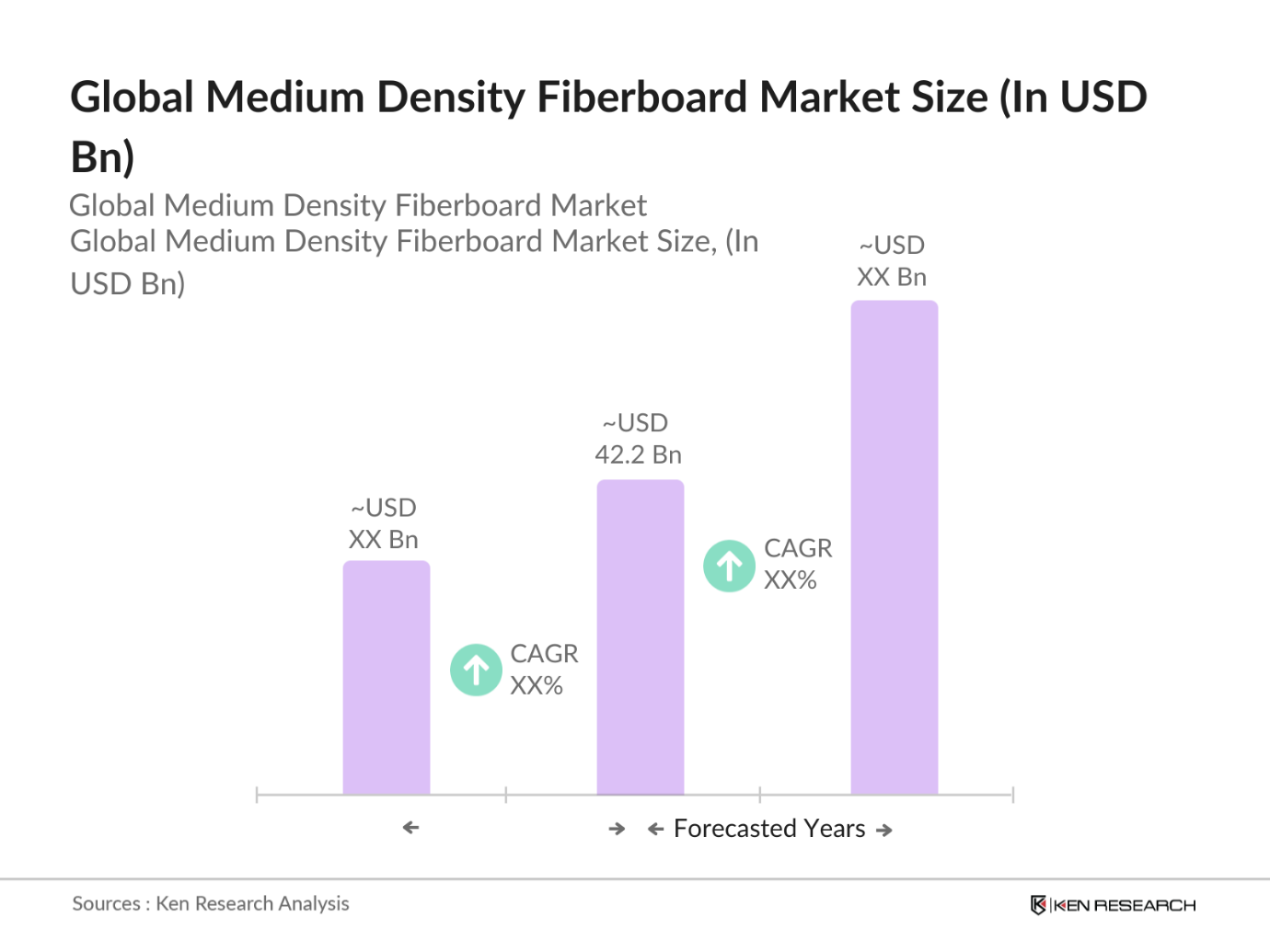
  • The global MDF market is valued at USD 42.2 billion, driven by the construction and furniture sectors, which continue to expand globally. MDFs versatility, ease of machining, and eco-friendliness as a substitute for traditional plywood have increased demand, particularly in developed regions. With sustained interest from key industries, this market has seen consistent growth over the past five years.

Global Medium Density Fiberboard Market Size

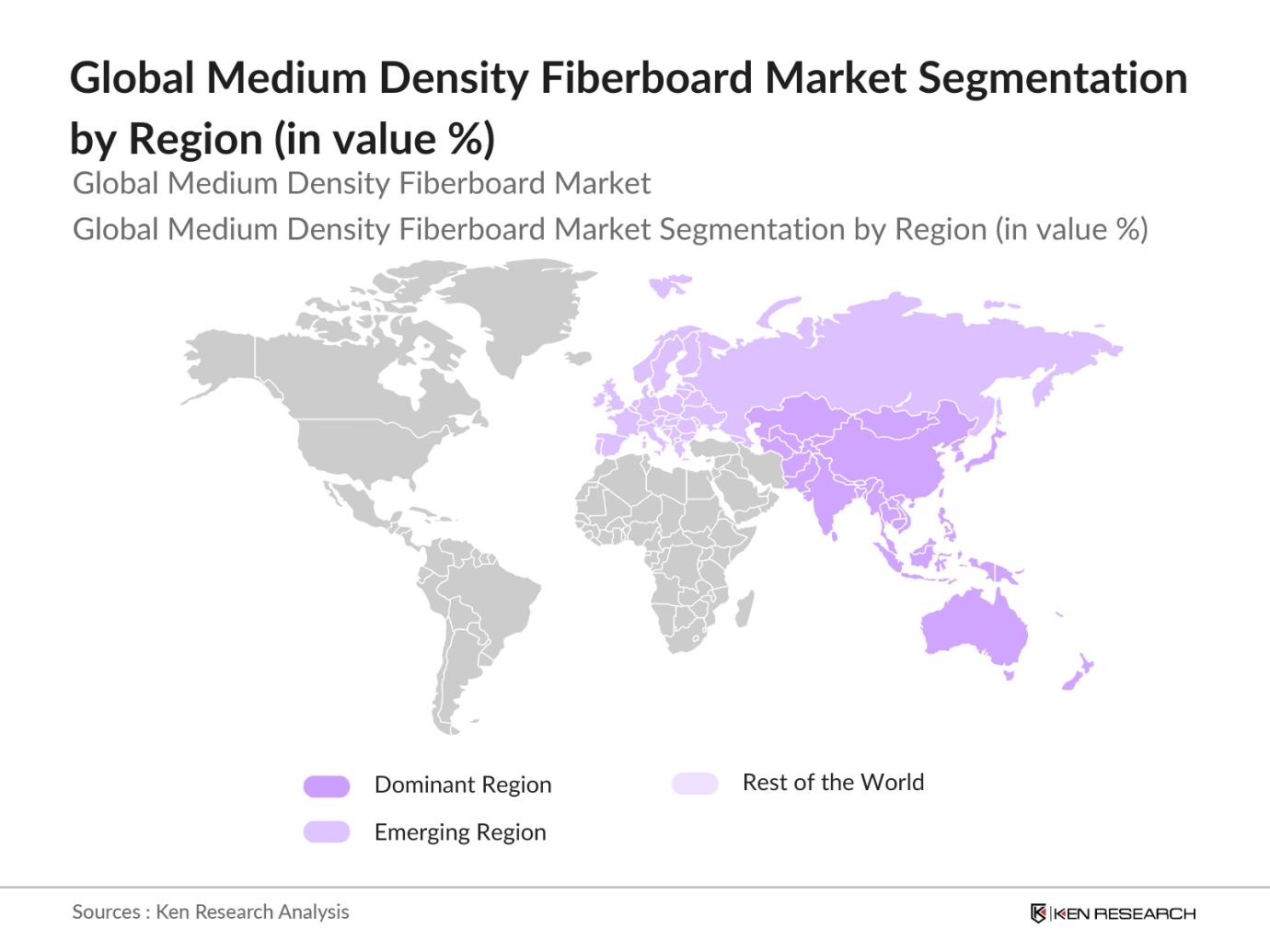
  • Regions such as Asia-Pacific and Europe are dominant in the MDF market. Asia-Pacific, led by China and India, benefits from high construction activity, while Europe focuses on sustainable wood sourcing and stringent environmental regulations. The preference for cost-effective, durable materials supports MDFs prominence in these regions, as it meets both affordability and regulatory standards for green construction.
  • Governments are introducing incentives to encourage sustainable MDF manufacturing. In 2023, the European Commission launched a EUR 50 million fund to support eco-friendly manufacturing practices in wood product industries, including MDF. Similarly, the Indian government provided tax incentives for green building materials in 2023, aligning with its carbon reduction goals.

Global Medium Density Fiberboard Market Segmentation

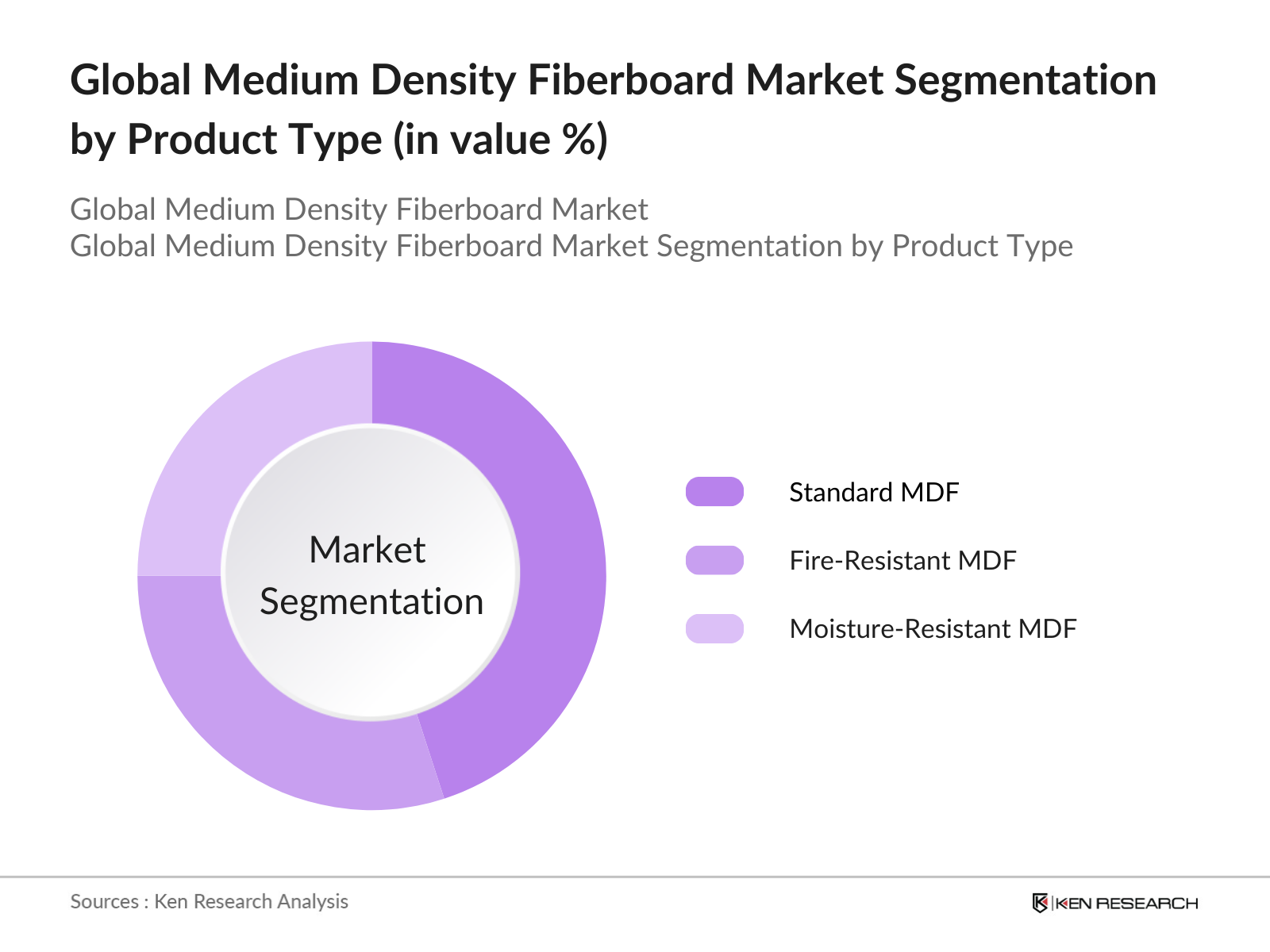
  • By Product Type: The MDF market is segmented by product type into Standard MDF, Fire-Resistant MDF, and Moisture-Resistant MDF. Recently, Standard MDF has held a dominant market share in the product type segment due to its widespread application in furniture and construction. Its cost-effectiveness and ability to be easily shaped make it highly suitable for mass-market applications. Standard MDF is used widely in both residential and commercial settings, offering a reliable, affordable alternative to solid wood.

Global Medium Density Fiberboard Market Segmentation By Product Type

  • By Region: Geographically, the market is segmented into North America, Europe, Asia-Pacific, Latin America, and Middle East & Africa. The Asia-Pacific region, led by China and India, dominates due to high demand in the construction and furniture manufacturing industries. The region's large population and rapid urbanization fuel the demand for affordable, versatile building materials like MDF. North America and Europe also have a notable market presence, driven by eco-friendly initiatives and advancements in engineered wood technology.

Global Medium Density Fiberboard Market Segmentation By Region

  • By Application: The MDF market is further segmented by application into Residential, Commercial, and Industrial. Within this segmentation, the Residential sector commands a significant share due to high demand for affordable wood alternatives in home furnishings and cabinetry. MDFs smooth surface is well-suited for painting and laminating, making it an attractive choice for modern home designs, especially in developed markets where housing aesthetics are prioritized.

Global Medium Density Fiberboard Market Competitive Landscape

The MDF market is primarily dominated by a combination of local and global players who maintain competitive positions through extensive product portfolios and strategic initiatives.

Global Medium Density Fiberboard Industry Analysis

Growth Drivers

  • Urbanization and Infrastructure Growth: Urbanization is fueling demand for building materials, with the UN estimating that by 2023, around 58% of the global population resided in urban areas, up from 55% in 2021. This rapid urban expansion, notably in Asia-Pacific and parts of Africa, has increased the demand for cost-effective building materials like MDF for construction. According to the World Bank, global infrastructure investment surged in 2023, reaching approximately USD 2.5 trillion, further driving the use of MDF in housing and commercial projects due to its affordability and ease of use in modern infrastructure projects.
  • Construction Sector Demand (Residential, Commercial): The construction sector is a key consumer of MDF due to its versatility in both residential and commercial spaces. In 2023, the U.S. Census Bureau reported nearly 1.6 million new housing starts, while Europe showed a 7% growth in residential construction activities, emphasizing the sectors contribution to MDF demand. Additionally, developing economies, like India and Brazil, continue to push for affordable housing, with Indias Housing for All initiative allocating USD 31 billion in 2023 to promote residential projects, thereby bolstering the MDF market in construction.
  • Increased Focus on Sustainability and Green Building: The global shift towards sustainable construction materials has placed MDF as a favored choice in green building. According to the International Energy Agency, nearly 40% of CO emissions come from the construction sector, pushing regulations towards eco-friendly materials. MDFs sustainable aspects, like low formaldehyde emissions and recycled wood usage, align with these green building standards, leading to its adoption in projects adhering to LEED and BREEAM certifications in regions like Europe and North America.

Market Restraints

  • High Raw Material Costs: Rising costs for timber and wood by-products, the primary raw materials for MDF, have challenged manufacturers. The FAO noted that global timber prices increased by 15% from 2022 to 2024 due to supply chain disruptions and increased demand, particularly in Asia-Pacific. This spike in raw material costs has resulted in constrained production capacities and higher end-product prices, limiting MDF accessibility for cost-sensitive markets and hindering profitability for manufacturers reliant on affordable wood sources.
  • Limited Supply Chain Integration: Inconsistent supply chain integration within the MDF industry impacts efficient production and distribution. A 2023 report by the World Bank noted significant logistics delays in the transportation of wood and MDF products in Southeast Asia and Latin America, regions heavily dependent on MDF imports. This lack of integration leads to delays in supply availability and contributes to regional price fluctuations, limiting market growth in areas where timely supply of MDF materials is critical for ongoing projects.

Global Medium Density Fiberboard Market Future Outlook

The MDF market is projected to experience robust growth, driven by ongoing advancements in MDF production technology and rising consumer demand for sustainable building materials. Increased urbanization in emerging economies, coupled with eco-friendly construction standards in developed nations, will likely boost MDF's global presence. The market's trajectory also reflects heightened demand for high-density and moisture-resistant MDF, as interior applications grow more specialized.

Market Opportunities

  • Innovations in Fire-Resistant MDF: Advances in fire-resistant MDF technology are opening new avenues in commercial and public building projects. The NFPA reported that fire-resistant construction materials saw a 12% demand increase in 2023, driven by stricter building codes. Fire-resistant MDF, with its low flammability, is gaining traction in the construction of high-rise buildings and schools, particularly in fire-prone areas across North America and Australia.
  • Market Expansion in Emerging Economies: Emerging economies, notably in Southeast Asia and Africa, are witnessing rapid urbanization and demand for cost-effective building materials. The African Development Bank reported a 5% increase in infrastructure projects across Africa in 2023, and MDF is often used as an affordable alternative to traditional wood. India also saw significant MDF adoption, supported by government housing programs and a 13% rise in construction output according to the Ministry of Housing.

Scope of the Report

By Type

Standard MDF
Fire-Resistant MDF
Moisture-Resistant MDF

By Density

Low Density MDF
Standard Density MDF
High Density MDF

By Application

Residential
Commercial
Industrial

By End-Use Industry

Construction
Furniture
Interior Design

By Region

North America
Europe
Asia-Pacific
Latin America
Middle East & Africa

Products

Key Target Audience

  • MDF Manufacturers

  • Construction and Housing Developers

  • Furniture Manufacturers

  • Government and Regulatory Bodies (Environmental Protection Agency, Forestry Departments)

  • Interior Designers and Architects

  • MDF Product Distributors and Retailers

  • Investor and Venture Capitalist Firms

  • Industrial Safety and Standards Organizations

Companies

Players Mentioned in the Report:

  • Kronospan

  • Egger Group

  • Greenply Industries Ltd.

  • Arauco

  • Norbord Inc.

  • Uniboard

  • Dare Wood-Based Panels Group

  • Duratex SA

  • Weyerhaeuser Company

  • Masisa

  • Sonae Arauco

  • Pfleiderer Group

  • Dongwha Group

  • Nelson Pine Industries Ltd.

  • Century Plyboards Ltd.

Table of Contents

1. Global MDF Market Overview

1.1 Definition and Scope

1.2 Market Taxonomy

1.3 Market Structure and Key Stakeholders

1.4 Market Segmentation Overview

2. Global MDF Market Size (In USD Mn)

2.1 Historical Market Size

2.2 Year-On-Year Growth Analysis

2.3 Market Development Milestones

3. Global MDF Market Analysis

3.1 Growth Drivers

3.1.1 Urbanization and Infrastructure Growth

3.1.2 Construction Sector Demand (Residential, Commercial)

3.1.3 Increased Focus on Sustainability and Green Building

3.2 Market Challenges

3.2.1 High Raw Material Costs

3.2.2 Limited Supply Chain Integration

3.2.3 Environmental Regulations and Compliance

3.3 Opportunities

3.3.1 Innovations in Fire-Resistant MDF

3.3.2 Market Expansion in Emerging Economies

3.3.3 Increased Adoption in Furniture Manufacturing

3.4 Trends

3.4.1 Growth in Eco-Friendly MDF Varieties

3.4.2 Increasing Application of Digital Printing

3.4.3 Enhanced Surface Texture and Durability

3.5 Government Regulation

3.5.1 Emission Standards for Wood Products

3.5.2 Forest Management and Sourcing Guidelines

3.5.3 Incentives for Sustainable Manufacturing

3.6 SWOT Analysis

3.7 Stakeholder Ecosystem

3.8 Porters Five Forces

3.9 Competition Ecosystem

4. Global MDF Market Segmentation

4.1 By Type (In Value %)

4.1.1 Standard MDF

4.1.2 Fire-Resistant MDF

4.1.3 Moisture-Resistant MDF

4.2 By Density (In Value %)

4.2.1 Low Density MDF

4.2.2 Standard Density MDF

4.2.3 High Density MDF

4.3 By Application (In Value %)

4.3.1 Residential

4.3.2 Commercial

4.3.3 Industrial

4.4 By End-Use Industry (In Value %)

4.4.1 Construction

4.4.2 Furniture

4.4.3 Interior Design

4.5 By Region (In Value %)

4.5.1 North America

4.5.2 Europe

4.5.3 Asia-Pacific

4.5.4 Latin America

4.5.5 Middle East & Africa

5. Global MDF Market Competitive Analysis

5.1 Detailed Profiles of Major Companies

5.1.1 Kronospan

5.1.2 Egger Group

5.1.3 Greenply Industries Ltd.

5.1.4 Arauco

5.1.5 Norbord Inc.

5.1.6 Uniboard

5.1.7 Dare Wood-Based Panels Group

5.1.8 Duratex SA

5.1.9 Weyerhaeuser Company

5.1.10 Masisa

5.1.11 Sonae Arauco

5.1.12 Pfleiderer Group

5.1.13 Dongwha Group

5.1.14 Nelson Pine Industries Ltd.

5.1.15 Century Plyboards Ltd.

5.2 Cross Comparison Parameters (Production Capacity, Market Share, Manufacturing Facilities, Product Range, Revenue, Global Reach, Innovations, Strategic Initiatives)

5.3 Market Share Analysis

5.4 Strategic Initiatives

5.5 Mergers and Acquisitions

5.6 Investment Analysis

5.7 Venture Capital Funding

5.8 Government Subsidies

5.9 Private Equity Investments

6. Global MDF Market Regulatory Framework

6.1 Environmental Standards

6.2 Compliance with Emission Protocols

6.3 Certification Processes (FSC, PEFC)

7. Global MDF Future Market Size (In USD Mn)

7.1 Future Market Size Projections

7.2 Factors Driving Future Market Growth

8. Global MDF Market Analysts Recommendations

8.1 Market Penetration Analysis

8.2 Consumer Cohort Insights

8.3 Strategic Marketing Initiatives

8.4 Opportunity Mapping

Disclaimer Contact Us

Research Methodology

Step 1: Identification of Key Variables

The research begins with identifying key market drivers, segmentation, and competitive factors within the global MDF market. This involves rigorous secondary research to map the ecosystem and pinpoint crucial variables influencing the market's dynamics.

Step 2: Market Analysis and Data Compilation

The data collected in this step includes historical growth rates, supply-demand ratios, and market capacity figures. The analysis emphasizes revenue and volume trends, validated through cross-referencing with proprietary databases and credible industry publications.

Step 3: Hypothesis Validation and Expert Consultation

Primary research is conducted through interviews with MDF industry experts and stakeholders to validate hypotheses developed in the previous stages. This step provides insights into operational trends, financial impacts, and strategic priorities.

Step 4: Final Data Synthesis and Reporting

The final phase consolidates all data, ensuring accuracy through quantitative validation. The reporting phase involves constructing detailed findings, validated by market-specific cross-comparison metrics, to provide a holistic and precise overview of the global MDF market.

Frequently Asked Questions

01. How big is the Global MDF Market?

The global MDF market is valued at USD 42.2 billion, driven by construction and furniture demand and heightened environmental awareness.

02. What are the challenges in the Global MDF Market?

Key challenges include fluctuating raw material costs, regulatory compliance, and limited supply chain integration, which impact overall market stability.

03. Who are the major players in the Global MDF Market?

Major players in the market include Kronospan, Egger Group, Greenply Industries, Arauco, and Norbord Inc., each leveraging extensive production capacity and strategic growth initiatives.

04. What drives growth in the Global MDF Market?

Growth is fueled by demand in the residential and commercial sectors, as well as regulatory pressure for sustainable building materials.


Why Buy From Us?

RRR
Refine Robust Result (RRR) Framework

What makes us stand out is that our consultants follows Robust, Refine and Result (RRR) methodology. i.e. Robust for clear definitions, approaches and sanity checking, Refine for differentiating respondents facts and opinions and Result for presenting data with story

Our Reach Is Unmatched

We have set a benchmark in the industry by offering our clients with syndicated and customized market research reports featuring coverage of entire market as well as meticulous research and analyst insights.

Research
Shifting the Research Paradigm

While we don't replace traditional research, we flip the method upside down. Our dual approach of Top Bottom & Bottom Top ensures quality deliverable by not just verifying company fundamentals but also looking at the sector and macroeconomic factors.

Insite
More Insights-Better Decisions

With one step in the future, our research team constantly tries to show you the bigger picture. We help with some of the tough questions you may encounter along the way: How is the industry positioned? Best marketing channel? KPI's of competitors? By aligning every element, we help maximize success.

Trust
Transparency and Trust

Our report gives you instant access to the answers and sources that other companies might choose to hide. We elaborate each steps of research methodology we have used and showcase you the sample size to earn your trust.

support
Round the Clock Support

If you need any support, we are here! We pride ourselves on universe strength, data quality, and quick, friendly, and professional service.

Why Client Choose Us?

400000+ Reports in repository
150+ Consulting project a year
100+ Analysts
8000+ Client Queries in 2022