
Global Methacrylate Butadiene Styrene Market Outlook 2030
Region:Global
Author(s):Shivani Mehra
Product Code:KROD8252
December 2024
98
About the Report
Global Methacrylate Butadiene Styrene Market Overview
- The Methacrylate Butadiene Styrene market, based on historical data, is valued at USD 950 million. The growth of the market is driven primarily by the increasing demand from automotive and electronics industries, where high-performance polymers are critical. The automotive sector, in particular, plays a major role due to the rising need for lightweight materials to improve fuel efficiency.
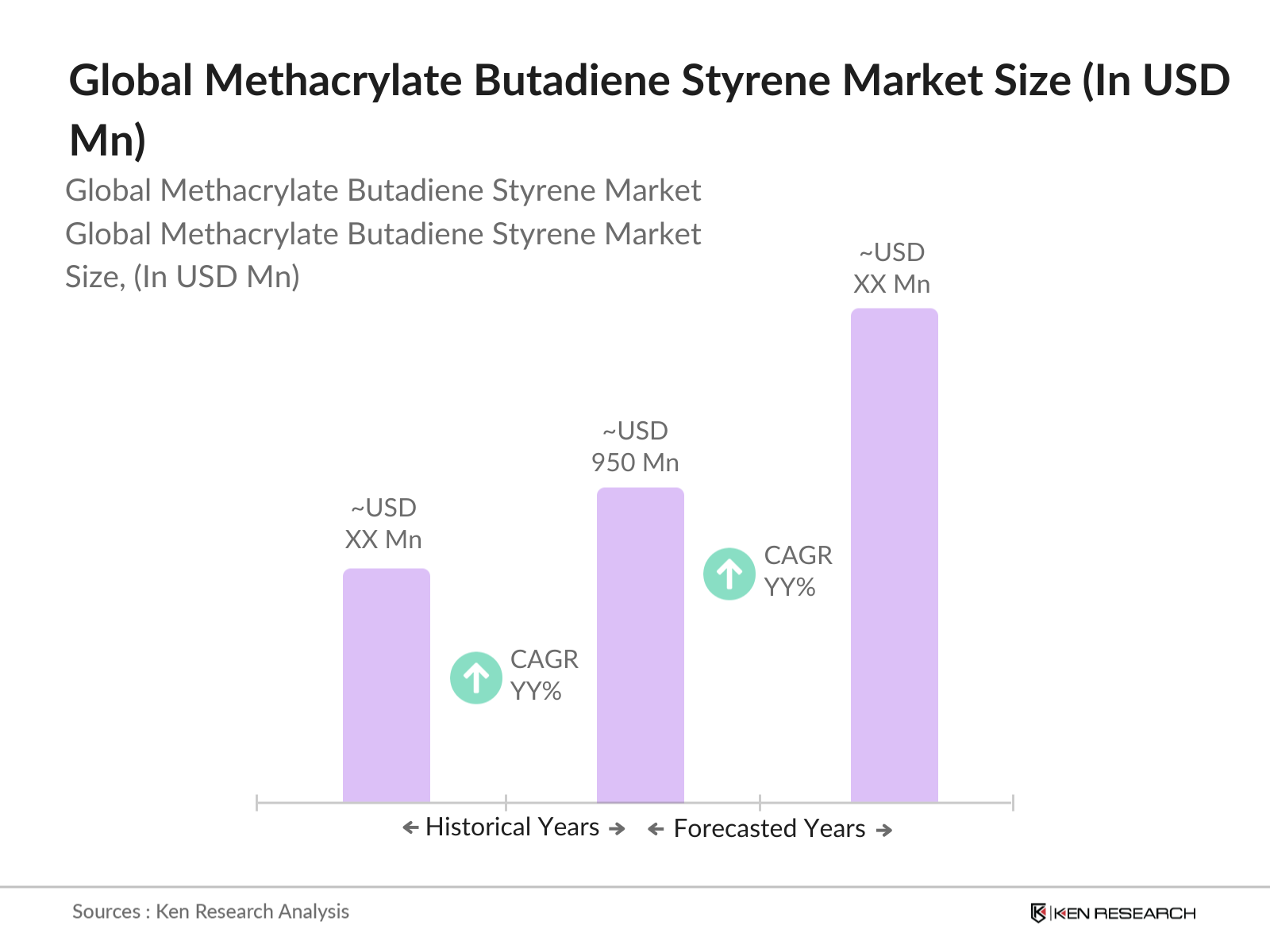
- Countries like Germany, China, and the United States are leading contributors to the Methacrylate Butadiene Styrene market. Germanys dominance stems from its robust automotive industry, which is continuously innovating with advanced materials. China, being a major manufacturing hub for consumer electronics, automotive, and packaging, holds significant market share due to its high production capacity and government initiatives to modernize its industrial base. The United States benefits from both a strong automotive sector and advancements in 3D printing technologies that rely heavily on Methacrylate Butadiene Styrene polymers.
- The European Unions REACH (Registration, Evaluation, Authorisation and Restriction of Chemicals) and RoHS (Restriction of Hazardous Substances) directives have impacted the production and use of MBS in consumer electronics. In 2023, the EU updated these regulations to further limit the use of hazardous substances in electronic devices, compelling manufacturers to seek safer alternatives. MBS, known for its low toxicity and compliance with these directives, is increasingly used in electronics manufacturing. This regulatory environment has driven higher MBS adoption in the EU electronics sector.
Global Methacrylate Butadiene Styrene Market Segmentation
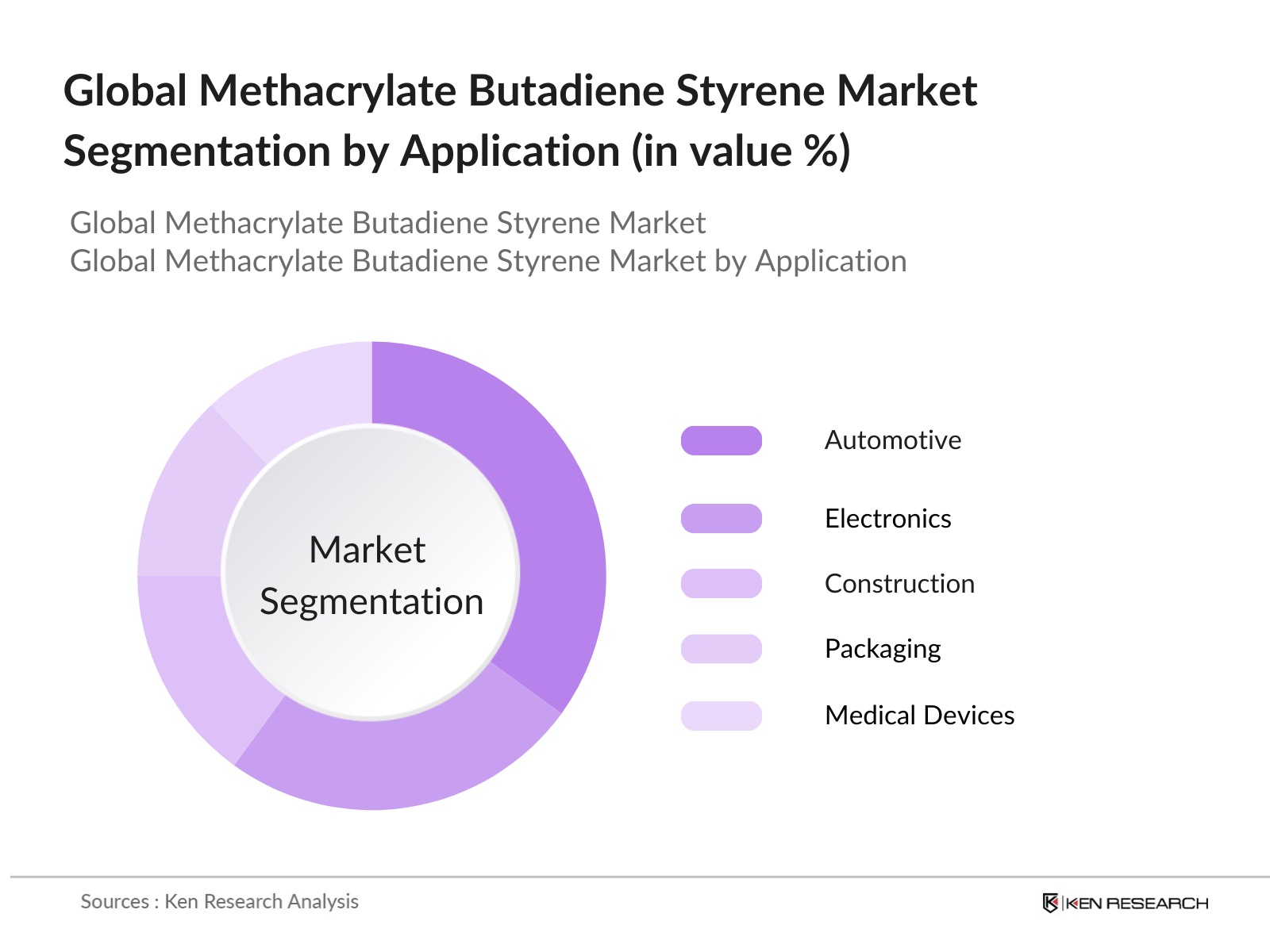
By Application: The Methacrylate Butadiene Styrene market is segmented by application into Automotive, Electronics, Construction, Packaging, and Medical Devices. Automotive dominates the application segment due to the increasing demand for lightweight, durable materials that can reduce vehicle weight while maintaining structural integrity. The need for better fuel efficiency and compliance with emission standards has significantly increased the adoption of Methacrylate Butadiene Styrene in the automotive sector, especially in Europe and North America.
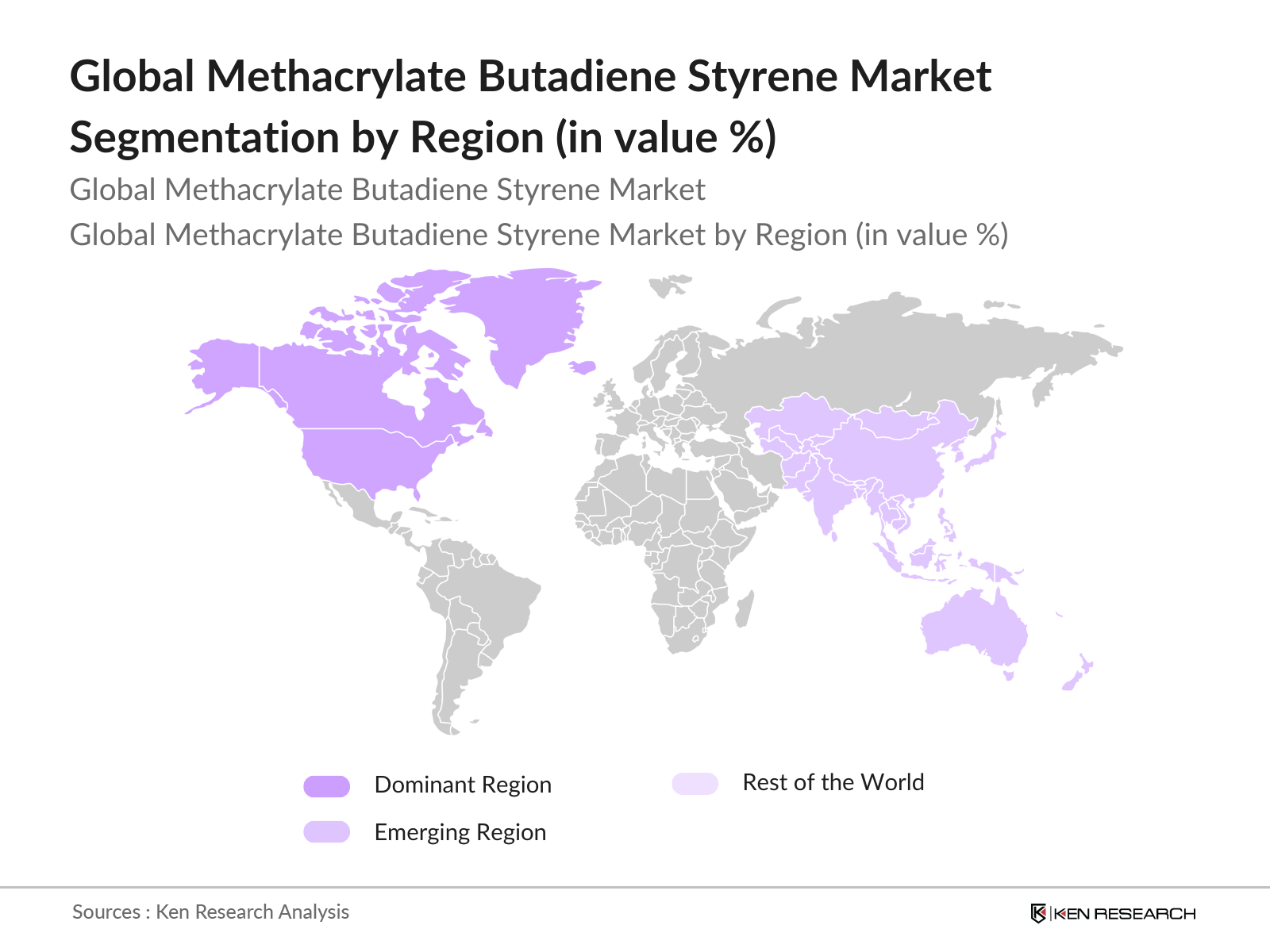
By Region: The Methacrylate Butadiene Styrene market is segmented into North America, Europe, Asia-Pacific, Latin America, and Middle East & Africa. Asia-Pacific leads the market due to the strong industrial base of countries like China, Japan, and South Korea. The regions dominance is attributed to the extensive use of Methacrylate Butadiene Styrene in electronics and automotive manufacturing. China, in particular, is a major consumer due to its vast production capabilities and rising consumer demand for electronics.
Global Methacrylate Butadiene Styrene Market Competitive Landscape
The Methacrylate Butadiene Styrene market is characterized by a high degree of competition with a few dominant players leading the market. These companies are involved in both product development and large-scale manufacturing, which gives them a competitive edge in terms of production costs and innovation.
|
Company |
Establishment Year |
Headquarters |
Revenue |
R&D Investment |
No. of Employees |
Global Presence |
Product Portfolio |
Sustainability Initiatives |
|
Mitsubishi Chemical Corp. |
1933 |
Tokyo, Japan |
||||||
|
BASF SE |
1865 |
Ludwigshafen, Germany |
||||||
|
LG Chem |
1947 |
Seoul, South Korea |
||||||
|
Dow Inc. |
1897 |
Midland, USA |
||||||
|
Chi Mei Corporation |
1957 |
Tainan, Taiwan |
Global Methacrylate Butadiene Styrene Market Analysis
Market Growth Drivers
- Increasing Demand in Automotive & Consumer Electronics: Methacrylate Butadiene Styrene (MBS) has seen significant growth in the automotive and consumer electronics sectors due to its lightweight properties. In 2022, the global automotive industry produced 85 million vehicles, with major manufacturers increasing their reliance on MBS-based components to reduce vehicle weight and enhance fuel efficiency. The use of MBS polymers in electronics, particularly for durable and high-performance products, has expanded as global shipments of smartphones reached 1.35 billion units in 2023. These figures underscore the strong demand for MBS in these sectors.
- Rising Applications in 3D Printing: The adoption of MBS in 3D printing has gained traction due to its flexibility and strength. According to data from the World Bank, global investments in 3D printing technologies surpassed $20 billion in 2022, with more than 4 million 3D printers sold globally. MBS is increasingly used in producing customized, durable components, especially for automotive and medical applications. The material's versatility in the additive manufacturing industry has made it a key player in producing cost-efficient, lightweight, and high-performance components.
- Rising Investment in R&D: The global R&D expenditure in materials science saw a significant increase, with over $500 billion invested in 2023. R&D in MBS-based materials has been particularly strong in the automotive, aerospace, and construction industries. For example, automotive manufacturers have invested $30 billion in lightweight and durable polymers, such as MBS, which has helped in vehicle weight reduction and improved fuel efficiency. This investment trend is likely to continue as industries focus on innovation and product development.
Market Challenges
- Volatility in Raw Material Prices (Impact on Supply Chain): Raw material price fluctuations have been a persistent challenge for MBS production. Between 2022 and 2023, the price of butadiene, a key raw material in MBS production, saw a substantial increase, impacting supply chains globally. The rise in crude oil prices, which reached $95 per barrel in late 2023, further exacerbated the issue as butadiene is a petroleum byproduct. This volatility has strained the market, affecting manufacturers' ability to maintain stable production costs.
- Environmental Concerns (Recycling and Waste Management): The disposal and recycling of MBS products pose environmental challenges. According to the World Bank, global plastic waste generation reached 360 million tons in 2022, and MBS, being a non-biodegradable material, contributes to this growing concern. Countries like Germany have implemented strict regulations on plastic recycling, putting pressure on manufacturers to develop more sustainable alternatives or improve recycling capabilities.
Global Methacrylate Butadiene Styrene Market Future Outlook
Over the next few years, the Methacrylate Butadiene Styrene market is expected to experience significant growth, driven by increased demand from the automotive and electronics industries. With the ongoing advancements in electric vehicles and the rapid adoption of sustainable, lightweight materials, the market will see an uptick in production and application. The rising awareness of environmental sustainability will further encourage manufacturers to focus on recyclable and bio-based alternatives to traditional polymers.
Market Opportunities:
- Development of Bio-based Alternatives: In response to growing environmental concerns, the development of bio-based MBS alternatives has gained momentum. As of 2023, global production of bio-based polymers, including MBS alternatives, stood at 2.8 million metric tons. Governments in Europe and North America are providing subsidies for the production of bio-based materials, driving innovation in this field. The shift towards bio-based MBS aligns with global sustainability goals, reducing reliance on petroleum-based products.
- Customization in Polymer Manufacturing: The demand for customized polymer formulations has grown significantly, driven by industry-specific requirements. In 2023, global demand for customized polymers exceeded 6 million tons, with MBS manufacturers tailoring properties such as impact resistance, flexibility, and heat resistance for sectors like automotive and consumer electronics. This trend highlights the growing need for highly specialized materials, pushing manufacturers to innovate and diversify their product offerings.
Scope of the Report
|
By Product Type |
Automotive Electronic Construction Packaging Medical Devices |
|
By End-Use Industry |
OEMs Contractors Distributors |
|
By Technology |
Extrusion Injection Molding Thermoforming |
|
By Product Type |
Resin Pellets Sheets Films Compounds |
|
By Region |
North America Europe Asia-Pacific Latin America Middle East & Africa |
Products
Key Target Audience
Automotive Manufacturers
Electronics Manufacturers
3D Printing Companies
Chemical Suppliers
Packaging Companies
Medical Device Manufacturers
Investments and Venture Capitalist Firms
Government and Regulatory Bodies (REACH, RoHS)
Companies
Players Mention in the Report
Mitsubishi Chemical Corporation
BASF SE
LG Chem
SABIC
Dow Inc.
Styrolution (Trinseo)
Sumitomo Chemical
Daicel Corporation
Evonik Industries
Arkema Group
Chi Mei Corporation
Kaneka Corporation
Plaskolite
INEOS Styrolution
Asahi Kasei Corporation
Table of Contents
1. Global Methacrylate Butadiene Styrene Market Overview
1.1. Definition and Scope
1.2. Market Taxonomy
1.3. Market Growth Rate (Key Growth Drivers)
1.4. Market Segmentation Overview
2. Global Methacrylate Butadiene Styrene Market Size (In USD Bn)
2.1. Historical Market Size (Market Impact Events)
2.2. Year-On-Year Growth Analysis (Global Market Dynamics)
2.3. Key Market Developments and Milestones (Major Technological Advancements)
3. Global Methacrylate Butadiene Styrene Market Analysis
3.1. Growth Drivers
3.1.1. Increasing Demand in Automotive & Consumer Electronics
3.1.2. Rising Applications in 3D Printing
3.1.3. Sustainability Initiatives and Green Product Adoption
3.1.4. Rising Investment in R&D
3.2. Market Challenges
3.2.1. Volatility in Raw Material Prices (Impact on Supply Chain)
3.2.2. Environmental Concerns (Recycling and Waste Management)
3.2.3. Market Penetration Issues in Emerging Economies
3.3. Opportunities
3.3.1. Growth of Electric Vehicle Industry (Demand for Lightweight Polymers)
3.3.2. Expansion into APAC Markets (Regional Demand Shift)
3.3.3. Technological Advancements in Product Formulation
3.4. Trends
3.4.1. Development of Bio-based Alternatives
3.4.2. Customization in Polymer Manufacturing
3.4.3. Integration of IoT in Production Monitoring
3.5. Government Regulation
3.5.1. Stringent Emission Regulations (Automotive Sector Impact)
3.5.2. REACH and RoHS Compliance (European Market)
3.5.3. Incentives for Sustainable Production
3.6. SWOT Analysis
3.6.1. Strengths
3.6.2. Weaknesses
3.6.3. Opportunities
3.6.4. Threats
3.7. Stakeholder Ecosystem
3.7.1. Raw Material Suppliers
3.7.2. Manufacturers
3.7.3. Distributors
3.7.4. End-Users
3.8. Porters Five Forces
3.8.1. Threat of New Entrants
3.8.2. Bargaining Power of Suppliers
3.8.3. Bargaining Power of Buyers
3.8.4. Threat of Substitutes
3.8.5. Industry Rivalry
3.9. Competition Ecosystem
3.9.1. Mergers & Acquisitions
3.9.2. Strategic Collaborations
3.9.3. Technological Innovations
4. Global Methacrylate Butadiene Styrene Market Segmentation
4.1. By Application (In Value %)
4.1.1. Automotive
4.1.2. Electronics
4.1.3. Construction
4.1.4. Packaging
4.1.5. Medical Devices
4.2. By End-Use Industry (In Value %)
4.2.1. OEMs
4.2.2. Contractors
4.2.3. Distributors
4.3. By Technology (In Value %)
4.3.1. Extrusion
4.3.2. Injection Molding
4.3.3. Thermoforming
4.4. By Region (In Value %)
4.4.1. North America
4.4.2. Europe
4.4.3. Asia-Pacific
4.4.4. Latin America
4.4.5. Middle East & Africa
5. Global Methacrylate Butadiene Styrene Market Competitive Analysis
5.1. Detailed Profiles of Major Companies
5.1.1. Mitsubishi Chemical Corporation
5.1.2. BASF SE
5.1.3. LG Chem
5.1.4. SABIC
5.1.5. Dow Inc.
5.1.6. Chi Mei Corporation
5.1.7. INEOS Styrolution Group
5.1.8. Styrolution (Trinseo)
5.1.9. Sumitomo Chemical
5.1.10. Daicel Corporation
5.1.11. Evonik Industries
5.1.12. Arkema Group
5.1.13. Asahi Kasei Corporation
5.1.14. Plaskolite
5.1.15. Kaneka Corporation
5.2. Cross Comparison Parameters (Revenue, Market Share, Product Portfolio, R&D Focus, Global Presence)
5.3. Market Share Analysis
5.4. Strategic Initiatives
5.5. Mergers & Acquisitions
5.6. Investment Analysis
5.7. Government Incentives and Grants
5.8. Venture Capital Funding
5.9. Private Equity Investments
6. Global Methacrylate Butadiene Styrene Market Regulatory Framework
6.1. International Standards and Certifications
6.2. Environmental Regulations and Compliance
6.3. Certification Processes
6.4. Global Trade Policies Affecting the Market
7. Global Methacrylate Butadiene Styrene Future Market Size (In USD Bn)
7.1. Future Market Size Projections
7.2. Key Factors Driving Future Market Growth
8. Global Methacrylate Butadiene Styrene Future Market Segmentation
8.1. By Application (In Value %)
8.2. By End-Use Industry (In Value %)
8.3. By Technology (In Value %)
8.4. By Region (In Value %)
9. Global Methacrylate Butadiene Styrene Market Analysts Recommendations
9.1. TAM/SAM/SOM Analysis
9.2. Marketing Initiatives
9.3. White Space Opportunity Analysis
Disclaimer Contact UsResearch Methodology
Step 1: Identification of Key Variables
The research begins by mapping out key stakeholders in the Methacrylate Butadiene Styrene market. Extensive desk research and data collection from proprietary databases help identify the critical variables that influence market behavior, such as production capacity, material pricing, and end-user demand.
Step 2: Market Analysis and Construction
Historical data is gathered to analyze market performance and trends over the years. This includes evaluating production techniques, technological advancements, and revenue generation from key market segments like automotive, electronics, and packaging industries.
Step 3: Hypothesis Validation and Expert Consultation
Market assumptions are tested by conducting interviews with industry experts through Computer-Assisted Telephone Interviews (CATI). These experts provide insights into market operations, consumer preferences, and the future direction of product development, ensuring that the data is accurate and well-rounded.
Step 4: Research Synthesis and Final Output
The final stage consolidates the data gathered from various stakeholders, including Methacrylate Butadiene Styrene manufacturers, end-users, and government bodies. This data is synthesized into a comprehensive report, ensuring that all key variables are covered, and market forecasts are supported by factual analysis.
Frequently Asked Questions
1. How big is the Global Methacrylate Butadiene Styrene Market?
The Global Methacrylate Butadiene Styrene market is valued at USD 950 million, driven by demand from automotive and electronics industries.
2. What are the challenges in the Methacrylate Butadiene Styrene Market?
The major challenges include fluctuating raw material prices, environmental concerns regarding disposal and recycling, and the high cost of product development.
3. Who are the major players in the Global Methacrylate Butadiene Styrene Market?
Key players in the market include Mitsubishi Chemical Corporation, BASF SE, LG Chem, SABIC, and Dow Inc. These companies dominate the market through extensive R&D and global distribution networks.
4. What are the growth drivers of the Methacrylate Butadiene Styrene Market?
The market is driven by increasing demand for lightweight materials in the automotive industry, advancements in electronics, and the growing adoption of sustainable polymers.
Why Buy From Us?

What makes us stand out is that our consultants follows Robust, Refine and Result (RRR) methodology. i.e. Robust for clear definitions, approaches and sanity checking, Refine for differentiating respondents facts and opinions and Result for presenting data with story

We have set a benchmark in the industry by offering our clients with syndicated and customized market research reports featuring coverage of entire market as well as meticulous research and analyst insights.

While we don't replace traditional research, we flip the method upside down. Our dual approach of Top Bottom & Bottom Top ensures quality deliverable by not just verifying company fundamentals but also looking at the sector and macroeconomic factors.

With one step in the future, our research team constantly tries to show you the bigger picture. We help with some of the tough questions you may encounter along the way: How is the industry positioned? Best marketing channel? KPI's of competitors? By aligning every element, we help maximize success.

Our report gives you instant access to the answers and sources that other companies might choose to hide. We elaborate each steps of research methodology we have used and showcase you the sample size to earn your trust.

If you need any support, we are here! We pride ourselves on universe strength, data quality, and quick, friendly, and professional service.