Ken Research Logo

Global Supersonic Jet Market Outlook to 2030

Region:Global

Author(s):Naman Rohilla

Product Code:KROD9264

Published On

December 2024

Total pages

97

About the Report

Global Supersonic Jet Market Overview

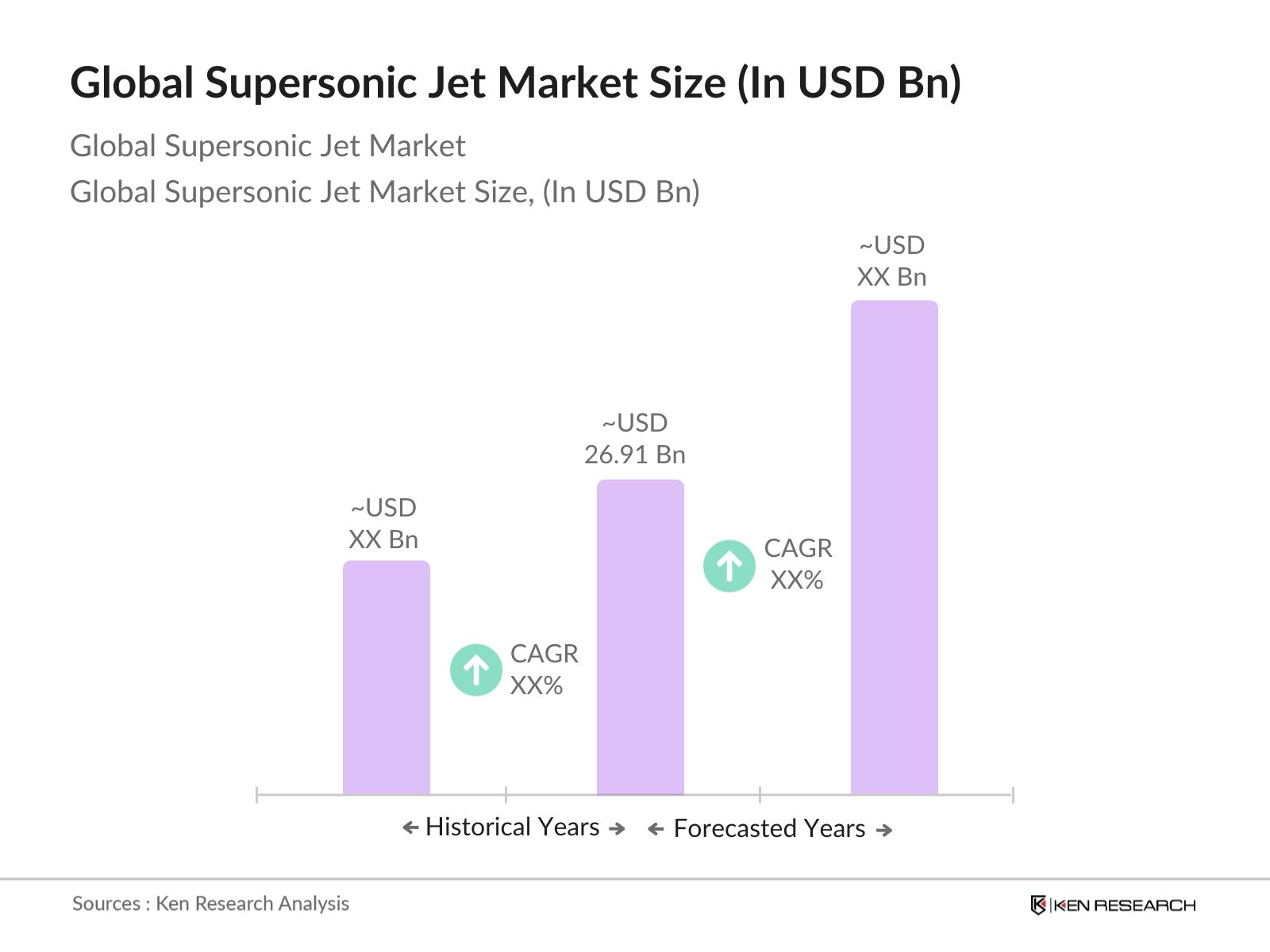
  • The global supersonic jet market, valued at USD 26.91 billion, is underpinned by technological advancements in aerospace design and a growing demand for reduced travel times among high-net-worth individuals and corporate executives. Market momentum is bolstered by key technological innovations aimed at enhancing jet efficiency, such as advancements in aerodynamics and fuel efficiency optimization. The heightened interest in luxury and rapid transportation solutions across the globe has created a strong foundation for this market.
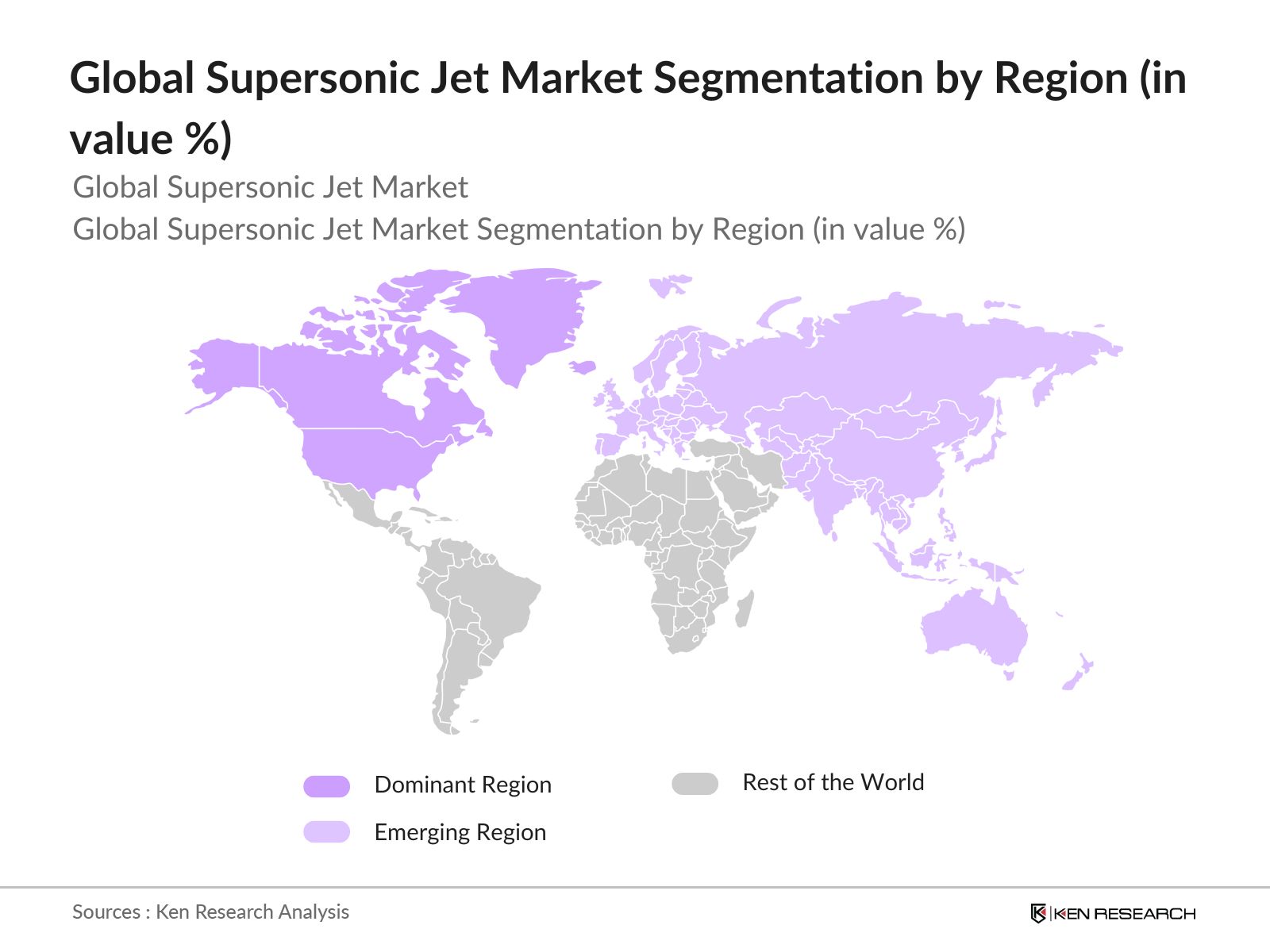
  • The North American and European regions currently dominate the global supersonic jet market due to their advanced aerospace manufacturing infrastructure and substantial R&D investments. The United States leads in the development of supersonic jets, attributed to government support for aerospace research and the presence of major players in the industry. Similarly, Europe has a strong foothold due to collaborative projects and stringent environmental regulations guiding innovations in fuel efficiency and noise reduction technologies.
  • The ICAO sets stringent standards that regulate supersonic jet operations, primarily focusing on safety, noise reduction, and environmental impact. In 2024, ICAO introduced revised guidelines for emissions and noise compliance that mandate higher safety and environmental standards. Compliance with ICAO standards is essential for supersonic jets to operate internationally, necessitating that manufacturers adapt to these regulations to expand market reach.

Global Supersonic Jet Market Size

Global Supersonic Jet Market Segmentation

  • By Technology: In terms of technology, the supersonic jet market includes Turbojet, Turbofan, and Ramjet technologies. The turbofan technology segment currently holds a dominant position due to its superior fuel efficiency and ability to manage noise levels, essential for compliance with aviation regulations. This makes it the preferred technology for both commercial and military applications, especially in markets where stringent environmental policies are enforced.
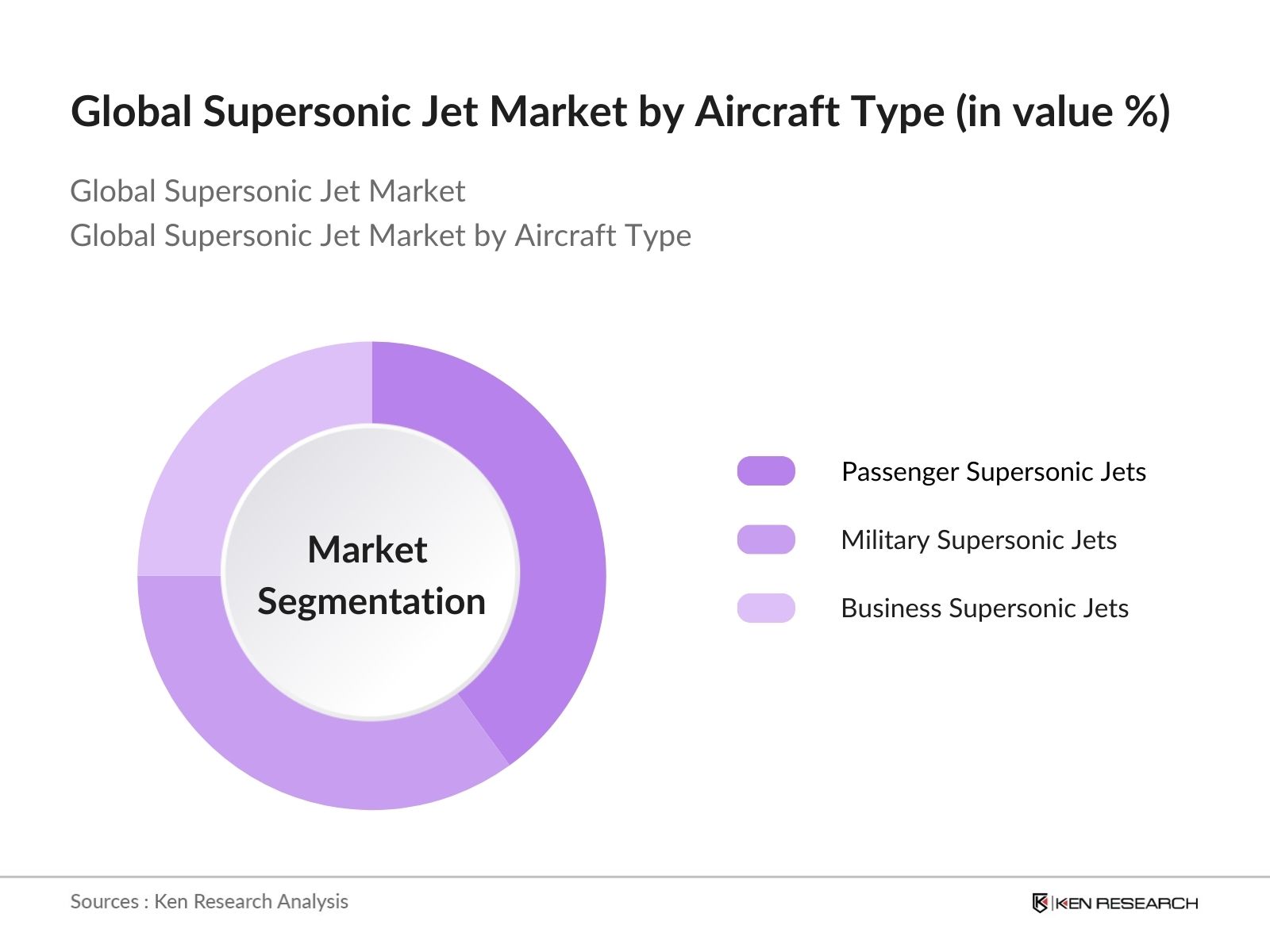
  • By Aircraft Type: The global supersonic jet market is segmented by aircraft type into Passenger Supersonic Jets, Military Supersonic Jets, and Business Supersonic Jets. Currently, passenger supersonic jets dominate the segment due to high consumer demand for reduced travel times in commercial aviation. Additionally, advancements in noise reduction and environmental compliance contribute to their popularity, particularly in regions like North America and Europe where demand for commercial supersonic travel is increasing.

Global Supersonic Jet Market Segmentation by Aircraft Type

  • By Region: Geographically, the supersonic jet market is segmented into North America, Europe, Asia-Pacific, Middle East, and Latin America. North America holds the highest market share, driven by the strong presence of major aerospace manufacturers and investments in R&D. This region's dominance is also reinforced by supportive policies and government initiatives fostering innovation in aerospace technology.

Global Supersonic Jet Market Segmentation by region

Global Supersonic Jet Market Competitive Landscape

The global supersonic jet market is characterized by a few key players who maintain a influence on market direction. These companies leverage their expertise in aerospace innovation and partnerships to enhance market reach and technological advancements. The market's competitiveness is underscored by consistent product innovations and strategic partnerships within the aerospace sector.
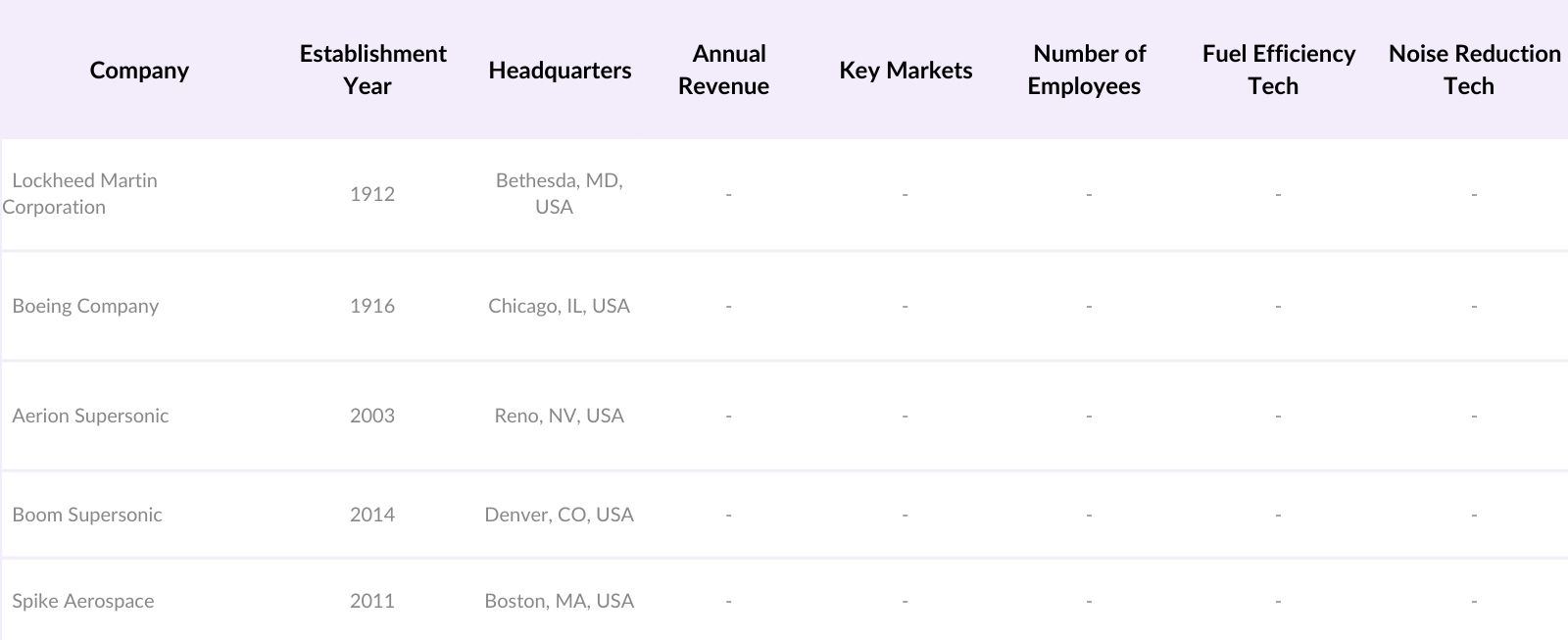
Global Supersonic Jet Market Players

Global Supersonic Jet Market Analysis

Market Growth Drivers

  • Environmental Regulations: Stringent environmental regulations have influenced the adoption of eco-friendly technologies in the supersonic jet industry. In 2024, the International Civil Aviation Organization (ICAO) introduced updated emission standards for jets, necessitating the incorporation of advanced technologies that reduce greenhouse gas emissions. These requirements are especially critical for supersonic jets, which traditionally consume high levels of fuel. Compliance efforts have pushed manufacturers toward low-emission fuel options, aligning with global targets for carbon neutrality by 2050. The U.S. Environmental Protection Agency (EPA) reported a marked increase in R&D funding for such technologies, reaching $15 billion in 2024.
  • High-Net-Worth Individual (HNWI) Adoption: The demand for supersonic jets is rising among high-net-worth individuals (HNWIs), who increasingly seek premium, time-efficient travel options. The global HNWI population reached over 22 million in 2024, with combined wealth exceeding $75 trillion, according to the IMF. This wealth concentration has enabled affluent individuals to explore faster travel options, boosting interest in supersonic jets for personal use. Reports indicate a 20% year-on-year increase in HNWI preference for private air travel, a trend that aligns with the growth of exclusive air services and ultra-premium jets.
  • Technological Innovations in Aerodynamics: Aerodynamic advancements have played a critical role in making supersonic travel feasible and more efficient. Research on laminar flow and drag reduction led to a reduction in fuel consumption per passenger mile by 10-15% in 2023 compared to previous supersonic models, as noted by the U.S. Department of Energy. These innovations enable manufacturers to develop jets capable of achieving Mach 1.5-2.5 with optimized performance and improved energy efficiency. Additionally, technological advances in composite materials have reduced jet weight by 30%, further enhancing fuel efficiency.
  • Demand for Reduced Flight Time: Rising demand for reduced flight times has spurred the adoption of supersonic jets, particularly for long-haul, transcontinental routes. Supersonic jets offer travel times up to 50% shorter than subsonic flights. Data from ICAO shows that 70% of travelers in high-income markets prioritize time efficiency over cost in travel preferences, making these jets particularly appealing. With business travel expenditure in North America alone reaching $320 billion in 2024, the appeal for shorter travel times positions the supersonic jet market favorably for further development and adoption.

Market Challenges

  • Fuel Efficiency Constraints: Fuel efficiency remains a critical challenge in supersonic aviation. Supersonic jets require two to three times more fuel per mile than subsonic aircraft, which can lead to operational costs and environmental concerns. According to the U.S. Department of Transportation, the cost per mile for supersonic flights is approximately 45% higher, making commercial viability a challenge. Reducing these costs through sustainable fuel alternatives remains a priority, though no breakthroughs have been widely implemented as of 2024.
  • Noise Pollution and Sonic Boom Limitations: Sonic booms, the loud noise associated with breaking the sound barrier, remain a major barrier to widespread adoption of supersonic jets. International noise regulations limit supersonic flights over land due to the environmental and public disturbance caused by these sonic booms. The Federal Aviation Administration (FAA) has enforced stringent sonic boom regulations, limiting operational routes and market potential. Sonic boom mitigation technology has been researched, but no commercially viable solution has met the FAA's standards as of 2024.

Global Supersonic Jet Market Future Outlook

The global supersonic jet market is poised for considerable growth over the coming years, driven by advancements in fuel efficiency, noise reduction technologies, and increasing demand for luxury and fast travel options. With sustained support from governments and an ongoing shift toward environmentally friendly fuel alternatives, the supersonic jet industry is expected to cater to both commercial and military segments effectively. Continued technological innovation in aerodynamics and materials is anticipated to support market expansion and address environmental concerns.

Market Opportunities

  • Sustainable Supersonic Fuel Development: The development of sustainable fuels presents a growth opportunity for the supersonic jet market. Efforts to produce synthetic fuels that reduce carbon emissions are being accelerated. In 2024, the U.S. Department of Energy allocated $2.5 billion toward research in synthetic aviation fuels that meet sustainability goals, paving the way for reduced dependency on traditional jet fuel. Sustainable fuel adoption aligns with global initiatives targeting a 50% reduction in aviation emissions by 2050.
  • Partnerships with Aerospace Engineering Firms: Collaborations with aerospace engineering firms provide opportunities for technological advancement in supersonic jets. In 2024, several leading aerospace companies formed alliances to innovate in material science, propulsion systems, and aerodynamics, facilitating the development of next-generation supersonic jets. These partnerships leverage joint expertise and resources, making the R&D process more efficient and cost-effective. This collaborative approach has increased funding in supersonic research by 18% in 2024, according to industry data.

Scope of the Report

By Aircraft Type

Passenger Supersonic Jets

Military Supersonic Jets

Business Supersonic Jets

By Technology

Turbojet

Turbofan

Ramjet

By Material Type

Carbon Composites

Titanium Alloys

Aluminum Alloys

By Application

Commercial Aviation

Military and Defense

Corporate Aviation

By Region

North America

Europe

Asia-Pacific

Middle East

Latin America

Products

Key Target Audience

  • High-Net-Worth Individual (HNWI) Travel Operators

  • Commercial Aviation Corporations

  • Banks and Financial Institution

  • Defense and Military Departments (e.g., U.S. Department of Defense)

  • Aerospace R&D Institutions

  • Aviation Infrastructure Developers

  • Government and Regulatory Bodies (e.g., International Civil Aviation Organization - ICAO)

  • Investor and Venture Capitalist Firms

  • Environmental Policy and Sustainability Agencies

Companies

Players Mentioned in the Report

  • Lockheed Martin Corporation

  • Boeing Company

  • Aerion Supersonic

  • Boom Supersonic

  • Spike Aerospace

  • Gulfstream Aerospace Corporation

  • Northrop Grumman

  • General Dynamics

  • Aviation Industry Corporation of China

  • Dassault Aviation

Table of Contents

1. Global Supersonic Jet Market Overview

1.1 Definition and Scope
1.2 Market Taxonomy
1.3 Supersonic Speed Segmentation
1.4 Key Industry Milestones
1.5 Market Segmentation Overview

2. Global Supersonic Jet Market Size (USD Billion)

2.1 Historical Market Size
2.2 Year-On-Year Growth Analysis
2.3 Technological Advancements Impacting Market Size
2.4 Key Market Developments and Milestones

3. Global Supersonic Jet Market Dynamics

3.1 Growth Drivers

3.1.1 Environmental Regulations

3.1.2 High-Net-Worth Individual (HNWI) Adoption

3.1.3 Technological Innovations in Aerodynamics

3.1.4 Demand for Reduced Flight Time

3.2 Market Challenges

3.2.1 Fuel Efficiency Constraints

3.2.2 Noise Pollution and Sonic Boom Limitations

3.2.3 High Manufacturing Costs

3.2.4 Compliance with International Aviation Standards

3.3 Opportunities

3.3.1 Sustainable Supersonic Fuel Development

3.3.2 Partnerships with Aerospace Engineering Firms

3.3.3 Expansion into Emerging Markets

3.3.4 Luxury Travel Demand

3.4 Trends

3.4.1 Development of Carbon-Neutral Jets

3.4.2 Advancements in Noise Reduction Technology

3.4.3 Enhanced Passenger Experiences in Supersonic Travel

3.4.4 Introduction of Hybrid-Electric Models

3.5 Regulatory Framework

3.5.1 International Civil Aviation Organization (ICAO) Standards

3.5.2 Noise Abatement Compliance

3.5.3 Emission Standards and Carbon Offset Policies

3.5.4 Regional Noise Regulations

3.6 Industry Analysis

3.6.1 Porters Five Forces Analysis

3.6.2 SWOT Analysis

3.6.3 Ecosystem Mapping

3.6.4 Stakeholder Analysis

4. Global Supersonic Jet Market Segmentation

4.1 By Aircraft Type (In Value %)

4.1.1 Passenger Supersonic Jets

4.1.2 Military Supersonic Jets

4.1.3 Business Supersonic Jets

4.2 By Technology (In Value %)

4.2.1 Turbojet

4.2.2 Turbofan

4.2.3 Ramjet

4.3 By Material Type (In Value %)

4.3.1 Carbon Composites

4.3.2 Titanium Alloys

4.3.3 Aluminum Alloys

4.4 By Application (In Value %)

4.4.1 Commercial Aviation

4.4.2 Military and Defense

4.4.3 Corporate Aviation

4.5 By Region (In Value %)

4.5.1 North America

4.5.2 Europe

4.5.3 Asia-Pacific

4.5.4 Middle East

4.5.5 Latin America

5. Global Supersonic Jet Market Competitive Analysis

5.1 Profiles of Major Companies

5.1.1 Lockheed Martin Corporation

5.1.2 Boeing Company

5.1.3 Aerion Supersonic

5.1.4 Boom Supersonic

5.1.5 Airbus SE

5.1.6 Spike Aerospace

5.1.7 Exosonic

5.1.8 Dassault Aviation

5.1.9 Gulfstream Aerospace Corporation

5.1.10 Northrop Grumman

5.1.11 General Dynamics

5.1.12 Aviation Industry Corporation of China

5.1.13 Tupolev PJSC

5.1.14 Sierra Nevada Corporation

5.1.15 Mitsubishi Heavy Industries

5.2 Cross Comparison Parameters (Revenue, Headquarters, Production Volume, R&D Investment, Fuel Efficiency, Noise Reduction Capability, Number of Employees, Market Expansion Initiatives)

5.3 Strategic Initiatives
5.4 Partnerships & Collaborations
5.5 Mergers & Acquisitions
5.6 Product Innovations
5.7 Government Contracts and Defense Investments

6. Global Supersonic Jet Market Regulatory Framework

6.1 Safety and Security Standards
6.2 International Aviation Emission Policies
6.3 Certification Requirements for Supersonic Travel
6.4 Licensing and Airworthiness

7. Global Supersonic Jet Future Market Segmentation

7.1 By Aircraft Type
7.2 By Technology
7.3 By Material Type
7.4 By Application
7.5 By Region

8. Analyst Recommendations

8.1 Market Entry Strategy
8.2 Risk Mitigation Strategies
8.3 Targeted Marketing Initiatives
8.4 Strategic Partnerships and Alliances

Disclaimer Contact Us

Research Methodology

Step 1: Identification of Key Variables

This initial phase involved mapping the supersonic jet market ecosystem, identifying major stakeholders, and compiling data from proprietary databases and secondary resources. The aim was to identify key variables, including fuel efficiency and noise reduction technologies, that shape market trends.

Step 2: Market Analysis and Construction

In this phase, historical data was assessed to understand market penetration, regional dominance, and the role of each segment in revenue generation. This included evaluating technological developments and regulatory factors impacting market share.

Step 3: Hypothesis Validation and Expert Consultation

Market hypotheses were formulated based on initial research and validated through consultations with industry experts via computer-assisted telephone interviews (CATIs). These insights provided operational and financial data necessary for refining market estimates.

Step 4: Research Synthesis and Final Output

In the final step, data from the bottom-up approach was cross-verified through interviews with supersonic jet manufacturers and industry insiders. This stage ensured accuracy and comprehensiveness, leading to a validated, data-backed market report.

Frequently Asked Questions

01. How big is the Global Supersonic Jet Market?

The global supersonic jet market is valued at USD 26.91 billion, driven by increasing demand for fast and efficient travel solutions, particularly within the luxury and defence sectors.

02. What are the primary challenges in the Global Supersonic Jet Market?

Key challenges include regulatory compliance for noise and emissions, high production costs, and limited infrastructure for supersonic flight, which affect the pace of market expansion.

03. Which companies are major players in the Global Supersonic Jet Market?

Leading companies include Lockheed Martin, Boeing, Aerion Supersonic, Boom Supersonic, and Spike Aerospace, who have a competitive advantage through R&D investments and strategic partnerships.

04. What factors are driving growth in the Global Supersonic Jet Market?

Growth drivers include technological advancements in noise reduction, environmental sustainability, and an increase in demand for luxury, high-speed travel among corporate and high-net-worth individuals.

Why Buy From Us?

RRR
Refine Robust Result (RRR) Framework

What makes us stand out is that our consultants follows Robust, Refine and Result (RRR) methodology. i.e. Robust for clear definitions, approaches and sanity checking, Refine for differentiating respondents facts and opinions and Result for presenting data with story

Our Reach Is Unmatched

We have set a benchmark in the industry by offering our clients with syndicated and customized market research reports featuring coverage of entire market as well as meticulous research and analyst insights.

Research
Shifting the Research Paradigm

While we don't replace traditional research, we flip the method upside down. Our dual approach of Top Bottom & Bottom Top ensures quality deliverable by not just verifying company fundamentals but also looking at the sector and macroeconomic factors.

Insite
More Insights-Better Decisions

With one step in the future, our research team constantly tries to show you the bigger picture. We help with some of the tough questions you may encounter along the way: How is the industry positioned? Best marketing channel? KPI's of competitors? By aligning every element, we help maximize success.

Trust
Transparency and Trust

Our report gives you instant access to the answers and sources that other companies might choose to hide. We elaborate each steps of research methodology we have used and showcase you the sample size to earn your trust.

support
Round the Clock Support

If you need any support, we are here! We pride ourselves on universe strength, data quality, and quick, friendly, and professional service.

Why Client Choose Us?

400000+ Reports in repository
150+ Consulting project a year
100+ Analysts
8000+ Client Queries in 2022