
Global Textile Mills Market Outlook to 2030
Region:Global
Author(s):Paribhasha Tiwari
Product Code:KROD2614
October 2024
94
About the Report
Global Textile Mills Market Overview
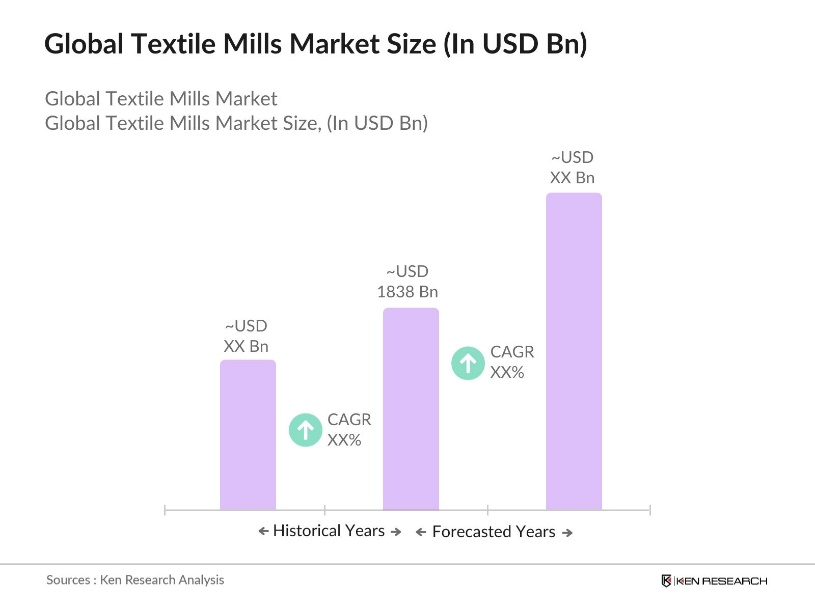
- The global textile mills market reached a market size of USD 1838 billion in 2023, driven by increasing demand for textiles across various industries, including apparel, home textiles, and industrial applications. The apparel industry accounts for the largest share, contributing significantly to the growth. Rising disposable incomes, coupled with fashion trends and population growth, have spurred demand, especially in developing countries. Additionally, technological advancements in textile manufacturing and growing e-commerce platforms have also accelerated market expansion.
- The global textile mills market is highly competitive, with key players such as Toray Industries (Japan), Weiqiao Textile (China), Indorama Ventures (Thailand), Arvind Limited (India), and Luthai Textile (China). These companies dominate the market due to their extensive product portfolios, vertically integrated production systems, and global distribution networks. Their focus on sustainability and innovation has positioned them as leaders in the textile manufacturing sector. Their ability to meet rising demand through efficient production processes has also contributed to their market leadership.
- Indorama Ventures has allocated $1.89 billion in capital expenditure over the next three years, focusing on recycling and expanding capacity in bio-based materials. This includes $660 million for 2024, with a plan to build four recycling plants in India through a joint venture. Additionally, the company is optimizing its asset footprint, reviewing underperforming assets, and targeting increased production volumes across its global operations. Indorama anticipates a recovery in earnings by 2026, driven by growing demand for recycled PET and improving operational efficiencies.
- Key cities that dominate the global textile mills market include Surat, Guangzhou, and Bursa. Surat is known as the "Textile City of India" due to its high concentration of textile mills, producing over 40% of India's synthetic textiles. Guangzhou, as a manufacturing hub in China, dominates due to its well-established textile industry, with over 2,000 textile companies operating in the region. Bursa, Turkey, is a leader in technical textiles, catering to automotive and industrial sectors. These cities benefit from infrastructure, skilled labor, and government support.
Global Textile Mills Market Segmentation
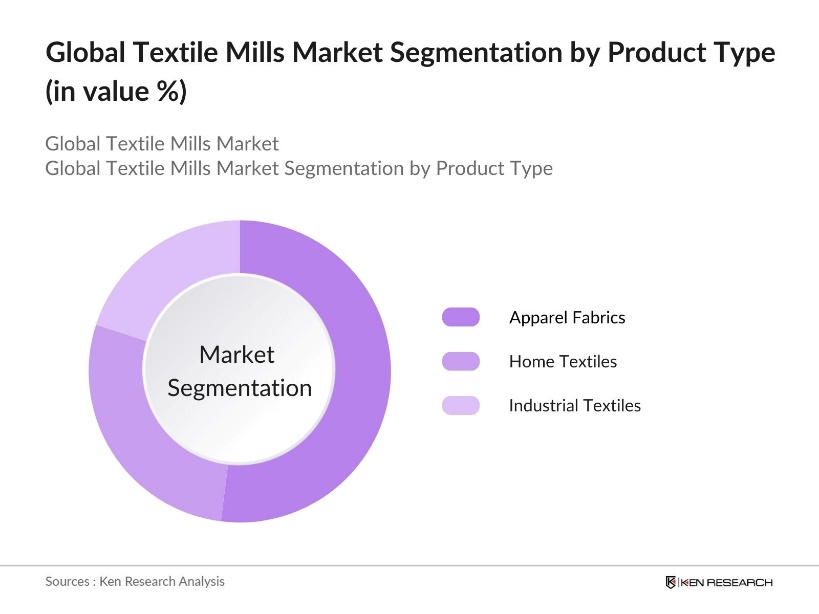
By Product Type: The global textile mills market is segmented by product type into apparel fabrics, home textiles, and industrial textiles. In 2023, apparel fabrics dominated the product type segment due to high consumer demand for clothing and fashion products. The global expansion of the e-commerce sector and rising middle-class incomes in developing countries have further driven this demand. Leading brands, such as Zara and Uniqlo, have established strong supply chains that utilize apparel fabrics, cementing the dominance of this segment.
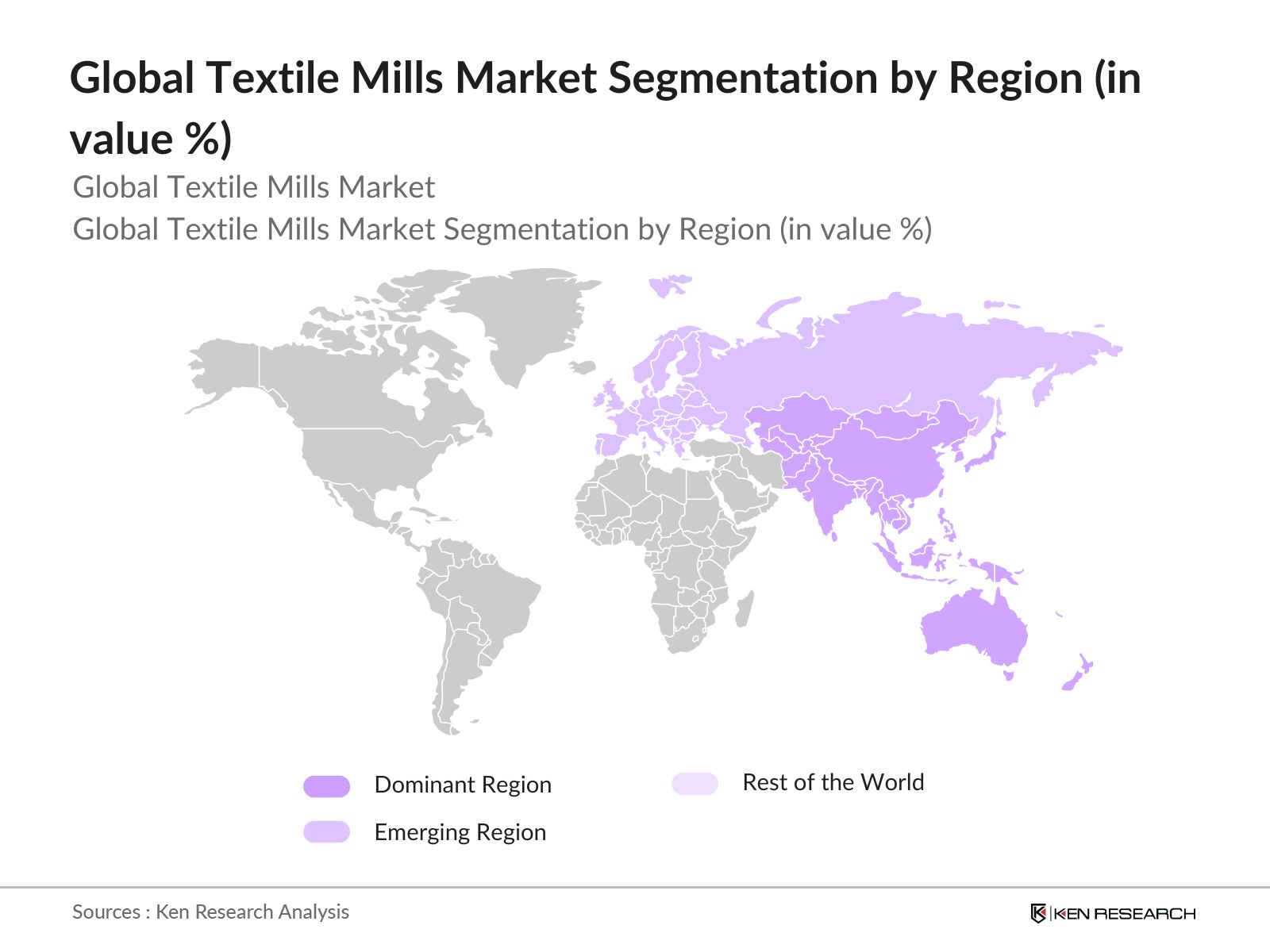
By Region: The textile mills market is segmented by region into North America, Europe, APAC, MEA, and Latin America. In 2023, Asia-Pacific (APAC) dominated the regional market, accounting for the largest share. This region's dominance is driven by countries like China and India, which are global leaders in textile production due to their low labor costs, abundant raw material supply, and large manufacturing capacity. APACs growing middle class and increasing disposable incomes are also contributing factors, making it a central hub for textile exports to North America and Europe.
By Raw Material: The textile mills market is segmented by raw materials into cotton, polyester, and wool. In 2023, cotton led the raw materials segment due to its widespread use in apparel and home textiles. Cotton is a preferred raw material for consumers due to its natural properties, comfort, and breathability. Major cotton-producing countries such as India, the US, and China supply raw cotton to textile mills globally. The rising demand for organic cotton is also contributing to this segments dominance.
Global Textile Mills Market Competitive Landscape
|
Company |
Establishment Year |
Headquarters |
|---|---|---|
|
Toray Industries |
1926 |
Tokyo, Japan |
|
Weiqiao Textile |
1997 |
Shandong, China |
|
Indorama Ventures |
1994 |
Bangkok, Thailand |
|
Arvind Limited |
1931 |
Gujarat, India |
|
Luthai Textile |
1987 |
Shandong, China |
- Toray Industries: In 2023, Toray Industries implemented energy conservation initiatives through advanced materials such as TORAYCA carbon fibers, which help reduce energy consumption in various sectors, including automobiles, aircraft, and construction. These materials enhance fuel efficiency and lower energy usage by making structures and vehicles lighter and stronger. Additionally, Toray is actively improving its production processes to reduce carbon emissions, supporting global efforts towards sustainability by incorporating eco-friendly materials.
- Weiqiao Textile: In 2022, Weiqiao Textile reported significant performance improvements driven by its focus on sustainable and smart manufacturing practices. The company increased production efficiency through automation and integrated digital solutions, which led to reduced operational costs and higher output. Additionally, Weiqiaos commitment to green energy and resource conservation has positioned it strongly in the global textile market, allowing it to maintain a competitive edge and meet the rising demand for sustainable textiles globally.
Global Textile Mills Market Analysis
Growth Drivers
-
Sustainability and Eco-Friendly Textiles: The global demand for sustainable and eco-friendly textiles is a major growth driver in the textile industry. Brands like H&M and Adidas have made commitments to using 100% recycled or sustainably sourced materials by 2030.This is propelling textile mills to shift toward organic cotton and recycled polyester to meet this demand.
- Growth of E-Commerce Platforms: The surge in global e-commerce sales, which reached USD 5.7 trillion in 2022, has significantly impacted the global textile mills market. The shift to online retail has increased demand for textiles, particularly in the apparel and home textiles sectors. As consumers increasingly turn to digital platforms for purchasing, textile mills are scaling up production to meet this growing online demand, particularly in emerging markets such as India and Southeast Asia.
- Technical Textiles Demand in Emerging Industries: The demand for technical textiles in industries such as automotive, construction, and healthcare has grown exponentially. In 2023, the global demand for technical textiles reached USD 200 billion, with applications in medical textiles, geotextiles, and automotive textiles leading the market. As industries evolve, especially in developing economies like India and China, demand for high-performance textiles is expected to rise by 30% through 2025. Government incentives supporting technical textile production, such as Indias National Technical Textiles Mission, further drive this demand.
Challenges
-
Rising Raw Material Costs: The textile mills market faces significant challenges due to rising raw material costs, particularly cotton and synthetic fibers. Textile mills are grappling with these rising costs, which affect their profitability and lead to higher end-product prices, impacting their competitiveness in the global market.
- Environmental Regulations and Compliance Costs: Stringent environmental regulations are becoming a growing challenge for textile mills, particularly in regions like Europe and North America. The European Union's new Textile Strategy mandates sustainable production practices by 2025, further complicating compliance for mills operating in multiple jurisdictions.
Government Initiatives
-
Indias Production Linked Incentive (PLI) Scheme for Textiles: The Indian government's Production Linked Incentive (PLI) Scheme for textiles, launched in 2021, allocates INR 10,683 crore to enhance the production of man-made fibers and technical textiles. This initiative is expected to boost investments, aiming to generate INR 19,000 crore in new manufacturing activities and create around 7.5 lakh direct jobs in the textile sector. The scheme focuses on strengthening Indias position as a key player in global textile exports, particularly in sustainable and high-performance textile segments.
- Chinas Textile Industry Upgradation Plan: In 2021, China introduced its 14th Five-Year Plan for the textile and apparel industry, focusing on technological innovation, sustainability, and upgrading its manufacturing processes by 2035. The plan includes promoting smart manufacturing, increasing the use of green technologies, and enhancing China's global competitiveness in the textile sector. The initiative aims to transform the industry with a significant reduction in carbon emissions and higher production efficiency to meet the evolving global demand for sustainable textiles.
Global Textile Mills Future Market Outlook
The Global Textile Mills Market is projected to grow exponentially over the next five years. This growth will be driven by the sustainability and eco-friendly textiles, growth of e-commerce platforms and technical textiles demand in emerging industries.
Future Trends
- Increasing Investment in Sustainable Textiles: Soon, the global textile mills market is expected to be driven by significant investments in sustainable and eco-friendly textile production. With growing consumer demand and government mandates pushing for sustainability, textile mills will increasingly adopt recycled materials and water-efficient technologies. Countries like India, China, and the U.S. are expected to lead this shift globally.
- Expansion of Technical Textiles for Industrial Applications: The global textile mills market is projected to see a rise in demand for technical textiles, driven by their growing use in sectors such as automotive, healthcare, and construction. Innovations in high-performance fabrics, such as fire-retardant and antimicrobial textiles, will drive this expansion. Governments, particularly in Asia-Pacific, are expected to invest heavily in R&D to develop new applications for technical textiles.
Scope of the Report
|
By Product Type |
Apparel fabrics Home textiles Industrial textiles |
|
By Region |
North America Europe APAC MEA Latin America |
|
By Raw Material |
Cotton Polyester Wool |
|
By Application |
Fashion and Apparel |
|
By Technology |
Spinning |
Products
Key Target Audience Organizations and Entities Who Can Benefit by Subscribing This Report:
Apparel Manufacturers
Home Textile Manufacturers
Industrial Textile Manufacturers
Textile Machinery Manufacturers
Raw Material Suppliers (Cotton, Polyester, Wool)
International Trade Bodies (e.g., World Trade Organization)
Investors and Venture Capitalist Firms
Government and Regulatory Bodies (e.g., Ministry of Textiles, India; China National Textile and Apparel Council)
Companies
Players mentioned in the Report:
Toray Industries
Weiqiao Textile
Indorama Ventures
Arvind Limited
Luthai Textile
Alok Industries
Zhejiang Hengsheng Textile
Vardhman Textiles
Shandong Ruyi Technology Group
Reliance Industries Limited
Parkdale Mills
China National Textile Group
Gokaldas Exports
Raymond Limited
Welspun India
Table of Contents
1. Global Textile Mills Market Overview
1.1. Definition and Scope
1.2. Market Taxonomy
1.3. Market Size and Growth Rate
1.4. Industry Value Chain
1.5. Overview of Major Players
1.6. Key Market Dynamics
2. Global Textile Mills Market Size and Analysis (Financial Parameters, Revenue, Units Produced)
2.1. Historical Market Size and Growth Rate
2.2. Current Market Size Analysis (2023 Data)
2.3. Contribution of Major Segments to Overall Market Size (Apparel, Home Textiles, Industrial Textiles)
2.4. Key Market Milestones and Recent Developments (Technological Advancements, New Entrants)
2.5. Market Growth Rate by Segment (Product, Raw Material, Application, Region)
2.6. Macro-Economic Factors Impacting Market Growth (Global Trade, Supply Chain Dynamics)
3. Global Textile Mills Market Segmentation
3.1. By Product Type
3.1.1. Apparel Fabrics
3.1.2. Home Textiles
3.1.3. Industrial Textiles
3.2.By Raw Material
3.2.1. Cotton
3.2.2. Polyester
3.2.3. Wool
3.3. By Application
3.3.1. Fashion and Apparel
3.3.2. Home Textiles
3.3.3. Technical Textiles
3.4. By Technology
3.4.1. Spinning
3.4.2. Weaving
3.4.3. Knitting
3.5. By Region (in Value %)
3.5.1. North America
3.5.2. Europe
3.5.3. APAC
3.5.4. MEA
3.5.5. Latin America
4. Global Textile Mills Market Growth Drivers, Challenges, and Opportunities
4.1. Growth Drivers
4.1.1.Sustainability and Eco-Friendly Textiles
4.1.2. Expansion of E-commerce and Global Retail Chains
4.1.3. Technological Advancements in Textile Production
4.2. Challenges
4.2.1. Increasing Raw Material Costs
4.2.2. Regulatory Compliance Costs
4.2.3. Labor Shortages in Major Textile Hubs
4.3. Opportunities
4.3.1. Growth of Technical Textiles
4.3.2. Investment in Smart Textiles
4.3.3. Expansion into Emerging Markets
5. Competitive Landscape of Global Textile Mills Market
5.1. Major Competitors by Market Share
5.2. Detailed Profiles of Key Competitors
5.2.1. Toray Industries
5.2.2. Weiqiao Textile
5.2.3. Indorama Ventures
5.2.4. Arvind Limited
5.2.5. Luthai Textile
5.3. Company Comparisons (Revenue, Production Capacity, Global Reach, Sustainability Initiatives)
5.4. Competitive Strategies (Product Innovations, Strategic Partnerships, Geographic Expansions)
6. Global Textile Mills Market Regulatory Framework
6.1. Environmental Regulations and Sustainability Standard
6.2. Textile Industry Certifications
6.3. Trade Agreements and Tariffs
6.4. Labor Laws and Compliance
6.5. Government Subsidies and Incentives
7. Global Textile Mills Market Trends
7.1. Adoption of Sustainable Textiles
7.2. Growth of Smart Textiles
7.3. Integration of Digital Printing in Textile Manufacturing
7.4. Rise of Direct-to-Consumer (D2C) Brands in the Textile Industry
7.5. Adoption of Automation and AI in Textile Production
8. Future Outlook: Global Textile Mills Market (Market Forecast, Growth Projections)
8.1. Market Forecast
8.2. Key Factors Driving Future Growth (Sustainability, Smart Textiles, Automation)
8.3. Investment Trends (Public-Private Partnerships, FDI in Textile Industry)
8.4. Emerging Markets for Textile Production (Africa, Southeast Asia)
8.5. Impact of Technological Advancements on Future Market (AI, IoT Integration)
9. Investment Analysis of Global Textile Mills Market
9.1. Recent Investments and Funding Rounds (Venture Capital, Private Equity)
9.2. Strategic Mergers and Acquisitions (Key Deals, Market Impact)
9.3. Government Funding and Grants (India, China, Europe)
9.4. Financial Analysis of Major Players (Revenue Growth, Profit Margins)
9.5. Investment Opportunities in Emerging Markets (Africa, South America)
10. SWOT Analysis of Global Textile Mills Market
11. Analyst Recommendations
11.1. Market Entry Strategies for New Players
11.2. Opportunities for Market Expansion
11.3. Risk Mitigation Strategies
11.4. Innovations and Future Directions
12. Cross-Comparison of Major Competitors
12.1. Competitor Matrix (Revenue, Production Volume, Product Portfolio, Market Share)
12.2. Strategic Initiatives (Sustainability Goals, Technological Investments)
12.3. Geographic Footprint and Regional Presence
12.4. Key M&A Activities and Collaborations (Impact on Market Share)
12.5. Performance Benchmarking (Financial Performance, Operational Efficiency)
13. Global Textile Mills Market Regional Analysis
13.1. North America Market Analysis
13.2. Europe Market Analysis
13.3. APAC Market Analysis
13.4. MEA Market Analysis
13.5. Latin America Market Analysis
Disclaimer
Contact Us
Research Methodology
Step: 1 Identifying Key Variables:
Ecosystem creation for all the major entities and referring to multiple secondary and proprietary databases to perform desk research around market to collate industry level information.
Step: 2 Market Building:
Collating statistics on Global Textile Mills Market over the years, penetration of marketplaces and service providers ratio to compute revenue generated for Global Textile Mills Industry. We will also review service quality statistics to understand revenue generated which can ensure accuracy behind the data points shared.
Step: 3 Validating and Finalizing:
Building market hypothesis and conducting CATIs with industry experts belonging to different companies to validate statistics and seek operational and financial information from company representatives.
Step: 4 Research Output:
Our team will approach multiple textile mill and understand nature of product segments and sales, consumer preference and other parameters, which will support us validate statistics derived through bottom to top approach from textile mills.
Frequently Asked Questions
01. How big is the global textile mills market?
The global textile mills market was valued at USD 1838 billion in 2023, driven by the growing demand for apparel fabrics, home textiles, and technical textiles, along with technological advancements in textile manufacturing.
02. What are the challenges in the global textile mills market?
Challenges in the global textile mills market include rising raw material costs, particularly for cotton and synthetic fibers, stringent environmental regulations, and labor shortages in key manufacturing regions like India and Bangladesh.
03. Who are the major players in the global textile mills market?
Key players in the global textile mills market include Toray Industries, Weiqiao Textile, Indorama Ventures, Arvind Limited, and Luthai Textile. These companies dominate the market due to their extensive production capabilities and focus on sustainable textile production.
04. What are the growth drivers of the global textile mills market?
The global textile mills market is driven by the rising demand for sustainable and eco-friendly textiles, the expansion of e-commerce platforms, and the increasing application of technical textiles in industries like healthcare and automotive.
Why Buy From Us?

What makes us stand out is that our consultants follows Robust, Refine and Result (RRR) methodology. i.e. Robust for clear definitions, approaches and sanity checking, Refine for differentiating respondents facts and opinions and Result for presenting data with story

We have set a benchmark in the industry by offering our clients with syndicated and customized market research reports featuring coverage of entire market as well as meticulous research and analyst insights.

While we don't replace traditional research, we flip the method upside down. Our dual approach of Top Bottom & Bottom Top ensures quality deliverable by not just verifying company fundamentals but also looking at the sector and macroeconomic factors.

With one step in the future, our research team constantly tries to show you the bigger picture. We help with some of the tough questions you may encounter along the way: How is the industry positioned? Best marketing channel? KPI's of competitors? By aligning every element, we help maximize success.

Our report gives you instant access to the answers and sources that other companies might choose to hide. We elaborate each steps of research methodology we have used and showcase you the sample size to earn your trust.

If you need any support, we are here! We pride ourselves on universe strength, data quality, and quick, friendly, and professional service.