
Global Train Market Outlook to 2030
Region:Global
Author(s):Shubham Kashyap
Product Code:KROD2048
Region:Global
Author(s):Shubham Kashyap
Product Code:KROD2048
November 2024
92
Global Train Market Segmentation
The Global Train Market can be segmented based on type, application, technology, end-user, and region:
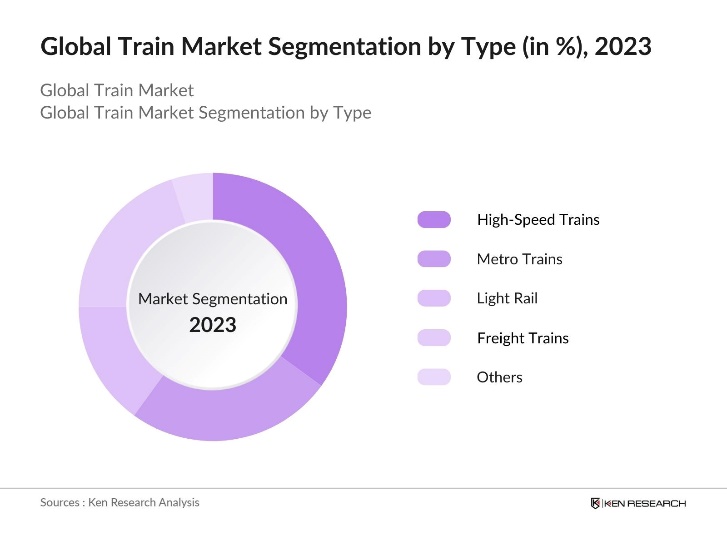
By Type: The market is segmented into high-speed trains, metro trains, light rail, freight trains, and others. In 2023, high-speed trains held the largest market share due to their increasing adoption across major economies for long-distance travel. These trains offer substantial advantages in terms of speed and efficiency, making them an attractive option for reducing travel time between major cities.
By Application: The market is further segmented into passenger transport, freight transport, and others. The passenger transport segment led the market in 2023, driven by rising urbanization, increased commuter traffic, and the growing preference for public transportation over private vehicles. This trend is particularly strong in densely populated regions like Asia-Pacific and Europe, where governments are investing heavily in expanding and modernizing rail networks. 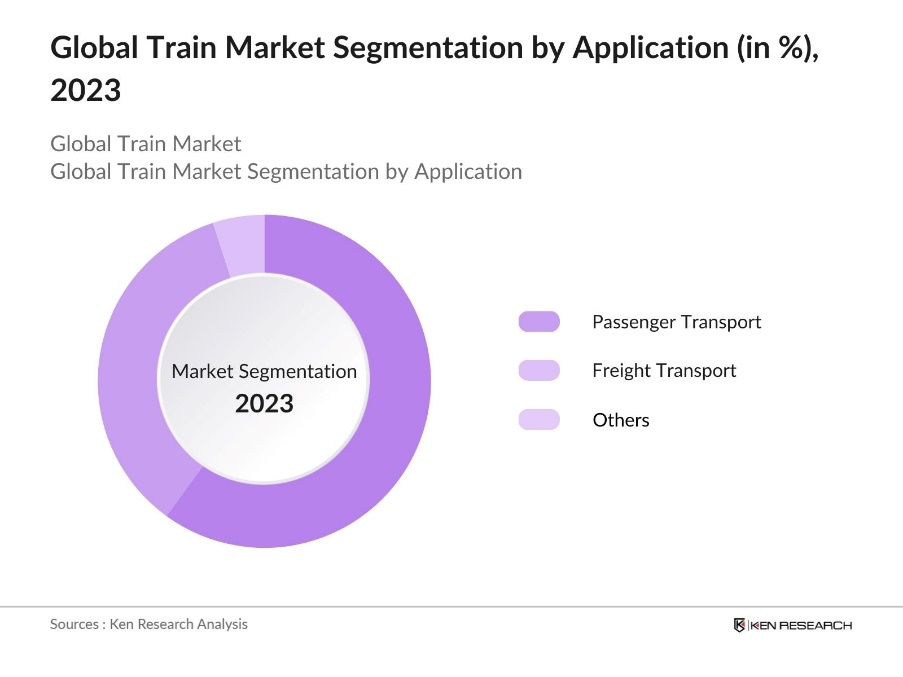
By Region: The global market is segmented into North America, Europe, Asia-Pacific (APAC), Latin America, and Middle East & Africa (MEA). Asia-Pacific dominated the market with a substantial share in 2023 due to the presence of the world's largest rail networks in countries like China and India, combined with rapid urbanization and the expansion of high-speed rail infrastructure.
Global Train Market Competitive Landscape
|
Company |
Establishment Year |
Headquarters |
|
Siemens AG |
1847 |
Munich, Germany |
|
Alstom SA |
1928 |
Saint-Ouen, France |
|
CRRC Corporation Limited |
2015 |
Beijing, China |
|
Bombardier Inc. |
1942 |
Montreal, Canada |
|
Hitachi Ltd. |
1910 |
Tokyo, Japan |
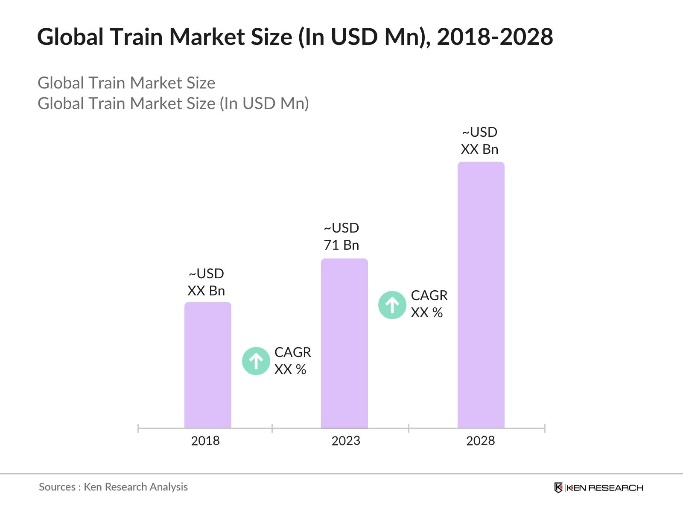
The global train market is expected to witness steady growth during the forecast period of 2023-2028, driven by continued investments in rail infrastructure, increasing adoption of sustainable transportation solutions, and technological advancements in train systems.
|
By Region |
North America Europe APAC Latin America MEA |
|
By Type |
High-Speed Trains Metro Trains Light Rail Freight Trains Others |
|
By Application |
Passenger Transport Freight Transport Others |
|
By Technology |
Autonomous Trains Electric Trains Diesel Trains Hybrid Trains |
|
By End-User |
Government/Public Sector Private Sector Industrial Users |
1.1. Definition and Scope
1.2. Market Taxonomy
1.3. Market Growth Rate
1.4. Market Segmentation Overview
2.1. Historical Market Size
2.2. Year-on-Year Growth Analysis
2.3. Key Market Developments and Milestones
3.1. Growth Drivers
3.2. Restraints
3.3. Opportunities
3.4. Trends
3.5. Government Regulation
3.6. SWOT Analysis
3.7. Stake Ecosystem
3.8. Competition Ecosystem
4.1. By Type (in Value %)
High-Speed Trains
Metro Trains
Light Rail
Freight Trains
Regional and Intercity Trains
4.2. By Application (in Value %)
Passenger Transport
Freight Transport
Urban Transit
Intercity Travel
Cross-Border Transport
4.3. By Technology (in Value %)
Electric Trains
Diesel Trains
Autonomous Trains
Hydrogen-Powered Trains
Hybrid Trains
4.4. By End-User (in Value %)
Government/Public Sector
Private Sector Operators
Industrial Users
Commercial Logistics Companies
Urban and Municipal Authorities
4.5. By Region (in Value %)
North America
Europe
APAC
Latin America
MEA
Global Train Market Cross Comparison
5.1. Detailed Profiles of Major Companies
5.2. Cross Comparison Parameters (No. of Employees, Headquarters, Inception Year, Revenue)
6.1. Market Share Analysis
6.2. Strategic Initiatives
6.3. Mergers and Acquisitions
6.4. Investment Analysis
7.1. Regulatory Policies
7.2. Compliance Requirements
7.3. Certification Processes
8.1. Future Market Size Projections
8.2. Key Factors Driving Future Market Growth
9.1. By Type (in Value %)
9.2. By Application (in Value %)
9.3. By Technology (in Value %)
9.4. By End-User (in Value %)
9.5. By Region (in Value %)
10.1. TAM/SAM/SOM Analysis
10.2. Customer Cohort Analysis
10.3. Marketing Initiatives
10.4. White Space Opportunity Analysis
Disclaimer Contact UsEcosystem creation for all the major entities and referring to multiple secondary and proprietary databases to perform desk research around market to collate industry level information.
Collating statistics on global train market over the years, penetration of marketplaces and service providers ratio to compute revenue generated for on global train market. We will also review service quality statistics to understand revenue generated which can ensure accuracy behind the data points shared.
Building market hypothesis and conducting CATIs with industry experts belonging to different companies to validate statistics and seek operational and financial information from company representatives.
Our team will approach multiple essential train companies and understand nature of product segments and sales, consumer preference and other parameters, which will support us validate statistics derived through bottom to top approach from train companies.
The Global Train Market was valued at USD 71 billion in 2023, driven by increasing investments in rail infrastructure, the need for efficient mass transit solutions, and a global shift towards sustainable transportation options.
Challenges in the Global Train Market include high capital costs and lengthy development cycles, regulatory and environmental compliance issues, and competition from alternative transport modes such as road and air travel.
Major players in the Global Train Market include Siemens AG, Alstom SA, CRRC Corporation Limited, Bombardier Inc., and Hitachi Ltd. These companies are leaders in train manufacturing and technology innovation, contributing significantly to market dynamics.
The market is driven by increased government spending on rail infrastructure, the rising demand for rail freight transport due to the e-commerce boom, and the expansion of high-speed rail networks, particularly in Asia-Pacific and Europe.

What makes us stand out is that our consultants follows Robust, Refine and Result (RRR) methodology. i.e. Robust for clear definitions, approaches and sanity checking, Refine for differentiating respondents facts and opinions and Result for presenting data with story

We have set a benchmark in the industry by offering our clients with syndicated and customized market research reports featuring coverage of entire market as well as meticulous research and analyst insights.

While we don't replace traditional research, we flip the method upside down. Our dual approach of Top Bottom & Bottom Top ensures quality deliverable by not just verifying company fundamentals but also looking at the sector and macroeconomic factors.

With one step in the future, our research team constantly tries to show you the bigger picture. We help with some of the tough questions you may encounter along the way: How is the industry positioned? Best marketing channel? KPI's of competitors? By aligning every element, we help maximize success.

Our report gives you instant access to the answers and sources that other companies might choose to hide. We elaborate each steps of research methodology we have used and showcase you the sample size to earn your trust.

If you need any support, we are here! We pride ourselves on universe strength, data quality, and quick, friendly, and professional service.