
Global Voice Assistant Market Outlook to 2030
Region:Global
Author(s):Shreya
Product Code:KROD372
Region:Global
Author(s):Shreya
Product Code:KROD372
November 2024
81
The Global Voice Assistant Market has witnessed substantial growth over recent years. The market size was valued at $ 5.7 billion in 2023. This growth is driven by the increasing adoption of smart devices, advancements in artificial intelligence (AI), and the growing demand for hands-free technology. The proliferation of smartphones, smart speakers, and other IoT devices has led to a flow in the usage of voice assistants.
The major companies include Amazon (Alexa), Google (Google Assistant), Apple (Siri), Microsoft (Cortana), and Samsung (Bixby). These companies are investing heavily in R&D to enhance the capabilities of their voice assistants, making them more intuitive, responsive, and capable of handling complex tasks. Their strategic partnerships and acquisitions also play an important role in expanding their market presence and enhancing product offerings.
In 2023, Amazon introduced new features to its Alexa platform, including enhanced language processing capabilities and improved integration with smart home devices. Alexa now supports over 80,000 skills, making it one of the most versatile voice assistants available. Additionally, Google announced its partnership with several automakers to integrate Google Assistant into their vehicle infotainment systems, further expanding the reach of its voice technology.
San Francisco dominates the voice assistant market due to its proximity to Silicon Valley, the global hub for tech innovation. Major companies like Amazon, Google, and Apple, which lead the market, have headquarters or significant operations here. The city's rich talent pool and robust tech ecosystem drive continuous advancements in voice assistant technology.
The global voice assistant Market can be segmented by various factors like product type, application, and region.
By Product Type: This market is segmented by product type into smart speakers, smartphones, and wearables. In 2023, smart speakers held a dominant market share. The popularity of devices like Amazon Echo, Google Home, and Apple HomePod has significantly contributed to this segment's growth. The convenience of hands-free control for smart home devices and access to a wide range of skills and services makes smart speakers highly attractive to consumers.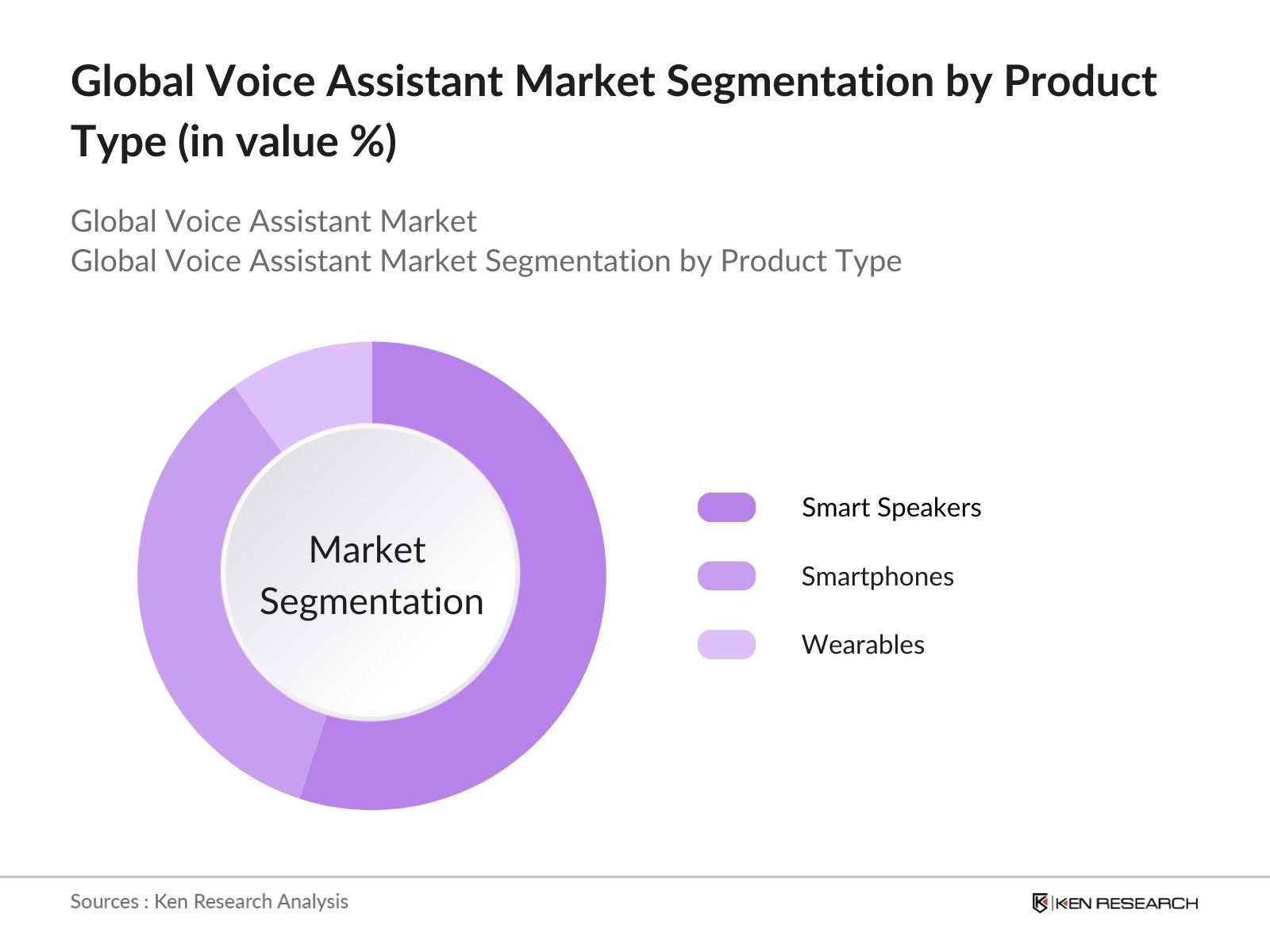
By Application: This market is segmented by application into smart home, automotive, and healthcare. In 2023, the smart home segment held the dominant market share. The increasing adoption of smart home devices and the integration of voice assistants for home automation drive this segment's growth. Voice assistants are used to control lighting, thermostats, security systems, and entertainment devices, enhancing the convenience and efficiency of smart homes.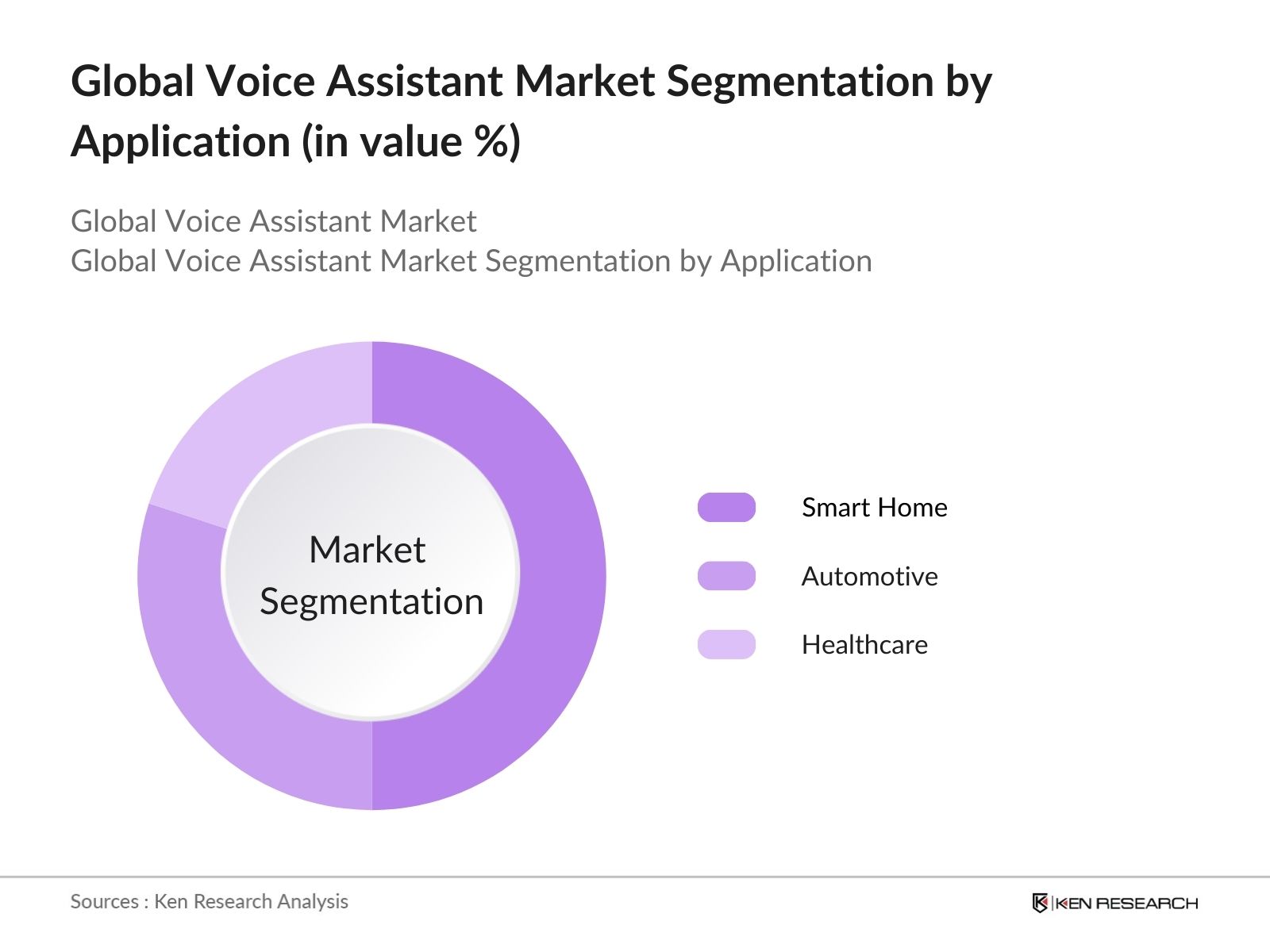
By Region: This market is segmented by region into North America, Europe, Asia-Pacific, and Rest of the World. In 2023, North America held the largest market share. The region's dominance is attributed to the high adoption rate of smart devices, technological advancements, and important investments by key players. The presence of tech giants like Amazon, Google, and Apple further drives the market growth in this region.
|
Company |
Establishment Year |
Headquarters |
|
Amazon (Alexa) |
1994 |
Seattle, Washington, USA |
|
Google (Assistant) |
1998 |
Mountain View, California, USA |
|
Apple (Siri) |
1976 |
Cupertino, California, USA |
|
Microsoft (Cortana) |
1975 |
Redmond, Washington, USA |
|
Samsung (Bixby) |
1938 |
Seoul, South Korea |
Google: Google has indeed formed partnerships with several major automakers, including Ford, Mercedes-Benz, Volvo, and Renault, to integrate its technologies into vehicle infotainment systems. These partnerships aim to enhance connected car experiences by embedding Google services like Google Assistant, Google Maps, and other applications into vehicles.
Microsoft: As of June 2024, Microsoft has retired Cortana as a standalone application in various platforms, including Windows and Microsoft 365, transitioning its capabilities toMicrosoft 365 Copilot, which is designed to enhance productivity across Microsoft applications using advanced AI technologies. Microsoft 365 Copilot, which leverages AI to assist users in managing tasks, scheduling, and data analysis across Microsoft 365 applications.
China's National AI Development Plan: In 2024, China continued to advance its National AI Development Plan, with a substantial investment of USD 350 million aimed at becoming a global leader in AI by 2030. A key component of this plan is the development and deployment of voice assistant technologies in sectors such as healthcare, education, and public services. The government's support for AI research and its emphasis on integrating voice technologies into everyday applications are driving the growth of the voice assistant market in China.
Looking ahead, the global voice assistant market is expected to continue its robust growth by 2028. Factors such as advancements in AI and machine learning, increased consumer demand for smart devices, and the integration of voice assistants in various industries will drive this growth. The development of multilingual support and improvements in natural language processing will further enhance the user experience and expand the market's reach.
Integration with Augmented Reality (AR) and Virtual Reality (VR): The integration of voice assistants with AR and VR technologies is expected to become more prevalent over the next five years. This combination will enhance user experiences in gaming, education, and virtual meetings, providing more interactive and immersive environments. By 2028, AR and VR devices will feature voice assistant capabilities, transforming how users interact with these technologies.
|
By Product Type |
Smart Speakers Smartphones Wearables |
|
By End User |
Smart Home Automotive Healthcare |
|
By Technology |
Natural Voice Processing Speed Voice Processing Text to Speech Processing |
|
Components |
Hardware Software |
|
By Region |
North South East West |
1.1. Definition and Scope
1.2. Market Taxonomy
1.3. Market Growth Rate
1.4. Market Segmentation Overview
2.1. Historical Market Size
2.2. Year-On-Year Growth Analysis
2.3. Key Market Developments and Milestones
3.1. Growth Drivers
3.1.1. Integration with Smart Devices
3.1.2. Expansion in IoT Applications
3.1.3. Increasing Adoption in Healthcare & Retail
3.1.4. Technological Advancements in AI & NLP
3.2. Market Challenges
3.2.1. Privacy and Security Concerns
3.2.2. Language & Cultural Barriers
3.2.3. High Cost of Deployment for Enterprises
3.3. Opportunities
3.3.1. Penetration of Smart Homes
3.3.2. Integration with Augmented Reality (AR)
3.3.3. Expansion in Developing Economies
3.4. Trends
3.4.1. Emergence of Voice Commerce
3.4.2. Growth in Wearable Voice Assistants
3.4.3. Advancements in Multilingual Support
3.5. Government Regulation
3.5.1. Data Protection Laws Impacting Voice Assistants
3.5.2. Standards for AI Usage
3.6. SWOT Analysis
3.7. Stake Ecosystem
3.8. Porter’s Five Forces
3.9. Competition Ecosystem
4.1. By Technology (In Value %)
4.1.1. Automatic Speech Recognition (ASR)
4.1.2. Text-to-Speech (TTS)
4.1.3. Natural Language Processing (NLP)
4.2. By Application (In Value %)
4.2.1. Personal Assistance
4.2.2. Smart Home Devices
4.2.3. E-commerce & Retail
4.2.4. Healthcare Assistance
4.2.5. Customer Service & Support
4.3. By Component (In Value %)
4.3.1. Hardware
4.3.2. Software
4.4. By End-User (In Value %)
4.4.1. Residential
4.4.2. Commercial
4.4.3. Industrial
4.5. By Region (In Value %)
4.5.1. North America
4.5.2. Europe
4.5.3. Asia Pacific
4.5.4. Latin America
4.5.5. Middle East & Africa
5.1. Detailed Profiles of Major Companies
5.1.1. Amazon.com, Inc.
5.1.2. Google LLC
5.1.3. Apple Inc.
5.1.4. Microsoft Corporation
5.1.5. Samsung Electronics Co., Ltd.
5.1.6. IBM Corporation
5.1.7. Baidu, Inc.
5.1.8. Alibaba Group Holding Limited
5.1.9. Xiaomi Corporation
5.1.10. Nuance Communications, Inc.
5.1.11. SoundHound Inc.
5.1.12. Cerence Inc.
5.1.13. Tencent Holdings Limited
5.1.14. Harman International Industries, Inc.
5.1.15. Sonos, Inc.
5.2. Cross Comparison Parameters (Number of Employees, Headquarters, Inception Year, Revenue, Product Portfolio, AI Capabilities, Market Penetration, Partnerships)
5.3. Market Share Analysis
5.4. Strategic Initiatives
5.5. Mergers and Acquisitions
5.6. Investment Analysis
5.7. Venture Capital Funding
5.8. Government Grants
5.9. Private Equity Investments
6.1. Data Privacy and Security Standards
6.2. Compliance Requirements for Smart Devices
6.3. Certification Processes for AI Integration
7.1. Future Market Size Projections
7.2. Key Factors Driving Future Market Growth
8.1. By Technology (In Value %)
8.2. By Application (In Value %)
8.3. By Component (In Value %)
8.4. By End-User (In Value %)
8.5. By Region (In Value %)
9.1. TAM/SAM/SOM Analysis
9.2. Customer Cohort Analysis
9.3. Marketing Initiatives
9.4. White Space Opportunity Analysis
Disclaimer Contact UsIn this phase, we identified key variables influencing the Market. This was done through extensive secondary research using proprietary databases and trade publications, focusing on factors like export volumes, domestic consumption, and processing capacities.
Historical data on production, export growth, and domestic trends were analyzed. This included assessing market penetration for different coffee types, evaluating the supply-demand balance, and understanding revenue generation trends.
Our market hypotheses were validated through interviews with producers, exporters, and industry experts. These interviews provided valuable insights into challenges, market dynamics, and future trends in sector.
The final output was synthesized using both qualitative and quantitative data from interviews, industry reports, and proprietary databases, ensuring an accurate and holistic understanding of the Market.
The Global Voice Assistant Market has witnessed substantial growth over recent years. The market size was valued at $ 5.7 billion in 2023. This growth is driven by the increasing adoption of smart devices, advancements in artificial intelligence (AI), and the growing demand for hands-free technology. The proliferation of smartphones, smart speakers, and other IoT devices has led to a flow in the usage of voice assistants.
Key growth drivers in the Global Voice Assistant Market include the widespread adoption of smart home devices, advancements in AI and natural language processing, increased use in healthcare for tasks like appointment scheduling and medication reminders, and the rising integration of voice assistants in the automotive industry to enhance driver safety and convenience.
Challenges in the Global Voice Assistant Market include ensuring data privacy and security, the high cost of advanced voice assistant technologies, limited language support and regional adaptation, and dependence on stable internet connectivity, which poses difficulties in regions with poor or inconsistent internet infrastructure.
Major players in the Global Voice Assistant market include Amazon (Alexa), Google (Google Assistant), Apple (Siri), Microsoft (Cortana), and Samsung (Bixby). These companies dominate the market through continuous innovation, strategic partnerships, and extensive product offerings across various smart devices and applications.

What makes us stand out is that our consultants follows Robust, Refine and Result (RRR) methodology. i.e. Robust for clear definitions, approaches and sanity checking, Refine for differentiating respondents facts and opinions and Result for presenting data with story

We have set a benchmark in the industry by offering our clients with syndicated and customized market research reports featuring coverage of entire market as well as meticulous research and analyst insights.

While we don't replace traditional research, we flip the method upside down. Our dual approach of Top Bottom & Bottom Top ensures quality deliverable by not just verifying company fundamentals but also looking at the sector and macroeconomic factors.

With one step in the future, our research team constantly tries to show you the bigger picture. We help with some of the tough questions you may encounter along the way: How is the industry positioned? Best marketing channel? KPI's of competitors? By aligning every element, we help maximize success.

Our report gives you instant access to the answers and sources that other companies might choose to hide. We elaborate each steps of research methodology we have used and showcase you the sample size to earn your trust.

If you need any support, we are here! We pride ourselves on universe strength, data quality, and quick, friendly, and professional service.