
India Synthetic Fiber Market Outlook to 2030
Region:Asia
Author(s):Paribhasha Tiwari
Product Code:KROD8569
November 2024
89
About the Report
India Synthetic Fiber Market Overview
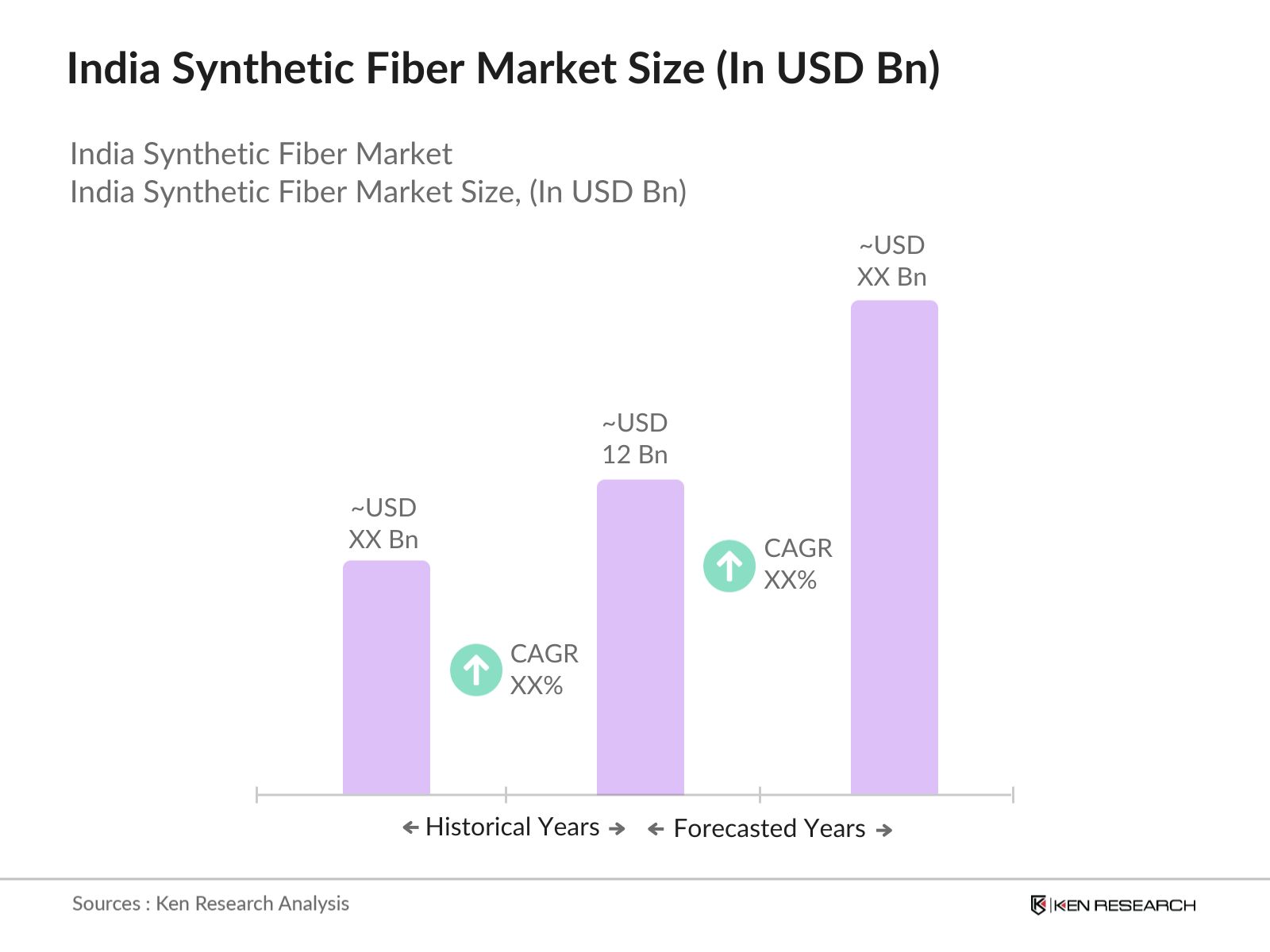
- The India synthetic fiber market is valued at USD 12 Billion, based on a five-year historical analysis, driven by the booming textile and apparel sector. The growing demand for polyester and nylon in various applications, including home furnishings, industrial textiles, and non-woven fabrics, is fueling the expansion. Government initiatives, like the Production Linked Incentive (PLI) scheme and textile parks under the Atmanirbhar Bharat initiative, are further contributing to market growth.
- Mumbai and Surat are dominant cities in the India synthetic fiber market. Their dominance stems from their established textile industries, robust infrastructure, and proximity to ports, which facilitate both domestic and international trade. Surat, in particular, is recognized for its significant contribution to synthetic textile manufacturing, while Mumbai acts as a major trade hub.
- The PLI scheme for the textile industry has earmarked $1.4 billion to boost the production of synthetic fibers and technical textiles. This initiative is designed to incentivize large-scale production, attract foreign investments, and strengthen domestic capabilities, making India a global hub for synthetic fiber production.
India Synthetic Fiber Market Segmentation
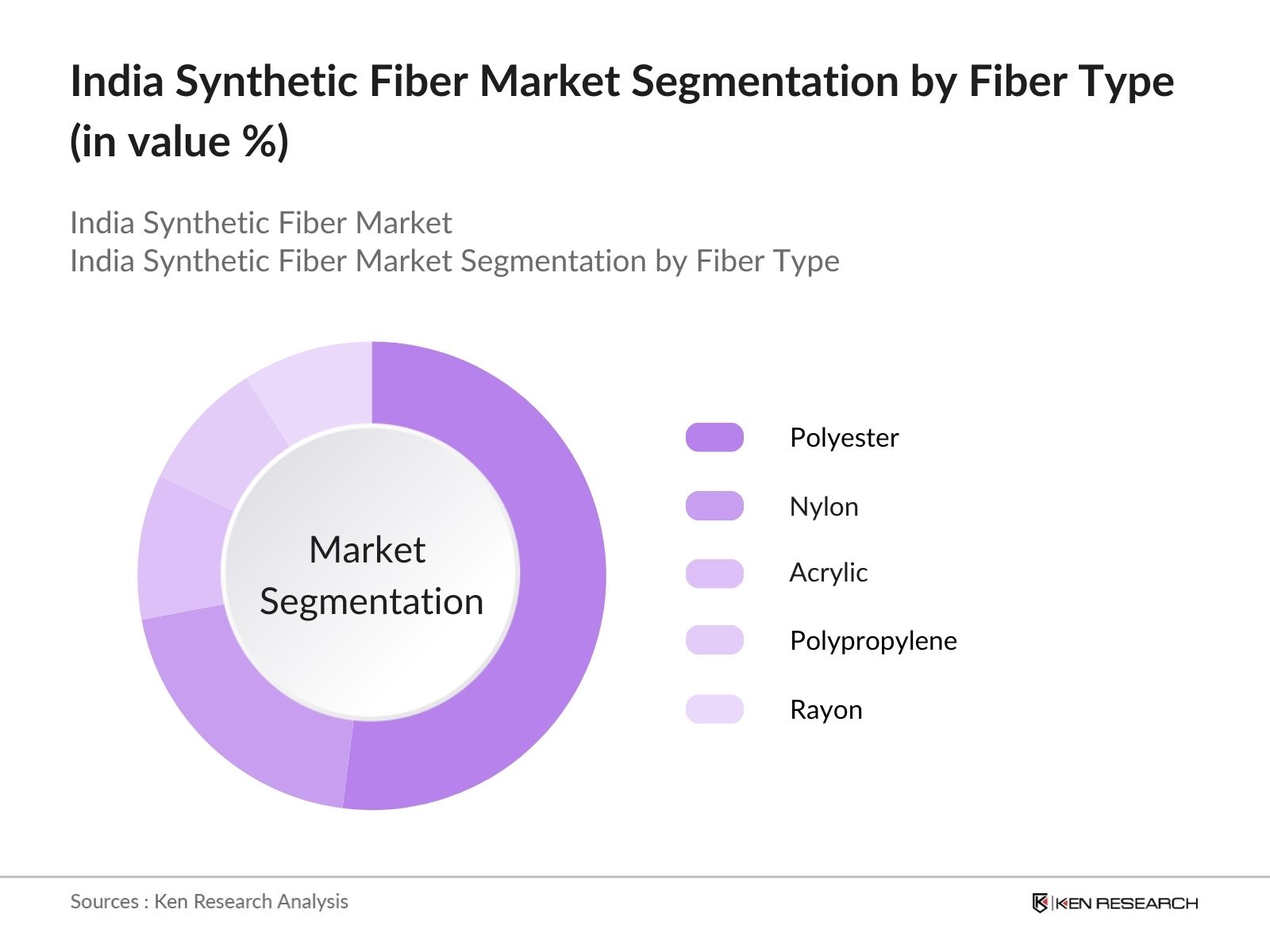
- By Fiber Type: India's synthetic fiber market is segmented by fiber type into polyester, nylon, acrylic, polypropylene, and rayon. Polyester dominates the market due to its low production cost, versatility in applications, and durability. The materials wide use in the textile and apparel industry, particularly for sportswear, home textiles, and industrial applications, contributes to its extensive demand. Nylon holds the second-largest share due to its high resistance to abrasion, strength, and elasticity, making it suitable for use in the automotive and industrial textile sectors.
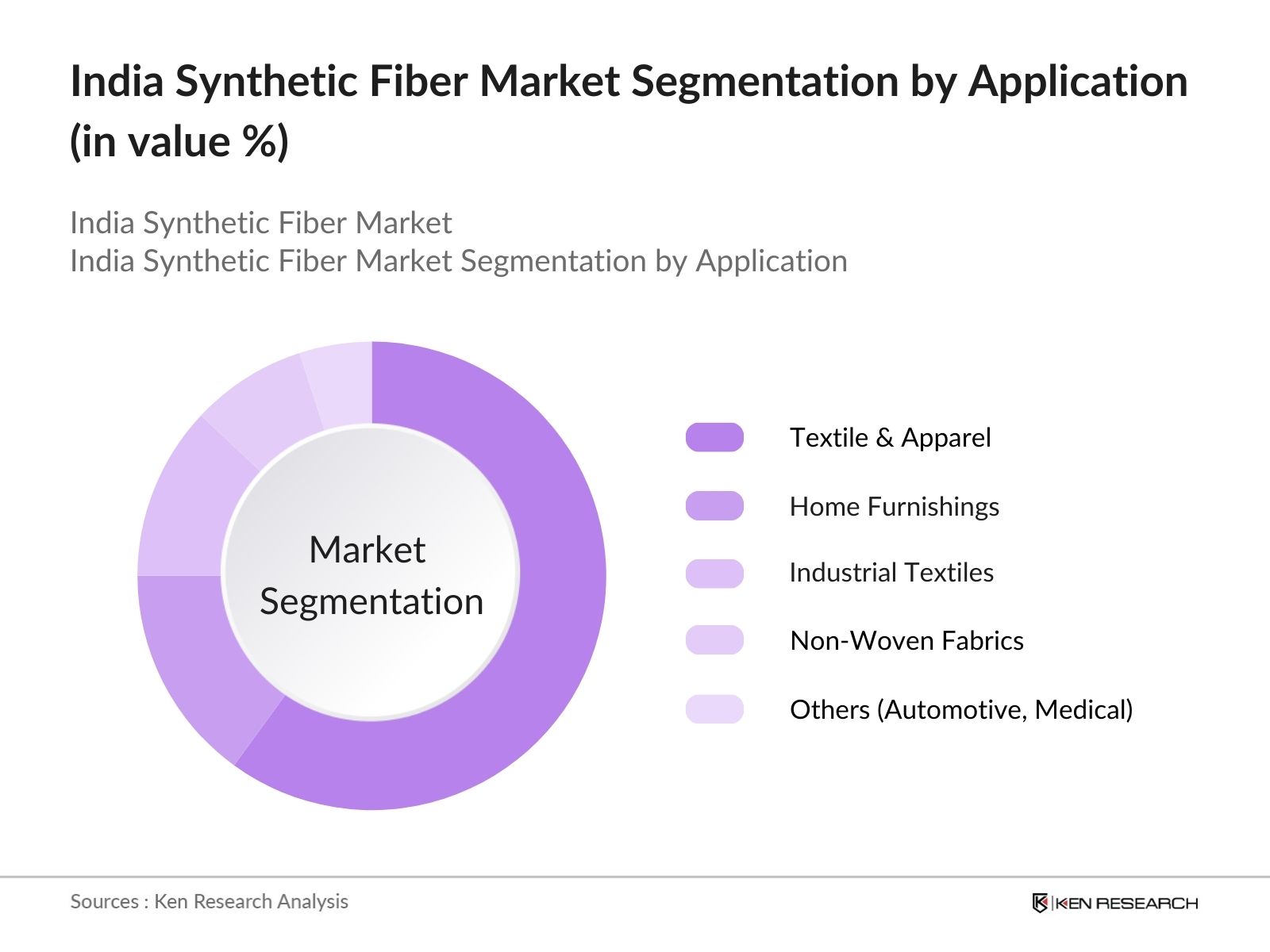
- By Application: The synthetic fiber market in India is segmented by application into textile & apparel, home furnishings, industrial textiles, non-woven fabrics, and others. Textile & apparel dominate the application segment, driven by the rising urban population, changing fashion trends, and increased disposable incomes. Synthetic fibers are widely used in this segment due to their lightweight, easy-care properties, and durability, making them a preferred choice for both consumers and manufacturers.
India Synthetic Fiber Market Competitive Landscape
The India synthetic fiber market is dominated by key domestic and international players, who maintain strong production capabilities, diverse product portfolios, and innovative manufacturing processes. Local companies benefit from government incentives and proximity to raw materials, while international companies leverage advanced technologies and global distribution networks. This competitive environment emphasizes the significant market influence of major players, with both established companies and new entrants striving to gain market share.
|
Company Name |
Establishment Year |
Headquarters |
Production Capacity |
Sustainability Initiatives |
Key Fiber Types |
Revenue (INR Bn) |
Number of Employees |
Global Presence |
|
Reliance Industries Limited |
1973 |
Mumbai, India |
- | - | - | - | - | - |
|
SRF Limited |
1970 |
Gurgaon, India |
- | - | - | - | - | - |
|
Indorama Ventures |
1994 |
Bangkok, Thailand |
- | - | - | - | - | - |
|
Grasim Industries |
1947 |
Mumbai, India |
- | - | - | - | - | - |
|
Bombay Dyeing |
1879 |
Mumbai, India |
- | - | - | - | - | - |
India Synthetic Fiber Market Analysis
Market Growth Drivers
-
Increased Demand from the Textile Industry: The textile industry in India, which contributes significantly to the economy, is driving the demand for synthetic fibers like polyester and nylon. As of 2024, Indias textile and apparel sector is valued at approximately $150 billion, with synthetic fibers being a key component. The rise of technical textiles, including geotextiles used in infrastructure and construction, has further accelerated synthetic fiber consumption. The increased demand is largely attributed to the durability and cost-effectiveness of synthetic fibers compared to natural fibers.
-
Growing Fashion Industry: Indias fashion industry is significantly contributing to the growth of synthetic fibers, especially in fast fashion. Leading apparel companies are increasingly using synthetic fibers due to their ability to offer affordable, high-quality products at a faster pace. The shift towards man-made fibers allows manufacturers to experiment with new designs, fabrics, and clothing styles, addressing the increasing consumer demand for trendy, versatile, and long-lasting clothing. This shift is bolstered by the rise of e-commerce platforms, where synthetic fiber-based apparel has witnessed higher sales volumes.
- Rise in Industrial Applications: The demand for synthetic fibers extends beyond the textile sector into industries such as construction, automotive, and FMCG. For example, synthetic fibers are widely used in the automotive sector for seat covers and interior fabrics, contributing to the sectors estimated $35 billion valuation in 2024. In construction, synthetic fibers are increasingly used in concrete reinforcement and non-woven geotextiles. These industrial applications are expected to drive long-term demand as they provide strength, flexibility, and cost efficiency compared to traditional materials.
Market Challenges
-
Fluctuating Raw Material Prices: The synthetic fiber industry is highly dependent on petrochemicals, such as crude oil, for the production of polyester and nylon. In 2024, crude oil prices hovered around $85-$90 per barrel, leading to fluctuating raw material costs for synthetic fiber manufacturers. This volatility impacts profit margins and production costs, creating uncertainty in the market. Manufacturers are forced to either absorb these costs or pass them on to consumers, which can affect competitiveness.
- Environmental Concerns: Synthetic fibers, particularly polyester and nylon, contribute significantly to environmental pollution. These fibers are non-biodegradable and contribute to microplastic pollution, an issue that has gained international attention. The Indian government has imposed stricter environmental regulations on textile production under the "Clean Ganga" and "National Clean Air Programme," affecting production processes that rely heavily on synthetic fibers. Compliance with these environmental regulations increases operational costs, posing challenges for manufacturers.
India Synthetic Fiber Market Future Outlook
Over the next five years, the India synthetic fiber market is expected to see steady growth, driven by advancements in textile manufacturing technologies, increasing demand for eco-friendly and recycled fibers, and strong government support. The growing awareness of sustainability in textile production is expected to spur the adoption of recyclable materials, especially in the polyester segment. Additionally, technological innovations in fiber production and an increasing focus on circular economy models will play a critical role in shaping the future landscape of the market.
Market Opportunities
- Technological Innovations in Fiber Production: The development of bio-based and recyclable synthetic fibers presents significant opportunities. By 2024, several Indian companies have invested in research to develop eco-friendly alternatives, such as bio-polyester, which can reduce reliance on petrochemical derivatives. These technological advancements offer the potential to meet both environmental standards and market demand, positioning Indian manufacturers as leaders in sustainable fiber production.
- Expansion in Non-Woven Textiles: The non-woven textiles market in India is witnessing rapid growth, especially in sectors like medical, hygiene, and industrial applications. As of 2024, the Indian non-woven fabric market is valued at $2.5 billion, driven by the demand for synthetic fibers used in medical textiles such as surgical masks, gowns, and hygiene products. This expansion offers new opportunities for synthetic fiber manufacturers to cater to emerging sectors.
Scope of the Report
|
By Fiber Type |
Polyester Nylon Acrylic Polypropylene Rayon |
|
By Application |
Textile & Apparel Home Furnishings Industrial Textiles Non-Woven Fabrics Others |
|
By Technology |
Polymerization Melt Spinning Solution Spinning Bi-Component Fiber Technology |
|
By End-Use Industry |
Apparel Construction Automotive Medical & Healthcare FMCG |
|
By Region |
North East South West |
Products
Key Target Audience
Fiber Manufacturers
Textile & Apparel Companies
Home Furnishings Manufacturers
Industrial Textile Producers
Automotive Textile Suppliers
Investors and Venture Capitalist Firms
Government and Regulatory Bodies (Ministry of Textiles, Bureau of Indian Standards)
Technology Providers for Textile Industry
Companies
Players Mentioned in the Report:
Reliance Industries Limited
SRF Limited
Indorama Ventures
Grasim Industries
Bombay Dyeing
Century Enka Limited
Bhilosa Industries
Vardhman Textiles
Wellknown Polyesters
JCT Limited
Table of Contents
1. India Synthetic Fiber Market Overview
1.1. Definition and Scope
1.2. Market Taxonomy
1.3. Market Growth Rate (Domestic Demand, Export Potential, Import Dynamics)
1.4. Market Segmentation Overview (Fiber Type, Application, End-Use Industry, Technology, Region)
2. India Synthetic Fiber Market Size (USD Mn)
2.1. Historical Market Size (Demand by Volume, Supply Chain Analysis)
2.2. Year-On-Year Growth Analysis
2.3. Key Market Developments and Milestones (Government Policies, Major Investments, Manufacturing Expansions)
3. India Synthetic Fiber Market Analysis
3.1. Growth Drivers
3.1.1. Increased Urbanization (Impact on Textile Demand)
3.1.2. Growing Fashion Industry
3.1.3. Rise in Industrial Applications (Construction, Automotive, FMCG)
3.1.4. Government Initiatives (PLI Scheme, Atmanirbhar Bharat, Textile Parks)
3.2. Market Challenges
3.2.1. Fluctuating Raw Material Prices (Oil Derivatives)
3.2.2. Environmental Concerns (Pollution, Non-Biodegradability)
3.2.3. Competition from Natural Fibers (Cotton, Wool, Jute)
3.2.4. Technological Barriers (Recycling and Reusability)
3.3. Opportunities
3.3.1. Technological Innovations in Fiber Production (Bio-Based Fibers, Recyclable Materials)
3.3.2. Expansion in Non-Woven Textiles Market (Medical, Hygiene Products)
3.3.3. Export Growth Potential (USA, EU, Middle East)
3.3.4. Rise in Demand for Smart Textiles (Wearable Tech Integration)
3.4. Trends
3.4.1. Sustainability Focus (Eco-Friendly Synthetic Fibers)
3.4.2. Increasing Adoption of Automation in Production (Industry 4.0, IoT)
3.4.3. Innovation in High-Performance Synthetic Fibers (Kevlar, Nylon 6)
3.4.4. Circular Economy Integration (Recycling of Polyester, Nylon)
3.5. Government Regulations
3.5.1. Textile and Apparel Policies (PLI Scheme, PM MITRA Scheme)
3.5.2. Environmental Standards (Recycling Mandates, Pollution Control Norms)
3.5.3. Trade Regulations (Export-Import Policy, Duty Structures)
3.5.4. Green Certification Requirements (Ecomark for Sustainable Textiles)
3.6. SWOT Analysis (Specific to Indias Fiber Manufacturing Capabilities)
3.7. Stake Ecosystem (Suppliers, Manufacturers, Distributors, Retailers)
3.8. Porters Five Forces Analysis (Supplier Power, Buyer Power, Substitutes, Competitors, New Entrants)
3.9. Competition Ecosystem
4. India Synthetic Fiber Market Segmentation
4.1. By Fiber Type (In Value %)
4.1.1. Polyester
4.1.2. Nylon
4.1.3. Acrylic
4.1.4. Polypropylene
4.1.5. Rayon
4.2. By Application (In Value %)
4.2.1. Textile & Apparel
4.2.2. Home Furnishings
4.2.3. Industrial Textiles
4.2.4. Non-Woven Fabrics
4.2.5. Others (Automotive, Medical)
4.3. By Technology (In Value %)
4.3.1. Polymerization
4.3.2. Melt Spinning
4.3.3. Solution Spinning
4.3.4. Bi-Component Fiber Technology
4.4. By End-Use Industry (In Value %)
4.4.1. Apparel
4.4.2. Construction
4.4.3. Automotive
4.4.4. Medical & Healthcare
4.4.5. FMCG
4.5. By Region (In Value %)
4.5.1. North
4.5.2. South
4.5.3. West
4.5.4. East
5. India Synthetic Fiber Market Competitive Analysis
5.1. Detailed Profiles of Major Companies
5.1.1. Reliance Industries Limited
5.1.2. SRF Limited
5.1.3. Grasim Industries
5.1.4. Indorama Ventures
5.1.5. Toray Industries
5.1.6. Bhilosa Industries
5.1.7. Bombay Dyeing
5.1.8. Century Enka Limited
5.1.9. JCT Limited
5.1.10. Sutlej Textiles and Industries
5.1.11. Wellknown Polyesters
5.1.12. Garden Silk Mills
5.1.13. Alok Industries
5.1.14. Vardhman Textiles
5.1.15. Indo Rama Synthetics
5.2. Cross Comparison Parameters
(Revenue, Production Capacity, Fiber Type Portfolio, Sustainability Initiatives, No. of Employees, Headquarters, Market Share, Supply Chain Efficiency)
5.3. Market Share Analysis
5.4. Strategic Initiatives
5.5. Mergers And Acquisitions
5.6. Investment Analysis
5.7. Venture Capital Funding
5.8. Government Grants
5.9. Private Equity Investments
6. India Synthetic Fiber Market Regulatory Framework
6.1. Textile Industry Compliance Regulations
6.2. Environmental Standards (Polymer Recycling Regulations)
6.3. Certification Processes (ISO, BIS)
6.4. Import and Export Regulations (Duty, Tariff Policies)
7. India Synthetic Fiber Future Market Size (In INR Bn)
7.1. Future Market Size Projections
7.2. Key Factors Driving Future Market Growth (Growing Apparel Sector, Export Market Dynamics)
8. India Synthetic Fiber Market Analysts Recommendations
8.1. TAM/SAM/SOM Analysis
8.2. Customer Cohort Analysis
8.3. Marketing Initiatives
8.4. White Space Opportunity Analysis
Research Methodology
Step 1: Identification of Key Variables
The initial phase involved identifying and defining the key variables influencing the India synthetic fiber market. This was achieved through extensive desk research, leveraging both proprietary and secondary sources to map out the ecosystem, including key stakeholders such as manufacturers, distributors, and end-use industries.
Step 2: Market Analysis and Construction
We analyzed historical data on synthetic fiber production, consumption, and export-import dynamics to construct a comprehensive understanding of the market. Additionally, we examined market penetration and revenue generation metrics to ensure accuracy in our estimates.
Step 3: Hypothesis Validation and Expert Consultation
Market hypotheses were developed and validated through direct interviews with industry experts. These consultations, carried out via phone and email, provided critical insights into market operations, technological trends, and financial performance.
Step 4: Research Synthesis and Final Output
The final phase involved synthesizing research findings into a cohesive report. This was done by cross-referencing data from fiber manufacturers, regulatory bodies, and market participants to ensure the analysis was both comprehensive and accurate.
Frequently Asked Questions
01. How big is the India Synthetic Fiber Market?
The India synthetic fiber market is valued at USD 12 Billion, driven by the growing textile and apparel sector, increased demand for non-woven fabrics, and government initiatives promoting local manufacturing.
02. What are the challenges in the India Synthetic Fiber Market?
Key challenges include fluctuating raw material prices, environmental concerns related to non-biodegradable fibers, and competition from natural fibers such as cotton and jute.
03. Who are the major players in the India Synthetic Fiber Market?
Major players in the India synthetic fiber market include Reliance Industries, SRF Limited, Indorama Ventures, Grasim Industries, and Bombay Dyeing. These companies dominate due to their extensive production capacity, technological advancements, and focus on sustainable fibers.
04. What are the growth drivers of the India Synthetic Fiber Market?
The India synthetic fiber market is propelled by the rise in demand for synthetic fabrics in textile & apparel, government initiatives like the PLI scheme, and growing demand for sustainable and recyclable fibers.
Why Buy From Us?

What makes us stand out is that our consultants follows Robust, Refine and Result (RRR) methodology. i.e. Robust for clear definitions, approaches and sanity checking, Refine for differentiating respondents facts and opinions and Result for presenting data with story

We have set a benchmark in the industry by offering our clients with syndicated and customized market research reports featuring coverage of entire market as well as meticulous research and analyst insights.

While we don't replace traditional research, we flip the method upside down. Our dual approach of Top Bottom & Bottom Top ensures quality deliverable by not just verifying company fundamentals but also looking at the sector and macroeconomic factors.

With one step in the future, our research team constantly tries to show you the bigger picture. We help with some of the tough questions you may encounter along the way: How is the industry positioned? Best marketing channel? KPI's of competitors? By aligning every element, we help maximize success.

Our report gives you instant access to the answers and sources that other companies might choose to hide. We elaborate each steps of research methodology we have used and showcase you the sample size to earn your trust.

If you need any support, we are here! We pride ourselves on universe strength, data quality, and quick, friendly, and professional service.