
North America AI in Construction Market Outlook to 2030
Region:North America
Author(s):Shreya Garg
Product Code:KROD9526
November 2024
81
About the Report
North America AI in Construction Market Overview
- The North America AI in Construction market, based on a five-year historical analysis, is valued at USD 310 Million. The market is driven by the increasing adoption of AI technologies to optimize construction processes, reduce costs, and improve safety. Key factors such as the integration of AI in project management, enhanced collaboration through Building Information Modeling (BIM) systems, and AI-powered predictive maintenance tools are some of the critical drivers behind this substantial market size.
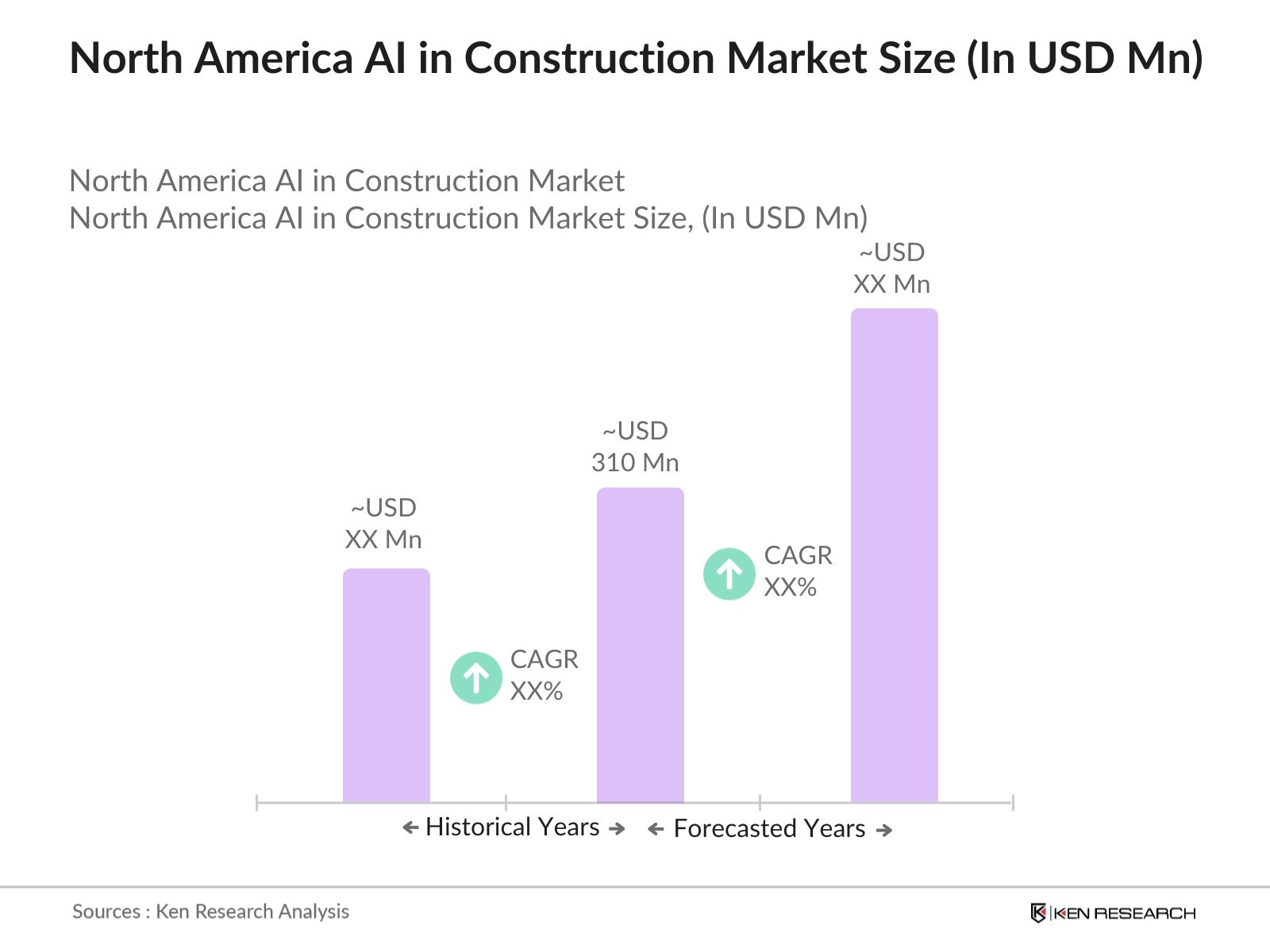
- The market is dominated by major cities and regions in the U.S. and Canada. Cities like New York, Los Angeles, and Toronto are at the forefront of AI adoption in construction due to their booming infrastructure projects and the presence of leading technology providers. These cities are home to large-scale smart city projects, major commercial developments, and government-driven infrastructure upgrades, which make them key players in the AI in construction space.
- Data privacy laws are increasingly affecting AI implementation in construction, especially concerning project and client data. In 2024, compliance with laws such as the U.S. Cybersecurity Framework and Canada's Personal Information Protection and Electronic Documents Act (PIPEDA) has become mandatory for construction firms using AI systems. Failure to comply with these data protection standards can result in fines of up to $250,000. These laws aim to protect sensitive data collected by AI-driven systems from misuse and breaches, ensuring the confidentiality and integrity of project information
North America AI in Construction Market Segmentation
By Component: The market is segmented by component into software solutions, hardware, and services. Software solutions dominate this segmentation due to the increasing use of AI-driven project management and predictive analytics software. These solutions help construction firms streamline their operations and predict potential risks, making them a crucial part of modern construction projects. 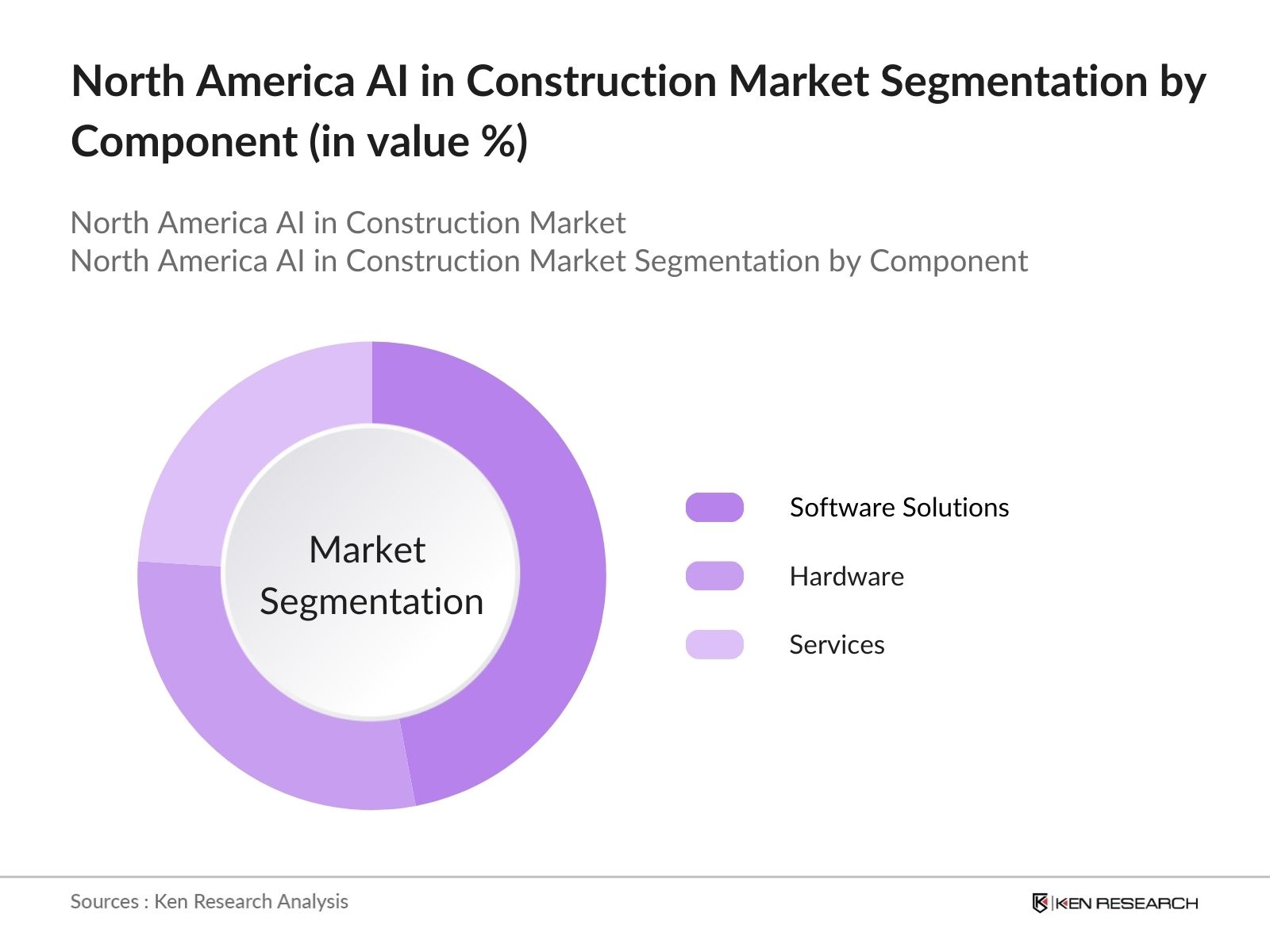
By Technology: The market is further segmented by technology into machine learning, natural language processing (NLP), computer vision, and robotics. Among these, machine learning has the largest market share due to its widespread use in predictive maintenance, project scheduling, and real-time risk assessment. The ability of machine learning algorithms to process large amounts of construction site data and provide actionable insights has propelled its adoption. 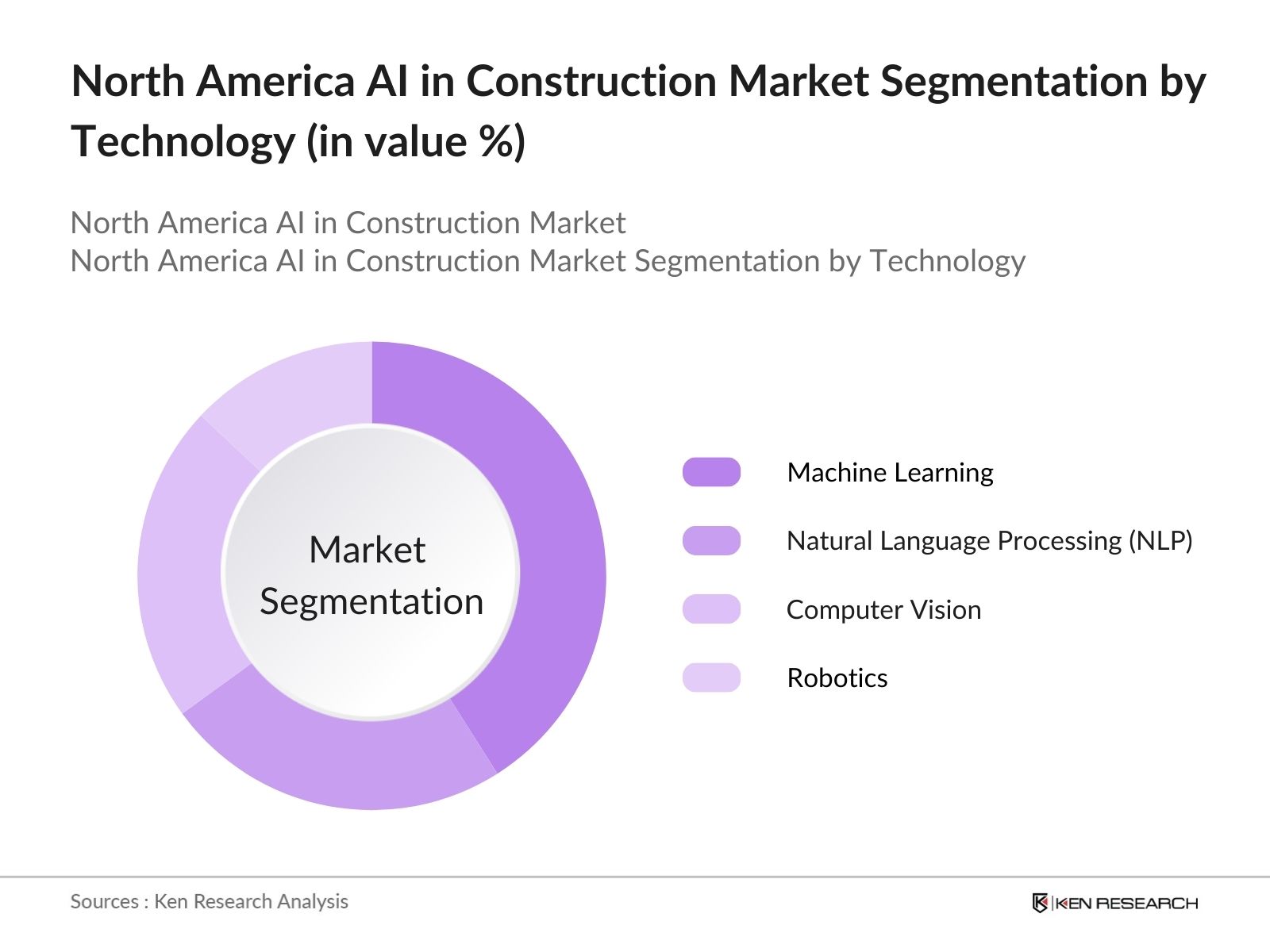
North America AI in Construction Market Competitive Landscape
The North America AI in Construction market is highly competitive, with a mix of major global technology players and specialized AI construction startups. Companies are focusing on innovations, strategic partnerships, and acquisitions to strengthen their market position. The top five players dominate the landscape, providing a range of solutions from AI-powered project management to robotics for construction automation. The market is dominated by companies like Autodesk, Oracle, and IBM, which have developed robust AI solutions tailored to construction needs.
|
Company |
Establishment Year |
Headquarters |
AI Focus |
Revenue (2023) |
Partnerships |
R&D Investment |
AI Patents |
Construction Focus |
Global Presence |
|
Autodesk, Inc. |
1982 |
San Rafael, CA |
|||||||
|
Oracle Corporation |
1977 |
Austin, TX |
|||||||
|
IBM Corporation |
1911 |
Armonk, NY |
|||||||
|
Trimble Inc. |
1978 |
Westminster, CO |
|||||||
|
Smartvid.io |
2015 |
Boston, MA |
North America AI in Construction Industry Analysis
Growth Drivers
- Increasing Adoption of AI for Project Management: AI technologies are increasingly being utilized in North America's construction sector for enhancing project management, leading to more efficient execution and monitoring. In 2024, companies are leveraging AI to streamline complex tasks such as scheduling, cost estimation, and resource allocation. The U.S. governments infrastructure projects now mandate advanced digital technologies, including AI, to enhance transparency and mitigate delays. Large-scale projects worth over $1 trillion are benefiting from AI-based project management tools. According to U.S. government statistics, the adoption of AI has increased by 40% across public infrastructure projects.
- Rising Investments in AI-driven Construction Technologies: Significant investments in AI-driven construction technologies are a key growth driver in North America. Between 2022 and 2024, investments in R&D for AI applications in construction surged, particularly for predictive analytics and robotics. Venture capital funding in construction technology exceeded $5 billion in 2023, with AI solutions capturing a large portion of that funding, according to government-released investment data. Public and private entities are increasingly allocating funds towards AI to drive productivity, with federal projects receiving approximately $3.5 billion in AI-related technology upgrades.
- Government Initiatives Promoting AI in Infrastructure Development: The U.S. and Canadian governments are promoting the use of AI through public-private partnerships aimed at modernizing infrastructure. In 2023, the U.S. government allocated over $500 million for smart infrastructure initiatives under the Infrastructure Investment and Jobs Act, which includes AI integration for construction efficiency. These funds have been directed towards the development of smart highways and AI-enhanced public works projects. In Canada, the government has initiated a $200 million program to integrate AI in large-scale construction projects aimed at enhancing urban infrastructure.
Market Challenges
- High Costs of AI Solutions: AI solutions in construction come with high upfront costs, which pose significant challenges for small and mid-sized firms. Procurement costs for AI-driven software and hardware, such as robotics and analytics platforms, can exceed $1 million for large projects. According to a report by the U.S. Department of Commerce, these high costs are often prohibitive, resulting in slower adoption rates among smaller firms. The high cost of implementation, including training and integration, has resulted in delayed AI adoption for approximately 30% of mid-sized construction companies.
- Lack of Skilled AI Talent in the Construction Sector: A shortage of skilled talent capable of implementing and managing AI technologies is a persistent challenge. The U.S. Bureau of Labor Statistics reported that the demand for AI specialists in construction exceeded 10,000 job openings in 2023, but only about 5,000 qualified professionals were available, creating a significant talent gap. This shortage hinders the full potential of AI integration in the sector. Governments and industry players are now collaborating on skill development initiatives, with over $100 million invested in AI-focused training programs to bridge this gap.
North America AI in Construction Market Future Outlook
The North America AI in Construction market is set to experience significant growth over the next few years, driven by continuous innovation in AI-powered construction tools and the increasing demand for automation in the construction industry. Key drivers such as government infrastructure projects, the expansion of smart city initiatives, and the need for sustainable and efficient construction practices will contribute to this upward trend. The role of AI in enhancing safety, optimizing project management, and reducing construction delays will become even more prominent as the market evolves.
Future Market Opportunities
- AI for Predictive Analytics and Maintenance: The adoption of AI for predictive analytics and maintenance in construction is revolutionizing how firms manage project lifecycles. AI algorithms analyze historical data to predict equipment failures, optimize maintenance schedules, and reduce downtime. By 2024, AI-driven predictive maintenance solutions have reduced equipment breakdown rates by 20%, according to data from the U.S. Department of Energy. This efficiency translates to billions in savings for the industry, as AI tools enhance asset management for large-scale construction operations.
- Expansion of AI Applications in Smart Cities and Green Buildings: AI technologies are playing a pivotal role in the development of smart cities and sustainable, green buildings. In 2024, North Americas smart city projects, worth an estimated $15 billion, are leveraging AI for urban planning, energy management, and sustainable construction. AI-enabled sensors, real-time data monitoring, and energy optimization tools are key in reducing the carbon footprint of new developments. U.S. Department of Energy reports confirm that AI applications in green building projects have improved energy efficiency by up to 30% compared to traditional methods.
Scope of the Report
|
Component |
Software Solutions Hardware Services |
|
Technology |
Machine Learning NLP Computer Vision Robotics |
|
Application |
Project Planning and Design Risk Management Construction Automation Supply Chain Management Resource Management |
|
Deployment Type |
On-Premise Cloud-Based |
|
End-User |
Residential Commercial Industrial Government and Infrastructure |
|
Region |
US Canada Mexico |
Products
Key Target Audience
AI Solution Providers for Construction
Construction Firms and Contractors
Building Information Modeling (BIM) Software Providers
Robotics and Automation Providers
Government and Regulatory Bodies (U.S. Department of Transportation, Infrastructure Canada)
Smart City Developers
Real Estate Developers
Investors and Venture Capitalist Firms
Companies
Major Players
Autodesk, Inc.
Oracle Corporation
IBM Corporation
Trimble Inc.
Microsoft Corporation
Smartvid.io
Buildots Ltd.
Doxel AI
Nvidia Corporation
Bentley Systems, Inc.
Procore Technologies, Inc.
PTC Inc.
Siemens AG
SAP SE
eSUB Construction Software
Table of Contents
1. North America AI in Construction Market Overview
1.1. Definition and Scope
1.2. Market Taxonomy
1.3. Market Growth Rate
1.4. Market Segmentation Overview
2. North America AI in Construction Market Size (In USD Mn)
2.1. Historical Market Size
2.2. Year-On-Year Growth Analysis
2.3. Key Market Developments and Milestones
3. North America AI in Construction Market Analysis
3.1. Growth Drivers
3.1.1. Increasing Adoption of AI for Project Management (Adoption Rate, Use Cases in Project Execution)
3.1.2. Rising Investments in AI-driven Construction Technologies (Investment in R&D, VC Funding)
3.1.3. Government Initiatives Promoting AI in Infrastructure Development (Government Funding, Public-Private Partnerships)
3.1.4. Integration of AI with BIM (Building Information Modeling) Systems (AI-BIM Integration, Enhanced Collaboration Tools)
3.2. Market Challenges
3.2.1. High Costs of AI Solutions (Cost Barriers, Procurement Challenges)
3.2.2. Lack of Skilled AI Talent in the Construction Sector (Talent Gaps, Skill Development Initiatives)
3.2.3. Cybersecurity and Data Privacy Issues in AI-Driven Systems (Cybersecurity Breaches, Data Regulations)
3.3. Opportunities
3.3.1. AI for Predictive Analytics and Maintenance (Maintenance Efficiency, Data Analytics Opportunities)
3.3.2. Expansion of AI Applications in Smart Cities and Green Buildings (AI in Sustainability, Urban Planning Solutions)
3.3.3. Collaboration between AI Vendors and Construction Firms (Collaborative Innovation, AI-Based Joint Ventures)
3.4. Trends
3.4.1. Use of AI-Driven Robotics for Construction Automation (Automation Rate, Robotics Deployment in Large Projects)
3.4.2. AI-Enhanced Construction Safety Management Systems (AI Safety Monitoring, Hazard Detection Algorithms)
3.4.3. Integration of AI in Construction Drones and Site Surveillance (Drones in Construction, Surveillance Efficiency)
3.5. Regulatory Environment
3.5.1. Construction Industry Standards for AI Systems (AI Standardization, Compliance Requirements)
3.5.2. Federal and State-Level AI Regulations (Regulatory Framework, Regional Compliance)
3.5.3. Construction Data Privacy Laws (Data Management Standards, Compliance with GDPR and Other Laws)
3.6. SWOT Analysis
3.7. Stakeholder Ecosystem Analysis
3.8. Porters Five Forces Analysis
3.9. Competitive Ecosystem (AI Companies, Construction Firms, Regulatory Bodies)
4. North America AI in Construction Market Segmentation
4.1. By Component (In Value %)
4.1.1. Software Solutions
4.1.2. Hardware
4.1.3. Services
4.2. By Technology (In Value %)
4.2.1. Machine Learning
4.2.2. Natural Language Processing (NLP)
4.2.3. Computer Vision
4.2.4. Robotics
4.3. By Application (In Value %)
4.3.1. Project Planning and Design
4.3.2. Risk Management and Forecasting
4.3.3. Construction Automation
4.3.4. Supply Chain Management
4.3.5. Resource Management
4.4. By Deployment Type (In Value %)
4.4.1. On-Premise
4.4.2. Cloud-Based
4.5. By End-User (In Value %)
4.5.1. Residential Construction
4.5.2. Commercial Construction
4.5.3. Industrial Construction
4.5.4. Government and Infrastructure
4.6. By Region (In Value %)
4.6.1. US
4.6.2. Canada
4.6.3. Mexico
5. North America AI in Construction Market Competitive Analysis
5.1. Detailed Profiles of Major Companies
5.1.1. Autodesk, Inc.
5.1.2. Oracle Corporation
5.1.3. Trimble Inc.
5.1.4. IBM Corporation
5.1.5. Bentley Systems, Inc.
5.1.6. Microsoft Corporation
5.1.7. SAP SE
5.1.8. Procore Technologies, Inc.
5.1.9. Smartvid.io
5.1.10. Nvidia Corporation
5.1.11. Siemens AG
5.1.12. PTC Inc.
5.1.13. Buildots Ltd.
5.1.14. Doxel AI
5.1.15. eSUB Construction Software
5.2. Cross Comparison Parameters (No. of Employees, Headquarters, AI Adoption Level, Construction Industry Focus, Revenue, Market Share, Major Partnerships, AI Patents)
5.3. Market Share Analysis
5.4. Strategic Initiatives
5.5. Mergers and Acquisitions
5.6. Investment Analysis
5.7. Venture Capital Funding
5.8. Government Grants
5.9. Private Equity Investments
6. North America AI in Construction Market Regulatory Framework
6.1. AI Compliance and Certification Processes
6.2. Regional AI Policies for Construction Industry
6.3. Environmental and Sustainability Regulations
7. North America AI in Construction Future Market Size (In USD Mn)
7.1. Future Market Size Projections
7.2. Key Factors Driving Future Market Growth
8. North America AI in Construction Future Market Segmentation
8.1. By Component (In Value %)
8.2. By Technology (In Value %)
8.3. By Application (In Value %)
8.4. By Deployment Type (In Value %)
8.5. By End-User (In Value %)
9. North America AI in Construction Market Analysts Recommendations
9.1. TAM/SAM/SOM Analysis
9.2. Strategic Customer Segmentation
9.3. White Space Opportunity Analysis
9.4. Innovation and Technological Roadmap
Research Methodology
Step 1: Identification of Key Variables
The initial stage focuses on identifying critical variables influencing the North America AI in Construction market, such as AI adoption rates, infrastructure development projects, and regulatory impacts. This step involves extensive desk research and the analysis of proprietary databases to gather relevant market insights.
Step 2: Market Analysis and Construction
We conducted a detailed analysis of the historical data, focusing on the penetration of AI across various construction domains, revenue generation from AI-driven projects, and market developments. Key market performance indicators were evaluated to assess growth potential accurately.
Step 3: Hypothesis Validation and Expert Consultation
After formulating market hypotheses, we consulted industry experts from leading construction firms, AI solution providers, and government bodies. These consultations provided practical insights into market dynamics and helped validate our assumptions.
Step 4: Research Synthesis and Final Output
The final phase synthesized all data from primary and secondary sources, ensuring accuracy through direct engagement with AI construction solution providers. The report was meticulously verified to ensure that it reflected the market's current state and future trajectory.
Frequently Asked Questions
01. How big is the North America AI in Construction market?
The North America AI in Construction market is valued at USD 310 Million. It is driven by factors such as increasing AI adoption for project management, enhanced safety solutions, and government-backed infrastructure projects.
02. What are the challenges in the North America AI in Construction market?
Challenges in the North America AI in Construction market include high implementation costs of AI solutions, a shortage of skilled professionals, and concerns about cybersecurity and data privacy within AI-driven construction environments.
03. Who are the major players in the North America AI in Construction market?
Key players in the North America AI in Construction market include Autodesk, Oracle Corporation, Trimble Inc., IBM Corporation, and Smartvid.io. These companies dominate due to their advanced AI technologies and partnerships with major construction firms.
04. What are the growth drivers of the North America AI in Construction market?
The North America AI in Construction market is driven by the need for efficiency in construction processes, government support for smart cities, and the growing demand for AI-powered safety management systems to reduce construction risks.
05. What is the role of AI in construction safety?
AI enhances construction safety by using computer vision and machine learning algorithms to monitor real-time site conditions, detect hazards, and predict potential risks, thereby preventing accidents and improving overall safety compliance in the North America AI in Construction market.
Why Buy From Us?

What makes us stand out is that our consultants follows Robust, Refine and Result (RRR) methodology. i.e. Robust for clear definitions, approaches and sanity checking, Refine for differentiating respondents facts and opinions and Result for presenting data with story

We have set a benchmark in the industry by offering our clients with syndicated and customized market research reports featuring coverage of entire market as well as meticulous research and analyst insights.

While we don't replace traditional research, we flip the method upside down. Our dual approach of Top Bottom & Bottom Top ensures quality deliverable by not just verifying company fundamentals but also looking at the sector and macroeconomic factors.

With one step in the future, our research team constantly tries to show you the bigger picture. We help with some of the tough questions you may encounter along the way: How is the industry positioned? Best marketing channel? KPI's of competitors? By aligning every element, we help maximize success.

Our report gives you instant access to the answers and sources that other companies might choose to hide. We elaborate each steps of research methodology we have used and showcase you the sample size to earn your trust.

If you need any support, we are here! We pride ourselves on universe strength, data quality, and quick, friendly, and professional service.