
North America Flying Cars Market Outlook to 2030
Region:North America
Author(s):Naman Rohilla
Product Code:KROD4081
October 2024
95
About the Report
North America Flying Cars Market Overview
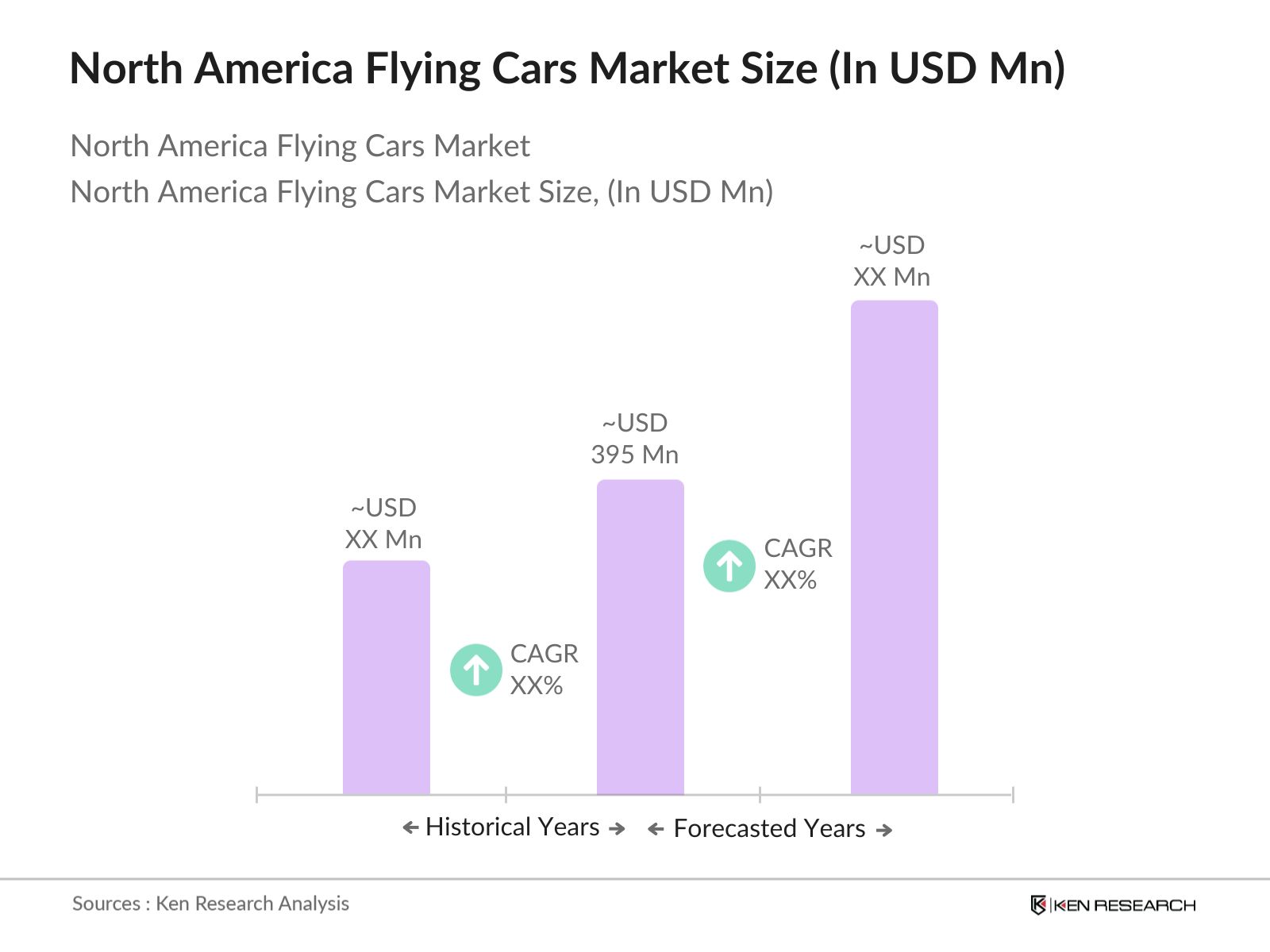
- The North America flying cars market is valued at USD 395 million, based on a five-year historical analysis. This market is primarily driven by technological advancements in urban air mobility and the rising demand for sustainable transportation solutions. The need for efficient solutions to combat urban congestion, along with a growing investment from key automotive and aviation industries, has accelerated the adoption of flying cars. Governments in the region are increasingly focusing on smart city infrastructure, further propelling market growth.
- The market is dominated by cities and countries with advanced infrastructure and technology ecosystems, such as the United States and Canada. The U.S., in particular, leads due to its early adoption of autonomous technology and a robust regulatory framework supporting urban air mobility. Additionally, cities like Los Angeles, New York, and San Francisco are at the forefront of testing and deploying flying cars, benefiting from collaborations between major industry players and government agencies.
- The FAA is taking a proactive approach to regulating urban air mobility (UAM), with a focus on ensuring the safety and efficiency of flying cars. In 2024, the FAA introduced new guidelines for the certification and operation of eVTOL vehicles, which include specific requirements for airworthiness, noise levels, and environmental impact. These regulations are designed to ensure that flying cars can safely integrate into the current airspace without causing disruptions. The FAA's regulatory efforts are critical to the future success of the flying car market in North America, helping to create a safe and structured operating environment for these vehicles.
North America Flying Cars Market Segmentation
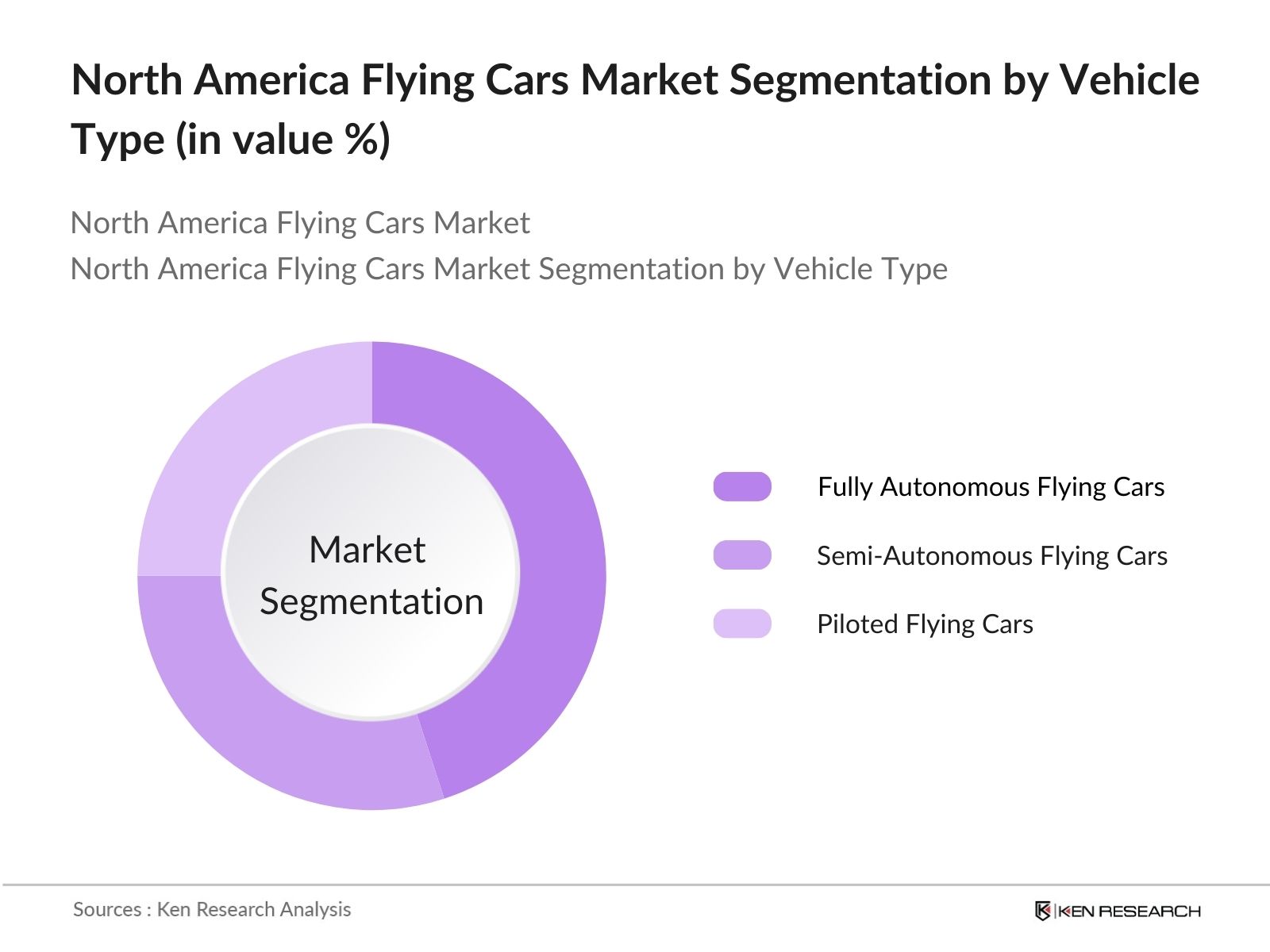
- By Vehicle Type: The North America flying cars market is segmented by vehicle type into fully autonomous flying cars, semi-autonomous flying cars, and piloted flying cars. Fully autonomous flying cars hold a dominant market share due to the increasing demand for self-driving technologies and advancements in AI-driven navigation systems. Companies are investing heavily in this segment to minimize human intervention, making fully autonomous flying cars a preferred choice for urban air mobility solutions.
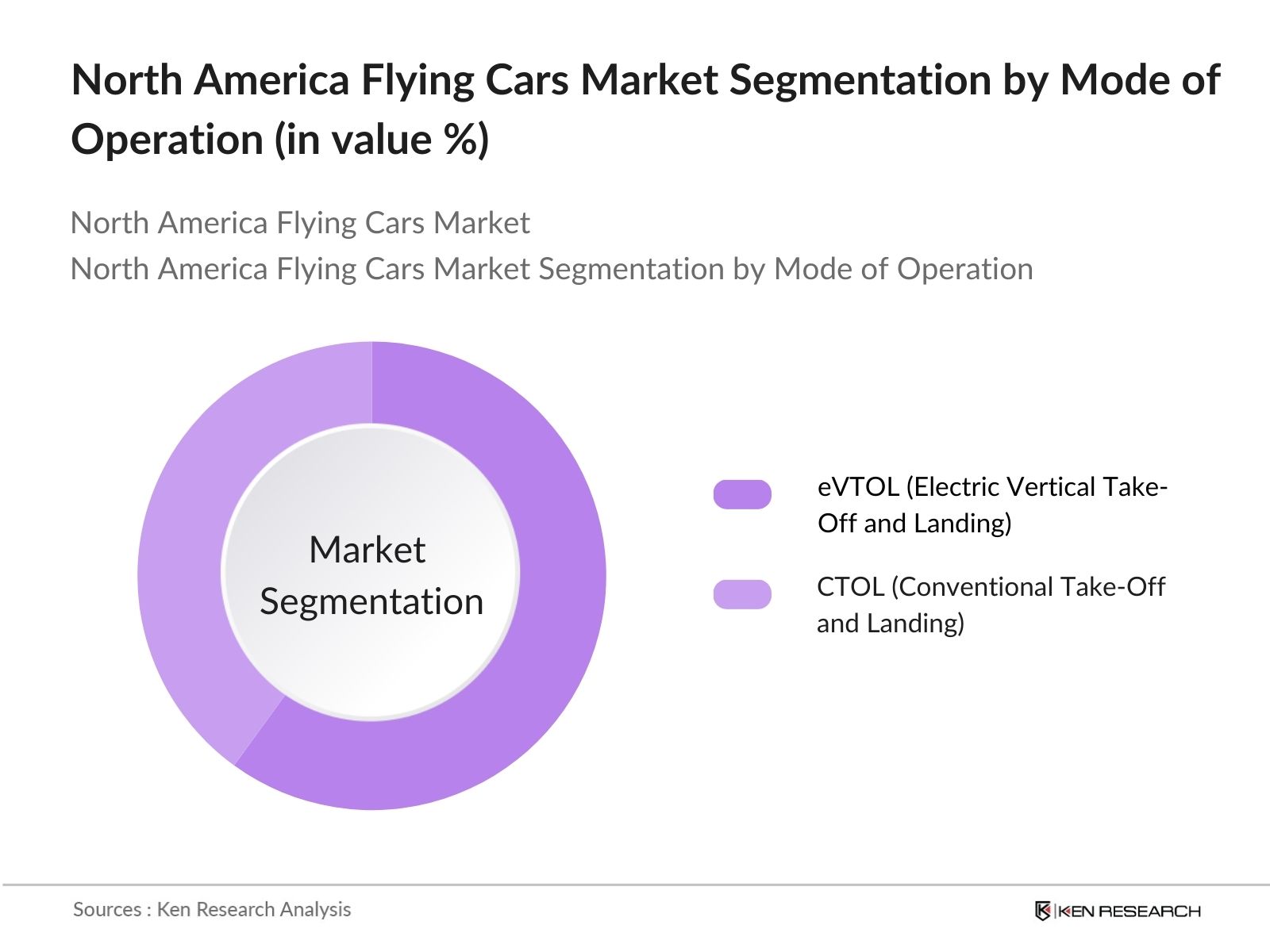
- By Mode of Operation: The market is also segmented by mode of operation into electric vertical take-off and landing (eVTOL) and conventional take-off and landing (CTOL). The eVTOL segment dominates the market due to its ability to operate in densely populated urban areas, requiring minimal runway space. eVTOL vehicles are gaining traction due to their efficiency and lower operational costs, which align with the market’s focus on sustainability and reduced emissions.
North America Flying Cars Market Competitive Landscape
The North American flying cars market is dominated by several key players, ranging from automotive giants to specialized air mobility companies. These players focus on innovation, partnerships, and regulatory approvals to stay competitive.
| Company Name | Year of Establishment | Headquarters | Revenue (USD Bn) | No. of Employees | Product Portfolio | Market Penetra tion |
R&D Invest ment |
Partner ships |
Techno logy Focus |
|---|---|---|---|---|---|---|---|---|---|
| Terrafugia Inc. | 2006 | Woburn, Massachusetts | - | - | - | - | - | - | - |
| AeroMobil | 2010 | Bratislava, Slovakia | - | - | - | - | - | - | - |
| Joby Aviation | 2009 | Santa Cruz, California | - | - | - | - | - | - | - |
| Lilium GmbH | 2015 | Munich, Germany | - | - | - | - | - | - | - |
| Bell Textron Inc. | 1935 | Fort Worth, Texas | - | - | - | - | - | - | - |
North America Flying Cars Market Analysis
North America Flying Cars Market Growth Drivers
- Rise of Autonomous Technology: Autonomous technology is a key growth driver for the flying cars market. Advances in AI and machine learning are accelerating the adoption of autonomous systems in flying vehicles. According to the World Economic Forum, autonomous flying cars could reduce human error, responsible for over 90% of road traffic accidents. The International Energy Agency (IEA) reports that around 25% of new aircraft models in 2024 incorporate autonomous flight capabilities, enhancing safety and efficiency. These advancements set the stage for broader acceptance of autonomous flying cars.
- Increased Investment in Air Mobility Solutions: Investment in air mobility is surging, with substantial funding from both companies and governments for flying car technologies. In 2024, the U.S. Department of Transportation allocated $350 million for urban air mobility (UAM) research to improve flying vehicle integration into infrastructure. The International Transport Forum notes that private investment in UAM exceeded $4.5 billion in 2024, indicating strong market momentum toward operationalizing flying cars in North American cities.
- Government Support for Urban Mobility Initiatives: Government backing is crucial for advancing flying cars. In North America, agencies like the FAA are actively supporting urban air mobility through regulatory frameworks that promote innovation while ensuring public safety. In 2024, the FAA introduced new guidelines to streamline eVTOL vehicle certification. Additionally, the U.S. government allocated $1.2 billion for urban mobility infrastructure improvements to facilitate the integration of flying cars into urban landscapes.
North America Flying Cars Market Challenges
- Stringent Air Traffic Regulations: One of the most major challenges facing the North American flying car market is the stringent air traffic regulations imposed by federal bodies like the FAA. In 2024, the FAA has maintained strict rules governing the altitude, speed, and operational zones for urban air vehicles. According to a report by the FAA, there are currently over 87,000 air traffic operations daily in the U.S., which could complicate the safe integration of flying cars without further regulatory adjustments. This challenge highlights the need for advanced air traffic management systems to ensure the safety and coordination of flying vehicles in densely populated airspaces.
- High Initial Investment Costs: The high initial investment costs for flying car manufacturing and infrastructure development remain a substantial hurdle. A 2024 report from the National Aeronautics and Space Administration (NASA) estimates that the cost of developing a flying car prototype is upwards of $5 million, with additional expenses for testing, certification, and commercialization. Building the necessary infrastructure, including vertiports and charging stations, adds to these costs. This financial barrier is deterring many potential market entrants and slowing down the overall pace of flying car deployment across North American cities.
North America Flying Cars Market Future Outlook
The North American flying cars market is expected to experience growth over the next five years, driven by increasing urbanization, advancements in air traffic management technologies, and consumer demand for sustainable urban transportation. The development of electric and autonomous flying vehicles is set to reshape the region's transportation infrastructure. Moreover, government support through favourable regulations and incentives will continue to encourage new entrants and foster innovation in this rapidly evolving market.
North America Flying Cars Market Opportunities
- Development of Advanced Air Traffic Control Systems: One of the most promising opportunities in the North American flying car market is the development of advanced air traffic control systems. These systems are designed to manage the complex airspace that flying cars will navigate. In 2024, NASA has been actively working on the Unmanned Aircraft System Traffic Management (UTM) project, which includes real-time traffic monitoring and collision avoidance systems specifically for low-altitude vehicles. With the UTM project receiving a $450 million boost from the U.S. government, the implementation of these advanced air traffic solutions is expected to expedite the safe deployment of flying cars in urban areas.
- Collaboration with Automotive and Aviation Firms: Collaborations between automotive and aviation companies are driving innovation in the flying car market. Leading firms from both sectors are entering into strategic partnerships to share technological expertise and resources. In 2024, automaker General Motors and aviation giant Boeing announced a joint venture aimed at developing electric flying car prototypes. These collaborations not only accelerate product development but also provide flying car manufacturers access to established supply chains, reducing the time to market for new products. This cross-industry collaboration represents a substantial growth opportunity for the sector.
Scope of the Report
| By Vehicle Type |
Fully Autonomous Flying Cars Semi-Autonomous Flying Cars Piloted Flying Cars |
| By Mode of Operation |
Electric Vertical Take-Off and Landing (eVTOL) Conventional Take-Off and Landing (CTOL) |
| By Application |
Commercial Air Mobility Personal Use Military and Government |
| By Propulsion Type |
Electric Hybrid Combustion |
| By Region |
U.S. Canada Mexico |
Products
Key Target Audience
Automotive Manufacturers
Aerospace Companies
Urban Mobility Solution Providers
Governments and Regulatory Bodies (FAA, NASA)
Banks and Financial Institutions
Investments and Venture Capitalist Firms
Electric Vehicle Manufacturers
Infrastructure Developers
Municipal Bodies and City Planners
Companies
Terrafugia Inc.
AeroMobil
PAL-V International B.V.
Volocopter GmbH
Joby Aviation
Lilium GmbH
Vertical Aerospace
Archer Aviation Inc.
Kitty Hawk Corporation
Urban Aeronautics Ltd.
EHang Holdings Ltd.
Bell Textron Inc.
SkyDrive Inc.
Hyundai Motor Group
Uber Elevate
Table of Contents
1. North America Flying Cars Market Overview
1.1 Definition and Scope
1.2 Market Taxonomy
1.3 Market Growth Rate
1.4 Market Segmentation Overview
2. North America Flying Cars Market Size (In USD Bn)
2.1 Historical Market Size
2.2 Year-On-Year Growth Analysis
2.3 Key Market Developments and Milestones
3. North America Flying Cars Market Analysis
3.1 Growth Drivers (Technological Innovation, Demand for Urban Air Mobility)
3.1.1 Rise of Autonomous Technology
3.1.2 Increased Investment in Air Mobility Solutions
3.1.3 Government Support for Urban Mobility Initiatives
3.2 Market Challenges (Infrastructural Limitations, Regulatory Barriers)
3.2.1 Stringent Air Traffic Regulations
3.2.2 High Initial Investment Costs
3.2.3 Safety Concerns and Public Acceptance
3.3 Opportunities (Emerging Markets, Technological Advancements)
3.3.1 Development of Advanced Air Traffic Control Systems
3.3.2 Collaboration with Automotive and Aviation Firms
3.3.3 Potential for Ride-Hailing Services
3.4 Trends (Electric Vertical Take-Off and Landing (eVTOL), Autonomous Flight)
3.4.1 Integration of AI in Navigation Systems
3.4.2 Shift Toward Sustainable and Electric Vehicles
3.4.3 Growing Interest in Pilotless Flying Cars
3.5 Government Regulation (Air Traffic Control, Safety Standards)
3.5.1 FAA Regulations for Urban Air Mobility
3.5.2 Government Incentives for Green Transportation
3.5.3 Collaboration with Municipal Bodies for Infrastructure
3.6 SWOT Analysis
3.7 Stakeholder Ecosystem
3.8 Porter’s Five Forces Analysis
3.9 Competition Ecosystem
4. North America Flying Cars Market Segmentation
4.1 By Vehicle Type (In Value %)
4.1.1 Fully Autonomous Flying Cars
4.1.2 Semi-Autonomous Flying Cars
4.1.3 Piloted Flying Cars
4.2 By Mode of Operation (In Value %)
4.2.1 Electric Vertical Take-Off and Landing (eVTOL)
4.2.2 Conventional Take-Off and Landing (CTOL)
4.3 By Application (In Value %)
4.3.1 Commercial Air Mobility
4.3.2 Personal Use
4.3.3 Military and Government
4.4 By Propulsion Type (In Value %)
4.4.1 Electric
4.4.2 Hybrid
4.4.3 Combustion Engine
4.5 By Region (In Value %)
4.5.1 U.S.
4.5.2 Canada
4.5.3 Mexico
5. North America Flying Cars Market Competitive Analysis
5.1 Detailed Profiles of Major Companies
5.1.1 Terrafugia Inc.
5.1.2 AeroMobil
5.1.3 PAL-V International B.V.
5.1.4 Volocopter GmbH
5.1.5 Uber Elevate
5.1.6 Joby Aviation
5.1.7 Lilium GmbH
5.1.8 Vertical Aerospace
5.1.9 Archer Aviation Inc.
5.1.10 Kitty Hawk Corporation
5.1.11 Urban Aeronautics Ltd.
5.1.12 EHang Holdings Ltd.
5.1.13 Bell Textron Inc.
5.1.14 SkyDrive Inc.
5.1.15 Hyundai Motor Group
5.2 Cross Comparison Parameters (Headquarters, Revenue, Number of Employees, Patent Portfolio, Market Share, Strategic Partnerships, Investment in R&D, Technological Advancements)
5.3 Market Share Analysis
5.4 Strategic Initiatives
5.5 Mergers and Acquisitions
5.6 Investment Analysis
5.7 Venture Capital Funding
5.8 Government Grants and Subsidies
5.9 Private Equity Investments
6. North America Flying Cars Market Regulatory Framework
6.1 Safety Standards and Certifications (FAA Certifications, Airworthiness Requirements)
6.2 Compliance Requirements (Urban Air Mobility Guidelines, Noise and Emission Standards)
6.3 Certification Processes (Autonomous Flying Vehicle Approvals, Navigation System Certifications)
7. North America Flying Cars Future Market Size (In USD Bn)
7.1 Future Market Size Projections
7.2 Key Factors Driving Future Market Growth
8. North America Flying Cars Future Market Segmentation
8.1 By Vehicle Type (In Value %)
8.2 By Mode of Operation (In Value %)
8.3 By Application (In Value %)
8.4 By Propulsion Type (In Value %)
8.5 By Region (In Value %)
9. North America Flying Cars Market Analysts’ Recommendations
9.1 TAM/SAM/SOM Analysis
9.2 Market Penetration Strategy
9.3 Strategic Partnerships and Collaborations
9.4 Marketing and Advertising Initiatives
Disclaimer Contact UsResearch Methodology
Step 1: Identification of Key Variables
The research begins by mapping the ecosystem of the North American flying cars market, focusing on critical stakeholders such as manufacturers, regulatory bodies, and urban planners. Data is collected from reliable secondary sources to identify market drivers, challenges, and emerging trends.
Step 2: Market Analysis and Construction
In this phase, historical data related to market performance, technological advancements, and consumer adoption rates are compiled and analyzed. The goal is to understand the existing market landscape and forecast future trends based on the data gathered.
Step 3: Hypothesis Validation and Expert Consultation
Market hypotheses are developed regarding the adoption of flying cars and validated through consultations with industry experts, including executives from major players and policymakers. These interviews provide insights into market strategies and key operational metrics.
Step 4: Research Synthesis and Final Output
The final report synthesizes data gathered from multiple sources, including direct engagement with manufacturers, to validate findings and produce a comprehensive analysis of the market. The report offers actionable insights, which are used to finalize the conclusions and market forecasts.
Frequently Asked Questions
01. How big is the North America Flying Cars Market?
The North American flying cars market is valued at USD 395 million, driven by the increasing demand for autonomous air mobility solutions and advancements in electric propulsion technology.
02. What are the challenges in the North America Flying Cars Market?
Challenges in the North American flying cars market include stringent air traffic regulations, high operational costs, and the need for large-scale infrastructure development to accommodate flying cars in urban areas.
03. Who are the major players in the North America Flying Cars Market?
Key players in the North American flying cars market include Terrafugia Inc., Joby Aviation, AeroMobil, Volocopter GmbH, and Bell Textron Inc., dominating the market due to their extensive R&D investments and technological advancements.
04. What are the growth drivers of the North America Flying Cars Market?
The North American flying cars market is driven by factors such as technological innovations in autonomous vehicles, increasing urbanization, and government support for sustainable transportation solutions.
Why Buy From Us?

What makes us stand out is that our consultants follows Robust, Refine and Result (RRR) methodology. i.e. Robust for clear definitions, approaches and sanity checking, Refine for differentiating respondents facts and opinions and Result for presenting data with story

We have set a benchmark in the industry by offering our clients with syndicated and customized market research reports featuring coverage of entire market as well as meticulous research and analyst insights.

While we don't replace traditional research, we flip the method upside down. Our dual approach of Top Bottom & Bottom Top ensures quality deliverable by not just verifying company fundamentals but also looking at the sector and macroeconomic factors.

With one step in the future, our research team constantly tries to show you the bigger picture. We help with some of the tough questions you may encounter along the way: How is the industry positioned? Best marketing channel? KPI's of competitors? By aligning every element, we help maximize success.

Our report gives you instant access to the answers and sources that other companies might choose to hide. We elaborate each steps of research methodology we have used and showcase you the sample size to earn your trust.

If you need any support, we are here! We pride ourselves on universe strength, data quality, and quick, friendly, and professional service.