
North America Steel Rebar Market Outlook to 2030
Region:North America
Author(s):Sanjna Verma
Product Code:KROD7635
November 2024
88
About the Report
North America Steel Rebar Market Overview
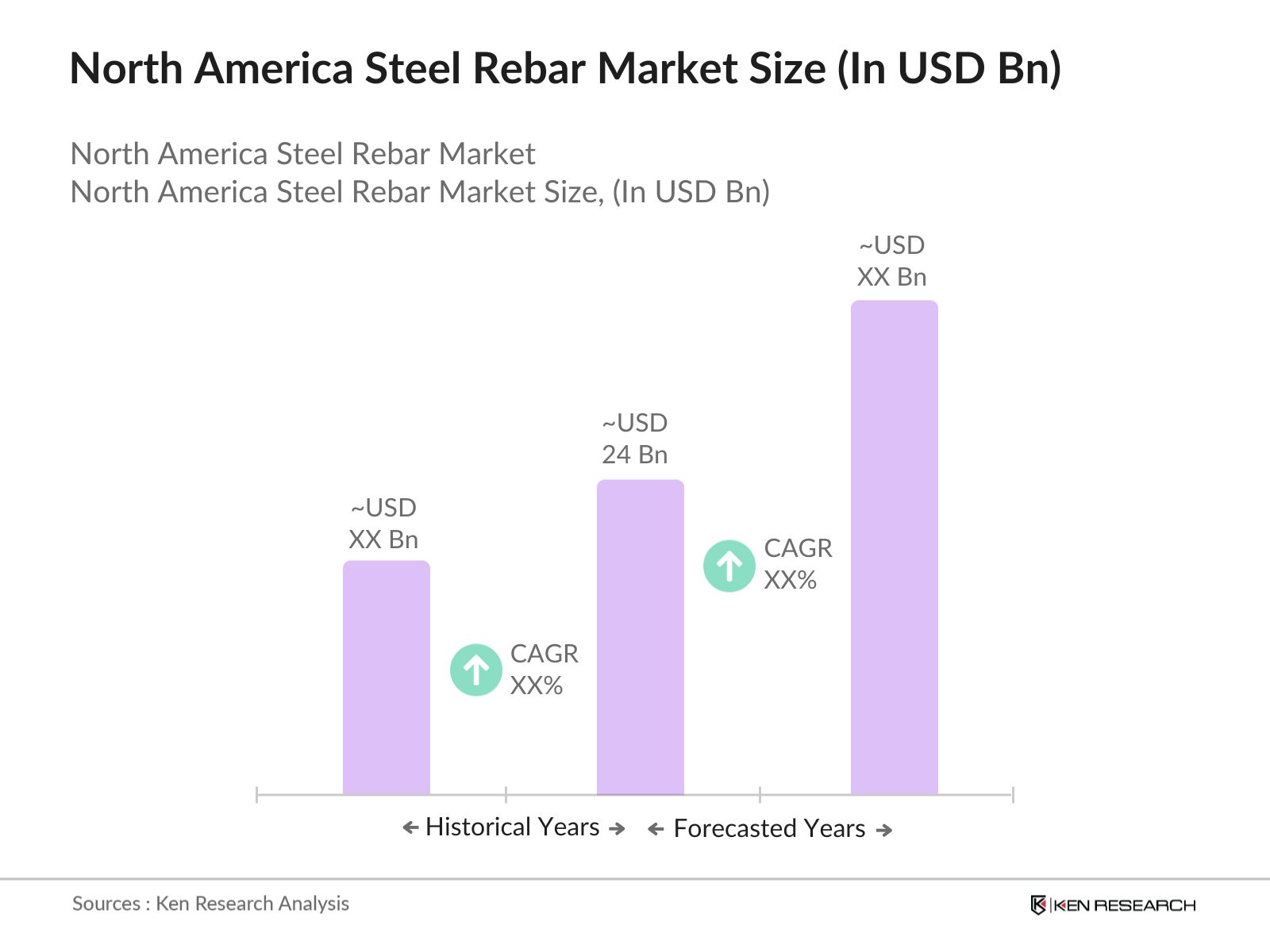
- The North America Steel Rebar market is valued at USD 24 billion, driven by significant investments in infrastructure projects across the region. The market's growth is primarily fueled by the expansion of transportation infrastructure, especially highways and bridges, and the continued growth in urban construction. The demand for durable construction materials, including steel rebars, is further reinforced by the increasing focus on sustainable building practices.
- Key cities and regions that dominate the steel rebar market in North America include the United States and Canada, with major metropolitan areas like New York, Chicago, and Toronto leading the way. These cities dominate because of their ongoing large-scale infrastructure projects and stringent building codes that require high-quality construction materials. Additionally, government initiatives in urban development, earthquake-resistant infrastructure, and green building certifications contribute to the market dominance of these regions.
- In 2024, North American governments-maintained import tariffs on steel, with the U.S. imposing a 25% tariff on steel imports to protect domestic producers. These tariffs are part of ongoing trade policies aimed at reducing reliance on foreign steel, thus creating a favorable environment for local steel rebar manufacturers. However, they also raise the cost of imported steel, impacting industries reliant on affordable materials.
North America Steel Rebar Market Segmentation
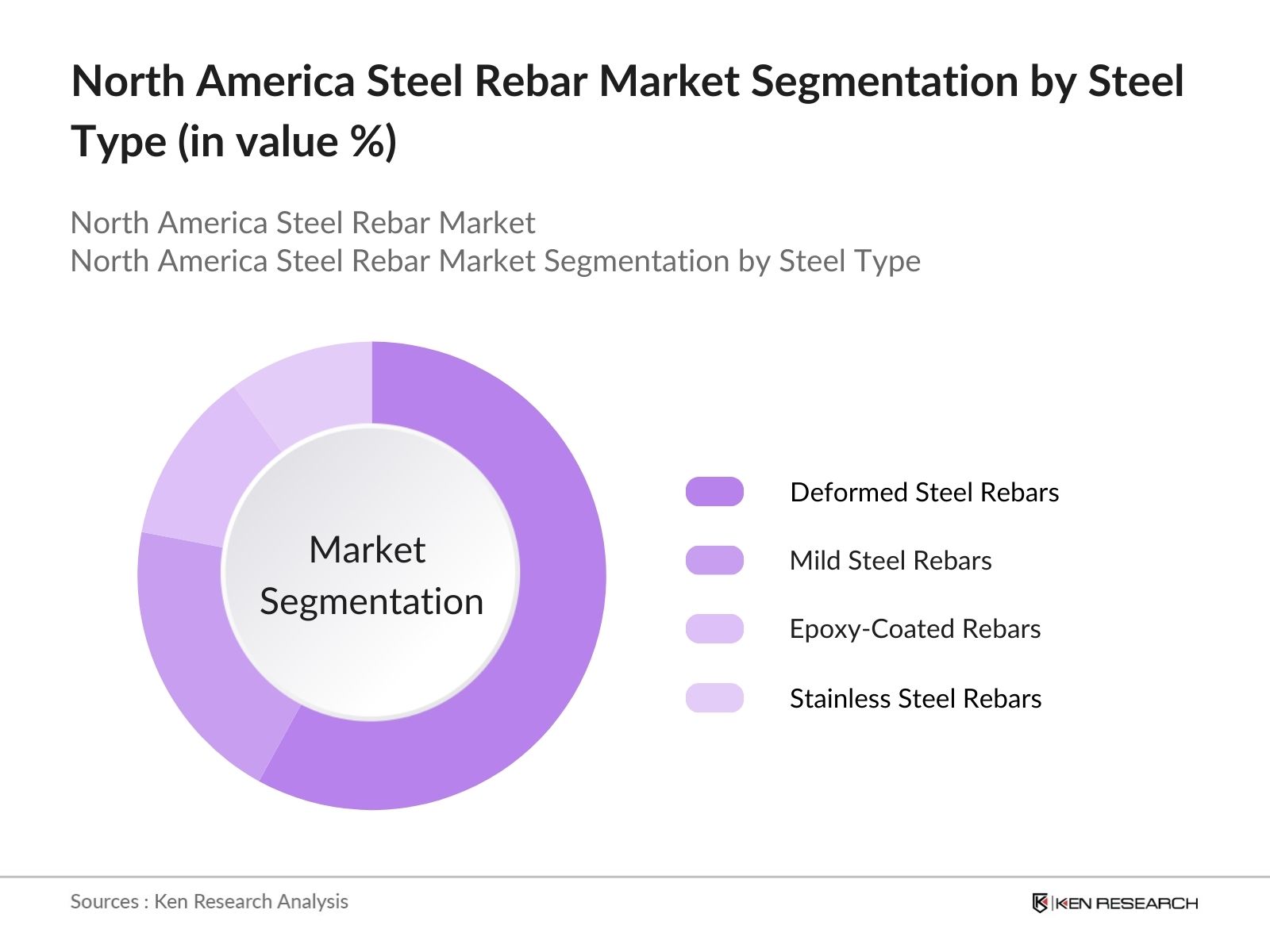
By Steel Type: The North America steel rebar market is segmented by steel type into deformed steel rebars, mild steel rebars, epoxy-coated rebars, and stainless steel rebars. Currently, deformed steel rebars hold a dominant position in the market due to their superior tensile strength and durability, making them ideal for use in large-scale construction projects. They are widely utilized in reinforced concrete structures, which are crucial for infrastructure projects like bridges, tunnels, and skyscrapers. Their enhanced bonding capability with concrete is another factor driving their widespread use.
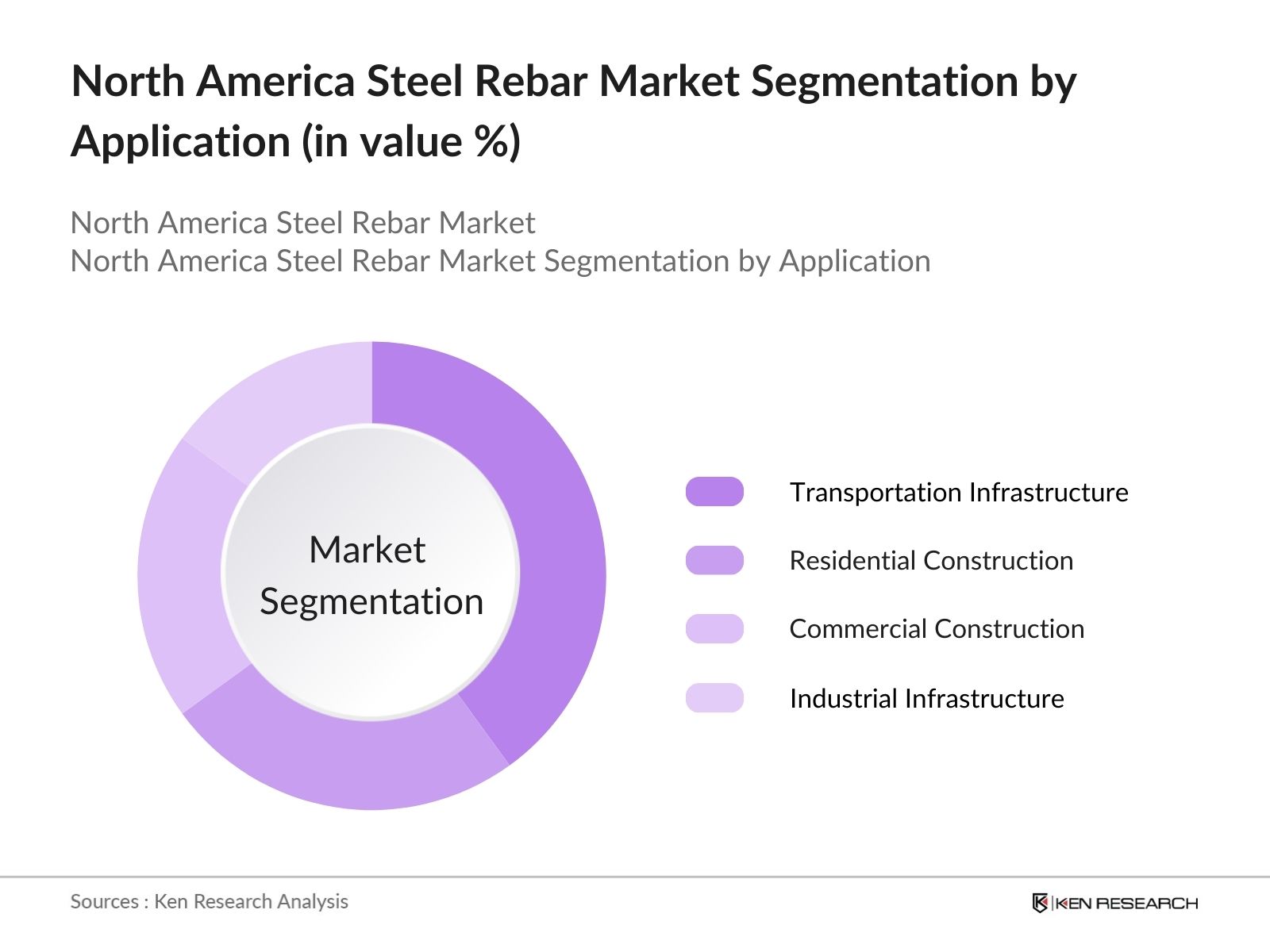
By Application: The steel rebar market in North America is segmented by application into residential construction, commercial construction, industrial infrastructure, and transportation infrastructure. Transportation infrastructure, including the construction of highways, railways, and airports, dominates the market due to the high demand for heavy-duty steel reinforcements. The rise in government-funded infrastructure projects, coupled with the need for long-lasting structures, makes this segment the leading consumer of steel rebars.
North America Steel Rebar Market Competitive Landscape
The North America Steel Rebar market is dominated by both local and international players who have established a strong foothold through technological advancements, strategic partnerships, and acquisitions. These companies have a solid distribution network and consistently invest in innovation, which positions them as market leaders. Additionally, strategic acquisitions and partnerships have allowed these companies to expand their market presence.
Key players in the market include:
|
Company |
Establishment Year |
Headquarters |
Steel Output |
Number of Plants |
Sustainability Programs |
Revenue |
Employees |
R&D Expenditure |
Certifications |
|
Nucor Corporation |
1940 |
Charlotte, NC, USA |
- |
- |
- |
- |
- |
- |
- |
|
Gerdau S.A. |
1901 |
So Paulo, Brazil |
- |
- |
- |
- |
- |
- |
- |
|
Commercial Metals Company |
1915 |
Irving, TX, USA |
- |
- |
- |
- |
- |
- |
- |
|
Steel Dynamics, Inc. |
1993 |
Fort Wayne, IN, USA |
- |
- |
- |
- |
- |
- |
- |
|
ArcelorMittal |
2006 |
Luxembourg, Luxembourg |
- |
- |
- |
- |
- |
- |
- |
North America Steel Rebar Market Analysis
Growth Drivers
- Expansion of Construction Industry: The North American construction industry has witnessed significant growth, with the U.S. and Canada being key contributors. In 2024, U.S. construction output is projected to reach $1.67 trillion, driven by a surge in residential, commercial, and industrial projects. Canada is also seeing a steady rise in construction, particularly in major cities such as Toronto and Vancouver, with a projected output of $165 billion in 2024. This robust construction activity has increased demand for steel rebar, which is essential in building strong foundations and structures in both residential and commercial buildings.
- Increasing Infrastructure Development: In 2024, the U.S. government allocated $550 billion for infrastructure development under the Infrastructure Investment and Jobs Act (IIJA), focusing on roads, bridges, and public transportation. Similarly, Canada has invested over USD 25.3 billion in its "Investing in Canada Plan" for infrastructure development in 2024. These investments are directly boosting the demand for steel rebar, which plays a vital role in constructing durable infrastructure, including highways and bridges.
- Rising Demand for Sustainable Construction Materials: The rising focus on sustainability in construction has led to increased demand for eco-friendly materials, including rebar made from recycled steel. In 2024, over 40% of construction projects in North America incorporate green building practices, with an emphasis on using sustainable and recyclable materials. The U.S. Green Building Council has reported that there are 104,000 LEED-certified projects in the U.S. alone, further driving the demand for steel rebar made from environmentally friendly sources.
Challenges
- Volatility in Steel Prices: The steel price index in North America has experienced fluctuations, which poses a significant challenge for the steel rebar market. In 2024, the steel price index stood at 122.6, a drop from 134.2 in 2023, indicating market volatility. These price changes affect the production cost of rebar and its affordability in the market. Volatility in raw material prices, including iron ore and scrap steel, adds uncertainty to long-term procurement contracts for construction projects, impacting rebar manufacturers' margins.
- High Energy Consumption in Production: Steel rebar production is highly energy-intensive. On average, producing one ton of steel rebar requires around 20 gigajoules of energy, which adds to production costs. With energy prices rising in 2024, North American manufacturers face increased operational costs. The energy consumption in the production process contributes to higher carbon emissions, complicating compliance with stringent environmental regulations, making it a challenge for the industry to balance cost and sustainability.
North America Steel Rebar Market Future Outlook
North America Steel Rebar market is poised for robust growth, driven by continuous government investments in infrastructure, rising demand for sustainable construction materials, and the adoption of innovative technologies in the construction sector. The ongoing development of smart cities, along with an increase in public-private partnerships for infrastructure development, is expected to contribute significantly to the markets expansion. Furthermore, advancements in rebar manufacturing processes, including low-carbon steel production, are expected to drive the market forward.
Market Opportunities
- Technological Advancements in Rebar Production: Advancements in rebar production technology, such as micro-alloying and thermomechanical treatment, are enhancing the strength and durability of steel rebar. In 2024, new production techniques reduced energy consumption by 10% per ton of steel. These innovations not only improve the quality of rebar but also help manufacturers meet environmental regulations while reducing costs. The adoption of these technologies is an opportunity for manufacturers to differentiate their products and gain a competitive edge.
- Increasing Demand for Earthquake-Resistant Structures: With increasing awareness of seismic risks, North America has seen a rise in demand for earthquake-resistant buildings. Steel rebar is essential in the construction of these earthquake-resistant structures, as it provides the necessary tensile strength to prevent collapse during seismic activity. This trend presents a growing opportunity for rebar manufacturers to meet the demand in high-risk areas.
Scope of the Report
|
Segment |
Sub-segment |
|
Steel Type |
Deformed Steel Rebars |
|
Mild Steel Rebars |
|
|
Epoxy-Coated Rebars |
|
|
Stainless Steel Rebars |
|
|
Process |
Electric Arc Furnace (EAF) |
|
Basic Oxygen Furnace (BOF) |
|
|
Continuous Casting |
|
|
Application |
Residential Construction |
|
Commercial Construction |
|
|
Industrial Infrastructure |
|
|
Transportation Infrastructure |
|
|
End-User |
Construction Companies |
|
Government Infrastructure Projects |
|
|
Private Developers |
|
|
Region |
USA |
|
Canada |
|
|
Mexico |
Products
Key Target Audience
Construction Companies
Steel Manufacturers
Infrastructure Development Firms
Engineering and Design Firms
Real Estate Developers
Environmental and Sustainability Organizations
Investors and Venture Capitalist Firms
Government and Regulatory Bodies (U.S. Department of Transportation, Federal Highway Administration)
Companies
Players Mentioned in the Report
Nucor Corporation
Gerdau S.A.
Commercial Metals Company
Steel Dynamics, Inc.
ArcelorMittal
Tata Steel
Schnitzer Steel Industries
JSW Steel
Evraz North America
Celsa Group
Table of Contents
1. North America Steel Rebar Market Overview
1.1 Definition and Scope
1.2 Market Taxonomy
1.3 Market Growth Rate
1.4 Market Segmentation Overview
2. North America Steel Rebar Market Size (In USD Mn)
2.1 Historical Market Size
2.2 Year-On-Year Growth Analysis
2.3 Key Market Developments and Milestones
3. North America Steel Rebar Market Analysis
3.1 Growth Drivers
3.1.1 Expansion of Construction Industry (Metric: Regional Construction Output)
3.1.2 Increasing Infrastructure Development (Metric: Infrastructure Investment)
3.1.3 Rising Demand for Sustainable Construction Materials (Metric: Green Building Projects)
3.1.4 Government Stimulus Programs (Metric: Infrastructure Stimulus Packages)
3.2 Market Challenges
3.2.1 Volatility in Steel Prices (Metric: Steel Price Index)
3.2.2 High Energy Consumption in Production (Metric: Energy Usage per Ton of Steel)
3.2.3 Stringent Environmental Regulations (Metric: Carbon Emission Limits)
3.2.4 Competition from Alternative Materials (Metric: Market Share of Alternatives)
3.3 Opportunities
3.3.1 Technological Advancements in Rebar Production (Metric: Innovation in Steel Manufacturing)
3.3.2 Increasing Demand for Earthquake-Resistant Structures (Metric: Earthquake-Proof Construction Projects)
3.3.3 Expansion of Urban Transportation Projects (Metric: Transportation Infrastructure Spending)
3.3.4 Growth in Prefabricated Construction (Metric: Prefabrication Construction Adoption)
3.4 Trends
3.4.1 Adoption of High-Strength Rebars (Metric: Demand for High-Grade Steel)
3.4.2 Integration of Digital Tools in Construction (Metric: Use of BIM in Rebar Design)
3.4.3 Shift Towards Low-Carbon Steel Production (Metric: Low-Carbon Steel Market Share)
3.4.4 Increasing Use of Recycled Steel (Metric: Recycled Steel in Total Production)
3.5 Government Regulation
3.5.1 Steel Industry Emission Standards (Metric: Regulatory Emission Thresholds)
3.5.2 Trade Tariffs and Quotas (Metric: Import Tariff Rates on Steel)
3.5.3 Buy America Requirements (Metric: Compliance with Domestic Steel Use Mandates)
3.5.4 Construction Safety Codes (Metric: Compliance with Rebar Safety Standards)
3.6 SWOT Analysis
3.7 Stakeholder Ecosystem
3.8 Porters Five Forces Analysis
3.9 Competition Ecosystem
4. North America Steel Rebar Market Segmentation
4.1 By Steel Type (In Value %)
4.1.1 Deformed Steel Rebars
4.1.2 Mild Steel Rebars
4.1.3 Epoxy-Coated Rebars
4.1.4 Stainless Steel Rebars
4.2 By Process (In Value %)
4.2.1 Electric Arc Furnace (EAF)
4.2.2 Basic Oxygen Furnace (BOF)
4.2.3 Continuous Casting
4.3 By Application (In Value %)
4.3.1 Residential Construction
4.3.2 Commercial Construction
4.3.3 Industrial Infrastructure
4.3.4 Transportation Infrastructure
4.4 By End-User (In Value %)
4.4.1 Construction Companies
4.4.2 Government Infrastructure Projects
4.4.3 Private Developers
4.5 By Region (In Value %)
4.5.1 USA
4.5.2 Canada
4.5.3 Mexico
5. North America Steel Rebar Market Competitive Analysis
5.1 Detailed Profiles of Major Companies
5.1.1 Nucor Corporation
5.1.2 Gerdau S.A.
5.1.3 Commercial Metals Company (CMC)
5.1.4 Steel Dynamics, Inc.
5.1.5 ArcelorMittal
5.1.6 Tata Steel
5.1.7 Schnitzer Steel Industries
5.1.8 JSW Steel
5.1.9 Evraz North America
5.1.10 Celsa Group
5.2 Cross Comparison Parameters (Steel Output, Regional Presence, Revenue, Employees, Production Facilities, Sustainability Initiatives, R&D Expenditure, Certification Standards)
5.3 Market Share Analysis
5.4 Strategic Initiatives
5.5 Mergers and Acquisitions
5.6 Investment Analysis
5.7 Venture Capital Funding
5.8 Government Grants
5.9 Private Equity Investments
6. North America Steel Rebar Market Regulatory Framework
6.1 Environmental Standards
6.2 Compliance Requirements
6.3 Certification Processes
7. North America Steel Rebar Future Market Size (In USD Mn)
7.1 Future Market Size Projections
7.2 Key Factors Driving Future Market Growth
8. North America Steel Rebar Future Market Segmentation
8.1 By Steel Type (In Value %)
8.2 By Process (In Value %)
8.3 By Application (In Value %)
8.4 By End-User (In Value %)
8.5 By Region (In Value %)
9. North America Steel Rebar Market Analyst's Recommendations
9.1 TAM/SAM/SOM Analysis
9.2 Customer Cohort Analysis
9.3 Marketing Initiatives
9.4 White Space Opportunity Analysis
Research Methodology
Step 1: Identification of Key Variables
The first step in our research methodology involves constructing an ecosystem map encompassing the entire steel rebar supply chain in North America. This is based on extensive desk research and a review of proprietary databases to gather comprehensive market-level information. The primary objective is to define critical variables like raw material availability, regulatory impacts, and end-user demand.
Step 2: Market Analysis and Construction
This step involves compiling historical data to analyze the steel rebar market dynamics, assessing production rates, and revenue generation from key application segments. By reviewing government infrastructure projects and their impacts, we ensure that our estimates reflect accurate market conditions.
Step 3: Hypothesis Validation and Expert Consultation
To validate market hypotheses, we conduct interviews with industry experts, including construction managers, rebar manufacturers, and government officials, to gain real-time insights into the market trends and challenges. This expert feedback allows us to refine and validate our market data.
Step 4: Research Synthesis and Final Output
In this final phase, we synthesize the collected data and conduct a bottom-up approach to verify sales and production statistics across the steel rebar industry. We engage with leading steel manufacturers to ensure the accuracy of our data and produce a comprehensive analysis.
Frequently Asked Questions
01. How big is the North America Steel Rebar Market?
The North America Steel Rebar market is valued at USD 24 billion, driven by the expanding infrastructure and construction activities in the region.
02. What are the challenges in the North America Steel Rebar Market?
Challenges in North America Steel Rebar market include the volatility of steel prices, high energy consumption in rebar production, and stringent environmental regulations that limit carbon emissions.
03. Who are the major players in the North America Steel Rebar Market?
Key players in North America Steel Rebar market include Nucor Corporation, Gerdau S.A., Commercial Metals Company, Steel Dynamics, Inc., and ArcelorMittal. These companies lead due to their strong production capacities and extensive distribution networks.
04. What are the growth drivers of the North America Steel Rebar Market?
Key drivers in North America Steel Rebar market include increased government investments in infrastructure projects, the rising demand for sustainable building materials, and technological advancements in steel production.
Why Buy From Us?

What makes us stand out is that our consultants follows Robust, Refine and Result (RRR) methodology. i.e. Robust for clear definitions, approaches and sanity checking, Refine for differentiating respondents facts and opinions and Result for presenting data with story

We have set a benchmark in the industry by offering our clients with syndicated and customized market research reports featuring coverage of entire market as well as meticulous research and analyst insights.

While we don't replace traditional research, we flip the method upside down. Our dual approach of Top Bottom & Bottom Top ensures quality deliverable by not just verifying company fundamentals but also looking at the sector and macroeconomic factors.

With one step in the future, our research team constantly tries to show you the bigger picture. We help with some of the tough questions you may encounter along the way: How is the industry positioned? Best marketing channel? KPI's of competitors? By aligning every element, we help maximize success.

Our report gives you instant access to the answers and sources that other companies might choose to hide. We elaborate each steps of research methodology we have used and showcase you the sample size to earn your trust.

If you need any support, we are here! We pride ourselves on universe strength, data quality, and quick, friendly, and professional service.