
USA NVH (Noise, Vibration, and Harshness) Market Outlook to 2030
Region:North America
Author(s):Shreya Garg
Product Code:KROD5799
December 2024
92
About the Report
USA NVH (Noise, Vibration, and Harshness) Market Overview
- The USA NVH (Noise, Vibration, and Harshness) market is valued at USD 2.2 billion, driven primarily by the increasing demand in the automotive and aerospace sectors. This market has seen consistent growth due to the rising focus on enhancing passenger comfort and reducing external and internal noise in vehicles and aircraft. Additionally, advancements in noise insulation technologies, coupled with government regulations aimed at reducing noise pollution levels, have significantly contributed to the market's expansion. Factors like the increasing production of electric vehicles (EVs), which require more sophisticated NVH solutions, also bolster this markets growth.
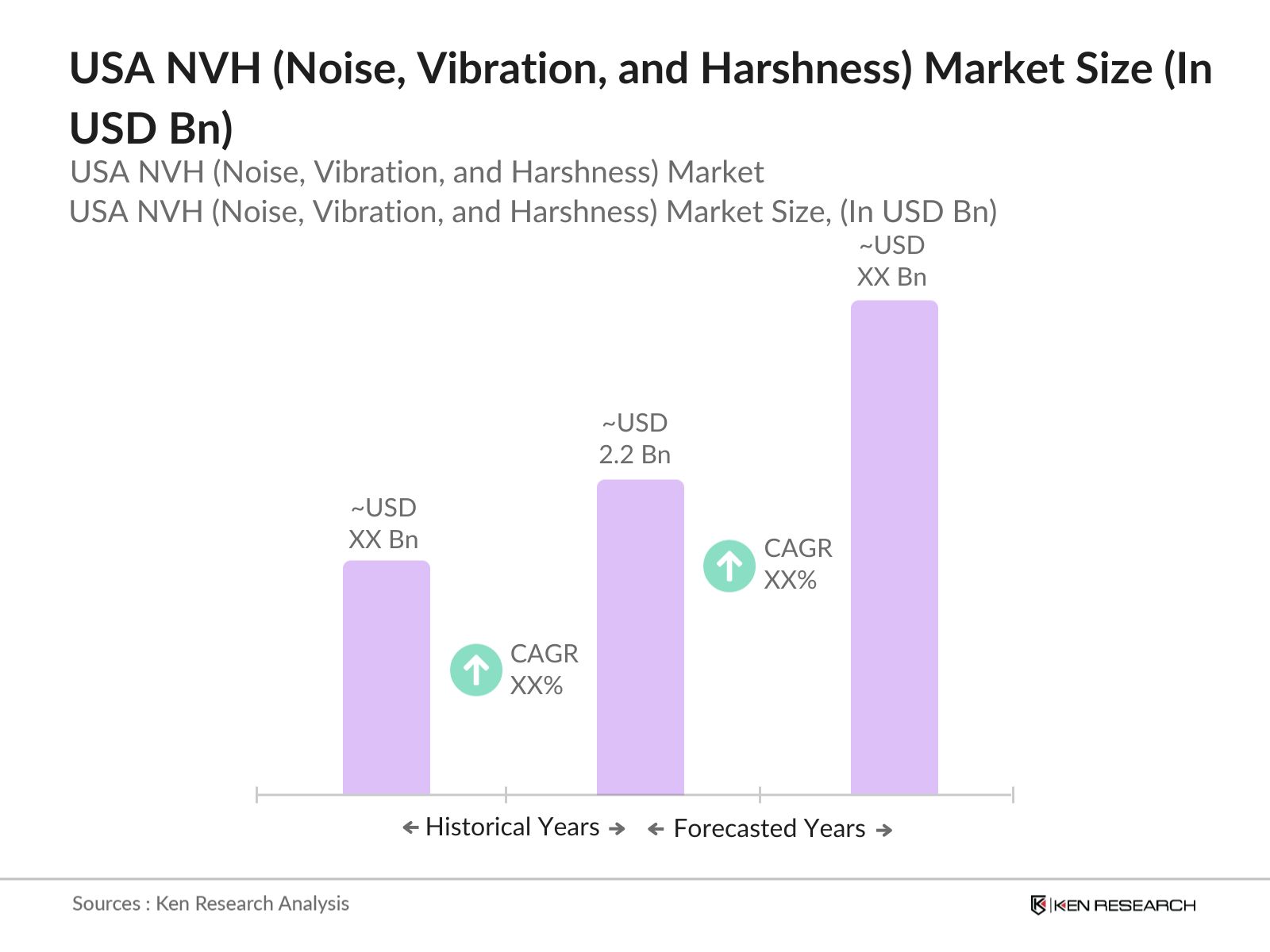
- The USA NVH market sees dominance in cities like Detroit, which serves as a hub for the automotive industry, and Seattle, home to major aerospace players. These cities have a strong presence of both vehicle and aircraft manufacturers, such as Ford, GM, and Boeing, which contribute to their dominance. These industries require advanced NVH solutions to comply with stringent regulatory requirements and enhance vehicle and aircraft performance. The concentration of manufacturing facilities, skilled labor, and technological advancements in these cities further strengthens their position in the NVH market.
- The U.S. Federal Noise Control Act mandates strict noise control standards for automotive manufacturers, which has a direct impact on NVH market growth. Enforced by the Environmental Protection Agency, this law ensures that vehicle manufacturers comply with noise emission standards. As of 2023, the automotive industry invested over $1 billion in meeting these regulatory requirements, further fueling demand for NVH solutions.
USA NVH (Noise, Vibration, and Harshness) Market Segmentation
By Product Type: The market is segmented by product type into soundproofing materials, acoustic insulators, vibration dampers, and active noise control systems. Among these, soundproofing materials hold a dominant share due to their extensive application in both automotive and aerospace industries. The ability of these materials to provide insulation from noise while also being cost-effective has led to their widespread adoption. In vehicles, soundproofing materials are used extensively in doors, dashboards, and floors to enhance passenger comfort. Aerospace companies also rely on these materials to reduce cabin noise, which is a key factor for customer satisfaction. 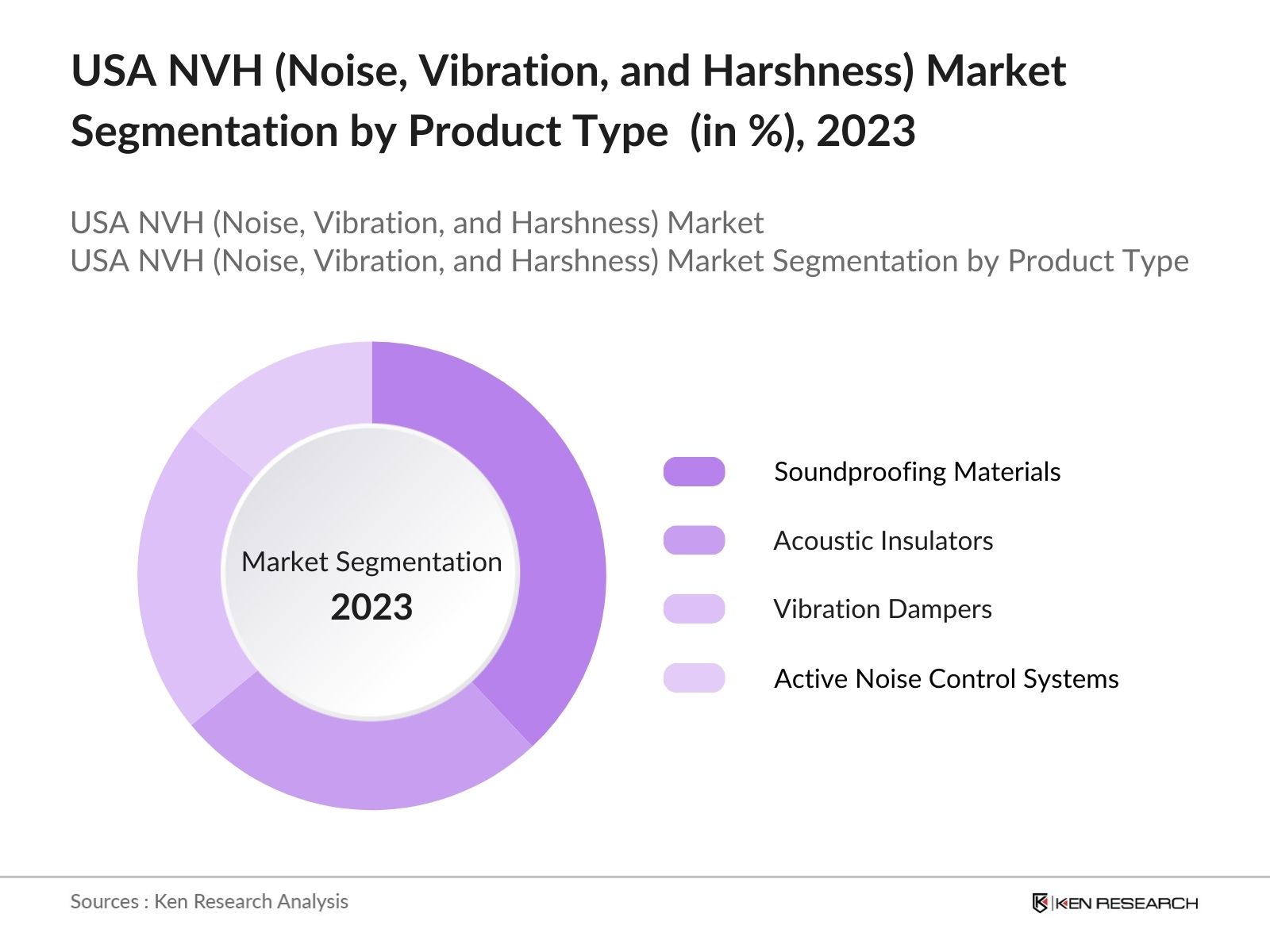
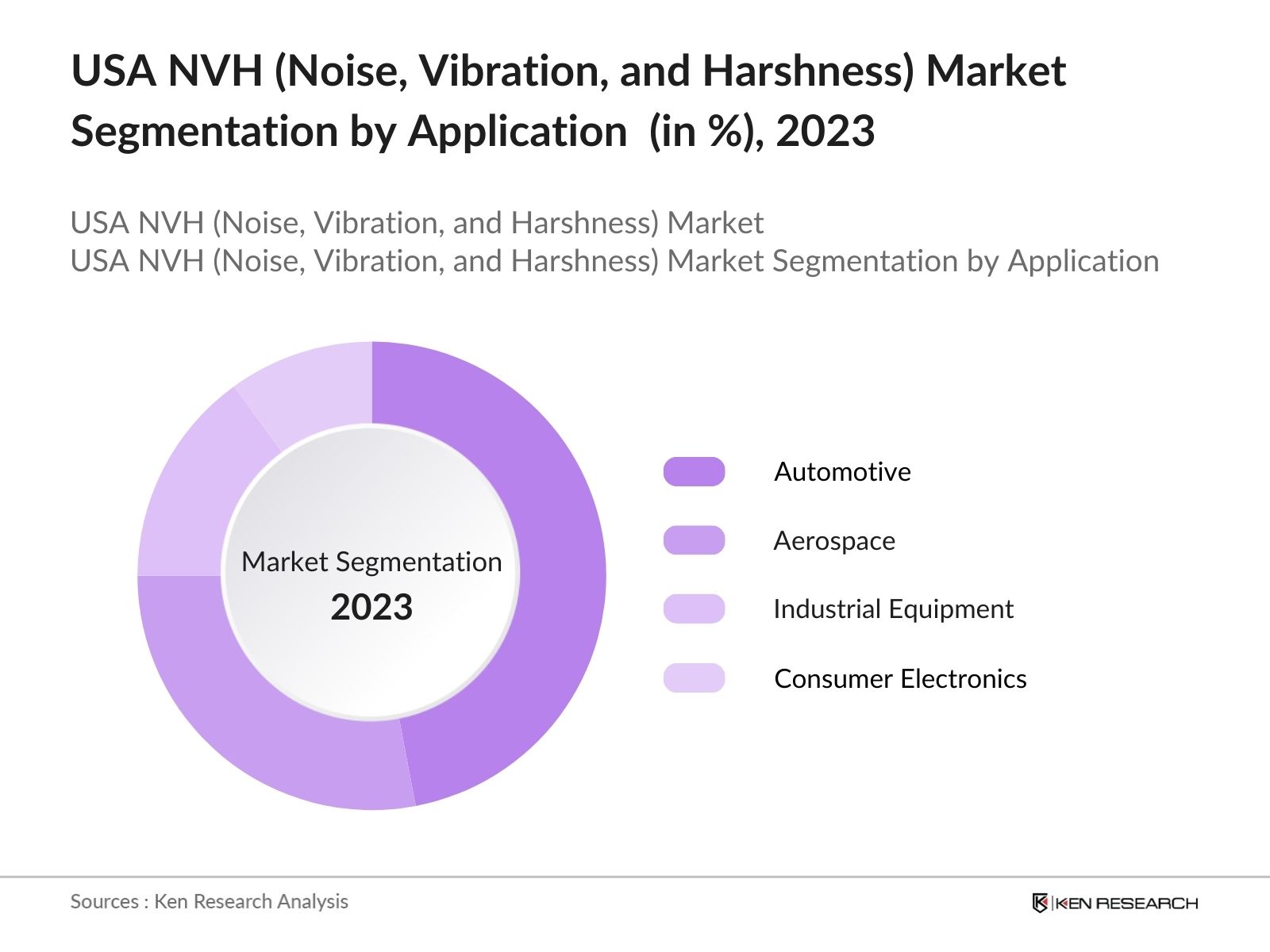
By Application: The market is also segmented by application into automotive, aerospace, industrial equipment, and consumer electronics. The automotive segment dominates the market due to the high demand for reducing vehicle noise and vibrations to meet consumer expectations and regulatory standards. The surge in electric vehicle production has accelerated the demand for NVH solutions, as EVs require specialized noise control materials to mitigate the absence of traditional engine noise. Additionally, manufacturers are increasingly integrating advanced NVH materials into premium vehicles to enhance comfort and ensure compliance with environmental noise regulations.
USA NVH (Noise, Vibration, and Harshness) Market Competitive Landscape
The USA NVH market is dominated by several key players, each leveraging their unique strengths in innovation, R&D, and manufacturing capabilities. Companies with a strong foothold in both the automotive and aerospace industries lead the market. Their ability to deliver customized NVH solutions that cater to specific industry needs has allowed them to maintain a competitive edge. The market landscape highlights the influence of these major players, with their strong research and development capabilities, global reach, and partnerships driving innovation in noise and vibration control solutions.
|
Company |
Established |
Headquarters |
Revenue |
Employees |
Product Portfolio |
R&D Spending |
Global Presence |
Strategic Partnerships |
|
3M Company |
1902 |
St. Paul, Minnesota |
||||||
|
Trelleborg AB |
1905 |
Trelleborg, Sweden |
||||||
|
DuPont de Nemours, Inc. |
1802 |
Wilmington, Delaware |
||||||
|
Autoneum Holding AG |
2011 |
Winterthur, Switzerland |
||||||
|
Sumitomo Riko Company Limited |
1929 |
Nagoya, Japan |
USA NVH (Noise, Vibration, and Harshness) Industry Analysis
Growth Drivers
- Automotive Industry Expansion: The expansion of the automotive industry in the U.S. is a key driver for the NVH (Noise, Vibration, and Harshness) market. In 2023, the U.S. produced over 9.1 million vehicles, which requires stringent NVH standards to ensure performance and comfort. NVH management is critical for both internal combustion engine (ICE) vehicles and the growing electric vehicle (EV) segment. According to the Bureau of Economic Analysis (BEA), the automotive industry's GDP contribution exceeded $700 billion in 2022, reflecting its strong impact on NVH demand for automotive manufacturers.
- Increasing Stringent Regulatory Standards: Stringent regulations by agencies like the Environmental Protection Agency (EPA) and National Highway Traffic Safety Administration (NHTSA) are pushing manufacturers to adopt advanced NVH technologies. The EPA's noise control standards, particularly for vehicle emissions, require effective NVH mitigation strategies. The NHTSA enforces noise standards for vehicle safety, especially for EVs, where sound design for pedestrian safety is critical. In 2022, 1,020 enforcement actions were undertaken by NHTSA, many of which related to noise and safety standards, driving the need for enhanced NVH solutions.
- Technological Advancements in Material Science: Advancements in material science have enabled the development of more efficient NVH-reducing materials such as lightweight composites and acoustic foams. In 2023, investments in material science research reached $15.6 billion in the U.S., supported by government initiatives such as the National Science Foundation. These materials not only improve NVH properties but also support the automotive industry's shift towards lighter vehicles, crucial for improving fuel efficiency and reducing emissions.
Market Challenges
- High R&D Costs: The high cost of research and development in NVH technologies is a significant barrier. In 2022, automotive R&D expenditures in the U.S. exceeded $105 billion, with a large portion dedicated to NVH testing and innovation. The need for advanced testing equipment, specialized materials, and skilled personnel makes NVH R&D cost-intensive, limiting the entry of smaller players into the market and slowing down the pace of innovation.
- Complexity of NVH Testing Procedures: NVH testing is complex, requiring specialized equipment and testing environments. The NVH testing process involves multiple iterations of vehicle prototyping, which is both time-consuming and costly. Data from the U.S. Department of Energy shows that testing a single prototype can cost manufacturers between $500,000 and $1 million, depending on the complexity of the vehicle. This complexity adds to the overall development time for new vehicle models, creating a bottleneck in production.
USA NVH (Noise, Vibration, and Harshness) Market Future Outlook
Over the next five years, the USA NVH market is expected to experience steady growth driven by the expansion of the electric vehicle (EV) market, advancements in material science, and the rising adoption of active noise control technologies. The increasing emphasis on reducing noise pollution, coupled with stringent government regulations on noise levels, will propel the demand for advanced NVH solutions. The automotive industry, in particular, will continue to drive demand for NVH products as manufacturers focus on improving passenger comfort and meeting regulatory standards.
Future Market Opportunities
- Electric Vehicle Growth and NVH Management: The rapid growth of the electric vehicle (EV) market presents significant opportunities for the NVH sector. EVs require sophisticated noise control strategies, particularly in terms of reducing high-frequency electrical noises and managing pedestrian safety. In 2023, the U.S. had over 3.5 million EVs on the road, and this growing fleet is driving demand for enhanced NVH solutions specifically designed for the quiet nature of EVs.
- Global Expansion and Export Potential: The U.S. NVH industry has significant export potential, particularly in regions with growing automotive production. In 2022, U.S. exports of automotive parts, including NVH components, amounted to $56 billion, according to the U.S. Census Bureau. Expanding export markets, especially in Asia and Europe, where stringent NVH standards are being adopted, offers new growth opportunities for U.S. NVH solution providers.
Scope of the Report
|
Product Type |
Soundproofing Materials Acoustic Insulators Vibration Dampers Active Noise Control Systems |
|
Application |
Automotive Aerospace Industrial Equipment Consumer Electronics |
|
Testing Type |
Physical Testing Virtual Testing |
|
Material |
Rubber Metal Plastic Composites |
|
Region |
North-East West South Mid-West |
Products
Key Target Audience
Automotive Manufacturers
Aerospace Manufacturers
NVH Material Suppliers
OEM Suppliers
Acoustic Engineering Firms
Investor and Venture Capitalist Firms
Government and Regulatory Bodies (EPA, NHTSA)
Research and Development Institutes
Companies
Major Players
3M Company
DuPont de Nemours, Inc.
Trelleborg AB
BASF SE
Faurecia
Sumitomo Riko Company Limited
Harman International
Autoneum Holding AG
Henkel AG & Co. KGaA
Huntsman Corporation
Cooper-Standard Holdings Inc.
Sika AG
NVH Korea
Nihon Tokushu Toryo Co., Ltd.
L&L Products
Table of Contents
USA NVH Market Overview
1.1. Definition and Scope
1.2. Market Taxonomy
1.3. Market Growth Rate
1.4. Market Segmentation Overview
USA NVH Market Size (In USD Bn)
2.1. Historical Market Size
2.2. Year-On-Year Growth Analysis
2.3. Key Market Developments and Milestones
USA NVH Market Analysis
3.1. Growth Drivers
3.1.1. Automotive Industry Expansion
3.1.2. Increasing Stringent Regulatory Standards (EPA, NHTSA)
3.1.3. Rising Consumer Demand for Vehicle Comfort and Performance
3.1.4. Technological Advancements in Material Science
3.2. Market Challenges
3.2.1. High R&D Costs
3.2.2. Complexity of NVH Testing Procedures
3.2.3. Lack of Skilled Labor in NVH Engineering
3.3. Opportunities
3.3.1. Electric Vehicle Growth and NVH Management
3.3.2. Increasing Adoption of Active Noise Control Solutions
3.3.3. Global Expansion and Export Potential
3.4. Trends
3.4.1. Adoption of Lightweight and Acoustic Materials
3.4.2. Integration of NVH Solutions in Autonomous Vehicles
3.4.3. Growing Investments in Acoustic Simulation Software
3.5. Government Regulation
3.5.1. U.S. Federal Noise Control Act
3.5.2. National Highway Traffic Safety Administration (NHTSA) Standards
3.5.3. Environmental Protection Agency (EPA) Guidelines
3.6. SWOT Analysis
3.7. Porters Five Forces Analysis
3.8. Competition Ecosystem
USA NVH Market Segmentation
4.1. By Product Type (In Value %)
4.1.1. Soundproofing Materials
4.1.2. Acoustic Insulators
4.1.3. Vibration Dampers
4.1.4. Active Noise Control Systems
4.2. By Application (In Value %)
4.2.1. Automotive
4.2.2. Aerospace
4.2.3. Industrial Equipment
4.2.4. Consumer Electronics
4.3. By Testing Type (In Value %)
4.3.1. Physical Testing
4.3.2. Virtual Testing
4.4. By Material (In Value %)
4.4.1. Rubber
4.4.2. Metal
4.4.3. Plastic Composites
4.5. By Region (In Value %)
4.5.1. North-East USA
4.5.2. West USA
4.5.3. South USA
4.5.4. Mid-West USA
USA NVH Market Competitive Analysis
5.1. Detailed Profiles of Major Companies
5.1.1. 3M Company
5.1.2. Trelleborg AB
5.1.3. DuPont de Nemours, Inc.
5.1.4. BASF SE
5.1.5. Huntsman Corporation
5.1.6. Henkel AG & Co. KGaA
5.1.7. Faurecia
5.1.8. Autoneum Holding AG
5.1.9. Sumitomo Riko Company Limited
5.1.10. Cooper-Standard Holdings Inc.
5.1.11. Sika AG
5.1.12. Harman International
5.1.13. NVH Korea
5.1.14. Nihon Tokushu Toryo Co., Ltd.
5.1.15. L&L Products
5.2. Cross Comparison Parameters (No. of Employees, Revenue, R&D Spending, Market Share, Headquarters, Product Portfolio, Key Clients, Global Presence)
5.3. Market Share Analysis
5.4. Strategic Initiatives
5.5. Mergers and Acquisitions
5.6. Investment Analysis
5.7. Venture Capital Funding
USA NVH Market Regulatory Framework
6.1. Noise Standards and Guidelines
6.2. Industry Compliance Requirements
6.3. Certification and Testing Procedures
USA NVH Future Market Size (In USD Bn)
7.1. Future Market Size Projections
7.2. Key Factors Driving Future Market Growth
USA NVH Future Market Segmentation
8.1. By Product Type (In Value %)
8.2. By Application (In Value %)
8.3. By Testing Type (In Value %)
8.4. By Material (In Value %)
8.5. By Region (In Value %)
USA NVH Market Analysts Recommendations
9.1. TAM/SAM/SOM Analysis
9.2. Market Entry Strategies
9.3. White Space Opportunity Analysis
9.4. Customer Retention Strategies
Disclaimer
Contact Us
Research Methodology
Step 1: Identification of Key Variables
The first step in our research process involves mapping the NVH market's key stakeholders, including automotive, aerospace, and industrial sectors. Extensive desk research, coupled with the use of secondary databases, is employed to gather industry-level information, allowing us to identify key market variables.
Step 2: Market Analysis and Construction
In this step, historical data on market penetration, NVH product usage, and revenue generation are collected. We also analyze service quality and performance metrics to ensure accurate revenue estimations and market dynamics.
Step 3: Hypothesis Validation and Expert Consultation
We conduct hypothesis testing through consultations with industry experts and company representatives. These interviews help us validate key data points and refine our understanding of market trends and growth factors.
Step 4: Research Synthesis and Final Output
Finally, we engage with multiple NVH product manufacturers to obtain insights on segment performance, product innovations, and sales trends. This stage ensures a comprehensive, validated market report.
Frequently Asked Questions
01 How big is the USA NVH Market?
The USA NVH market is valued at USD 2.2 billion, driven by increasing demand for noise and vibration control solutions in the automotive and aerospace sectors.
02 What are the challenges in the USA NVH Market?
Key challenges include high R&D costs, complex testing requirements, and a shortage of skilled labor in NVH engineering. These factors can slow down product development and increase production costs.
03 Who are the major players in the USA NVH Market?
Key players include 3M Company, DuPont, BASF SE, Faurecia, and Trelleborg AB. These companies dominate due to their advanced technology, strong customer relationships, and global presence.
04 What are the growth drivers of the USA NVH Market?
The market is driven by the rise in electric vehicle production, increasing regulatory standards on noise levels, and consumer demand for improved vehicle comfort and performance.
05 What is the future outlook for the USA NVH Market?
The market is expected to grow steadily, supported by advancements in noise control technology, the expansion of the electric vehicle market, and continued government regulations aimed at reducing noise pollution.
Why Buy From Us?

What makes us stand out is that our consultants follows Robust, Refine and Result (RRR) methodology. i.e. Robust for clear definitions, approaches and sanity checking, Refine for differentiating respondents facts and opinions and Result for presenting data with story

We have set a benchmark in the industry by offering our clients with syndicated and customized market research reports featuring coverage of entire market as well as meticulous research and analyst insights.

While we don't replace traditional research, we flip the method upside down. Our dual approach of Top Bottom & Bottom Top ensures quality deliverable by not just verifying company fundamentals but also looking at the sector and macroeconomic factors.

With one step in the future, our research team constantly tries to show you the bigger picture. We help with some of the tough questions you may encounter along the way: How is the industry positioned? Best marketing channel? KPI's of competitors? By aligning every element, we help maximize success.

Our report gives you instant access to the answers and sources that other companies might choose to hide. We elaborate each steps of research methodology we have used and showcase you the sample size to earn your trust.

If you need any support, we are here! We pride ourselves on universe strength, data quality, and quick, friendly, and professional service.