About the Report
Base Year 2024Japan Cloud Gaming & Streaming Platforms Market Overview
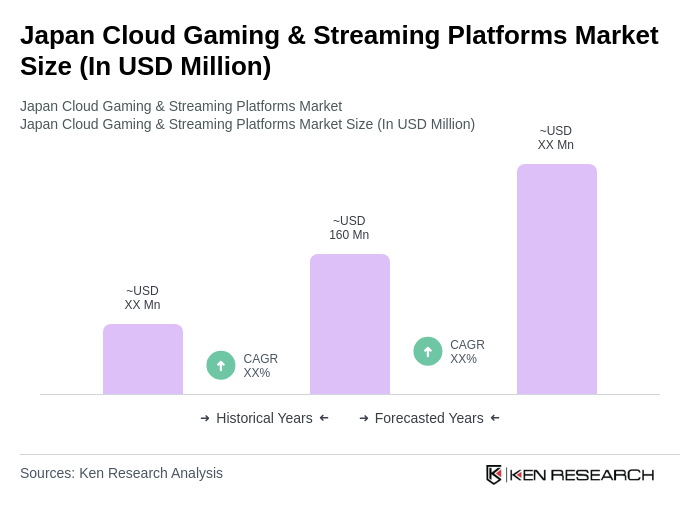
- The Japan Cloud Gaming & Streaming Platforms Market is valued at USD 160 million, based on a five-year historical analysis. This growth is primarily driven by the proliferation of high-speed internet connectivity, advanced 5G networks, increasing smartphone penetration, and a growing consumer preference for on-demand and cross-platform gaming experiences. The market has seen a significant rise in user engagement, with more gamers opting for cloud-based solutions that offer flexibility, cost-efficiency, and instant access to a vast library of games without the need for high-end hardware .
- Tokyo, Osaka, and Yokohama are the dominant cities in the Japan Cloud Gaming & Streaming Platforms Market. These cities are characterized by advanced technological infrastructure, high population density, and a strong gaming culture. The presence of major gaming companies and technology firms in these urban centers further fuels market growth, as they continuously innovate and expand their service offerings to meet evolving consumer demands .
- In 2023, the Japanese government strengthened data privacy and security requirements for cloud-based digital services, including cloud gaming, through the Act on the Protection of Personal Information (APPI), as amended by the Personal Information Protection Commission. The APPI mandates that all cloud gaming service providers implement robust data protection measures, including encryption and secure data storage, and requires explicit user consent for data handling. These operational requirements aim to enhance consumer trust and support the growth of Japan’s digital economy .
Japan Cloud Gaming & Streaming Platforms Market Segmentation
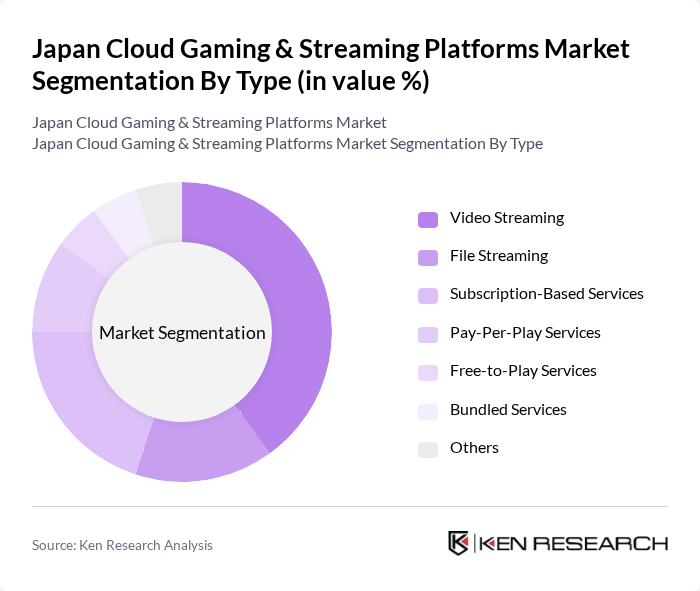
By Type:The market is segmented into Video Streaming, File Streaming, Subscription-Based Services, Pay-Per-Play Services, Free-to-Play Services, Bundled Services, and Others. Video Streaming is the leading sub-segment, driven by the increasing demand for high-quality, low-latency gaming experiences and the convenience of accessing games without downloads or installations. The rise of platforms offering extensive libraries of games for streaming, along with seamless device switching and instant access, has significantly contributed to this trend .
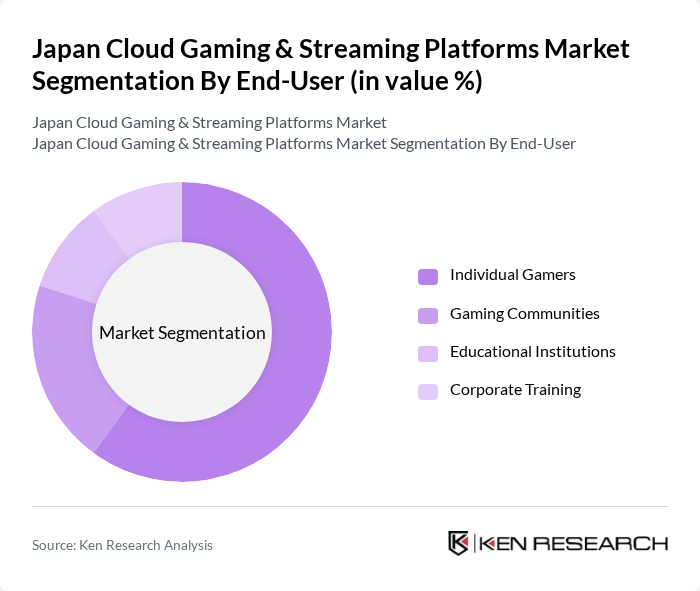
By End-User:The end-user segmentation includes Individual Gamers, Gaming Communities, Educational Institutions, and Corporate Training. Individual Gamers represent the largest segment, as the majority of cloud gaming users are casual and hardcore gamers seeking diverse, flexible, and social gaming experiences. The increasing popularity of online multiplayer games, esports, and social gaming platforms has further solidified this segment's dominance, as gamers prefer platforms that allow for easy access, device flexibility, and interaction with others .
Japan Cloud Gaming & Streaming Platforms Market Competitive Landscape
The Japan Cloud Gaming & Streaming Platforms Market is characterized by a dynamic mix of regional and international players. Leading participants such as Sony Interactive Entertainment Inc., Nintendo Co., Ltd., Microsoft Japan Co., Ltd., GREE, Inc., DeNA Co., Ltd., Capcom Co., Ltd., Bandai Namco Entertainment Inc., Square Enix Holdings Co., Ltd., SEGA Corporation, Ubitus K.K., Rakuten Group, Inc., Amazon Web Services Japan G.K., NVIDIA GK, Tencent Games Japan, and Google Japan G.K. contribute to innovation, geographic expansion, and service delivery in this space.
Japan Cloud Gaming & Streaming Platforms Market Industry Analysis
Growth Drivers
- Increasing Internet Penetration:Japan's internet penetration rate is approximately93%, with over120 millionusers accessing online content. This widespread connectivity facilitates cloud gaming and streaming services, allowing users to engage with high-quality content seamlessly. The government’s initiatives to enhance digital infrastructure, including investments of approximatelyUSD 1.5 billionin broadband expansion, further support this growth. As more households gain access to reliable internet, the demand for cloud gaming platforms is expected to rise significantly.
- Rise in Mobile Gaming Popularity:The mobile gaming sector in Japan generated approximatelyUSD 13 billionin revenue, reflecting a significant increase from the previous year. With over80%of gamers using mobile devices, the convenience and accessibility of mobile gaming drive the adoption of cloud gaming platforms. The proliferation of smartphones, with over90 millionunits in active use, supports this trend, as users seek high-quality gaming experiences on-the-go, further propelling the cloud gaming market.
- Advancements in Cloud Technology:The cloud technology landscape in Japan is evolving rapidly, with investments in cloud infrastructure exceedingUSD 3 billion. Major tech companies are enhancing their cloud services, leading to improved latency and streaming quality. The introduction of edge computing solutions is expected to reduce latency by up to30%, making cloud gaming more viable. These technological advancements are crucial for attracting gamers who demand high-performance experiences, thereby driving market growth.
Market Challenges
- High Latency Issues:Despite advancements, latency remains a significant challenge for cloud gaming in Japan. Average latency levels are reported at around50-100 milliseconds, which can hinder the gaming experience, particularly for fast-paced games. This issue is exacerbated in rural areas where internet speeds are lower. As gamers increasingly demand seamless experiences, addressing latency will be critical for service providers to retain and grow their user base.
- Limited Game Library Availability:The current game library for cloud gaming platforms in Japan is limited, with only about200 titlesavailable. This restricts consumer choice and can deter potential users from subscribing to these services. Major competitors in traditional gaming still offer extensive libraries, making it challenging for cloud platforms to attract a broader audience. Expanding the game library is essential for enhancing user engagement and satisfaction.
Japan Cloud Gaming & Streaming Platforms Market Future Outlook
The future of the cloud gaming and streaming market in Japan appears promising, driven by technological advancements and increasing consumer demand. As 5G networks expand, expected to coverover 85% of the population in future, latency issues will diminish, enhancing user experiences. Additionally, the rise of esports and competitive gaming is likely to create new revenue streams. Companies that prioritize user experience and invest in diverse game libraries will be well-positioned to capture market share in this evolving landscape.
Market Opportunities
- Expansion of 5G Networks:The rollout of 5G technology is projected to reachover 85% coverage in urban areas in future, significantly improving streaming quality and reducing latency. This advancement will enable cloud gaming platforms to offer more immersive experiences, attracting a larger user base. Enhanced connectivity will also facilitate real-time multiplayer gaming, further driving engagement and subscription growth.
- Partnerships with Local Developers:Collaborating with local game developers can enhance the content library of cloud gaming platforms. By leveraging Japan's rich gaming culture and expertise, platforms can offer exclusive titles that resonate with local audiences. Such partnerships can lead to increased user acquisition and retention, as gamers are more likely to engage with content that reflects their preferences and cultural context.
Scope of the Report
| Segment | Sub-Segments |
|---|---|
| By Type | Video Streaming File Streaming Subscription-Based Services Pay-Per-Play Services Free-to-Play Services Bundled Services Others |
| By End-User | Individual Gamers Gaming Communities Educational Institutions Corporate Training |
| By Device Type | Mobile Devices Consoles PCs Smart TVs |
| By Content Type | Action Games Adventure Games Sports Games Simulation Games Others |
| By Subscription Model | Monthly Subscription Annual Subscription One-Time Purchase |
| By Distribution Channel | Online Platforms Retail Stores Direct Sales |
| By User Demographics | Age Groups Gender Geographic Distribution |
Key Target Audience
Investors and Venture Capitalist Firms
Government and Regulatory Bodies (e.g., Ministry of Internal Affairs and Communications, Japan Fair Trade Commission)
Game Developers and Publishers
Telecommunications Companies
Content Delivery Network (CDN) Providers
Digital Rights Management (DRM) Solution Providers
Advertising Agencies
Market Analysts and Industry Experts
Players Mentioned in the Report:
Sony Interactive Entertainment Inc.
Nintendo Co., Ltd.
Microsoft Japan Co., Ltd.
GREE, Inc.
DeNA Co., Ltd.
Capcom Co., Ltd.
Bandai Namco Entertainment Inc.
Square Enix Holdings Co., Ltd.
SEGA Corporation
Ubitus K.K.
Rakuten Group, Inc.
Amazon Web Services Japan G.K.
NVIDIA GK
Tencent Games Japan
Google Japan G.K.
Table of Contents
Market Assessment Phase
1. Executive Summary and Approach
2. Japan Cloud Gaming & Streaming Platforms Market Overview
2.1 Key Insights and Strategic Recommendations
2.2 Japan Cloud Gaming & Streaming Platforms Market Overview
2.3 Definition and Scope
2.4 Evolution of Market Ecosystem
2.5 Timeline of Key Regulatory Milestones
2.6 Value Chain & Stakeholder Mapping
2.7 Business Cycle Analysis
2.8 Policy & Incentive Landscape
3. Japan Cloud Gaming & Streaming Platforms Market Analysis
3.1 Growth Drivers
3.1.1 Increasing Internet Penetration
3.1.2 Rise in Mobile Gaming Popularity
3.1.3 Advancements in Cloud Technology
3.1.4 Growing Demand for On-Demand Content
3.2 Market Challenges
3.2.1 High Latency Issues
3.2.2 Limited Game Library Availability
3.2.3 Competition from Traditional Gaming
3.2.4 Regulatory Compliance Hurdles
3.3 Market Opportunities
3.3.1 Expansion of 5G Networks
3.3.2 Partnerships with Local Developers
3.3.3 Growth of Esports and Competitive Gaming
3.3.4 Increasing Adoption of Subscription Models
3.4 Market Trends
3.4.1 Integration of AR/VR Technologies
3.4.2 Rise of Cross-Platform Gaming
3.4.3 Focus on User Experience and Personalization
3.4.4 Emergence of Cloud-Based Game Development
3.5 Government Regulation
3.5.1 Data Privacy Regulations
3.5.2 Content Rating Systems
3.5.3 Tax Incentives for Digital Content
3.5.4 Compliance with International Standards
4. SWOT Analysis
5. Stakeholder Analysis
6. Porter's Five Forces Analysis
7. Japan Cloud Gaming & Streaming Platforms Market Market Size, 2019-2024
7.1 By Value
7.2 By Volume
7.3 By Average Selling Price
8. Japan Cloud Gaming & Streaming Platforms Market Segmentation
8.1 By Type
8.1.1 Video Streaming
8.1.2 File Streaming
8.1.3 Subscription-Based Services
8.1.4 Pay-Per-Play Services
8.1.5 Free-to-Play Services
8.1.6 Bundled Services
8.1.7 Others
8.2 By End-User
8.2.1 Individual Gamers
8.2.2 Gaming Communities
8.2.3 Educational Institutions
8.2.4 Corporate Training
8.3 By Device Type
8.3.1 Mobile Devices
8.3.2 Consoles
8.3.3 PCs
8.3.4 Smart TVs
8.4 By Content Type
8.4.1 Action Games
8.4.2 Adventure Games
8.4.3 Sports Games
8.4.4 Simulation Games
8.4.5 Others
8.5 By Subscription Model
8.5.1 Monthly Subscription
8.5.2 Annual Subscription
8.5.3 One-Time Purchase
8.6 By Distribution Channel
8.6.1 Online Platforms
8.6.2 Retail Stores
8.6.3 Direct Sales
8.7 By User Demographics
8.7.1 Age Groups
8.7.2 Gender
8.7.3 Geographic Distribution
9. Japan Cloud Gaming & Streaming Platforms Market Competitive Analysis
9.1 Market Share of Key Players
9.2 Cross Comparison of Key Players
9.2.1 Company Name
9.2.2 Group Size (Large, Medium, or Small as per industry convention)
9.2.3 Monthly Active Users (MAU)
9.2.4 Average Revenue Per User (ARPU)
9.2.5 Customer Acquisition Cost (CAC)
9.2.6 Churn Rate
9.2.7 Pricing Strategy (e.g., Subscription, Freemium, Pay-Per-Play)
9.2.8 Customer Lifetime Value (CLV)
9.2.9 Engagement Rate (e.g., Average Session Length, DAU/MAU Ratio)
9.2.10 Market Penetration Rate (Japan-specific)
9.2.11 Content Library Size (Number of Titles)
9.2.12 Streaming Latency (ms)
9.2.13 Device Compatibility (Number of Supported Platforms)
9.3 SWOT Analysis of Top Players
9.4 Pricing Analysis
9.5 Detailed Profile of Major Companies
9.5.1 Sony Interactive Entertainment Inc.
9.5.2 Nintendo Co., Ltd.
9.5.3 Microsoft Japan Co., Ltd.
9.5.4 GREE, Inc.
9.5.5 DeNA Co., Ltd.
9.5.6 Capcom Co., Ltd.
9.5.7 Bandai Namco Entertainment Inc.
9.5.8 Square Enix Holdings Co., Ltd.
9.5.9 SEGA Corporation
9.5.10 Ubitus K.K.
9.5.11 Rakuten Group, Inc.
9.5.12 Amazon Web Services Japan G.K.
9.5.13 NVIDIA GK
9.5.14 Tencent Games Japan
9.5.15 Google Japan G.K.
10. Japan Cloud Gaming & Streaming Platforms Market End-User Analysis
10.1 Procurement Behavior of Key Ministries
10.1.1 Ministry of Internal Affairs and Communications
10.1.2 Ministry of Education, Culture, Sports, Science and Technology
10.1.3 Ministry of Economy, Trade and Industry
10.2 Corporate Spend on Infrastructure & Energy
10.2.1 Investment in Cloud Infrastructure
10.2.2 Expenditure on Gaming Hardware
10.2.3 Budget Allocation for Software Development
10.3 Pain Point Analysis by End-User Category
10.3.1 Individual Gamers
10.3.2 Educational Institutions
10.3.3 Corporate Users
10.4 User Readiness for Adoption
10.4.1 Awareness of Cloud Gaming Benefits
10.4.2 Accessibility of High-Speed Internet
10.4.3 Familiarity with Gaming Platforms
10.5 Post-Deployment ROI and Use Case Expansion
10.5.1 Increased User Engagement
10.5.2 Expansion into New Markets
10.5.3 Enhanced Customer Satisfaction
11. Japan Cloud Gaming & Streaming Platforms Market Future Size, 2025-2030
11.1 By Value
11.2 By Volume
11.3 By Average Selling Price
Go-To-Market Strategy Phase
1. Whitespace Analysis + Business Model Canvas
1.1 Market Gaps Identification
1.2 Value Proposition Development
1.3 Revenue Streams Analysis
1.4 Customer Segmentation
1.5 Key Partnerships
1.6 Cost Structure
1.7 Channels of Distribution
2. Marketing and Positioning Recommendations
2.1 Branding Strategies
2.2 Product USPs
3. Distribution Plan
3.1 Urban Retail vs Rural NGO Tie-ups
4. Channel & Pricing Gaps
4.1 Underserved Routes
4.2 Pricing Bands
5. Unmet Demand & Latent Needs
5.1 Category Gaps
5.2 Consumer Segments
6. Customer Relationship
6.1 Loyalty Programs
6.2 After-Sales Service
7. Value Proposition
7.1 Sustainability
7.2 Integrated Supply Chains
8. Key Activities
8.1 Regulatory Compliance
8.2 Branding
8.3 Distribution Setup
9. Entry Strategy Evaluation
9.1 Domestic Market Entry Strategy
9.1.1 Product Mix
9.1.2 Pricing Band
9.1.3 Packaging
9.2 Export Entry Strategy
9.2.1 Target Countries
9.2.2 Compliance Roadmap
10. Entry Mode Assessment
10.1 JV
10.2 Greenfield
10.3 M&A
10.4 Distributor Model
11. Capital and Timeline Estimation
11.1 Capital Requirements
11.2 Timelines
12. Control vs Risk Trade-Off
12.1 Ownership vs Partnerships
13. Profitability Outlook
13.1 Breakeven Analysis
13.2 Long-Term Sustainability
14. Potential Partner List
14.1 Distributors
14.2 JVs
14.3 Acquisition Targets
15. Execution Roadmap
15.1 Phased Plan for Market Entry
15.1.1 Market Setup
15.1.2 Market Entry
15.1.3 Growth Acceleration
15.1.4 Scale & Stabilize
15.2 Key Activities and Milestones
15.2.1 Milestone Planning
15.2.2 Activity Scheduling
Research Methodology
Phase 1: Approach1
Desk Research
- Analysis of market reports from industry associations and government publications on cloud gaming trends in Japan
- Review of financial reports and press releases from leading cloud gaming and streaming companies operating in Japan
- Examination of academic journals and white papers focusing on consumer behavior and technology adoption in gaming
Primary Research
- Interviews with executives from major cloud gaming platforms to understand strategic initiatives and market positioning
- Surveys targeting gamers to gather insights on preferences, usage patterns, and spending behavior
- Focus groups with industry experts and gamers to discuss emerging trends and future outlooks for cloud gaming
Validation & Triangulation
- Cross-validation of findings through comparison with historical data and market growth rates
- Triangulation of insights from primary interviews with secondary data sources to ensure consistency
- Sanity checks conducted through expert panel reviews to validate assumptions and projections
Phase 2: Market Size Estimation1
Top-down Assessment
- Estimation of total addressable market (TAM) based on overall gaming revenue in Japan and the share attributed to cloud gaming
- Segmentation of the market by user demographics, including age, gender, and gaming preferences
- Incorporation of growth rates from related sectors such as internet infrastructure and mobile gaming
Bottom-up Modeling
- Collection of user data from cloud gaming platforms to establish average revenue per user (ARPU)
- Analysis of subscription models and pricing strategies employed by leading platforms
- Estimation of user growth rates based on historical trends and market penetration rates
Forecasting & Scenario Analysis
- Development of predictive models using historical data and market trends to forecast future growth
- Scenario analysis based on potential regulatory changes and technological advancements impacting the market
- Creation of multiple growth scenarios (baseline, optimistic, and pessimistic) to assess market resilience
Phase 3: CATI Sample Composition1
| Scope Item/Segment | Sample Size | Target Respondent Profiles |
|---|---|---|
| Casual Gamers | 120 | Individuals aged 18-35, frequent mobile game users |
| Hardcore Gamers | 90 | Individuals aged 18-45, console and PC gamers |
| Streaming Service Subscribers | 60 | Users subscribed to cloud gaming platforms for over 6 months |
| Industry Experts | 40 | Game developers, analysts, and technology consultants |
| Parents of Young Gamers | 50 | Parents of children aged 6-17 who engage in gaming |
Frequently Asked Questions
What is the current value of the Japan Cloud Gaming & Streaming Platforms Market?
The Japan Cloud Gaming & Streaming Platforms Market is valued at approximately USD 160 million, driven by factors such as high-speed internet connectivity, advanced 5G networks, and increasing smartphone penetration, which enhance user engagement and access to cloud gaming services.
Which cities are the main hubs for cloud gaming in Japan?
What are the key growth drivers for cloud gaming in Japan?
What challenges does the Japan Cloud Gaming Market face?
Other Regional/Country Reports
Indonesia Cloud Gaming & Streaming Platforms Market
Malaysia Cloud Gaming & Streaming Platforms Market
KSA Cloud Gaming & Streaming Platforms Market
APAC Cloud Gaming & Streaming Platforms Market
SEA Cloud Gaming & Streaming Platforms Market
Vietnam Cloud Gaming & Streaming Platforms Market
Other Adjacent Reports
Egypt Mobile Gaming Market
UAE Esports MarketUAE Video Streaming Services Market
Saudi Arabia 5G Technology Market Outlook to 2030Vietnam Cloud Computing Market Outlook to 2030: Size, Share, Growth and TrendsJapan Gaming Hardware Market
UAE Digital Content Distribution Market
Malaysia Online Entertainment Market
South Korea Virtual Reality Gaming Market
Belgium Subscription Services Market
Why Buy From Us?

What makes us stand out is that our consultants follow Robust, Refine and Result (RRR) methodology. Robust for clear definitions, approaches and sanity checking, Refine for differentiating respondents' facts and opinions, and Result for presenting data with story.

We have set a benchmark in the industry by offering our clients with syndicated and customized market research reports featuring coverage of entire market as well as meticulous research and analyst insights.

While we don't replace traditional research, we flip the method upside down. Our dual approach of Top Bottom & Bottom Top ensures quality deliverable by not just verifying company fundamentals but also looking at the sector and macroeconomic factors.

With one step in the future, our research team constantly tries to show you the bigger picture. We help with some of the tough questions you may encounter along the way: How is the industry positioned? Best marketing channel? KPI's of competitors? By aligning every element, we help maximize success.

Our report gives you instant access to the answers and sources that other companies might choose to hide. We elaborate each steps of research methodology we have used and showcase you the sample size to earn your trust.

If you need any support, we are here! We pride ourselves on universe strength, data quality, and quick, friendly, and professional service.