
Saudi Arabia 5G Technology Market Outlook to 2030
Region:Saudi Arabia
Author(s):Sanjeev
Product Code:KROD1006
Region:Saudi Arabia
Author(s):Sanjeev
Product Code:KROD1006
November 2024
92
The Saudi Arabia 5G technology market is valued at USD 2.1 billion, primarily driven by the nations Vision 2030 initiative, which aims to diversify the economy and enhance technological infrastructure. The adoption of 5G is crucial for supporting advancements in smart cities, IoT, and autonomous technologies. With increasing demand from both consumer and enterprise sectors, the rapid deployment of 5G networks by major telecom players like STC and Mobily is fueling market growth. This expansion is further bolstered by rising investments in network infrastructure and the governments push for digital transformation.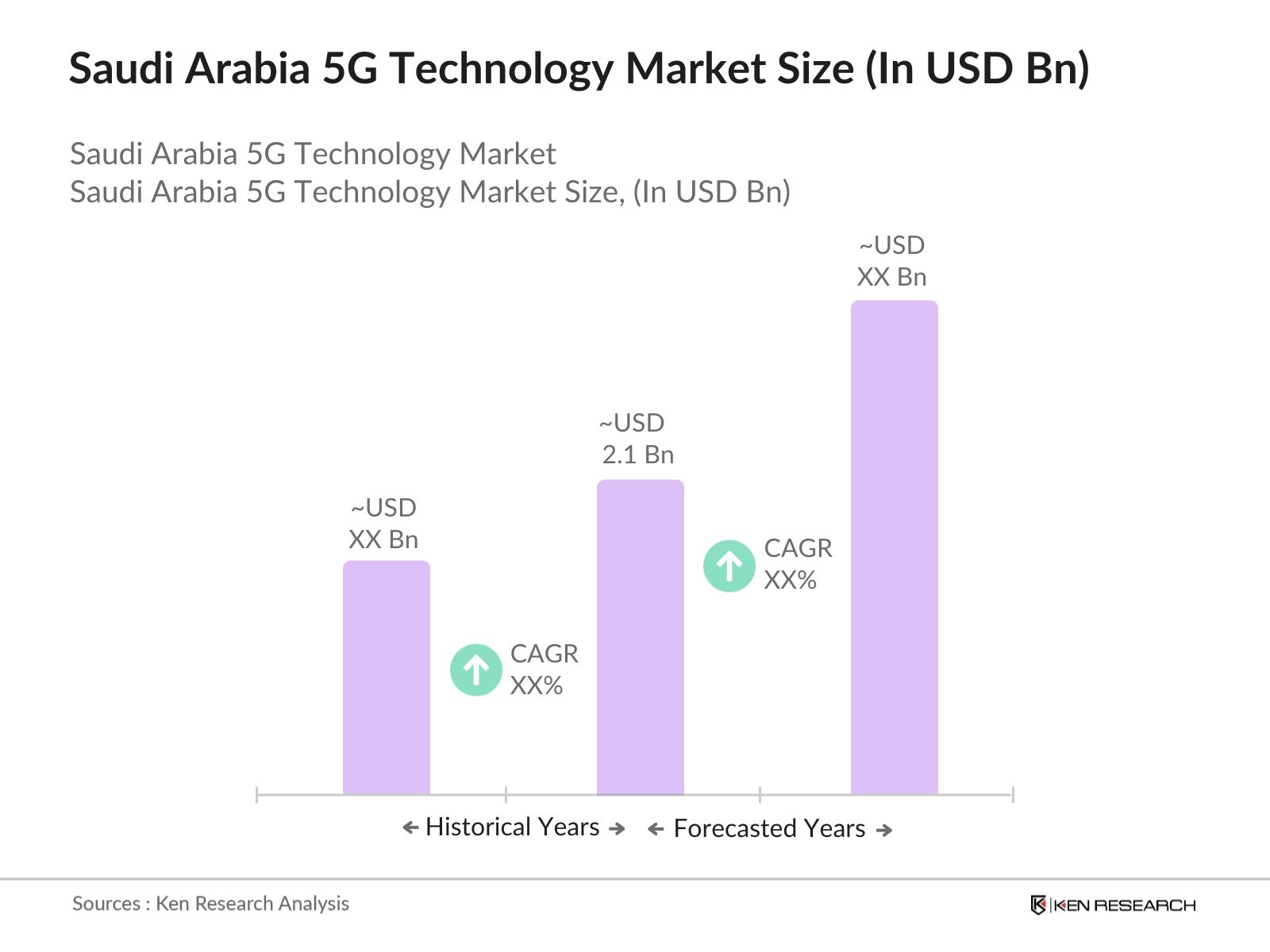 Saudi Arabia's major cities, such as Riyadh, Jeddah, and Dammam, dominate the 5G market due to their advanced infrastructure and population density, making them prime locations for early 5G adoption. Riyadh, as the capital, attracts significant investments from both government and private entities, while Jeddah and Dammam are key commercial hubs. These cities have seen high demand for enhanced mobile broadband services and smart city projects, which are among the primary drivers of the 5G technology market.The Saudi CITC plays a critical role in overseeing the deployment and regulation of 5G technology in the kingdom. In 2023, CITC implemented new guidelines to ensure fair competition and set security standards for telecom operators. These guidelines mandate that telecom operators must offer 5G services across all major urban areas by 2024. The CITC is also responsible for regulating 5G spectrum allocation and enforcing strict cybersecurity protocols to protect the integrity of national networks.
The Saudi Arabia 5G market is dominated by a few key players that have made significant contributions to the deployment and advancement of 5G technology. These companies have established themselves through a combination of strategic investments, collaborations with global technology firms, and participation in public-private initiatives under the governments Vision 2030 plan. Companies such as STC, Mobily, and Zain are leading the market by investing in state-of-the-art 5G infrastructure and offering cutting-edge services to both consumers and enterprises.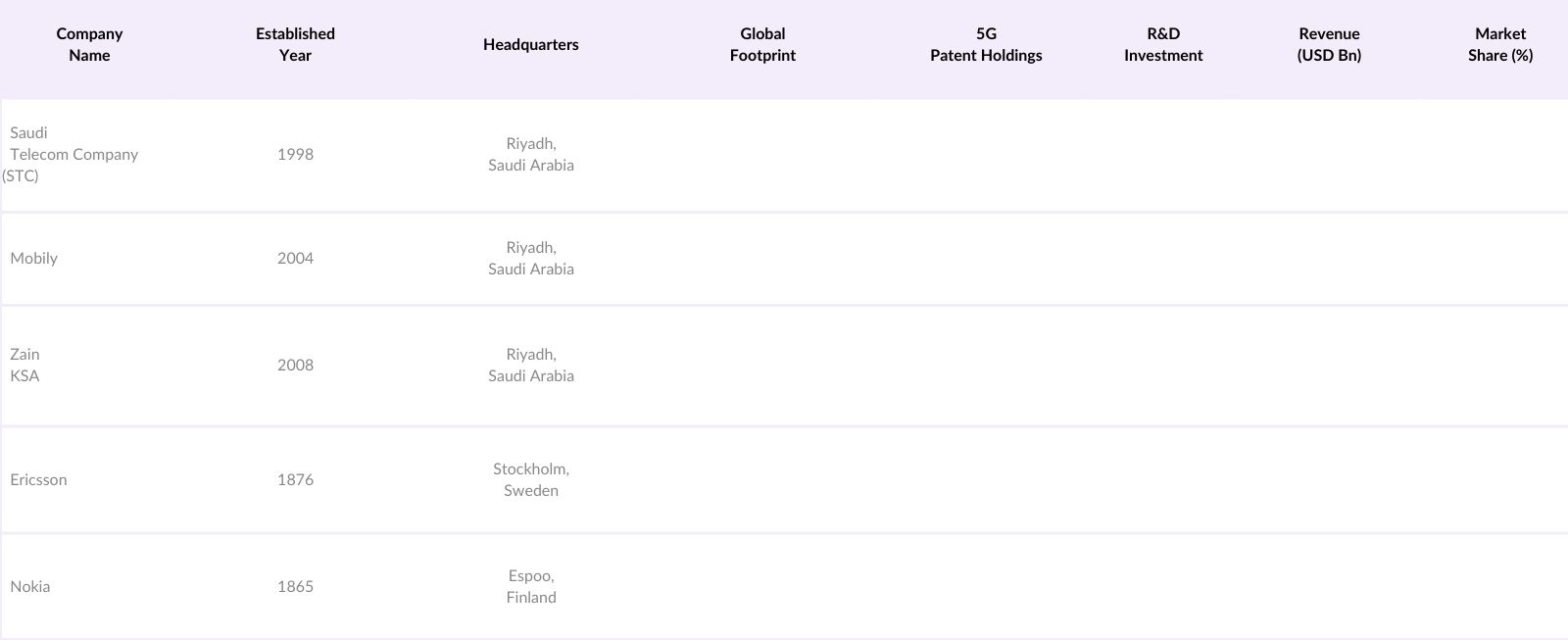
Over the next five years, the Saudi Arabia 5G technology market is poised for significant growth, driven by government-backed initiatives like Vision 2030, which aim to transform the nation into a digitally-enabled economy. The expansion of smart cities, along with increasing demand for IoT and autonomous systems across industries, will further fuel this growth. As Saudi Arabia continues to invest in 5G infrastructure, including the deployment of standalone networks, industries like manufacturing, healthcare, and transportation will experience the most significant impact from 5Gs transformative capabilities.
|
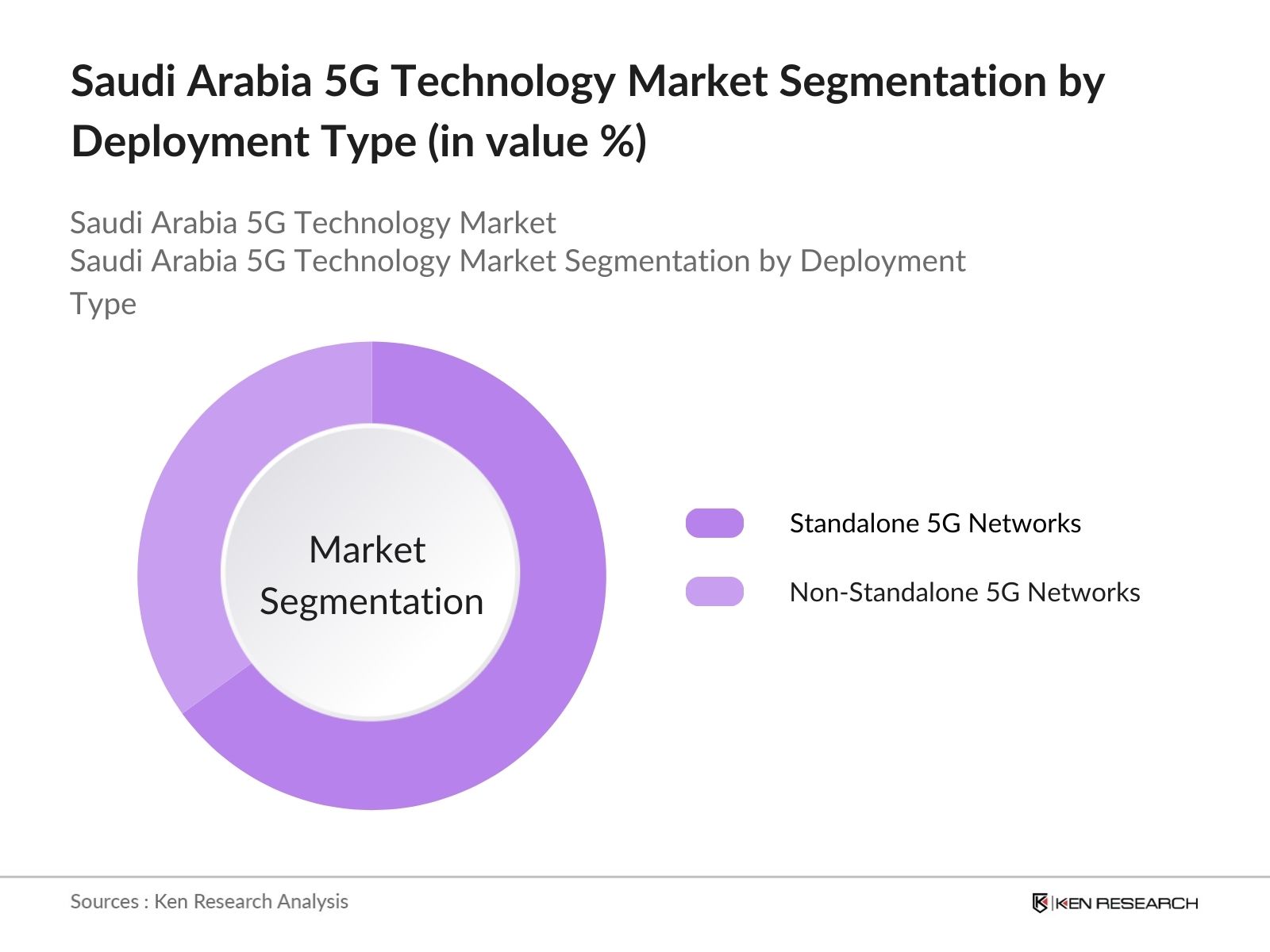
Standalone 5G Networks Non-Standalone 5G Networks |
|
|
By Spectrum Band |
Sub-6 GHz mmWave |
|
By Application |
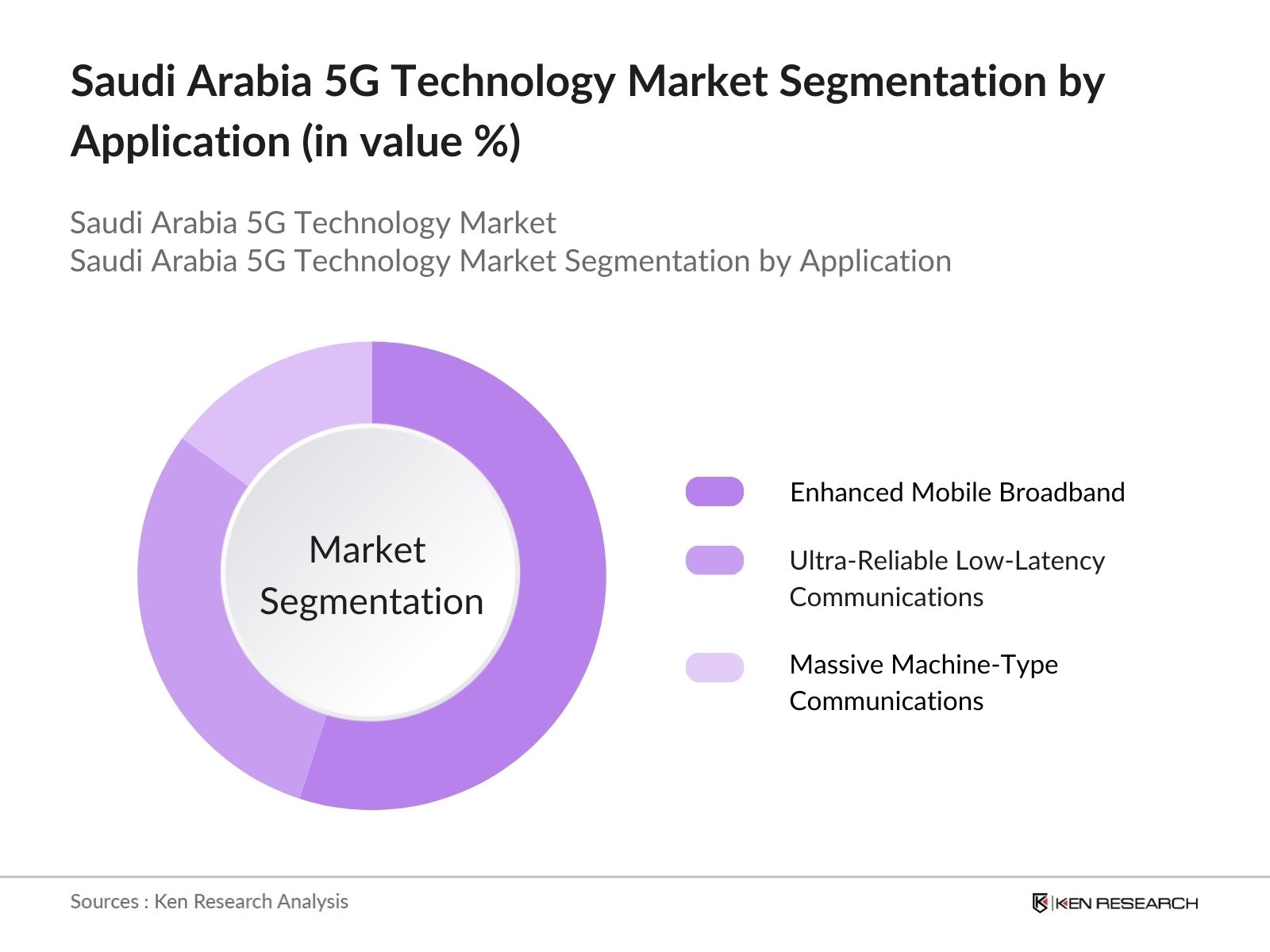
Enhanced Mobile Broadband (eMBB) Ultra-Reliable Low-Latency Communications (URLLC) Massive Machine-Type Communications (mMTC) |
|
By End-User Industry |
Telecom Manufacturing Healthcare Media and Entertainment Automotive |
|
By Region |
North East West South |
1.1 Definition and Scope
1.2 Market Taxonomy
1.3 Market Growth Rate
1.4 Market Segmentation Overview
2.1 Historical Market Size
2.2 Year-On-Year Growth Analysis
2.3 Key Market Developments and Milestones
3.1 Growth Drivers
3.1.1 Government Vision 2030 [Market Policy Driver]
3.1.2 Increasing Demand for Mobile Data [Consumer Adoption]
3.1.3 Expansion of Smart Cities [Infrastructure Development]
3.1.4 Corporate Investments in Telecom Sector [Capital Inflow]
3.2 Market Challenges
3.2.1 High Infrastructure Costs [Capital Expenditure]
3.2.2 Regulatory Delays in Spectrum Allocation [Regulatory Framework]
3.2.3 Limited Availability of 5G-Compatible Devices [Consumer Electronics]
3.2.4 Security Concerns in 5G Network [Data Privacy and Security]
3.3 Opportunities
3.3.1 Growth of IoT and AI Applications [Technology Integration]
3.3.2 Industrial 5G Adoption for Automation [Industrial Applications]
3.3.3 Partnerships between Telecom Operators and Enterprises [B2B Collaboration]
3.3.4 Regional Collaborations for 5G Trials [Geopolitical Alignment]
3.4 Trends
3.4.1 5G Use in Healthcare and Telemedicine [Sector Innovation]
3.4.2 Network Slicing and Edge Computing [Advanced Network Capabilities]
3.4.3 Rollout of Private 5G Networks for Enterprises [Enterprise Solutions]
3.4.4 Development of 5G Applications for Autonomous Vehicles [Transportation]
3.5 Government Regulations
3.5.1 Saudi Communications and Information Technology Commission (CITC) Guidelines [Regulatory Oversight]
3.5.2 National Spectrum Management Plan [Spectrum Allocation]
3.5.3 Policies for 5G Security and Data Privacy [Cybersecurity Framework]
3.5.4 Public-Private Partnerships for 5G Deployment [Government Incentives]
3.6 SWOT Analysis
3.7 Stake Ecosystem
3.8 Porters Five Forces Analysis
3.9 Competition Ecosystem
4.1 By Deployment Type (In Value %)
4.1.1 Standalone 5G Networks
4.1.2 Non-Standalone 5G Networks
4.2 By Spectrum Band (In Value %)
4.2.1 Sub-6 GHz
4.2.2 mmWave
4.3 By Application (In Value %)
4.3.1 Enhanced Mobile Broadband (eMBB)
4.3.2 Ultra-Reliable Low-Latency Communications (URLLC)
4.3.3 Massive Machine-Type Communications (mMTC)
4.4 By End-User Industry (In Value %)
4.4.1 Telecom
4.4.2 Manufacturing
4.4.3 Healthcare
4.4.4 Media and Entertainment
4.4.5 Automotive
4.5 By Region (In Value %)
4.5.1 Central Region (Riyadh)
4.5.2 West
4.5.3 East
4.5.4 North
4.5.5 South
5.1 Detailed Profiles of Major Companies
5.1.1 Saudi Telecom Company (STC)
5.1.2 Mobily
5.1.3 Zain KSA
5.1.4 Nokia Corporation
5.1.5 Ericsson
5.1.6 Huawei Technologies Co. Ltd.
5.1.7 Qualcomm Technologies Inc.
5.1.8 Samsung Electronics Co. Ltd.
5.1.9 NEC Corporation
5.1.10 Cisco Systems Inc.
5.1.11 Intel Corporation
5.1.12 Fujitsu Limited
5.1.13 Oracle Corporation
5.1.14 Microsoft Corporation
5.1.15 Hewlett Packard Enterprise
5.2 Cross Comparison Parameters (Number of Employees, Headquarters, Revenue, Global Footprint, R&D Investment, 5G Patent Holdings, Product Innovation, Service Offerings)
5.3 Market Share Analysis
5.4 Strategic Initiatives
5.5 Mergers and Acquisitions
5.6 Investment Analysis
5.7 Government Grants and Incentives
5.8 Private Equity and Venture Capital Funding
6.1 Compliance Requirements
6.2 Licensing and Spectrum Allocation Process
6.3 Data Protection and Privacy Regulations
6.4 Certification Processes for Telecom Equipment
7.1 Future Market Size Projections
7.2 Key Factors Driving Future Market Growth
8.1 By Deployment Type (In Value %)
8.2 By Spectrum Band (In Value %)
8.3 By Application (In Value %)
8.4 By End-User Industry (In Value %)
8.5 By Region (In Value %)
9.1 TAM/SAM/SOM Analysis
9.2 Customer Cohort Analysis
9.3 Marketing and Sales Initiatives
9.4 White Space Opportunity Analysis
The research process begins with mapping the entire Saudi Arabia 5G ecosystem, identifying all critical stakeholders, including telecom operators, government bodies, and technology providers. Extensive desk research utilizing secondary sources, including proprietary databases, was conducted to capture industry-level information and key variables such as network deployments, adoption rates, and regulatory frameworks.
This phase involved analyzing historical data related to Saudi Arabias 5G market, including the rollout of network infrastructure and consumer adoption of 5G services. Specific attention was given to network capacity, urbanization trends, and enterprise adoption across key sectors, ensuring accurate and reliable revenue forecasts and market penetration ratios.
Market hypotheses were developed based on secondary research and validated through consultations with industry experts, telecom operators, and regulatory bodies. These experts provided critical insights into current 5G deployment strategies, network challenges, and the impact of government policies on market growth.
The final stage involved synthesizing the research findings into a comprehensive market report. Detailed interactions with telecom operators and technology providers provided validation for the bottom-up analysis, ensuring that the market size, segmentation, and growth forecasts were accurate and well-supported by both quantitative and qualitative insights.
The Saudi Arabia 5G technology market is valued at USD 2.1 billion, driven by the rapid adoption of 5G-enabled devices, investments in smart city initiatives, and a growing enterprise demand for advanced communication infrastructure.
The key challenges in Saudi Arabia 5G technology market include high infrastructure costs, delays in spectrum allocation, and security concerns related to 5G networks. Additionally, there is a need for greater investment in 5G-compatible devices to drive widespread consumer adoption.
The major players in Saudi Arabia 5G technology market include Saudi Telecom Company (STC), Mobily, Zain KSA, Nokia Corporation, and Ericsson. These companies dominate the market due to their extensive network infrastructure, technological expertise, and strategic partnerships.
Growth drivers in Saudi Arabia 5G technology market include the governments Vision 2030 initiative, increasing investments in 5G infrastructure, and rising demand for IoT and smart city solutions. The growing enterprise demand for URLLC and eMBB services also contributes to market expansion.
Riyadh, Jeddah, and Dammam are leading the 5G market in Saudi Arabia due to their advanced infrastructure, dense populations, and strategic importance as commercial and governmental hubs. These cities are also early adopters of smart city and IoT technologies.

What makes us stand out is that our consultants follows Robust, Refine and Result (RRR) methodology. i.e. Robust for clear definitions, approaches and sanity checking, Refine for differentiating respondents facts and opinions and Result for presenting data with story

We have set a benchmark in the industry by offering our clients with syndicated and customized market research reports featuring coverage of entire market as well as meticulous research and analyst insights.

While we don't replace traditional research, we flip the method upside down. Our dual approach of Top Bottom & Bottom Top ensures quality deliverable by not just verifying company fundamentals but also looking at the sector and macroeconomic factors.

With one step in the future, our research team constantly tries to show you the bigger picture. We help with some of the tough questions you may encounter along the way: How is the industry positioned? Best marketing channel? KPI's of competitors? By aligning every element, we help maximize success.

Our report gives you instant access to the answers and sources that other companies might choose to hide. We elaborate each steps of research methodology we have used and showcase you the sample size to earn your trust.

If you need any support, we are here! We pride ourselves on universe strength, data quality, and quick, friendly, and professional service.