About the Report
Base Year 2024Japan Hyperhidrosis Treatment Market Overview
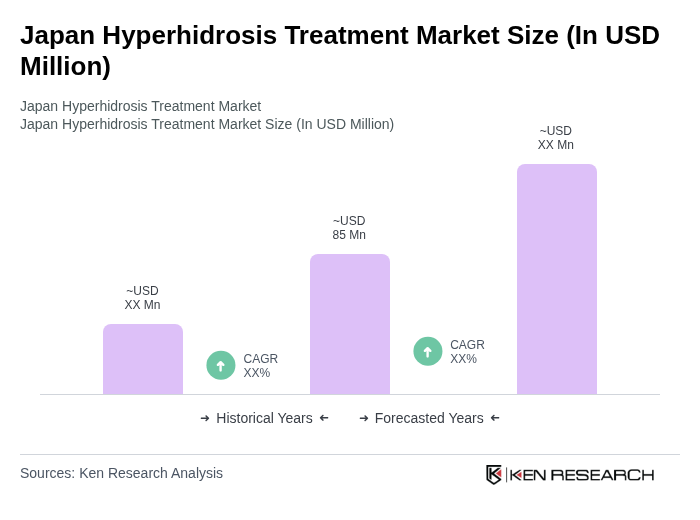
- The Japan Hyperhidrosis Treatment Market is valued at USD 85 million, based on a five-year historical analysis. This growth is primarily driven by increasing awareness of hyperhidrosis, advancements in treatment options including minimally invasive procedures like botulinum toxin injections, and a growing demand for effective solutions among the population. The rising prevalence of excessive sweating conditions has led to a surge in the adoption of various treatment modalities, including drug therapies and surgical interventions.
- Tokyo, Osaka, and Yokohama are the dominant cities in the Japan Hyperhidrosis Treatment Market. These cities are characterized by high population density, advanced healthcare infrastructure, and a concentration of dermatology clinics and hospitals. The presence of leading healthcare providers and a growing number of patients seeking treatment contribute to the market's robust growth in these urban areas.
- The Pharmaceuticals and Medical Devices Agency (PMDA) Act, 2013 issued by the Ministry of Health, Labour and Welfare governs the approval process for new hyperhidrosis treatments through its regulatory framework for new drug applications. This requires manufacturers to submit comprehensive clinical data demonstrating safety and efficacy, with review timelines typically spanning 12 months for standard approvals and expedited pathways for priority reviews involving innovative therapies. The framework ensures quality standards, post-marketing surveillance, and compliance for pharmaceutical products targeting conditions like hyperhidrosis.
Japan Hyperhidrosis Treatment Market Segmentation
By Treatment Type:
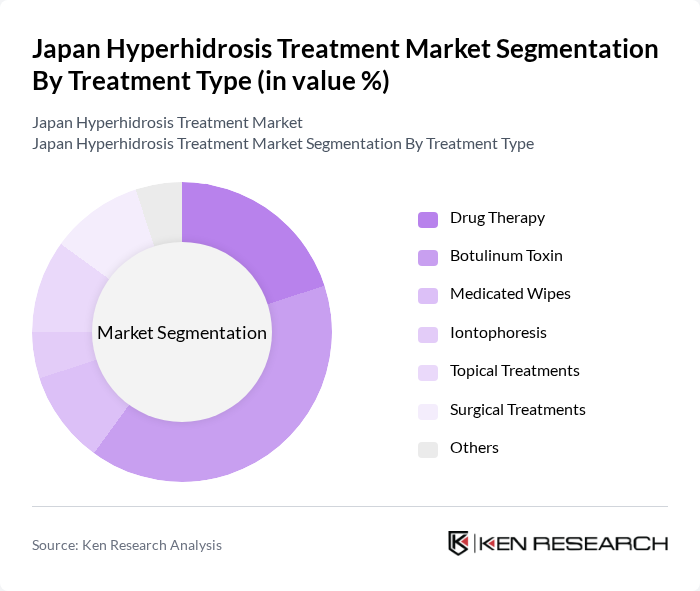
The treatment type segmentation includes Drug Therapy, Botulinum Toxin, Medicated Wipes, Iontophoresis, Topical Treatments, Surgical Treatments, and Others. Among these, Botulinum Toxin is the leading sub-segment due to its effectiveness and quick results in treating localized hyperhidrosis. The increasing preference for minimally invasive procedures and the high success rate of botulinum toxin injections have made it a popular choice among patients. Additionally, the growing awareness of treatment options and the availability of skilled practitioners contribute to its dominance in the market.
By Disease Type:
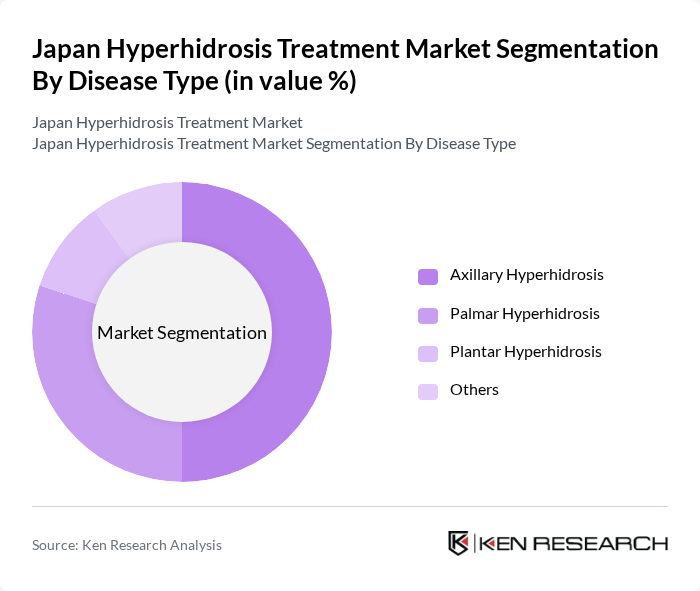
This segmentation includes Axillary Hyperhidrosis, Palmar Hyperhidrosis, Plantar Hyperhidrosis, and Others. Axillary Hyperhidrosis is the most prevalent type, accounting for a significant portion of the market. The high visibility of underarm sweating and its impact on social interactions drive patients to seek treatment. Additionally, the availability of effective therapies specifically targeting axillary hyperhidrosis has further solidified its position as the leading sub-segment in the market.
Japan Hyperhidrosis Treatment Market Competitive Landscape
The Japan Hyperhidrosis Treatment Market is characterized by a dynamic mix of regional and international players. Leading participants such as Allergan plc. (AbbVie), Ipsen, Galderma, Merz Pharmaceuticals, Revance Therapeutics, Hugel, Sientra, Elysium Therapeutics, Dermira, Inc. (Journey Medical Corporation), Teva Pharmaceutical Industries, Valeant Pharmaceuticals, Aclaris Therapeutics, Solta Medical, ZELTIQ Aesthetics, CORAD Healthcare contribute to innovation, geographic expansion, and service delivery in this space.
Japan Hyperhidrosis Treatment Market Industry Analysis
Growth Drivers
- Increasing Awareness of Hyperhidrosis:The awareness of hyperhidrosis has significantly increased in Japan, with over 60% of the population now recognizing the condition. This rise in awareness is attributed to educational campaigns and social media, which have reached approximately 30 million individuals. As a result, more patients are seeking treatment, leading to a projected increase in consultations and treatment uptake, which is expected to reach 1.5 million in future.
- Advancements in Treatment Technologies:The Japanese healthcare sector has seen substantial advancements in hyperhidrosis treatment technologies, including the introduction of innovative devices and procedures. For instance, the use of microwave therapy has increased by 40% in the last two years, with over 200 clinics adopting this method. These advancements not only enhance treatment efficacy but also improve patient satisfaction, driving market growth as more patients opt for these modern solutions.
- Rising Demand for Minimally Invasive Procedures:There is a growing preference for minimally invasive procedures among patients in Japan, with a reported 50% increase in demand for such treatments over the past year. This trend is driven by the desire for quicker recovery times and reduced side effects. As a result, clinics are expanding their offerings, with over 150 new facilities providing these services, further propelling the hyperhidrosis treatment market forward.
Market Challenges
- High Treatment Costs:The cost of hyperhidrosis treatments in Japan can be prohibitively high, with average expenses ranging from ¥100,000 to ¥300,000 per session. This financial burden limits access for many patients, particularly those in lower-income brackets. As a result, an estimated 70% of individuals with hyperhidrosis remain untreated, highlighting a significant barrier to market growth and patient care.
- Limited Insurance Coverage:Insurance coverage for hyperhidrosis treatments in Japan is often inadequate, with only 30% of treatments being reimbursed. This lack of support discourages patients from seeking necessary care, as many are unable to afford out-of-pocket expenses. Consequently, this challenge restricts market expansion and leaves a substantial portion of the population without access to effective treatment options.
Japan Hyperhidrosis Treatment Market Future Outlook
The future of the hyperhidrosis treatment market in Japan appears promising, driven by technological advancements and increasing patient awareness. The integration of telemedicine is expected to enhance access to consultations, allowing more patients to receive timely care. Additionally, ongoing research and development efforts are likely to yield innovative treatment modalities, further expanding the market. As patient-centric care becomes a priority, the focus on personalized treatment plans will also shape the future landscape of this industry.
Market Opportunities
- Expansion of Telemedicine for Consultations:The rise of telemedicine presents a significant opportunity for the hyperhidrosis treatment market. With over 20 million telehealth consultations conducted in future, this trend is expected to grow, providing patients with easier access to specialists and reducing barriers to treatment. This shift can lead to increased diagnosis and treatment rates, benefiting both patients and providers.
- Development of New Treatment Modalities:There is a substantial opportunity for the development of new treatment modalities, particularly those that are less invasive and more effective. With an estimated ¥5 billion allocated for R&D in dermatology in future, innovative solutions are likely to emerge, attracting more patients and enhancing overall market growth. This investment will foster advancements that cater to diverse patient needs.
Scope of the Report
| Segment | Sub-Segments |
|---|---|
| By Treatment Type | Drug Therapy Botulinum Toxin Medicated Wipes Iontophoresis Topical Treatments Surgical Treatments Others |
| By Disease Type | Axillary Hyperhidrosis Palmar Hyperhidrosis Plantar Hyperhidrosis Others |
| By Route of Administration | Oral Injectable Topical |
| By Distribution Channel | Hospitals Dermatology Clinics General Physician Clinics Retail Pharmacies Online Pharmacies Others |
| By Geographic Region | Kanto Region Kansai Region Chubu Region Others |
Key Target Audience
Investors and Venture Capitalist Firms
Government and Regulatory Bodies (e.g., Ministry of Health, Labour and Welfare)
Manufacturers and Producers of Hyperhidrosis Treatments
Distributors and Retailers of Medical Devices
Pharmaceutical Companies
Healthcare Providers and Clinics Specializing in Dermatology
Industry Associations (e.g., Japan Dermatological Association)
Health Insurance Companies
Players Mentioned in the Report:
Allergan plc. (AbbVie)
Ipsen
Galderma
Merz Pharmaceuticals
Revance Therapeutics
Hugel
Sientra
Elysium Therapeutics
Dermira, Inc. (Journey Medical Corporation)
Teva Pharmaceutical Industries
Valeant Pharmaceuticals
Aclaris Therapeutics
Solta Medical
ZELTIQ Aesthetics
CORAD Healthcare
Table of Contents
Market Assessment Phase
1. Executive Summary and Approach
2. Japan Hyperhidrosis Treatment Market Overview
2.1 Key Insights and Strategic Recommendations
2.2 Japan Hyperhidrosis Treatment Market Overview
2.3 Definition and Scope
2.4 Evolution of Market Ecosystem
2.5 Timeline of Key Regulatory Milestones
2.6 Value Chain & Stakeholder Mapping
2.7 Business Cycle Analysis
2.8 Policy & Incentive Landscape
3. Japan Hyperhidrosis Treatment Market Analysis
3.1 Growth Drivers
3.1.1 Increasing awareness of hyperhidrosis
3.1.2 Advancements in treatment technologies
3.1.3 Rising demand for minimally invasive procedures
3.1.4 Growing prevalence of hyperhidrosis in urban areas
3.2 Market Challenges
3.2.1 High treatment costs
3.2.2 Limited insurance coverage
3.2.3 Stigma associated with the condition
3.2.4 Lack of awareness among healthcare providers
3.3 Market Opportunities
3.3.1 Expansion of telemedicine for consultations
3.3.2 Development of new treatment modalities
3.3.3 Increasing investment in R&D
3.3.4 Collaborations with dermatology clinics
3.4 Market Trends
3.4.1 Rise in demand for personalized treatment plans
3.4.2 Growth of online platforms for treatment access
3.4.3 Increasing focus on patient-centric care
3.4.4 Adoption of AI in treatment planning
3.5 Government Regulation
3.5.1 Approval processes for new treatments
3.5.2 Guidelines for clinical practice
3.5.3 Regulations on advertising medical treatments
3.5.4 Policies promoting research in dermatology
4. SWOT Analysis
5. Stakeholder Analysis
6. Porter's Five Forces Analysis
7. Japan Hyperhidrosis Treatment Market Market Size, 2019-2024
7.1 By Value
7.2 By Volume
7.3 By Average Selling Price
8. Japan Hyperhidrosis Treatment Market Segmentation
8.1 By Treatment Type
8.1.1 Drug Therapy
8.1.2 Botulinum Toxin
8.1.3 Medicated Wipes
8.1.4 Iontophoresis
8.1.5 Topical Treatments
8.1.6 Surgical Treatments
8.1.7 Others
8.2 By Disease Type
8.2.1 Axillary Hyperhidrosis
8.2.2 Palmar Hyperhidrosis
8.2.3 Plantar Hyperhidrosis
8.2.4 Others
8.3 By Route of Administration
8.3.1 Oral
8.3.2 Injectable
8.3.3 Topical
8.4 By Distribution Channel
8.4.1 Hospitals
8.4.2 Dermatology Clinics
8.4.3 General Physician Clinics
8.4.4 Retail Pharmacies
8.4.5 Online Pharmacies
8.4.6 Others
8.5 By Geographic Region
8.5.1 Kanto Region
8.5.2 Kansai Region
8.5.3 Chubu Region
8.5.4 Others
9. Japan Hyperhidrosis Treatment Market Competitive Analysis
9.1 Market Share of Key Players
9.2 Cross Comparison of Key Players
9.2.1 Company Name
9.2.2 Revenue (USD Million, Latest FY)
9.2.3 YoY Revenue Growth Rate (%)
9.2.4 Market Share (%)
9.2.5 CAGR (2019-2024, %)
9.2.6 EBITDA Margin (%)
9.2.7 R&D Investment as % of Revenue
9.2.8 Patent Portfolio Size
9.2.9 Number of Clinical Trials Ongoing
9.2.10 Net Promoter Score (NPS)
9.3 SWOT Analysis of Top Players
9.4 Pricing Analysis
9.5 Detailed Profile of Major Companies
9.5.1 Allergan plc. (AbbVie)
9.5.2 Ipsen
9.5.3 Galderma
9.5.4 Merz Pharmaceuticals
9.5.5 Revance Therapeutics
9.5.6 Hugel
9.5.7 Sientra
9.5.8 Elysium Therapeutics
9.5.9 Dermira, Inc. (Journey Medical Corporation)
9.5.10 Teva Pharmaceutical Industries
9.5.11 Valeant Pharmaceuticals
9.5.12 Aclaris Therapeutics
9.5.13 Solta Medical
9.5.14 ZELTIQ Aesthetics
9.5.15 CORAD Healthcare
10. Japan Hyperhidrosis Treatment Market End-User Analysis
10.1 Procurement Behavior of Key Ministries
10.1.1 Budget Allocation for Dermatological Treatments
10.1.2 Approval Processes for New Treatments
10.1.3 Collaboration with Private Sector
10.1.4 Others
10.2 Corporate Spend on Infrastructure & Energy
10.2.1 Investment in Treatment Facilities
10.2.2 Funding for Research and Development
10.2.3 Others
10.3 Pain Point Analysis by End-User Category
10.3.1 Access to Treatment
10.3.2 Affordability of Treatments
10.3.3 Awareness of Available Options
10.3.4 Others
10.4 User Readiness for Adoption
10.4.1 Willingness to Pay for Treatments
10.4.2 Acceptance of New Technologies
10.4.3 Others
10.5 Post-Deployment ROI and Use Case Expansion
10.5.1 Evaluation of Treatment Effectiveness
10.5.2 Long-term Patient Satisfaction
10.5.3 Others
11. Japan Hyperhidrosis Treatment Market Future Size, 2025-2030
11.1 By Value
11.2 By Volume
11.3 By Average Selling Price
Go-To-Market Strategy Phase
1. Whitespace Analysis + Business Model Canvas
1.1 Market Gaps Identification
1.2 Business Model Development
2. Marketing and Positioning Recommendations
2.1 Branding Strategies
2.2 Product USPs
3. Distribution Plan
3.1 Urban Retail vs Rural NGO Tie-ups
4. Channel & Pricing Gaps
4.1 Underserved Routes
4.2 Pricing Bands
5. Unmet Demand & Latent Needs
5.1 Category Gaps
5.2 Consumer Segments
6. Customer Relationship
6.1 Loyalty Programs
6.2 After-sales Service
7. Value Proposition
7.1 Sustainability
7.2 Integrated Supply Chains
8. Key Activities
8.1 Regulatory Compliance
8.2 Branding
8.3 Distribution Setup
9. Entry Strategy Evaluation
9.1 Domestic Market Entry Strategy
9.1.1 Product Mix
9.1.2 Pricing Band
9.1.3 Packaging
9.2 Export Entry Strategy
9.2.1 Target Countries
9.2.2 Compliance Roadmap
10. Entry Mode Assessment
10.1 JV
10.2 Greenfield
10.3 M&A
10.4 Distributor Model
11. Capital and Timeline Estimation
11.1 Capital Requirements
11.2 Timelines
12. Control vs Risk Trade-Off
12.1 Ownership vs Partnerships
13. Profitability Outlook
13.1 Breakeven Analysis
13.2 Long-term Sustainability
14. Potential Partner List
14.1 Distributors
14.2 JVs
14.3 Acquisition Targets
15. Execution Roadmap
15.1 Phased Plan for Market Entry
15.1.1 Market Setup
15.1.2 Market Entry
15.1.3 Growth Acceleration
15.1.4 Scale & Stabilize
15.2 Key Activities and Milestones
15.2.1 Milestone Planning
15.2.2 Activity Tracking
Research Methodology
Phase 1: Approach1
Desk Research
- Analysis of published market reports and white papers on hyperhidrosis treatments in Japan
- Review of clinical studies and medical journals focusing on treatment efficacy and patient demographics
- Examination of government health statistics and regulatory frameworks related to hyperhidrosis
Primary Research
- Interviews with dermatologists and healthcare professionals specializing in hyperhidrosis
- Surveys conducted with patients currently undergoing treatment for hyperhidrosis
- Focus groups with stakeholders in the pharmaceutical and medical device sectors
Validation & Triangulation
- Cross-validation of findings through multiple expert interviews and patient surveys
- Triangulation of data from clinical studies, market reports, and expert opinions
- Sanity checks through feedback from a panel of medical professionals and market analysts
Phase 2: Market Size Estimation1
Top-down Assessment
- Estimation of the total addressable market based on national healthcare expenditure on dermatological conditions
- Segmentation of the market by treatment type, including topical treatments, iontophoresis, and surgical options
- Incorporation of demographic data to assess the prevalence of hyperhidrosis in different age groups
Bottom-up Modeling
- Collection of sales data from leading pharmaceutical companies offering hyperhidrosis treatments
- Estimation of treatment costs and patient volume based on healthcare provider feedback
- Analysis of patient adherence rates and treatment frequency to project revenue potential
Forecasting & Scenario Analysis
- Multi-variable forecasting using trends in healthcare access and patient awareness campaigns
- Scenario analysis based on potential regulatory changes and advancements in treatment technologies
- Development of baseline, optimistic, and pessimistic market growth projections through 2030
Phase 3: CATI Sample Composition1
| Scope Item/Segment | Sample Size | Target Respondent Profiles |
|---|---|---|
| Dermatology Clinics | 100 | Dermatologists, Clinic Managers |
| Patient Surveys | 120 | Patients diagnosed with hyperhidrosis |
| Pharmaceutical Representatives | 80 | Sales Representatives, Product Managers |
| Medical Device Manufacturers | 60 | Product Development Managers, Regulatory Affairs Specialists |
| Healthcare Policy Experts | 40 | Health Economists, Policy Advisors |
Frequently Asked Questions
What is the current value of the Japan Hyperhidrosis Treatment Market?
The Japan Hyperhidrosis Treatment Market is valued at approximately USD 85 million, reflecting a significant growth driven by increased awareness, advancements in treatment options, and a rising demand for effective solutions among the population suffering from excessive sweating conditions.
Which cities are the primary markets for hyperhidrosis treatment in Japan?
What are the main treatment types available for hyperhidrosis in Japan?
What regulatory framework governs hyperhidrosis treatments in Japan?
Other Regional/Country Reports
Other Adjacent Reports
Oman Cosmetic Dermatology Market
Belgium Dermatological Devices Market
Brazil Minimally Invasive Procedures Market
Oman Topical Dermatologics Market
Oman Skin Care Pharmaceuticals Market
Indonesia Anti-Aging Treatment Market
Brazil Laser Therapy Market
Why Buy From Us?

What makes us stand out is that our consultants follow Robust, Refine and Result (RRR) methodology. Robust for clear definitions, approaches and sanity checking, Refine for differentiating respondents' facts and opinions, and Result for presenting data with story.

We have set a benchmark in the industry by offering our clients with syndicated and customized market research reports featuring coverage of entire market as well as meticulous research and analyst insights.

While we don't replace traditional research, we flip the method upside down. Our dual approach of Top Bottom & Bottom Top ensures quality deliverable by not just verifying company fundamentals but also looking at the sector and macroeconomic factors.

With one step in the future, our research team constantly tries to show you the bigger picture. We help with some of the tough questions you may encounter along the way: How is the industry positioned? Best marketing channel? KPI's of competitors? By aligning every element, we help maximize success.

Our report gives you instant access to the answers and sources that other companies might choose to hide. We elaborate each steps of research methodology we have used and showcase you the sample size to earn your trust.

If you need any support, we are here! We pride ourselves on universe strength, data quality, and quick, friendly, and professional service.