About the Report
Base Year 2024Malaysia Seafood Processing Equipment Market Overview
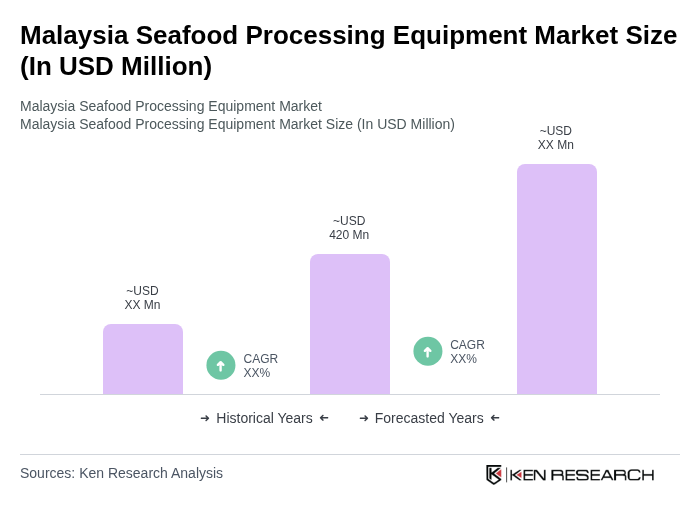
- The Malaysia Seafood Processing Equipment Market is valued at USD 420 million, based on a five-year historical analysis. This growth is primarily driven by the increasing demand for seafood products, advancements in processing technologies, a growing focus on food safety and quality standards, rapid expansion in aquaculture, and rising seafood trade. The market is also supported by rising consumer preferences for processed seafood, which is perceived as convenient and nutritious.
- Key players in this market include Kuala Lumpur, Penang, and Johor Bahru, which dominate due to their strategic locations, robust infrastructure, and proximity to major seafood supply chains. These cities are also home to numerous seafood processing facilities, which enhances their competitive edge in the market.
- The Food Safety and Quality Act, 1993 issued by the Ministry of Health Malaysia, mandates stringent regulations for seafood processing equipment to ensure compliance with health and safety standards through requirements for hygiene, material standards, and regular inspections of processing facilities. This regulation aims to enhance food safety, promote consumer confidence, and improve the overall quality of seafood products in the market.
Malaysia Seafood Processing Equipment Market Segmentation
By Type:The market is segmented into various types of seafood processing equipment, including Filleting Machines, Freezing Equipment, Cooking Equipment, Packaging Machines, Sorting and Grading Equipment, Cleaning Equipment, and Others. Each of these sub-segments plays a crucial role in the seafood processing industry, catering to different processing needs and enhancing operational efficiency.
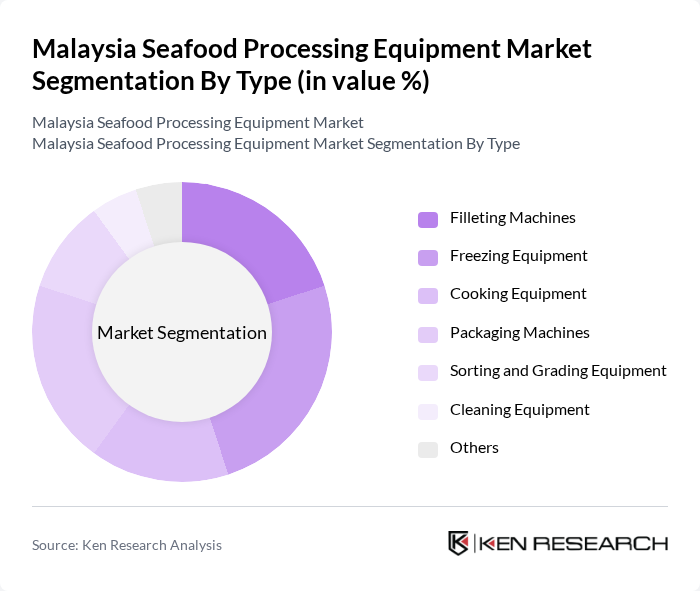
The Freezing Equipment sub-segment is currently dominating the market due to the increasing demand for frozen seafood products, which are favored for their extended shelf life and convenience. The rise in global seafood consumption, coupled with advancements in freezing technologies, has led to a significant uptick in the adoption of freezing equipment among processors. Additionally, the growing trend of e-commerce in food distribution has further propelled the need for efficient freezing solutions to maintain product quality during transportation.
By End-User:The market is segmented based on end-users, including Commercial Seafood Processors, Retail Chains, Food Service Providers, Government Agencies, and Others. Each end-user category has distinct requirements and preferences, influencing the types of processing equipment utilized in their operations.
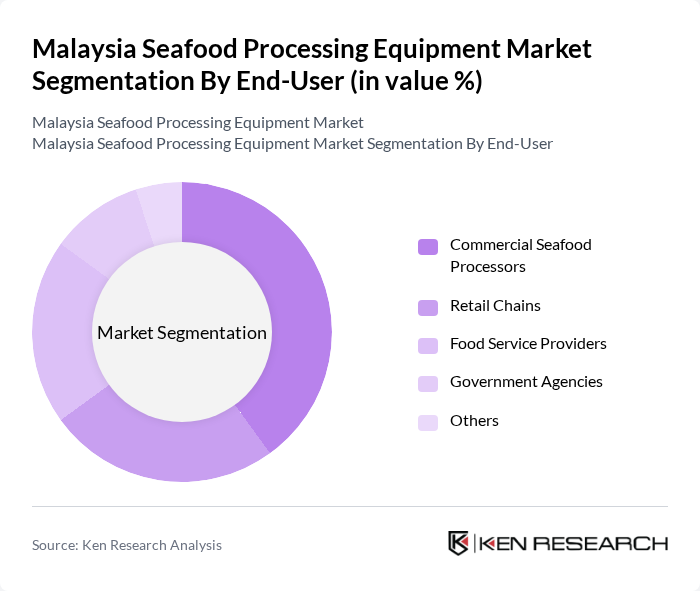
Commercial Seafood Processors are the leading end-users in the market, driven by the high volume of seafood processing activities and the need for efficient equipment to meet production demands. These processors are increasingly investing in advanced processing technologies to enhance productivity, reduce operational costs, and ensure compliance with food safety regulations. The growing trend of value-added seafood products is also contributing to the expansion of this segment.
Malaysia Seafood Processing Equipment Market Competitive Landscape
The Malaysia Seafood Processing Equipment Market is characterized by a dynamic mix of regional and international players. Leading participants such as Aqualogic, Marel, Baader, JBT Corporation, A. M. A. Seafood, A. C. M. Seafood Equipment, A. S. A. Seafood Processing, A. B. C. Seafood Technologies, S. A. M. Seafood Solutions, S. A. S. Seafood Machinery, T. A. S. Seafood Innovations, P. A. C. Seafood Equipment, M. A. R. Seafood Processing, F. A. S. Seafood Technologies, C. A. S. Seafood Equipment contribute to innovation, geographic expansion, and service delivery in this space.
Malaysia Seafood Processing Equipment Market Industry Analysis
Growth Drivers
- Increasing Demand for Processed Seafood:The Malaysian seafood market is projected to reach approximately MYR 12 billion in future, driven by rising consumer preferences for convenience and ready-to-eat products. The processed seafood segment is expected to grow significantly, with a 17% increase in demand for frozen and canned seafood products. This trend is supported by the growing urban population, which is anticipated to reach 85% in future, further fueling the need for processed seafood options.
- Technological Advancements in Processing Equipment:The seafood processing equipment sector is witnessing rapid technological innovations, with investments in automation and smart technologies projected to exceed MYR 600 million in future. These advancements enhance efficiency and reduce operational costs, making processing more competitive. The integration of IoT in equipment is expected to improve monitoring and quality control, aligning with the industry's shift towards more sophisticated processing methods to meet consumer demands.
- Government Support for the Seafood Industry:The Malaysian government has allocated MYR 250 million in future to support the seafood processing industry through various initiatives, including subsidies and grants for equipment upgrades. This support aims to enhance the competitiveness of local processors and promote sustainable practices. Additionally, the government is actively working to improve infrastructure, which is expected to facilitate better supply chain management and increase overall production capacity in the seafood sector.
Market Challenges
- High Initial Investment Costs:The seafood processing equipment market faces significant barriers due to high initial investment costs, which can range from MYR 1.2 million to MYR 5.5 million for advanced processing lines. Many small and medium-sized enterprises (SMEs) struggle to secure financing, limiting their ability to adopt modern technologies. This challenge is exacerbated by the need for continuous upgrades to remain competitive in a rapidly evolving market landscape.
- Stringent Regulatory Requirements:Compliance with food safety and environmental regulations poses a significant challenge for seafood processors in Malaysia. The government enforces strict standards, which require processors to invest in quality assurance systems and waste management solutions. Non-compliance can lead to penalties and loss of market access, with costs associated with compliance potentially reaching up to MYR 350,000 annually for larger operations, impacting profitability and operational viability.
Malaysia Seafood Processing Equipment Market Future Outlook
The future of the Malaysia seafood processing equipment market appears promising, driven by increasing consumer demand for processed seafood and technological advancements. In future, the integration of automation and IoT technologies is expected to enhance operational efficiency, while government initiatives will continue to support industry growth. Additionally, the focus on sustainability and eco-friendly practices will likely shape the market, encouraging investments in innovative processing solutions that align with consumer preferences for responsible sourcing and production.
Market Opportunities
- Expansion of Export Markets:Malaysia's seafood exports are projected to reach MYR 8 billion in future, driven by increasing global demand for high-quality seafood products. This presents significant opportunities for local processors to enhance their capabilities and meet international standards, thereby expanding their market reach and increasing revenue potential.
- Development of Eco-Friendly Processing Technologies:The growing consumer preference for sustainable seafood is driving the demand for eco-friendly processing technologies. Investments in green technologies are expected to exceed MYR 200 million in future, providing processors with opportunities to differentiate their products and appeal to environmentally conscious consumers, ultimately enhancing brand loyalty and market share.
Scope of the Report
| Segment | Sub-Segments |
|---|---|
| By Type | Filleting Machines Freezing Equipment Cooking Equipment Packaging Machines Sorting and Grading Equipment Cleaning Equipment Others |
| By End-User | Commercial Seafood Processors Retail Chains Food Service Providers Government Agencies Others |
| By Region | Northern Region Central Region Southern Region Eastern Region |
| By Technology | Automated Processing Systems Semi-Automated Processing Systems Manual Processing Equipment Others |
| By Application | Fresh Seafood Processing Frozen Seafood Processing Canned Seafood Processing Others |
| By Investment Source | Private Investments Government Funding Foreign Direct Investment (FDI) Public-Private Partnerships (PPP) |
| By Policy Support | Tax Incentives Grants for Equipment Purchase Training and Development Programs Others |
Key Target Audience
Investors and Venture Capitalist Firms
Government and Regulatory Bodies (e.g., Ministry of Agriculture and Food Security, Department of Fisheries Malaysia)
Manufacturers and Producers
Distributors and Retailers
Technology Providers
Industry Associations (e.g., Malaysian Fisheries Society)
Financial Institutions
Exporters and Importers
Players Mentioned in the Report:
Aqualogic
Marel
Baader
JBT Corporation
A. M. A. Seafood
A. C. M. Seafood Equipment
A. S. A. Seafood Processing
A. B. C. Seafood Technologies
S. A. M. Seafood Solutions
S. A. S. Seafood Machinery
T. A. S. Seafood Innovations
P. A. C. Seafood Equipment
M. A. R. Seafood Processing
F. A. S. Seafood Technologies
C. A. S. Seafood Equipment
Table of Contents
Market Assessment Phase
1. Executive Summary and Approach
2. Malaysia Seafood Processing Equipment Market Overview
2.1 Key Insights and Strategic Recommendations
2.2 Malaysia Seafood Processing Equipment Market Overview
2.3 Definition and Scope
2.4 Evolution of Market Ecosystem
2.5 Timeline of Key Regulatory Milestones
2.6 Value Chain & Stakeholder Mapping
2.7 Business Cycle Analysis
2.8 Policy & Incentive Landscape
3. Malaysia Seafood Processing Equipment Market Analysis
3.1 Growth Drivers
3.1.1 Increasing demand for processed seafood
3.1.2 Technological advancements in processing equipment
3.1.3 Government support for the seafood industry
3.1.4 Rising health consciousness among consumers
3.2 Market Challenges
3.2.1 High initial investment costs
3.2.2 Stringent regulatory requirements
3.2.3 Competition from imported equipment
3.2.4 Fluctuating raw material prices
3.3 Market Opportunities
3.3.1 Expansion of export markets
3.3.2 Adoption of automation in processing
3.3.3 Development of eco-friendly processing technologies
3.3.4 Increasing consumer preference for sustainable seafood
3.4 Market Trends
3.4.1 Growth in online sales channels
3.4.2 Integration of IoT in processing equipment
3.4.3 Focus on traceability and food safety
3.4.4 Rise of plant-based seafood alternatives
3.5 Government Regulation
3.5.1 Food safety standards compliance
3.5.2 Environmental regulations on waste disposal
3.5.3 Import/export regulations for seafood products
3.5.4 Subsidies for local seafood processing initiatives
4. SWOT Analysis
5. Stakeholder Analysis
6. Porter's Five Forces Analysis
7. Malaysia Seafood Processing Equipment Market Market Size, 2019-2024
7.1 By Value
7.2 By Volume
7.3 By Average Selling Price
8. Malaysia Seafood Processing Equipment Market Segmentation
8.1 By Type
8.1.1 Filleting Machines
8.1.2 Freezing Equipment
8.1.3 Cooking Equipment
8.1.4 Packaging Machines
8.1.5 Sorting and Grading Equipment
8.1.6 Cleaning Equipment
8.1.7 Others
8.2 By End-User
8.2.1 Commercial Seafood Processors
8.2.2 Retail Chains
8.2.3 Food Service Providers
8.2.4 Government Agencies
8.2.5 Others
8.3 By Region
8.3.1 Northern Region
8.3.2 Central Region
8.3.3 Southern Region
8.3.4 Eastern Region
8.4 By Technology
8.4.1 Automated Processing Systems
8.4.2 Semi-Automated Processing Systems
8.4.3 Manual Processing Equipment
8.4.4 Others
8.5 By Application
8.5.1 Fresh Seafood Processing
8.5.2 Frozen Seafood Processing
8.5.3 Canned Seafood Processing
8.5.4 Others
8.6 By Investment Source
8.6.1 Private Investments
8.6.2 Government Funding
8.6.3 Foreign Direct Investment (FDI)
8.6.4 Public-Private Partnerships (PPP)
8.7 By Policy Support
8.7.1 Tax Incentives
8.7.2 Grants for Equipment Purchase
8.7.3 Training and Development Programs
8.7.4 Others
9. Malaysia Seafood Processing Equipment Market Competitive Analysis
9.1 Market Share of Key Players
9.2 Cross Comparison of Key Players
9.2.1 Company Name
9.2.2 Group Size (Large, Medium, or Small as per industry convention)
9.2.3 Revenue Growth Rate
9.2.4 Market Penetration Rate
9.2.5 Customer Retention Rate
9.2.6 Pricing Strategy
9.2.7 Product Quality Index
9.2.8 Innovation Rate
9.2.9 Supply Chain Efficiency
9.2.10 Customer Satisfaction Score
9.3 SWOT Analysis of Top Players
9.4 Pricing Analysis
9.5 Detailed Profile of Major Companies
9.5.1 Aqualogic
9.5.2 Marel
9.5.3 Baader
9.5.4 JBT Corporation
9.5.5 A. M. A. Seafood
9.5.6 A. C. M. Seafood Equipment
9.5.7 A. S. A. Seafood Processing
9.5.8 A. B. C. Seafood Technologies
9.5.9 S. A. M. Seafood Solutions
9.5.10 S. A. S. Seafood Machinery
9.5.11 T. A. S. Seafood Innovations
9.5.12 P. A. C. Seafood Equipment
9.5.13 M. A. R. Seafood Processing
9.5.14 F. A. S. Seafood Technologies
9.5.15 C. A. S. Seafood Equipment
10. Malaysia Seafood Processing Equipment Market End-User Analysis
10.1 Procurement Behavior of Key Ministries
10.1.1 Ministry of Agriculture and Food Security
10.1.2 Ministry of International Trade and Industry
10.1.3 Ministry of Health
10.1.4 Ministry of Finance
10.2 Corporate Spend on Infrastructure & Energy
10.2.1 Investment in Processing Facilities
10.2.2 Budget Allocation for Equipment Upgrades
10.2.3 Expenditure on Training and Development
10.2.4 Others
10.3 Pain Point Analysis by End-User Category
10.3.1 Equipment Reliability Issues
10.3.2 High Maintenance Costs
10.3.3 Compliance with Food Safety Standards
10.3.4 Others
10.4 User Readiness for Adoption
10.4.1 Awareness of New Technologies
10.4.2 Training Needs Assessment
10.4.3 Financial Readiness for Investment
10.4.4 Others
10.5 Post-Deployment ROI and Use Case Expansion
10.5.1 Measurement of Efficiency Gains
10.5.2 Customer Feedback and Adaptation
10.5.3 Expansion into New Markets
10.5.4 Others
11. Malaysia Seafood Processing Equipment Market Future Size, 2025-2030
11.1 By Value
11.2 By Volume
11.3 By Average Selling Price
Go-To-Market Strategy Phase
1. Whitespace Analysis + Business Model Canvas
1.1 Market Gaps Identification
1.2 Business Model Development
2. Marketing and Positioning Recommendations
2.1 Branding Strategies
2.2 Product USPs
3. Distribution Plan
3.1 Urban Retail vs Rural NGO Tie-ups
4. Channel & Pricing Gaps
4.1 Underserved Routes
4.2 Pricing Bands
5. Unmet Demand & Latent Needs
5.1 Category Gaps
5.2 Consumer Segments
6. Customer Relationship
6.1 Loyalty Programs
6.2 After-sales Service
7. Value Proposition
7.1 Sustainability
7.2 Integrated Supply Chains
8. Key Activities
8.1 Regulatory Compliance
8.2 Branding
8.3 Distribution Setup
9. Entry Strategy Evaluation
9.1 Domestic Market Entry Strategy
9.1.1 Product Mix
9.1.2 Pricing Band
9.1.3 Packaging
9.2 Export Entry Strategy
9.2.1 Target Countries
9.2.2 Compliance Roadmap
10. Entry Mode Assessment
10.1 JV
10.2 Greenfield
10.3 M&A
10.4 Distributor Model
11. Capital and Timeline Estimation
11.1 Capital Requirements
11.2 Timelines
12. Control vs Risk Trade-Off
12.1 Ownership vs Partnerships
13. Profitability Outlook
13.1 Breakeven Analysis
13.2 Long-term Sustainability
14. Potential Partner List
14.1 Distributors
14.2 JVs
14.3 Acquisition Targets
15. Execution Roadmap
15.1 Phased Plan for Market Entry
15.1.1 Market Setup
15.1.2 Market Entry
15.1.3 Growth Acceleration
15.1.4 Scale & Stabilize
15.2 Key Activities and Milestones
15.2.1 Activity Planning
15.2.2 Milestone Tracking
Research Methodology
Phase 1: Approach1
Desk Research
- Industry reports from Malaysian government agencies and seafood associations
- Market analysis publications focusing on seafood processing technologies
- Statistical data from the Department of Fisheries Malaysia and trade journals
Primary Research
- Interviews with key stakeholders in seafood processing companies
- Surveys targeting equipment manufacturers and suppliers in the seafood sector
- Field visits to processing plants to gather firsthand insights on equipment usage
Validation & Triangulation
- Cross-validation of findings through multiple industry expert interviews
- Triangulation of data from trade publications, government reports, and primary research
- Sanity checks conducted through expert panel discussions and feedback sessions
Phase 2: Market Size Estimation1
Top-down Assessment
- Analysis of national seafood production statistics to estimate equipment demand
- Segmentation of the market by equipment type and processing methods
- Incorporation of growth trends in the seafood export market and consumer preferences
Bottom-up Modeling
- Estimation of equipment sales based on historical sales data from major suppliers
- Operational cost analysis of processing plants to determine investment levels
- Volume estimates based on processing capacity and utilization rates of equipment
Forecasting & Scenario Analysis
- Multi-variable forecasting using trends in seafood consumption and export growth
- Scenario analysis based on regulatory changes and technological advancements
- Development of baseline, optimistic, and pessimistic market projections through 2030
Phase 3: CATI Sample Composition1
| Scope Item/Segment | Sample Size | Target Respondent Profiles |
|---|---|---|
| Commercial Seafood Processors | 100 | Operations Managers, Plant Supervisors |
| Equipment Manufacturers | 50 | Product Development Managers, Sales Directors |
| Regulatory Bodies | 40 | Policy Makers, Compliance Officers |
| Industry Associations | 45 | Executive Directors, Research Analysts |
| Exporters and Importers | 60 | Logistics Managers, Supply Chain Coordinators |
Frequently Asked Questions
What is the current value of the Malaysia Seafood Processing Equipment Market?
The Malaysia Seafood Processing Equipment Market is valued at approximately USD 420 million, driven by increasing demand for seafood products, advancements in processing technologies, and a growing focus on food safety and quality standards.
What are the main drivers of growth in the Malaysia Seafood Processing Equipment Market?
Which cities are the key players in the Malaysia Seafood Processing Equipment Market?
What types of seafood processing equipment are available in Malaysia?
Other Regional/Country Reports
Other Adjacent Reports
South Africa Freezing Equipment Market
Global Packaging Machinery Market Size, Share & Forecast, By Machine Type, End-Use Industry & Technology, 2025-2032South Africa Sorting and Grading Equipment Market
Qatar Cleaning Equipment Market
KSA Meat Processing Equipment Market
Malaysia Poultry Processing Equipment Market
Southeast Asia Cold Chain Logistics Market Size, Share & Forecast, By Service Type, Mode of Transport & End-Use Industry, 2025-2032Qatar Food Safety Equipment Market
Why Buy From Us?

What makes us stand out is that our consultants follow Robust, Refine and Result (RRR) methodology. Robust for clear definitions, approaches and sanity checking, Refine for differentiating respondents' facts and opinions, and Result for presenting data with story.

We have set a benchmark in the industry by offering our clients with syndicated and customized market research reports featuring coverage of entire market as well as meticulous research and analyst insights.

While we don't replace traditional research, we flip the method upside down. Our dual approach of Top Bottom & Bottom Top ensures quality deliverable by not just verifying company fundamentals but also looking at the sector and macroeconomic factors.

With one step in the future, our research team constantly tries to show you the bigger picture. We help with some of the tough questions you may encounter along the way: How is the industry positioned? Best marketing channel? KPI's of competitors? By aligning every element, we help maximize success.

Our report gives you instant access to the answers and sources that other companies might choose to hide. We elaborate each steps of research methodology we have used and showcase you the sample size to earn your trust.

If you need any support, we are here! We pride ourselves on universe strength, data quality, and quick, friendly, and professional service.