About the Report
Base Year 2024Middle East Online Video Platforms Market Overview
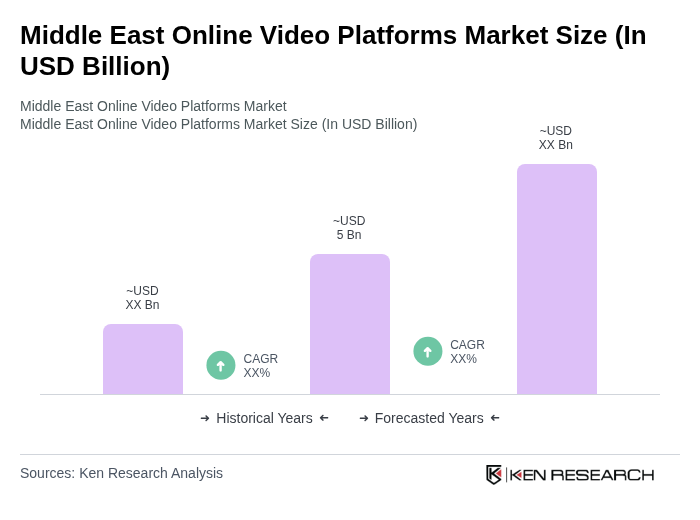
- The Middle East Online Video Platforms Market is valued at USD 4.5 billion, based on a five-year historical analysis. This growth is primarily driven by expanding digital infrastructure, rising mobile and internet penetration, and a youthful, engaged population embracing localized and ad-supported streaming experiences. Platforms are increasingly tailoring content using data-driven personalization and competitive bundling strategies to enhance user engagement.
- Key players in this market include Shahid, Netflix, StarzPlay, OSN+, and YouTube Premium. These platforms dominate the region, particularly in Saudi Arabia and the United Arab Emirates, where robust infrastructure, high disposable incomes, and strong telecom partnerships support streaming adoption. Their strategies focus on local content, bundling offers, and regional relevance to maintain a competitive advantage.
- In 2024, Saudi Arabia's government implemented the Implementing Regulations of the Audio-Visual Media Law, which mandates licensing, content classification, and cultural compliance for streaming services. This regulatory framework aims to foster industry formalization and localization while aligning platforms with national cultural and strategic objectives, thereby boosting Arabic content production.
Middle East Online Video Platforms Market Segmentation
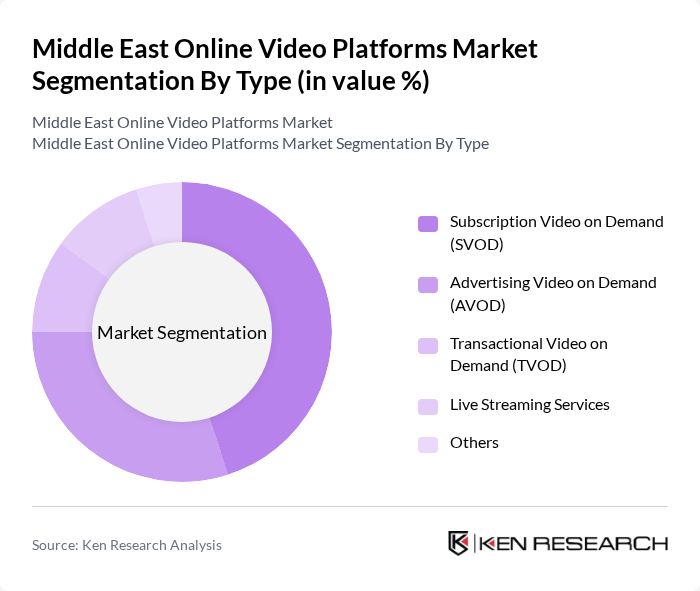
By Type:The market is segmented into various types, including Subscription Video on Demand (SVOD), Advertising Video on Demand (AVOD), Transactional Video on Demand (TVOD), Live Streaming Services, and Others. Among these, SVOD has emerged as a dominant segment due to the increasing consumer preference for ad-free viewing experiences and exclusive content offerings. AVOD is also gaining traction, particularly among budget-conscious consumers who prefer free content supported by advertisements. The growth of live streaming services is driven by the rising popularity of real-time content, especially in sports and events.
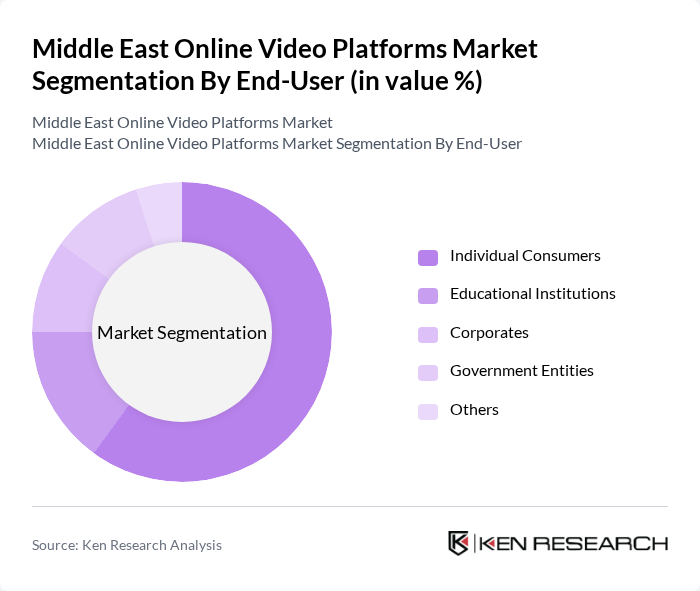
By End-User:The end-user segmentation includes Individual Consumers, Educational Institutions, Corporate Sector, Government Agencies, and Others. Individual consumers represent the largest segment, driven by the increasing adoption of streaming services for entertainment and leisure. Educational institutions are also leveraging online video platforms for e-learning and training purposes, while the corporate sector utilizes these platforms for internal communications and marketing. Government agencies are increasingly using video content for public service announcements and educational campaigns.
Middle East Online Video Platforms Market Competitive Landscape
The Middle East Online Video Platforms Market is characterized by a dynamic mix of regional and international players. Leading participants such as Netflix, OSN, Shahid, Starzplay, YouTube, Amazon Prime Video, MBC Group, ViacomCBS, beIN Media Group, Anghami, Vimeo, TikTok, Facebook Watch, Hulu, Dailymotion contribute to innovation, geographic expansion, and service delivery in this space.
Middle East Online Video Platforms Market Industry Analysis
Growth Drivers
- Rising OTT Revenues:OTT video streaming revenues in the MENA region are projected to reach USD 1.2 billion in future. This growth reflects an increasing consumption of digital entertainment, driven by a favorable environment for online video platforms. The rise in disposable income and urbanization in the region further supports this trend, as consumers seek diverse content options that cater to their preferences ((https://www.prnewswire.com/news-releases/omdia-streaming-video-revenues-in-mena-to-surpass-1-2bn-in-2024--302157881.html?utm_source=openai)).
- High Subscriber Counts on Leading Platforms:As of future, major platforms have reported significant subscriber numbers: Shahid with 4.4 million, YouTube Premium at 3.7 million, Netflix with 3.0 million, and StarzPlay at 2.3 million. This robust subscriber base indicates a strong foothold in the market, driven by localized content strategies that resonate with regional audiences ((https://www.businesswire.com/news/home/20250513597916/en/Omdia-SVOD-Growth-to-Drive-MENA-Streaming-Market-Past-%241.5-Billion-in-2025?utm_source=openai)).
- Smartphone & Internet Infrastructure Expansion:The MENA region is witnessing a surge in smartphone subscriptions, expected to exceed 626 million in future. Additionally, there are 348 million internet users in the Arab world as of future, representing 70.2 percent of the population. This high device penetration and large online population are crucial for the growth of video streaming services, enabling wider access to content ((https://www.statista.com/topics/5550/internet-usage-in-mena/?utm_source=openai)).
Market Challenges
- Slow GDP Growth & Economic Diversification Needs:The MENA region's GDP growth is forecasted at 2.2 percent in future, with the GCC averaging 1.9 percent. This modest economic growth may limit discretionary spending on subscriptions, as consumers prioritize essential expenditures over entertainment, posing a challenge for online video platforms ((https://www.worldbank.org/en/region/mena/overview?utm_source=openai)).
- Saudi Arabia’s Weak Oil Sector and Fiscal Pressure:In future, Saudi Arabia's GDP grew by only 1.3 percent, with the non-oil sector increasing by 4.3 percent while the oil sector declined by 4.5 percent. This ongoing vulnerability in oil revenues may impact investment in media infrastructure and consumer spending, creating challenges for video platforms reliant on a robust economic environment ((https://www.reuters.com/world/middle-east/saudi-arabia-gdp-grew-13-2024-govt-estimate-shows-2025-01-30/?utm_source=openai)).
Middle East Online Video Platforms Market Future Outlook
The future of the Middle East online video platforms market is poised for significant transformation, driven by platform convergence and the increasing adoption of connected TV (CTV) usage. As of future, YouTube reached 12 million users on connected TV in Saudi Arabia, indicating a shift in content consumption patterns. Additionally, the consolidation of media and streaming services, exemplified by the merger of OSN and Anghami, suggests a trend towards integrated multimedia ecosystems that enhance user engagement and content delivery capabilities.
Market Opportunities
- FAST (Free Ad-Supported Streaming TV) Growth:The FAST channel revenues in MENA were USD 7.2 million in future, with strong growth anticipated. This ad-supported model presents a significant opportunity for platforms to expand their audience base, particularly among price-sensitive consumers seeking free content options ((https://www.prnewswire.com/news-releases/omdia-streaming-video-revenues-in-mena-to-surpass-1-2bn-in-2024--302157881.html?utm_source=openai)).
- Connected TV (CTV) Content Delivery Expansion:The substantial reach of YouTube on CTV in Saudi Arabia and the UAE highlights the potential for platforms to deliver premium content in living-room environments. This trend offers a unique avenue for engaging audiences and enhancing viewer experiences through high-quality content delivery ((https://www.alfidigital.com/the-new-media-frontier?utm_source=openai)).
Scope of the Report
| Segment | Sub-Segments |
|---|---|
| By Type | Subscription Video on Demand (SVOD) Advertising Video on Demand (AVOD) Transactional Video on Demand (TVOD) Live Streaming Services Others |
| By End-User | Individual Consumers Educational Institutions Corporate Sector Government Agencies Others |
| By Content Genre | Movies TV Shows Documentaries Sports Others |
| By Device Type | Smart TVs Mobile Devices Laptops and Desktops Streaming Devices Others |
| By Distribution Channel | Direct-to-Consumer Third-Party Platforms Partnerships with Telecom Providers Others |
| By Payment Model | Subscription-Based Pay-Per-View Free with Ads Others |
| By Region | GCC Countries Levant Region North Africa Others |
Key Target Audience
Investors and Venture Capitalist Firms
Government and Regulatory Bodies (e.g., Ministry of Communications and Information Technology, National Media Council)
Content Creators and Influencers
Telecommunication Companies
Advertising Agencies
Media and Entertainment Companies
Technology Providers
Streaming Service Operators
Players Mentioned in the Report:
Netflix
OSN
Shahid
Starzplay
YouTube
Amazon Prime Video
MBC Group
ViacomCBS
beIN Media Group
Anghami
Vimeo
TikTok
Facebook Watch
Hulu
Dailymotion
Table of Contents
Market Assessment Phase
1. Executive Summary and Approach
2. Middle East Online Video Platforms Market Overview
2.1 Key Insights and Strategic Recommendations
2.2 Middle East Online Video Platforms Market Overview
2.3 Definition and Scope
2.4 Evolution of Market Ecosystem
2.5 Timeline of Key Regulatory Milestones
2.6 Value Chain & Stakeholder Mapping
2.7 Business Cycle Analysis
2.8 Policy & Incentive Landscape
3. Middle East Online Video Platforms Market Analysis
3.1 Growth Drivers
3.1.1 Increasing Internet Penetration
3.1.2 Rising Demand for On-Demand Content
3.1.3 Growth of Mobile Streaming Services
3.1.4 Expansion of Local Content Production
3.2 Market Challenges
3.2.1 Intense Competition Among Platforms
3.2.2 Regulatory Compliance Issues
3.2.3 Content Piracy Concerns
3.2.4 Limited Payment Options in Some Regions
3.3 Market Opportunities
3.3.1 Partnerships with Telecom Providers
3.3.2 Investment in Original Content
3.3.3 Expansion into Emerging Markets
3.3.4 Adoption of Advanced Technologies (e.g., AI, VR)
3.4 Market Trends
3.4.1 Shift Towards Subscription-Based Models
3.4.2 Increased Focus on User Experience
3.4.3 Growth of Interactive Content
3.4.4 Rise of Social Media Integration
3.5 Government Regulation
3.5.1 Content Licensing Requirements
3.5.2 Data Protection Laws
3.5.3 Advertising Regulations
3.5.4 Local Content Quotas
4. SWOT Analysis
5. Stakeholder Analysis
6. Porter's Five Forces Analysis
7. Middle East Online Video Platforms Market Market Size, 2019-2024
7.1 By Value
7.2 By Volume
7.3 By Average Selling Price
8. Middle East Online Video Platforms Market Segmentation
8.1 By Type
8.1.1 Subscription Video on Demand (SVOD)
8.1.2 Advertising Video on Demand (AVOD)
8.1.3 Transactional Video on Demand (TVOD)
8.1.4 Live Streaming Services
8.1.5 Others
8.2 By End-User
8.2.1 Individual Consumers
8.2.2 Educational Institutions
8.2.3 Corporate Sector
8.2.4 Government Agencies
8.2.5 Others
8.3 By Content Genre
8.3.1 Movies
8.3.2 TV Shows
8.3.3 Documentaries
8.3.4 Sports
8.3.5 Others
8.4 By Device Type
8.4.1 Smart TVs
8.4.2 Mobile Devices
8.4.3 Laptops and Desktops
8.4.4 Streaming Devices
8.4.5 Others
8.5 By Distribution Channel
8.5.1 Direct-to-Consumer
8.5.2 Third-Party Platforms
8.5.3 Partnerships with Telecom Providers
8.5.4 Others
8.6 By Payment Model
8.6.1 Subscription-Based
8.6.2 Pay-Per-View
8.6.3 Free with Ads
8.6.4 Others
8.7 By Region
8.7.1 GCC Countries
8.7.2 Levant Region
8.7.3 North Africa
8.7.4 Others
9. Middle East Online Video Platforms Market Competitive Analysis
9.1 Market Share of Key Players
9.2 Cross Comparison of Key Players
9.2.1 Company Name
9.2.2 Group Size (Large, Medium, or Small as per industry convention)
9.2.3 Subscriber Growth Rate
9.2.4 Average Revenue Per User (ARPU)
9.2.5 Content Acquisition Cost
9.2.6 Customer Retention Rate
9.2.7 Pricing Strategy
9.2.8 User Engagement Metrics
9.2.9 Market Penetration Rate
9.2.10 Advertising Revenue Growth
9.3 SWOT Analysis of Top Players
9.4 Pricing Analysis
9.5 Detailed Profile of Major Companies
9.5.1 Netflix
9.5.2 OSN
9.5.3 Shahid
9.5.4 Starzplay
9.5.5 YouTube
9.5.6 Amazon Prime Video
9.5.7 MBC Group
9.5.8 ViacomCBS
9.5.9 beIN Media Group
9.5.10 Anghami
9.5.11 Vimeo
9.5.12 TikTok
9.5.13 Facebook Watch
9.5.14 Hulu
9.5.15 Dailymotion
10. Middle East Online Video Platforms Market End-User Analysis
10.1 Procurement Behavior of Key Ministries
10.1.1 Government Content Acquisition Strategies
10.1.2 Budget Allocation for Digital Media
10.1.3 Collaboration with Local Content Creators
10.1.4 Evaluation of Platform Performance
10.2 Corporate Spend on Infrastructure & Energy
10.2.1 Investment in Streaming Infrastructure
10.2.2 Budget for Content Licensing
10.2.3 Expenditure on Marketing and Promotion
10.2.4 Technology Upgrades and Maintenance Costs
10.3 Pain Point Analysis by End-User Category
10.3.1 Content Accessibility Issues
10.3.2 Quality of Service Concerns
10.3.3 Pricing Affordability
10.3.4 User Interface Challenges
10.4 User Readiness for Adoption
10.4.1 Awareness of Available Platforms
10.4.2 Technical Literacy Levels
10.4.3 Device Availability
10.4.4 Willingness to Pay for Services
10.5 Post-Deployment ROI and Use Case Expansion
10.5.1 Measurement of User Engagement
10.5.2 Analysis of Revenue Growth
10.5.3 Feedback Mechanisms for Improvement
10.5.4 Opportunities for Content Diversification
11. Middle East Online Video Platforms Market Future Size, 2025-2030
11.1 By Value
11.2 By Volume
11.3 By Average Selling Price
Go-To-Market Strategy Phase
1. Whitespace Analysis + Business Model Canvas
1.1 Market Gaps Identification
1.2 Value Proposition Development
1.3 Revenue Streams Analysis
1.4 Customer Segmentation
1.5 Key Partnerships
1.6 Cost Structure Evaluation
1.7 Competitive Advantage Assessment
2. Marketing and Positioning Recommendations
2.1 Branding Strategies
2.2 Product USPs
2.3 Target Audience Identification
2.4 Marketing Channels Selection
2.5 Campaign Development
3. Distribution Plan
3.1 Urban Retail Strategies
3.2 Rural NGO Tie-Ups
3.3 Online Distribution Channels
3.4 Partnerships with Local Distributors
3.5 Logistics and Supply Chain Management
4. Channel & Pricing Gaps
4.1 Underserved Routes
4.2 Pricing Bands Analysis
4.3 Competitor Pricing Comparison
4.4 Customer Willingness to Pay
4.5 Value-Based Pricing Strategies
5. Unmet Demand & Latent Needs
5.1 Category Gaps Identification
5.2 Consumer Segments Analysis
5.3 Emerging Trends Exploration
5.4 Feedback Collection Mechanisms
5.5 Future Demand Projections
6. Customer Relationship
6.1 Loyalty Programs Development
6.2 After-Sales Service Strategies
6.3 Customer Feedback Integration
6.4 Community Engagement Initiatives
6.5 Customer Support Systems
7. Value Proposition
7.1 Sustainability Initiatives
7.2 Integrated Supply Chains
7.3 Unique Selling Points
7.4 Customer-Centric Innovations
7.5 Competitive Differentiation
8. Key Activities
8.1 Regulatory Compliance
8.2 Branding Initiatives
8.3 Distribution Setup
8.4 Marketing Campaign Execution
8.5 Performance Monitoring
9. Entry Strategy Evaluation
9.1 Domestic Market Entry Strategy
9.1.1 Product Mix Considerations
9.1.2 Pricing Band Selection
9.1.3 Packaging Strategies
9.2 Export Entry Strategy
9.2.1 Target Countries Identification
9.2.2 Compliance Roadmap Development
10. Entry Mode Assessment
10.1 Joint Ventures
10.2 Greenfield Investments
10.3 Mergers & Acquisitions
10.4 Distributor Model Evaluation
11. Capital and Timeline Estimation
11.1 Capital Requirements Analysis
11.2 Timelines for Market Entry
12. Control vs Risk Trade-Off
12.1 Ownership vs Partnerships
13. Profitability Outlook
13.1 Breakeven Analysis
13.2 Long-Term Sustainability Strategies
14. Potential Partner List
14.1 Distributors
14.2 Joint Ventures
14.3 Acquisition Targets
15. Execution Roadmap
15.1 Phased Plan for Market Entry
15.1.1 Market Setup
15.1.2 Market Entry
15.1.3 Growth Acceleration
15.1.4 Scale & Stabilize
15.2 Key Activities and Milestones
15.2.1 Milestone Identification
15.2.2 Activity Scheduling
Research Methodology
Phase 1: Approach1
Desk Research
- Analysis of industry reports from regional media and market research firms
- Review of government publications and regulatory frameworks affecting online video platforms
- Examination of consumer behavior studies and digital content consumption trends in the Middle East
Primary Research
- Interviews with executives from leading online video platforms operating in the region
- Surveys targeting content creators and distributors to understand market dynamics
- Focus groups with consumers to gauge preferences and viewing habits
Validation & Triangulation
- Cross-validation of findings through multiple data sources, including user engagement metrics
- Triangulation of insights from industry experts, market reports, and consumer feedback
- Sanity checks conducted through expert panel discussions and feedback loops
Phase 2: Market Size Estimation1
Top-down Assessment
- Estimation of total addressable market based on digital advertising spend in the region
- Segmentation of market size by content type (e.g., movies, series, user-generated content)
- Incorporation of growth rates from regional internet penetration and smartphone usage
Bottom-up Modeling
- Collection of subscription and ad-revenue data from key players in the market
- Estimation of average revenue per user (ARPU) across different platforms
- Volume analysis based on content consumption patterns and user demographics
Forecasting & Scenario Analysis
- Multi-variable forecasting using historical growth rates and emerging trends in content consumption
- Scenario analysis based on potential regulatory changes and shifts in consumer preferences
- Development of baseline, optimistic, and pessimistic growth projections through 2030
Phase 3: CATI Sample Composition1
| Scope Item/Segment | Sample Size | Target Respondent Profiles |
|---|---|---|
| Subscription-Based Platforms | 150 | Product Managers, Marketing Directors |
| Ad-Supported Video Services | 100 | Advertising Executives, Content Strategists |
| User-Generated Content Platforms | 80 | Content Creators, Community Managers |
| Regional Content Distribution | 70 | Distribution Managers, Licensing Executives |
| Consumer Viewing Habits | 120 | General Consumers, Media Analysts |
Frequently Asked Questions
What is the current value of the Middle East Online Video Platforms Market?
The Middle East Online Video Platforms Market is valued at approximately USD 4.5 billion, driven by factors such as expanding digital infrastructure, increased mobile and internet penetration, and a youthful population engaging with localized streaming content.
Who are the key players in the Middle East Online Video Platforms Market?
What are the main types of online video platforms in the Middle East?
How has government regulation impacted the online video platforms in Saudi Arabia?
Other Regional/Country Reports
Indonesia Online Video Platforms Market
Malaysia Online Video Platforms Market
KSA Online Video Platforms Market
APAC Online Video Platforms Market
SEA Online Video Platforms Market
Vietnam Online Video Platforms Market
Other Adjacent Reports
Indonesia Content Delivery Network Market
Thailand Over-the-Top Services Market
Brazil Mobile Entertainment Market
Brazil E-Learning Platforms Market
Vietnam Enterprise Video Solutions Market
UAE Social Media Platforms Market
South Africa Video Production Equipment Market
Malaysia Broadband Infrastructure Market
Philippines Connected TV Devices Market
Why Buy From Us?

What makes us stand out is that our consultants follow Robust, Refine and Result (RRR) methodology. Robust for clear definitions, approaches and sanity checking, Refine for differentiating respondents' facts and opinions, and Result for presenting data with story.

We have set a benchmark in the industry by offering our clients with syndicated and customized market research reports featuring coverage of entire market as well as meticulous research and analyst insights.

While we don't replace traditional research, we flip the method upside down. Our dual approach of Top Bottom & Bottom Top ensures quality deliverable by not just verifying company fundamentals but also looking at the sector and macroeconomic factors.

With one step in the future, our research team constantly tries to show you the bigger picture. We help with some of the tough questions you may encounter along the way: How is the industry positioned? Best marketing channel? KPI's of competitors? By aligning every element, we help maximize success.

Our report gives you instant access to the answers and sources that other companies might choose to hide. We elaborate each steps of research methodology we have used and showcase you the sample size to earn your trust.

If you need any support, we are here! We pride ourselves on universe strength, data quality, and quick, friendly, and professional service.