About the Report
Base Year 2024Listen to the audio summary
Middle East Print on Demand Market Overview
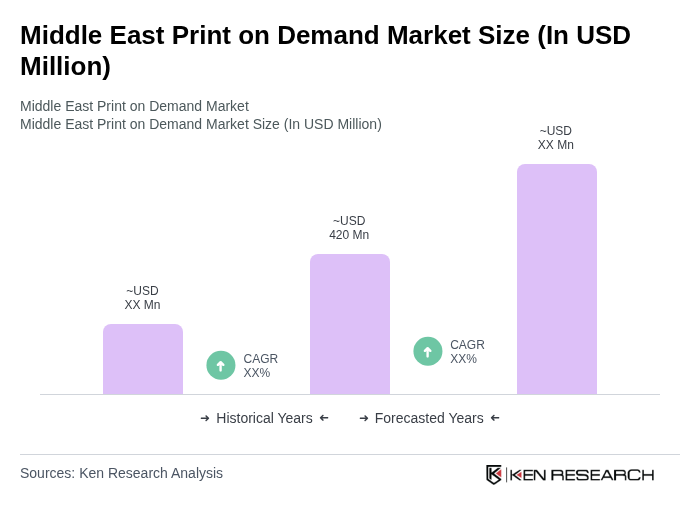
- The Middle East Print on Demand market is valued at USD 420 million, based on a five-year historical analysis. This growth is primarily driven by the increasing demand for customized products, the rise of e-commerce, and the growing trend of personalization among consumers. The market has seen a significant uptick in online shopping and digital payments, alongside wider smartphone adoption, which has further fueled the need for print on demand services across categories such as apparel, home décor, and promotional merchandise.
- Key players in this market include the United Arab Emirates and Saudi Arabia, which dominate due to their advanced digital infrastructure, high internet penetration rates, and a burgeoning e-commerce sector. The UAE, in particular, has become a hub for startups and innovation supported by strong logistics and cross-border e-commerce, while Saudi Arabia's Vision 2030 initiative promotes digital transformation, entrepreneurship, and the growth of online retail, creating favorable conditions for print on demand platforms and merchants.
- In 2023, the UAE government implemented regulations to support the print on demand industry by easing licensing requirements for e-commerce businesses. This initiative aims to foster innovation and entrepreneurship, allowing more businesses to enter the market and contribute to the overall growth of the digital economy. A key instrument in this context is the E-Commerce Law issued under Federal Decree-Law No. 46 of 2021 on Electronic Transactions and Trust Services by the UAE Federal Government, which sets out rules for electronic contracts, digital signatures, and online commercial activities, thereby streamlining compliance for businesses operating print on demand and other digital commerce models.
Middle East Print on Demand Market Segmentation
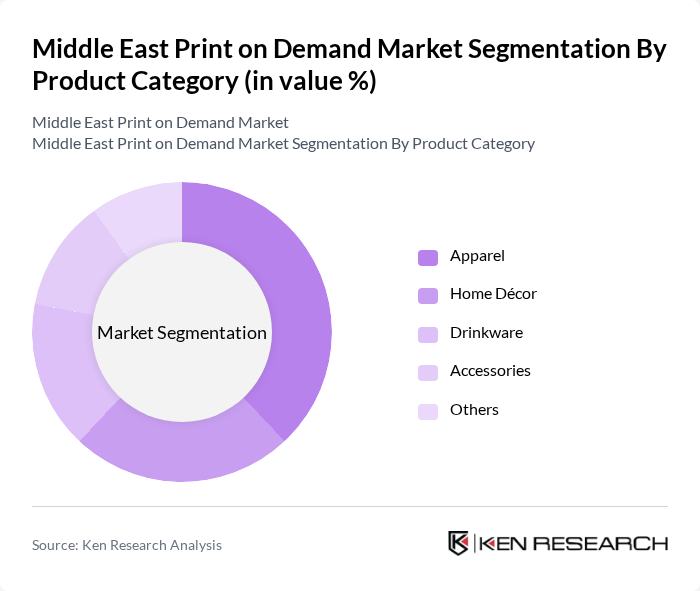
By Product Category:The product category segmentation includes Apparel, Home Décor, Drinkware, Accessories, and Others. Among these, Apparel is the leading sub-segment, driven by the increasing consumer preference for personalized clothing, fashion-focused social media content, and influencer-led merchandising on platforms like Instagram and TikTok. Home Décor follows closely, as consumers seek unique items such as wall art, posters, and canvas prints to enhance their living and workspace environments. The demand for Drinkware and Accessories is also growing, particularly among younger demographics and small brands that use customized mugs, bottles, phone cases, and bags for lifestyle expression and promotional purposes.
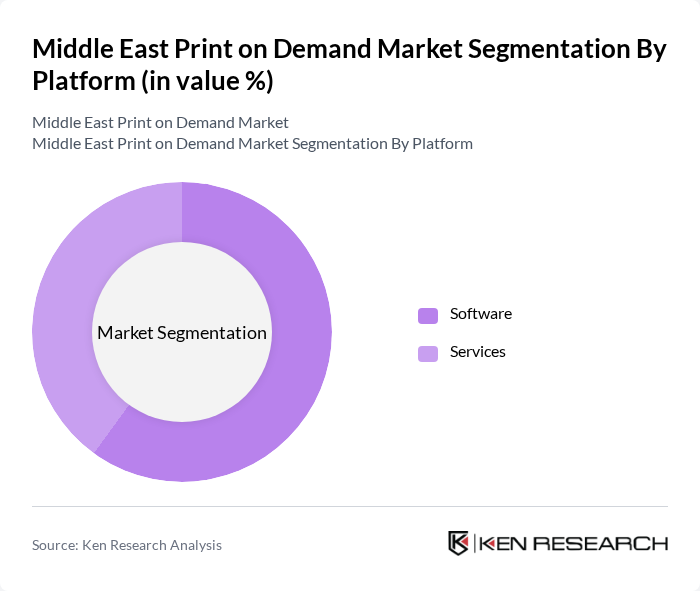
By Platform:The platform segmentation includes Software and Services. The Services sub-segment is currently leading the market in terms of growth momentum, as businesses increasingly seek comprehensive solutions that include design, production, and fulfillment, often bundled with logistics and integration support from global and regional providers. Software solutions are also gaining traction and currently account for a larger revenue share, particularly those that integrate seamlessly with e-commerce platforms and marketplaces, enabling businesses to streamline their operations, automate order processing, and enhance customer experiences through real-time personalization tools.
Middle East Print on Demand Market Competitive Landscape
The Middle East Print on Demand Market is characterized by a dynamic mix of regional and international players. Leading participants such as Printful, Printify, Redbubble, Zazzle, Gelato, Gooten, Teespring (Spring), CustomCat, Society6, Fine Art America, Teelaunch, Vistaprint (Cimpress), Local / Regional POD Platforms, E-commerce Marketplaces with POD Integration, Niche POD Players (Art, Books, and Specialty Products) contribute to innovation, geographic expansion, and service delivery in this space.
Middle East Print on Demand Market Industry Analysis
Growth Drivers
- Increasing E-commerce Adoption:The Middle East's e-commerce sector is projected to reach $28.5 billion, driven by a 20% annual growth rate. This surge is fueled by increased internet penetration, which stands at over 99% in the UAE and around 99% in Saudi Arabia. As consumers increasingly prefer online shopping, the demand for print on demand services is expected to rise, allowing businesses to offer customized products without significant upfront investment.
- Customization Demand from Consumers:A report from Statista indicates that 60% of consumers in the Middle East prefer personalized products. This trend is particularly strong among millennials, who represent a significant portion of the market. The desire for unique items drives demand for print on demand services, enabling businesses to cater to individual preferences while minimizing inventory costs, thus enhancing customer satisfaction and loyalty.
- Technological Advancements in Printing:The Middle East is witnessing rapid advancements in printing technology, with investments in digital printing expected to exceed $1.2 billion. Innovations such as 3D printing and eco-friendly inks are becoming more accessible, allowing print on demand providers to enhance product quality and reduce production times. These technological improvements are crucial for meeting the growing consumer expectations for high-quality, customized products.
Market Challenges
- High Competition Among Providers:The print on demand market in the Middle East is becoming increasingly saturated, with over 200 providers competing for market share. This intense competition leads to price wars, which can erode profit margins. Companies must differentiate themselves through unique offerings or superior customer service to maintain a competitive edge, making it challenging for new entrants to establish themselves in the market.
- Supply Chain Disruptions:The region has faced significant supply chain disruptions, particularly due to geopolitical tensions and the COVID-19 pandemic. According to the World Bank, logistics costs in the Middle East are approximately 13% of GDP, higher than the global average. These disruptions can lead to delays in production and delivery, impacting customer satisfaction and overall business performance in the print on demand sector.
Middle East Print on Demand Market Future Outlook
The future of the Middle East print on demand market appears promising, driven by the increasing integration of technology and consumer preferences for personalized products. As e-commerce continues to expand, businesses are likely to invest in innovative printing solutions that enhance efficiency and sustainability. Additionally, the growing trend of social media marketing will further amplify the visibility of print on demand services, creating new avenues for customer engagement and sales growth in the future.
Market Opportunities
- Expansion into Untapped Markets:There are significant opportunities for print on demand services to expand into underserved regions within the Middle East, such as Iraq and Yemen. With a combined population of over 70 million, these markets present a chance for businesses to introduce customized products, catering to local tastes and preferences while capitalizing on the growing e-commerce trend.
- Collaborations with Local Artists:Partnering with local artists can create unique product offerings that resonate with consumers. This strategy not only supports local talent but also enhances brand authenticity. By leveraging the cultural richness of the region, print on demand businesses can differentiate themselves and attract a loyal customer base, driving sales and brand recognition.
Scope of the Report
| Segment | Sub-Segments |
|---|---|
| By Product Category | Apparel Home Décor Drinkware Accessories Others |
| By Platform | Software Services |
| By End-User | Individual Consumers Small Businesses & Entrepreneurs Large Corporates & Brands Artists & Creators Others |
| By Distribution Channel | Online Marketplaces Brand-owned Webstores Social Commerce Platforms Offline / Retail Partnerships Others |
| By Technology | Digital Printing Direct-to-Garment (DTG) Direct-to-Film (DTF) Sublimation Printing Screen Printing Others |
| By Application | Custom Apparel Home Décor & Lifestyle Products Corporate & Promotional Merchandise Publishing & Stationery Others |
| By Region | Saudi Arabia United Arab Emirates Other GCC Countries Levant North Africa |
Key Target Audience
Investors and Venture Capitalist Firms
Government and Regulatory Bodies (e.g., Ministry of Economy, Ministry of Culture and Knowledge Development)
Manufacturers and Producers
Distributors and Retailers
Print Service Providers
Technology Providers
Industry Associations (e.g., Middle East Printing and Publishing Association)
Financial Institutions
Players Mentioned in the Report:
Printful
Printify
Redbubble
Zazzle
Gelato
Gooten
Teespring (Spring)
CustomCat
Society6
Fine Art America
Teelaunch
Vistaprint (Cimpress)
Local / Regional POD Platforms
E-commerce Marketplaces with POD Integration
Niche POD Players (Art, Books, and Specialty Products)
Table of Contents
Market Assessment Phase
1. Executive Summary and Approach
2. Middle East Print on Demand Market Overview
2.1 Key Insights and Strategic Recommendations
2.2 Middle East Print on Demand Market Overview
2.3 Definition and Scope
2.4 Evolution of Market Ecosystem
2.5 Timeline of Key Regulatory Milestones
2.6 Value Chain & Stakeholder Mapping
2.7 Business Cycle Analysis
2.8 Policy & Incentive Landscape
3. Middle East Print on Demand Market Analysis
3.1 Growth Drivers
3.1.1 Increasing E-commerce Adoption
3.1.2 Customization Demand from Consumers
3.1.3 Technological Advancements in Printing
3.1.4 Rise of Social Media Marketing
3.2 Market Challenges
3.2.1 High Competition Among Providers
3.2.2 Supply Chain Disruptions
3.2.3 Limited Awareness Among Potential Users
3.2.4 Regulatory Compliance Issues
3.3 Market Opportunities
3.3.1 Expansion into Untapped Markets
3.3.2 Collaborations with Local Artists
3.3.3 Integration of AI in Design Processes
3.3.4 Eco-friendly Printing Solutions
3.4 Market Trends
3.4.1 Growth of Subscription Models
3.4.2 Increased Focus on Sustainability
3.4.3 Personalization in Marketing Strategies
3.4.4 Use of Augmented Reality in Shopping
3.5 Government Regulation
3.5.1 Intellectual Property Rights Enforcement
3.5.2 Environmental Regulations on Printing Materials
3.5.3 Tax Incentives for Local Businesses
3.5.4 Compliance with E-commerce Laws
4. SWOT Analysis
5. Stakeholder Analysis
6. Porter's Five Forces Analysis
7. Middle East Print on Demand Market Market Size, 2019-2024
7.1 By Value
7.2 By Volume
7.3 By Average Selling Price
8. Middle East Print on Demand Market Segmentation
8.1 By Product Category
8.1.1 Apparel
8.1.2 Home Décor
8.1.3 Drinkware
8.1.4 Accessories
8.1.5 Others
8.2 By Platform
8.2.1 Software
8.2.2 Services
8.3 By End-User
8.3.1 Individual Consumers
8.3.2 Small Businesses & Entrepreneurs
8.3.3 Large Corporates & Brands
8.3.4 Artists & Creators
8.3.5 Others
8.4 By Distribution Channel
8.4.1 Online Marketplaces
8.4.2 Brand-owned Webstores
8.4.3 Social Commerce Platforms
8.4.4 Offline / Retail Partnerships
8.4.5 Others
8.5 By Technology
8.5.1 Digital Printing
8.5.2 Direct-to-Garment (DTG)
8.5.3 Direct-to-Film (DTF)
8.5.4 Sublimation Printing
8.5.5 Screen Printing
8.5.6 Others
8.6 By Application
8.6.1 Custom Apparel
8.6.2 Home Décor & Lifestyle Products
8.6.3 Corporate & Promotional Merchandise
8.6.4 Publishing & Stationery
8.6.5 Others
8.7 By Region
8.7.1 Saudi Arabia
8.7.2 United Arab Emirates
8.7.3 Other GCC Countries
8.7.4 Levant
8.7.5 North Africa
9. Middle East Print on Demand Market Competitive Analysis
9.1 Market Share of Key Players
9.2 Cross Comparison of Key Players
9.2.1 Company Name
9.2.2 Ownership Type (Local, Regional, Global)
9.2.3 Revenue (Latest Financial Year)
9.2.4 3-year Revenue CAGR
9.2.5 EBITDA Margin
9.2.6 Gross Margin
9.2.7 Active Users / Merchants on Platform
9.2.8 Orders Processed per Year
9.2.9 Average Order Value (AOV)
9.2.10 Customer Acquisition Cost (CAC)
9.2.11 Customer Lifetime Value (LTV)
9.2.12 LTV/CAC Ratio
9.2.13 Customer Retention / Churn Rate
9.2.14 On-time Fulfilment Rate
9.2.15 Return & Refund Rate
9.2.16 Market Share in Middle East (by Revenue)
9.2.17 Share of Revenue from Middle East (% of Global)
9.2.18 Average Production Lead Time
9.2.19 Capital Intensity (Capex/Revenue)
9.2.20 Return on Invested Capital (ROIC)
9.3 SWOT Analysis of Top Players
9.4 Pricing Analysis
9.5 Detailed Profile of Major Companies
9.5.1 Printful
9.5.2 Printify
9.5.3 Redbubble
9.5.4 Zazzle
9.5.5 Gelato
9.5.6 Gooten
9.5.7 Teespring (Spring)
9.5.8 CustomCat
9.5.9 Society6
9.5.10 Fine Art America
9.5.11 Teelaunch
9.5.12 Vistaprint (Cimpress)
9.5.13 Local / Regional POD Platforms
9.5.14 E-commerce Marketplaces with POD Integration
9.5.15 Niche POD Players (Art, Books, and Specialty Products)
10. Middle East Print on Demand Market End-User Analysis
10.1 Procurement Behavior of Key Ministries
10.1.1 Government Procurement Policies
10.1.2 Budget Allocation for Custom Products
10.1.3 Supplier Selection Criteria
10.1.4 Contract Management Practices
10.2 Corporate Spend on Infrastructure & Energy
10.2.1 Investment in Custom Printing Solutions
10.2.2 Budgeting for Marketing Materials
10.2.3 Expenditure on Promotional Items
10.3 Pain Point Analysis by End-User Category
10.3.1 Quality Control Issues
10.3.2 Delivery Time Constraints
10.3.3 Cost Management Challenges
10.4 User Readiness for Adoption
10.4.1 Awareness of Print on Demand Solutions
10.4.2 Technical Skills Assessment
10.4.3 Infrastructure Readiness
10.5 Post-Deployment ROI and Use Case Expansion
10.5.1 Measurement of ROI
10.5.2 Case Studies of Successful Implementations
10.5.3 Future Use Case Opportunities
11. Middle East Print on Demand Market Future Size, 2025-2030
11.1 By Value
11.2 By Volume
11.3 By Average Selling Price
Go-To-Market Strategy Phase
1. Whitespace Analysis + Business Model Canvas
1.1 Market Gaps Identification
1.2 Business Model Development
2. Marketing and Positioning Recommendations
2.1 Branding Strategies
2.2 Product USPs
3. Distribution Plan
3.1 Urban Retail vs Rural NGO Tie-ups
4. Channel & Pricing Gaps
4.1 Underserved Routes
4.2 Pricing Bands
5. Unmet Demand & Latent Needs
5.1 Category Gaps
5.2 Consumer Segments
6. Customer Relationship
6.1 Loyalty Programs
6.2 After-sales Service
7. Value Proposition
7.1 Sustainability
7.2 Integrated Supply Chains
8. Key Activities
8.1 Regulatory Compliance
8.2 Branding
8.3 Distribution Setup
9. Entry Strategy Evaluation
9.1 Domestic Market Entry Strategy
9.1.1 Product Mix
9.1.2 Pricing Band
9.1.3 Packaging
9.2 Export Entry Strategy
9.2.1 Target Countries
9.2.2 Compliance Roadmap
10. Entry Mode Assessment
10.1 JV, Greenfield, M&A, Distributor Model
11. Capital and Timeline Estimation
11.1 Capital Requirements
11.2 Timelines
12. Control vs Risk Trade-Off
12.1 Ownership vs Partnerships
13. Profitability Outlook
13.1 Breakeven Analysis
13.2 Long-term Sustainability
14. Potential Partner List
14.1 Distributors
14.2 JVs
14.3 Acquisition Targets
15. Execution Roadmap
15.1 Phased Plan for Market Entry
15.1.1 Market Setup
15.1.2 Market Entry
15.1.3 Growth Acceleration
15.1.4 Scale & Stabilize
15.2 Key Activities and Milestones
15.2.1 Milestone Tracking
15.2.2 Activity Scheduling
Research Methodology
Phase 1: Approach1
Desk Research
- Analysis of industry reports from regional publishing houses and market research firms
- Review of government publications and trade association data on print on demand trends
- Examination of academic journals and white papers focusing on digital printing technologies
Primary Research
- Interviews with key stakeholders in the print on demand industry, including printers and publishers
- Surveys targeting end-users such as authors, artists, and small businesses utilizing print on demand services
- Focus groups with consumers to understand preferences and behaviors related to print on demand products
Validation & Triangulation
- Cross-validation of findings through multiple data sources, including sales data and market trends
- Triangulation of insights from primary interviews with secondary research findings
- Sanity checks conducted through expert panel discussions and feedback sessions
Phase 2: Market Size Estimation1
Top-down Assessment
- Estimation of market size based on overall printing industry revenue and growth rates
- Segmentation of the market by product type, including books, apparel, and promotional materials
- Incorporation of regional growth factors and demographic trends influencing print on demand adoption
Bottom-up Modeling
- Collection of data from leading print on demand service providers regarding their production volumes
- Analysis of pricing models and service offerings to estimate average revenue per order
- Calculation of market size based on the number of orders and average order value across segments
Forecasting & Scenario Analysis
- Development of forecasting models using historical growth rates and market drivers
- Scenario analysis based on potential shifts in consumer behavior and technological advancements
- Projections for market growth through 2030 under various economic conditions and industry trends
Phase 3: CATI Sample Composition1
| Scope Item/Segment | Sample Size | Target Respondent Profiles |
|---|---|---|
| Authors and Self-Publishers | 100 | Independent Authors, Publishing Consultants |
| Small Business Owners | 90 | Entrepreneurs, Marketing Managers |
| Graphic Designers and Artists | 70 | Freelance Designers, Art Directors |
| Educational Institutions | 60 | Administrators, Curriculum Developers |
| Retailers Utilizing Print on Demand | 80 | Store Owners, E-commerce Managers |
Frequently Asked Questions
What is the current value of the Middle East Print on Demand market?
The Middle East Print on Demand market is valued at approximately USD 420 million, driven by increasing demand for customized products, the rise of e-commerce, and consumer preferences for personalization.
Which countries dominate the Middle East Print on Demand market?
What are the main product categories in the Middle East Print on Demand market?
How is e-commerce influencing the Print on Demand market in the Middle East?
Other Regional/Country Reports
Indonesia Print on Demand Market Report Size Share Growth Drivers Trends Opportunities & Forecast 2025–2030
KSA Print on Demand Market Report Size Share Growth Drivers Trends Opportunities & Forecast 2025–2030
APAC Print on Demand Market Report Size Share Growth Drivers Trends Opportunities & Forecast 2025–2030
SEA Print on Demand Market Report Size Share Growth Drivers Trends Opportunities & Forecast 2025–2030
Other Adjacent Reports
KSA Customized Apparel Market
India Home Decor Market Outlook to 2030Thailand Personalized Gifts Market
Philippines Promotional Merchandise Market
Malaysia Graphic Design Market
Turkey Logistics Services MarketVietnam Software Platform Market
KSA 3D Printing Market Outlook to 2030Why Buy From Us?

What makes us stand out is that our consultants follow Robust, Refine and Result (RRR) methodology. Robust for clear definitions, approaches and sanity checking, Refine for differentiating respondents' facts and opinions, and Result for presenting data with story.

We have set a benchmark in the industry by offering our clients with syndicated and customized market research reports featuring coverage of entire market as well as meticulous research and analyst insights.

While we don't replace traditional research, we flip the method upside down. Our dual approach of Top Bottom & Bottom Top ensures quality deliverable by not just verifying company fundamentals but also looking at the sector and macroeconomic factors.

With one step in the future, our research team constantly tries to show you the bigger picture. We help with some of the tough questions you may encounter along the way: How is the industry positioned? Best marketing channel? KPI's of competitors? By aligning every element, we help maximize success.

Our report gives you instant access to the answers and sources that other companies might choose to hide. We elaborate each steps of research methodology we have used and showcase you the sample size to earn your trust.

If you need any support, we are here! We pride ourselves on universe strength, data quality, and quick, friendly, and professional service.