About the Report
Base Year 2024Middle East Smart Sports Wearables Market Overview
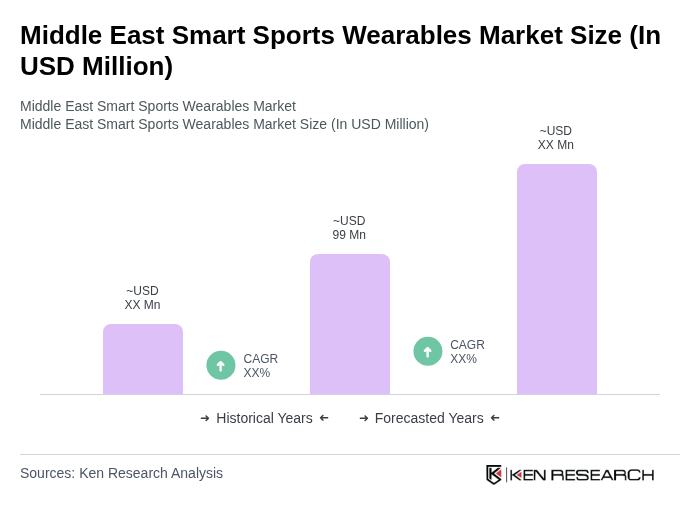
- The Middle East Smart Sports Wearables Market is valued at USD 99 million, based on a five-year historical analysis. This growth is primarily driven by increasing health consciousness among consumers, rapid technological advancements in wearable devices, and the rising popularity of fitness tracking applications. The market is also supported by a growing trend of integrating wearables with mobile health applications, enhancing user engagement and data collection.
- Key players in this market include the UAE, Saudi Arabia, and Qatar, which dominate due to their high disposable incomes, a strong focus on health and fitness, and government initiatives promoting sports and wellness. The UAE, in particular, has established itself as a hub for innovation and technology, attracting investments in smart wearables and fostering a culture of fitness among its population.
- The regulatory framework for smart sports wearables in the UAE is shaped by the "UAE Cabinet Resolution No. 32 of 2021 on the Regulation of Medical Devices and Products," issued by the Ministry of Health and Prevention. This regulation requires that wearable devices with health monitoring functions undergo registration and approval to ensure safety and compliance before being used in fitness centers and gyms. The regulation covers operational standards, device certification, and ongoing compliance monitoring for all wearable health technology deployed in commercial fitness environments.
Middle East Smart Sports Wearables Market Segmentation
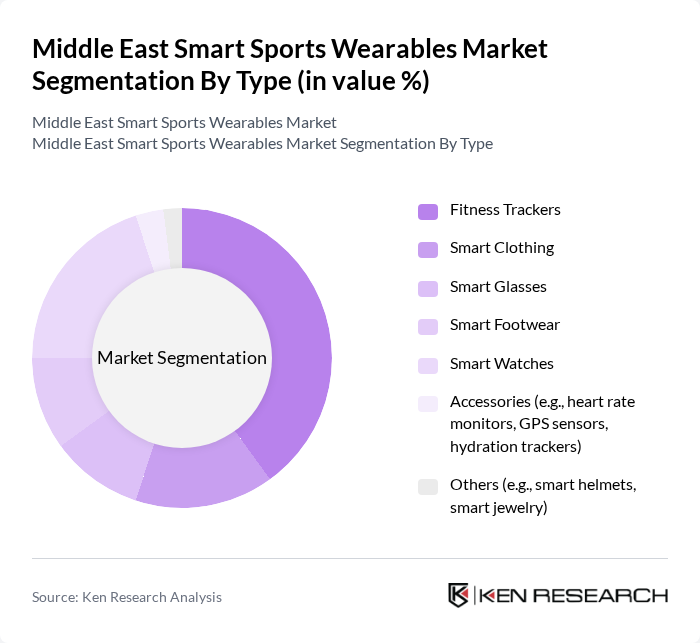
By Type:The market is segmented into various types of smart sports wearables, including fitness trackers, smart clothing, smart glasses, smart footwear, smart watches, accessories, and others. Among these,fitness trackersandsmart watchesare leading the market due to their affordability, ease of use, and growing consumer interest in personal health monitoring. Smart watches are also gaining traction, driven by their multifunctionality and integration with smartphones.
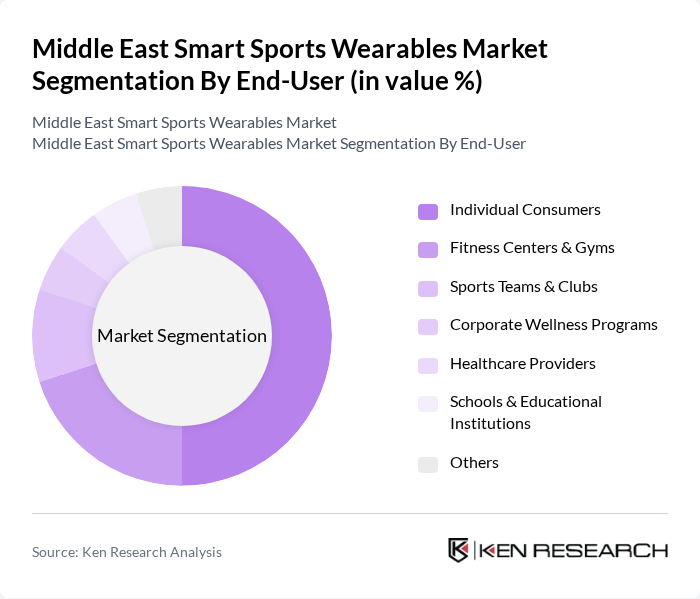
By End-User:The end-user segmentation includes individual consumers, fitness centers and gyms, sports teams and clubs, corporate wellness programs, healthcare providers, schools and educational institutions, and others.Individual consumersdominate the market, driven by the increasing trend of personal fitness and health monitoring. Fitness centers and gyms are also significant users, as they integrate wearables into their services to enhance member engagement and retention.
Middle East Smart Sports Wearables Market Competitive Landscape
The Middle East Smart Sports Wearables Market is characterized by a dynamic mix of regional and international players. Leading participants such as Garmin Ltd., Fitbit Inc. (Google LLC), Apple Inc., Samsung Electronics Co., Ltd., Xiaomi Corporation, Polar Electro Oy, Suunto Oy, Huawei Technologies Co., Ltd., Under Armour, Inc., Adidas AG, Nike, Inc., Withings SA, Whoop, Inc., Zepp Health Corporation (Amazfit), Lumo Bodytech Inc., Sony Middle East & Africa (Sony Corporation), Jawbone Health, Realme, Honor (Shenzhen Zhixin New Information Technology Co., Ltd.), Mobvoi Inc. contribute to innovation, geographic expansion, and service delivery in this space.
Middle East Smart Sports Wearables Market Industry Analysis
Growth Drivers
- Increasing Health Consciousness Among Consumers:The Middle East has seen a significant rise in health awareness, with 65% of the population actively seeking healthier lifestyles. According to the World Health Organization, obesity rates in the region have increased by 35% over the last decade, prompting consumers to invest in smart wearables. This trend is further supported by a report from the UAE Ministry of Health, indicating that 50% of adults are now using fitness tracking devices to monitor their health metrics.
- Rising Adoption of Fitness Tracking Technologies:The demand for fitness tracking technologies in the Middle East is surging, with an estimated 18 million wearables sold in 2023 alone. The International Data Corporation reported a 30% increase in shipments of smart wearables in the region, driven by younger demographics who prioritize fitness. This trend is expected to continue, as 75% of consumers express interest in integrating technology into their fitness routines, enhancing the market's growth potential.
- Technological Advancements in Wearable Devices:The Middle East is experiencing rapid technological advancements in smart wearables, with over 55 new products launched in 2023. Innovations such as real-time health monitoring and AI-driven analytics are attracting consumers. The region's investment in technology is projected to reach $2 billion in future, according to the Gulf Cooperation Council, further driving the adoption of advanced wearables that cater to diverse consumer needs and preferences.
Market Challenges
- High Cost of Advanced Wearables:The premium pricing of advanced smart wearables poses a significant challenge in the Middle East market. With average prices ranging from $250 to $600, many potential users are deterred from purchasing these devices. A report from the Middle East Consumer Electronics Association indicated that 45% of consumers cite cost as a barrier to entry, limiting market penetration and growth opportunities for manufacturers.
- Data Privacy and Security Concerns:Data privacy remains a critical challenge for the smart wearables market in the Middle East. A survey conducted by the Arab Digital Economy Report revealed that 70% of consumers are concerned about how their health data is used and shared. This apprehension is compounded by the lack of stringent regulations, leading to hesitance in adopting wearable technologies. Addressing these concerns is essential for fostering consumer trust and market growth.
Middle East Smart Sports Wearables Market Future Outlook
The future of the smart sports wearables market in the Middle East appears promising, driven by technological innovations and increasing health awareness. As consumers become more health-conscious, the demand for advanced wearables is expected to rise. Additionally, the integration of AI and machine learning will enhance user experience, making wearables more appealing. Companies that prioritize data security and affordability will likely capture a larger market share, paving the way for sustained growth in future.
Market Opportunities
- Expansion of E-commerce Platforms:The growth of e-commerce in the Middle East presents a significant opportunity for smart wearables. With online sales projected to reach $35 billion in future, brands can leverage digital channels to reach a broader audience. This shift allows for targeted marketing strategies and improved customer engagement, ultimately driving sales and brand loyalty in the wearables sector.
- Collaborations with Fitness Centers and Gyms:Partnerships with fitness centers and gyms can enhance the visibility and adoption of smart wearables. With over 1,500 fitness centers in the UAE alone, collaborations can facilitate product trials and promotions. This strategy not only boosts brand awareness but also encourages consumers to integrate wearables into their fitness routines, fostering a culture of health and fitness in the region.
Scope of the Report
| Segment | Sub-Segments |
|---|---|
| By Type | Fitness Trackers Smart Clothing Smart Glasses Smart Footwear Smart Watches Accessories (e.g., heart rate monitors, GPS sensors, hydration trackers) Others (e.g., smart helmets, smart jewelry) |
| By End-User | Individual Consumers Fitness Centers & Gyms Sports Teams & Clubs Corporate Wellness Programs Healthcare Providers Schools & Educational Institutions Others |
| By Gender | Male Female Unisex Others |
| By Age Group | Children (Below 12) Teenagers (13-19) Adults (20-59) Seniors (60+) Others |
| By Price Range | Budget (Below $100) Mid-Range ($100-$300) Premium (Above $300) Others |
| By Distribution Channel | Online Retail (E-commerce platforms, brand websites) Offline Retail (Specialty stores, sports outlets, electronics stores) Direct Sales (Corporate, institutional, B2B) Others (Pop-up events, exhibitions) |
| By Region | GCC Countries (Saudi Arabia, UAE, Qatar, Kuwait, Bahrain, Oman) Levant Region (Jordan, Lebanon, Iraq, Syria, Palestine) North Africa (Egypt, Morocco, Algeria, Tunisia) Others (Rest of Middle East & Africa) |
Key Target Audience
Investors and Venture Capitalist Firms
Government and Regulatory Bodies (e.g., Ministry of Sports, Ministry of Health)
Manufacturers and Producers
Distributors and Retailers
Fitness and Wellness Centers
Sports Teams and Organizations
Technology Providers
Health Insurance Companies
Players Mentioned in the Report:
Garmin Ltd.
Fitbit Inc. (Google LLC)
Apple Inc.
Samsung Electronics Co., Ltd.
Xiaomi Corporation
Polar Electro Oy
Suunto Oy
Huawei Technologies Co., Ltd.
Under Armour, Inc.
Adidas AG
Nike, Inc.
Withings SA
Whoop, Inc.
Zepp Health Corporation (Amazfit)
Lumo Bodytech Inc.
Sony Middle East & Africa (Sony Corporation)
Jawbone Health
Realme
Honor (Shenzhen Zhixin New Information Technology Co., Ltd.)
Mobvoi Inc.
Table of Contents
Market Assessment Phase
1. Executive Summary and Approach
2. Middle East Smart Sports Wearables Market Overview
2.1 Key Insights and Strategic Recommendations
2.2 Middle East Smart Sports Wearables Market Overview
2.3 Definition and Scope
2.4 Evolution of Market Ecosystem
2.5 Timeline of Key Regulatory Milestones
2.6 Value Chain & Stakeholder Mapping
2.7 Business Cycle Analysis
2.8 Policy & Incentive Landscape
3. Middle East Smart Sports Wearables Market Analysis
3.1 Growth Drivers
3.1.1 Increasing health consciousness among consumers
3.1.2 Rising adoption of fitness tracking technologies
3.1.3 Growth in sports participation and events
3.1.4 Technological advancements in wearable devices
3.2 Market Challenges
3.2.1 High cost of advanced wearables
3.2.2 Data privacy and security concerns
3.2.3 Limited awareness among potential users
3.2.4 Competition from traditional sports equipment
3.3 Market Opportunities
3.3.1 Expansion of e-commerce platforms
3.3.2 Collaborations with fitness centers and gyms
3.3.3 Development of personalized fitness solutions
3.3.4 Increasing government support for sports initiatives
3.4 Market Trends
3.4.1 Integration of AI and machine learning in wearables
3.4.2 Growth of smart clothing and textiles
3.4.3 Rise of social fitness applications
3.4.4 Focus on sustainability in product development
3.5 Government Regulation
3.5.1 Standards for health and safety in wearables
3.5.2 Regulations on data protection and privacy
3.5.3 Incentives for local manufacturing of wearables
3.5.4 Guidelines for marketing and advertising of fitness products
4. SWOT Analysis
5. Stakeholder Analysis
6. Porter's Five Forces Analysis
7. Middle East Smart Sports Wearables Market Market Size, 2019-2024
7.1 By Value
7.2 By Volume
7.3 By Average Selling Price
8. Middle East Smart Sports Wearables Market Segmentation
8.1 By Type
8.1.1 Fitness Trackers
8.1.2 Smart Clothing
8.1.3 Smart Glasses
8.1.4 Smart Footwear
8.1.5 Smart Watches
8.1.6 Accessories (e.g., heart rate monitors, GPS sensors, hydration trackers)
8.1.7 Others (e.g., smart helmets, smart jewelry)
8.2 By End-User
8.2.1 Individual Consumers
8.2.2 Fitness Centers & Gyms
8.2.3 Sports Teams & Clubs
8.2.4 Corporate Wellness Programs
8.2.5 Healthcare Providers
8.2.6 Schools & Educational Institutions
8.2.7 Others
8.3 By Gender
8.3.1 Male
8.3.2 Female
8.3.3 Unisex
8.3.4 Others
8.4 By Age Group
8.4.1 Children (Below 12)
8.4.2 Teenagers (13-19)
8.4.3 Adults (20-59)
8.4.4 Seniors (60+)
8.4.5 Others
8.5 By Price Range
8.5.1 Budget (Below $100)
8.5.2 Mid-Range ($100-$300)
8.5.3 Premium (Above $300)
8.5.4 Others
8.6 By Distribution Channel
8.6.1 Online Retail (E-commerce platforms, brand websites)
8.6.2 Offline Retail (Specialty stores, sports outlets, electronics stores)
8.6.3 Direct Sales (Corporate, institutional, B2B)
8.6.4 Others (Pop-up events, exhibitions)
8.7 By Region
8.7.1 GCC Countries (Saudi Arabia, UAE, Qatar, Kuwait, Bahrain, Oman)
8.7.2 Levant Region (Jordan, Lebanon, Iraq, Syria, Palestine)
8.7.3 North Africa (Egypt, Morocco, Algeria, Tunisia)
8.7.4 Others (Rest of Middle East & Africa)
9. Middle East Smart Sports Wearables Market Competitive Analysis
9.1 Market Share of Key Players
9.2 Cross Comparison of Key Players
9.2.1 Company Name
9.2.2 Group Size (Large, Medium, Small)
9.2.3 Revenue Growth Rate (YoY %)
9.2.4 Market Penetration Rate (Middle East share %)
9.2.5 Customer Retention Rate (%)
9.2.6 Pricing Strategy (Premium, Value, Mass Market)
9.2.7 Product Innovation Rate (New launches/year)
9.2.8 Brand Recognition Score (Survey-based index)
9.2.9 Distribution Efficiency (Retail coverage, channel diversity)
9.2.10 Customer Satisfaction Index (NPS or equivalent)
9.2.11 After-Sales Service Quality (Warranty, support ratings)
9.2.12 Local Partnerships/Presence (Offices, distributors in ME)
9.3 SWOT Analysis of Top Players
9.4 Pricing Analysis
9.5 Detailed Profile of Major Companies
9.5.1 Garmin Ltd.
9.5.2 Fitbit Inc. (Google LLC)
9.5.3 Apple Inc.
9.5.4 Samsung Electronics Co., Ltd.
9.5.5 Xiaomi Corporation
9.5.6 Polar Electro Oy
9.5.7 Suunto Oy
9.5.8 Huawei Technologies Co., Ltd.
9.5.9 Under Armour, Inc.
9.5.10 Adidas AG
9.5.11 Nike, Inc.
9.5.12 Withings SA
9.5.13 Whoop, Inc.
9.5.14 Zepp Health Corporation (Amazfit)
9.5.15 Lumo Bodytech Inc.
9.5.16 Sony Middle East & Africa (Sony Corporation)
9.5.17 Jawbone Health
9.5.18 Realme
9.5.19 Honor (Shenzhen Zhixin New Information Technology Co., Ltd.)
9.5.20 Mobvoi Inc.
10. Middle East Smart Sports Wearables Market End-User Analysis
10.1 Procurement Behavior of Key Ministries
10.1.1 Government initiatives for sports and fitness
10.1.2 Budget allocation for health and wellness programs
10.1.3 Partnerships with technology providers
10.1.4 Evaluation criteria for procurement
10.2 Corporate Spend on Infrastructure & Energy
10.2.1 Investment in employee wellness programs
10.2.2 Budget for fitness technology integration
10.2.3 Spending on health monitoring solutions
10.2.4 Others
10.3 Pain Point Analysis by End-User Category
10.3.1 Lack of awareness about wearables
10.3.2 High costs of advanced devices
10.3.3 Integration challenges with existing systems
10.3.4 Others
10.4 User Readiness for Adoption
10.4.1 Familiarity with technology
10.4.2 Willingness to invest in health
10.4.3 Availability of support and training
10.4.4 Others
10.5 Post-Deployment ROI and Use Case Expansion
10.5.1 Measurement of health outcomes
10.5.2 User engagement metrics
10.5.3 Expansion into new user segments
10.5.4 Others
11. Middle East Smart Sports Wearables Market Future Size, 2025-2030
11.1 By Value
11.2 By Volume
11.3 By Average Selling Price
Go-To-Market Strategy Phase
1. Whitespace Analysis + Business Model Canvas
1.1 Market Gaps Identification
1.2 Business Model Development
2. Marketing and Positioning Recommendations
2.1 Branding Strategies
2.2 Product USPs
3. Distribution Plan
3.1 Urban Retail vs Rural NGO Tie-ups
4. Channel & Pricing Gaps
4.1 Underserved Routes
4.2 Pricing Bands
5. Unmet Demand & Latent Needs
5.1 Category Gaps
5.2 Consumer Segments
6. Customer Relationship
6.1 Loyalty Programs
6.2 After-sales Service
7. Value Proposition
7.1 Sustainability
7.2 Integrated Supply Chains
8. Key Activities
8.1 Regulatory Compliance
8.2 Branding
8.3 Distribution Setup
9. Entry Strategy Evaluation
9.1 Domestic Market Entry Strategy
9.1.1 Product Mix
9.1.2 Pricing Band
9.1.3 Packaging
9.2 Export Entry Strategy
9.2.1 Target Countries
9.2.2 Compliance Roadmap
10. Entry Mode Assessment
10.1 JV
10.2 Greenfield
10.3 M&A
10.4 Distributor Model
11. Capital and Timeline Estimation
11.1 Capital Requirements
11.2 Timelines
12. Control vs Risk Trade-Off
12.1 Ownership vs Partnerships
13. Profitability Outlook
13.1 Breakeven Analysis
13.2 Long-term Sustainability
14. Potential Partner List
14.1 Distributors
14.2 JVs
14.3 Acquisition Targets
15. Execution Roadmap
15.1 Phased Plan for Market Entry
15.1.1 Market Setup
15.1.2 Market Entry
15.1.3 Growth Acceleration
15.1.4 Scale & Stabilize
15.2 Key Activities and Milestones
15.2.1 Milestone Planning
15.2.2 Activity Tracking
Research Methodology
Phase 1: Approach1
Desk Research
- Market reports from industry associations and research firms focusing on smart wearables in the Middle East
- Analysis of consumer behavior studies and trends in fitness and health technology
- Review of government publications and initiatives promoting health and fitness in the region
Primary Research
- Interviews with product managers at leading smart wearables manufacturers
- Surveys targeting fitness trainers and health professionals to understand user needs
- Focus groups with consumers to gather insights on preferences and purchasing behavior
Validation & Triangulation
- Cross-validation of findings through multiple data sources, including sales data and consumer feedback
- Triangulation of insights from primary interviews with secondary research findings
- Sanity checks conducted through expert panels comprising industry veterans and market analysts
Phase 2: Market Size Estimation1
Top-down Assessment
- Estimation of total addressable market based on regional health and fitness expenditure
- Segmentation of market size by product type, including fitness trackers, smart clothing, and health monitoring devices
- Incorporation of demographic data to assess potential market growth among different age groups
Bottom-up Modeling
- Collection of sales data from key retailers and e-commerce platforms in the region
- Estimation of average selling prices and unit sales for various smart wearable categories
- Analysis of consumer adoption rates and projected growth based on historical data
Forecasting & Scenario Analysis
- Utilization of time-series analysis to project market growth trends over the next five years
- Scenario modeling based on varying levels of consumer adoption and technological advancements
- Development of best-case, worst-case, and most-likely scenarios to inform strategic planning
Phase 3: CATI Sample Composition1
| Scope Item/Segment | Sample Size | Target Respondent Profiles |
|---|---|---|
| Consumer Fitness Wearables | 120 | Fitness Enthusiasts, Casual Users |
| Health Monitoring Devices | 90 | Healthcare Professionals, Patients |
| Smart Clothing Innovations | 60 | Fashion Designers, Tech Developers |
| Corporate Wellness Programs | 50 | HR Managers, Corporate Wellness Coordinators |
| Retail Market Insights | 70 | Retail Managers, E-commerce Specialists |
Frequently Asked Questions
What is the current value of the Middle East Smart Sports Wearables Market?
The Middle East Smart Sports Wearables Market is valued at approximately USD 99 million, reflecting a significant growth trend driven by increasing health consciousness, technological advancements, and the popularity of fitness tracking applications among consumers.
Which countries are leading in the Middle East Smart Sports Wearables Market?
What types of smart sports wearables are available in the market?
Who are the key players in the Middle East Smart Sports Wearables Market?
Other Regional/Country Reports
Indonesia Smart Sports Wearables Market
Malaysia Smart Sports Wearables Market
KSA Smart Sports Wearables Market
APAC Smart Sports Wearables Market
SEA Smart Sports Wearables Market
Vietnam Smart Sports Wearables Market
Other Adjacent Reports
Malaysia Fitness Tracking Applications Market
Indonesia Wearable Health Monitoring Market
Qatar smart clothing market report size, share, growth drivers, trends, opportunities & forecast 2025–2030Vietnam Sports Nutrition Market Report Size Share Growth Drivers Trends Opportunities & Forecast 2025–2030Belgium Corporate Wellness Programs Market
Japan E-commerce Platforms Market
Singapore AI in Fitness Technology Market
Malaysia Mobile Health Applications Market
KSA Gym and Fitness Centers Market
KSA Sports Performance Analytics Market
Why Buy From Us?

What makes us stand out is that our consultants follow Robust, Refine and Result (RRR) methodology. Robust for clear definitions, approaches and sanity checking, Refine for differentiating respondents' facts and opinions, and Result for presenting data with story.

We have set a benchmark in the industry by offering our clients with syndicated and customized market research reports featuring coverage of entire market as well as meticulous research and analyst insights.

While we don't replace traditional research, we flip the method upside down. Our dual approach of Top Bottom & Bottom Top ensures quality deliverable by not just verifying company fundamentals but also looking at the sector and macroeconomic factors.

With one step in the future, our research team constantly tries to show you the bigger picture. We help with some of the tough questions you may encounter along the way: How is the industry positioned? Best marketing channel? KPI's of competitors? By aligning every element, we help maximize success.

Our report gives you instant access to the answers and sources that other companies might choose to hide. We elaborate each steps of research methodology we have used and showcase you the sample size to earn your trust.

If you need any support, we are here! We pride ourselves on universe strength, data quality, and quick, friendly, and professional service.