About the Report
Base Year 2024New Zealand Brewer Spent Yeast Market Overview
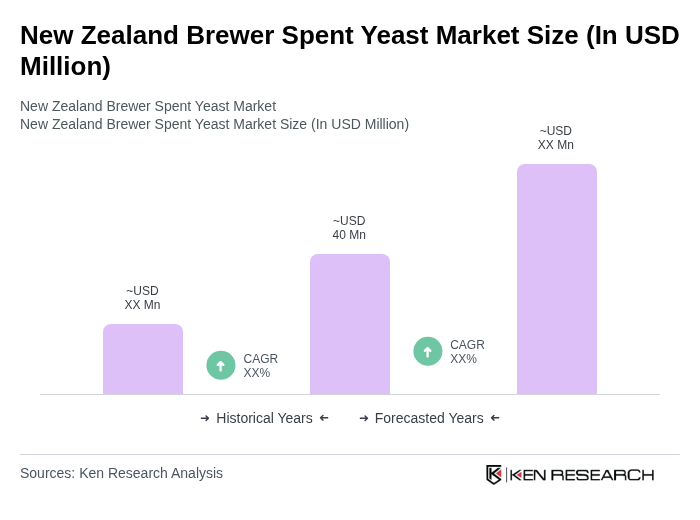
- The New Zealand Brewer Spent Yeast Market is valued at USD 40 million, based on a five-year historical analysis of New Zealand’s brewing output, the typical generation of brewer’s spent yeast as a co-product, and its valorization into animal feed and functional ingredients, benchmarked against the global brewer’s spent yeast and brewer’s yeast markets.This growth is primarily driven by the increasing demand for sustainable and nutritious animal feed, as well as the rising popularity of spent yeast as a functional ingredient in food, beverage, and pet nutrition applications, in line with global trends toward circular use of brewery by-products and high-value yeast derivatives.The market is also supported by the growing awareness of the health benefits associated with yeast-derived products, particularly proteins, B vitamins, beta-glucans, and mannan-oligosaccharides that are increasingly used in animal nutrition, functional foods, and nutraceuticals.
- Key hubs in this market include Auckland, Wellington, and Christchurch, which dominate due to their robust brewing industries and innovative approaches to utilizing spent yeast. Auckland hosts major breweries such as Lion and DB Breweries, Wellington has a high concentration of craft breweries, and Christchurch is an important center for malt and home-brewing supply, together creating strong demand for and supply of brewer’s spent yeast and related co-products.The concentration of breweries in these cities fosters collaboration and research around waste minimisation, co-product valorisation, and sustainable feed and ingredient solutions, enhancing overall market growth and product development in the region.
- To promote the sustainable use of brewing by-products, including spent yeast, the New Zealand government has established a regulatory and policy framework that emphasises waste minimisation, safe use of co-products in feed, and environmental protection. Under the Waste Minimisation Act 2008, administered by the Ministry for the Environment, businesses are encouraged and financially supported through levy-funded projects to reduce waste to landfill and increase the recovery and beneficial use of organic residues from industrial processes, including brewery by-products such as spent grain and spent yeast.In parallel, the Agricultural Compounds and Veterinary Medicines (ACVM) Act 1997, administered by the Ministry for Primary Industries, requires registration and approval of agricultural compounds placed on the market, ensuring that spent yeast and yeast-derived ingredients used as animal feed additives or nutritional supplements meet safety and performance standards.This framework encourages breweries to adopt eco‑friendly practices and supports the development of value-added spent yeast products, thereby enhancing the overall sustainability of the brewing industry.
New Zealand Brewer Spent Yeast Market Segmentation
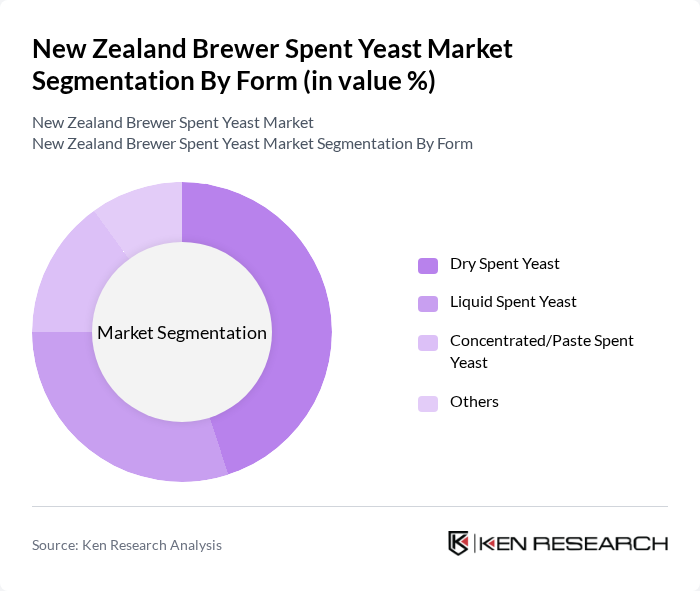
By Form:The market is segmented into various forms of spent yeast, including Dry Spent Yeast, Liquid Spent Yeast, Concentrated/Paste Spent Yeast, and Others. Among these, Dry Spent Yeast is the most dominant due to its longer shelf life, ease of transport, and versatility in various applications, particularly in compound animal feed, premixes, pet food, and functional food products, mirroring global preferences for dried or inactivated yeast formats.Liquid Spent Yeast is also gaining traction, especially in the beverage industry and on-farm uses, where it is used for fermentation processes or as a liquid feed ingredient close to the point of production.Concentrated/Paste Spent Yeast is preferred for its high nutrient content and dense protein and beta-glucan levels, making it suitable for specialized applications in aquaculture, pet nutrition, and fermentation-based ingredients, while the Others category includes blended or further processed yeast derivatives tailored for specific functional or bioactive benefits.
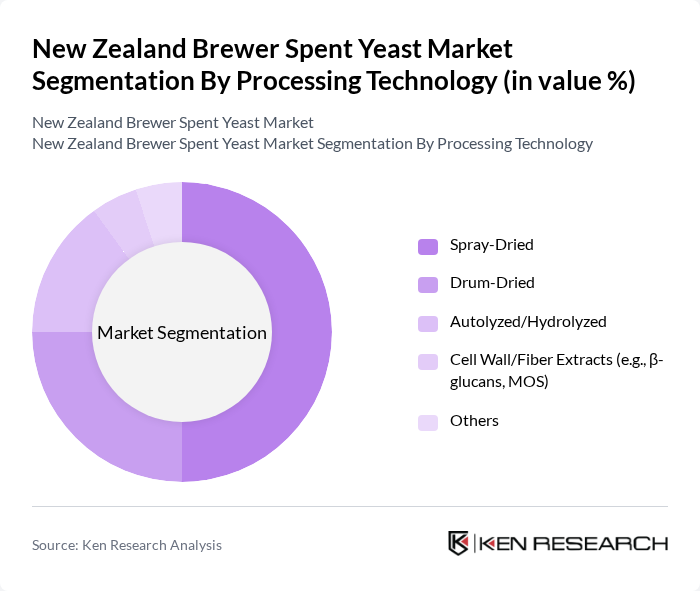
By Processing Technology:The processing technology segment includes Spray-Dried, Drum-Dried, Autolyzed/Hydrolyzed, Cell Wall/Fiber Extracts (e.g., β-glucans, MOS), and Others. Spray-Dried technology is leading the market due to its efficiency in preserving the nutritional value and functional properties of spent yeast while extending its shelf life and producing free‑flowing powders that are easy to handle in feed and food manufacturing, consistent with global industry practice for yeast-based ingredients.Drum-Dried is also significant, particularly for bulk applications in animal feed where slightly lower processing costs and robustness are prioritised over premium functionality.Autolyzed/Hydrolyzed products are gaining popularity for their enhanced digestibility, palatability, and bioavailability of amino acids, nucleotides, and peptides, supporting their use as flavour enhancers and functional components in pet food, aquafeed, and savoury food applications, while cell wall and fibre extracts rich in beta‑glucans and mannan-oligosaccharides are increasingly used as immunomodulatory and gut-health ingredients.
New Zealand Brewer Spent Yeast Market Competitive Landscape
The New Zealand Brewer Spent Yeast Market is characterized by a dynamic mix of regional and international players. Leading participants such as Lion Breweries (Lion New Zealand), DB Breweries, Asahi Beverages New Zealand, Independent Liquor (NZ) Ltd, Brewcraft NZ, Gladfield Malt, Fermentis, Lallemand Brewing, AB Mauri New Zealand, Lesaffre, Alltech, DSM-Firmenich, Archer Daniels Midland Company (ADM), Muntons, White Labs contribute to innovation, geographic expansion, and service delivery in this space.
New Zealand Brewer Spent Yeast Market Industry Analysis
Growth Drivers
- Increasing Demand for Sustainable Brewing Practices:The New Zealand brewing industry is increasingly adopting sustainable practices, with 60% of breweries implementing waste reduction strategies. This shift is driven by consumer preferences for eco-friendly products, as evidenced by a 30% rise in sales of organic beers in future. The government’s commitment to reducing carbon emissions by 30% in future further supports this trend, encouraging brewers to utilize spent yeast as a resource rather than waste.
- Rising Popularity of Craft Beers:The craft beer segment in New Zealand has seen a remarkable growth rate, with over 160 craft breweries operating. This surge is attributed to a growing consumer base that values unique flavors and local production. Craft breweries are increasingly using spent yeast for innovative brewing techniques, enhancing product offerings and driving demand for spent yeast as a valuable byproduct in the brewing process.
- Expanding Applications in Animal Feed:The utilization of brewer's spent yeast in animal feed is gaining traction, with the animal feed market in New Zealand projected to reach NZD 1.5 billion in future. Spent yeast is rich in protein and essential nutrients, making it an attractive ingredient for livestock feed. The New Zealand Ministry for Primary Industries supports this trend, promoting sustainable feed alternatives that can enhance animal health and productivity, thereby increasing the demand for spent yeast.
Market Challenges
- Fluctuating Raw Material Prices:The volatility in raw material prices poses a significant challenge for the spent yeast market. In future, the price of barley, a primary ingredient in brewing, surged by 15% due to adverse weather conditions affecting crop yields. This fluctuation impacts the cost of spent yeast production, making it difficult for producers to maintain stable pricing and profitability, ultimately affecting market growth.
- Regulatory Compliance Complexities:Navigating the regulatory landscape is a major hurdle for spent yeast producers. New Zealand's food safety regulations require stringent compliance, with over 200 specific guidelines governing the use of byproducts in food applications. The complexity of these regulations can lead to increased operational costs and delays in product development, hindering the market's ability to innovate and respond to consumer demands effectively.
New Zealand Brewer Spent Yeast Market Future Outlook
The future of the New Zealand brewer spent yeast market appears promising, driven by increasing consumer awareness of sustainability and health benefits. As the craft beer industry continues to flourish, brewers are likely to explore innovative uses for spent yeast, enhancing its value. Additionally, the growing trend towards circular economy practices will encourage more breweries to adopt spent yeast in various applications, including animal feed and health products, fostering a more sustainable industry landscape.
Market Opportunities
- Development of New Product Lines:There is significant potential for developing new product lines utilizing spent yeast, particularly in health supplements and functional foods. With the health and nutrition sector projected to grow by NZD 500 million in future, companies can capitalize on this trend by creating innovative products that leverage the nutritional benefits of spent yeast, appealing to health-conscious consumers.
- Export Potential to Asia-Pacific Markets:The Asia-Pacific region presents a lucrative export opportunity for New Zealand's spent yeast products. With a growing demand for sustainable food sources and animal feed, countries like Australia and Japan are increasingly seeking high-quality spent yeast. The New Zealand government’s trade initiatives aim to boost exports, potentially increasing market access and revenue for local producers.
Scope of the Report
| Segment | Sub-Segments |
|---|---|
| By Form | Dry Spent Yeast Liquid Spent Yeast Concentrated/Paste Spent Yeast Others |
| By Processing Technology | Spray-Dried Drum-Dried Autolyzed/Hydrolyzed Cell Wall/Fiber Extracts (e.g., ?-glucans, MOS) Others |
| By Application | Animal Feed & Aquaculture Food & Beverage Ingredients Nutraceuticals & Dietary Supplements Cosmetics & Personal Care Biofuels, Biogas & Industrial Bioproducts Others |
| By End-User Industry | Breweries & Beverage Manufacturers Animal Feed Manufacturers Food & Ingredient Manufacturers Nutraceutical & Pharmaceutical Companies Biotechnology & Bioenergy Companies Others |
| By Offtake/Distribution Channel | Direct B2B Contracts with Breweries Feed Integrators & Blenders Ingredient Distributors Online/Bulk Trading Platforms Others |
| By Quality & Certification | Food-Grade Feed-Grade Organic & Sustainable-Certified Conventional Others |
| By Region | North Island – Major Brewing Hubs South Island – Craft & Regional Breweries Others (Remote & Emerging Brewing Locations) |
Key Target Audience
Investors and Venture Capitalist Firms
Government and Regulatory Bodies (e.g., Ministry for Primary Industries, Environmental Protection Authority)
Brewing Companies
Food and Beverage Manufacturers
Biotechnology Firms
Waste Management Companies
Animal Feed Producers
Health and Nutraceutical Companies
Players Mentioned in the Report:
Lion Breweries (Lion New Zealand)
DB Breweries
Asahi Beverages New Zealand
Independent Liquor (NZ) Ltd
Brewcraft NZ
Gladfield Malt
Fermentis
Lallemand Brewing
AB Mauri New Zealand
Lesaffre
Alltech
DSM-Firmenich
Archer Daniels Midland Company (ADM)
Muntons
White Labs
Table of Contents
Market Assessment Phase
1. Executive Summary and Approach
2. New Zealand Brewer Spent Yeast Market Overview
2.1 Key Insights and Strategic Recommendations
2.2 New Zealand Brewer Spent Yeast Market Overview
2.3 Definition and Scope
2.4 Evolution of Market Ecosystem
2.5 Timeline of Key Regulatory Milestones
2.6 Value Chain & Stakeholder Mapping
2.7 Business Cycle Analysis
2.8 Policy & Incentive Landscape
3. New Zealand Brewer Spent Yeast Market Analysis
3.1 Growth Drivers
3.1.1 Increasing demand for sustainable brewing practices
3.1.2 Rising popularity of craft beers
3.1.3 Expanding applications in animal feed
3.1.4 Growth in the health and nutrition sector
3.2 Market Challenges
3.2.1 Fluctuating raw material prices
3.2.2 Regulatory compliance complexities
3.2.3 Limited consumer awareness
3.2.4 Competition from alternative protein sources
3.3 Market Opportunities
3.3.1 Development of new product lines
3.3.2 Export potential to Asia-Pacific markets
3.3.3 Collaborations with health food brands
3.3.4 Innovations in processing technologies
3.4 Market Trends
3.4.1 Shift towards circular economy practices
3.4.2 Increasing focus on nutritional benefits
3.4.3 Growth in online sales channels
3.4.4 Rising interest in fermentation-based products
3.5 Government Regulation
3.5.1 Food safety standards
3.5.2 Environmental regulations on waste management
3.5.3 Labeling requirements for health claims
3.5.4 Import/export regulations for food products
4. SWOT Analysis
5. Stakeholder Analysis
6. Porter's Five Forces Analysis
7. New Zealand Brewer Spent Yeast Market Market Size, 2019-2024
7.1 By Value
7.2 By Volume
7.3 By Average Selling Price
8. New Zealand Brewer Spent Yeast Market Segmentation
8.1 By Form
8.1.1 Dry Spent Yeast
8.1.2 Liquid Spent Yeast
8.1.3 Concentrated/Paste Spent Yeast
8.1.4 Others
8.2 By Processing Technology
8.2.1 Spray-Dried
8.2.2 Drum-Dried
8.2.3 Autolyzed/Hydrolyzed
8.2.4 Cell Wall/Fiber Extracts (e.g., ?-glucans, MOS)
8.2.5 Others
8.3 By Application
8.3.1 Animal Feed & Aquaculture
8.3.2 Food & Beverage Ingredients
8.3.3 Nutraceuticals & Dietary Supplements
8.3.4 Cosmetics & Personal Care
8.3.5 Biofuels, Biogas & Industrial Bioproducts
8.3.6 Others
8.4 By End-User Industry
8.4.1 Breweries & Beverage Manufacturers
8.4.2 Animal Feed Manufacturers
8.4.3 Food & Ingredient Manufacturers
8.4.4 Nutraceutical & Pharmaceutical Companies
8.4.5 Biotechnology & Bioenergy Companies
8.4.6 Others
8.5 By Offtake/Distribution Channel
8.5.1 Direct B2B Contracts with Breweries
8.5.2 Feed Integrators & Blenders
8.5.3 Ingredient Distributors
8.5.4 Online/Bulk Trading Platforms
8.5.5 Others
8.6 By Quality & Certification
8.6.1 Food-Grade
8.6.2 Feed-Grade
8.6.3 Organic & Sustainable-Certified
8.6.4 Conventional
8.6.5 Others
8.7 By Region
8.7.1 North Island – Major Brewing Hubs
8.7.2 South Island – Craft & Regional Breweries
8.7.3 Others (Remote & Emerging Brewing Locations)
9. New Zealand Brewer Spent Yeast Market Competitive Analysis
9.1 Market Share of Key Players
9.2 Cross Comparison of Key Players
9.2.1 Company Name
9.2.2 Group Size (Large, Medium, or Small as per industry convention)
9.2.3 New Zealand Brewer Spent Yeast Revenue (NZD, Latest FY)
9.2.4 3-Year Revenue CAGR from Spent Yeast-Derived Products
9.2.5 EBITDA Margin from Spent Yeast Business (%)
9.2.6 Share of Spent Yeast in Total Company Revenue (%)
9.2.7 Capex Intensity in Spent Yeast Processing (% of Sales)
9.2.8 R&D Spend on Spent Yeast Applications (% of Sales)
9.2.9 Export Revenue Share from Spent Yeast (%)
9.2.10 Average Realized Price per Tonne (NZD/tonne)
9.2.11 Installed Processing Capacity (Tonnes/Year)
9.2.12 Capacity Utilization Rate (%)
9.2.13 Customer Concentration (Top 5 Customers’ Revenue Share %)
9.2.14 Contract Coverage (Share of Offtake Under Long-Term Contracts %)
9.2.15 Innovation Index (Patents, New SKUs, New Applications – Score)
9.3 SWOT Analysis of Top Players
9.4 Pricing Analysis
9.5 Detailed Profile of Major Companies
9.5.1 Lion Breweries (Lion New Zealand)
9.5.2 DB Breweries
9.5.3 Asahi Beverages New Zealand
9.5.4 Independent Liquor (NZ) Ltd
9.5.5 Brewcraft NZ
9.5.6 Gladfield Malt
9.5.7 Fermentis
9.5.8 Lallemand Brewing
9.5.9 AB Mauri New Zealand
9.5.10 Lesaffre
9.5.11 Alltech
9.5.12 DSM-Firmenich
9.5.13 Archer Daniels Midland Company (ADM)
9.5.14 Muntons
9.5.15 White Labs
10. New Zealand Brewer Spent Yeast Market End-User Analysis
10.1 Procurement Behavior of Key Ministries
10.1.1 Government procurement policies
10.1.2 Budget allocation for brewing industry
10.1.3 Sustainability initiatives
10.1.4 Supplier evaluation criteria
10.2 Corporate Spend on Infrastructure & Energy
10.2.1 Investment in brewing technology
10.2.2 Energy efficiency measures
10.2.3 Infrastructure upgrades
10.2.4 Others
10.3 Pain Point Analysis by End-User Category
10.3.1 Cost management challenges
10.3.2 Quality control issues
10.3.3 Supply chain disruptions
10.3.4 Regulatory compliance burdens
10.4 User Readiness for Adoption
10.4.1 Awareness of spent yeast benefits
10.4.2 Willingness to switch suppliers
10.4.3 Training and support needs
10.4.4 Others
10.5 Post-Deployment ROI and Use Case Expansion
10.5.1 Measurement of ROI
10.5.2 Case studies of successful implementations
10.5.3 Opportunities for scaling
10.5.4 Others
11. New Zealand Brewer Spent Yeast Market Future Size, 2025-2030
11.1 By Value
11.2 By Volume
11.3 By Average Selling Price
Go-To-Market Strategy Phase
1. Whitespace Analysis + Business Model Canvas
1.1 Market gaps identification
1.2 Business model development
2. Marketing and Positioning Recommendations
2.1 Branding strategies
2.2 Product USPs
3. Distribution Plan
3.1 Urban retail vs rural NGO tie-ups
4. Channel & Pricing Gaps
4.1 Underserved routes
4.2 Pricing bands
5. Unmet Demand & Latent Needs
5.1 Category gaps
5.2 Consumer segments
6. Customer Relationship
6.1 Loyalty programs
6.2 After-sales service
7. Value Proposition
7.1 Sustainability
7.2 Integrated supply chains
8. Key Activities
8.1 Regulatory compliance
8.2 Branding
8.3 Distribution setup
9. Entry Strategy Evaluation
9.1 Domestic Market Entry Strategy
9.1.1 Product mix
9.1.2 Pricing band
9.1.3 Packaging
9.2 Export Entry Strategy
9.2.1 Target countries
9.2.2 Compliance roadmap
10. Entry Mode Assessment
10.1 JV
10.2 Greenfield
10.3 M&A
10.4 Distributor Model
11. Capital and Timeline Estimation
11.1 Capital requirements
11.2 Timelines
12. Control vs Risk Trade-Off
12.1 Ownership vs Partnerships
13. Profitability Outlook
13.1 Breakeven analysis
13.2 Long-term sustainability
14. Potential Partner List
14.1 Distributors
14.2 JVs
14.3 Acquisition targets
15. Execution Roadmap
15.1 Phased Plan for Market Entry
15.1.1 Market Setup
15.1.2 Market Entry
15.1.3 Growth Acceleration
15.1.4 Scale & Stabilize
15.2 Key Activities and Milestones
15.2.1 Milestone planning
15.2.2 Activity tracking
Research Methodology
Phase 1: Approach1
Desk Research
- Industry reports from New Zealand's Ministry for Primary Industries and relevant trade associations
- Published academic articles on yeast utilization in brewing and food industries
- Market analysis reports focusing on spent yeast applications and trends in New Zealand
Primary Research
- Interviews with brewers and fermentation specialists in New Zealand
- Surveys targeting suppliers and distributors of spent yeast products
- Field visits to breweries to observe spent yeast management practices
Validation & Triangulation
- Cross-validation of findings through multiple industry expert interviews
- Triangulation of data from trade publications, market reports, and expert insights
- Sanity checks through feedback from a panel of brewing industry experts
Phase 2: Market Size Estimation1
Top-down Assessment
- Analysis of the overall brewing market size in New Zealand and spent yeast's share
- Segmentation of the market by end-use applications such as animal feed, biofuels, and food additives
- Incorporation of trends in sustainability and circular economy initiatives affecting spent yeast usage
Bottom-up Modeling
- Volume estimates based on production data from major breweries in New Zealand
- Cost analysis of spent yeast processing and distribution channels
- Calculation of market size based on projected growth rates in brewing and related sectors
Forecasting & Scenario Analysis
- Multi-variable regression analysis incorporating factors like craft beer growth and regulatory changes
- Scenario modeling based on potential shifts in consumer preferences and sustainability practices
- Development of baseline, optimistic, and pessimistic forecasts through 2030
Phase 3: CATI Sample Composition1
| Scope Item/Segment | Sample Size | Target Respondent Profiles |
|---|---|---|
| Large Breweries | 60 | Brewery Owners, Production Managers |
| Craft Breweries | 50 | Head Brewers, Quality Control Managers |
| Spent Yeast Processors | 40 | Operations Managers, Product Development Leads |
| Animal Feed Manufacturers | 40 | Procurement Managers, Nutritionists |
| Research Institutions | 40 | Food Scientists, Sustainability Researchers |
Frequently Asked Questions
What is the current value of the New Zealand Brewer Spent Yeast Market?
The New Zealand Brewer Spent Yeast Market is valued at approximately USD 40 million, reflecting a five-year historical analysis of brewing output and the valorization of spent yeast into animal feed and functional ingredients.
What are the main drivers of growth in the New Zealand Brewer Spent Yeast Market?
Which cities are the main hubs for the Brewer Spent Yeast Market in New Zealand?
How does the New Zealand government support the Brewer Spent Yeast Market?
Other Regional/Country Reports
Other Adjacent Reports
Egypt Yeast Extracts Market
South Africa Brewing Ingredients Market
KSA craft beer market size, share, growth drivers, trends, opportunities & forecast 2025–2030UAE Food Additives MarketBelgium Sustainable Ingredients Market
Why Buy From Us?

What makes us stand out is that our consultants follow Robust, Refine and Result (RRR) methodology. Robust for clear definitions, approaches and sanity checking, Refine for differentiating respondents' facts and opinions, and Result for presenting data with story.

We have set a benchmark in the industry by offering our clients with syndicated and customized market research reports featuring coverage of entire market as well as meticulous research and analyst insights.

While we don't replace traditional research, we flip the method upside down. Our dual approach of Top Bottom & Bottom Top ensures quality deliverable by not just verifying company fundamentals but also looking at the sector and macroeconomic factors.

With one step in the future, our research team constantly tries to show you the bigger picture. We help with some of the tough questions you may encounter along the way: How is the industry positioned? Best marketing channel? KPI's of competitors? By aligning every element, we help maximize success.

Our report gives you instant access to the answers and sources that other companies might choose to hide. We elaborate each steps of research methodology we have used and showcase you the sample size to earn your trust.

If you need any support, we are here! We pride ourselves on universe strength, data quality, and quick, friendly, and professional service.