About the Report
Base Year 2024New Zealand Non Energy Based Aesthetic Treatment Market Overview
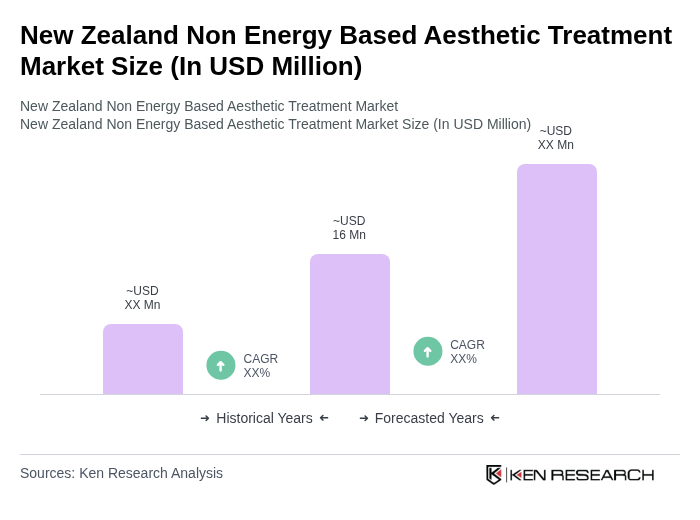
- The New Zealand Non Energy Based Aesthetic Treatment Market is valued at USD 16 million, based on a five-year historical analysis. This growth is primarily driven by increasing consumer demand for non-invasive aesthetic procedures, rising disposable incomes, growing awareness of personal grooming and aesthetics among the population, and rising popularity of injectables such as botulinum toxin and hyaluronic acid fillers.
- Auckland, Wellington, and Christchurch are the dominant cities in this market due to their higher population density, greater access to aesthetic clinics, and a more affluent consumer base that is willing to invest in aesthetic treatments. These urban centers also benefit from a concentration of skilled practitioners and advanced medical facilities.
- The Health (Cosmetic Procedures) Order 2023 issued by Medsafe, New Zealand Ministry of Health, regulates non-surgical cosmetic procedures including dermal fillers and botulinum toxin injections by restricting their supply to authorized prescribers and trained practitioners, requiring compliance with safety standards, practitioner registration, and facility licensing to ensure patient safety and service quality.
New Zealand Non Energy Based Aesthetic Treatment Market Segmentation
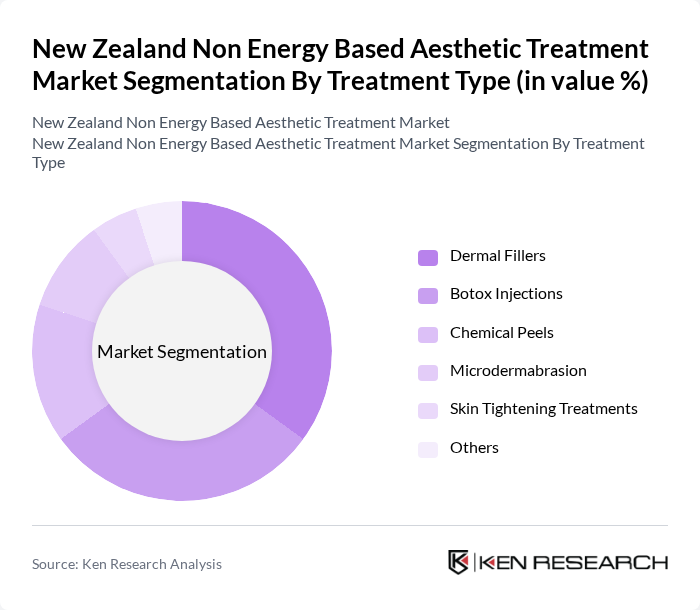
By Treatment Type:The market is segmented into various treatment types, including dermal fillers, Botox injections, chemical peels, microdermabrasion, skin tightening treatments, and others. Among these, dermal fillers and Botox injections are the most popular due to their effectiveness in enhancing facial aesthetics with minimal downtime. The increasing trend of preventive treatments among younger demographics is also contributing to the growth of these segments.
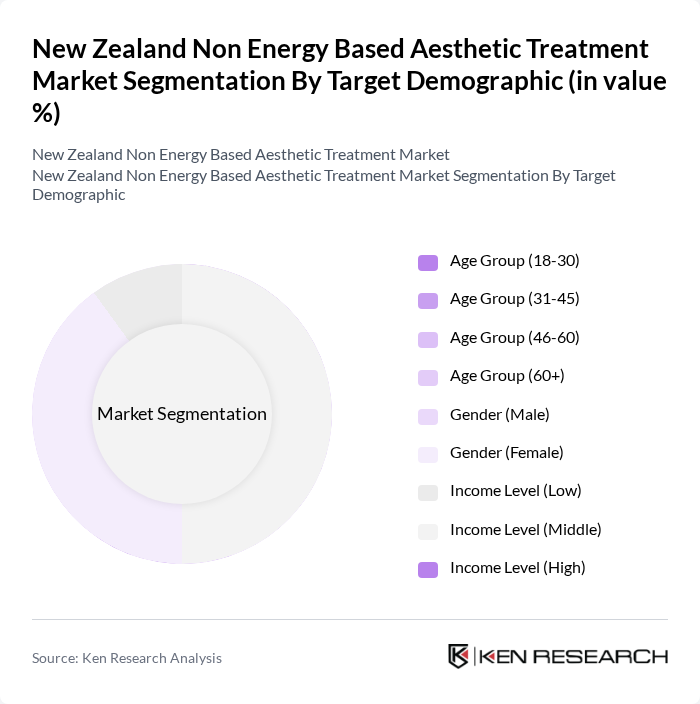
By Target Demographic:The target demographic for aesthetic treatments includes various age groups, genders, income levels, and others. The age group of 31-45 is particularly significant, as individuals in this range are increasingly seeking aesthetic enhancements to maintain a youthful appearance. Additionally, the market sees a growing trend of male clients opting for these treatments, reflecting a shift in societal norms regarding male grooming.
New Zealand Non Energy Based Aesthetic Treatment Market Competitive Landscape
The New Zealand Non Energy Based Aesthetic Treatment Market is characterized by a dynamic mix of regional and international players. Leading participants such as Skin Institute, The Face Place, Aesthetic Medical Centre, New Zealand Aesthetic Medicine, Cosmedics, The Cosmetic Clinic, Beauty & Aesthetics, Rejuvenation Clinics, Medispa, Skin Renewal, Aesthetic Solutions, The Aesthetic Clinic, Laser Clinics Australia, The Skin Centre, Aesthetic Medicine New Zealand contribute to innovation, geographic expansion, and service delivery in this space.
New Zealand Non Energy Based Aesthetic Treatment Market Industry Analysis
Growth Drivers
- Increasing Demand for Non-Invasive Procedures:The New Zealand aesthetic treatment market is witnessing a surge in demand for non-invasive procedures, with a reported increase of 15% in such treatments from the previous year to the current year. This trend is driven by consumer preferences for less invasive options that offer minimal downtime. According to the New Zealand Ministry of Health, the number of non-invasive procedures performed reached approximately 250,000, reflecting a growing acceptance and desire for aesthetic enhancements among the population.
- Rising Awareness of Aesthetic Treatments:Awareness of aesthetic treatments has significantly increased, with 60% of New Zealanders now familiar with various non-invasive options. This rise in awareness is attributed to enhanced marketing efforts and educational campaigns by clinics and practitioners. The New Zealand Aesthetic Association reported that inquiries about aesthetic treatments rose by 40%, indicating a shift in consumer attitudes towards self-care and beauty enhancement, particularly among younger demographics.
- Technological Advancements in Treatment Options:Technological innovations are transforming the aesthetic treatment landscape in New Zealand. In the current year, over 70 new devices and techniques were introduced, enhancing treatment efficacy and safety. The integration of advanced technologies, such as laser treatments and ultrasound therapies, has improved patient outcomes. The New Zealand Medical Technology Association noted that the market for aesthetic devices grew by NZD 30 million, reflecting the impact of these advancements on consumer choices and clinic offerings.
Market Challenges
- High Competition Among Providers:The aesthetic treatment market in New Zealand is characterized by intense competition, with over 1,200 registered clinics as of the current year. This saturation leads to price wars and reduced profit margins for providers. The New Zealand Aesthetic Industry Report indicated that 45% of clinics reported declining revenues due to competitive pressures, making it challenging for new entrants to establish a foothold in the market while maintaining service quality.
- Regulatory Compliance Issues:Navigating the regulatory landscape poses significant challenges for aesthetic treatment providers. The New Zealand Health and Disability Commissioner mandates strict compliance with safety and ethical standards, which can be costly and time-consuming. In the current year, approximately 30% of clinics faced compliance-related fines, averaging NZD 15,000 each. This regulatory burden can deter new investments and limit the growth potential of existing providers in the market.
New Zealand Non Energy Based Aesthetic Treatment Market Future Outlook
The future of the New Zealand non-energy based aesthetic treatment market appears promising, driven by ongoing consumer interest in aesthetic enhancements and the continuous evolution of treatment technologies. As the population ages, the demand for non-invasive procedures is expected to rise, particularly among older adults seeking rejuvenation. Additionally, the integration of personalized treatment plans and the growing influence of social media will likely shape consumer preferences, fostering a more dynamic and competitive market landscape in the coming years.
Market Opportunities
- Expansion of Service Offerings:Clinics have the opportunity to diversify their service offerings by incorporating complementary treatments, such as skincare and wellness programs. This strategy can attract a broader clientele and enhance customer loyalty, potentially increasing revenue by up to NZD 20 million annually for well-established clinics.
- Collaborations with Influencers and Social Media Marketing:Leveraging social media platforms for marketing can significantly enhance brand visibility. Collaborations with local influencers can drive engagement and attract younger demographics, potentially increasing client inquiries by 25% within six months, as evidenced by successful campaigns in the current year.
Scope of the Report
| Segment | Sub-Segments |
|---|---|
| By Treatment Type | Dermal Fillers Botox Injections Chemical Peels Microdermabrasion Skin Tightening Treatments Others |
| By Target Demographic | Age Group (18-30, 31-45, 46-60, 60+) Gender (Male, Female) Income Level (Low, Middle, High) Others |
| By Distribution Channel | Clinics Spas and Salons Online Platforms Others |
| By Geographic Region | North Island South Island Urban Areas Rural Areas |
| By Treatment Duration | Short-Term Treatments Long-Term Treatments Others |
| By Customer Type | First-Time Users Repeat Customers Others |
| By Service Package | Basic Packages Premium Packages Customized Packages Others |
Key Target Audience
Investors and Venture Capitalist Firms
Government and Regulatory Bodies (e.g., Ministry of Health, Medsafe)
Manufacturers and Producers
Distributors and Retailers
Medical Practitioners and Aesthetic Clinics
Technology Providers
Industry Associations (e.g., New Zealand Society of Cosmetic Medicine)
Financial Institutions
Players Mentioned in the Report:
Skin Institute
The Face Place
Aesthetic Medical Centre
New Zealand Aesthetic Medicine
Cosmedics
The Cosmetic Clinic
Beauty & Aesthetics
Rejuvenation Clinics
Medispa
Skin Renewal
Aesthetic Solutions
The Aesthetic Clinic
Laser Clinics Australia
The Skin Centre
Aesthetic Medicine New Zealand
Table of Contents
Market Assessment Phase
1. Executive Summary and Approach
2. New Zealand Non Energy Based Aesthetic Treatment Market Overview
2.1 Key Insights and Strategic Recommendations
2.2 New Zealand Non Energy Based Aesthetic Treatment Market Overview
2.3 Definition and Scope
2.4 Evolution of Market Ecosystem
2.5 Timeline of Key Regulatory Milestones
2.6 Value Chain & Stakeholder Mapping
2.7 Business Cycle Analysis
2.8 Policy & Incentive Landscape
3. New Zealand Non Energy Based Aesthetic Treatment Market Analysis
3.1 Growth Drivers
3.1.1 Increasing Demand for Non-Invasive Procedures
3.1.2 Rising Awareness of Aesthetic Treatments
3.1.3 Technological Advancements in Treatment Options
3.1.4 Growth of Medical Tourism in New Zealand
3.2 Market Challenges
3.2.1 High Competition Among Providers
3.2.2 Regulatory Compliance Issues
3.2.3 Economic Fluctuations Affecting Consumer Spending
3.2.4 Limited Insurance Coverage for Aesthetic Treatments
3.3 Market Opportunities
3.3.1 Expansion of Service Offerings
3.3.2 Collaborations with Influencers and Social Media Marketing
3.3.3 Development of Customized Treatment Plans
3.3.4 Increasing Investment in Research and Development
3.4 Market Trends
3.4.1 Growing Popularity of Natural and Organic Products
3.4.2 Rise of At-Home Aesthetic Treatment Devices
3.4.3 Focus on Holistic and Wellness Approaches
3.4.4 Integration of AI and Machine Learning in Treatment Planning
3.5 Government Regulation
3.5.1 Licensing Requirements for Practitioners
3.5.2 Safety Standards for Aesthetic Products
3.5.3 Advertising Regulations for Aesthetic Treatments
3.5.4 Patient Consent and Privacy Regulations
4. SWOT Analysis
5. Stakeholder Analysis
6. Porter's Five Forces Analysis
7. New Zealand Non Energy Based Aesthetic Treatment Market Market Size, 2019-2024
7.1 By Value
7.2 By Volume
7.3 By Average Selling Price
8. New Zealand Non Energy Based Aesthetic Treatment Market Segmentation
8.1 By Treatment Type
8.1.1 Dermal Fillers
8.1.2 Botox Injections
8.1.3 Chemical Peels
8.1.4 Microdermabrasion
8.1.5 Skin Tightening Treatments
8.1.6 Others
8.2 By Target Demographic
8.2.1 Age Group (18-30, 31-45, 46-60, 60+)
8.2.2 Gender (Male, Female)
8.2.3 Income Level (Low, Middle, High)
8.2.4 Others
8.3 By Distribution Channel
8.3.1 Clinics
8.3.2 Spas and Salons
8.3.3 Online Platforms
8.3.4 Others
8.4 By Geographic Region
8.4.1 North Island
8.4.2 South Island
8.4.3 Urban Areas
8.4.4 Rural Areas
8.5 By Treatment Duration
8.5.1 Short-Term Treatments
8.5.2 Long-Term Treatments
8.5.3 Others
8.6 By Customer Type
8.6.1 First-Time Users
8.6.2 Repeat Customers
8.6.3 Others
8.7 By Service Package
8.7.1 Basic Packages
8.7.2 Premium Packages
8.7.3 Customized Packages
8.7.4 Others
9. New Zealand Non Energy Based Aesthetic Treatment Market Competitive Analysis
9.1 Market Share of Key Players
9.2 Cross Comparison of Key Players
9.2.1 Company Name
9.2.2 Group Size (Large, Medium, or Small as per industry convention)
9.2.3 Revenue Growth Rate
9.2.4 Customer Retention Rate
9.2.5 Market Penetration Rate
9.2.6 Average Treatment Cost
9.2.7 Pricing Strategy
9.2.8 Customer Satisfaction Score
9.2.9 Brand Recognition Index
9.2.10 Treatment Efficacy Rate
9.3 SWOT Analysis of Top Players
9.4 Pricing Analysis
9.5 Detailed Profile of Major Companies
9.5.1 Skin Institute
9.5.2 The Face Place
9.5.3 Aesthetic Medical Centre
9.5.4 New Zealand Aesthetic Medicine
9.5.5 Cosmedics
9.5.6 The Cosmetic Clinic
9.5.7 Beauty & Aesthetics
9.5.8 Rejuvenation Clinics
9.5.9 Medispa
9.5.10 Skin Renewal
9.5.11 Aesthetic Solutions
9.5.12 The Aesthetic Clinic
9.5.13 Laser Clinics Australia
9.5.14 The Skin Centre
9.5.15 Aesthetic Medicine New Zealand
10. New Zealand Non Energy Based Aesthetic Treatment Market End-User Analysis
10.1 Procurement Behavior of Key Ministries
10.1.1 Budget Allocation for Aesthetic Treatments
10.1.2 Decision-Making Process
10.1.3 Preferred Treatment Providers
10.1.4 Others
10.2 Corporate Spend on Infrastructure & Energy
10.2.1 Investment in Aesthetic Facilities
10.2.2 Spending on Marketing and Promotions
10.2.3 Others
10.3 Pain Point Analysis by End-User Category
10.3.1 Accessibility of Treatments
10.3.2 Affordability Concerns
10.3.3 Quality of Service
10.3.4 Others
10.4 User Readiness for Adoption
10.4.1 Awareness of Non-Invasive Treatments
10.4.2 Willingness to Pay
10.4.3 Others
10.5 Post-Deployment ROI and Use Case Expansion
10.5.1 Measurement of Treatment Outcomes
10.5.2 Customer Feedback Mechanisms
10.5.3 Others
11. New Zealand Non Energy Based Aesthetic Treatment Market Future Size, 2025-2030
11.1 By Value
11.2 By Volume
11.3 By Average Selling Price
Go-To-Market Strategy Phase
1. Whitespace Analysis + Business Model Canvas
1.1 Market Gaps Identification
1.2 Business Model Development
2. Marketing and Positioning Recommendations
2.1 Branding Strategies
2.2 Product USPs
3. Distribution Plan
3.1 Urban Retail vs Rural NGO Tie-Ups
4. Channel & Pricing Gaps
4.1 Underserved Routes
4.2 Pricing Bands
5. Unmet Demand & Latent Needs
5.1 Category Gaps
5.2 Consumer Segments
6. Customer Relationship
6.1 Loyalty Programs
6.2 After-Sales Service
7. Value Proposition
7.1 Sustainability
7.2 Integrated Supply Chains
8. Key Activities
8.1 Regulatory Compliance
8.2 Branding
8.3 Distribution Setup
9. Entry Strategy Evaluation
9.1 Domestic Market Entry Strategy
9.1.1 Product Mix
9.1.2 Pricing Band
9.1.3 Packaging
9.2 Export Entry Strategy
9.2.1 Target Countries
9.2.2 Compliance Roadmap
10. Entry Mode Assessment
10.1 JV
10.2 Greenfield
10.3 M&A
10.4 Distributor Model
11. Capital and Timeline Estimation
11.1 Capital Requirements
11.2 Timelines
12. Control vs Risk Trade-Off
12.1 Ownership vs Partnerships
13. Profitability Outlook
13.1 Breakeven Analysis
13.2 Long-Term Sustainability
14. Potential Partner List
14.1 Distributors
14.2 JVs
14.3 Acquisition Targets
15. Execution Roadmap
15.1 Phased Plan for Market Entry
15.1.1 Market Setup
15.1.2 Market Entry
15.1.3 Growth Acceleration
15.1.4 Scale & Stabilize
15.2 Key Activities and Milestones
15.2.1 Milestone Planning
15.2.2 Activity Tracking
Research Methodology
Phase 1: Approach1
Desk Research
- Analysis of industry reports from New Zealand's Ministry of Health and aesthetic treatment associations
- Review of market trends and consumer behavior studies published in local journals
- Examination of demographic data and economic indicators relevant to non-energy based aesthetic treatments
Primary Research
- Interviews with dermatologists and aesthetic practitioners across New Zealand
- Surveys targeting patients who have undergone non-energy based aesthetic treatments
- Focus groups with industry stakeholders, including clinic owners and beauty therapists
Validation & Triangulation
- Cross-validation of findings through multiple expert interviews and patient surveys
- Triangulation of data from industry reports, expert opinions, and consumer feedback
- Sanity checks conducted through peer reviews and expert panel discussions
Phase 2: Market Size Estimation1
Top-down Assessment
- Estimation of market size based on national healthcare expenditure and beauty industry growth rates
- Segmentation of the market by treatment types, including injectables, fillers, and skin rejuvenation
- Incorporation of demographic trends and consumer spending patterns on aesthetic treatments
Bottom-up Modeling
- Collection of treatment volume data from leading aesthetic clinics and practitioners
- Operational cost analysis based on pricing models for various non-energy based treatments
- Calculation of market size using treatment volume multiplied by average treatment costs
Forecasting & Scenario Analysis
- Multi-factor regression analysis incorporating factors such as aging population and rising disposable income
- Scenario modeling based on potential regulatory changes and shifts in consumer preferences
- Development of baseline, optimistic, and pessimistic market projections through 2030
Phase 3: CATI Sample Composition1
| Scope Item/Segment | Sample Size | Target Respondent Profiles |
|---|---|---|
| Injectable Treatments | 150 | Dermatologists, Cosmetic Surgeons |
| Skin Rejuvenation Procedures | 100 | Beauty Therapists, Clinic Managers |
| Patient Experience Surveys | 120 | Recent Patients, Aesthetic Treatment Recipients |
| Market Trends Analysis | 80 | Industry Analysts, Market Researchers |
| Regulatory Impact Assessment | 50 | Healthcare Policy Makers, Regulatory Experts |
Frequently Asked Questions
What is the current value of the New Zealand Non Energy Based Aesthetic Treatment Market?
The New Zealand Non Energy Based Aesthetic Treatment Market is valued at approximately USD 16 million, reflecting a growing consumer demand for non-invasive aesthetic procedures and rising disposable incomes among the population.
Which cities dominate the New Zealand Non Energy Based Aesthetic Treatment Market?
What types of treatments are included in the New Zealand Non Energy Based Aesthetic Treatment Market?
What demographic trends are influencing the New Zealand Non Energy Based Aesthetic Treatment Market?
Other Regional/Country Reports
Other Adjacent Reports
UAE Energy Based Aesthetic Treatment Market
Brazil Cosmetic Surgery Market
Philippines Dermatology Services Market
UAE Skincare Products MarketMexico Anti-Aging Products Market
Brazil Medical Spa Services Market
KSA Cosmetic Injectables Market
Indonesia Beauty Devices Market
South Korea Wellness Services Market
Bahrain Facial Aesthetics Market
Why Buy From Us?

What makes us stand out is that our consultants follow Robust, Refine and Result (RRR) methodology. Robust for clear definitions, approaches and sanity checking, Refine for differentiating respondents' facts and opinions, and Result for presenting data with story.

We have set a benchmark in the industry by offering our clients with syndicated and customized market research reports featuring coverage of entire market as well as meticulous research and analyst insights.

While we don't replace traditional research, we flip the method upside down. Our dual approach of Top Bottom & Bottom Top ensures quality deliverable by not just verifying company fundamentals but also looking at the sector and macroeconomic factors.

With one step in the future, our research team constantly tries to show you the bigger picture. We help with some of the tough questions you may encounter along the way: How is the industry positioned? Best marketing channel? KPI's of competitors? By aligning every element, we help maximize success.

Our report gives you instant access to the answers and sources that other companies might choose to hide. We elaborate each steps of research methodology we have used and showcase you the sample size to earn your trust.

If you need any support, we are here! We pride ourselves on universe strength, data quality, and quick, friendly, and professional service.