About the Report
Base Year 2024Listen to the audio summary
New Zealand Non Injectable Insulin Market Overview
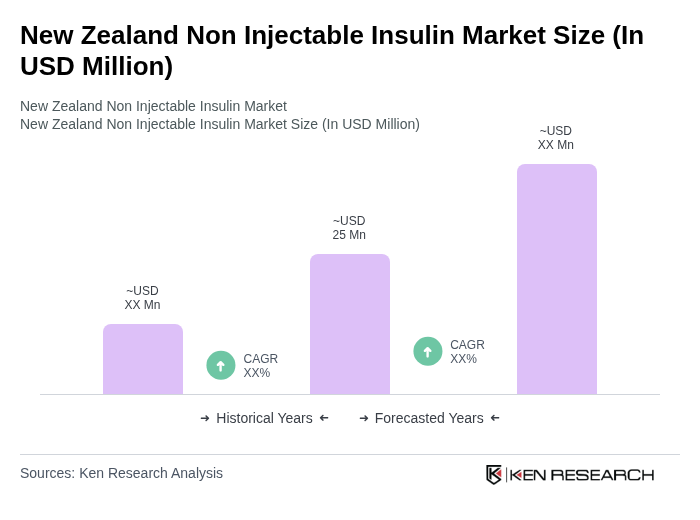
- The New Zealand Non Injectable Insulin Market is valued at USD 25 million, based on a five-year historical analysis. This growth is primarily driven by the increasing prevalence of diabetes, rising awareness about diabetes management, advancements in non-injectable insulin formulations, and expanding access to innovative delivery technologies like inhaled insulin. The market has seen a shift towards more patient-friendly options, which has contributed to its expansion.
- Auckland, Wellington, and Christchurch are the dominant cities in the New Zealand Non Injectable Insulin Market. Auckland leads due to its large population and healthcare infrastructure, while Wellington and Christchurch benefit from their strategic locations and access to healthcare services. The concentration of healthcare facilities and diabetes care programs in these cities further enhances their market dominance.
- The Medicines Act 1981, administered by Medsafe under the Ministry of Health, governs the approval, subsidy, and distribution of non-injectable insulin products. This requires all therapeutic products to obtain registration through demonstrated safety, quality, and efficacy standards prior to market entry, with subsidized access via the Pharmaceutical Management Agency for eligible patients to support adherence in diabetes management.
New Zealand Non Injectable Insulin Market Segmentation
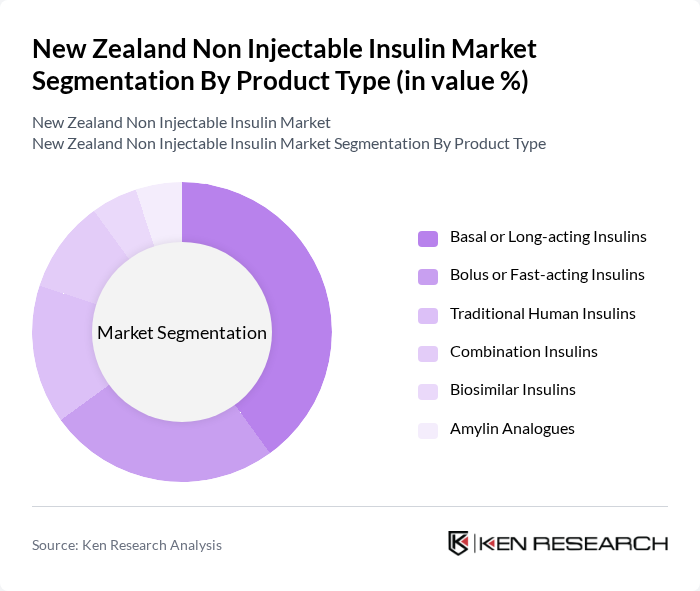
By Product Type:The product type segmentation includes various forms of non-injectable insulin, each catering to different patient needs and preferences. The subsegments are Basal or Long-acting Insulins, Bolus or Fast-acting Insulins, Traditional Human Insulins, Combination Insulins, Biosimilar Insulins, and Amylin Analogues. Among these, Basal or Long-acting Insulins dominate the market due to their convenience and effectiveness in maintaining stable blood glucose levels over extended periods. Patients prefer these formulations for their ease of use and reduced frequency of administration.
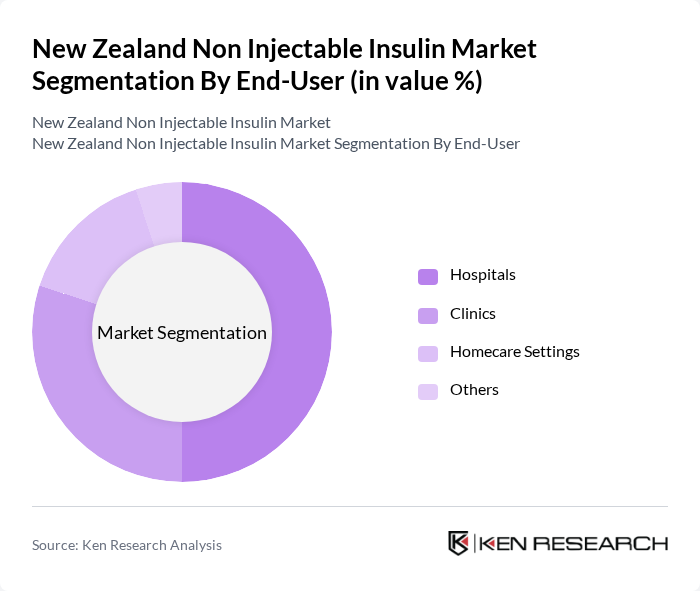
By End-User:The end-user segmentation encompasses various settings where non-injectable insulin is utilized, including Hospitals, Clinics, Homecare Settings, and Others. Hospitals are the leading end-user segment, as they provide comprehensive diabetes management services and have the necessary infrastructure to support the administration of non-injectable insulin. The increasing number of diabetes patients seeking treatment in hospitals contributes significantly to this segment's growth.
New Zealand Non Injectable Insulin Market Competitive Landscape
The New Zealand Non Injectable Insulin Market is characterized by a dynamic mix of regional and international players. Leading participants such as Novo Nordisk, Sanofi, Eli Lilly and Company, Boehringer Ingelheim, AstraZeneca, Roche, Medtronic, Insulet Corporation, Tandem Diabetes Care, Zealand Pharma, Valeritas Holdings, Abbott Laboratories, Johnson & Johnson, Bayer AG, Merck & Co. contribute to innovation, geographic expansion, and service delivery in this space.
New Zealand Non Injectable Insulin Market Industry Analysis
Growth Drivers
- Increasing Prevalence of Diabetes:The prevalence of diabetes in New Zealand is projected to reach approximately 300,000 cases in future, driven by lifestyle factors and an aging population. According to the Ministry of Health, around 7.4% of adults aged 15 and over are diagnosed with diabetes. This rising incidence creates a significant demand for effective management solutions, including non-injectable insulin, which is perceived as a more patient-friendly alternative to traditional methods.
- Rising Demand for Non-Invasive Treatment Options:A growing segment of the diabetic population is seeking non-invasive treatment alternatives, with a reported 60% of patients expressing a preference for non-injectable insulin methods. This shift is influenced by the discomfort and anxiety associated with injections. The New Zealand government’s health initiatives are also promoting non-invasive therapies, aligning with patient preferences and enhancing adherence to treatment regimens, thereby driving market growth.
- Technological Advancements in Insulin Delivery:Innovations in insulin delivery systems, such as inhalable insulin and smart insulin pens, are transforming diabetes management. In future, it is estimated that the market for advanced insulin delivery systems will exceed NZD 150 million. These technologies not only improve patient compliance but also enhance glycemic control, making non-injectable options more appealing to both patients and healthcare providers, thus propelling market expansion.
Market Challenges
- High Cost of Non-Injectable Insulin Products:The average cost of non-injectable insulin products in New Zealand can reach up to NZD 300 per month, which poses a significant barrier for many patients. With approximately 20% of the diabetic population living below the poverty line, affordability remains a critical challenge. This high cost limits access and adoption, particularly among lower-income groups, hindering overall market growth.
- Limited Availability in Rural Areas:Access to non-injectable insulin products is significantly restricted in rural regions of New Zealand, where healthcare facilities are sparse. According to the New Zealand Health Survey, about 15% of the population resides in rural areas, often facing challenges in obtaining necessary medications. This geographical disparity in availability creates a substantial challenge for market penetration and patient adherence to treatment plans.
New Zealand Non Injectable Insulin Market Future Outlook
The future of the New Zealand non-injectable insulin market appears promising, driven by increasing technological advancements and a shift towards patient-centric healthcare solutions. As telehealth services expand, more patients will have access to innovative diabetes management tools. Additionally, the integration of artificial intelligence in treatment plans is expected to enhance personalized care, improving patient outcomes. These trends indicate a robust growth trajectory for non-injectable insulin products in the coming years.
Market Opportunities
- Expansion of Telehealth Services for Diabetes Management:The rise of telehealth services presents a significant opportunity for the non-injectable insulin market. With over 1.5 million telehealth consultations conducted in future, the potential for remote monitoring and management of diabetes is substantial. This trend can facilitate better patient engagement and adherence to non-injectable therapies, ultimately driving market growth.
- Partnerships with Healthcare Providers:Collaborations between non-injectable insulin manufacturers and healthcare providers can enhance product visibility and accessibility. In future, it is anticipated that at least 30% of healthcare providers will actively promote non-injectable options, leveraging their networks to educate patients. Such partnerships can significantly increase market penetration and foster a supportive ecosystem for diabetes management.
Scope of the Report
| Segment | Sub-Segments |
|---|---|
| By Product Type | Basal or Long-acting Insulins Bolus or Fast-acting Insulins Traditional Human Insulins Combination Insulins Biosimilar Insulins Amylin Analogues |
| By End-User | Hospitals Clinics Homecare Settings Others |
| By Distribution Channel | Retail Pharmacies Online Pharmacies Hospitals and Clinics Others |
| By Demographics | Age Group (Children, Adults, Seniors) Gender (Male, Female) Others |
| By Geography | North Island South Island Others |
| By Product Formulation | Liquid Formulations Powder Formulations Others |
| By Pricing Strategy | Premium Pricing Competitive Pricing Others |
Key Target Audience
Investors and Venture Capitalist Firms
Government and Regulatory Bodies (e.g., Medsafe, Ministry of Health)
Manufacturers and Producers
Distributors and Retailers
Pharmaceutical Wholesalers
Healthcare Providers and Clinics
Health Insurance Companies
Industry Associations (e.g., Diabetes New Zealand)
Players Mentioned in the Report:
Novo Nordisk
Sanofi
Eli Lilly and Company
Boehringer Ingelheim
AstraZeneca
Roche
Medtronic
Insulet Corporation
Tandem Diabetes Care
Zealand Pharma
Valeritas Holdings
Abbott Laboratories
Johnson & Johnson
Bayer AG
Merck & Co.
Table of Contents
Market Assessment Phase
1. Executive Summary and Approach
2. New Zealand Non Injectable Insulin Market Overview
2.1 Key Insights and Strategic Recommendations
2.2 New Zealand Non Injectable Insulin Market Overview
2.3 Definition and Scope
2.4 Evolution of Market Ecosystem
2.5 Timeline of Key Regulatory Milestones
2.6 Value Chain & Stakeholder Mapping
2.7 Business Cycle Analysis
2.8 Policy & Incentive Landscape
3. New Zealand Non Injectable Insulin Market Analysis
3.1 Growth Drivers
3.1.1 Increasing prevalence of diabetes
3.1.2 Rising demand for non-invasive treatment options
3.1.3 Technological advancements in insulin delivery
3.1.4 Growing awareness and education on diabetes management
3.2 Market Challenges
3.2.1 High cost of non-injectable insulin products
3.2.2 Limited availability in rural areas
3.2.3 Regulatory hurdles for new product approvals
3.2.4 Competition from traditional injectable insulin
3.3 Market Opportunities
3.3.1 Expansion of telehealth services for diabetes management
3.3.2 Partnerships with healthcare providers
3.3.3 Development of personalized insulin therapies
3.3.4 Increasing investment in diabetes research and innovation
3.4 Market Trends
3.4.1 Shift towards patient-centric healthcare solutions
3.4.2 Growth of digital health applications for diabetes
3.4.3 Rising focus on preventive healthcare
3.4.4 Integration of AI in diabetes management
3.5 Government Regulation
3.5.1 Guidelines for insulin product approval
3.5.2 Subsidies for diabetes treatment
3.5.3 Regulations on advertising and marketing of insulin products
3.5.4 Policies promoting diabetes education and awareness
4. SWOT Analysis
5. Stakeholder Analysis
6. Porter's Five Forces Analysis
7. New Zealand Non Injectable Insulin Market Market Size, 2019-2024
7.1 By Value
7.2 By Volume
7.3 By Average Selling Price
8. New Zealand Non Injectable Insulin Market Segmentation
8.1 By Product Type
8.1.1 Basal or Long-acting Insulins
8.1.2 Bolus or Fast-acting Insulins
8.1.3 Traditional Human Insulins
8.1.4 Combination Insulins
8.1.5 Biosimilar Insulins
8.1.6 Amylin Analogues
8.2 By End-User
8.2.1 Hospitals
8.2.2 Clinics
8.2.3 Homecare Settings
8.2.4 Others
8.3 By Distribution Channel
8.3.1 Retail Pharmacies
8.3.2 Online Pharmacies
8.3.3 Hospitals and Clinics
8.3.4 Others
8.4 By Demographics
8.4.1 Age Group (Children, Adults, Seniors)
8.4.2 Gender (Male, Female)
8.4.3 Others
8.5 By Geography
8.5.1 North Island
8.5.2 South Island
8.5.3 Others
8.6 By Product Formulation
8.6.1 Liquid Formulations
8.6.2 Powder Formulations
8.6.3 Others
8.7 By Pricing Strategy
8.7.1 Premium Pricing
8.7.2 Competitive Pricing
8.7.3 Others
9. New Zealand Non Injectable Insulin Market Competitive Analysis
9.1 Market Share of Key Players
9.2 Cross Comparison of Key Players
9.2.1 Company Name
9.2.2 Market Share (%)
9.2.3 Revenue Growth Rate (CAGR %)
9.2.4 Market Penetration Rate (%)
9.2.5 Customer Retention Rate (%)
9.2.6 Pricing Strategy
9.2.7 Product Innovation Index
9.2.8 Distribution Network Reach
9.2.9 Brand Equity Score
9.2.10 Net Promoter Score (NPS)
9.3 SWOT Analysis of Top Players
9.4 Pricing Analysis
9.5 Detailed Profile of Major Companies
9.5.1 Novo Nordisk
9.5.2 Sanofi
9.5.3 Eli Lilly and Company
9.5.4 Boehringer Ingelheim
9.5.5 AstraZeneca
9.5.6 Roche
9.5.7 Medtronic
9.5.8 Insulet Corporation
9.5.9 Tandem Diabetes Care
9.5.10 Zealand Pharma
9.5.11 Valeritas Holdings
9.5.12 Abbott Laboratories
9.5.13 Johnson & Johnson
9.5.14 Bayer AG
9.5.15 Merck & Co.
10. New Zealand Non Injectable Insulin Market End-User Analysis
10.1 Procurement Behavior of Key Ministries
10.1.1 Budget Allocation for Diabetes Care
10.1.2 Procurement Processes and Timelines
10.1.3 Preferred Suppliers and Products
10.1.4 Others
10.2 Corporate Spend on Infrastructure & Energy
10.2.1 Investment in Diabetes Management Programs
10.2.2 Funding for Research and Development
10.2.3 Partnerships with Healthcare Providers
10.2.4 Others
10.3 Pain Point Analysis by End-User Category
10.3.1 Accessibility Issues
10.3.2 Affordability Concerns
10.3.3 Education and Awareness Gaps
10.3.4 Others
10.4 User Readiness for Adoption
10.4.1 Awareness of Non Injectable Options
10.4.2 Willingness to Switch from Injectable Insulin
10.4.3 Training and Support Needs
10.4.4 Others
10.5 Post-Deployment ROI and Use Case Expansion
10.5.1 Measurement of Treatment Outcomes
10.5.2 Cost Savings Analysis
10.5.3 Expansion into New User Segments
10.5.4 Others
11. New Zealand Non Injectable Insulin Market Future Size, 2025-2030
11.1 By Value
11.2 By Volume
11.3 By Average Selling Price
Go-To-Market Strategy Phase
1. Whitespace Analysis + Business Model Canvas
1.1 Market Gaps Identification
1.2 Value Proposition Development
1.3 Revenue Streams Analysis
1.4 Cost Structure Evaluation
1.5 Key Partnerships Exploration
1.6 Customer Segmentation
1.7 Channels and Customer Relationships
2. Marketing and Positioning Recommendations
2.1 Branding Strategies
2.2 Product USPs
2.3 Target Market Identification
2.4 Communication Strategy
2.5 Digital Marketing Approach
2.6 Customer Engagement Tactics
2.7 Performance Metrics
3. Distribution Plan
3.1 Urban Retail Strategy
3.2 Rural NGO Tie-Ups
3.3 E-commerce Integration
3.4 Logistics and Supply Chain Management
3.5 Distribution Partnerships
3.6 Inventory Management
3.7 Performance Tracking
4. Channel & Pricing Gaps
4.1 Underserved Routes
4.2 Pricing Bands Analysis
4.3 Competitor Pricing Comparison
4.4 Customer Willingness to Pay
4.5 Pricing Strategy Recommendations
4.6 Discount and Promotion Strategies
4.7 Monitoring and Adjustments
5. Unmet Demand & Latent Needs
5.1 Category Gaps Identification
5.2 Consumer Segments Analysis
5.3 Product Development Opportunities
5.4 Market Entry Strategies
5.5 Customer Feedback Mechanisms
5.6 Future Trends Consideration
5.7 Strategic Recommendations
6. Customer Relationship
6.1 Loyalty Programs
6.2 After-sales Service
6.3 Customer Support Channels
6.4 Feedback and Improvement Processes
6.5 Community Engagement Initiatives
6.6 Relationship Management Tools
6.7 Performance Evaluation
7. Value Proposition
7.1 Sustainability Initiatives
7.2 Integrated Supply Chains
7.3 Customer-Centric Innovations
7.4 Competitive Advantages
7.5 Value Communication Strategies
7.6 Long-term Value Creation
7.7 Performance Metrics
8. Key Activities
8.1 Regulatory Compliance
8.2 Branding Initiatives
8.3 Distribution Setup
8.4 Market Research and Analysis
8.5 Training and Development
8.6 Performance Monitoring
8.7 Continuous Improvement Processes
9. Entry Strategy Evaluation
9.1 Domestic Market Entry Strategy
9.1.1 Product Mix Considerations
9.1.2 Pricing Band Analysis
9.1.3 Packaging Strategies
9.2 Export Entry Strategy
9.2.1 Target Countries Identification
9.2.2 Compliance Roadmap Development
10. Entry Mode Assessment
10.1 Joint Ventures
10.2 Greenfield Investments
10.3 Mergers & Acquisitions
10.4 Distributor Model Evaluation
11. Capital and Timeline Estimation
11.1 Capital Requirements Analysis
11.2 Timelines for Market Entry
12. Control vs Risk Trade-Off
12.1 Ownership vs Partnerships
13. Profitability Outlook
13.1 Breakeven Analysis
13.2 Long-term Sustainability Considerations
14. Potential Partner List
14.1 Distributors
14.2 Joint Ventures
14.3 Acquisition Targets
15. Execution Roadmap
15.1 Phased Plan for Market Entry
15.1.1 Market Setup
15.1.2 Market Entry
15.1.3 Growth Acceleration
15.1.4 Scale & Stabilize
15.2 Key Activities and Milestones
15.2.1 Milestone Identification
15.2.2 Performance Tracking
Research Methodology
Phase 1: Approach1
Desk Research
- Analysis of market reports from New Zealand health authorities and diabetes organizations
- Review of published articles and journals on non-injectable insulin technologies
- Examination of regulatory frameworks and guidelines from Medsafe and PHARMAC
Primary Research
- Interviews with endocrinologists and diabetes care specialists in New Zealand
- Surveys with pharmacists regarding non-injectable insulin prescriptions
- Focus groups with patients using non-injectable insulin products
Validation & Triangulation
- Cross-validation of findings with data from diabetes management programs
- Triangulation of insights from healthcare professionals and patient feedback
- Sanity checks through expert panel discussions with industry stakeholders
Phase 2: Market Size Estimation1
Top-down Assessment
- Estimation of total diabetes population in New Zealand and prevalence of insulin use
- Analysis of healthcare expenditure on diabetes management and insulin therapies
- Incorporation of government health initiatives promoting non-injectable insulin
Bottom-up Modeling
- Volume estimates based on sales data from pharmacies and hospitals
- Cost analysis of non-injectable insulin products and patient adherence rates
- Market segmentation by type of non-injectable insulin and patient demographics
Forecasting & Scenario Analysis
- Multi-variable regression analysis considering population growth and diabetes trends
- Scenario modeling based on potential market entry of new non-injectable products
- Baseline, optimistic, and pessimistic forecasts through 2030
Phase 3: CATI Sample Composition1
| Scope Item/Segment | Sample Size | Target Respondent Profiles |
|---|---|---|
| Endocrinologists and Diabetes Specialists | 45 | Healthcare Providers, Clinical Researchers |
| Pharmacists in Community Settings | 80 | Pharmacy Managers, Dispensing Pharmacists |
| Patients Using Non-Injectable Insulin | 120 | Diabetes Patients, Caregivers |
| Healthcare Policy Makers | 60 | Health Economists, Policy Analysts |
| Diabetes Support Groups | 70 | Patient Advocates, Group Leaders |
Frequently Asked Questions
What is the current value of the New Zealand Non Injectable Insulin Market?
The New Zealand Non Injectable Insulin Market is valued at approximately USD 25 million, reflecting a growing demand driven by the increasing prevalence of diabetes and advancements in non-injectable insulin formulations.
Which cities dominate the New Zealand Non Injectable Insulin Market?
What regulatory framework governs non-injectable insulin in New Zealand?
What are the main product types in the New Zealand Non Injectable Insulin Market?
Other Regional/Country Reports
Other Adjacent Reports
South Africa Diabetes Therapeutics Market
India Insulin Delivery Devices Market Outlook to 2030UAE Blood Glucose Monitoring MarketAPAC Southeast Continuous Glucose Monitoring Market Report Size Share Growth Drivers Trends Opportunities & Forecast 2025–2030KSA Oral Antidiabetic Drugs Market
Qatar Biosimilar Insulin Market
South Korea Inhaled Pharmaceuticals Market
Germany Diabetes Management Software Market
South Korea Homecare Medical Devices Market
Philippines Telehealth Diabetes Care Market
Why Buy From Us?

What makes us stand out is that our consultants follow Robust, Refine and Result (RRR) methodology. Robust for clear definitions, approaches and sanity checking, Refine for differentiating respondents' facts and opinions, and Result for presenting data with story.

We have set a benchmark in the industry by offering our clients with syndicated and customized market research reports featuring coverage of entire market as well as meticulous research and analyst insights.

While we don't replace traditional research, we flip the method upside down. Our dual approach of Top Bottom & Bottom Top ensures quality deliverable by not just verifying company fundamentals but also looking at the sector and macroeconomic factors.

With one step in the future, our research team constantly tries to show you the bigger picture. We help with some of the tough questions you may encounter along the way: How is the industry positioned? Best marketing channel? KPI's of competitors? By aligning every element, we help maximize success.

Our report gives you instant access to the answers and sources that other companies might choose to hide. We elaborate each steps of research methodology we have used and showcase you the sample size to earn your trust.

If you need any support, we are here! We pride ourselves on universe strength, data quality, and quick, friendly, and professional service.