About the Report
Base Year 2024Philippines Avian Flu Treatment Market Overview
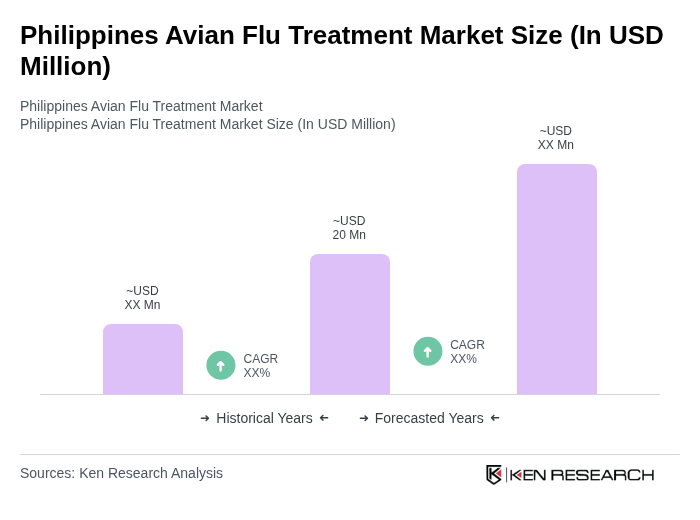
- The Philippines Avian Flu Treatment Market is valued at USD 20 million, based on a five-year historical analysis and recent estimates for the national avian flu market.This growth is primarily driven by increasing poultry production, heightened awareness of biosecurity measures, and the recurring incidence of avian influenza outbreaks in the region.The market is also supported by government initiatives aimed at enhancing poultry health and safety standards, including partnerships with trading partners such as France and the Netherlands to strengthen disease control and regionalization measures for poultry and poultry products.
- Key geographic hubs for this market include Metro Manila, Cebu, and Davao, which act as consolidation and distribution centers for poultry health products and veterinary services due to their strong logistics infrastructure and concentration of commercial poultry operations in surrounding regions.These cities benefit from robust distribution networks, access to government and private laboratories, and proximity to major academic and research institutions, which support surveillance, diagnostics, and technical services for avian influenza control.The concentration of veterinary services, importers, distributors, and multinational animal health companies in these urban areas further strengthens their market position.
- The Philippines’ national response to avian influenza is anchored in the Avian Influenza Protection Program under the Department of Agriculture, operationalized through the Administrative Order “Guidelines on the Prevention, Control and Containment of Avian Influenza” issued by the Bureau of Animal Industry in 2017 and updated through subsequent memoranda and implementing rules.This framework authorizes stamping-out, movement control, enhanced surveillance, and risk-based vaccination of poultry where technically justified, sets reporting and biosecurity requirements for commercial and backyard farms, and aligns control measures with World Organisation for Animal Health (WOAH) standards to protect both public health and the poultry industry.
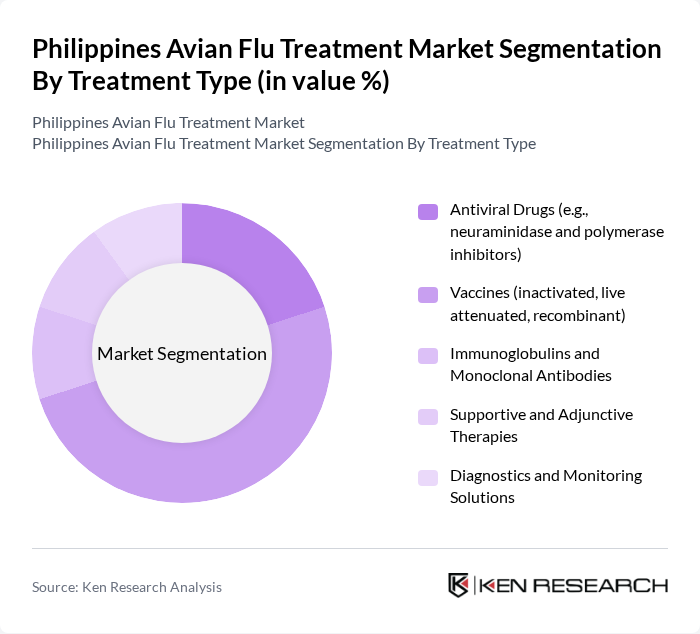
Philippines Avian Flu Treatment Market Segmentation
By Treatment Type:The treatment type segmentation includes various methods used to combat avian influenza. The subsegments are Antiviral Drugs (e.g., neuraminidase and polymerase inhibitors), Vaccines (inactivated, live attenuated, recombinant), Immunoglobulins and Monoclonal Antibodies, Supportive and Adjunctive Therapies, and Diagnostics and Monitoring Solutions.Among these, vaccines are the most dominant due to their preventive nature and effectiveness in controlling outbreaks in poultry populations.The increasing focus on structured vaccination and emergency response programs by poultry producers, together with government-led surveillance, movement control, and regionalization initiatives, has led to strong and sustained adoption of vaccine-based and diagnostic solutions in commercial operations.
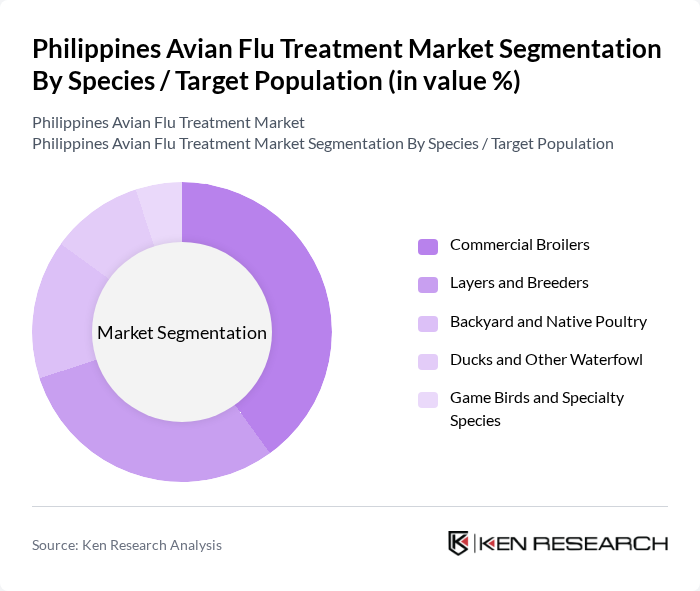
By Species / Target Population:This segmentation focuses on the different species affected by avian influenza. The subsegments include Commercial Broilers, Layers and Breeders, Backyard and Native Poultry, Ducks and Other Waterfowl, and Game Birds and Specialty Species. Commercial broilers dominate the market due to their large-scale production, intensive production systems, and high exposure risk to circulating avian influenza viruses in the region.The increasing demand for poultry meat and eggs, combined with export-oriented production and regionalization arrangements with trade partners, drives the need for effective treatment, vaccination, and surveillance strategies particularly in commercial broiler and layer operations.
Philippines Avian Flu Treatment Market Competitive Landscape
The Philippines Avian Flu Treatment Market is characterized by a dynamic mix of regional and international players. Leading participants such as Sanofi, Merck & Co., Zoetis, Boehringer Ingelheim, Elanco Animal Health, Ceva Santé Animale, Virbac, Vetoquinol, IDEXX Laboratories, Neogen Corporation, Alltech, Phibro Animal Health, Kemin Industries, and local and regional players contribute to innovation, geographic expansion, and service delivery in this space.
Philippines Avian Flu Treatment Market Industry Analysis
Growth Drivers
- Increasing Prevalence of Avian Flu Outbreaks:The Philippines has experienced over 20 avian flu outbreaks since 2017, with the most recent outbreak in the current year affecting more than 1.5 million birds. This alarming trend has heightened the urgency for effective treatment solutions. The Department of Agriculture reported a 30% increase in reported cases in the current year compared to the previous year, driving demand for avian flu treatments and preventive measures across the poultry industry.
- Rising Awareness About Poultry Health:The Philippine poultry sector, valued at approximately PHP 300 billion in the current year, is increasingly prioritizing health management. A survey by the Bureau of Animal Industry indicated that 65% of poultry farmers are now investing in health education programs. This growing awareness is fostering a proactive approach to avian flu treatment, leading to a surge in demand for veterinary services and innovative treatment options to ensure flock health and productivity.
- Government Initiatives for Disease Control:The Philippine government allocated PHP 500 million in the current year for avian flu control measures, including vaccination programs and biosecurity enhancements. These initiatives aim to mitigate the impact of avian flu outbreaks on the poultry industry. The Department of Agriculture's strategic plan emphasizes collaboration with local governments and international organizations, further driving the demand for effective treatment solutions and bolstering the overall market for avian flu treatments.
Market Challenges
- High Treatment Costs:The average cost of avian flu treatment in the Philippines can reach PHP 1,200 per affected bird, which poses a significant financial burden on poultry farmers. With over 80% of farmers operating on tight margins, these high costs can deter timely treatment and lead to increased mortality rates. The financial strain is exacerbated by the need for ongoing biosecurity measures, making it a critical challenge for the industry.
- Limited Access to Healthcare Facilities:Approximately 60% of rural areas in the Philippines lack adequate veterinary services, creating a significant barrier to effective avian flu treatment. The Philippine Veterinary Medical Association reported that only 30% of poultry farmers have access to qualified veterinarians. This limited access hampers timely diagnosis and treatment, increasing the risk of widespread outbreaks and undermining efforts to control avian flu in the country.
Philippines Avian Flu Treatment Market Future Outlook
The future of the avian flu treatment market in the Philippines appears promising, driven by increasing investments in veterinary healthcare and advancements in treatment technologies. As the government continues to enhance biosecurity measures and vaccination protocols, the market is expected to see a rise in innovative treatment solutions. Additionally, the growing consumer demand for safe poultry products will likely encourage further research and development, fostering a more resilient poultry industry in the face of avian flu challenges.
Market Opportunities
- Expansion of Veterinary Services:The Philippine government is actively promoting the establishment of veterinary clinics in underserved areas, aiming to increase access to avian flu treatments. This initiative is expected to enhance the overall health of poultry populations, potentially reducing outbreak occurrences and improving farmer livelihoods, thereby creating a more robust market for avian flu treatment solutions.
- Development of New Treatment Products:There is a significant opportunity for pharmaceutical companies to innovate and develop new avian flu treatment products. With the increasing prevalence of resistant strains, the demand for effective vaccines and antiviral medications is on the rise. Collaborations with research institutions can facilitate the development of cutting-edge solutions, positioning companies favorably in the growing avian flu treatment market.
Scope of the Report
| Segment | Sub-Segments |
|---|---|
| By Treatment Type | Antiviral Drugs (e.g., neuraminidase and polymerase inhibitors) Vaccines (inactivated, live attenuated, recombinant) Immunoglobulins and Monoclonal Antibodies Supportive and Adjunctive Therapies Diagnostics and Monitoring Solutions |
| By Species / Target Population | Commercial Broilers Layers and Breeders Backyard and Native Poultry Ducks and Other Waterfowl Game Birds and Specialty Species |
| By Application | Outbreak Treatment and Containment Preventive and Prophylactic Programs Surveillance, Screening, and Biosecurity Management Research, Field Trials, and Pilot Programs |
| By End-User | Large-Scale Commercial Poultry Integrators Small and Medium Poultry Farms Veterinary Clinics and Hospitals Government and Regulatory Agencies Research and Academic Institutions |
| By Distribution Channel | Veterinary Drug Distributors and Wholesalers Direct Sales to Integrators and Large Farms Retail Veterinary Pharmacies and Agro-Vet Stores Online and E-commerce Platforms |
| By Region | Luzon Visayas Mindanao |
Key Target Audience
Investors and Venture Capitalist Firms
Government and Regulatory Bodies (e.g., Department of Agriculture, Bureau of Animal Industry)
Pharmaceutical Manufacturers
Veterinary Clinics and Animal Health Professionals
Livestock Farmers and Poultry Producers
Importers and Exporters of Animal Health Products
Industry Associations (e.g., Philippine Association of Animal Health Products, Inc.)
Insurance Companies Specializing in Agricultural Risks
Players Mentioned in the Report:
Sanofi
Merck & Co.
Zoetis
Boehringer Ingelheim
Elanco Animal Health
Ceva Sante Animale
Virbac
Vetoquinol
IDEXX Laboratories
Neogen Corporation
Alltech
Phibro Animal Health
Kemin Industries
Local and Regional Players (Philippines-focused)
Table of Contents
Market Assessment Phase
1. Executive Summary and Approach
2. Philippines Avian Flu Treatment Market Overview
2.1 Key Insights and Strategic Recommendations
2.2 Philippines Avian Flu Treatment Market Overview
2.3 Definition and Scope
2.4 Evolution of Market Ecosystem
2.5 Timeline of Key Regulatory Milestones
2.6 Value Chain & Stakeholder Mapping
2.7 Business Cycle Analysis
2.8 Policy & Incentive Landscape
3. Philippines Avian Flu Treatment Market Analysis
3.1 Growth Drivers
3.1.1 Increasing prevalence of avian flu outbreaks
3.1.2 Rising awareness about poultry health
3.1.3 Government initiatives for disease control
3.1.4 Advancements in treatment technologies
3.2 Market Challenges
3.2.1 High treatment costs
3.2.2 Limited access to healthcare facilities
3.2.3 Regulatory hurdles
3.2.4 Lack of public awareness
3.3 Market Opportunities
3.3.1 Expansion of veterinary services
3.3.2 Development of new treatment products
3.3.3 Collaborations with international organizations
3.3.4 Increased funding for research and development
3.4 Market Trends
3.4.1 Growing demand for organic poultry products
3.4.2 Shift towards preventive healthcare measures
3.4.3 Integration of technology in treatment solutions
3.4.4 Rise in consumer awareness regarding food safety
3.5 Government Regulation
3.5.1 Implementation of biosecurity measures
3.5.2 Regulations on poultry vaccination
3.5.3 Guidelines for treatment protocols
3.5.4 Monitoring and reporting requirements
4. SWOT Analysis
5. Stakeholder Analysis
6. Porter's Five Forces Analysis
7. Philippines Avian Flu Treatment Market Market Size, 2019-2024
7.1 By Value
7.2 By Volume
7.3 By Average Selling Price
8. Philippines Avian Flu Treatment Market Segmentation
8.1 By Treatment Type
8.1.1 Antiviral Drugs (e.g., neuraminidase and polymerase inhibitors)
8.1.2 Vaccines (inactivated, live attenuated, recombinant)
8.1.3 Immunoglobulins and Monoclonal Antibodies
8.1.4 Supportive and Adjunctive Therapies
8.1.5 Diagnostics and Monitoring Solutions
8.2 By Species / Target Population
8.2.1 Commercial Broilers
8.2.2 Layers and Breeders
8.2.3 Backyard and Native Poultry
8.2.4 Ducks and Other Waterfowl
8.2.5 Game Birds and Specialty Species
8.3 By Application
8.3.1 Outbreak Treatment and Containment
8.3.2 Preventive and Prophylactic Programs
8.3.3 Surveillance, Screening, and Biosecurity Management
8.3.4 Research, Field Trials, and Pilot Programs
8.4 By End-User
8.4.1 Large-Scale Commercial Poultry Integrators
8.4.2 Small and Medium Poultry Farms
8.4.3 Veterinary Clinics and Hospitals
8.4.4 Government and Regulatory Agencies
8.4.5 Research and Academic Institutions
8.5 By Distribution Channel
8.5.1 Veterinary Drug Distributors and Wholesalers
8.5.2 Direct Sales to Integrators and Large Farms
8.5.3 Retail Veterinary Pharmacies and Agro-Vet Stores
8.5.4 Online and E-commerce Platforms
8.6 By Region
8.6.1 Luzon
8.6.2 Visayas
8.6.3 Mindanao
9. Philippines Avian Flu Treatment Market Competitive Analysis
9.1 Market Share of Key Players
9.2 Cross Comparison of Key Players
9.2.1 Company Name
9.2.2 Philippines Avian Flu Treatment Revenue (USD, Latest FY)
9.2.3 3-Year Revenue CAGR in Philippines Avian Flu Treatment
9.2.4 Share of Philippines Avian Flu Treatment in Total Company Revenue (%)
9.2.5 Avian Flu Treatment Market Share in the Philippines (%)
9.2.6 Average Realized Price per Dose / Course (PHP)
9.2.7 R&D Intensity for Avian / Zoonotic Vaccines and Antivirals (% of Revenue)
9.2.8 Geographic and Channel Coverage (Number of Provinces / Active Distributors)
9.2.9 Tender Win Rate in Public Procurement (%)
9.2.10 Gross Margin and EBITDA Margin from Avian Flu Treatment Portfolio (%)
9.3 SWOT Analysis of Top Players
9.4 Pricing Analysis
9.5 Detailed Profile of Major Companies
9.5.1 Sanofi
9.5.2 Merck & Co.
9.5.3 Zoetis
9.5.4 Boehringer Ingelheim
9.5.5 Elanco Animal Health
9.5.6 Ceva Santé Animale
9.5.7 Virbac
9.5.8 Vetoquinol
9.5.9 IDEXX Laboratories
9.5.10 Neogen Corporation
9.5.11 Alltech
9.5.12 Phibro Animal Health
9.5.13 Kemin Industries
9.5.14 Local and Regional Players (Philippines-focused)
10. Philippines Avian Flu Treatment Market End-User Analysis
10.1 Procurement Behavior of Key Ministries
10.1.1 Ministry of Agriculture
10.1.2 Department of Health
10.1.3 Local Government Units
10.2 Corporate Spend on Infrastructure & Energy
10.2.1 Investment in Veterinary Infrastructure
10.2.2 Funding for Research Initiatives
10.3 Pain Point Analysis by End-User Category
10.3.1 Poultry Farmers
10.3.2 Veterinary Practitioners
10.4 User Readiness for Adoption
10.4.1 Training and Education Needs
10.5 Post-Deployment ROI and Use Case Expansion
10.5.1 Evaluation of Treatment Efficacy
11. Philippines Avian Flu Treatment Market Future Size, 2025-2030
11.1 By Value
11.2 By Volume
11.3 By Average Selling Price
Go-To-Market Strategy Phase
1. Whitespace Analysis + Business Model Canvas
1.1 Market Gaps Identification
1.2 Business Model Development
2. Marketing and Positioning Recommendations
2.1 Branding Strategies
2.2 Product USPs
3. Distribution Plan
3.1 Urban Retail vs Rural NGO Tie-ups
4. Channel & Pricing Gaps
4.1 Underserved Routes
4.2 Pricing Bands
5. Unmet Demand & Latent Needs
5.1 Category Gaps
5.2 Consumer Segments
6. Customer Relationship
6.1 Loyalty Programs
6.2 After-sales Service
7. Value Proposition
7.1 Sustainability
7.2 Integrated Supply Chains
8. Key Activities
8.1 Regulatory Compliance
8.2 Branding
8.3 Distribution Setup
9. Entry Strategy Evaluation
9.1 Domestic Market Entry Strategy
9.1.1 Product Mix
9.1.2 Pricing Band
9.1.3 Packaging
9.2 Export Entry Strategy
9.2.1 Target Countries
9.2.2 Compliance Roadmap
10. Entry Mode Assessment
10.1 JV
10.2 Greenfield
10.3 M&A
10.4 Distributor Model
11. Capital and Timeline Estimation
11.1 Capital Requirements
11.2 Timelines
12. Control vs Risk Trade-Off
12.1 Ownership vs Partnerships
13. Profitability Outlook
13.1 Breakeven Analysis
13.2 Long-term Sustainability
14. Potential Partner List
14.1 Distributors
14.2 JVs
14.3 Acquisition Targets
15. Execution Roadmap
15.1 Phased Plan for Market Entry
15.1.1 Market Setup
15.1.2 Market Entry
15.1.3 Growth Acceleration
15.1.4 Scale & Stabilize
15.2 Key Activities and Milestones
15.2.1 Activity Planning
15.2.2 Milestone Tracking
Research Methodology
Phase 1: Approach1
Desk Research
- Analysis of government reports on avian flu outbreaks and treatment protocols
- Review of scientific literature on avian flu treatment methodologies and efficacy
- Examination of market reports from health organizations and veterinary associations
Primary Research
- Interviews with veterinarians specializing in avian diseases
- Surveys with poultry farm owners regarding treatment practices and challenges
- Focus groups with health officials on public health responses to avian flu
Validation & Triangulation
- Cross-validation of data from veterinary clinics and poultry industry reports
- Triangulation of treatment efficacy data from multiple research studies
- Sanity checks through expert panel reviews of findings and assumptions
Phase 2: Market Size Estimation1
Top-down Assessment
- Estimation of total healthcare spending on avian flu treatments in the Philippines
- Analysis of government funding and subsidies for avian flu management
- Breakdown of treatment costs by type (vaccines, antiviral drugs, etc.)
Bottom-up Modeling
- Collection of data on treatment volumes from veterinary clinics and hospitals
- Cost analysis based on procurement prices of avian flu treatment products
- Estimation of market share for different treatment modalities based on usage rates
Forecasting & Scenario Analysis
- Multi-factor regression analysis incorporating poultry population growth and disease incidence
- Scenario modeling based on potential outbreaks and government intervention strategies
- Baseline, optimistic, and pessimistic forecasts through 2030 based on historical trends
Phase 3: CATI Sample Composition1
| Scope Item/Segment | Sample Size | Target Respondent Profiles |
|---|---|---|
| Poultry Farm Owners | 120 | Farm Owners, Farm Managers |
| Veterinary Clinics | 90 | Veterinarians, Clinic Managers |
| Government Health Officials | 60 | Public Health Officers, Policy Makers |
| Pharmaceutical Suppliers | 50 | Sales Representatives, Product Managers |
| Research Institutions | 40 | Researchers, Epidemiologists |
Frequently Asked Questions
What is the current value of the Philippines Avian Flu Treatment Market?
The Philippines Avian Flu Treatment Market is valued at approximately USD 20 million, driven by increasing poultry production, awareness of biosecurity measures, and recurring avian influenza outbreaks in the region.
What are the main drivers of growth in the Philippines Avian Flu Treatment Market?
Which cities are key hubs for the Avian Flu Treatment Market in the Philippines?
What types of treatments are available for avian influenza in the Philippines?
Other Regional/Country Reports
Indonesia Avian Flu Treatment Market Size Share Growth Drivers Trends Opportunities & Forecast 2025–2030
Malaysia Avian Flu Treatment Market Size Share Growth Drivers Trends Opportunities & Forecast 2025–2030
Other Adjacent Reports
Singapore Veterinary Vaccine Market
Vietnam Animal Health Diagnostic Market
UAE Poultry Biosecurity Market
Singapore Veterinary Antiviral Market
Mexico Animal Nutrition Supplement Market
Indonesia Poultry Farming Equipment Market
South Africa Zoonotic Disease Treatment Market
Thailand Veterinary Pharmaceutical Market
Bahrain Animal Feed Additive Market
Philippines Poultry Health Services Market
Why Buy From Us?

What makes us stand out is that our consultants follow Robust, Refine and Result (RRR) methodology. Robust for clear definitions, approaches and sanity checking, Refine for differentiating respondents' facts and opinions, and Result for presenting data with story.

We have set a benchmark in the industry by offering our clients with syndicated and customized market research reports featuring coverage of entire market as well as meticulous research and analyst insights.

While we don't replace traditional research, we flip the method upside down. Our dual approach of Top Bottom & Bottom Top ensures quality deliverable by not just verifying company fundamentals but also looking at the sector and macroeconomic factors.

With one step in the future, our research team constantly tries to show you the bigger picture. We help with some of the tough questions you may encounter along the way: How is the industry positioned? Best marketing channel? KPI's of competitors? By aligning every element, we help maximize success.

Our report gives you instant access to the answers and sources that other companies might choose to hide. We elaborate each steps of research methodology we have used and showcase you the sample size to earn your trust.

If you need any support, we are here! We pride ourselves on universe strength, data quality, and quick, friendly, and professional service.