About the Report
Base Year 2024Bahrain Avian Flu Treatment Market Overview
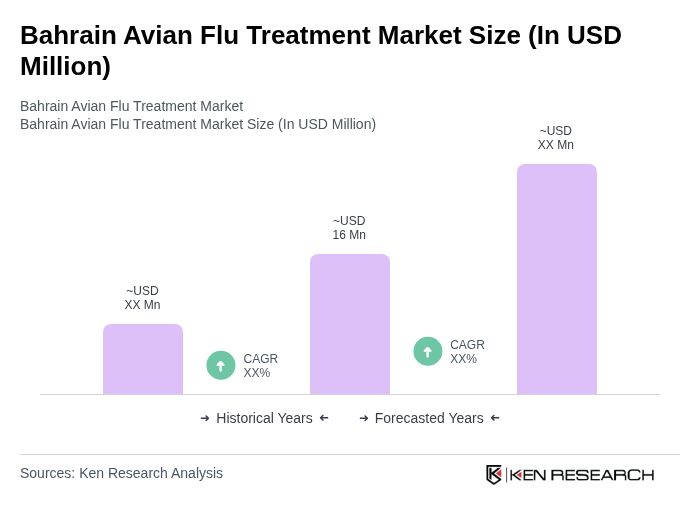
- The Bahrain Avian Flu Treatment Market is valued at USD 16 million, based on a five-year historical analysis and extrapolation from regional Middle East avian flu treatment and broader global bird flu treatment market benchmarks.This growth is primarily driven by increasing poultry farming activities, heightened awareness of avian influenza risks, and government initiatives aimed at disease prevention and control.The market has seen a steady rise in demand for effective treatment and prevention options, including vaccines and antiviral agents, as the poultry industry seeks to mitigate the impact of avian flu outbreaks in the wider Middle East and Gulf region.
- Key contributors in this market include poultry production clusters around Manama, Riffa, and Muharraq, which play a central role due to their proximity to major distribution channels and veterinary service networks.The concentration of commercial poultry farms and trading operations linked to these urban centers, coupled with access to government and private veterinary services, enhances their role in the avian health value chain, making them important hubs for both treatment access and preventive interventions such as vaccination and biosecurity support.
- In 2023, Bahrain's government strengthened its avian influenza control efforts under the national veterinary and public health framework, aligning with Gulf Cooperation Council and World Organisation for Animal Health (WOAH, formerly OIE) guidance on high pathogenic avian influenza surveillance, culling, and vaccination where appropriate.The Veterinary Quarantine Law promulgated by Legislative Decree No. 13 of 2005, issued by the Government of Bahrain, establishes binding requirements for notification of animal diseases, import controls, quarantine, and implementation of disease control programs, including vaccination measures for poultry where mandated by the competent authority.These measures aim to reduce the incidence of outbreaks and protect public health, supported by regional and international collaboration on research, surveillance, and vaccine or antiviral use.
Bahrain Avian Flu Treatment Market Segmentation
By Treatment Type:The treatment type segmentation includes various methods used to combat avian influenza, focusing on the most effective solutions available in the market and reflecting global practice in avian influenza management.
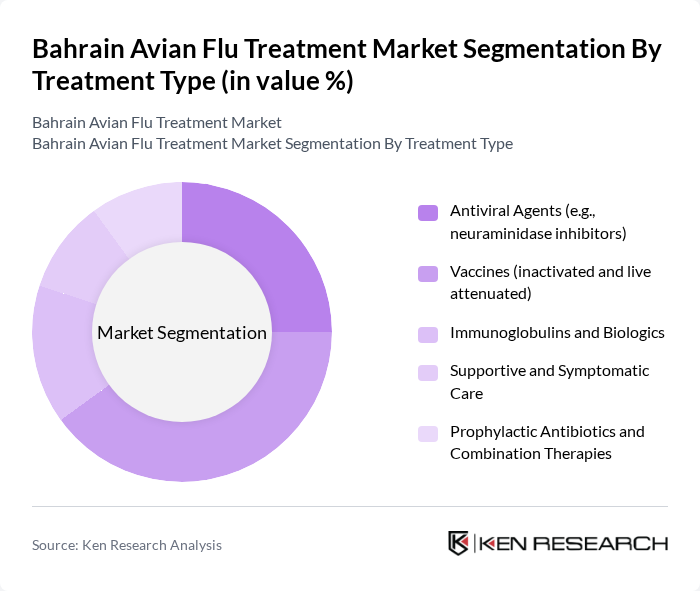
The vaccines segment is the dominant player in the market, accounting for a significant share due to the increasing focus on preventive measures against avian influenza in poultry populations and in high‑risk occupational groups globally.The rising incidence of high pathogenic avian influenza outbreaks across the Middle East, Asia, Europe, and Africa has led to heightened demand for both inactivated and live attenuated vaccines, as poultry producers prioritize biosecurity, flock immunity, and continuity of food supply.Additionally, government and international guidelines that support vaccination programs in at‑risk poultry sectors, alongside surveillance and stamping‑out where indicated, further bolster this segment's growth.The trend towards proactive disease management and contingency planning is shaping procurement behavior, with a clear preference for vaccination as a primary strategy complemented by antivirals and strict farm‑level biosecurity.
By Species / Target Population:This segmentation focuses on the different species affected by avian influenza, highlighting the target populations for prevention and treatment in line with regional poultry production structures.
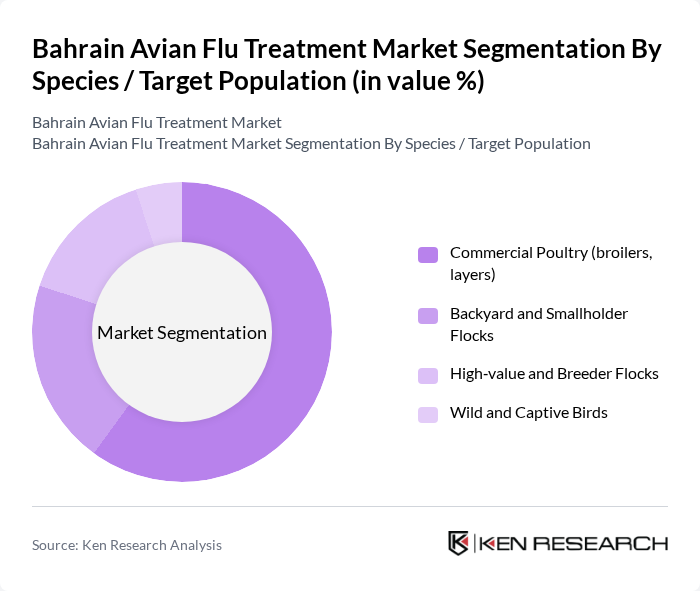
Commercial poultry, particularly broilers and layers, dominate the market due to their significant contribution to the food supply and economic stability in Bahrain and the wider Gulf region, where poultry meat and eggs are key protein sources.The high volume of intensive poultry production necessitates effective vaccination, surveillance, and rapid response options to prevent avian influenza outbreaks, which can have severe trade and production impacts.Additionally, the focus on biosecurity measures, regular flock health monitoring, and targeted vaccination programs in commercial settings drives the demand for products tailored to this population. Growing awareness of disease management among commercial and contract farmers, supported by veterinary authorities and integrators, further solidifies the position of commercial poultry as the leading target population in the avian flu treatment and prevention market.
Bahrain Avian Flu Treatment Market Competitive Landscape
The Bahrain Avian Flu Treatment Market is characterized by a dynamic mix of regional and international players. Leading participants such as Zoetis Inc., Merck Animal Health (MSD Animal Health), Boehringer Ingelheim Animal Health, Elanco Animal Health, Ceva Santé Animale, Virbac, Vetoquinol, Huvepharma, Phibro Animal Health Corporation, Dechra Pharmaceuticals PLC, IDEXX Laboratories, Local and Regional GCC Manufacturers contribute to innovation, geographic expansion, and service delivery in this space.
Bahrain Avian Flu Treatment Market Industry Analysis
Growth Drivers
- Increasing Prevalence of Avian Flu Outbreaks:The frequency of avian flu outbreaks in Bahrain has surged, with reports indicating over 15 significant outbreaks in the last five years. This alarming trend has led to heightened demand for effective treatment solutions. The Ministry of Agriculture and Fisheries has allocated approximately $2 million in future for avian flu control measures, underscoring the urgency to address this public health concern and protect the poultry industry, which contributes around $100 million annually to the economy.
- Government Initiatives for Poultry Health:The Bahraini government has implemented various initiatives to enhance poultry health, including the establishment of a national poultry health program. In future, the government plans to invest $1.5 million in biosecurity measures and vaccination campaigns. These initiatives aim to reduce the incidence of avian flu, thereby increasing the demand for treatment solutions. The poultry sector employs over 5,000 individuals, making these initiatives crucial for both public health and economic stability.
- Advancements in Veterinary Medicine:The veterinary sector in Bahrain is witnessing significant advancements, particularly in the development of new antiviral treatments. In future, the introduction of at least three novel antiviral drugs is anticipated, which could enhance treatment efficacy against avian flu. The Bahrain Veterinary Association has reported a 20% increase in veterinary research funding, amounting to $500,000, aimed at improving treatment protocols and ensuring better health outcomes for poultry, thus driving market growth.
Market Challenges
- High Cost of Treatment Solutions:The financial burden of avian flu treatment solutions poses a significant challenge for poultry farmers in Bahrain. The average cost of antiviral medications can reach up to $300 per treatment cycle, which is prohibitive for many small-scale farmers. With over 70% of poultry farms operating on tight margins, this high cost can lead to inadequate treatment and increased mortality rates among infected birds, ultimately affecting the overall poultry supply chain.
- Limited Access to Veterinary Services:Access to veterinary services remains a critical challenge in Bahrain, particularly in rural areas where only 30% of poultry farmers have regular access to veterinary care. This limited access hampers timely diagnosis and treatment of avian flu, exacerbating outbreaks. The government has recognized this issue, but with only 15 licensed veterinarians serving the entire poultry sector, the gap in service provision continues to hinder effective disease management and control efforts.
Bahrain Avian Flu Treatment Market Future Outlook
The future of the avian flu treatment market in Bahrain appears promising, driven by ongoing government support and advancements in veterinary medicine. As the prevalence of avian flu continues to rise, the demand for innovative treatment solutions is expected to increase. Additionally, the integration of technology in veterinary practices will enhance disease monitoring and management. With a focus on preventive healthcare measures, the market is likely to evolve, ensuring better health outcomes for poultry and safeguarding food security in the region.
Market Opportunities
- Development of New Antiviral Drugs:The ongoing research into antiviral drugs presents a significant opportunity for market growth. With an estimated $1 million allocated for R&D in future, the potential introduction of more effective treatments could revolutionize avian flu management, improving recovery rates and reducing mortality in poultry populations.
- Expansion of Veterinary Healthcare Infrastructure:The expansion of veterinary healthcare infrastructure is crucial for improving disease management. The government plans to invest $2 million in enhancing veterinary facilities and training programs in future. This investment will facilitate better access to veterinary services, ultimately leading to improved health outcomes for poultry and increased market demand for treatment solutions.
Scope of the Report
| Segment | Sub-Segments |
|---|---|
| By Treatment Type | Antiviral Agents (e.g., neuraminidase inhibitors) Vaccines (inactivated and live attenuated) Immunoglobulins and Biologics Supportive and Symptomatic Care Prophylactic Antibiotics and Combination Therapies |
| By Species / Target Population | Commercial Poultry (broilers, layers) Backyard and Smallholder Flocks High?value and Breeder Flocks Wild and Captive Birds |
| By End User | Poultry Integrators and Commercial Farms Independent Poultry Farmers Veterinary Clinics and Hospitals Government and Municipal Veterinary Services Research and Academic Institutes |
| By Distribution Channel | Direct Sales and Tender-based Procurement Veterinary Pharmacies and Wholesalers Online and Tele-veterinary Platforms Distributors and Importers |
| By Application | Treatment of Confirmed Avian Flu Cases Preventive and Prophylactic Programs Outbreak Containment and Emergency Stockpiling Surveillance, Diagnostics, and Monitoring |
| By Formulation / Route of Administration | Injectable Oral (solutions, premix, tablets) In-ovo and Spray Vaccines Others (topical, feed and water additives) |
| By Policy and Procurement Model | Government-funded Programs and Subsidies Private Sector and Out-of-pocket Purchases Public–Private Partnerships Multilateral and NGO-supported Initiatives |
Key Target Audience
Investors and Venture Capitalist Firms
Government and Regulatory Bodies (e.g., Ministry of Health, Bahrain Animal Production Directorate)
Pharmaceutical Manufacturers
Veterinary Clinics and Hospitals
Animal Health Product Distributors
Biotechnology Firms
Livestock Farmers and Poultry Producers
Public Health Organizations
Players Mentioned in the Report:
Zoetis Inc.
Merck Animal Health (MSD Animal Health)
Boehringer Ingelheim Animal Health
Elanco Animal Health
Ceva Sante Animale
Virbac
Vetoquinol
Huvepharma
Phibro Animal Health Corporation
Dechra Pharmaceuticals PLC
IDEXX Laboratories
Local and Regional GCC Manufacturers
Table of Contents
Market Assessment Phase
1. Executive Summary and Approach
2. Bahrain Avian Flu Treatment Market Overview
2.1 Key Insights and Strategic Recommendations
2.2 Bahrain Avian Flu Treatment Market Overview
2.3 Definition and Scope
2.4 Evolution of Market Ecosystem
2.5 Timeline of Key Regulatory Milestones
2.6 Value Chain & Stakeholder Mapping
2.7 Business Cycle Analysis
2.8 Policy & Incentive Landscape
3. Bahrain Avian Flu Treatment Market Analysis
3.1 Growth Drivers
3.1.1 Increasing prevalence of avian flu outbreaks
3.1.2 Government initiatives for poultry health
3.1.3 Rising awareness about avian flu treatment
3.1.4 Advancements in veterinary medicine
3.2 Market Challenges
3.2.1 High cost of treatment solutions
3.2.2 Limited access to veterinary services
3.2.3 Regulatory hurdles in drug approval
3.2.4 Resistance to treatment among avian species
3.3 Market Opportunities
3.3.1 Development of new antiviral drugs
3.3.2 Expansion of veterinary healthcare infrastructure
3.3.3 Increased funding for research and development
3.3.4 Collaboration with international health organizations
3.4 Market Trends
3.4.1 Growing demand for organic and natural treatments
3.4.2 Integration of technology in veterinary practices
3.4.3 Focus on preventive healthcare measures
3.4.4 Rise in consumer awareness regarding food safety
3.5 Government Regulation
3.5.1 Strict biosecurity measures for poultry farms
3.5.2 Mandatory vaccination programs
3.5.3 Surveillance and reporting requirements
3.5.4 Guidelines for the use of antiviral medications
4. SWOT Analysis
5. Stakeholder Analysis
6. Porter's Five Forces Analysis
7. Bahrain Avian Flu Treatment Market Size, 2019-2024
7.1 By Value
7.2 By Volume
7.3 By Average Selling Price
8. Bahrain Avian Flu Treatment Market Segmentation
8.1 By Treatment Type
8.1.1 Antiviral Agents (e.g., neuraminidase inhibitors)
8.1.2 Vaccines (inactivated and live attenuated)
8.1.3 Immunoglobulins and Biologics
8.1.4 Supportive and Symptomatic Care
8.1.5 Prophylactic Antibiotics and Combination Therapies
8.2 By Species / Target Population
8.2.1 Commercial Poultry (broilers, layers)
8.2.2 Backyard and Smallholder Flocks
8.2.3 High?value and Breeder Flocks
8.2.4 Wild and Captive Birds
8.3 By End User
8.3.1 Poultry Integrators and Commercial Farms
8.3.2 Independent Poultry Farmers
8.3.3 Veterinary Clinics and Hospitals
8.3.4 Government and Municipal Veterinary Services
8.3.5 Research and Academic Institutes
8.4 By Distribution Channel
8.4.1 Direct Sales and Tender-based Procurement
8.4.2 Veterinary Pharmacies and Wholesalers
8.4.3 Online and Tele-veterinary Platforms
8.4.4 Distributors and Importers
8.5 By Application
8.5.1 Treatment of Confirmed Avian Flu Cases
8.5.2 Preventive and Prophylactic Programs
8.5.3 Outbreak Containment and Emergency Stockpiling
8.5.4 Surveillance, Diagnostics, and Monitoring
8.6 By Formulation / Route of Administration
8.6.1 Injectable
8.6.2 Oral (solutions, premix, tablets)
8.6.3 In-ovo and Spray Vaccines
8.6.4 Others (topical, feed and water additives)
8.7 By Policy and Procurement Model
8.7.1 Government-funded Programs and Subsidies
8.7.2 Private Sector and Out-of-pocket Purchases
8.7.3 Public–Private Partnerships
8.7.4 Multilateral and NGO-supported Initiatives
9. Bahrain Avian Flu Treatment Market Competitive Analysis
9.1 Market Share of Key Players
9.2 Cross Comparison of Key Players
9.2.1 Company Name
9.2.2 Bahrain Market Revenue (USD, Latest FY)
9.2.3 3-year CAGR in Bahrain Avian Flu Treatment Revenue
9.2.4 Bahrain Avian Flu Treatment Market Share (%)
9.2.5 Gross Margin from Avian Flu Portfolio (%)
9.2.6 R&D Intensity (% of Revenue from Avian Flu Products)
9.2.7 Capex / Investment in Bahrain & GCC Operations (USD)
9.2.8 Average Selling Price Index vs Global Benchmark
9.2.9 Channel Mix (Direct vs Distributor Sales %)
9.2.10 Days Sales Outstanding (DSO) in Bahrain
9.2.11 Portfolio Breadth (Number of Avian Flu SKUs Registered in Bahrain)
9.2.12 Registration / Tender Wins with Key Government Buyers
9.3 SWOT Analysis of Top Players
9.4 Pricing Analysis
9.5 Detailed Profile of Major Companies
9.5.1 Zoetis Inc.
9.5.2 Merck Animal Health (MSD Animal Health)
9.5.3 Boehringer Ingelheim Animal Health
9.5.4 Elanco Animal Health
9.5.5 Ceva Santé Animale
9.5.6 Virbac
9.5.7 Vetoquinol
9.5.8 Huvepharma
9.5.9 Phibro Animal Health Corporation
9.5.10 Dechra Pharmaceuticals PLC
9.5.11 IDEXX Laboratories
9.5.12 Local and Regional GCC Manufacturers
10. Bahrain Avian Flu Treatment Market End-User Analysis
10.1 Procurement Behavior of Key Ministries
10.1.1 Ministry of Agriculture
10.1.2 Ministry of Health
10.1.3 Ministry of Finance
10.1.4 Others
10.2 Corporate Spend on Infrastructure & Energy
10.2.1 Investment in Veterinary Facilities
10.2.2 Funding for Research Projects
10.2.3 Budget Allocation for Disease Control
10.2.4 Others
10.3 Pain Point Analysis by End-User Category
10.3.1 Poultry Farmers
10.3.2 Veterinary Practitioners
10.3.3 Government Officials
10.3.4 Others
10.4 User Readiness for Adoption
10.4.1 Awareness Levels
10.4.2 Training and Support Needs
10.4.3 Financial Readiness
10.4.4 Others
10.5 Post-Deployment ROI and Use Case Expansion
10.5.1 Evaluation of Treatment Efficacy
10.5.2 Cost-Benefit Analysis
10.5.3 Expansion into New Markets
10.5.4 Others
11. Bahrain Avian Flu Treatment Market Future Size, 2025-2030
11.1 By Value
11.2 By Volume
11.3 By Average Selling Price
Go-To-Market Strategy Phase
1. Whitespace Analysis + Business Model Canvas
1.1 Market Gaps Identification
1.2 Business Model Development
2. Marketing and Positioning Recommendations
2.1 Branding Strategies
2.2 Product USPs
3. Distribution Plan
3.1 Urban Retail Strategies
3.2 Rural NGO Tie-ups
4. Channel & Pricing Gaps
4.1 Underserved Routes
4.2 Pricing Bands
5. Unmet Demand & Latent Needs
5.1 Category Gaps
5.2 Consumer Segments
6. Customer Relationship
6.1 Loyalty Programs
6.2 After-sales Service
7. Value Proposition
7.1 Sustainability
7.2 Integrated Supply Chains
8. Key Activities
8.1 Regulatory Compliance
8.2 Branding
8.3 Distribution Setup
9. Entry Strategy Evaluation
9.1 Domestic Market Entry Strategy
9.1.1 Product Mix
9.1.2 Pricing Band
9.1.3 Packaging
9.2 Export Entry Strategy
9.2.1 Target Countries
9.2.2 Compliance Roadmap
10. Entry Mode Assessment
10.1 Joint Ventures
10.2 Greenfield Investments
10.3 Mergers & Acquisitions
10.4 Distributor Model
11. Capital and Timeline Estimation
11.1 Capital Requirements
11.2 Timelines
12. Control vs Risk Trade-Off
12.1 Ownership vs Partnerships
13. Profitability Outlook
13.1 Breakeven Analysis
13.2 Long-term Sustainability
14. Potential Partner List
14.1 Distributors
14.2 Joint Ventures
14.3 Acquisition Targets
15. Execution Roadmap
15.1 Phased Plan for Market Entry
15.1.1 Market Setup
15.1.2 Market Entry
15.1.3 Growth Acceleration
15.1.4 Scale & Stabilize
15.2 Key Activities and Milestones
15.2.1 Activity Planning
15.2.2 Milestone Tracking
Research Methodology
Phase 1: Approach1
Desk Research
- Analysis of avian flu treatment guidelines from the Bahrain Ministry of Health
- Review of published studies and reports from international health organizations
- Examination of market reports and white papers from veterinary pharmaceutical companies
Primary Research
- Interviews with veterinarians specializing in avian diseases in Bahrain
- Surveys with poultry farm owners regarding treatment practices and challenges
- Focus groups with health officials to understand regulatory perspectives
Validation & Triangulation
- Cross-validation of findings through multiple expert interviews
- Triangulation of data from veterinary clinics, farms, and health authorities
- Sanity checks through feedback from industry stakeholders and experts
Phase 2: Market Size Estimation1
Top-down Assessment
- Estimation of total healthcare spending on avian flu treatments in Bahrain
- Segmentation of market size by treatment type and poultry population
- Incorporation of government health initiatives and vaccination programs
Bottom-up Modeling
- Volume estimates based on poultry production statistics and disease prevalence
- Cost analysis of treatment options available in the market
- Calculation of market size based on treatment frequency and average costs
Forecasting & Scenario Analysis
- Multi-factor regression analysis considering poultry population growth and disease outbreaks
- Scenario modeling based on potential regulatory changes and vaccination rates
- Baseline, optimistic, and pessimistic forecasts through 2030
Phase 3: CATI Sample Composition1
| Scope Item/Segment | Sample Size | Target Respondent Profiles |
|---|---|---|
| Poultry Farm Owners | 120 | Farm Managers, Veterinary Advisors |
| Veterinary Clinics | 80 | Veterinarians, Clinic Managers |
| Government Health Officials | 60 | Public Health Officers, Policy Makers |
| Pharmaceutical Distributors | 70 | Sales Managers, Product Specialists |
| Research Institutions | 45 | Research Scientists, Epidemiologists |
Frequently Asked Questions
What is the current value of the Bahrain Avian Flu Treatment Market?
The Bahrain Avian Flu Treatment Market is valued at approximately USD 16 million, reflecting a five-year historical analysis and regional benchmarks from the Middle East and global markets. This valuation highlights the growing demand for effective avian flu treatment solutions.
What factors are driving the growth of the avian flu treatment market in Bahrain?
Which treatment types dominate the Bahrain Avian Flu Treatment Market?
How does the Bahraini government support avian flu control efforts?
Other Regional/Country Reports
Indonesia Avian Flu Treatment Market Size Share Growth Drivers Trends Opportunities & Forecast 2025–2030
Malaysia Avian Flu Treatment Market Size Share Growth Drivers Trends Opportunities & Forecast 2025–2030
Other Adjacent Reports
Germany Animal Vaccine Market
New Zealand Veterinary Pharmaceuticals Market Report Size Share Growth Drivers Trends Opportunities & Forecast 2025–2030Singapore Poultry Biosecurity Market
Germany Animal Health Diagnostics Market
GCC veterinary services market report size, share, growth drivers, trends, opportunities & forecast 2025–2030Bahrain Poultry Feed Additives Market
Japan Livestock Nutrition Market
Egypt Zoonotic Disease Prevention Market
Brazil Animal Antiviral Drugs Market
Qatar Poultry Farming Equipment Market
Why Buy From Us?

What makes us stand out is that our consultants follow Robust, Refine and Result (RRR) methodology. Robust for clear definitions, approaches and sanity checking, Refine for differentiating respondents' facts and opinions, and Result for presenting data with story.

We have set a benchmark in the industry by offering our clients with syndicated and customized market research reports featuring coverage of entire market as well as meticulous research and analyst insights.

While we don't replace traditional research, we flip the method upside down. Our dual approach of Top Bottom & Bottom Top ensures quality deliverable by not just verifying company fundamentals but also looking at the sector and macroeconomic factors.

With one step in the future, our research team constantly tries to show you the bigger picture. We help with some of the tough questions you may encounter along the way: How is the industry positioned? Best marketing channel? KPI's of competitors? By aligning every element, we help maximize success.

Our report gives you instant access to the answers and sources that other companies might choose to hide. We elaborate each steps of research methodology we have used and showcase you the sample size to earn your trust.

If you need any support, we are here! We pride ourselves on universe strength, data quality, and quick, friendly, and professional service.