About the Report
Base Year 2024Philippines BNPL for E-Commerce Market Overview
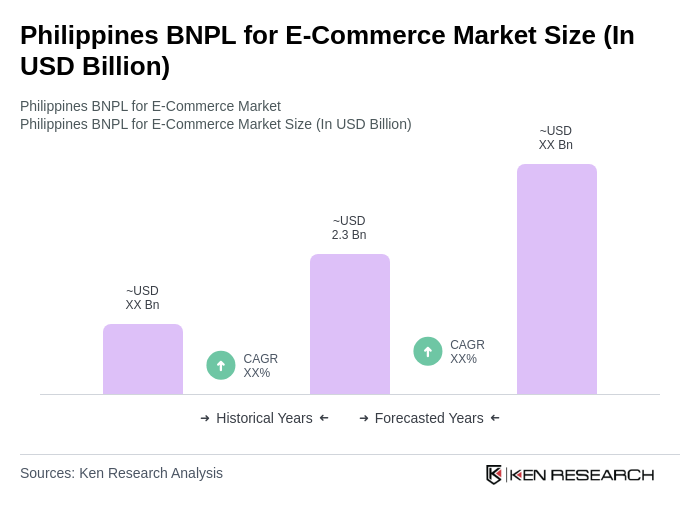
- The Philippines BNPL for E-Commerce Market is valued at approximately USD 2.3 billion, based on a five-year historical analysis. This growth is primarily driven by the increasing adoption of digital payment solutions, a surge in online shopping, and the rising number of underbanked consumers seeking flexible payment options. The market has witnessed a significant uptick in transactions as consumers prefer the convenience and accessibility offered by BNPL services. Additional growth drivers include rising smartphone penetration, improved internet connectivity, and partnerships between BNPL providers and major e-commerce platforms, which have made BNPL options more accessible, especially to younger, tech-savvy demographics. The COVID-19 pandemic further accelerated e-commerce adoption, making BNPL a preferred option for consumers seeking flexible payment plans in a rapidly digitizing economy.
- Metro Manila, Cebu, and Davao are the dominant cities in the Philippines BNPL for E-Commerce Market. Metro Manila leads due to its high population density, advanced infrastructure, and concentration of e-commerce platforms. Cebu and Davao follow closely, benefiting from growing urbanization and increasing internet penetration, which enhances the accessibility of BNPL services to a broader audience.
- In 2023, the Bangko Sentral ng Pilipinas (BSP) issued the “Circular No. 1168, Series of 2023: Guidelines on Buy Now, Pay Later Arrangements,” which requires BNPL providers to disclose all fees, charges, and terms clearly to consumers before entering into agreements, ensuring transparency and consumer protection. The Circular mandates that BNPL providers must obtain the necessary licenses, comply with anti-money laundering and consumer protection standards, and maintain records for regulatory review. This initiative aims to foster a safer and more trustworthy environment for consumers engaging in BNPL transactions.
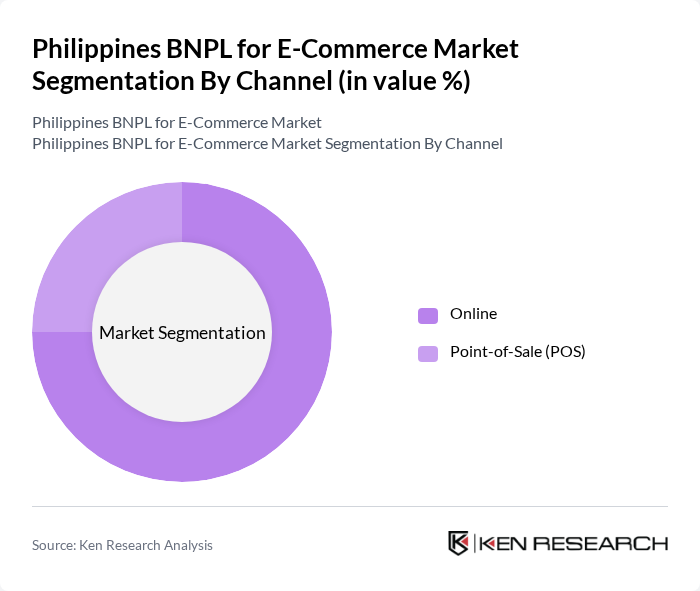
Philippines BNPL for E-Commerce Market Segmentation
By Channel:The market is segmented into two primary channels: Online and Point-of-Sale (POS). The online channel dominates the market due to the rapid growth of e-commerce and the increasing preference for digital transactions among consumers. Online platforms provide a seamless shopping experience, allowing consumers to access BNPL options easily. The POS channel, while smaller, is gaining traction as brick-and-mortar retailers adopt BNPL solutions to enhance customer purchasing power.
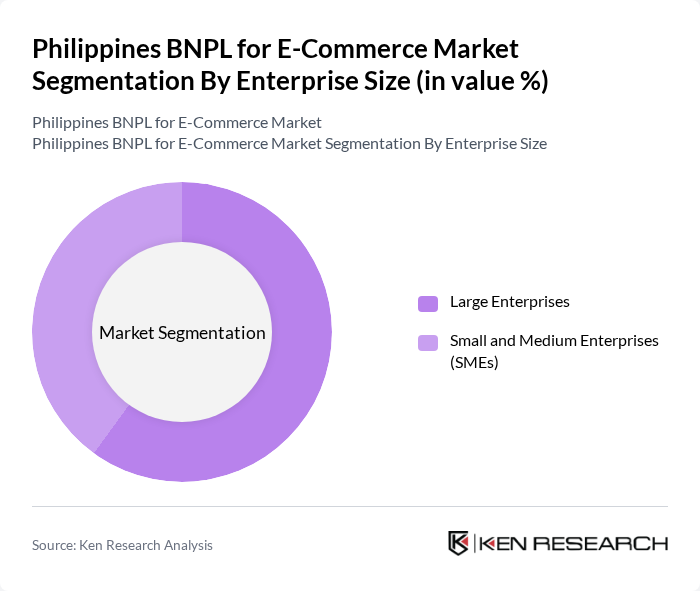
By Enterprise Size:This segmentation includes Large Enterprises and Small and Medium Enterprises (SMEs). Large Enterprises dominate the market due to their established customer bases and extensive resources, enabling them to offer competitive BNPL solutions. SMEs are increasingly adopting BNPL services to attract customers and boost sales, particularly in the e-commerce sector, where flexibility in payment options is crucial for driving consumer engagement.
Philippines BNPL for E-Commerce Market Competitive Landscape
The Philippines BNPL for E-Commerce Market is characterized by a dynamic mix of regional and international players. Leading participants such as BillEase, Home Credit Philippines, Atome Philippines, UnaCash, Cashalo, GCash (Globe Fintech Innovations), PayMaya (Maya Bank), Grab Financial Group Philippines, Lazada Philippines, Shopee Philippines, Growsari, UnionBank of the Philippines, BPI (Bank of the Philippine Islands), Metrobank, RCBC (Rizal Commercial Banking Corporation) contribute to innovation, geographic expansion, and service delivery in this space.
Philippines BNPL for E-Commerce Market Industry Analysis
Growth Drivers
- Increasing E-Commerce Adoption:The Philippines has seen a significant rise in e-commerce, with online sales reaching approximately PHP 250 billion in future. This growth is driven by a 35% increase in internet penetration, now at 80% of the population. The convenience of online shopping, coupled with a growing number of digital platforms, has led to a surge in consumer spending, creating a favorable environment for Buy Now Pay Later (BNPL) services to thrive.
- Rising Consumer Demand for Flexible Payment Options:A survey indicated that 70% of Filipino consumers prefer flexible payment methods, with BNPL emerging as a popular choice. The increasing cost of living, with inflation rates projected at 5% in future, has heightened the need for manageable payment solutions. This trend is further supported by the growing number of millennials and Gen Z consumers who prioritize financial flexibility in their purchasing decisions.
- Expansion of Digital Payment Infrastructure:The Philippines is investing heavily in its digital payment infrastructure, with the Bangko Sentral ng Pilipinas aiming for 60% of all transactions to be digital by future. In future, digital payment transactions reached PHP 2 trillion, reflecting a 25% year-on-year growth. This infrastructure expansion facilitates the adoption of BNPL services, making them more accessible to a broader consumer base across urban and rural areas.
Market Challenges
- High Default Rates:The BNPL sector in the Philippines faces challenges with default rates, which are estimated to be around 20% as of future. This high rate poses a significant risk to providers, as it can lead to increased operational costs and reduced profitability. The economic uncertainty and rising living costs contribute to consumers' inability to meet payment obligations, making risk management a critical focus for BNPL companies.
- Limited Consumer Awareness:Despite the growth of BNPL services, consumer awareness remains low, with only 50% of the population familiar with these options. This lack of understanding can hinder market penetration and adoption rates. Educational initiatives and marketing strategies are essential to inform consumers about the benefits and functionalities of BNPL, particularly in rural areas where financial literacy is often lower.
Philippines BNPL for E-Commerce Market Future Outlook
The future of the BNPL market in the Philippines appears promising, driven by technological advancements and evolving consumer preferences. As digital payment solutions become more integrated into everyday transactions, BNPL providers are likely to enhance their offerings, focusing on user experience and security. Additionally, partnerships with e-commerce platforms will facilitate broader access to BNPL services, potentially increasing market penetration and consumer engagement in the coming years.
Market Opportunities
- Untapped Rural Markets:Approximately 65% of the Philippine population resides in rural areas, presenting a significant opportunity for BNPL providers. By tailoring services to meet the unique needs of these consumers, such as localized marketing and simplified application processes, companies can expand their customer base and drive growth in underserved regions.
- Partnerships with E-Commerce Platforms:Collaborating with major e-commerce platforms can enhance visibility and accessibility for BNPL services. With e-commerce sales projected to grow by 30% annually, strategic partnerships can facilitate seamless integration of BNPL options at checkout, driving higher conversion rates and customer satisfaction.
Scope of the Report
| Segment | Sub-Segments |
|---|---|
| By Channel | Online Point-of-Sale (POS) |
| By Enterprise Size | Large Enterprises Small and Medium Enterprises (SMEs) |
| By Business Model | B2C (Business-to-Consumer) B2B (Business-to-Business) |
| By Device Type | Mobile Devices Desktop/Web |
| By Payment Mode | Mobile Wallets Other Payment Modes |
| By Product Category | Electronics Fashion & Apparel Home & Furniture Healthcare & Education Others |
| By Customer Demographics | Age Group (Gen Z & Millennials) Income Level (Underbanked Population) Geographic Location (Urban vs Rural) |
Key Target Audience
Investors and Venture Capitalist Firms
Government and Regulatory Bodies (e.g., Bangko Sentral ng Pilipinas, Department of Trade and Industry)
E-Commerce Platforms
Payment Gateway Providers
Retail Associations
Consumer Advocacy Groups
Telecommunications Companies
Financial Technology Startups
Players Mentioned in the Report:
BillEase
Home Credit Philippines
Atome Philippines
UnaCash
Cashalo
GCash (Globe Fintech Innovations)
PayMaya (Maya Bank)
Grab Financial Group Philippines
Lazada Philippines
Shopee Philippines
Growsari
UnionBank of the Philippines
BPI (Bank of the Philippine Islands)
Metrobank
RCBC (Rizal Commercial Banking Corporation)
Table of Contents
Market Assessment Phase
1. Executive Summary and Approach
2. Philippines BNPL for E-Commerce Market Overview
2.1 Key Insights and Strategic Recommendations
2.2 Philippines BNPL for E-Commerce Market Overview
2.3 Definition and Scope
2.4 Evolution of Market Ecosystem
2.5 Timeline of Key Regulatory Milestones
2.6 Value Chain & Stakeholder Mapping
2.7 Business Cycle Analysis
2.8 Policy & Incentive Landscape
3. Philippines BNPL for E-Commerce Market Analysis
3.1 Growth Drivers
3.1.1 Increasing E-Commerce Adoption
3.1.2 Rising Consumer Demand for Flexible Payment Options
3.1.3 Expansion of Digital Payment Infrastructure
3.1.4 Supportive Regulatory Environment
3.2 Market Challenges
3.2.1 High Default Rates
3.2.2 Limited Consumer Awareness
3.2.3 Competition from Traditional Credit Providers
3.2.4 Regulatory Compliance Costs
3.3 Market Opportunities
3.3.1 Untapped Rural Markets
3.3.2 Partnerships with E-Commerce Platforms
3.3.3 Technological Innovations in Payment Solutions
3.3.4 Growing Interest in Sustainable Financing Options
3.4 Market Trends
3.4.1 Shift Towards Mobile Payment Solutions
3.4.2 Increasing Personalization in Consumer Offers
3.4.3 Rise of Social Commerce
3.4.4 Integration of AI in Credit Scoring
3.5 Government Regulation
3.5.1 Consumer Protection Laws
3.5.2 Data Privacy Regulations
3.5.3 Licensing Requirements for BNPL Providers
3.5.4 Anti-Money Laundering Compliance
4. SWOT Analysis
5. Stakeholder Analysis
6. Porter's Five Forces Analysis
7. Philippines BNPL for E-Commerce Market Market Size, 2019-2024
7.1 By Value
7.2 By Volume
7.3 By Average Selling Price
8. Philippines BNPL for E-Commerce Market Segmentation
8.1 By Channel
8.1.1 Online
8.1.2 Point-of-Sale (POS)
8.2 By Enterprise Size
8.2.1 Large Enterprises
8.2.2 Small and Medium Enterprises (SMEs)
8.3 By Business Model
8.3.1 B2C (Business-to-Consumer)
8.3.2 B2B (Business-to-Business)
8.4 By Device Type
8.4.1 Mobile Devices
8.4.2 Desktop/Web
8.5 By Payment Mode
8.5.1 Mobile Wallets
8.5.2 Other Payment Modes
8.6 By Product Category
8.6.1 Electronics
8.6.2 Fashion & Apparel
8.6.3 Home & Furniture
8.6.4 Healthcare & Education
8.6.5 Others
8.7 By Customer Demographics
8.7.1 Age Group (Gen Z & Millennials)
8.7.2 Income Level (Underbanked Population)
8.7.3 Geographic Location (Urban vs Rural)
9. Philippines BNPL for E-Commerce Market Competitive Analysis
9.1 Market Share of Key Players
9.2 Cross Comparison of Key Players
9.2.1 Company Name
9.2.2 Market Share (%)
9.2.3 Total Transaction Volume (USD Million)
9.2.4 Average Transaction Value (USD)
9.2.5 Merchant Network Size
9.2.6 Default Rate (%)
9.2.7 Customer Acquisition Cost (USD)
9.2.8 Revenue Growth Rate (%)
9.2.9 Mobile App Downloads
9.2.10 Geographic Coverage (Cities/Provinces)
9.3 SWOT Analysis of Top Players
9.4 Pricing Analysis
9.5 Detailed Profile of Major Companies
9.5.1 BillEase
9.5.2 Home Credit Philippines
9.5.3 Atome Philippines
9.5.4 UnaCash
9.5.5 Cashalo
9.5.6 GCash (Globe Fintech Innovations)
9.5.7 PayMaya (Maya Bank)
9.5.8 Grab Financial Group Philippines
9.5.9 Lazada Philippines
9.5.10 Shopee Philippines
9.5.11 Growsari
9.5.12 UnionBank of the Philippines
9.5.13 BPI (Bank of the Philippine Islands)
9.5.14 Metrobank
9.5.15 RCBC (Rizal Commercial Banking Corporation)
10. Philippines BNPL for E-Commerce Market End-User Analysis
10.1 Procurement Behavior of Key Ministries
10.1.1 Budget Allocation Trends
10.1.2 Preferred Payment Methods
10.1.3 Supplier Selection Criteria
10.2 Corporate Spend on Infrastructure & Energy
10.2.1 Investment Priorities
10.2.2 Financing Preferences
10.2.3 Impact of BNPL on Corporate Spending
10.3 Pain Point Analysis by End-User Category
10.3.1 Payment Delays
10.3.2 Lack of Flexible Options
10.3.3 High Interest Rates
10.4 User Readiness for Adoption
10.4.1 Awareness Levels
10.4.2 Technology Adoption Rates
10.4.3 Trust in BNPL Providers
10.5 Post-Deployment ROI and Use Case Expansion
10.5.1 ROI Measurement Techniques
10.5.2 Case Studies of Successful Implementations
10.5.3 Future Use Case Opportunities
11. Philippines BNPL for E-Commerce Market Future Size, 2025-2030
11.1 By Value
11.2 By Volume
11.3 By Average Selling Price
Go-To-Market Strategy Phase
1. Whitespace Analysis + Business Model Canvas
1.1 Market Gaps Identification
1.2 Value Proposition Development
1.3 Revenue Streams Analysis
1.4 Cost Structure Evaluation
1.5 Key Partnerships Exploration
1.6 Customer Segments Definition
1.7 Channels Strategy
2. Marketing and Positioning Recommendations
2.1 Branding Strategies
2.2 Product USPs
3. Distribution Plan
3.1 Urban Retail vs Rural NGO Tie-ups
4. Channel & Pricing Gaps
4.1 Underserved Routes
4.2 Pricing Bands
5. Unmet Demand & Latent Needs
5.1 Category Gaps
5.2 Consumer Segments
6. Customer Relationship
6.1 Loyalty Programs
6.2 After-sales Service
7. Value Proposition
7.1 Sustainability
7.2 Integrated Supply Chains
8. Key Activities
8.1 Regulatory Compliance
8.2 Branding
8.3 Distribution Setup
9. Entry Strategy Evaluation
9.1 Domestic Market Entry Strategy
9.1.1 Product Mix
9.1.2 Pricing Band
9.1.3 Packaging
9.2 Export Entry Strategy
9.2.1 Target Countries
9.2.2 Compliance Roadmap
10. Entry Mode Assessment
10.1 JV
10.2 Greenfield
10.3 M&A
10.4 Distributor Model
11. Capital and Timeline Estimation
11.1 Capital Requirements
11.2 Timelines
12. Control vs Risk Trade-Off
12.1 Ownership vs Partnerships
13. Profitability Outlook
13.1 Breakeven Analysis
13.2 Long-term Sustainability
14. Potential Partner List
14.1 Distributors
14.2 JVs
14.3 Acquisition Targets
15. Execution Roadmap
15.1 Phased Plan for Market Entry
15.1.1 Market Setup
15.1.2 Market Entry
15.1.3 Growth Acceleration
15.1.4 Scale & Stabilize
15.2 Key Activities and Milestones
15.2.1 Milestone Planning
15.2.2 Activity Tracking
Research Methodology
Phase 1: Approach1
Desk Research
- Analysis of industry reports from local e-commerce associations and financial institutions
- Review of government publications on consumer finance and digital payment trends
- Examination of academic journals and white papers on BNPL (Buy Now Pay Later) models in the Philippines
Primary Research
- Interviews with key stakeholders in the e-commerce sector, including platform operators and payment service providers
- Surveys targeting consumers who have utilized BNPL services for online purchases
- Focus group discussions with financial experts and fintech innovators in the Philippines
Validation & Triangulation
- Cross-validation of findings through multiple data sources, including consumer behavior studies and market analytics
- Triangulation of insights from expert interviews and survey data to ensure consistency
- Sanity checks through feedback from industry panels and advisory groups
Phase 2: Market Size Estimation1
Top-down Assessment
- Estimation of the total addressable market (TAM) for e-commerce in the Philippines
- Segmentation of the market by product categories and consumer demographics
- Incorporation of macroeconomic indicators such as GDP growth and digital adoption rates
Bottom-up Modeling
- Collection of transaction data from leading e-commerce platforms offering BNPL options
- Estimation of average order values and frequency of BNPL usage among consumers
- Analysis of merchant fees and consumer repayment patterns to derive revenue potential
Forecasting & Scenario Analysis
- Development of predictive models based on historical growth rates and market trends
- Scenario analysis considering regulatory changes and shifts in consumer preferences
- Creation of baseline, optimistic, and pessimistic forecasts for the next five years
Phase 3: CATI Sample Composition1
| Scope Item/Segment | Sample Size | Target Respondent Profiles |
|---|---|---|
| Consumer Adoption of BNPL Services | 150 | Online Shoppers, Millennials, Gen Z Consumers |
| E-commerce Platform Insights | 80 | Product Managers, Marketing Directors |
| Financial Institutions' Perspectives | 60 | Banking Executives, Fintech Analysts |
| Regulatory Impact Assessment | 40 | Policy Makers, Economic Advisors |
| Merchant Experience with BNPL | 50 | Retail Owners, E-commerce Managers |
Frequently Asked Questions
What is the current value of the Philippines BNPL for E-Commerce Market?
The Philippines BNPL for E-Commerce Market is valued at approximately USD 2.3 billion, driven by the increasing adoption of digital payment solutions and a surge in online shopping, particularly among underbanked consumers seeking flexible payment options.
What are the main growth drivers for the BNPL market in the Philippines?
Which cities are the primary markets for BNPL services in the Philippines?
What regulatory measures have been introduced for BNPL providers in the Philippines?
Other Regional/Country Reports
Indonesia BNPL for E-Commerce Market
Malaysia BNPL for E-Commerce Market
KSA BNPL for E-Commerce Market
APAC BNPL for E-Commerce Market
SEA BNPL for E-Commerce Market
Vietnam BNPL for E-Commerce Market
Other Adjacent Reports
South Africa E-Commerce Platforms Market
Bahrain Digital Payments MarketMalaysia Fintech Solutions Market
Qatar Mobile Wallets Market Size, Share, Growth Drivers & Forecast 2025–2030Mexico Online Lending Market
UAE Payment Gateways Market
UAE Consumer Credit MarketIndonesia Retail Finance Market
Kuwait Digital Banking Market Size, Share, Opportunities, Trends & Forecast 2025–2030Oman Financial Inclusion Market
Why Buy From Us?

What makes us stand out is that our consultants follow Robust, Refine and Result (RRR) methodology. Robust for clear definitions, approaches and sanity checking, Refine for differentiating respondents' facts and opinions, and Result for presenting data with story.

We have set a benchmark in the industry by offering our clients with syndicated and customized market research reports featuring coverage of entire market as well as meticulous research and analyst insights.

While we don't replace traditional research, we flip the method upside down. Our dual approach of Top Bottom & Bottom Top ensures quality deliverable by not just verifying company fundamentals but also looking at the sector and macroeconomic factors.

With one step in the future, our research team constantly tries to show you the bigger picture. We help with some of the tough questions you may encounter along the way: How is the industry positioned? Best marketing channel? KPI's of competitors? By aligning every element, we help maximize success.

Our report gives you instant access to the answers and sources that other companies might choose to hide. We elaborate each steps of research methodology we have used and showcase you the sample size to earn your trust.

If you need any support, we are here! We pride ourselves on universe strength, data quality, and quick, friendly, and professional service.