About the Report
Base Year 2024Philippines Boom Lifts Market Overview
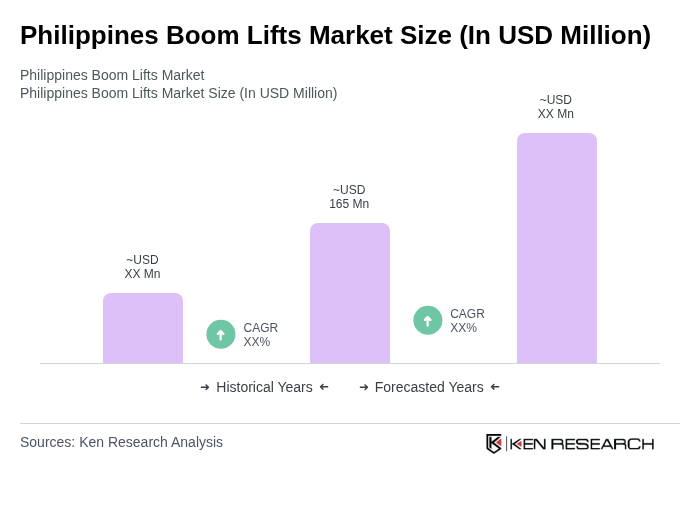
- The Philippines Boom Lifts Market is valued at USD 165 million, based on a five-year historical analysis. This growth is primarily driven by the rapid expansion of the construction and infrastructure sectors, alongside increasing demand for efficient lifting solutions in various industries. The market has seen a surge in investments, particularly in urban development projects and infrastructure initiatives such as the Metro Manila Subway and New Manila International Airport, which have significantly contributed to the overall market size.
- Metro Manila, Cebu, and Davao are the dominant regions in the Philippines Boom Lifts Market. Metro Manila leads due to its high concentration of construction activities and urbanization, while Cebu and Davao are emerging as key players due to their growing infrastructure projects and economic development initiatives. The strategic location and accessibility of these cities further enhance their market presence, with Cebu IT Park recording particularly strong activity and low vacancy rates supporting equipment demand.
- The Philippines government has implemented comprehensive infrastructure policies and regulations to enhance the construction sector's efficiency and safety standards. The "Build Better More" initiative, supported by P1.507 trillion in infrastructure outlays, emphasizes the adoption of modern equipment, including boom lifts, to improve productivity and ensure compliance with safety protocols. Additionally, the Pambansang Pabahay para sa Pilipino Housing Program (4PH) aims to construct one million housing units annually, further fostering growth in the boom lifts market through increased demand for vertical access equipment in residential and commercial construction projects.
Philippines Boom Lifts Market Segmentation
By Type:
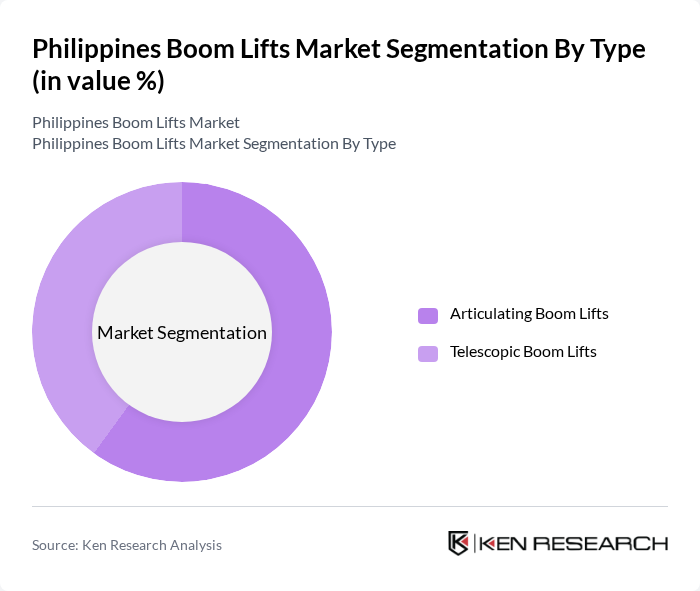
The boom lifts market can be segmented into two primary types: Articulating Boom Lifts and Telescopic Boom Lifts. Articulating Boom Lifts are gaining traction due to their ability to navigate around obstacles and reach difficult areas, making them ideal for construction and maintenance tasks. Telescopic Boom Lifts, on the other hand, are preferred for their straightforward vertical reach and are widely used in applications requiring high elevation. The demand for both types is influenced by the specific needs of various industries, with articulating lifts identified as the fastest-growing segment in the global market.
By End-User:
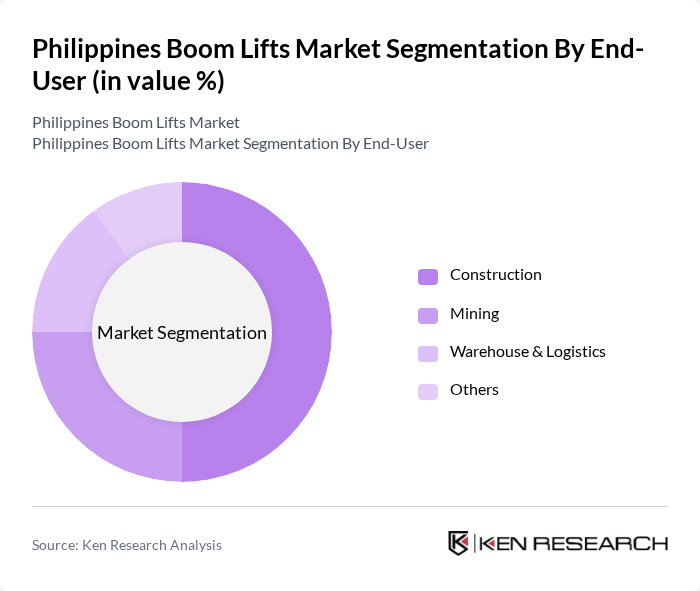
The boom lifts market is segmented by end-user into Construction, Mining, Warehouse & Logistics, and Others. The Construction sector dominates the market due to the ongoing infrastructure projects and urban development initiatives across the Philippines, supported by significant government funding for road, bridge, and highway construction. Mining also contributes significantly, as boom lifts are essential for accessing elevated areas in mining operations, particularly with the expansion of nickel mining activities. The Warehouse & Logistics sector is increasingly adopting boom lifts for efficient material handling, driven by port expansions and warehouse growth, while the "Others" category includes sectors like telecommunications and maintenance services, which are also witnessing growth.
Philippines Boom Lifts Market Competitive Landscape
The Philippines Boom Lifts Market is characterized by a dynamic mix of regional and international players. Leading participants such as JLG Industries, Inc., Genie (Terex Corporation), Haulotte Group, Skyjack Inc., Aichi Corporation, Manitou Group, Snorkel, Niftylift, XCMG, SANY Group, Doosan Infracore, Kobelco Construction Machinery, LiuGong Machinery, AUSA, Altec Industries, Inc. contribute to innovation, geographic expansion, and service delivery in this space.
Philippines Boom Lifts Market Industry Analysis
Growth Drivers
- Increasing Urbanization:The Philippines is experiencing rapid urbanization, with urban areas projected to grow from 47% in the past to 56% in future, according to the World Bank. This urban expansion drives the demand for construction and maintenance activities, necessitating the use of boom lifts. The construction sector is expected to contribute approximately PHP 1.4 trillion to the GDP in future, further fueling the need for efficient lifting equipment in urban projects.
- Infrastructure Development Projects:The Philippine government has allocated PHP 1.2 trillion for infrastructure development under the "Build, Build, Build" program, aiming to enhance transportation and public facilities. This investment is expected to create a surge in construction activities, increasing the demand for boom lifts. With over 1,200 infrastructure projects planned for completion in future, the need for advanced lifting solutions will be critical to meet project timelines and safety standards.
- Technological Advancements in Boom Lifts:The boom lift market is witnessing significant technological advancements, including the integration of IoT and electric models. In future, it is estimated that 35% of boom lifts sold will be electric, driven by environmental regulations and operational efficiency. These innovations not only enhance productivity but also reduce operational costs, making boom lifts more attractive to construction companies looking to optimize their equipment usage.
Market Challenges
- High Initial Investment Costs:The high initial investment required for boom lifts, which can range from PHP 1.2 million to PHP 5.5 million depending on the model, poses a significant barrier for many construction firms. This financial hurdle limits access to advanced lifting equipment, particularly for small and medium-sized enterprises. As a result, many companies may opt for less efficient alternatives, impacting overall productivity in the construction sector.
- Limited Availability of Skilled Operators:The Philippines faces a shortage of skilled operators trained to handle advanced boom lift technology. With only 25% of the workforce in the construction sector possessing the necessary certifications, companies struggle to find qualified personnel. This challenge not only affects operational efficiency but also raises safety concerns, as improper handling of boom lifts can lead to accidents and increased liability for construction firms.
Philippines Boom Lifts Market Future Outlook
The Philippines boom lifts market is poised for significant growth, driven by ongoing urbanization and government infrastructure initiatives. As the construction sector expands, the demand for advanced lifting solutions will increase, particularly with the adoption of eco-friendly technologies. Additionally, the integration of IoT in equipment will enhance operational efficiency and safety. Companies that invest in training skilled operators will be better positioned to capitalize on these trends, ensuring they meet the evolving needs of the construction industry.
Market Opportunities
- Expansion of Rental Services:The boom lift rental market is expected to grow, driven by the increasing preference for rental over ownership. With rental services projected to account for 45% of the market in future, companies can reduce capital expenditure while accessing modern equipment. This trend presents a lucrative opportunity for rental service providers to expand their fleets and enhance service offerings.
- Growth in Renewable Energy Projects:The Philippine government aims to increase renewable energy capacity to 25,000 MW in future. This growth will necessitate the use of boom lifts for installation and maintenance of renewable energy infrastructure, such as wind and solar farms. Companies involved in this sector can leverage this opportunity to provide specialized lifting solutions tailored to the unique requirements of renewable energy projects.
Scope of the Report
| Segment | Sub-Segments |
|---|---|
| By Type | Articulating Boom Lifts Telescopic Boom Lifts |
| By End-User | Construction Mining Warehouse & Logistics Others |
| By Boom Type | Articulated Boom Lifts Straight (Telescopic) Boom Lifts |
| By Power Source | Diesel-Powered Electric-Powered Hybrid |
| By Height Capacity | Up to 20m m to 40m Above 40m |
| By Rental vs. Purchase | Rental Purchase |
| By Region | Luzon Visayas Mindanao |
Key Target Audience
Investors and Venture Capitalist Firms
Government and Regulatory Bodies (e.g., Department of Public Works and Highways, Department of Trade and Industry)
Manufacturers and Producers
Distributors and Retailers
Construction and Infrastructure Companies
Rental Service Providers
Industry Associations (e.g., Philippine Constructors Association)
Financial Institutions
Players Mentioned in the Report:
JLG Industries, Inc.
Genie (Terex Corporation)
Haulotte Group
Skyjack Inc.
Aichi Corporation
Manitou Group
Snorkel
Niftylift
XCMG
SANY Group
Doosan Infracore
Kobelco Construction Machinery
LiuGong Machinery
AUSA
Altec Industries, Inc.
Table of Contents
Market Assessment Phase
1. Executive Summary and Approach
2. Philippines Boom Lifts Market Overview
2.1 Key Insights and Strategic Recommendations
2.2 Philippines Boom Lifts Market Overview
2.3 Definition and Scope
2.4 Evolution of Market Ecosystem
2.5 Timeline of Key Regulatory Milestones
2.6 Value Chain & Stakeholder Mapping
2.7 Business Cycle Analysis
2.8 Policy & Incentive Landscape
3. Philippines Boom Lifts Market Analysis
3.1 Growth Drivers
3.1.1 Increasing Urbanization
3.1.2 Infrastructure Development Projects
3.1.3 Rising Demand for Construction Equipment
3.1.4 Technological Advancements in Boom Lifts
3.2 Market Challenges
3.2.1 High Initial Investment Costs
3.2.2 Limited Availability of Skilled Operators
3.2.3 Regulatory Compliance Issues
3.2.4 Competition from Alternative Equipment
3.3 Market Opportunities
3.3.1 Expansion of Rental Services
3.3.2 Adoption of Electric Boom Lifts
3.3.3 Growth in Renewable Energy Projects
3.3.4 Government Infrastructure Initiatives
3.4 Market Trends
3.4.1 Shift Towards Eco-Friendly Equipment
3.4.2 Integration of IoT in Boom Lifts
3.4.3 Increasing Focus on Safety Standards
3.4.4 Rise of Digital Platforms for Equipment Rental
3.5 Government Regulation
3.5.1 Safety and Operational Standards
3.5.2 Environmental Regulations
3.5.3 Import Tariffs and Duties
3.5.4 Licensing Requirements for Operators
4. SWOT Analysis
5. Stakeholder Analysis
6. Porter's Five Forces Analysis
7. Philippines Boom Lifts Market Market Size, 2019-2024
7.1 By Value
7.2 By Volume
7.3 By Average Selling Price
8. Philippines Boom Lifts Market Segmentation
8.1 By Type
8.1.1 Articulating Boom Lifts
8.1.2 Telescopic Boom Lifts
8.2 By End-User
8.2.1 Construction
8.2.2 Mining
8.2.3 Warehouse & Logistics
8.2.4 Others
8.3 By Boom Type
8.3.1 Articulated Boom Lifts
8.3.2 Straight (Telescopic) Boom Lifts
8.4 By Power Source
8.4.1 Diesel-Powered
8.4.2 Electric-Powered
8.4.3 Hybrid
8.5 By Height Capacity
8.5.1 Up to 20m
8.5.2 20m to 40m
8.5.3 Above 40m
8.6 By Rental vs. Purchase
8.6.1 Rental
8.6.2 Purchase
8.7 By Region
8.7.1 Luzon
8.7.2 Visayas
8.7.3 Mindanao
9. Philippines Boom Lifts Market Competitive Analysis
9.1 Market Share of Key Players
9.2 Cross Comparison of Key Players
9.2.1 Company Name
9.2.2 Revenue (USD Million)
9.2.3 YoY Revenue Growth (%)
9.2.4 Market Share (%)
9.2.5 EBITDA Margin (%)
9.2.6 Return on Equity (ROE %)
9.2.7 Fleet Size (Units)
9.2.8 Service Network Coverage
9.2.9 R&D Investment (% of Revenue)
9.2.10 Customer Acquisition Cost (CAC)
9.3 SWOT Analysis of Top Players
9.4 Pricing Analysis
9.5 Detailed Profile of Major Companies
9.5.1 JLG Industries, Inc.
9.5.2 Genie (Terex Corporation)
9.5.3 Haulotte Group
9.5.4 Skyjack Inc.
9.5.5 Aichi Corporation
9.5.6 Manitou Group
9.5.7 Snorkel
9.5.8 Niftylift
9.5.9 XCMG
9.5.10 SANY Group
9.5.11 Doosan Infracore
9.5.12 Kobelco Construction Machinery
9.5.13 LiuGong Machinery
9.5.14 AUSA
9.5.15 Altec Industries, Inc.
10. Philippines Boom Lifts Market End-User Analysis
10.1 Procurement Behavior of Key Ministries
10.1.1 Government Procurement Policies
10.1.2 Budget Allocation for Infrastructure
10.1.3 Supplier Selection Criteria
10.1.4 Contract Management Practices
10.2 Corporate Spend on Infrastructure & Energy
10.2.1 Investment Trends in Construction
10.2.2 Budgeting for Equipment Rental
10.2.3 Long-term Infrastructure Plans
10.2.4 Cost Management Strategies
10.3 Pain Point Analysis by End-User Category
10.3.1 Equipment Availability
10.3.2 Maintenance and Support Issues
10.3.3 Training and Skill Gaps
10.3.4 Safety Concerns
10.4 User Readiness for Adoption
10.4.1 Awareness of Boom Lift Benefits
10.4.2 Training Programs Availability
10.4.3 Financial Readiness
10.4.4 Regulatory Compliance Understanding
10.5 Post-Deployment ROI and Use Case Expansion
10.5.1 Performance Metrics Tracking
10.5.2 Case Studies of Successful Deployments
10.5.3 User Feedback Mechanisms
10.5.4 Future Expansion Plans
11. Philippines Boom Lifts Market Future Size, 2025-2030
11.1 By Value
11.2 By Volume
11.3 By Average Selling Price
Go-To-Market Strategy Phase
1. Whitespace Analysis + Business Model Canvas
1.1 Market Gaps Identification
1.2 Value Proposition Development
1.3 Revenue Streams Analysis
1.4 Cost Structure Evaluation
1.5 Key Partnerships Exploration
1.6 Customer Segments Definition
1.7 Channels Strategy
2. Marketing and Positioning Recommendations
2.1 Branding Strategies
2.2 Product USPs
2.3 Target Market Identification
2.4 Communication Strategy
2.5 Digital Marketing Approach
2.6 Customer Engagement Tactics
2.7 Performance Metrics
3. Distribution Plan
3.1 Urban Retail Strategy
3.2 Rural NGO Tie-ups
3.3 Logistics and Supply Chain Management
3.4 Distribution Channel Optimization
3.5 Partnership Opportunities
3.6 Inventory Management
3.7 Performance Tracking
4. Channel & Pricing Gaps
4.1 Underserved Routes Analysis
4.2 Pricing Bands Evaluation
4.3 Competitor Pricing Comparison
4.4 Customer Willingness to Pay
4.5 Pricing Strategy Recommendations
4.6 Discount and Promotion Strategies
4.7 Pricing Model Innovation
5. Unmet Demand & Latent Needs
5.1 Category Gaps Identification
5.2 Consumer Segments Analysis
5.3 Product Development Opportunities
5.4 Market Entry Strategies
5.5 Customer Feedback Integration
5.6 Future Trends Anticipation
5.7 Competitive Advantage Development
6. Customer Relationship
6.1 Loyalty Programs Design
6.2 After-sales Service Strategies
6.3 Customer Support Framework
6.4 Feedback Mechanisms
6.5 Relationship Management Tools
6.6 Customer Retention Strategies
6.7 Performance Evaluation
7. Value Proposition
7.1 Sustainability Initiatives
7.2 Integrated Supply Chains
7.3 Unique Selling Points Development
7.4 Customer-Centric Approach
7.5 Market Differentiation Strategies
7.6 Value Communication
7.7 Performance Metrics
8. Key Activities
8.1 Regulatory Compliance
8.2 Branding Initiatives
8.3 Distribution Setup
8.4 Marketing Campaigns
8.5 Training and Development
8.6 Performance Monitoring
8.7 Continuous Improvement
9. Entry Strategy Evaluation
9.1 Domestic Market Entry Strategy
9.1.1 Product Mix Considerations
9.1.2 Pricing Band Analysis
9.1.3 Packaging Strategies
9.2 Export Entry Strategy
9.2.1 Target Countries Identification
9.2.2 Compliance Roadmap Development
10. Entry Mode Assessment
10.1 Joint Ventures
10.2 Greenfield Investments
10.3 Mergers & Acquisitions
10.4 Distributor Model Evaluation
10.5 Risk Assessment
10.6 Strategic Fit Analysis
10.7 Performance Metrics
11. Capital and Timeline Estimation
11.1 Capital Requirements Analysis
11.2 Timelines for Market Entry
11.3 Financial Projections
11.4 Funding Sources Exploration
11.5 Risk Management Strategies
11.6 Performance Tracking
12. Control vs Risk Trade-Off
12.1 Ownership Considerations
12.2 Partnership Opportunities
12.3 Risk Mitigation Strategies
12.4 Performance Metrics
12.5 Long-term Sustainability
12.6 Strategic Alignment
13. Profitability Outlook
13.1 Breakeven Analysis
13.2 Long-term Sustainability Strategies
13.3 Financial Health Monitoring
13.4 Profit Margin Optimization
13.5 Performance Metrics
13.6 Market Positioning
14. Potential Partner List
14.1 Distributors Identification
14.2 Joint Ventures Opportunities
14.3 Acquisition Targets
14.4 Strategic Alliances
14.5 Partnership Evaluation
14.6 Performance Metrics
15. Execution Roadmap
15.1 Phased Plan for Market Entry
15.1.1 Market Setup
15.1.2 Market Entry
15.1.3 Growth Acceleration
15.1.4 Scale & Stabilize
15.2 Key Activities and Milestones
15.2.1 Activity Planning
15.2.2 Milestone Tracking
15.2.3 Performance Evaluation
Research Methodology
Phase 1: Approach1
Desk Research
- Industry reports from local construction and equipment associations
- Government publications on infrastructure development and investment trends
- Market analysis from trade journals focusing on construction equipment
Primary Research
- Interviews with fleet managers in construction and rental companies
- Surveys with project managers in large-scale infrastructure projects
- Field interviews with operators and technicians using boom lifts
Validation & Triangulation
- Cross-validation of data from multiple industry sources and reports
- Triangulation of insights from primary interviews and secondary data
- Sanity checks through expert panel discussions and feedback
Phase 2: Market Size Estimation1
Top-down Assessment
- Analysis of national construction spending and its impact on boom lift demand
- Segmentation of the market by end-user industries such as construction, maintenance, and events
- Incorporation of government infrastructure projects and public-private partnerships
Bottom-up Modeling
- Volume estimates based on rental rates and utilization rates of boom lifts
- Cost analysis derived from operational expenses of boom lift providers
- Estimation of market size based on fleet composition and turnover rates
Forecasting & Scenario Analysis
- Multi-factor regression analysis considering economic growth and urbanization trends
- Scenario planning based on potential regulatory changes and environmental policies
- Baseline, optimistic, and pessimistic forecasts through 2030
Phase 3: CATI Sample Composition1
| Scope Item/Segment | Sample Size | Target Respondent Profiles |
|---|---|---|
| Construction Sector Boom Lift Usage | 120 | Project Managers, Site Supervisors |
| Rental Companies Fleet Management | 100 | Fleet Managers, Operations Directors |
| Maintenance and Repair Services | 80 | Service Technicians, Maintenance Managers |
| Event Management Equipment Rental | 70 | Event Coordinators, Logistics Managers |
| Government Infrastructure Projects | 90 | Public Works Officials, Procurement Officers |
Frequently Asked Questions
What is the current value of the Philippines Boom Lifts Market?
The Philippines Boom Lifts Market is valued at approximately USD 165 million, driven by the rapid growth of the construction and infrastructure sectors, alongside increasing demand for efficient lifting solutions across various industries.
Which regions dominate the Philippines Boom Lifts Market?
What are the key growth drivers for the Boom Lifts Market in the Philippines?
What challenges does the Philippines Boom Lifts Market face?
Other Regional/Country Reports
Other Adjacent Reports
UAE Aerial Work Platforms Market
Belgium Scissor Lifts Market
Philippines Telehandlers Market
Kuwait Construction Equipment Market Report Size Share Growth Drivers Trends Opportunities & Forecast 2025–2030Global Mining Equipment MarketAsia Pacific Material Handling Equipment Market Outlook to 2030: Size, Share, Growth and TrendsVietnam Warehouse Logistics Equipment Market
Egypt Renewable Energy Equipment Market
Singapore Equipment Rental Services Market
South Korea Cranes Market
Why Buy From Us?

What makes us stand out is that our consultants follow Robust, Refine and Result (RRR) methodology. Robust for clear definitions, approaches and sanity checking, Refine for differentiating respondents' facts and opinions, and Result for presenting data with story.

We have set a benchmark in the industry by offering our clients with syndicated and customized market research reports featuring coverage of entire market as well as meticulous research and analyst insights.

While we don't replace traditional research, we flip the method upside down. Our dual approach of Top Bottom & Bottom Top ensures quality deliverable by not just verifying company fundamentals but also looking at the sector and macroeconomic factors.

With one step in the future, our research team constantly tries to show you the bigger picture. We help with some of the tough questions you may encounter along the way: How is the industry positioned? Best marketing channel? KPI's of competitors? By aligning every element, we help maximize success.

Our report gives you instant access to the answers and sources that other companies might choose to hide. We elaborate each steps of research methodology we have used and showcase you the sample size to earn your trust.

If you need any support, we are here! We pride ourselves on universe strength, data quality, and quick, friendly, and professional service.