About the Report
Base Year 2024Philippines Circuit Protection Market Overview
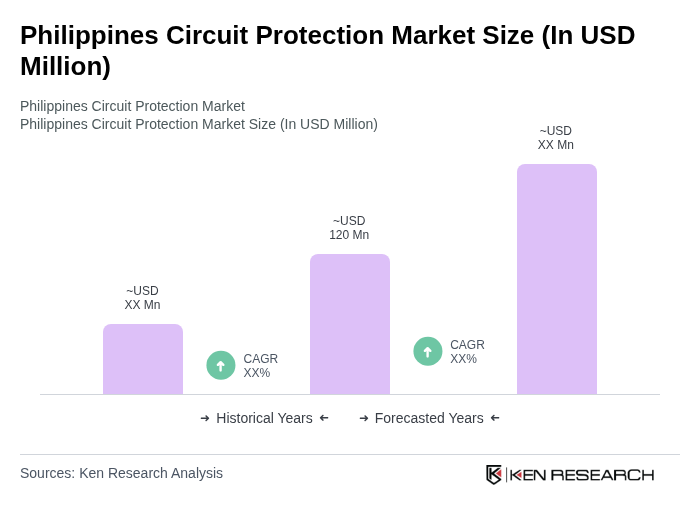
- The Philippines Circuit Protection Market is valued at USD 120 million, based on a five-year historical analysis. This growth is primarily driven by the increasing demand for electrical safety solutions in residential, commercial, and industrial sectors, alongside rapid urbanization, expansion of the construction sector, and ongoing investments in power distribution and industrial facilities across the country.
- Metro Manila, Cebu, and Davao are the dominant cities in the Philippines Circuit Protection Market. Metro Manila leads due to its status as the economic and commercial hub and concentration of high-rise residential, commercial, and industrial facilities, while Cebu and Davao benefit from growing industrial activities, special economic zones, and infrastructure projects, contributing to the overall demand for circuit protection solutions in buildings, utilities, and manufacturing plants.
- The Philippines regulates the design, installation, and protection of electrical systems through the Philippine Electrical Code, implemented under the Electrical Engineering Law and enforced by the Department of Public Works and Highways and local building officials, which requires the use of appropriate overcurrent and circuit protection devices (such as circuit breakers, fuses, residual current devices, and surge protection) in residential, commercial, and industrial installations to enhance electrical safety and reduce the risk of electrical fires and accidents, thereby supporting demand for circuit protection products.
Philippines Circuit Protection Market Segmentation
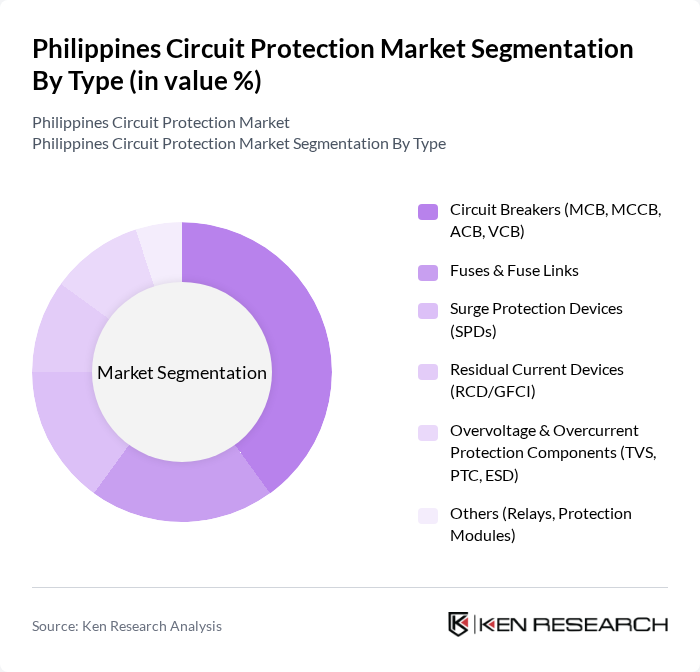
By Type:The circuit protection market can be segmented into various types, including Circuit Breakers (MCB, MCCB, ACB, VCB), Fuses & Fuse Links, Surge Protection Devices (SPDs), Residual Current Devices (RCD/GFCI), Overvoltage & Overcurrent Protection Components (TVS, PTC, ESD), and Others (Relays, Protection Modules). This segmentation aligns with typical circuit protection classifications used in global and Asia?Pacific markets, where circuit breakers account for the largest share, followed by fuses and surge protection devices in distribution and end?use applications. Among these, Circuit Breakers are the most widely used due to their reliability, ease of reset, coordination with distribution equipment, and effectiveness in preventing electrical overloads and short circuits in low? and medium?voltage systems used across buildings, industry, and utilities.
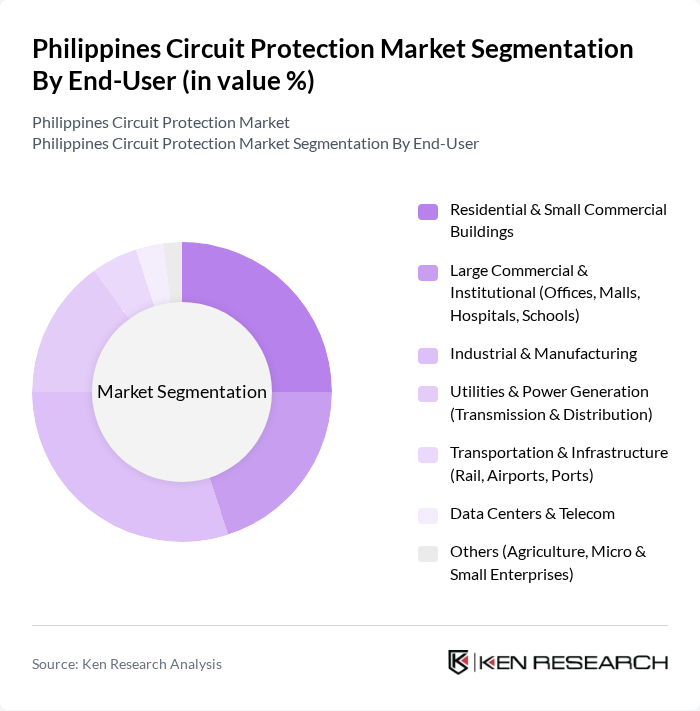
By End-User:The end-user segmentation includes Residential & Small Commercial Buildings, Large Commercial & Institutional (Offices, Malls, Hospitals, Schools), Industrial & Manufacturing, Utilities & Power Generation (Transmission & Distribution), Transportation & Infrastructure (Rail, Airports, Ports), Data Centers & Telecom, and Others (Agriculture, Micro & Small Enterprises). This structure is consistent with the way circuit breaker and circuit protection demand is reported in the Philippines and Asia?Pacific, where building construction, industrial facilities, and utility distribution are the main consuming sectors. The Industrial & Manufacturing sector is the leading end-user, driven by the need for robust electrical safety measures, reliable power distribution, and equipment protection in production facilities, industrial parks, and process industries, which aligns with findings that industrial users form the largest segment in the Philippines circuit breaker market.
Philippines Circuit Protection Market Competitive Landscape
The Philippines Circuit Protection Market is characterized by a dynamic mix of regional and international players. Leading participants such as Schneider Electric Philippines, Inc., Siemens, Inc. (Philippines), ABB, Inc. (Philippines), Eaton Corporation plc, Legrand Philippines, Inc., Mitsubishi Electric Asia Pte. Ltd. – Philippine Branch, LS Electric Co., Ltd. (Formerly LSIS), Fuji Electric Co., Ltd., Chint Group Co., Ltd., Del Monte Electric and Construction Corporation (Philippines Panel Builder & Integrator), Concepcion Industrial Corporation (CIC), Phoenix Contact (Philippines Representative / Distributor), Littelfuse, Inc., Bel Fuse Inc., CIRCUTOR, S.A. contribute to innovation, geographic expansion, and service delivery in this space, supplying circuit breakers, fuses, surge protection, residual current devices, and related low? and medium?voltage protection solutions for building, industrial, and utility applications.
Philippines Circuit Protection Market Industry Analysis
Growth Drivers
- Increasing Demand for Electrical Safety:The Philippines has seen a significant rise in electrical safety awareness, driven by a reported 30% increase in electrical accidents over the past five years. This has prompted both consumers and businesses to invest in circuit protection devices. The Department of Energy reported that electrical safety regulations are being enforced more stringently, leading to a projected increase in demand for circuit protection solutions in future, which are essential for preventing electrical hazards and ensuring compliance with safety standards.
- Government Initiatives for Infrastructure Development:The Philippine government allocated approximately 9 billion USD for infrastructure projects in future, focusing on enhancing electrical systems across urban and rural areas. This investment is expected to drive the demand for circuit protection devices, as new constructions require advanced safety measures. The Build, Build, Build program aims to improve the electrical grid, thereby increasing the need for reliable circuit protection solutions to safeguard these investments and ensure operational efficiency.
- Rising Adoption of Renewable Energy Sources:The Philippines aims to increase its renewable energy share to 35% in future, according to the Renewable Energy Act. This shift necessitates advanced circuit protection devices to manage the complexities of integrating renewable sources like solar and wind into the existing grid. The Department of Energy's initiatives to promote solar energy installations have led to a 25% increase in demand for circuit protection solutions, ensuring the safe operation of these systems and enhancing energy reliability.
Market Challenges
- High Cost of Advanced Circuit Protection Solutions:The initial investment for advanced circuit protection devices can be prohibitive, with costs ranging from 500 USD to 2,000 USD per unit. This high price point limits accessibility for small businesses and residential users, who may opt for cheaper alternatives. The Philippine Statistics Authority reported that 40% of small enterprises cite cost as a primary barrier to adopting advanced electrical safety solutions, hindering overall market growth and innovation in the sector.
- Lack of Awareness Among End-Users:Despite the growing importance of circuit protection, a significant knowledge gap exists among end-users. A survey by the Philippine Institute of Electrical Engineers indicated that over 60% of consumers are unaware of the benefits of circuit protection devices. This lack of awareness leads to underutilization of available technologies, resulting in increased risks of electrical failures and accidents, which could otherwise be mitigated through proper circuit protection measures.
Philippines Circuit Protection Market Future Outlook
The Philippines circuit protection market is poised for significant growth, driven by increasing investments in infrastructure and renewable energy. As the government continues to enforce stricter safety regulations, the demand for advanced circuit protection solutions will likely rise. Additionally, the integration of smart technologies and IoT in electrical systems will create new opportunities for innovation. Companies that focus on developing cost-effective, user-friendly products will be well-positioned to capture market share and address the evolving needs of consumers and businesses alike.
Market Opportunities
- Expansion of Smart Grid Technologies:The Philippine government is investing heavily in smart grid technologies, with an estimated budget of 1.5 billion USD in future. This investment will create opportunities for circuit protection manufacturers to develop solutions that enhance grid reliability and efficiency, addressing the growing demand for modern electrical infrastructure.
- Growth in the Construction Sector:The construction sector is projected to grow by 8% in future, driven by urbanization and infrastructure projects. This growth presents a significant opportunity for circuit protection providers to supply essential safety devices for new buildings, ensuring compliance with safety standards and enhancing electrical system reliability in emerging urban areas.
Scope of the Report
| Segment | Sub-Segments |
|---|---|
| By Type | Circuit Breakers (MCB, MCCB, ACB, VCB) Fuses & Fuse Links Surge Protection Devices (SPDs) Residual Current Devices (RCD/GFCI) Overvoltage & Overcurrent Protection Components (TVS, PTC, ESD) Others (Relays, Protection Modules) |
| By End-User | Residential & Small Commercial Buildings Large Commercial & Institutional (Offices, Malls, Hospitals, Schools) Industrial & Manufacturing Utilities & Power Generation (Transmission & Distribution) Transportation & Infrastructure (Rail, Airports, Ports) Data Centers & Telecom Others (Agriculture, Micro & Small Enterprises) |
| By Application | Building Power Distribution & Final Circuits Transmission & Distribution Networks / Substations Renewable Energy Systems (Solar PV, Wind, Hybrid Microgrids) Electric Vehicle Charging Infrastructure Industrial Motor Control & Automation Data Centers, ICT & Critical Power Consumer & Low-Voltage Electronics Others |
| By Material | Thermoplastics & Thermoset Housings Copper & Copper Alloys Silver & Silver Alloy Contacts Composite & Hybrid Materials Others |
| By Voltage Rating | Low Voltage (< 1 kV) Medium Voltage (1 kV – 72.5 kV) High Voltage (> 72.5 kV) Extra?High Voltage (T&D Interconnection) |
| By Distribution Channel | Direct Sales to Utilities & Large EPCs Electrical Distributors & Wholesalers Retail / Hardware & Electrical Stores Online & E?Commerce Platforms Panel Builders & System Integrators (OEM) |
| By Region | Luzon (Including Metro Manila) Visayas Mindanao Other Island Grids & Off?Grid Areas |
Key Target Audience
Investors and Venture Capitalist Firms
Government and Regulatory Bodies (e.g., Department of Energy, Department of Trade and Industry)
Manufacturers and Producers
Distributors and Retailers
Electrical Equipment Wholesalers
Industry Associations (e.g., Philippine Electrical Manufacturers Association)
Utility Companies
Financial Institutions
Players Mentioned in the Report:
Schneider Electric Philippines, Inc.
Siemens, Inc. (Philippines)
ABB, Inc. (Philippines)
Eaton Corporation plc
Legrand Philippines, Inc.
Mitsubishi Electric Asia Pte. Ltd. Philippine Branch
LS Electric Co., Ltd. (Formerly LSIS)
Fuji Electric Co., Ltd.
Chint Group Co., Ltd.
Del Monte Electric and Construction Corporation (Philippines Panel Builder & Integrator)
Concepcion Industrial Corporation (CIC)
Phoenix Contact (Philippines Representative / Distributor)
Littelfuse, Inc.
Bel Fuse Inc.
CIRCUTOR, S.A.
Table of Contents
Market Assessment Phase
1. Executive Summary and Approach
2. Philippines Circuit Protection Market Overview
2.1 Key Insights and Strategic Recommendations
2.2 Philippines Circuit Protection Market Overview
2.3 Definition and Scope
2.4 Evolution of Market Ecosystem
2.5 Timeline of Key Regulatory Milestones
2.6 Value Chain & Stakeholder Mapping
2.7 Business Cycle Analysis
2.8 Policy & Incentive Landscape
3. Philippines Circuit Protection Market Analysis
3.1 Growth Drivers
3.1.1 Increasing demand for electrical safety
3.1.2 Government initiatives for infrastructure development
3.1.3 Rising adoption of renewable energy sources
3.1.4 Technological advancements in circuit protection devices
3.2 Market Challenges
3.2.1 High cost of advanced circuit protection solutions
3.2.2 Lack of awareness among end-users
3.2.3 Regulatory compliance issues
3.2.4 Competition from low-cost alternatives
3.3 Market Opportunities
3.3.1 Expansion of smart grid technologies
3.3.2 Growth in the construction sector
3.3.3 Increasing investments in energy efficiency
3.3.4 Development of innovative circuit protection products
3.4 Market Trends
3.4.1 Shift towards digital circuit protection solutions
3.4.2 Integration of IoT in circuit protection systems
3.4.3 Focus on sustainability and eco-friendly products
3.4.4 Rise in demand for customized solutions
3.5 Government Regulation
3.5.1 Implementation of safety standards for electrical installations
3.5.2 Incentives for renewable energy projects
3.5.3 Regulations on energy efficiency
3.5.4 Compliance requirements for circuit protection devices
4. SWOT Analysis
5. Stakeholder Analysis
6. Porter's Five Forces Analysis
7. Philippines Circuit Protection Market Market Size, 2019-2024
7.1 By Value
7.2 By Volume
7.3 By Average Selling Price
8. Philippines Circuit Protection Market Segmentation
8.1 By Type
8.1.1 Circuit Breakers (MCB, MCCB, ACB, VCB)
8.1.2 Fuses & Fuse Links
8.1.3 Surge Protection Devices (SPDs)
8.1.4 Residual Current Devices (RCD/GFCI)
8.1.5 Overvoltage & Overcurrent Protection Components (TVS, PTC, ESD)
8.1.6 Others (Relays, Protection Modules)
8.2 By End-User
8.2.1 Residential & Small Commercial Buildings
8.2.2 Large Commercial & Institutional (Offices, Malls, Hospitals, Schools)
8.2.3 Industrial & Manufacturing
8.2.4 Utilities & Power Generation (Transmission & Distribution)
8.2.5 Transportation & Infrastructure (Rail, Airports, Ports)
8.2.6 Data Centers & Telecom
8.2.7 Others (Agriculture, Micro & Small Enterprises)
8.3 By Application
8.3.1 Building Power Distribution & Final Circuits
8.3.2 Transmission & Distribution Networks / Substations
8.3.3 Renewable Energy Systems (Solar PV, Wind, Hybrid Microgrids)
8.3.4 Electric Vehicle Charging Infrastructure
8.3.5 Industrial Motor Control & Automation
8.3.6 Data Centers, ICT & Critical Power
8.3.7 Consumer & Low-Voltage Electronics
8.3.8 Others
8.4 By Material
8.4.1 Thermoplastics & Thermoset Housings
8.4.2 Copper & Copper Alloys
8.4.3 Silver & Silver Alloy Contacts
8.4.4 Composite & Hybrid Materials
8.4.5 Others
8.5 By Voltage Rating
8.5.1 Low Voltage (< 1 kV)
8.5.2 Medium Voltage (1 kV – 72.5 kV)
8.5.3 High Voltage (> 72.5 kV)
8.5.4 Extra?High Voltage (T&D Interconnection)
8.6 By Distribution Channel
8.6.1 Direct Sales to Utilities & Large EPCs
8.6.2 Electrical Distributors & Wholesalers
8.6.3 Retail / Hardware & Electrical Stores
8.6.4 Online & E?Commerce Platforms
8.6.5 Panel Builders & System Integrators (OEM)
8.7 By Region
8.7.1 Luzon (Including Metro Manila)
8.7.2 Visayas
8.7.3 Mindanao
8.7.4 Other Island Grids & Off?Grid Areas
9. Philippines Circuit Protection Market Competitive Analysis
9.1 Market Share of Key Players
9.2 Cross Comparison of Key Players
9.2.1 Company Name
9.2.2 Group Size (Global, Regional, or Local Player)
9.2.3 Philippines Circuit Protection Revenue (USD Million)
9.2.4 Revenue Growth Rate in the Philippines (%)
9.2.5 Market Share in Philippines Circuit Protection Market (%)
9.2.6 Product Portfolio Breadth (LV/MV/HV, Devices Covered)
9.2.7 Presence Across Key End?User Segments (No. of Segments Served)
9.2.8 Channel Coverage (No. of Distributors / Partners in the Philippines)
9.2.9 Installed Base in Utilities & Large Projects (No. of Major Projects)
9.2.10 R&D and Product Innovation Intensity (% of Revenue)
9.2.11 Average Price Positioning (Premium / Mid?Range / Value)
9.2.12 After?Sales & Service Footprint (Service Centers / Field Engineers)
9.2.13 Brand Awareness & Preference Among Specifiers / Contractors
9.3 SWOT Analysis of Top Players
9.4 Pricing Analysis
9.5 Detailed Profile of Major Companies
9.5.1 Schneider Electric Philippines, Inc.
9.5.2 Siemens, Inc. (Philippines)
9.5.3 ABB, Inc. (Philippines)
9.5.4 Eaton Corporation plc
9.5.5 Legrand Philippines, Inc.
9.5.6 Mitsubishi Electric Asia Pte. Ltd. – Philippine Branch
9.5.7 LS Electric Co., Ltd. (Formerly LSIS)
9.5.8 Fuji Electric Co., Ltd.
9.5.9 Chint Group Co., Ltd.
9.5.10 Del Monte Electric and Construction Corporation (Philippines Panel Builder & Integrator)
9.5.11 Concepcion Industrial Corporation (CIC)
9.5.12 Phoenix Contact (Philippines Representative / Distributor)
9.5.13 Littelfuse, Inc.
9.5.14 Bel Fuse Inc.
9.5.15 CIRCUTOR, S.A.
10. Philippines Circuit Protection Market End-User Analysis
10.1 Procurement Behavior of Key Ministries
10.1.1 Budget Allocation Trends
10.1.2 Procurement Processes
10.1.3 Key Decision-Makers
10.1.4 Contracting Strategies
10.2 Corporate Spend on Infrastructure & Energy
10.2.1 Investment Trends
10.2.2 Major Projects
10.2.3 Funding Sources
10.2.4 Spending Priorities
10.3 Pain Point Analysis by End-User Category
10.3.1 Common Challenges Faced
10.3.2 Impact of Circuit Protection Failures
10.3.3 Demand for Reliable Solutions
10.3.4 Cost Considerations
10.4 User Readiness for Adoption
10.4.1 Awareness Levels
10.4.2 Training Needs
10.4.3 Adoption Barriers
10.4.4 Support Requirements
10.5 Post-Deployment ROI and Use Case Expansion
10.5.1 Measurement of ROI
10.5.2 Case Studies of Successful Implementations
10.5.3 Future Use Cases
10.5.4 Feedback Mechanisms
11. Philippines Circuit Protection Market Future Size, 2025-2030
11.1 By Value
11.2 By Volume
11.3 By Average Selling Price
Go-To-Market Strategy Phase
1. Whitespace Analysis + Business Model Canvas
1.1 Market Gaps Identification
1.2 Business Model Components
2. Marketing and Positioning Recommendations
2.1 Branding Strategies
2.2 Product USPs
3. Distribution Plan
3.1 Urban Retail Strategies
3.2 Rural NGO Tie-ups
4. Channel & Pricing Gaps
4.1 Underserved Routes
4.2 Pricing Bands
5. Unmet Demand & Latent Needs
5.1 Category Gaps
5.2 Consumer Segments
6. Customer Relationship
6.1 Loyalty Programs
6.2 After-sales Service
7. Value Proposition
7.1 Sustainability Initiatives
7.2 Integrated Supply Chains
8. Key Activities
8.1 Regulatory Compliance
8.2 Branding Efforts
8.3 Distribution Setup
9. Entry Strategy Evaluation
9.1 Domestic Market Entry Strategy
9.1.1 Product Mix
9.1.2 Pricing Band
9.1.3 Packaging Considerations
9.2 Export Entry Strategy
9.2.1 Target Countries
9.2.2 Compliance Roadmap
10. Entry Mode Assessment
10.1 Joint Ventures
10.2 Greenfield Investments
10.3 Mergers & Acquisitions
10.4 Distributor Model
11. Capital and Timeline Estimation
11.1 Capital Requirements
11.2 Timelines
12. Control vs Risk Trade-Off
12.1 Ownership Considerations
12.2 Partnerships
13. Profitability Outlook
13.1 Breakeven Analysis
13.2 Long-term Sustainability
14. Potential Partner List
14.1 Distributors
14.2 Joint Ventures
14.3 Acquisition Targets
15. Execution Roadmap
15.1 Phased Plan for Market Entry
15.1.1 Market Setup
15.1.2 Market Entry
15.1.3 Growth Acceleration
15.1.4 Scale & Stabilize
15.2 Key Activities and Milestones
15.2.1 Milestone Planning
15.2.2 Activity Tracking
Research Methodology
Phase 1: Approach1
Desk Research
- Analysis of industry reports from government agencies and trade associations in the Philippines
- Review of market studies and white papers published by industry experts and consultancy firms
- Examination of import/export data and statistics from the Philippine Statistics Authority
Primary Research
- Interviews with key stakeholders in the circuit protection industry, including manufacturers and distributors
- Surveys conducted with electrical engineers and project managers in construction and infrastructure sectors
- Field visits to manufacturing plants and distribution centers to gather firsthand insights
Validation & Triangulation
- Cross-validation of findings through multiple data sources, including trade publications and expert interviews
- Triangulation of market trends using historical data and current market dynamics
- Sanity checks through feedback from an advisory panel of industry experts
Phase 2: Market Size Estimation1
Top-down Assessment
- Estimation of the overall circuit protection market size based on national electrical equipment spending
- Segmentation of the market by product type, including fuses, circuit breakers, and surge protectors
- Incorporation of growth rates from related sectors such as construction and renewable energy
Bottom-up Modeling
- Collection of sales data from leading circuit protection manufacturers operating in the Philippines
- Estimation of market share based on production capacity and sales volume of key players
- Analysis of pricing strategies and average selling prices across different product categories
Forecasting & Scenario Analysis
- Development of forecasting models based on historical growth trends and economic indicators
- Scenario analysis considering factors such as regulatory changes and technological advancements
- Creation of multiple projections (baseline, optimistic, and pessimistic) through 2030
Phase 3: CATI Sample Composition1
| Scope Item/Segment | Sample Size | Target Respondent Profiles |
|---|---|---|
| Residential Circuit Protection | 100 | Homeowners, Electrical Contractors |
| Commercial Electrical Systems | 80 | Facility Managers, Electrical Engineers |
| Industrial Circuit Protection Solutions | 70 | Plant Managers, Safety Officers |
| Renewable Energy Integration | 60 | Project Developers, Energy Consultants |
| Government Infrastructure Projects | 90 | Public Works Officials, Procurement Managers |
Frequently Asked Questions
What is the current value of the Philippines Circuit Protection Market?
The Philippines Circuit Protection Market is valued at approximately USD 120 million, reflecting a five-year historical analysis. This growth is driven by increasing demand for electrical safety solutions across various sectors, including residential, commercial, and industrial.
Which cities are the key players in the Philippines Circuit Protection Market?
What types of circuit protection devices are available in the Philippines?
What are the main end-user segments for circuit protection in the Philippines?
Other Regional/Country Reports
Indonesia Circuit Protection Market
Malaysia Circuit Protection Market
KSA Circuit Protection Market
APAC Circuit Protection Market
SEA Circuit Protection Market
Vietnam Circuit Protection Market
Other Adjacent Reports
Thailand Electrical Switchgear Market
Mexico Power Distribution Equipment Market
South Korea Surge Protection Devices Market
Mexico Circuit Breaker Market
Brazil Fuse Market
Belgium Renewable Energy Integration Market
Egypt Smart Grid Technology Market
United States Industrial Automation Market Outlook to 2030: Size, Share, Growth and TrendsKSA Building Management Systems Market
Bahrain Energy Storage Systems MarketWhy Buy From Us?

What makes us stand out is that our consultants follow Robust, Refine and Result (RRR) methodology. Robust for clear definitions, approaches and sanity checking, Refine for differentiating respondents' facts and opinions, and Result for presenting data with story.

We have set a benchmark in the industry by offering our clients with syndicated and customized market research reports featuring coverage of entire market as well as meticulous research and analyst insights.

While we don't replace traditional research, we flip the method upside down. Our dual approach of Top Bottom & Bottom Top ensures quality deliverable by not just verifying company fundamentals but also looking at the sector and macroeconomic factors.

With one step in the future, our research team constantly tries to show you the bigger picture. We help with some of the tough questions you may encounter along the way: How is the industry positioned? Best marketing channel? KPI's of competitors? By aligning every element, we help maximize success.

Our report gives you instant access to the answers and sources that other companies might choose to hide. We elaborate each steps of research methodology we have used and showcase you the sample size to earn your trust.

If you need any support, we are here! We pride ourselves on universe strength, data quality, and quick, friendly, and professional service.