About the Report
Base Year 2024Philippines Hyperloop Technology Market Overview
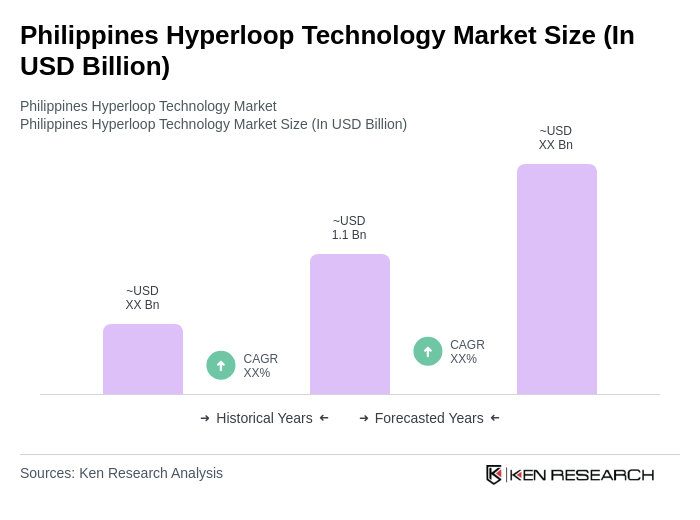
- The Philippines Hyperloop Technology Market is valued at USD 1.1 billion, based on a five-year historical analysis. This valuation reflects the country’s nascent but growing interest in next-generation transport solutions; global hyperloop technology market estimates for 2024–2025 range from USD 2.7 billion to USD 5 billion, with Asia-Pacific as the fastest-growing region. Growth in the Philippines is primarily driven by the increasing need for efficient transportation solutions, urban congestion, and government initiatives aimed at modernizing infrastructure. The rising interest in sustainable transport options has also contributed to the market's expansion, as Hyperloop technology promises reduced travel times and lower carbon emissions, aligning with global trends toward decarbonization and smart mobility.
- Key players in this market include Metro Manila, Cebu, and Davao, which dominate due to their high population density and significant economic activities. These cities are experiencing rapid urbanization, leading to increased demand for innovative transport solutions. The government's focus on infrastructure development and public-private partnerships further enhances the attractiveness of these regions for Hyperloop projects, mirroring regional trends where urban centers lead in pilot programs and feasibility studies.
- In 2023, the Philippine government introduced the National Transport Policy Framework for Emerging Technologies, issued by the Department of Transportation. This framework establishes guidelines for safety standards, environmental impact assessments, and mandatory public consultations for Hyperloop and other advanced transport systems. Compliance includes obtaining permits from the Land Transportation Franchising and Regulatory Board (LTFRB) and adherence to international safety benchmarks, with projects exceeding USD 50 million subject to additional review by the National Economic and Development Authority (NEDA). The framework aims to ensure that Hyperloop projects align with national transportation goals and sustainability objectives, while fostering innovation through clear regulatory pathways.
Philippines Hyperloop Technology Market Segmentation
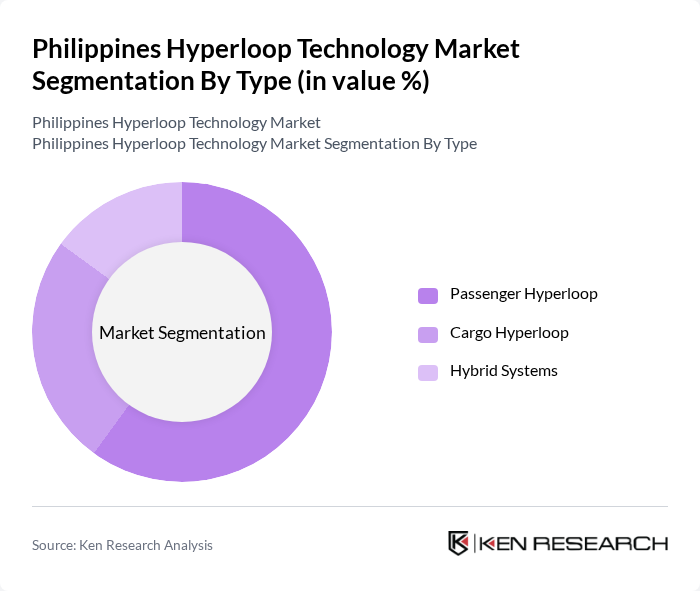
By Type:The market is segmented into three main types: Passenger Hyperloop, Cargo Hyperloop, and Hybrid Systems. The Passenger Hyperloop segment is gaining traction due to its potential to revolutionize intercity and urban travel, with global data indicating passenger applications currently lead the market. Cargo Hyperloop is being explored for its efficiency in freight transport, particularly for time-sensitive and high-value goods, with the cargo segment expected to experience the fastest growth globally as logistics companies seek to reduce shipping times and costs. Hybrid Systems combine both passenger and cargo capabilities, catering to diverse transportation needs and offering operational flexibility for mixed-use corridors.
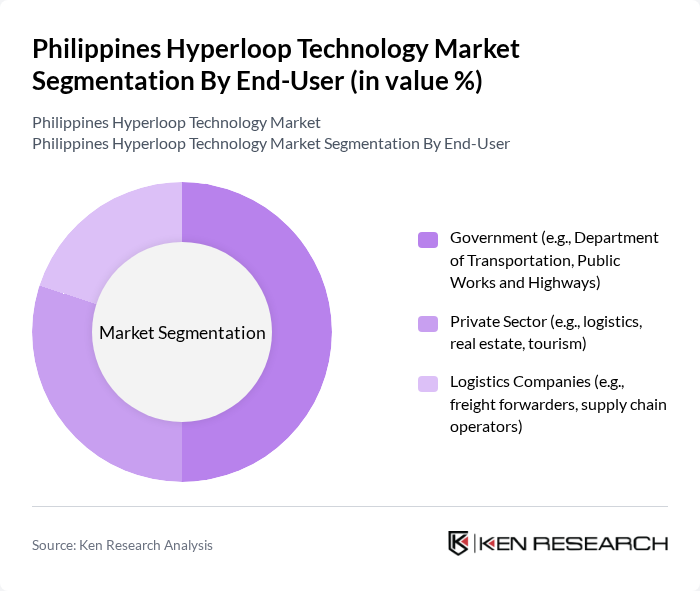
By End-User:The end-user segmentation includes Government, Private Sector, and Logistics Companies. The Government is a significant player due to its role in infrastructure development and public transport initiatives, with major projects typically requiring state approval and funding. The Private Sector is increasingly investing in Hyperloop technology for logistics, real estate, and tourism, driven by the potential for high returns and urban redevelopment. Logistics Companies are exploring Hyperloop for efficient freight solutions, especially as e-commerce and just-in-time supply chains grow in importance. This segmentation reflects broader industry trends where public-private collaboration is critical for large-scale infrastructure projects.
Philippines Hyperloop Technology Market Competitive Landscape
The Philippines Hyperloop Technology Market is characterized by a dynamic mix of regional and international players. Leading participants such as Virgin Hyperloop, Hyperloop Transportation Technologies (HyperloopTT), TransPod Inc., The Boring Company, Hardt Hyperloop, Zeleros, AECOM, Bechtel Corporation, CRRC Corporation, Mitsubishi Heavy Industries (MHI), Vinci Construction, Jacobs Engineering, Local Philippine Engineering Firms (e.g., EEI Corporation, Megawide Construction), Asian Development Bank (as potential financier/partner), Philippine Government Agencies (e.g., DOTr, DPWH, as key stakeholders) contribute to innovation, geographic expansion, and service delivery in this space.
Philippines Hyperloop Technology Market Industry Analysis
Growth Drivers
- Increasing Urbanization:The Philippines is experiencing rapid urbanization, with urban areas projected to house 56% of the population in future, up from approximately 47% in 2020. This shift is driving demand for efficient transportation solutions. The urban population is expected to reach approximately 60 million in future, necessitating innovative transport systems like Hyperloop to alleviate congestion and improve connectivity. Urbanization is a key factor in shaping the future of transportation infrastructure in the country.
- Government Infrastructure Investments:The Philippine government allocated approximately PHP 1.2 trillion (USD 21 billion) for infrastructure projects in future, focusing on enhancing transportation networks. This investment includes funding for high-speed rail and innovative transport solutions, such as Hyperloop technology. The government's commitment to infrastructure development aims to boost economic growth and improve mobility, creating a conducive environment for the adoption of advanced transportation systems.
- Demand for Sustainable Transportation:With the Philippines aiming to reduce greenhouse gas emissions by up to 75% in future, there is a growing demand for sustainable transportation solutions. The Hyperloop system, which promises to be energy-efficient and environmentally friendly, aligns with this goal. The increasing awareness of climate change impacts is driving both public and private sectors to invest in sustainable transport technologies, making Hyperloop a viable option for future transportation needs.
Market Challenges
- High Initial Capital Investment:The implementation of Hyperloop technology requires substantial initial capital, estimated at around PHP 500 billion (USD 9 billion) for the first phase. This high investment poses a significant barrier to entry, as funding must be secured from both public and private sectors. The financial burden can deter potential investors and slow down the development of necessary infrastructure, impacting the overall market growth.
- Regulatory Hurdles:The Hyperloop technology faces various regulatory challenges, including compliance with existing transportation laws and safety standards. The Philippine government has stringent regulations governing transportation infrastructure, which can delay project approvals. Navigating these regulatory frameworks requires time and resources, potentially hindering the timely deployment of Hyperloop systems and affecting investor confidence in the market.
Philippines Hyperloop Technology Market Future Outlook
The future of the Hyperloop technology market in the Philippines appears promising, driven by urbanization and government support for innovative transport solutions. As infrastructure investments increase, the integration of Hyperloop systems could significantly enhance connectivity between urban centers. Additionally, advancements in technology and growing public interest in sustainable transport solutions will likely foster a conducive environment for Hyperloop adoption, positioning it as a key player in the future transportation landscape of the Philippines.
Market Opportunities
- Partnerships with Local Governments:Collaborating with local governments presents a significant opportunity for Hyperloop developers. By aligning projects with regional development plans, stakeholders can secure funding and support, facilitating smoother project execution. Such partnerships can enhance public acceptance and ensure that Hyperloop systems meet local transportation needs effectively.
- Technological Collaborations:Engaging in technological collaborations with universities and research institutions can drive innovation in Hyperloop technology. These partnerships can lead to advancements in safety, efficiency, and sustainability, making the technology more appealing to investors and the public. Collaborative research initiatives can also help address regulatory challenges, paving the way for successful implementation.
Scope of the Report
| Segment | Sub-Segments |
|---|---|
| By Type | Passenger Hyperloop Cargo Hyperloop Hybrid Systems |
| By End-User | Government (e.g., Department of Transportation, Public Works and Highways) Private Sector (e.g., logistics, real estate, tourism) Logistics Companies (e.g., freight forwarders, supply chain operators) |
| By Application | Intercity Transport (e.g., Manila–Clark, Manila–Batangas) Urban Transit (e.g., Metro Manila, Cebu, Davao) Freight Transport (e.g., port-to-inland logistics, industrial zones) |
| By Investment Source | Public Funding (e.g., national and local government budgets, PPPs) Private Investments (e.g., venture capital, corporate funding) Foreign Direct Investment (e.g., Asian Development Bank, international consortia) |
| By Policy Support | Government Subsidies Tax Incentives Research Grants |
| By Infrastructure Type | Ground Infrastructure (e.g., tube networks, pylons) Station Facilities (e.g., passenger terminals, cargo hubs) Maintenance Facilities (e.g., depots, control centers) |
| By Others | Research and Development (e.g., academic partnerships, pilot projects) Consulting Services (e.g., feasibility studies, environmental impact assessments) Training and Education (e.g., workforce development, public awareness campaigns) |
Key Target Audience
Investors and Venture Capitalist Firms
Government and Regulatory Bodies (e.g., Department of Transportation, National Economic and Development Authority)
Infrastructure Development Agencies
Transportation and Logistics Companies
Real Estate Developers
Technology Providers
Public-Private Partnership (PPP) Units
Environmental and Sustainability Organizations
Players Mentioned in the Report:
Virgin Hyperloop
Hyperloop Transportation Technologies (HyperloopTT)
TransPod Inc.
The Boring Company
Hardt Hyperloop
Zeleros
AECOM
Bechtel Corporation
CRRC Corporation
Mitsubishi Heavy Industries (MHI)
Vinci Construction
Jacobs Engineering
Local Philippine Engineering Firms (e.g., EEI Corporation, Megawide Construction)
Asian Development Bank (as potential financier/partner)
Philippine Government Agencies (e.g., DOTr, DPWH, as key stakeholders)
Table of Contents
Market Assessment Phase
1. Executive Summary and Approach
2. Philippines Hyperloop Technology Market Overview
2.1 Key Insights and Strategic Recommendations
2.2 Philippines Hyperloop Technology Market Overview
2.3 Definition and Scope
2.4 Evolution of Market Ecosystem
2.5 Timeline of Key Regulatory Milestones
2.6 Value Chain & Stakeholder Mapping
2.7 Business Cycle Analysis
2.8 Policy & Incentive Landscape
3. Philippines Hyperloop Technology Market Analysis
3.1 Growth Drivers
3.1.1 Increasing Urbanization
3.1.2 Government Infrastructure Investments
3.1.3 Demand for Sustainable Transportation
3.1.4 Technological Advancements in Transport
3.2 Market Challenges
3.2.1 High Initial Capital Investment
3.2.2 Regulatory Hurdles
3.2.3 Public Acceptance and Awareness
3.2.4 Competition from Established Transport Modes
3.3 Market Opportunities
3.3.1 Partnerships with Local Governments
3.3.2 Expansion of Infrastructure Projects
3.3.3 Technological Collaborations
3.3.4 Growing Interest in Eco-Friendly Solutions
3.4 Market Trends
3.4.1 Rise of Smart City Initiatives
3.4.2 Integration of AI in Transportation
3.4.3 Focus on Renewable Energy Sources
3.4.4 Development of Multi-Modal Transport Systems
3.5 Government Regulation
3.5.1 Infrastructure Development Policies
3.5.2 Environmental Compliance Regulations
3.5.3 Safety Standards for Transportation
3.5.4 Investment Incentives for New Technologies
4. SWOT Analysis
5. Stakeholder Analysis
6. Porter's Five Forces Analysis
7. Philippines Hyperloop Technology Market Market Size, 2019-2024
7.1 By Value
7.2 By Volume
7.3 By Average Selling Price
8. Philippines Hyperloop Technology Market Segmentation
8.1 By Type
8.1.1 Passenger Hyperloop
8.1.2 Cargo Hyperloop
8.1.3 Hybrid Systems
8.2 By End-User
8.2.1 Government (e.g., Department of Transportation, Public Works and Highways)
8.2.2 Private Sector (e.g., logistics, real estate, tourism)
8.2.3 Logistics Companies (e.g., freight forwarders, supply chain operators)
8.3 By Application
8.3.1 Intercity Transport (e.g., Manila–Clark, Manila–Batangas)
8.3.2 Urban Transit (e.g., Metro Manila, Cebu, Davao)
8.3.3 Freight Transport (e.g., port-to-inland logistics, industrial zones)
8.4 By Investment Source
8.4.1 Public Funding (e.g., national and local government budgets, PPPs)
8.4.2 Private Investments (e.g., venture capital, corporate funding)
8.4.3 Foreign Direct Investment (e.g., Asian Development Bank, international consortia)
8.5 By Policy Support
8.5.1 Government Subsidies
8.5.2 Tax Incentives
8.5.3 Research Grants
8.6 By Infrastructure Type
8.6.1 Ground Infrastructure (e.g., tube networks, pylons)
8.6.2 Station Facilities (e.g., passenger terminals, cargo hubs)
8.6.3 Maintenance Facilities (e.g., depots, control centers)
8.7 Others
8.7.1 Research and Development (e.g., academic partnerships, pilot projects)
8.7.2 Consulting Services (e.g., feasibility studies, environmental impact assessments)
8.7.3 Training and Education (e.g., workforce development, public awareness campaigns)
9. Philippines Hyperloop Technology Market Competitive Analysis
9.1 Market Share of Key Players
9.2 Cross Comparison of Key Players
9.2.1 Company Name
9.2.2 Group Size (Large, Medium, or Small as per industry convention)
9.2.3 Revenue Growth Rate (YoY, CAGR)
9.2.4 Market Penetration Rate (Share of addressable market)
9.2.5 Project Pipeline Value (USD, local currency)
9.2.6 Funding Raised (Total capital, recent rounds)
9.2.7 Technology Readiness Level (TRL)
9.2.8 Partnerships with Local Entities (Number, strategic value)
9.2.9 Regulatory Approvals Secured (Number, stage)
9.2.10 Sustainability Metrics (Carbon footprint, energy efficiency)
9.3 SWOT Analysis of Top Players
9.4 Pricing Analysis
9.5 Detailed Profile of Major Companies
9.5.1 Virgin Hyperloop
9.5.2 Hyperloop Transportation Technologies (HyperloopTT)
9.5.3 TransPod Inc.
9.5.4 The Boring Company
9.5.5 Hardt Hyperloop
9.5.6 Zeleros
9.5.7 AECOM
9.5.8 Bechtel Corporation
9.5.9 CRRC Corporation
9.5.10 Mitsubishi Heavy Industries (MHI)
9.5.11 Vinci Construction
9.5.12 Jacobs Engineering
9.5.13 Local Philippine Engineering Firms (e.g., EEI Corporation, Megawide Construction)
9.5.14 Asian Development Bank (as potential financier/partner)
9.5.15 Philippine Government Agencies (e.g., DOTr, DPWH, as key stakeholders)
10. Philippines Hyperloop Technology Market End-User Analysis
10.1 Procurement Behavior of Key Ministries
10.1.1 Ministry of Transportation
10.1.2 Department of Public Works and Highways
10.1.3 Department of Trade and Industry
10.2 Corporate Spend on Infrastructure & Energy
10.2.1 Investment in Transportation Infrastructure
10.2.2 Budget Allocation for Sustainable Projects
10.2.3 Corporate Partnerships for Development
10.3 Pain Point Analysis by End-User Category
10.3.1 Infrastructure Limitations
10.3.2 Cost of Implementation
10.3.3 Regulatory Compliance Issues
10.4 User Readiness for Adoption
10.4.1 Awareness of Hyperloop Technology
10.4.2 Perceived Benefits vs. Costs
10.4.3 Infrastructure Preparedness
10.5 Post-Deployment ROI and Use Case Expansion
10.5.1 Evaluation of Initial Projects
10.5.2 Potential for Future Expansion
10.5.3 Long-term Economic Impact
11. Philippines Hyperloop Technology Market Future Size, 2025-2030
11.1 By Value
11.2 By Volume
11.3 By Average Selling Price
Go-To-Market Strategy Phase
1. Whitespace Analysis + Business Model Canvas
1.1 Market Gaps Identification
1.2 Value Proposition Development
1.3 Revenue Streams Analysis
1.4 Cost Structure Evaluation
1.5 Key Partnerships Exploration
1.6 Customer Segmentation
1.7 Channels of Distribution
2. Marketing and Positioning Recommendations
2.1 Branding Strategies
2.2 Product USPs
2.3 Target Audience Identification
2.4 Communication Strategy
2.5 Digital Marketing Approaches
3. Distribution Plan
3.1 Urban Retail Strategies
3.2 Rural NGO Tie-ups
3.3 Logistics and Supply Chain Management
3.4 Distribution Partnerships
4. Channel & Pricing Gaps
4.1 Underserved Routes Analysis
4.2 Pricing Bands Evaluation
4.3 Competitor Pricing Strategies
5. Unmet Demand & Latent Needs
5.1 Category Gaps Identification
5.2 Consumer Segments Analysis
5.3 Future Demand Projections
6. Customer Relationship
6.1 Loyalty Programs Development
6.2 After-sales Service Strategies
6.3 Customer Feedback Mechanisms
7. Value Proposition
7.1 Sustainability Initiatives
7.2 Integrated Supply Chains
7.3 Competitive Advantages
8. Key Activities
8.1 Regulatory Compliance
8.2 Branding Initiatives
8.3 Distribution Setup
9. Entry Strategy Evaluation
9.1 Domestic Market Entry Strategy
9.1.1 Product Mix Considerations
9.1.2 Pricing Band Strategy
9.1.3 Packaging Options
9.2 Export Entry Strategy
9.2.1 Target Countries Identification
9.2.2 Compliance Roadmap Development
10. Entry Mode Assessment
10.1 Joint Ventures
10.2 Greenfield Investments
10.3 Mergers & Acquisitions
10.4 Distributor Model Evaluation
11. Capital and Timeline Estimation
11.1 Capital Requirements Analysis
11.2 Timelines for Implementation
12. Control vs Risk Trade-Off
12.1 Ownership vs Partnerships
12.2 Risk Management Strategies
13. Profitability Outlook
13.1 Breakeven Analysis
13.2 Long-term Sustainability Strategies
14. Potential Partner List
14.1 Distributors
14.2 Joint Ventures
14.3 Acquisition Targets
15. Execution Roadmap
15.1 Phased Plan for Market Entry
15.1.1 Market Setup
15.1.2 Market Entry
15.1.3 Growth Acceleration
15.1.4 Scale & Stabilize
15.2 Key Activities and Milestones
15.2.1 Milestone Planning
15.2.2 Activity Scheduling
Research Methodology
Phase 1: Approach1
Desk Research
- Analysis of government reports on transportation infrastructure and investment in the Philippines
- Review of academic papers and case studies on Hyperloop technology and its feasibility in Southeast Asia
- Examination of industry publications and white papers from transportation and technology think tanks
Primary Research
- Interviews with transportation policy makers and urban planners in the Philippines
- Surveys with potential users, including commuters and logistics companies, to gauge interest and demand
- Field interviews with engineers and technology experts specializing in high-speed transportation systems
Validation & Triangulation
- Cross-validation of findings through multiple data sources, including government and private sector reports
- Triangulation of insights from expert interviews with quantitative data from surveys
- Sanity checks through feedback from a panel of industry experts and stakeholders
Phase 2: Market Size Estimation1
Top-down Assessment
- Estimation of potential market size based on national transportation spending and infrastructure development plans
- Segmentation of the market by passenger transport, freight transport, and urban mobility solutions
- Incorporation of government initiatives aimed at enhancing public transportation and reducing congestion
Bottom-up Modeling
- Collection of data on existing transportation modes and their capacity to inform Hyperloop demand
- Estimation of operational costs and pricing models based on similar high-speed transport systems
- Volume projections based on demographic trends and urbanization rates in key metropolitan areas
Forecasting & Scenario Analysis
- Multi-factor regression analysis incorporating economic growth, urbanization, and technological adoption rates
- Scenario modeling based on varying levels of government support and public acceptance of Hyperloop technology
- Development of baseline, optimistic, and pessimistic forecasts through 2035
Phase 3: CATI Sample Composition1
| Scope Item/Segment | Sample Size | Target Respondent Profiles |
|---|---|---|
| Urban Commuter Insights | 120 | Daily commuters, Public transport users |
| Logistics and Freight Operators | 85 | Logistics Managers, Supply Chain Executives |
| Government Transportation Officials | 65 | Policy Makers, Urban Planners |
| Technology and Engineering Experts | 55 | Transportation Engineers, Technology Consultants |
| Potential Investors and Stakeholders | 50 | Venture Capitalists, Infrastructure Investors |
Frequently Asked Questions
What is the current value of the Philippines Hyperloop Technology Market?
The Philippines Hyperloop Technology Market is valued at approximately USD 1.1 billion, reflecting the country's growing interest in advanced transportation solutions and the increasing demand for efficient transport systems amid urban congestion and infrastructure modernization efforts.
What are the main drivers of growth in the Philippines Hyperloop Technology Market?
Which cities in the Philippines are leading in Hyperloop technology initiatives?
What types of Hyperloop systems are being considered in the Philippines?
Other Regional/Country Reports
Indonesia Hyperloop Technology Market
Malaysia Hyperloop Technology Market
APAC Hyperloop Technology Market
Other Adjacent Reports
UAE <xaiArtifact artifact_id=adj-markets-ph-hyperloop-001 title=Adjacent_Markets_for_Philippines_Hyperloop_Technology.txt contentType=text/plain>
Japan Adjacent Markets to Philippines Hyperloop Technology
Thailand **High-Speed Rail Market**
Mexico Connection: High-speed rail systems in the Philippines and APAC region aim to connect major cities efficiently
KSA utilizing advanced track and propulsion technologies similar to hyperloops vacuum tube systems. This market is driven by government investments in infrastructure
Brazil with a projected CAGR of 8-10% in APAC through 2025
Qatar Why Adjacent: It shares synergies in high-speed ground transportation infrastructure and regulatory frameworks
UAE enabling cross-technology collaborations for urban connectivity
Bahrain **Magnetic Levitation Train Market**
Japan Connection: Maglev trains employ magnetic propulsion for frictionless travel
Kuwait mirroring hyperloops low-pressure tube mechanics
Kuwait and are being explored in APAC for intercity links. With global market growth at around 15% CAGR up to 2025
Japan it addresses similar congestion issues in densely populated areas like the Philippines
Belgium Why Adjacent: Overlap in propulsion technologies and engineering expertise fosters innovation and shared supply chains for advanced rail systems
UAE **Electric Vehicle Market**
Egypt Connection: Electric vehicles promote sustainable mobility
Mexico and hyperloop systems can integrate with EV charging networks for seamless multimodal transport in the Philippines. The APAC EV market is expanding at a 25% CAGR through 2025
Malaysia driven by green initiatives
Why Buy From Us?

What makes us stand out is that our consultants follow Robust, Refine and Result (RRR) methodology. Robust for clear definitions, approaches and sanity checking, Refine for differentiating respondents' facts and opinions, and Result for presenting data with story.

We have set a benchmark in the industry by offering our clients with syndicated and customized market research reports featuring coverage of entire market as well as meticulous research and analyst insights.

While we don't replace traditional research, we flip the method upside down. Our dual approach of Top Bottom & Bottom Top ensures quality deliverable by not just verifying company fundamentals but also looking at the sector and macroeconomic factors.

With one step in the future, our research team constantly tries to show you the bigger picture. We help with some of the tough questions you may encounter along the way: How is the industry positioned? Best marketing channel? KPI's of competitors? By aligning every element, we help maximize success.

Our report gives you instant access to the answers and sources that other companies might choose to hide. We elaborate each steps of research methodology we have used and showcase you the sample size to earn your trust.

If you need any support, we are here! We pride ourselves on universe strength, data quality, and quick, friendly, and professional service.