About the Report
Base Year 2024Global Hyperloop Technology Market Overview
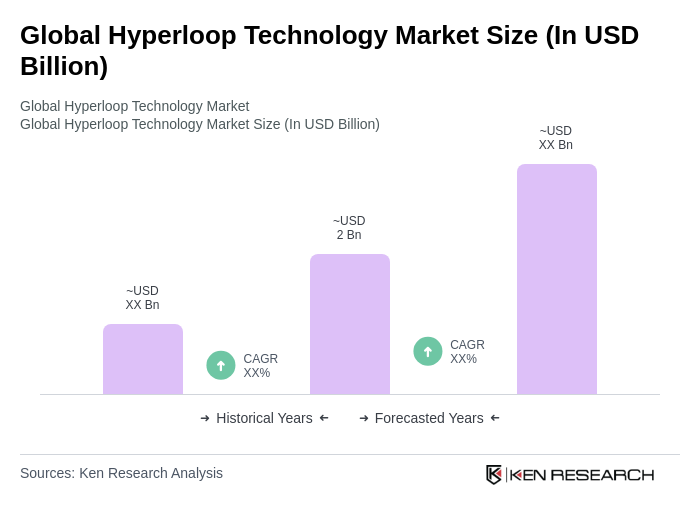
- The Global Hyperloop Technology Market is valued at USD 2 billion, based on a five-year historical analysis. This growth is primarily driven by advancements in transportation technology (magnetic levitation, linear electric propulsion, digital simulation), rising infrastructure investment and feasibility programs, and the push for energy-efficient, lower-emission mobility solutions .
- Key players in this market include the United States, Europe, and parts of Asia, particularly India and China. Europe and the U.S. host leading programs and pilots, while Asia-Pacific is frequently cited as a leading or dominant region in market analyses due to active government and private initiatives; these regions benefit from strong technology ecosystems and public-sector engagement .
- In 2023, the U.S. government introduced regulations aimed at establishing safety standards for hyperloop systems. U.S. federal engagement has focused on integrating hyperloop within existing regulatory frameworks through the Federal Railroad Administration (FRA) and Department of Transportation initiatives, including guidance on testing and safety; market studies and industry reports note progress toward standardization and feasibility studies supporting safe deployment .
Global Hyperloop Technology Market Segmentation
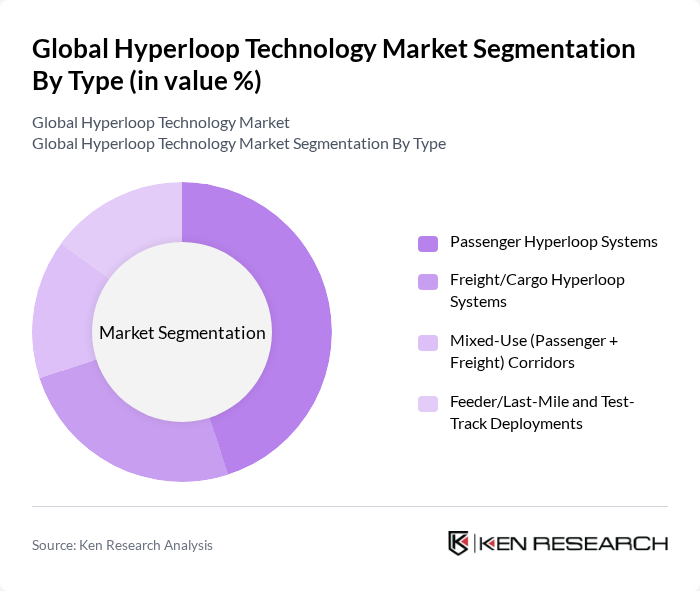
By Type:The segmentation of the market by type includes various systems designed for different purposes. The subsegments are Passenger Hyperloop Systems, Freight/Cargo Hyperloop Systems, Mixed-Use (Passenger + Freight) Corridors, and Feeder/Last-Mile and Test-Track Deployments. Among these, Passenger Hyperloop Systems are currently leading the market due to the increasing demand for rapid intercity travel solutions. The focus on reducing travel time and enhancing passenger experience drives investments in this subsegment .
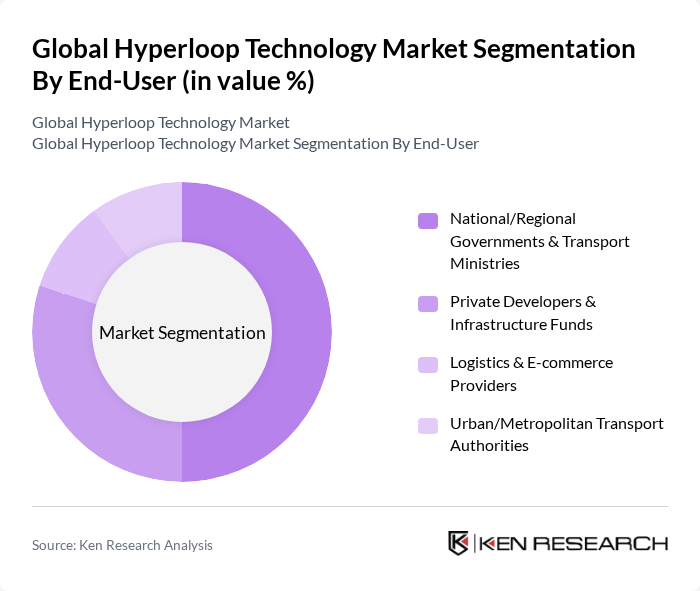
By End-User:The market is segmented by end-user, which includes National/Regional Governments & Transport Ministries, Private Developers & Infrastructure Funds, Logistics & E-commerce Providers, and Urban/Metropolitan Transport Authorities. National/Regional Governments & Transport Ministries dominate this segment as they are the primary investors in infrastructure projects and are responsible for regulatory frameworks that support the development of hyperloop systems. Their commitment to enhancing public transportation options significantly influences market dynamics .
Global Hyperloop Technology Market Competitive Landscape
The Global Hyperloop Technology Market is characterized by a dynamic mix of regional and international players. Leading participants such as Hyperloop Transportation Technologies (HTT), Hardt Hyperloop (Hardt Global Mobility), TransPod Inc., Zeleros Hyperloop, TUM Hyperloop, Swisspod Technologies, Nevomo (formerly Hyper Poland), The Boring Company, AECOM, Siemens AG, Alstom SA, Thales Group, Bechtel Corporation, Virgin Hyperloop One (legacy; now DP World Cargospeed), TCDD Ta??mac?l?k A.?. contribute to innovation, geographic expansion, and service delivery in this space .
Global Hyperloop Technology Market Industry Analysis
Growth Drivers
- Increasing Demand for High-Speed Transportation:The global demand for high-speed transportation is projected to reach 1.5 billion passengers in future, driven by urbanization and population growth. Countries like India and China are investing heavily in infrastructure, with India allocating $1.2 billion for hyperloop projects. This demand is further fueled by the need for efficient travel solutions that can reduce congestion and travel time, making hyperloop technology a viable alternative to traditional transport modes.
- Technological Advancements in Transportation:The hyperloop technology sector is witnessing significant advancements, with over $1.2 billion invested in R&D in future alone. Innovations in magnetic levitation and vacuum technology are enhancing system efficiency and safety. For instance, the development of new materials has reduced construction costs by approximately 15%, making hyperloop systems more feasible. These technological strides are crucial for attracting investment and fostering public interest in hyperloop solutions.
- Environmental Sustainability Initiatives:With global carbon emissions projected to reach 40 billion tons in future, the push for sustainable transportation is intensifying. Hyperloop systems promise to reduce emissions by up to 70% compared to conventional rail systems. Governments are increasingly prioritizing green technologies, with the European Union committing €1.5 trillion to sustainable infrastructure in future. This commitment enhances the attractiveness of hyperloop projects as eco-friendly alternatives, aligning with global sustainability goals.
Market Challenges
- High Initial Investment Costs:The estimated initial investment for hyperloop infrastructure can exceed $100 million per mile, posing a significant barrier to entry. For example, the proposed California hyperloop project requires approximately $60 billion in funding. This high capital requirement often deters private investors and complicates public funding efforts, making it challenging to initiate projects despite the potential long-term benefits of hyperloop technology.
- Regulatory Hurdles:Navigating the regulatory landscape remains a significant challenge for hyperloop projects. In future, over 30 countries reported delays in transportation project approvals due to stringent regulations. For instance, the U.S. Federal Railroad Administration has yet to establish clear guidelines for hyperloop systems, leading to uncertainty among investors. This regulatory ambiguity can slow down project timelines and increase costs, hindering market growth.
Global Hyperloop Technology Market Future Outlook
The future of hyperloop technology appears promising, driven by increasing investments in infrastructure and a growing focus on sustainability. As governments and private entities collaborate on projects, the integration of smart technologies will enhance operational efficiency. Additionally, public-private partnerships are expected to play a crucial role in overcoming funding challenges, facilitating the development of hyperloop systems. With ongoing advancements in technology and a supportive regulatory environment, the hyperloop market is poised for significant growth in the coming years.
Market Opportunities
- Expansion into Emerging Markets:Emerging markets, particularly in Asia and Africa, present significant opportunities for hyperloop technology. With urban populations expected to grow by 1.2 billion in future, these regions require innovative transportation solutions. Investments in hyperloop infrastructure can address urban congestion and improve connectivity, making it an attractive option for governments seeking to modernize their transport systems.
- Partnerships with Technology Providers:Collaborating with technology providers can enhance the development of hyperloop systems. By leveraging expertise in automation and data analytics, companies can improve operational efficiency and safety. For instance, partnerships with tech firms specializing in AI can optimize route planning and passenger management, ultimately reducing costs and enhancing the user experience, thus driving market growth.
Scope of the Report
| Segment | Sub-Segments |
|---|---|
| By Type | Passenger Hyperloop Systems Freight/Cargo Hyperloop Systems Mixed-Use (Passenger + Freight) Corridors Feeder/Last-Mile and Test-Track Deployments |
| By End-User | National/Regional Governments & Transport Ministries Private Developers & Infrastructure Funds Logistics & E-commerce Providers Urban/Metropolitan Transport Authorities |
| By Application | Intercity and Interregional Travel (200–1,000 km) Cross-Border/International Corridors Dedicated Freight Lanes (Ports, Dry Ports, Airports) R&D, Prototyping, and Pilot Demonstrations |
| By Component | Pods/Capsules Guideway/Tubes & Civil Infrastructure Propulsion & Levitation (Linear Motors, Maglev, EDS/EMS) Power, Vacuum, and Control Systems (Pumps, SCADA, Signaling) |
| By Investment Source | Private Venture & Growth Equity Government Grants & Sovereign Funding Public-Private Partnerships (PPP/Concession) Corporate & Strategic Investments |
| By Policy Support | Pilot Exemptions & Regulatory Sandboxes Tax Incentives & Accelerated Depreciation Safety Certification & Standards Frameworks Land Acquisition & Right-of-Way Facilitation |
| By Market Maturity | Concept & Feasibility (Pre-commercial) Prototype & Test Track (TRL 4–6) Pilot Corridor Development (TRL 7–8) Early Commercial Deployment (TRL 9) |
Key Target Audience
Investors and Venture Capitalist Firms
Government and Regulatory Bodies (e.g., Federal Aviation Administration, Department of Transportation)
Manufacturers and Producers of Hyperloop Components
Infrastructure Development Agencies
Transportation Authorities
Technology Providers and Innovators
Industry Associations (e.g., Hyperloop Transportation Technologies Association)
Financial Institutions and Investment Banks
Players Mentioned in the Report:
Hyperloop Transportation Technologies (HTT)
Hardt Hyperloop (Hardt Global Mobility)
TransPod Inc.
Zeleros Hyperloop
TUM Hyperloop
Swisspod Technologies
Nevomo (formerly Hyper Poland)
The Boring Company
AECOM
Siemens AG
Alstom SA
Thales Group
Bechtel Corporation
Virgin Hyperloop One (legacy; now DP World Cargospeed)
TCDD Tasmaclk A.S.
Table of Contents
Market Assessment Phase
1. Executive Summary and Approach
2. Global Hyperloop Technology Market Overview
2.1 Key Insights and Strategic Recommendations
2.2 Global Hyperloop Technology Market Overview
2.3 Definition and Scope
2.4 Evolution of Market Ecosystem
2.5 Timeline of Key Regulatory Milestones
2.6 Value Chain & Stakeholder Mapping
2.7 Business Cycle Analysis
2.8 Policy & Incentive Landscape
3. Global Hyperloop Technology Market Analysis
3.1 Growth Drivers
3.1.1 Increasing Demand for High-Speed Transportation
3.1.2 Technological Advancements in Transportation
3.1.3 Environmental Sustainability Initiatives
3.1.4 Government Support and Funding
3.2 Market Challenges
3.2.1 High Initial Investment Costs
3.2.2 Regulatory Hurdles
3.2.3 Public Acceptance and Perception
3.2.4 Competition from Established Transportation Modes
3.3 Market Opportunities
3.3.1 Expansion into Emerging Markets
3.3.2 Partnerships with Technology Providers
3.3.3 Development of Hybrid Transportation Solutions
3.3.4 Investment in Research and Development
3.4 Market Trends
3.4.1 Increasing Investment in Infrastructure
3.4.2 Focus on Sustainability and Green Technologies
3.4.3 Integration of Smart Technologies
3.4.4 Rise of Public-Private Partnerships
3.5 Government Regulation
3.5.1 Safety Standards and Compliance Regulations
3.5.2 Environmental Impact Assessments
3.5.3 Funding and Subsidy Programs
3.5.4 Land Use and Zoning Regulations
4. SWOT Analysis
5. Stakeholder Analysis
6. Porter's Five Forces Analysis
7. Global Hyperloop Technology Market Market Size, 2019-2024
7.1 By Value
7.2 By Volume
7.3 By Average Selling Price
8. Global Hyperloop Technology Market Segmentation
8.1 By Type
8.1.1 Passenger Hyperloop Systems
8.1.2 Freight/Cargo Hyperloop Systems
8.1.3 Mixed-Use (Passenger + Freight) Corridors
8.1.4 Feeder/Last-Mile and Test-Track Deployments
8.2 By End-User
8.2.1 National/Regional Governments & Transport Ministries
8.2.2 Private Developers & Infrastructure Funds
8.2.3 Logistics & E-commerce Providers
8.2.4 Urban/Metropolitan Transport Authorities
8.3 By Application
8.3.1 Intercity and Interregional Travel (200–1,000 km)
8.3.2 Cross-Border/International Corridors
8.3.3 Dedicated Freight Lanes (Ports, Dry Ports, Airports)
8.3.4 R&D, Prototyping, and Pilot Demonstrations
8.4 By Component
8.4.1 Pods/Capsules
8.4.2 Guideway/Tubes & Civil Infrastructure
8.4.3 Propulsion & Levitation (Linear Motors, Maglev, EDS/EMS)
8.4.4 Power, Vacuum, and Control Systems (Pumps, SCADA, Signaling)
8.5 By Investment Source
8.5.1 Private Venture & Growth Equity
8.5.2 Government Grants & Sovereign Funding
8.5.3 Public-Private Partnerships (PPP/Concession)
8.5.4 Corporate & Strategic Investments
8.6 By Policy Support
8.6.1 Pilot Exemptions & Regulatory Sandboxes
8.6.2 Tax Incentives & Accelerated Depreciation
8.6.3 Safety Certification & Standards Frameworks
8.6.4 Land Acquisition & Right-of-Way Facilitation
8.7 By Market Maturity
8.7.1 Concept & Feasibility (Pre-commercial)
8.7.2 Prototype & Test Track (TRL 4–6)
8.7.3 Pilot Corridor Development (TRL 7–8)
8.7.4 Early Commercial Deployment (TRL 9)
9. Global Hyperloop Technology Market Competitive Analysis
9.1 Market Share of Key Players
9.2 Cross Comparison of Key Players
9.2.1 Company Name
9.2.2 Stage/Scale (TRL level; team size; test-track length)
9.2.3 Capital Raised to Date (USD) and Funding Round
9.2.4 Partnerships & MOUs (governments, operators, EPCs)
9.2.5 Pipeline Projects (corridor length; countries; status)
9.2.6 Technology Approach (levitation, propulsion, power, control)
9.2.7 IP/Patents Filed and Granted
9.2.8 Regulatory Progress (safety certification, sandbox approvals)
9.2.9 Pilot/Test Performance (top speed, energy per passenger-km)
9.2.10 Unit Economics (capex/km; projected opex/km; payback)
9.3 SWOT Analysis of Top Players
9.4 Pricing Analysis
9.5 Detailed Profile of Major Companies
9.5.1 Hyperloop Transportation Technologies (HTT)
9.5.2 Hardt Hyperloop (Hardt Global Mobility)
9.5.3 TransPod Inc.
9.5.4 Zeleros Hyperloop
9.5.5 TUM Hyperloop
9.5.6 Swisspod Technologies
9.5.7 Nevomo (formerly Hyper Poland)
9.5.8 The Boring Company
9.5.9 AECOM
9.5.10 Siemens AG
9.5.11 Alstom SA
9.5.12 Thales Group
9.5.13 Bechtel Corporation
9.5.14 Virgin Hyperloop One (legacy; now DP World Cargospeed)
9.5.15 TCDD Ta??mac?l?k A.?.
10. Global Hyperloop Technology Market End-User Analysis
10.1 Procurement Behavior of Key Ministries
10.1.1 Government Transportation Departments
10.1.2 Infrastructure Development Agencies
10.1.3 Environmental Regulatory Bodies
10.2 Corporate Spend on Infrastructure & Energy
10.2.1 Investment in Transportation Infrastructure
10.2.2 Budget Allocation for Sustainable Projects
10.2.3 Funding for Research and Development
10.3 Pain Point Analysis by End-User Category
10.3.1 Cost of Implementation
10.3.2 Regulatory Compliance Challenges
10.3.3 Public Acceptance Issues
10.4 User Readiness for Adoption
10.4.1 Awareness of Hyperloop Technology
10.4.2 Perceived Benefits vs. Costs
10.4.3 Infrastructure Readiness
10.5 Post-Deployment ROI and Use Case Expansion
10.5.1 Evaluation of Initial Investments
10.5.2 Long-term Operational Savings
10.5.3 Potential for Service Expansion
11. Global Hyperloop Technology Market Future Size, 2025-2030
11.1 By Value
11.2 By Volume
11.3 By Average Selling Price
Go-To-Market Strategy Phase
1. Whitespace Analysis + Business Model Canvas
1.1 Market Gaps Identification
1.2 Value Proposition Development
1.3 Revenue Streams Analysis
1.4 Cost Structure Evaluation
1.5 Key Partnerships
1.6 Customer Segments
1.7 Channels
2. Marketing and Positioning Recommendations
2.1 Branding Strategies
2.2 Product USPs
3. Distribution Plan
3.1 Urban Retail vs Rural NGO Tie-ups
4. Channel & Pricing Gaps
4.1 Underserved Routes
4.2 Pricing Bands
5. Unmet Demand & Latent Needs
5.1 Category Gaps
5.2 Consumer Segments
6. Customer Relationship
6.1 Loyalty Programs
6.2 After-sales Service
7. Value Proposition
7.1 Sustainability
7.2 Integrated Supply Chains
8. Key Activities
8.1 Regulatory Compliance
8.2 Branding
8.3 Distribution Setup
9. Entry Strategy Evaluation
9.1 Domestic Market Entry Strategy
9.1.1 Product Mix
9.1.2 Pricing Band
9.1.3 Packaging
9.2 Export Entry Strategy
9.2.1 Target Countries
9.2.2 Compliance Roadmap
10. Entry Mode Assessment
10.1 JV
10.2 Greenfield
10.3 M&A
10.4 Distributor Model
11. Capital and Timeline Estimation
11.1 Capital Requirements
11.2 Timelines
12. Control vs Risk Trade-Off
12.1 Ownership vs Partnerships
13. Profitability Outlook
13.1 Breakeven Analysis
13.2 Long-term Sustainability
14. Potential Partner List
14.1 Distributors
14.2 JVs
14.3 Acquisition Targets
15. Execution Roadmap
15.1 Phased Plan for Market Entry
15.1.1 Market Setup
15.1.2 Market Entry
15.1.3 Growth Acceleration
15.1.4 Scale & Stabilize
15.2 Key Activities and Milestones
15.2.1 Activity Planning
15.2.2 Milestone Tracking
Research Methodology
Phase 1: Approach1
Desk Research
- Analysis of industry reports from organizations such as the U.S. Department of Transportation NETT Council and European standards bodies (CEN/CENELEC)
- Review of academic papers and publications on hyperloop technology advancements and feasibility studies
- Examination of government and regulatory documents related to transportation infrastructure and innovation funding
Primary Research
- Interviews with engineers and project managers involved in hyperloop development projects
- Surveys targeting transportation policy experts and urban planners
- Field interviews with executives from companies investing in hyperloop technology
Validation & Triangulation
- Cross-validation of findings through multiple data sources, including market reports and expert opinions
- Triangulation of data from industry stakeholders, government reports, and academic research
- Sanity checks conducted through expert panel discussions to ensure data accuracy and relevance
Phase 2: Market Size Estimation1
Top-down Assessment
- Estimation of market size based on global transportation infrastructure spending trends
- Segmentation of the market by geographic regions and application sectors (e.g., passenger transport, freight transport)
- Incorporation of projected growth rates from government transportation initiatives and urban development plans
Bottom-up Modeling
- Analysis of investment levels from key players in the hyperloop sector
- Estimation of operational costs based on technology deployment and maintenance requirements
- Volume and frequency analysis of potential passenger and freight traffic for hyperloop systems
Forecasting & Scenario Analysis
- Multi-factor regression analysis incorporating economic indicators, technological advancements, and regulatory changes
- Scenario modeling based on varying levels of public acceptance and infrastructure readiness
- Development of baseline, optimistic, and pessimistic forecasts through 2030
Phase 3: CATI Sample Composition1
| Scope Item/Segment | Sample Size | Target Respondent Profiles |
|---|---|---|
| Passenger Transport Systems | 120 | Transportation Engineers, Urban Planners |
| Freight Transport Solutions | 100 | Logistics Managers, Supply Chain Analysts |
| Infrastructure Development Projects | 80 | Project Managers, Civil Engineers |
| Government Policy Makers | 70 | Transportation Policy Experts, Regulatory Officials |
| Investment and Funding Agencies | 60 | Venture Capitalists, Infrastructure Investors |
Frequently Asked Questions
What is the current value of the Global Hyperloop Technology Market?
The Global Hyperloop Technology Market is valued at approximately USD 2 billion, driven by advancements in transportation technology, infrastructure investments, and the demand for energy-efficient mobility solutions.
Which regions are leading in the Hyperloop Technology Market?
What are the key drivers of growth in the Hyperloop Technology Market?
What challenges does the Hyperloop Technology Market face?
Other Regional/Country Reports
Indonesia Hyperloop Technology Market
Malaysia Hyperloop Technology Market
APAC Hyperloop Technology Market
Why Buy From Us?

What makes us stand out is that our consultants follow Robust, Refine and Result (RRR) methodology. Robust for clear definitions, approaches and sanity checking, Refine for differentiating respondents' facts and opinions, and Result for presenting data with story.

We have set a benchmark in the industry by offering our clients with syndicated and customized market research reports featuring coverage of entire market as well as meticulous research and analyst insights.

While we don't replace traditional research, we flip the method upside down. Our dual approach of Top Bottom & Bottom Top ensures quality deliverable by not just verifying company fundamentals but also looking at the sector and macroeconomic factors.

With one step in the future, our research team constantly tries to show you the bigger picture. We help with some of the tough questions you may encounter along the way: How is the industry positioned? Best marketing channel? KPI's of competitors? By aligning every element, we help maximize success.

Our report gives you instant access to the answers and sources that other companies might choose to hide. We elaborate each steps of research methodology we have used and showcase you the sample size to earn your trust.

If you need any support, we are here! We pride ourselves on universe strength, data quality, and quick, friendly, and professional service.