About the Report
Base Year 2024Philippines Middle East Decks Market Overview
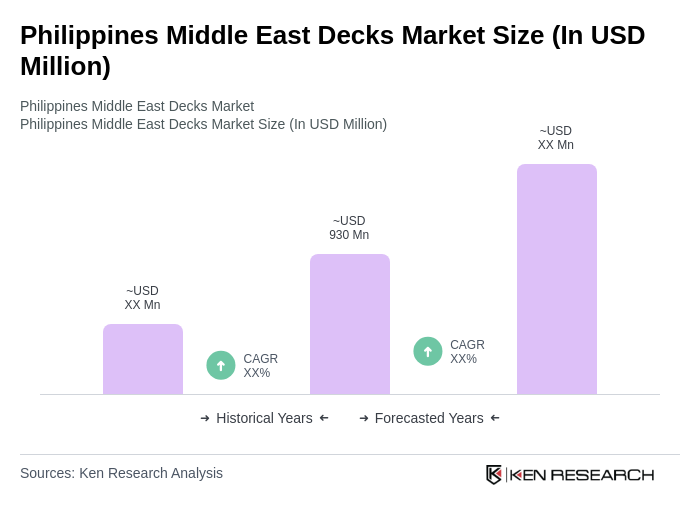
- The Philippines Middle East Decks Market is valued at USD 930 million, based on a five-year historical analysis. This growth is primarily driven by the increasing demand for outdoor living spaces, coupled with a rise in construction activities in both residential and commercial sectors. The market is also influenced by the growing trend of home improvement and renovation projects, as consumers seek to enhance their outdoor environments.
- Key players in this market include major cities such as Manila, Cebu, and Davao, which dominate due to their rapid urbanization and infrastructure development. The concentration of economic activities and a growing population in these areas contribute to the high demand for decking solutions, making them pivotal in the market landscape. Metro Manila's substantial infrastructure investments, including the USD 8.72 billion subway and USD 15.60 billion commuter railway projects, have significantly boosted demand for structural components including decking materials in both residential and commercial applications.
- The Build, Build, Build program, launched by the Philippine government under Republic Act No. 11054 (Department of Public Works and Highways Modernization Act of 2018), established by the Department of Public Works and Highways in 2018, aims to accelerate infrastructure development across the country. This comprehensive initiative includes significant investments in public works and housing projects, with the government allocating substantial budgets for expressways, bridges, social housing, and rural road networks, thereby boosting the demand for decking materials and services in both urban and rural areas.
Philippines Middle East Decks Market Segmentation
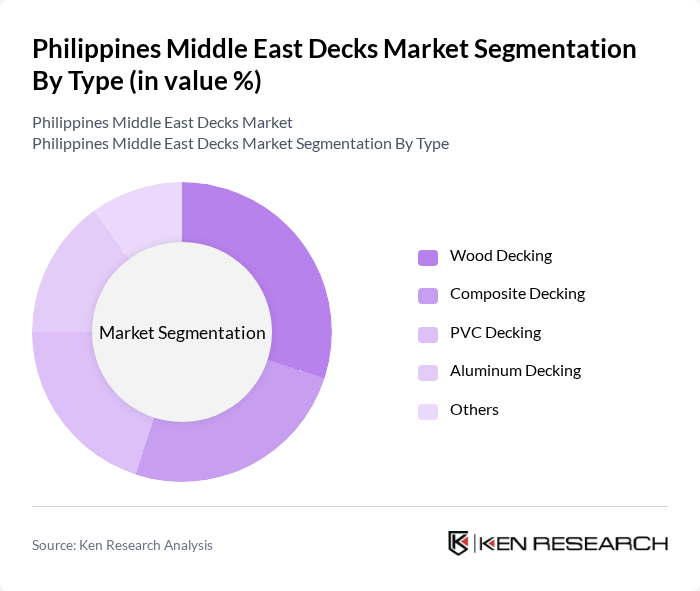
By Type:The market is segmented into various types of decking materials, including wood decking, composite decking, PVC decking, aluminum decking, and others. Each type caters to different consumer preferences and applications, with wood decking being favored for its aesthetic appeal and traditional architectural preferences, while composite and PVC options are gaining traction due to their durability, low maintenance requirements, and suitability for the region's climatic challenges. Plastics and composites are experiencing particularly strong growth due to their eco-friendly characteristics and resistance to weathering in tropical environments.
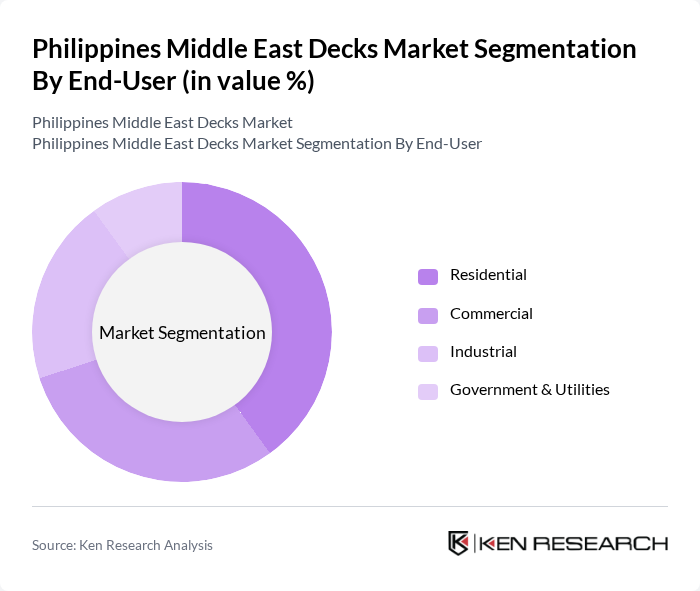
By End-User:The market is categorized based on end-users, including residential, commercial, industrial, and government & utilities. The residential segment is the largest, driven by homeowners investing in outdoor spaces, supported by remittance-funded homebuilding and vertical condominium launches around transit corridors. The commercial segment follows closely due to the increasing number of hospitality and retail establishments requiring decking solutions, while the industrial segment is experiencing accelerated growth driven by warehouse and factory developments linked to the Luzon Economic Corridor and electronics manufacturing expansions.
Philippines Middle East Decks Market Competitive Landscape
The Philippines Middle East Decks Market is characterized by a dynamic mix of regional and international players. Leading participants such as A. Brown Company, Inc., Aboitiz InfraCapital, Inc., DMCI Holdings, Inc., Megaworld Corporation, Ayala Land, Inc., Robinsons Land Corporation, Vista Land & Lifescapes, Inc., San Miguel Corporation, Filinvest Development Corporation, DoubleDragon Properties Corp., Century Properties Group, Inc., Sta. Lucia Land, Inc., Greenfield Development Corporation, Eton Properties Philippines, Inc., Federal Land, Inc. contribute to innovation, geographic expansion, and service delivery in this space.
Philippines Middle East Decks Market Industry Analysis
Growth Drivers
- Increasing Demand for Outdoor Living Spaces:The Philippines has seen a significant rise in outdoor living space demand, with a reported 30% increase in residential outdoor renovations from 2020 to future. This trend is driven by urbanization, where 48% of the population now resides in urban areas, leading to a greater emphasis on enhancing outdoor environments. The growing popularity of outdoor leisure activities further fuels this demand, as families seek to maximize their living spaces.
- Growth in Tourism and Hospitality Sectors:The tourism sector in the Philippines is projected to contribute approximately $10 billion to the economy in future, reflecting a 15% increase from the previous period. This growth is bolstered by the influx of international tourists, which reached 5.45 million in the most recent period. Consequently, the hospitality industry is investing heavily in outdoor amenities, including decks, to enhance guest experiences and capitalize on the scenic landscapes, driving demand for decking solutions.
- Rising Disposable Incomes:The Philippines is experiencing a steady increase in disposable incomes, with an average growth rate of approximately 5% annually. In future, the average household income is expected to reach around $3,800, allowing more families to invest in home improvements, including outdoor decks. This trend is particularly evident in urban areas, where higher income levels correlate with increased spending on lifestyle enhancements, including outdoor living spaces.
Market Challenges
- High Import Costs of Materials:The Philippines faces significant challenges due to high import costs for decking materials, which have risen by approximately 20% over the past two years. This increase is attributed to global supply chain disruptions and rising shipping costs, which have made it difficult for local manufacturers to compete with imported products. Consequently, this affects pricing strategies and profit margins for local decking companies.
- Regulatory Hurdles:The regulatory environment in the Philippines presents challenges for decking manufacturers, with over 50 different building codes and regulations that must be adhered to. Compliance with these regulations can lead to increased operational costs and project delays. Additionally, navigating the bureaucratic processes can be time-consuming, hindering the ability of companies to respond swiftly to market demands and opportunities.
Philippines Middle East Decks Market Future Outlook
The future of the decking market in the Philippines appears promising, driven by increasing consumer interest in outdoor living and sustainable building practices. Innovations in eco-friendly materials are expected to gain traction, aligning with global sustainability trends. Additionally, the expansion of the tourism sector will likely continue to drive demand for high-quality outdoor spaces. As disposable incomes rise, homeowners will increasingly invest in customized outdoor solutions, enhancing the overall market landscape and creating new opportunities for growth.
Market Opportunities
- Innovations in Eco-Friendly Materials:The demand for sustainable decking solutions is on the rise, with eco-friendly materials projected to capture a significant market share. Companies that invest in research and development of biodegradable and recycled materials can tap into this growing consumer preference, potentially increasing their market presence and profitability.
- Partnerships with Local Contractors:Collaborating with local contractors can provide decking companies with valuable insights into regional preferences and construction practices. Such partnerships can enhance market penetration and facilitate tailored solutions that meet specific consumer needs, ultimately driving sales and fostering long-term relationships within the community.
Scope of the Report
| Segment | Sub-Segments |
|---|---|
| By Type | Wood Decking Composite Decking PVC Decking Aluminum Decking Others |
| By End-User | Residential Commercial Industrial Government & Utilities |
| By Application | Patios Balconies Pool Decks Walkways Others |
| By Distribution Channel | Direct Sales Retail Outlets Online Sales Distributors |
| By Price Range | Budget Mid-Range Premium |
| By Material Source | Domestic Sourcing Imported Materials |
| By Design Style | Traditional Modern Rustic Contemporary |
| By Cross Comparison of Key Players | Company Name Group Size (Large, Medium, or Small as per industry convention) Revenue Growth Rate Market Penetration Rate Customer Retention Rate Pricing Strategy Product Diversification Index Supply Chain Efficiency Brand Recognition Score Customer Satisfaction Index |
| By Detailed Profile of Major Companies | A. Brown Company, Inc. Aboitiz InfraCapital, Inc. DMCI Holdings, Inc. Megaworld Corporation Ayala Land, Inc. Robinsons Land Corporation Vista Land & Lifescapes, Inc. San Miguel Corporation Filinvest Development Corporation DoubleDragon Properties Corp. Century Properties Group, Inc. Sta. Lucia Land, Inc. Greenfield Development Corporation Eton Properties Philippines, Inc. Federal Land, Inc. |
Key Target Audience
Investors and Venture Capitalist Firms
Government and Regulatory Bodies (e.g., Department of Trade and Industry, Bureau of Customs)
Manufacturers and Producers
Distributors and Retailers
Construction and Engineering Firms
Logistics and Supply Chain Companies
Industry Associations (e.g., Philippine Chamber of Commerce and Industry)
Financial Institutions (e.g., Development Bank of the Philippines)
Players Mentioned in the Report:
A. Brown Company, Inc.
Aboitiz InfraCapital, Inc.
DMCI Holdings, Inc.
Megaworld Corporation
Ayala Land, Inc.
Robinsons Land Corporation
Vista Land & Lifescapes, Inc.
San Miguel Corporation
Filinvest Development Corporation
DoubleDragon Properties Corp.
Century Properties Group, Inc.
Sta. Lucia Land, Inc.
Greenfield Development Corporation
Eton Properties Philippines, Inc.
Federal Land, Inc.
Table of Contents
Market Assessment Phase
1. Executive Summary and Approach
2. Middle East Decks Market Overview
2.1 Key Insights and Strategic Recommendations
2.2 Middle East Decks Market Overview
2.3 Definition and Scope
2.4 Evolution of Market Ecosystem
2.5 Timeline of Key Regulatory Milestones
2.6 Value Chain & Stakeholder Mapping
2.7 Business Cycle Analysis
2.8 Policy & Incentive Landscape
3. Middle East Decks Market Analysis
3.1 Growth Drivers
3.1.1 Increasing demand for outdoor living spaces
3.1.2 Growth in tourism and hospitality sectors
3.1.3 Rising disposable incomes
3.1.4 Expansion of residential construction
3.2 Market Challenges
3.2.1 High import costs of materials
3.2.2 Regulatory hurdles
3.2.3 Competition from alternative materials
3.2.4 Environmental concerns and sustainability issues
3.3 Market Opportunities
3.3.1 Innovations in eco-friendly materials
3.3.2 Expansion into rural markets
3.3.3 Partnerships with local contractors
3.3.4 Government incentives for construction
3.4 Market Trends
3.4.1 Increasing popularity of composite decking
3.4.2 Shift towards sustainable building practices
3.4.3 Customization and personalization in design
3.4.4 Integration of smart technology in outdoor spaces
3.5 Government Regulation
3.5.1 Building code compliance
3.5.2 Environmental impact assessments
3.5.3 Import tariffs on decking materials
3.5.4 Safety standards for construction materials
4. SWOT Analysis
5. Stakeholder Analysis
6. Porter's Five Forces Analysis
7. Middle East Decks Market Market Size, 2019-2024
7.1 By Value
7.2 By Volume
7.3 By Average Selling Price
8. Middle East Decks Market Segmentation
8.1 By Type
8.1.1 Wood Decking
8.1.2 Composite Decking
8.1.3 PVC Decking
8.1.4 Aluminum Decking
8.1.5 Others
8.2 By End-User
8.2.1 Residential
8.2.2 Commercial
8.2.3 Industrial
8.2.4 Government & Utilities
8.3 By Application
8.3.1 Patios
8.3.2 Balconies
8.3.3 Pool Decks
8.3.4 Walkways
8.3.5 Others
8.4 By Distribution Channel
8.4.1 Direct Sales
8.4.2 Retail Outlets
8.4.3 Online Sales
8.4.4 Distributors
8.5 By Price Range
8.5.1 Budget
8.5.2 Mid-Range
8.5.3 Premium
8.6 By Material Source
8.6.1 Domestic Sourcing
8.6.2 Imported Materials
8.7 By Design Style
8.7.1 Traditional
8.7.2 Modern
8.7.3 Rustic
8.7.4 Contemporary
9. Middle East Decks Market Competitive Analysis
9.1 Market Share of Key Players
9.2 Cross Comparison of Key Players
9.2.1 Company Name
9.2.2 Group Size (Large, Medium, or Small as per industry convention)
9.2.3 Revenue Growth Rate
9.2.4 Market Penetration Rate
9.2.5 Customer Retention Rate
9.2.6 Pricing Strategy
9.2.7 Product Diversification Index
9.2.8 Supply Chain Efficiency
9.2.9 Brand Recognition Score
9.2.10 Customer Satisfaction Index
9.3 SWOT Analysis of Top Players
9.4 Pricing Analysis
9.5 Detailed Profile of Major Companies
9.5.1 Al Zubaidi Modern Pergola Systems
9.5.2 Technical Supplies & Services Co. LLC
9.5.3 Arabian Outdoor Living
9.5.4 Smithline Reinforced Composites
9.5.5 Danube Group
9.5.6 Floors & Decks Middle East
9.5.7 Green Paradise
9.5.8 Woodfloors Middle East LLC
9.5.9 Bloomsbury Outdoor Living
9.5.10 Madirakshi Decking Systems
10. Middle East Decks Market End-User Analysis
10.1 Procurement Behavior of Key Ministries
10.1.1 Budget Allocation Trends
10.1.2 Decision-Making Processes
10.1.3 Preferred Suppliers
10.2 Corporate Spend on Infrastructure & Energy
10.2.1 Investment Priorities
10.2.2 Spending Patterns
10.2.3 Project Financing Sources
10.3 Pain Point Analysis by End-User Category
10.3.1 Quality Concerns
10.3.2 Delivery Timeliness
10.3.3 Cost Management
10.4 User Readiness for Adoption
10.4.1 Awareness Levels
10.4.2 Training Needs
10.4.3 Technology Adoption Rates
10.5 Post-Deployment ROI and Use Case Expansion
10.5.1 Performance Metrics
10.5.2 Case Studies
10.5.3 Future Investment Plans
11. Middle East Decks Market Future Size, 2025-2030
11.1 By Value
11.2 By Volume
11.3 By Average Selling Price
Go-To-Market Strategy Phase
1. Whitespace Analysis + Business Model Canvas
1.1 Market Gaps Identification
1.2 Value Proposition Development
1.3 Revenue Streams Analysis
1.4 Cost Structure Evaluation
1.5 Key Partnerships Exploration
1.6 Customer Segmentation
1.7 Channels of Distribution
2. Marketing and Positioning Recommendations
2.1 Branding Strategies
2.2 Product USPs
2.3 Target Market Positioning
2.4 Communication Strategies
2.5 Digital Marketing Approaches
3. Distribution Plan
3.1 Urban Retail Strategies
3.2 Rural NGO Tie-Ups
3.3 E-commerce Integration
3.4 Logistics and Supply Chain Management
4. Channel & Pricing Gaps
4.1 Underserved Routes
4.2 Pricing Bands Analysis
4.3 Competitor Pricing Strategies
5. Unmet Demand & Latent Needs
5.1 Category Gaps
5.2 Consumer Segments Analysis
5.3 Emerging Trends Identification
6. Customer Relationship
6.1 Loyalty Programs
6.2 After-sales Service
6.3 Customer Feedback Mechanisms
7. Value Proposition
7.1 Sustainability Initiatives
7.2 Integrated Supply Chains
7.3 Competitive Advantages
8. Key Activities
8.1 Regulatory Compliance
8.2 Branding Initiatives
8.3 Distribution Setup
9. Entry Strategy Evaluation
9.1 Domestic Market Entry Strategy
9.1.1 Product Mix Considerations
9.1.2 Pricing Band Strategy
9.1.3 Packaging Innovations
9.2 Export Entry Strategy
9.2.1 Target Countries Identification
9.2.2 Compliance Roadmap Development
10. Entry Mode Assessment
10.1 Joint Ventures
10.2 Greenfield Investments
10.3 Mergers & Acquisitions
10.4 Distributor Model Evaluation
11. Capital and Timeline Estimation
Research Methodology
Phase 1: Approach1
Desk Research
- Analysis of trade statistics from the Philippine Statistics Authority and relevant trade organizations
- Review of industry reports and publications from the Philippine Chamber of Commerce and Industry
- Examination of market trends and forecasts from government economic bulletins and international trade agencies
Primary Research
- Interviews with key stakeholders in the Philippine decking supply chain, including manufacturers and distributors
- Surveys targeting architects and construction firms involved in decking projects in the Philippines
- Field interviews with retailers and wholesalers specializing in decking materials
Validation & Triangulation
- Cross-validation of findings through multiple data sources, including trade data and expert opinions
- Triangulation of market insights from primary interviews with secondary data trends
- Sanity checks conducted through expert panel discussions to ensure data reliability
Phase 2: Market Size Estimation1
Top-down Assessment
- Estimation of the total market size based on national construction spending and decking material consumption
- Segmentation of the market by decking type (wood, composite, PVC) and application (residential, commercial)
- Incorporation of growth rates from government infrastructure projects and housing developments
Bottom-up Modeling
- Collection of sales data from leading decking suppliers and manufacturers in the Philippines
- Estimation of average pricing per decking type and volume sold across different market segments
- Calculation of market size based on unit sales and average selling prices
Forecasting & Scenario Analysis
- Utilization of historical growth rates to project future market trends through 2030
- Scenario analysis based on economic conditions, regulatory changes, and consumer preferences
- Development of baseline, optimistic, and pessimistic forecasts to account for market volatility
Phase 3: CATI Sample Composition1
| Scope Item/Segment | Sample Size | Target Respondent Profiles |
|---|---|---|
| Residential Decking Projects | 80 | Homeowners, Contractors, Architects |
| Commercial Decking Installations | 65 | Project Managers, Facility Managers, Developers |
| Decking Material Suppliers | 50 | Sales Managers, Product Managers, Distributors |
| Construction Firms Utilizing Decking | 60 | Construction Managers, Procurement Officers |
| Retailers of Decking Products | 45 | Store Managers, Merchandising Directors |
Frequently Asked Questions
What is the current value of the Philippines Middle East Decks Market?
The Philippines Middle East Decks Market is valued at approximately USD 930 million, reflecting a significant growth driven by increased demand for outdoor living spaces and rising construction activities in both residential and commercial sectors.
What factors are driving the growth of the decking market in the Philippines?
Which cities are the main contributors to the decking market in the Philippines?
How does the Philippine government's Build, Build, Build program impact the decking market?
Other Regional/Country Reports
Indonesia Middle East Decks Market
Malaysia Middle East Decks Market
KSA Middle East Decks Market
APAC Middle East Decks Market
SEA Middle East Decks Market
Vietnam Middle East Decks Market
Other Adjacent Reports
Bahrain Composite Decking Market
Belgium Wood Decking Market
Mexico PVC Decking Market
Qatar Aluminum Decking Market
Middle East Outdoor Furniture Market Report Size Share Growth Drivers Trends Opportunities & Forecast 2025–2030Global Landscaping Services Market Outlook 2030Egypt Home Renovation Market
India Construction Materials Market Outlook to 2030Kuwait Roofing Systems Market
Singapore Patio Construction Market
Why Buy From Us?

What makes us stand out is that our consultants follow Robust, Refine and Result (RRR) methodology. Robust for clear definitions, approaches and sanity checking, Refine for differentiating respondents' facts and opinions, and Result for presenting data with story.

We have set a benchmark in the industry by offering our clients with syndicated and customized market research reports featuring coverage of entire market as well as meticulous research and analyst insights.

While we don't replace traditional research, we flip the method upside down. Our dual approach of Top Bottom & Bottom Top ensures quality deliverable by not just verifying company fundamentals but also looking at the sector and macroeconomic factors.

With one step in the future, our research team constantly tries to show you the bigger picture. We help with some of the tough questions you may encounter along the way: How is the industry positioned? Best marketing channel? KPI's of competitors? By aligning every element, we help maximize success.

Our report gives you instant access to the answers and sources that other companies might choose to hide. We elaborate each steps of research methodology we have used and showcase you the sample size to earn your trust.

If you need any support, we are here! We pride ourselves on universe strength, data quality, and quick, friendly, and professional service.