About the Report
Base Year 2024Philippines Outdoor Fabric Market Overview
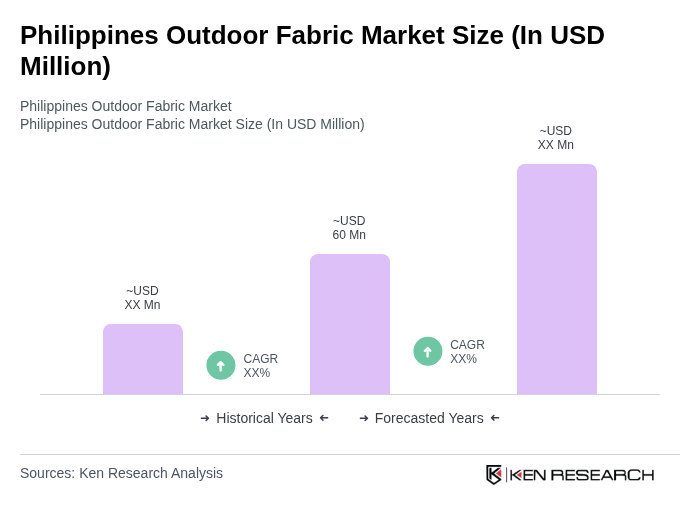
- The Philippines Outdoor Fabric Market is valued at USD 60 million, based on a five-year historical analysis of the broader Philippines textile and textile fabrics industry and the share attributed to outdoor and performance applications. This growth is primarily driven by the increasing demand for outdoor living spaces, coupled with a rise in tourism and recreational activities, including resorts, hotels, cafes, and mixed-use developments that incorporate outdoor seating and amenity areas. The market is also supported by the growing trend of home improvement and outdoor furnishings, as consumers seek durable and aesthetically pleasing fabric options for their outdoor environments, aligned with rising demand for performance textiles such as moisture? and UV?management fabrics in the wider textile sector.
- Metro Manila stands out as the dominant region in the Philippines Outdoor Fabric Market due to its high population density, urbanization, and concentration of middle? to high?income households, which drives demand for outdoor furniture, rooftop decks, commercial developments, and recreational spaces. Other key areas include Cebu and Davao, where tourism and hospitality sectors are flourishing and where coastal resorts, hotels, and leisure facilities continue to expand, further boosting the need for high-quality outdoor fabrics for awnings, umbrellas, marine covers, and poolside furniture.
- The Philippine Green Building Code, issued by the Department of Public Works and Highways under Department Order No. 64, Series of 2017, as a referral code to the National Building Code (Presidential Decree No. 1096), encourages the integration of resource?efficient and environmentally responsive materials in building projects, including textiles used for shading, canopies, and other building components. This regulatory framework promotes energy efficiency, reduced heat gain, and sustainable material choices in new constructions and major renovations, thereby supporting the use of eco?friendly and performance outdoor fabric options in compliant buildings and green developments.
Philippines Outdoor Fabric Market Segmentation
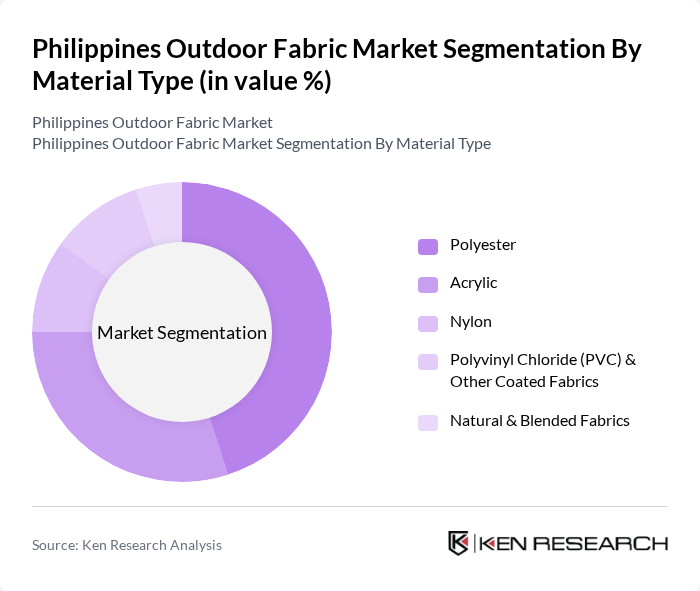
By Material Type:The material type segmentation includes various subsegments such as Polyester, Acrylic, Nylon, Polyvinyl Chloride (PVC) & Other Coated Fabrics, and Natural & Blended Fabrics. Among these, Polyester is the leading subsegment due to its durability, affordability, weather resistance, and versatility, making it a preferred choice for outdoor applications such as furniture covers, canopies, and umbrellas in line with its leading share in performance and technical textiles globally. Acrylic follows closely, known for its color retention, UV resistance, and soft hand feel, appealing to consumers looking for long-lasting outdoor solutions in awnings and marine applications.
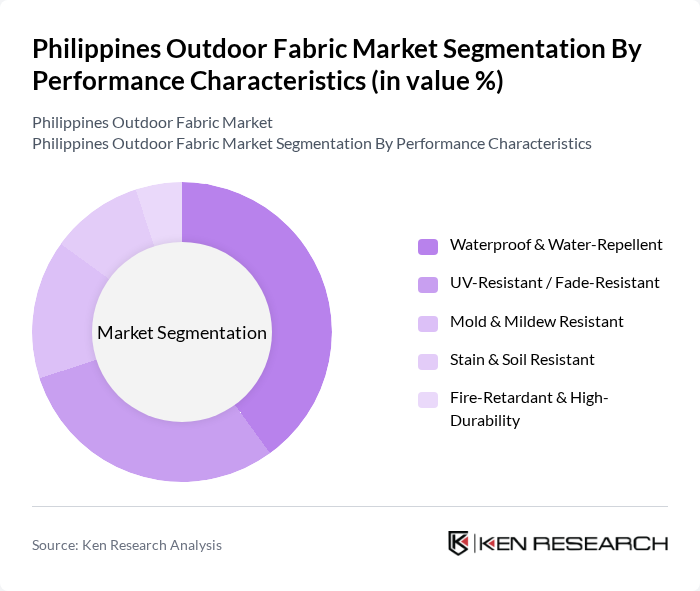
By Performance Characteristics:This segmentation includes Waterproof & Water-Repellent, UV-Resistant / Fade-Resistant, Mold & Mildew Resistant, Stain & Soil Resistant, and Fire-Retardant & High-Durability fabrics. The Waterproof & Water-Repellent subsegment dominates the market, driven by consumer preferences for fabrics that can withstand heavy rainfall, humidity, and frequent cleaning in a tropical climate like the Philippines, consistent with global demand for water?repellent performance fabrics. UV-Resistant fabrics are also gaining traction as consumers and commercial buyers, particularly in hospitality and marine sectors, become more aware of the harmful effects of sun exposure, color fading, and material degradation, leading to higher adoption of UV?stable and solution?dyed outdoor textiles.
Philippines Outdoor Fabric Market Competitive Landscape
The Philippines Outdoor Fabric Market is characterized by a dynamic mix of regional and international players. Leading participants such as Sunbrella (Glen Raven, Inc.), Serge Ferrari Group, Sattler AG, Recasens, Dickson Constant, Phifer Incorporated, Patio Republic Philippines, Fabric Warehouse Philippines, Manila Canvas & Outdoor Fabrics, Metro Manila Textile Mills, Philippine Textile Research Institute (PTRI) – Relevant Initiatives, Local Upholstery & Outdoor Fabric Importers / Converters, Major Furniture & Home Retailers (e.g., SM Home, Our Home), Leading E-commerce Sellers / Marketplaces for Outdoor Fabrics, Regional Marine & Awning Fabricators contribute to innovation, geographic expansion, and service delivery in this space.
Philippines Outdoor Fabric Market Industry Analysis
Growth Drivers
- Increasing Demand for Outdoor Recreational Activities:The Philippines has seen a surge in outdoor recreational activities, with participation rates increasing by 15% annually. In future, approximately 12 million Filipinos engaged in activities such as hiking, camping, and beach outings. This growing interest drives the demand for durable and weather-resistant outdoor fabrics, which are essential for outdoor gear and furnishings. The rise in disposable income, projected to reach an average of PHP 35,000 per month in future, further supports this trend.
- Growth in the Tourism Sector:The tourism sector in the Philippines is projected to contribute PHP 4 trillion to the economy in future, reflecting a 10% increase from previous estimates. This growth is fueled by the influx of international tourists, expected to reach 9 million in future. As hotels and resorts expand their outdoor facilities, the demand for high-quality outdoor fabrics for furniture, awnings, and other applications will rise, creating significant opportunities for local manufacturers and suppliers.
- Rising Awareness of Sustainable Materials:With a growing emphasis on sustainability, the demand for eco-friendly outdoor fabrics is on the rise. In future, the market for sustainable textiles in the Philippines was valued at PHP 1.5 billion, with expectations to grow by 20% in future. Consumers are increasingly seeking products made from recycled or organic materials, prompting manufacturers to innovate and adapt their offerings. This shift not only meets consumer preferences but also aligns with global sustainability goals.
Market Challenges
- Fluctuating Raw Material Prices:The outdoor fabric market faces challenges due to volatile raw material prices, particularly for polyester and nylon, which have seen price increases of up to 25% in the past year. This instability affects production costs and profit margins for manufacturers. As global supply chains remain disrupted, local producers may struggle to maintain competitive pricing, impacting their ability to invest in innovation and quality improvements.
- Intense Competition from Imported Fabrics:The influx of imported outdoor fabrics, particularly from countries like China and Vietnam, poses a significant challenge to local manufacturers. In future, imports accounted for 45% of the market share, with prices often undercutting local products by 15-20%. This competition pressures local businesses to enhance their value propositions through quality, customization, and service, while also navigating the complexities of import tariffs and regulations.
Philippines Outdoor Fabric Market Future Outlook
The Philippines outdoor fabric market is poised for significant growth, driven by increasing consumer interest in outdoor activities and sustainable products. As the tourism sector expands, local manufacturers are likely to innovate and diversify their offerings to meet evolving consumer preferences. Additionally, the rise of e-commerce platforms will facilitate broader market access, enabling businesses to reach untapped customer segments. Overall, the market is expected to adapt to challenges while capitalizing on emerging trends, ensuring a dynamic landscape in the coming years.
Market Opportunities
- Development of Eco-Friendly Outdoor Fabrics:There is a growing opportunity for manufacturers to develop eco-friendly outdoor fabrics, leveraging the increasing consumer demand for sustainable products. By investing in research and development, companies can create innovative materials that appeal to environmentally conscious consumers, potentially capturing a larger market share and enhancing brand loyalty.
- Customization and Personalization Trends:The trend towards customization in outdoor fabrics presents a lucrative opportunity for businesses. By offering personalized designs and tailored solutions, manufacturers can cater to specific consumer preferences, enhancing customer satisfaction and driving sales. This approach not only differentiates products in a competitive market but also fosters stronger customer relationships.
Scope of the Report
| Segment | Sub-Segments |
|---|---|
| By Material Type | Polyester Acrylic Nylon Polyvinyl Chloride (PVC) & Other Coated Fabrics Natural & Blended Fabrics |
| By Performance Characteristics | Waterproof & Water-Repellent UV-Resistant / Fade-Resistant Mold & Mildew Resistant Stain & Soil Resistant Fire-Retardant & High-Durability |
| By Application | Outdoor Furniture & Upholstery Tents, Canopies & Shade Structures Awnings & Pergolas Marine & Boating Outdoor Covers (Vehicle, Equipment, Tarpaulins) |
| By End-User | Residential Hospitality & Commercial (Hotels, Resorts, Cafés) Institutional & Government (Parks, Public Spaces) Industrial & Contract Projects |
| By Distribution Channel | Specialized Fabric Retailers Home Improvement & Modern Trade Direct B2B / Project Sales Online Marketplaces & Brand Websites |
| By Geographic Region | Metro Manila / NCR Luzon (Ex-NCR) Visayas Mindanao |
| By Price Positioning | Economy Mid-Range Premium / Imported Brands |
Key Target Audience
Investors and Venture Capitalist Firms
Government and Regulatory Bodies (e.g., Department of Trade and Industry, Department of Environment and Natural Resources)
Manufacturers and Producers
Distributors and Retailers
Outdoor Furniture and Equipment Companies
Textile and Fabric Suppliers
Industry Associations (e.g., Philippine Textile Research Institute)
Financial Institutions
Players Mentioned in the Report:
Sunbrella (Glen Raven, Inc.)
Serge Ferrari Group
Sattler AG
Recasens
Dickson Constant
Phifer Incorporated
Patio Republic Philippines
Fabric Warehouse Philippines
Manila Canvas & Outdoor Fabrics
Metro Manila Textile Mills
Philippine Textile Research Institute (PTRI) Relevant Initiatives
Local Upholstery & Outdoor Fabric Importers / Converters
Major Furniture & Home Retailers (e.g., SM Home, Our Home)
Leading E-commerce Sellers / Marketplaces for Outdoor Fabrics
Regional Marine & Awning Fabricators
Table of Contents
Market Assessment Phase
1. Executive Summary and Approach
2. Philippines Outdoor Fabric Market Overview
2.1 Key Insights and Strategic Recommendations
2.2 Philippines Outdoor Fabric Market Overview
2.3 Definition and Scope
2.4 Evolution of Market Ecosystem
2.5 Timeline of Key Regulatory Milestones
2.6 Value Chain & Stakeholder Mapping
2.7 Business Cycle Analysis
2.8 Policy & Incentive Landscape
3. Philippines Outdoor Fabric Market Analysis
3.1 Growth Drivers
3.1.1 Increasing demand for outdoor recreational activities
3.1.2 Growth in the tourism sector
3.1.3 Rising awareness of sustainable materials
3.1.4 Expansion of the construction and hospitality industries
3.2 Market Challenges
3.2.1 Fluctuating raw material prices
3.2.2 Intense competition from imported fabrics
3.2.3 Limited local manufacturing capabilities
3.2.4 Regulatory hurdles and compliance issues
3.3 Market Opportunities
3.3.1 Development of eco-friendly outdoor fabrics
3.3.2 Customization and personalization trends
3.3.3 Expansion into untapped rural markets
3.3.4 Collaborations with local artisans and designers
3.4 Market Trends
3.4.1 Increasing use of digital marketing strategies
3.4.2 Growth in online retail channels
3.4.3 Rising popularity of multifunctional outdoor fabrics
3.4.4 Shift towards direct-to-consumer sales models
3.5 Government Regulation
3.5.1 Standards for fabric durability and safety
3.5.2 Environmental regulations on manufacturing processes
3.5.3 Import tariffs on outdoor fabrics
3.5.4 Incentives for sustainable production practices
4. SWOT Analysis
5. Stakeholder Analysis
6. Porter's Five Forces Analysis
7. Philippines Outdoor Fabric Market Market Size, 2019-2024
7.1 By Value
7.2 By Volume
7.3 By Average Selling Price
8. Philippines Outdoor Fabric Market Segmentation
8.1 By Material Type
8.1.1 Polyester
8.1.2 Acrylic
8.1.3 Nylon
8.1.4 Polyvinyl Chloride (PVC) & Other Coated Fabrics
8.1.5 Natural & Blended Fabrics
8.2 By Performance Characteristics
8.2.1 Waterproof & Water-Repellent
8.2.2 UV-Resistant / Fade-Resistant
8.2.3 Mold & Mildew Resistant
8.2.4 Stain & Soil Resistant
8.2.5 Fire-Retardant & High-Durability
8.3 By Application
8.3.1 Outdoor Furniture & Upholstery
8.3.2 Tents, Canopies & Shade Structures
8.3.3 Awnings & Pergolas
8.3.4 Marine & Boating
8.3.5 Outdoor Covers (Vehicle, Equipment, Tarpaulins)
8.4 By End-User
8.4.1 Residential
8.4.2 Hospitality & Commercial (Hotels, Resorts, Cafés)
8.4.3 Institutional & Government (Parks, Public Spaces)
8.4.4 Industrial & Contract Projects
8.5 By Distribution Channel
8.5.1 Specialized Fabric Retailers
8.5.2 Home Improvement & Modern Trade
8.5.3 Direct B2B / Project Sales
8.5.4 Online Marketplaces & Brand Websites
8.6 By Geographic Region
8.6.1 Metro Manila / NCR
8.6.2 Luzon (Ex-NCR)
8.6.3 Visayas
8.6.4 Mindanao
8.7 By Price Positioning
8.7.1 Economy
8.7.2 Mid-Range
8.7.3 Premium / Imported Brands
9. Philippines Outdoor Fabric Market Competitive Analysis
9.1 Market Share of Key Players
9.2 Cross Comparison of Key Players
9.2.1 Company Name
9.2.2 Scale of Operations (Local, Regional, International)
9.2.3 Philippines Outdoor Fabric Revenue (PHP / USD)
9.2.4 3-Year CAGR in Outdoor Fabric Revenue
9.2.5 Outdoor Fabric Volume Sold (sqm / tons)
9.2.6 Market Share in Philippines Outdoor Fabric Market (%)
9.2.7 Average Realized Price per sqm
9.2.8 EBITDA Margin from Outdoor Fabric Portfolio (%)
9.2.9 Share of Outdoor Fabrics in Total Company Revenue (%)
9.2.10 Number of Active Trade / Retail Partners in the Philippines
9.2.11 Store / Channel Footprint (Own Stores, Dealers, Online)
9.2.12 Portfolio Breadth (No. of SKUs / Collections)
9.2.13 Import vs Local Sourcing Mix (%)
9.2.14 On-Time Delivery Performance (%)
9.2.15 Brand Awareness & Preference Score (Survey-Based)
9.3 SWOT Analysis of Top Players
9.4 Pricing Analysis
9.5 Detailed Profile of Major Companies
9.5.1 Sunbrella (Glen Raven, Inc.)
9.5.2 Serge Ferrari Group
9.5.3 Sattler AG
9.5.4 Recasens
9.5.5 Dickson Constant
9.5.6 Phifer Incorporated
9.5.7 Patio Republic Philippines
9.5.8 Fabric Warehouse Philippines
9.5.9 Manila Canvas & Outdoor Fabrics
9.5.10 Metro Manila Textile Mills
9.5.11 Philippine Textile Research Institute (PTRI) – Relevant Initiatives
9.5.12 Local Upholstery & Outdoor Fabric Importers / Converters
9.5.13 Major Furniture & Home Retailers (e.g., SM Home, Our Home)
9.5.14 Leading E-commerce Sellers / Marketplaces for Outdoor Fabrics
9.5.15 Regional Marine & Awning Fabricators
10. Philippines Outdoor Fabric Market End-User Analysis
10.1 Procurement Behavior of Key Ministries
10.1.1 Government contracts for public projects
10.1.2 Budget allocation for outdoor infrastructure
10.1.3 Preference for local suppliers
10.1.4 Compliance with sustainability standards
10.2 Corporate Spend on Infrastructure & Energy
10.2.1 Investment in outdoor facilities
10.2.2 Budget for sustainable materials
10.2.3 Spending on maintenance and upgrades
10.2.4 Allocation for community projects
10.3 Pain Point Analysis by End-User Category
10.3.1 Quality and durability concerns
10.3.2 Availability of diverse options
10.3.3 Price sensitivity
10.3.4 Delivery timelines
10.4 User Readiness for Adoption
10.4.1 Awareness of product benefits
10.4.2 Willingness to invest in quality
10.4.3 Interest in sustainable options
10.4.4 Feedback from pilot projects
10.5 Post-Deployment ROI and Use Case Expansion
10.5.1 Evaluation of performance metrics
10.5.2 Case studies of successful implementations
10.5.3 Opportunities for product upgrades
10.5.4 Expansion into new applications
11. Philippines Outdoor Fabric Market Future Size, 2025-2030
11.1 By Value
11.2 By Volume
11.3 By Average Selling Price
Go-To-Market Strategy Phase
1. Whitespace Analysis + Business Model Canvas
1.1 Market Gaps Identification
1.2 Value Proposition Development
1.3 Revenue Streams Analysis
1.4 Cost Structure Evaluation
1.5 Key Partnerships Exploration
1.6 Customer Segmentation
1.7 Channels of Distribution
2. Marketing and Positioning Recommendations
2.1 Branding Strategies
2.2 Product USPs
3. Distribution Plan
3.1 Urban Retail vs Rural NGO Tie-ups
4. Channel & Pricing Gaps
4.1 Underserved Routes
4.2 Pricing Bands
5. Unmet Demand & Latent Needs
5.1 Category Gaps
5.2 Consumer Segments
6. Customer Relationship
6.1 Loyalty Programs
6.2 After-sales Service
7. Value Proposition
7.1 Sustainability
7.2 Integrated Supply Chains
8. Key Activities
8.1 Regulatory Compliance
8.2 Branding
8.3 Distribution Setup
9. Entry Strategy Evaluation
9.1 Domestic Market Entry Strategy
9.1.1 Product Mix
9.1.2 Pricing Band
9.1.3 Packaging
9.2 Export Entry Strategy
9.2.1 Target Countries
9.2.2 Compliance Roadmap
10. Entry Mode Assessment
10.1 JV
10.2 Greenfield
10.3 M&A
10.4 Distributor Model
11. Capital and Timeline Estimation
11.1 Capital Requirements
11.2 Timelines
12. Control vs Risk Trade-Off
12.1 Ownership vs Partnerships
13. Profitability Outlook
13.1 Breakeven Analysis
13.2 Long-term Sustainability
14. Potential Partner List
14.1 Distributors
14.2 JVs
14.3 Acquisition Targets
15. Execution Roadmap
15.1 Phased Plan for Market Entry
15.1.1 Market Setup
15.1.2 Market Entry
15.1.3 Growth Acceleration
15.1.4 Scale & Stabilize
15.2 Key Activities and Milestones
15.2.1 Milestone Planning
15.2.2 Activity Tracking
Research Methodology
Phase 1: Approach1
Desk Research
- Industry reports from local trade associations and government agencies
- Market analysis from academic journals focusing on outdoor fabric applications
- Consumer behavior studies published by market research firms in the Philippines
Primary Research
- Interviews with manufacturers of outdoor fabrics and textiles
- Surveys with retailers specializing in outdoor and recreational products
- Focus groups with end-users to understand preferences and usage patterns
Validation & Triangulation
- Cross-validation of findings through multiple data sources including sales data and consumer feedback
- Triangulation of insights from industry experts and market analysts
- Sanity checks through expert panel discussions to ensure data reliability
Phase 2: Market Size Estimation1
Top-down Assessment
- Analysis of national textile production statistics to estimate outdoor fabric market size
- Segmentation of market by application areas such as camping, marine, and outdoor furniture
- Incorporation of growth trends in tourism and outdoor activities in the Philippines
Bottom-up Modeling
- Volume estimates based on production capacities of leading outdoor fabric manufacturers
- Cost analysis derived from pricing strategies of various outdoor fabric products
- Estimation of market share based on sales data from key distribution channels
Forecasting & Scenario Analysis
- Multi-variable regression analysis incorporating economic indicators and consumer trends
- Scenario planning based on potential impacts of climate change on outdoor activities
- Baseline, optimistic, and pessimistic forecasts through 2030 based on market dynamics
Phase 3: CATI Sample Composition1
| Scope Item/Segment | Sample Size | Target Respondent Profiles |
|---|---|---|
| Manufacturers of Outdoor Fabrics | 90 | Production Managers, Quality Control Officers |
| Retailers of Outdoor Equipment | 70 | Store Managers, Purchasing Agents |
| End-Users in Recreational Activities | 120 | Outdoor Enthusiasts, Campers, Boaters |
| Distributors of Textile Products | 60 | Sales Representatives, Logistics Coordinators |
| Industry Experts and Analysts | 40 | Market Analysts, Textile Engineers |
Frequently Asked Questions
What is the current value of the Philippines Outdoor Fabric Market?
The Philippines Outdoor Fabric Market is valued at approximately USD 60 million, driven by increasing demand for outdoor living spaces and performance textiles, particularly in tourism and recreational sectors.
What factors are driving growth in the Philippines Outdoor Fabric Market?
Which regions in the Philippines are leading in outdoor fabric demand?
What are the main material types used in outdoor fabrics in the Philippines?
Other Regional/Country Reports
Indonesia Outdoor Fabric Market
Malaysia Outdoor Fabric Market
KSA Outdoor Fabric Market
APAC Outdoor Fabric Market
Other Adjacent Reports
Bahrain Performance Textile Market
Vietnam Awning and Canopy Market
Germany Marine Fabric Market
Singapore Sustainable Textile Market
Philippines Hospitality Furnishing Market
Indonesia Home Improvement Market Size, Share & Forecast, By Product Category, Project Type & Distribution Channel, 2025-2032Brazil Camping Gear Market
Belgium Patio Accessory Market
Bahrain Textile Coating Market
Why Buy From Us?

What makes us stand out is that our consultants follow Robust, Refine and Result (RRR) methodology. Robust for clear definitions, approaches and sanity checking, Refine for differentiating respondents' facts and opinions, and Result for presenting data with story.

We have set a benchmark in the industry by offering our clients with syndicated and customized market research reports featuring coverage of entire market as well as meticulous research and analyst insights.

While we don't replace traditional research, we flip the method upside down. Our dual approach of Top Bottom & Bottom Top ensures quality deliverable by not just verifying company fundamentals but also looking at the sector and macroeconomic factors.

With one step in the future, our research team constantly tries to show you the bigger picture. We help with some of the tough questions you may encounter along the way: How is the industry positioned? Best marketing channel? KPI's of competitors? By aligning every element, we help maximize success.

Our report gives you instant access to the answers and sources that other companies might choose to hide. We elaborate each steps of research methodology we have used and showcase you the sample size to earn your trust.

If you need any support, we are here! We pride ourselves on universe strength, data quality, and quick, friendly, and professional service.