About the Report
Base Year 2024New Zealand Home Improvement Market Overview
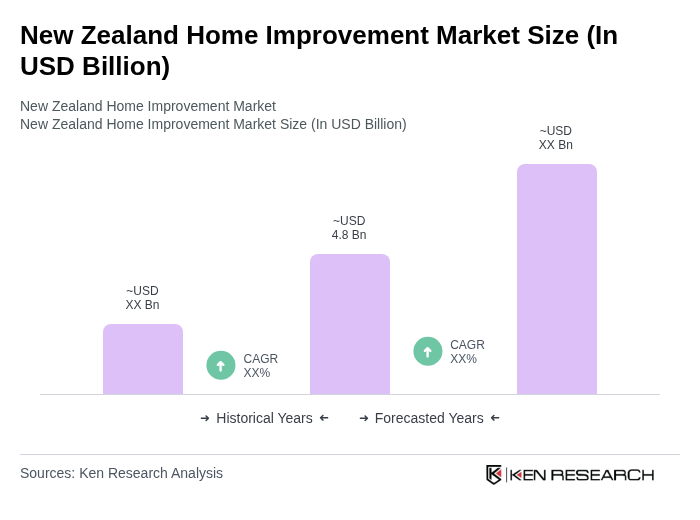
- The New Zealand Home Improvement Market is valued at USD 4.8 billion, based on a five-year historical analysis and benchmarking against the national interior design, renovation, and DIY and hardware retail segments. This growth is primarily driven by increasing consumer spending on home renovations, a surge in property ownership, and a growing trend towards sustainable living, supported by steady expansion in residential construction activity. The market has seen a significant uptick in demand for energy-efficient products and smart home technologies, as homeowners increasingly invest in insulation, efficient heating and cooling, and connected devices to improve comfort and reduce energy costs.
- Auckland, Wellington, and Christchurch are the dominant cities in the New Zealand Home Improvement Market. Auckland leads due to its large population base and high property values, which underpin a high level of renovation and upgrade activity. Wellington's active housing market and strong professional services economy, together with Christchurch's ongoing renewal and remodeling of the housing stock following earlier seismic events, continue to support robust demand for home improvement projects in these centres. These factors make the three cities key hubs for building supplies, trade services, and renovation-focused retailers within the national home improvement ecosystem.
- In 2022, the New Zealand Government introduced new energy efficiency requirements for housing through amendments to clause H1 Energy efficiency of the Building Code, under the Building Act 2004, issued by the Ministry of Business, Innovation and Employment (MBIE). These H1 Energy Efficiency provisions set higher minimum insulation levels and performance requirements for building envelopes, windows, and heating systems in new homes and significant alterations, with staged implementation dates from 2022. The regulation aims to enhance the sustainability and thermal performance of residential buildings, encouraging greater use of energy-efficient materials, glazing, and technologies, and thereby shaping product choices in the home improvement sector.
New Zealand Home Improvement Market Segmentation
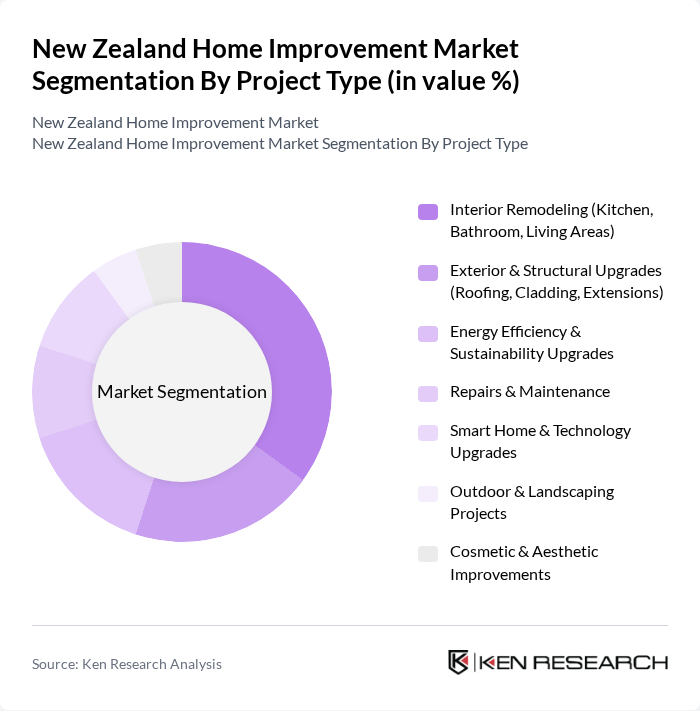
By Project Type:The project type segmentation includes various categories such as interior remodeling, exterior upgrades, energy efficiency improvements, repairs, smart home upgrades, outdoor projects, and cosmetic enhancements. This reflects the mix of renovation and remodeling work observed across the New Zealand interior design and renovation markets. Among these, interior remodeling, particularly kitchen and bathroom renovations, dominates the market due to the high return on investment and strong homeowner preference for modern, functional, and open-plan spaces. The trend towards open-plan living, integrated indoor–outdoor areas, and the incorporation of smart appliances, lighting, and environmental controls in home design further supports growth in this segment.
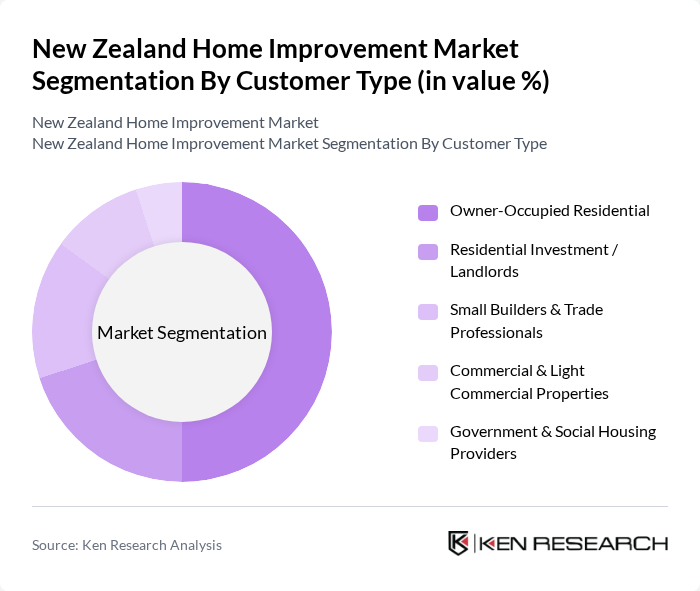
By Customer Type:The customer type segmentation encompasses owner-occupied residential, residential investment, small builders, commercial properties, and government housing providers. The owner-occupied residential segment is the largest, consistent with the predominance of homeowners in renovation and interior design spending in New Zealand. It is driven by homeowners investing in renovations to increase property value, improve thermal comfort, and enhance living conditions, including adaptations for working from home. This trend is supported by an active housing market, the availability of renovation finance through mortgage top-ups, and a growing emphasis on home personalization and lifestyle-focused upgrades, making this segment a key focus for retailers, trades, and design professionals in the market.
New Zealand Home Improvement Market Competitive Landscape
The New Zealand Home Improvement Market is characterized by a dynamic mix of regional and international players. Leading participants such as Bunnings Warehouse, Mitre 10, PlaceMakers, The Warehouse Group, Resene, DuluxGroup, Carter Holt Harvey, Plumbing World, ITM (Independent Timber Merchants Co-operative), Firth Industries, GIB (Winstone Wallboards), Fletcher Building, APL Window Solutions (Aluminium Profiles Ltd), Steel & Tube Holdings, HPM Legrand New Zealand contribute to innovation, geographic expansion, and service delivery in this space.
New Zealand Home Improvement Market Industry Analysis
Growth Drivers
- Increasing Home Renovation Activities:The New Zealand home improvement market is experiencing a surge in renovation activities, with over NZD 3.5 billion spent on renovations in the future. This trend is driven by homeowners seeking to enhance property value and adapt to changing lifestyles. The average renovation cost per household has risen to approximately NZD 27,000, reflecting a growing willingness to invest in home upgrades. This increase is supported by favorable housing market conditions and a robust real estate sector, which saw a 9% increase in property values in the future.
- Rising Disposable Income:New Zealand's disposable income has seen a steady increase, reaching NZD 1,250 per week in the future, up from NZD 1,150 in the previous year. This rise in disposable income allows consumers to allocate more funds towards home improvement projects. As households experience financial growth, they are more inclined to invest in renovations and upgrades, contributing to the overall market expansion. The increase in disposable income is also supported by a low unemployment rate of 3.2%, which enhances consumer confidence and spending power.
- Expansion of E-commerce Platforms:The growth of e-commerce platforms has revolutionized the home improvement market in New Zealand, with online sales reaching NZD 1.5 billion in the future. This shift allows consumers to access a wider range of products and services conveniently. The increasing penetration of high-speed internet, which stands at 97% in urban areas, facilitates this trend. Additionally, the rise of mobile shopping has made it easier for consumers to compare prices and find the best deals, further driving market growth as more people opt for online purchases.
Market Challenges
- Supply Chain Disruptions:The New Zealand home improvement market faces significant supply chain disruptions, exacerbated by global events such as the COVID-19 pandemic. In the future, 65% of construction firms reported delays in material deliveries, impacting project timelines and costs. These disruptions have led to increased lead times for essential materials, with some experiencing delays of up to 10 weeks. Such challenges hinder the ability of contractors and homeowners to complete renovations on schedule, ultimately affecting market growth.
- High Material Costs:The rising costs of construction materials pose a significant challenge to the home improvement market. In the future, the price of timber increased by 12%, while steel prices surged by 18%, driven by global demand and supply constraints. These escalating costs have resulted in an overall increase in renovation budgets, with average project costs rising by NZD 6,000. Consequently, many homeowners are reconsidering or delaying their renovation plans, which could slow market growth in the coming years.
New Zealand Home Improvement Market Future Outlook
The New Zealand home improvement market is poised for continued growth, driven by increasing consumer interest in sustainable living and smart home technologies. As more homeowners prioritize eco-friendly renovations, the demand for green building materials and energy-efficient solutions is expected to rise. Additionally, the expansion of e-commerce platforms will likely enhance accessibility to home improvement products, further stimulating market activity. With a focus on innovation and sustainability, the industry is set to adapt to evolving consumer preferences and technological advancements in the future.
Market Opportunities
- Adoption of Smart Home Technologies:The integration of smart home technologies presents a significant opportunity for the New Zealand home improvement market. With an estimated 1.8 million smart home devices sold in the future, homeowners are increasingly investing in automation and energy management solutions. This trend is expected to grow as consumers seek convenience and efficiency, creating a lucrative market segment for innovative home improvement products.
- Increased Investment in Green Building:The rising emphasis on sustainability is driving increased investment in green building practices. In the future, the green building sector in New Zealand attracted NZD 600 million in investments, reflecting a growing commitment to environmentally friendly construction. This trend is likely to continue, providing opportunities for businesses that specialize in sustainable materials and energy-efficient solutions, aligning with consumer preferences for eco-conscious home improvements.
Scope of the Report
| Segment | Sub-Segments |
|---|---|
| By Project Type | Interior Remodeling (Kitchen, Bathroom, Living Areas) Exterior & Structural Upgrades (Roofing, Cladding, Extensions) Energy Efficiency & Sustainability Upgrades Repairs & Maintenance Smart Home & Technology Upgrades Outdoor & Landscaping Projects Cosmetic & Aesthetic Improvements |
| By Customer Type | Owner-Occupied Residential Residential Investment / Landlords Small Builders & Trade Professionals Commercial & Light Commercial Properties Government & Social Housing Providers |
| By Region | North Island – Auckland North Island – Wellington North Island – Other Regions South Island – Christchurch South Island – Other Regions |
| By Product Category | Building Materials & Structural Components Paints, Coatings & Surface Finishes Tools, Hardware & Fastenings Kitchen, Bathroom & Plumbing Fixtures Flooring, Tiles & Wall Coverings Outdoor, Garden & Landscaping Products |
| By Service Type | Design & Planning Services Installation & Construction Services Repairs, Maintenance & Handyman Services Project Management & Turnkey Solutions |
| By Distribution Channel | Big-Box Home Improvement & DIY Stores Trade & Specialist Merchants Online & Omnichannel Retail Direct-to-Consumer from Manufacturers Independent Hardware & Local Stores |
| By Project Execution Mode | DIY (Do-It-Yourself) DIFM (Do-It-For-Me / Professionally Installed) Hybrid (DIY + Professional Support) |
Key Target Audience
Investors and Venture Capitalist Firms
Government and Regulatory Bodies (e.g., Ministry of Business, Innovation and Employment)
Manufacturers and Producers
Distributors and Retailers
Home Improvement Contractors and Builders
Real Estate Developers
Home Improvement Product Designers
Financial Institutions
Players Mentioned in the Report:
Bunnings Warehouse
Mitre 10
PlaceMakers
The Warehouse Group
Resene
DuluxGroup
Carter Holt Harvey
Plumbing World
ITM (Independent Timber Merchants Co-operative)
Firth Industries
GIB (Winstone Wallboards)
Fletcher Building
APL Window Solutions (Aluminium Profiles Ltd)
Steel & Tube Holdings
HPM Legrand New Zealand
Table of Contents
Market Assessment Phase
1. Executive Summary and Approach
2. New Zealand Home Improvement Market Overview
2.1 Key Insights and Strategic Recommendations
2.2 New Zealand Home Improvement Market Overview
2.3 Definition and Scope
2.4 Evolution of Market Ecosystem
2.5 Timeline of Key Regulatory Milestones
2.6 Value Chain & Stakeholder Mapping
2.7 Business Cycle Analysis
2.8 Policy & Incentive Landscape
3. New Zealand Home Improvement Market Analysis
3.1 Growth Drivers
3.1.1 Increasing Home Renovation Activities
3.1.2 Rising Disposable Income
3.1.3 Growing Interest in Sustainable Living
3.1.4 Expansion of E-commerce Platforms
3.2 Market Challenges
3.2.1 Supply Chain Disruptions
3.2.2 High Material Costs
3.2.3 Skilled Labor Shortages
3.2.4 Regulatory Compliance Issues
3.3 Market Opportunities
3.3.1 Adoption of Smart Home Technologies
3.3.2 Growth in DIY Projects
3.3.3 Increased Investment in Green Building
3.3.4 Expansion into Rural Markets
3.4 Market Trends
3.4.1 Shift Towards Eco-Friendly Products
3.4.2 Rise of Online Home Improvement Communities
3.4.3 Customization and Personalization in Home Design
3.4.4 Integration of Augmented Reality in Shopping
3.5 Government Regulation
3.5.1 Building Code Compliance
3.5.2 Environmental Protection Regulations
3.5.3 Health and Safety Standards
3.5.4 Consumer Protection Laws
4. SWOT Analysis
5. Stakeholder Analysis
6. Porter's Five Forces Analysis
7. New Zealand Home Improvement Market Market Size, 2019-2024
7.1 By Value
7.2 By Volume
7.3 By Average Selling Price
8. New Zealand Home Improvement Market Segmentation
8.1 By Project Type
8.1.1 Interior Remodeling (Kitchen, Bathroom, Living Areas)
8.1.2 Exterior & Structural Upgrades (Roofing, Cladding, Extensions)
8.1.3 Energy Efficiency & Sustainability Upgrades
8.1.4 Repairs & Maintenance
8.1.5 Smart Home & Technology Upgrades
8.1.6 Outdoor & Landscaping Projects
8.1.7 Cosmetic & Aesthetic Improvements
8.2 By Customer Type
8.2.1 Owner-Occupied Residential
8.2.2 Residential Investment / Landlords
8.2.3 Small Builders & Trade Professionals
8.2.4 Commercial & Light Commercial Properties
8.2.5 Government & Social Housing Providers
8.3 By Region
8.3.1 North Island – Auckland
8.3.2 North Island – Wellington
8.3.3 North Island – Other Regions
8.3.4 South Island – Christchurch
8.3.5 South Island – Other Regions
8.4 By Product Category
8.4.1 Building Materials & Structural Components
8.4.2 Paints, Coatings & Surface Finishes
8.4.3 Tools, Hardware & Fastenings
8.4.4 Kitchen, Bathroom & Plumbing Fixtures
8.4.5 Flooring, Tiles & Wall Coverings
8.4.6 Outdoor, Garden & Landscaping Products
8.5 By Service Type
8.5.1 Design & Planning Services
8.5.2 Installation & Construction Services
8.5.3 Repairs, Maintenance & Handyman Services
8.5.4 Project Management & Turnkey Solutions
8.6 By Distribution Channel
8.6.1 Big-Box Home Improvement & DIY Stores
8.6.2 Trade & Specialist Merchants
8.6.3 Online & Omnichannel Retail
8.6.4 Direct-to-Consumer from Manufacturers
8.6.5 Independent Hardware & Local Stores
8.7 By Project Execution Mode
8.7.1 DIY (Do-It-Yourself)
8.7.2 DIFM (Do-It-For-Me / Professionally Installed)
8.7.3 Hybrid (DIY + Professional Support)
9. New Zealand Home Improvement Market Competitive Analysis
9.1 Market Share of Key Players
9.2 Cross Comparison of Key Players
9.2.1 Company Name
9.2.2 Group Size (Large, Medium, or Small as per industry convention)
9.2.3 Annual Revenue (NZD, Latest Financial Year)
9.2.4 3-Year Revenue CAGR
9.2.5 EBITDA Margin
9.2.6 Like-for-Like Sales Growth
9.2.7 Average Ticket Size / Basket Value
9.2.8 Store Footprint (Number of Stores / Branches in New Zealand)
9.2.9 Online Sales Share (% of Total Revenue)
9.2.10 Customer Retention / Repeat Purchase Rate
9.2.11 Market Share in Core Category (%)
9.2.12 Capex Intensity (% of Revenue Invested in Expansion / Digital)
9.3 SWOT Analysis of Top Players
9.4 Pricing Analysis
9.5 Detailed Profile of Major Companies
9.5.1 Bunnings Warehouse
9.5.2 Mitre 10
9.5.3 PlaceMakers
9.5.4 The Warehouse Group
9.5.5 Resene
9.5.6 DuluxGroup
9.5.7 Carter Holt Harvey
9.5.8 Plumbing World
9.5.9 ITM (Independent Timber Merchants Co-operative)
9.5.10 Firth Industries
9.5.11 GIB (Winstone Wallboards)
9.5.12 Fletcher Building
9.5.13 APL Window Solutions (Aluminium Profiles Ltd)
9.5.14 Steel & Tube Holdings
9.5.15 HPM Legrand New Zealand
10. New Zealand Home Improvement Market End-User Analysis
10.1 Procurement Behavior of Key Ministries
10.1.1 Budget Allocation Trends
10.1.2 Preferred Suppliers
10.1.3 Procurement Processes
10.1.4 Contracting Strategies
10.2 Corporate Spend on Infrastructure & Energy
10.2.1 Investment Priorities
10.2.2 Spending Patterns
10.2.3 Key Projects
10.3 Pain Point Analysis by End-User Category
10.3.1 Common Challenges Faced
10.3.2 Service Gaps
10.3.3 Product Limitations
10.4 User Readiness for Adoption
10.4.1 Awareness Levels
10.4.2 Adoption Barriers
10.4.3 Training Needs
10.5 Post-Deployment ROI and Use Case Expansion
10.5.1 ROI Measurement Techniques
10.5.2 Success Stories
10.5.3 Future Use Cases
11. New Zealand Home Improvement Market Future Size, 2025-2030
11.1 By Value
11.2 By Volume
11.3 By Average Selling Price
Go-To-Market Strategy Phase
1. Whitespace Analysis + Business Model Canvas
1.1 Market Gaps Identification
1.2 Value Proposition Development
1.3 Revenue Streams
1.4 Cost Structure Analysis
1.5 Key Partnerships
1.6 Customer Segments
1.7 Channels
2. Marketing and Positioning Recommendations
2.1 Branding Strategies
2.2 Product USPs
3. Distribution Plan
3.1 Urban Retail vs Rural NGO Tie-ups
4. Channel & Pricing Gaps
4.1 Underserved Routes
4.2 Pricing Bands
5. Unmet Demand & Latent Needs
5.1 Category Gaps
5.2 Consumer Segments
6. Customer Relationship
6.1 Loyalty Programs
6.2 After-sales Service
7. Value Proposition
7.1 Sustainability
7.2 Integrated Supply Chains
8. Key Activities
8.1 Regulatory Compliance
8.2 Branding
8.3 Distribution Setup
9. Entry Strategy Evaluation
9.1 Domestic Market Entry Strategy
9.1.1 Product Mix
9.1.2 Pricing Band
9.1.3 Packaging
9.2 Export Entry Strategy
9.2.1 Target Countries
9.2.2 Compliance Roadmap
10. Entry Mode Assessment
10.1 JV
10.2 Greenfield
10.3 M&A
10.4 Distributor Model
11. Capital and Timeline Estimation
11.1 Capital Requirements
11.2 Timelines
12. Control vs Risk Trade-Off
12.1 Ownership vs Partnerships
13. Profitability Outlook
13.1 Breakeven Analysis
13.2 Long-term Sustainability
14. Potential Partner List
14.1 Distributors
14.2 JVs
14.3 Acquisition Targets
15. Execution Roadmap
15.1 Phased Plan for Market Entry
15.1.1 Market Setup
15.1.2 Market Entry
15.1.3 Growth Acceleration
15.1.4 Scale & Stabilize
15.2 Key Activities and Milestones
15.2.1 Milestone Planning
15.2.2 Activity Tracking
Research Methodology
Phase 1: Approach1
Desk Research
- Analysis of industry reports from New Zealand's construction and home improvement associations
- Review of government publications on housing trends and renovation statistics
- Examination of market studies and consumer behavior reports from local research firms
Primary Research
- Interviews with home improvement retailers and suppliers to gather insights on market dynamics
- Surveys targeting homeowners who have recently undertaken renovation projects
- Focus groups with contractors and builders to understand their perspectives on market trends
Validation & Triangulation
- Cross-validation of findings through multiple data sources, including sales data and consumer feedback
- Triangulation of insights from primary interviews with secondary data trends
- Sanity checks conducted through expert panel reviews comprising industry veterans
Phase 2: Market Size Estimation1
Top-down Assessment
- Estimation of total market size based on national home improvement expenditure data
- Segmentation of the market by product categories such as flooring, fixtures, and appliances
- Incorporation of demographic trends influencing home renovation activities
Bottom-up Modeling
- Collection of sales data from leading home improvement retailers to establish baseline figures
- Estimation of average spending per household on home improvement projects
- Analysis of regional variations in spending patterns across New Zealand
Forecasting & Scenario Analysis
- Development of forecasts based on historical growth rates and economic indicators
- Scenario analysis considering factors such as housing market fluctuations and consumer confidence
- Projections for market growth through 2030 under various economic conditions
Phase 3: CATI Sample Composition1
| Scope Item/Segment | Sample Size | Target Respondent Profiles |
|---|---|---|
| Home Renovation Projects | 120 | Homeowners, DIY Enthusiasts |
| Retailer Insights | 80 | Store Managers, Sales Representatives |
| Contractor Perspectives | 60 | General Contractors, Specialty Tradespeople |
| Supplier Feedback | 40 | Product Managers, Supply Chain Coordinators |
| Consumer Behavior Analysis | 100 | Recent Renovators, Home Improvement Shoppers |
Frequently Asked Questions
What is the current value of the New Zealand Home Improvement Market?
The New Zealand Home Improvement Market is valued at approximately USD 4.8 billion. This valuation reflects a comprehensive analysis of the interior design, renovation, and DIY hardware retail segments, indicating robust growth driven by increased consumer spending and property ownership.
What factors are driving growth in the New Zealand Home Improvement Market?
Which cities are the main hubs for home improvement in New Zealand?
What are the new energy efficiency requirements introduced by the New Zealand Government?
Other Regional/Country Reports
Other Adjacent Reports
Malaysia Energy Efficiency Products Market
Oman DIY Retail Market
KSA Hardware Retail Market
UAE Green Building MarketThailand Real Estate Development Market
Egypt Home Furnishings Market
Why Buy From Us?

What makes us stand out is that our consultants follow Robust, Refine and Result (RRR) methodology. Robust for clear definitions, approaches and sanity checking, Refine for differentiating respondents' facts and opinions, and Result for presenting data with story.

We have set a benchmark in the industry by offering our clients with syndicated and customized market research reports featuring coverage of entire market as well as meticulous research and analyst insights.

While we don't replace traditional research, we flip the method upside down. Our dual approach of Top Bottom & Bottom Top ensures quality deliverable by not just verifying company fundamentals but also looking at the sector and macroeconomic factors.

With one step in the future, our research team constantly tries to show you the bigger picture. We help with some of the tough questions you may encounter along the way: How is the industry positioned? Best marketing channel? KPI's of competitors? By aligning every element, we help maximize success.

Our report gives you instant access to the answers and sources that other companies might choose to hide. We elaborate each steps of research methodology we have used and showcase you the sample size to earn your trust.

If you need any support, we are here! We pride ourselves on universe strength, data quality, and quick, friendly, and professional service.